

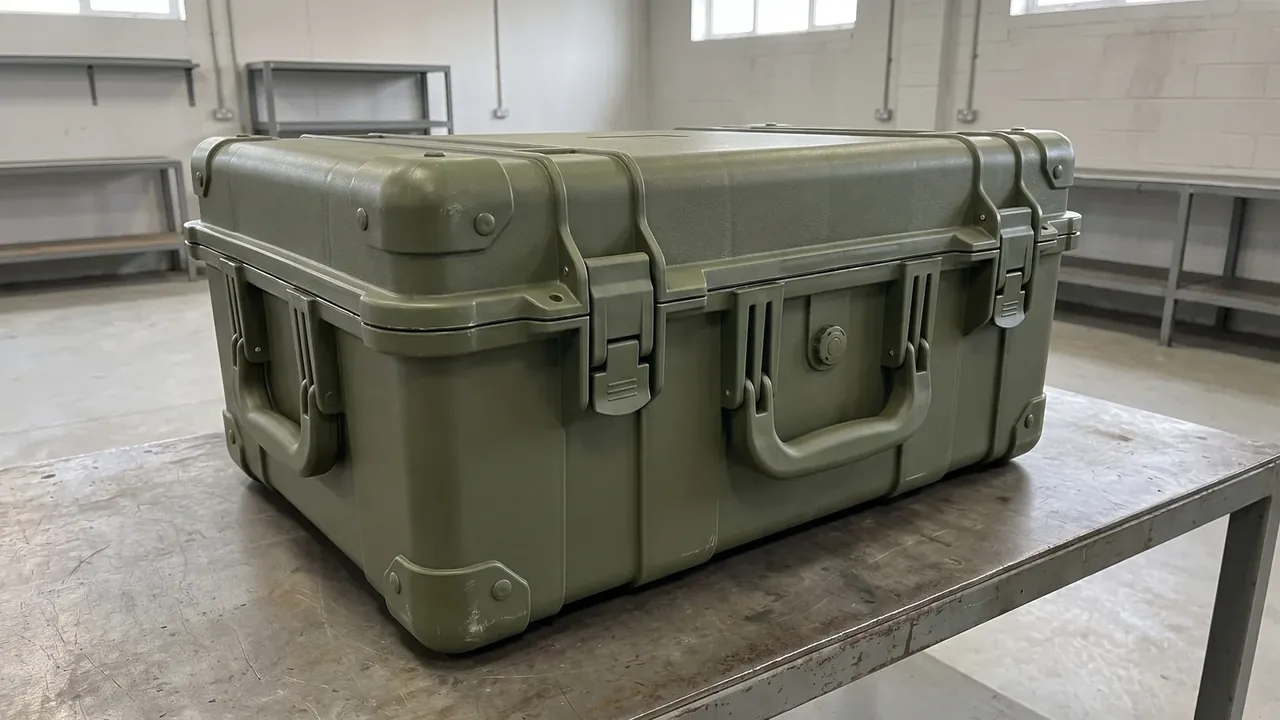
Quick answer: A sample tells you little until you measure it. Check the cavity, seal face, latches, foam fit, salt spray and traceability mark, score them out of 100, and reject anything under 78 before price enters the conversation.
Table of contents
- Measure Five Numbers Before Asking About Resin
- The Seal Face: A 0.05 mm Feeler Gauge Decides
- Latches and Hinges After 5,000 Cycles
- Foam Fit: What a 3 mm Gap Means
- Reading Results After 96 Hours of Salt Spray
- Turning Six Checks Into 100 Points
- FAQ
1. Measure Five Numbers Before Asking About Resin
Buyers open with resin grade, which is the wrong end of the problem. A Military Chemical Agent Container either takes 12 bottles of 500 mL across a 520 mm by 380 mm by 260 mm cavity or it does not, and no additive fixes a cavity 8 mm short.
Bring a tape, a square and a scale. Measure the cavity at rim, mid-height and floor; a spread above 2 mm means the body warped in demolding. A 3 mm difference between outer diagonals means a twisted box.
| Check | Tool | Pass line | Cost of failure |
|---|---|---|---|
| Cavity length, width, depth | Tape | 3-section spread ≤2 mm | Insert will not seat |
| Outer diagonals | Tape | Difference ≤3 mm | Uneven corner load when stacked |
| Empty weight | Scale | 9.4 kg, plus or minus 0.3 kg | Full load exceeds one person |
| Wall thickness | Ultrasonic gauge | 6 mm, plus or minus 0.4 mm | Corner cracks on drop |
| Floor flatness | Straightedge | ≤1.5 mm over 1 m | Bottom case deforms in a stack |
2. The Seal Face: A 0.05 mm Feeler Gauge Decides
Seal failures rarely come from the gasket but from a groove that is not flat. Run a 0.05 mm feeler around it and mark points sinking deeper than 10 mm; three of them mean the mold has worn.
A vacuum check is faster and harder to argue with: pull the closed Military Chemical Agent Container to minus 20 kPa, hold 90 seconds, fail anything losing more than 1.5%.
| Feeler thickness | Allowed penetration | Verdict |
|---|---|---|
| 0.05 mm | ≤10 mm | Accept |
| 0.10 mm | None | Retest |
| 0.15 mm | None | Reject |
3. Latches and Hinges After 5,000 Cycles
Every latch on a new Military Chemical Agent Container feels tight, so the useful reading comes after fatigue. With the lid closed, one latch should hold 180 N; below 140 N the spring has softened and vibration lifts the lid by a millimetre.
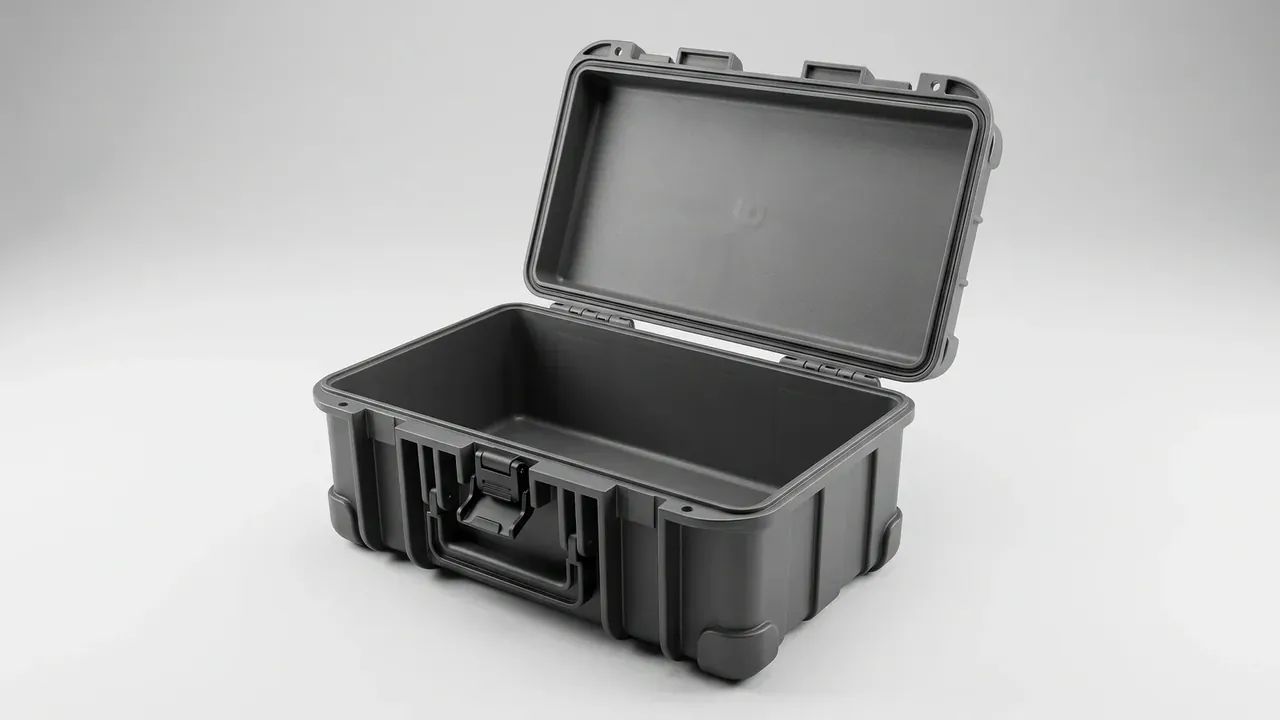
Hinges on a Military Chemical Agent Container are judged on axial play. After 5,000 open and close cycles, a gap above 0.3 mm makes the lid sit to one side, pressing the gasket flat on one edge while leaving 1 mm of daylight on the other. That daylight is where humidity enters.
A crude test works well: stand the case on its lid, load 28 kg of ballast, wait 30 minutes. A lid shifting more than 2 mm has latch geometry worth rejecting.
4. Foam Fit: What a 3 mm Gap Means
Tighter foam in a Military Chemical Agent Container is not better foam. For an 88 mm reagent bottle, cut the pocket at 92 mm and leave 2 mm per side, so roughly 15% compression holds the body without gripping it; under a 1.5 m drop the bottle then moves less than 5 mm.
| Bottle diameter | Pocket size | Gap per side | Verdict |
|---|---|---|---|
| 88 mm | 92 mm | 2 mm | Matched |
| 88 mm | 90 mm | 1 mm | Tight, hard to load |
| 88 mm | 98 mm | 5 mm | Loose, needs a shim |
Inside a Military Chemical Agent Container, EVA returns about 40% of its compression and loses 1.5 mm after 200 cycles; PE returns under 25% and loses 3 mm. Where bottles come out daily, EVA pays.
Two drain holes at the bottom of the insert matter as much as the pocket size, because a Military Chemical Agent Container that traps rinse water for a week will grow mold along the foam edge.
5. Reading Results After 96 Hours of Salt Spray
Neutral salt spray for 96 hours is the slowest of the six checks on a Military Chemical Agent Container and the one that filters out cheap builds. Read only two things: whether base metal is exposed anywhere, and whether corrosion creeps more than 2 mm out from a scribe line.
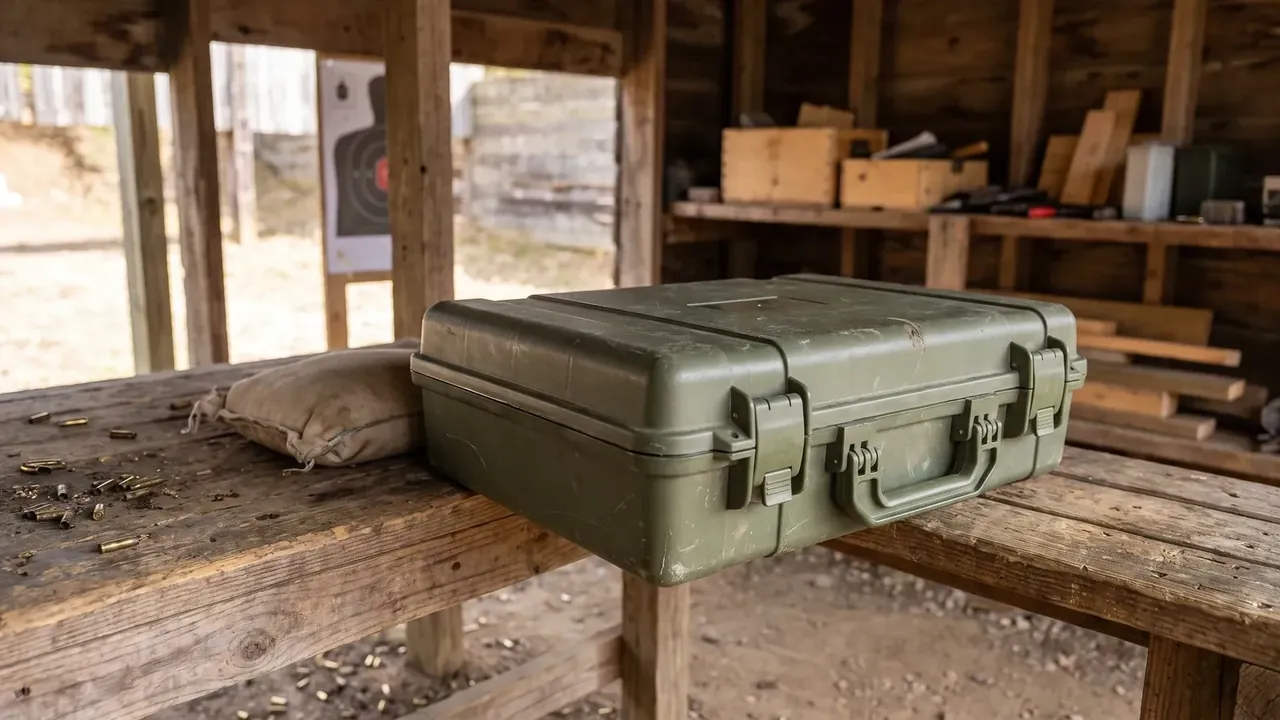
Use a 5x loupe: two panels that look identical differ by a full rating step under magnification, which separates a 15-year shell from a 6-year one.
Add a thermal loop: minus 40 °C for 24 hours, back to 25 °C, 5 repeats; a latch below 120 N after the loop fails in a northern winter.
6. Turning Six Checks Into 100 Points
Weight the six checks and the argument ends quickly. Seal 25 points, latches 20, insert 20, salt spray 15, size and weight 10, marking and traceability 10. A score of 78 is the floor for use; 86 and above is where long-term supply makes sense.
| Dimension | Weight | Pass | How to sample |
|---|---|---|---|
| Seal | 25 | 20 | Vacuum to minus 20 kPa, hold 90 seconds |
| Latches | 20 | 16 | 180 N hold, 0.3 mm play |
| Insert | 20 | 16 | 2 mm gap per side, 15% compression |
| Salt spray | 15 | 12 | 96 hours, creep ≤2 mm |
| Size and weight | 10 | 8 | 2 mm spread across 3 sections |
| Traceability | 10 | 7 | Batch, mold and date readable |
Score a Military Chemical Agent Container sample and its batch together, since a new mold changes every seal number. Write the mold number into the sheet and resample on a 6-month cycle with 3 units.
Conclusion
Order matters when you judge a sample: cavity, seal face, latches, insert, then spray data. One dimension below its pass line cannot be rescued elsewhere, and a Military Chemical Agent Container scored this way stops depending on how it feels in the hand.
This article discusses only the container (case body) side of specifications and design intent, and does not cover any handling, loading or use of the contents.
Related Reading
- Test sequence and acceptance rules for this case type
- How the shell is built, from compound to molding
- Selection criteria for ammunition storage cases
- A general method for picking military boxes
- How firearm storage cases seal differently
Related Products
- 8 Series — Gun Cases; Military Equipment Cases; Camera Equipment Cases; Drone Cases; Watch Cases; Knife Cases; First Aid Cases; Electronics Equipment Cases
- WL8-2812 PP Gun Case — model WL8-2812
- All protective cases and toolboxes: 7 series, 158 models