

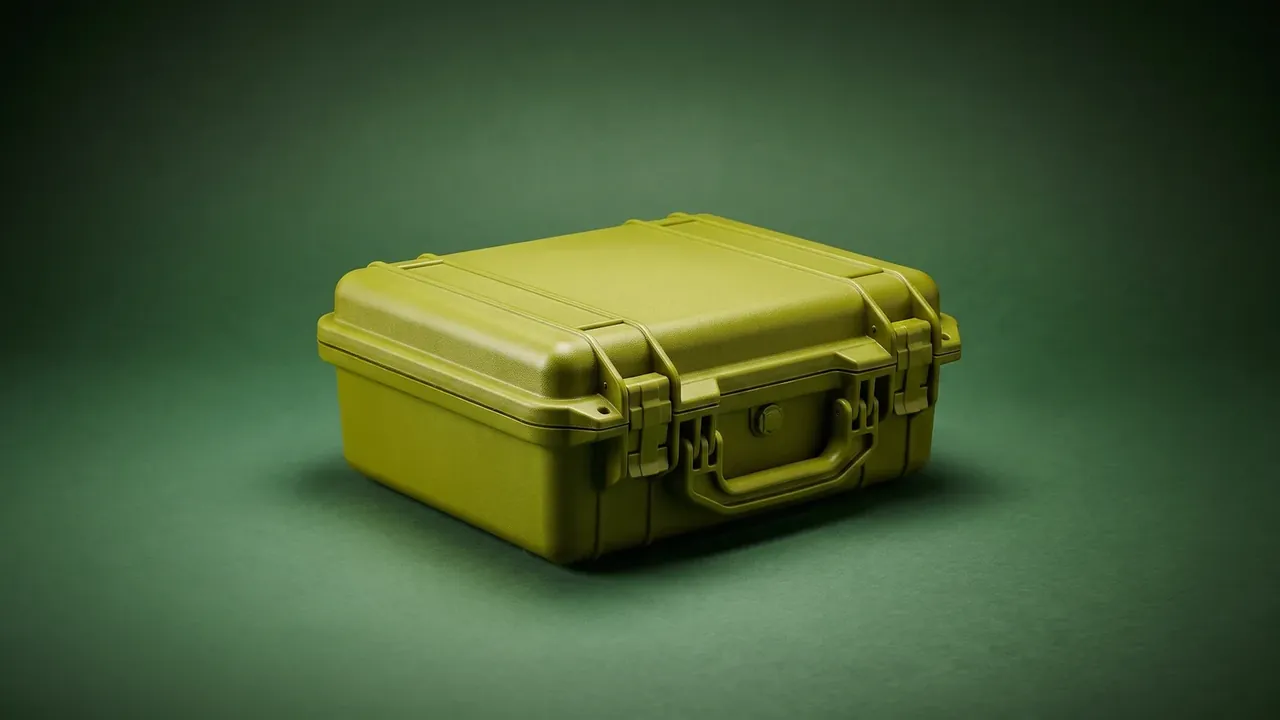
Quick answer: Score the job against six criteria — load, sealing, one-way cost, shielding, temperature, stacking. Four or more outside the limit means another box.
Table of contents
- Where the case stops being the answer
- Aluminium flight case: what the extra money buys
- Plywood and totes: cheaper only on a one-way trip
- Dry bags: the weight saved comes out of protection
- Mixed loads: how the two types divide the work
- FAQ
1. Where the case stops being the answer
A geology crew went through three box types before settling. Their first attempt put a 48 kg battery pack into a 34 litre multi-purpose outdoor case; on the second transfer the grab handle tore out of the lid root. That model is rated for 25 kg.
The first edge is one-way delivery: never returned, service life is wasted, and an 85 yuan plywood box does the same job as a 260 yuan case. The second is concentrated load — a 500 kg mould creeps the base white within months. The third is EMI, where polypropylene attenuates 0 dB and only an aluminium shell with a conductive gasket reaches the threshold. The fourth is storage rotation: under 20 moves a year, a 42 yuan tote does the work. None of the four needs the shell's three costliest parts: the seal, the latch set, the replaceable liner.
| Task | Field signature | Case performance | Better fit |
|---|---|---|---|
| One-way | Unpacked, never returned | 260 yuan, return freight too high | Plywood, 85 yuan |
| Point load | Moulds at 500 kg | Feet whiten at 300 kg | Steel crate |
| EMI | Radio modules | No shield, 0 dB | Aluminium, 40 dB |
| Rotation | Under 20 moves a year | Seal unused | Tote, 42 yuan |
Run it backwards: under 25 kg per unit, IP67 and repeated handling leave no room for an alternative.
2. Aluminium flight case: what the extra money buys
Swapping a 34 litre moulded case for aluminium moves the price from 260 yuan to 980 yuan; the extra 720 yuan buys shielding and stiffness.
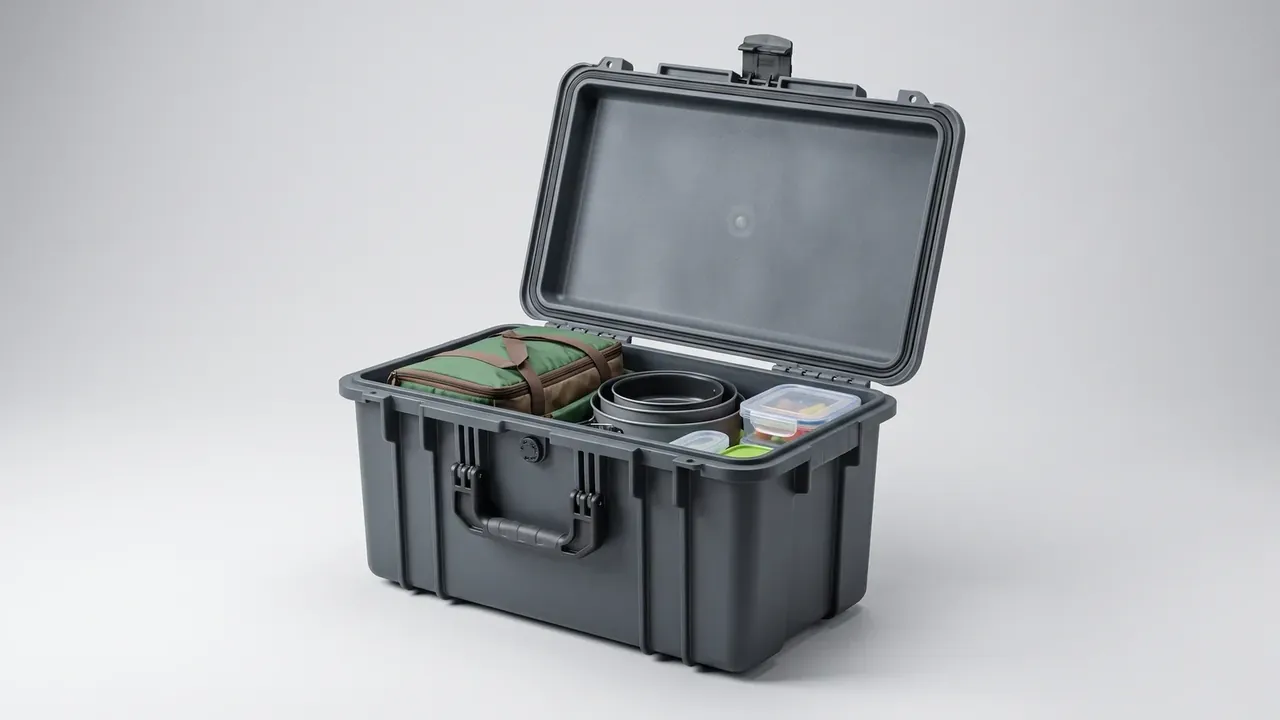
The shell uses 1.2 mm 5052 sheet over a 15 mm honeycomb core, deflecting under 2 mm at 500 kg; the moulded wall, 3.2 mm, sags 9 mm and throws the lid register out. A gasket compressed along every seam takes attenuation from 30 MHz to 1 GHz to 40 dB; sprayed paint rubs through in a season.
Three penalties follow. Mass climbs from 4.6 kg to 7.8 kg, so fatigue arrives earlier. A dent cannot be repaired. After 240 hours of salt spray, corrosion blooms around the rivets unless stainless ones replace standard.
3. Plywood and totes: cheaper only on a one-way trip
In a one-way structure the box is consumable. Plywood at 85 yuan and totes at 42 yuan share one weakness: no seal, no tolerance for off-centre loads.
| Option | Unit price | Trips | Cost per trip | Lead time |
|---|---|---|---|---|
| Plywood box | 85 yuan | 1 | 85 yuan | 12 days |
| Plastic tote | 42 yuan | 80 | 0.5 yuan | 7 days |
| Multi-purpose outdoor case | 260 yuan | 300 | 0.9 yuan | 25 days |
Spread over trips, the return rate decides. A tote at 0.5 yuan is cheapest only while it comes back; below a 60 percent return the cost doubles. The case reaches 0.9 yuan at 300 openings, and wins only where the box must return dry.
One entry gets missed: plywood excludes moisture protection. A 40 foot container with 6 kg of desiccant adds about 90 yuan, the depreciation on a sealed case.
4. Dry bags: the weight saved comes out of protection
A 60 litre waterproof pack weighs 1.8 kg and costs 130 yuan; an empty multi-purpose outdoor case of the same volume weighs 6.2 kg. On an 8 hour walk the 4.4 kg decides who carries food.
The gap is structure. A dry bag carries load in coated fabric with no frame, so the contents absorb impact. A moulded shell spreads it across wall and corner radius: dropped 1.2 m onto concrete, peak acceleration stays under 40 g against 120 g. Sealing differs too — the bag zip weeps at 0.6 m, where the case holds IP67 at 1 m for 30 minutes. That is why a bag earns its place under 8 hours and 20 kg, and the shell takes over at the first drop.
5. Mixed loads: how the two types divide the work
A field station seldom runs one box type: place each box where it loses least.
| Criterion | Limit | Multi-purpose outdoor case | Alternative |
|---|---|---|---|
| Load per unit | 25 kg | Meets | Steel crate to 500 kg |
| Ingress rating | IP67 | Meets | Dry bag fails |
| Cost per trip | 1 yuan | 0.9 yuan | Tote 0.5 yuan |
| Shielding | 40 dB | 0 dB | Aluminium meets |
| Temperature | -20 to 60℃ | Meets | Metal to 120℃ |
| Stacking | 3 high | Meets | Plywood to 5 high |
Read right to left: find the cell where an alternative is stronger, then ask whether it matters here. One cell in six is no reason to switch.
Conclusion
Aluminium wins on shielding and stiffness, plywood and totes on one-way cost, dry bags on dead weight. A multi-purpose outdoor case sits in the overlap of three criteria: modest load, a real seal, repeated handling. Outside it, switching beats reinforcing.
This article discusses only the container (case body) side of specifications and design intent, and does not cover any handling, loading or use of the contents.
Related Reading
- The four structural interfaces behind one-box reuse
- Loading plans for campsites and roof racks
- Where airdrop cases and standard cases part ways
- Trade-offs between ammunition box types
- When an ammunition chest can stand in
Related Products
- 8 Series — Gun Cases; Military Equipment Cases; Camera Equipment Cases; Drone Cases; Watch Cases; Knife Cases; First Aid Cases; Electronics Equipment Cases
- WL8-2812 PP Gun Case — model WL8-2812
- All protective cases and toolboxes: 7 series, 158 models