

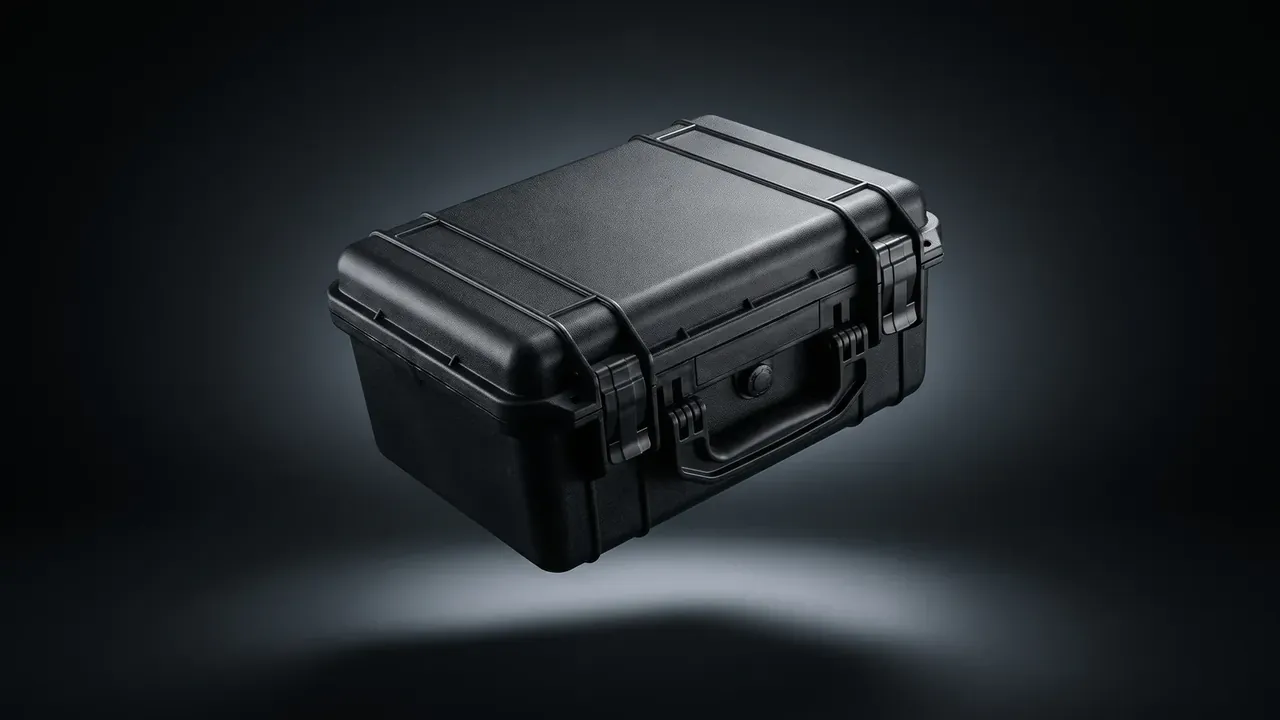
Quick answer: A munitions shipping and storage container is rigged differently in each condition: vehicle load runs through the ribs, warehouse load through pallet footprint and shelf pitch, field use through opening frequency, transit through corner fittings. Six conditions are mapped against MIL-STD-810H shock and immersion methods and IEC 60529 IP6X and IPX7 grades.
Table of contents
- Vehicle Mounting: Where the Tie-Down Load Enters
- Warehouse Stacking and Tray Constraints
- Opening Frequency Sets the Seal Type
- Intermodal Palletizing Loads the Corners
- Cold and Wet Conditions: Gasket and Valve
- Loading Actions and Field Mistakes
- FAQ
1. Vehicle Mounting: Where the Tie-Down Load Enters
A munitions shipping and storage container rarely splits on a truck. It slides, jams a catch against the side board, and pops open.
MIL-STD-810H Method 516.8 asks for three axes; a truck constrains two. Vertically the case rests on weight and rib friction, lifting over a bump and landing a few centimetres off.
Four fixing points is the minimum: M10 bolts at 35 N·m, or straps tensioned until creep stays under 5 mm.
| Fixing method | Fits | Key figure | Time per case | Failure |
|---|---|---|---|---|
| Straps over the top | Short moves | Four points, 50 mm webbing | 90 seconds | Strap bears on the lid and slackens |
| Clamp plate and bolts | Permanent vehicle fit | M10 at 35 N·m | 6 minutes | Over-torque crushes the gasket channel |
| Rail-mounted shoes | Shelter and van bodies | Pitch matched to the ribs | 20 seconds | Rib rides on top of a shoe |
Catch orientation follows: sideways or down is fine, upward lets anything on the lid lever the tongue open.
2. Warehouse Stacking and Tray Constraints
Shelf pitch on a munitions shipping and storage container runs at case height plus 50 mm, usually near 450 mm, and the middle case of three is pinched by its neighbours' catches.
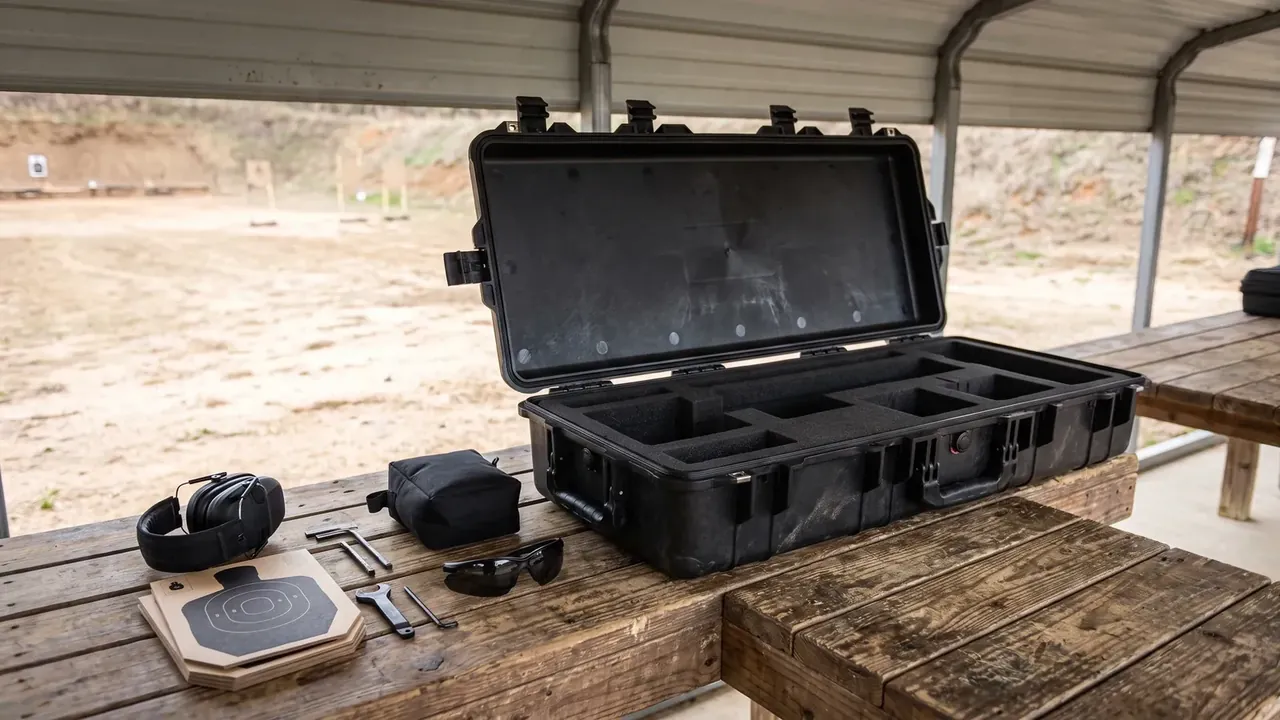
Pallet footprint comes first. Two layers of four cases on a 1200 × 1000 mm pallet leaves 30 mm of overhang, where tines tear the wrap; three per row staggered keeps it inside 10 mm. At four layers the base carries three above, so a loose item on the lid turns the pick into a drag. Aisles need better than 1.2 m, or tines angle and contact lands on the thinnest corner.
3. Opening Frequency Sets the Seal Type
Opening frequency decides the seal on a munitions shipping and storage container. Opened six or more times a day, a double-line gasket costs three to five millimetres of compression per closure and ends up half-latched; a single line with a drip lip in 70 Shore A closes in eight seconds.
IP6X governs dust and IPX7 short immersion; they are separate claims.
Name the IEC 60529 grade together with the state it applies to, lid closed or during handling. A desiccant sachet handles moisture trapped at closure and nothing that has already come through.
4. Intermodal Palletizing Loads the Corners
Palletized, the load path leaves the walls for the corner fittings: container lashings, aircraft rings and rail stops bear there, so insert depth matters more than wall thickness.
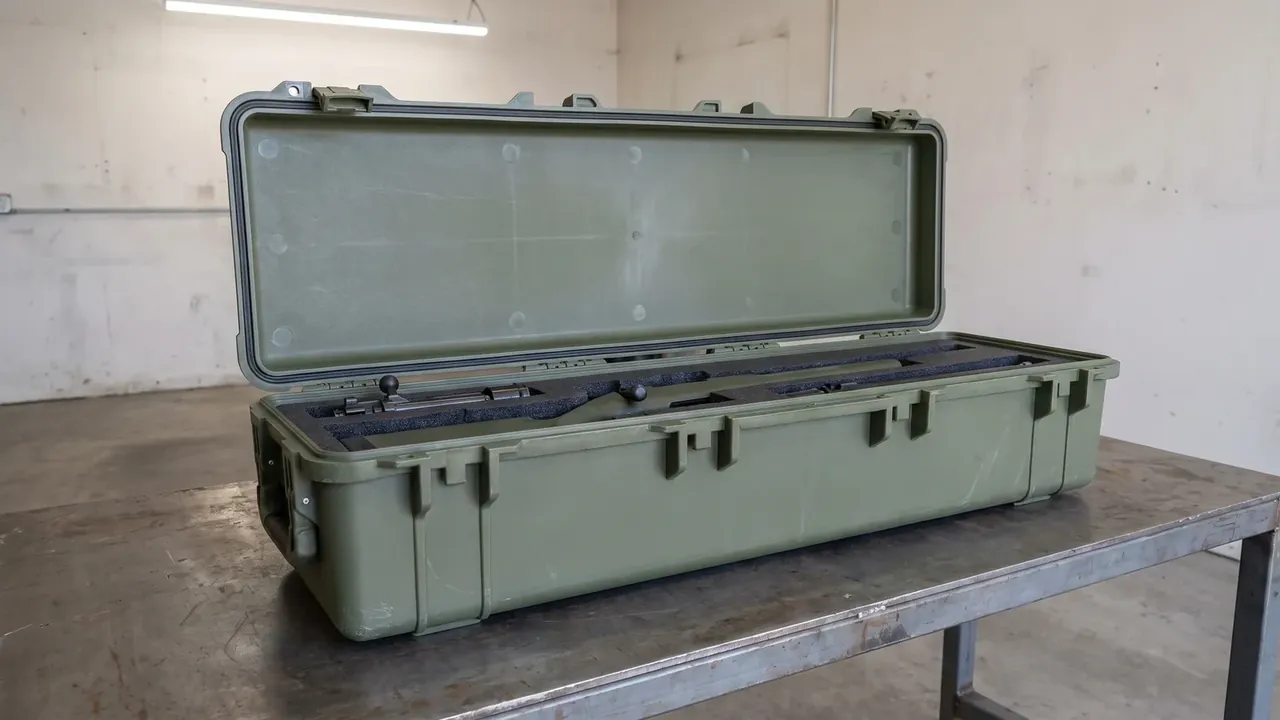
Keep the fitting centre within 60 mm of the edge and the lashing load spreads along the wall; set it inboard and load concentrates where the wall is thinnest. Air tie-down runs two opposing points at 1.5 times loaded weight each, and four points instead of two roughly halve local stress.
| Corner detail | Spreads load when | Common error | Symptom |
|---|---|---|---|
| Fitting within 60 mm of edge | Lashing pulls along the wall | Fitting set inboard | Star cracks at the corner |
| Two-point air tie-down | 1.5 times loaded weight per point | Rated on empty weight | Corner block pulled proud |
| Ribs across fork entry | Tines meet the rib face | Ribs run with the entry | Floor scuffed through |
5. Cold and Wet Conditions: Gasket and Valve
At minus thirty the gasket of a munitions shipping and storage container hardens, then loses rebound. Open slowly: a quick lift drags the profile from its channel, and pushed back by hand it looks seated while the closure leaks.
A relief valve cracking near 0.2 bar handles a thirty-degree swing without letting water in. Salt fog over 96 hours shows at catch tongues and rivets, not in body colour.
6. Loading Actions and Field Mistakes
Mistakes cluster in the same places on a munitions shipping and storage container:
- Latching one side first, which pushes the gasket to one edge
- Cutting foam with no 5 mm clearance, so blocks shift on the first bump
- Using the carry handle as a lifting point, though its root is thinnest when loaded
- Standing the open lid on the ground, where grit enters the channel
- Stacking empty cases more than six high, which deforms the base walls
The first two are method problems, the rest hardware: a method change holds for years, hardware has to be issued by the batch.
Conclusion
Across six conditions the differences sit in fixing points, pallet layout, seal type, corner position, cold handling and loading sequence, each measurable on site. Settle the condition first, then thickness. A munitions shipping and storage container is only as good as the condition it was configured for.
This article discusses only the container (case body) side of specifications and design intent, and does not cover any handling, loading or use of the contents.
Related Reading
- Inspection items and pass criteria for munitions cases
- Sizing, wall thickness and load derivation
- Specialized cases across niche working conditions
- Inspection intervals and replacement lines
- Reusable cases against the alternatives
Related Products
- 8 Series — Gun Cases; Military Equipment Cases; Camera Equipment Cases; Drone Cases; Watch Cases; Knife Cases; First Aid Cases; Electronics Equipment Cases
- WL8-2812 PP Gun Case — model WL8-2812
- All protective cases and toolboxes: 7 series, 158 models