

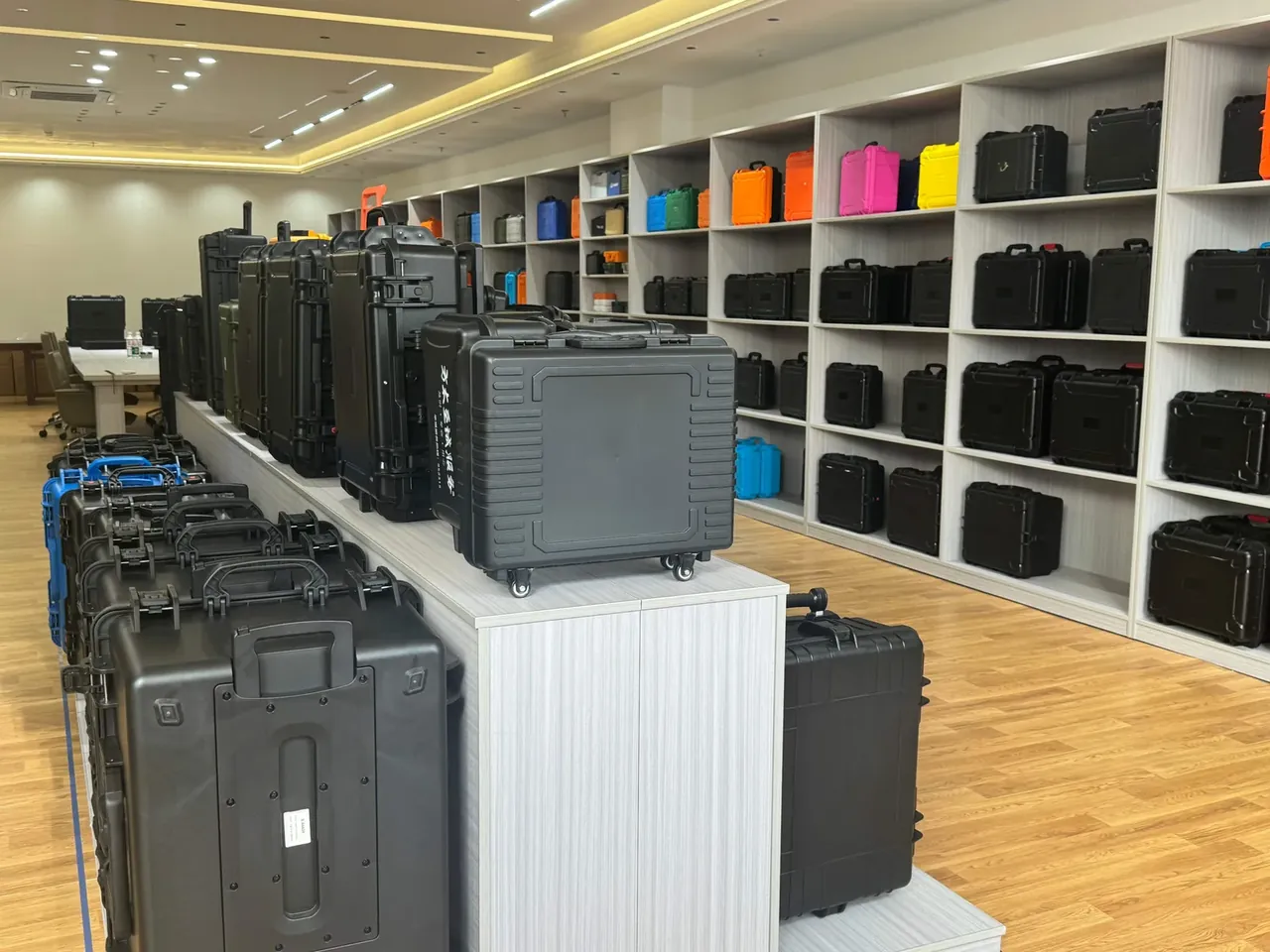
Quick answer: A nuclear maintenance case leaves the red zone after three checks: 0.5 μSv/h at 100 mm, 4 Bq/cm² after wiping, and a matching seal code.
Table of contents
- Three-colour zoning and numbering
- Dose-rate thresholds at the gate
- Wipe-down and surface contamination
- Materials that survive decontamination
- In-place checks and seal numbers
- Case weight and lifting
- FAQ
1. Three-colour zoning and numbering
A nuclear maintenance case is banded by destination on arrival: 40 mm red with an R prefix for the red zone, Y for yellow, G for green. One overhaul order runs 12 red, 20 yellow and 30 green cases. The band decides which doorway the case passes today.
The number is 8 digits, unit, zone and a six-digit sequence, laser-marked in a 60 mm × 40 mm field on the lid under an in-mould label. Paper stickers lift by the third decontamination round and lose a digit.
Keep the band off the parting line, where a 0.2 mm mismatch stops any label bedding down: 25 mm in from the lid edge, 40 mm wide, 10 mm radius.
| Zone | Band | Prefix | Wall | Movement |
|---|---|---|---|---|
| Red | Red, 40 mm | R | 4.5 mm | Control area |
| Yellow | Yellow, 40 mm | Y | 4.0 mm | Corridor, wipe 2 |
| Green | Green, 40 mm | G | 3.5 mm | Out of control area |
| Grey | Grey, 40 mm | X | 4.0 mm | Buffer only |
Grey holds tools not yet assigned: buffer store only, recoloured and renumbered once the zone is fixed.
2. Dose-rate thresholds at the gate
The first gate reads dose rate against two lines: 10 μSv/h at 100 mm to enter the yellow corridor, 0.5 μSv/h to leave the control area. Background runs 0.08 to 0.15 μSv/h, and seven points are counted over 30 s, six faces plus the handle.
At five times background, 0.5 μSv/h leaves room for a repeat reading. The 10 μSv/h line splits traffic: above it the shell still carries transferable contamination, so the case goes back for a wipe, not to scrap.
A groove 0.8 mm deep holds liquid, dries to a film and reads hot again, so the shell wants countersunk screws, radii of R10 and a liner that lifts out whole.
| Gate | Measured | Criterion | If it fails |
|---|---|---|---|
| First | Dose rate, 7 pts | 10 μSv/h at 100 mm | Stays red, 24 h retest |
| Second | Contamination | 4 Bq/cm² | Re-wipe, no release |
| Third | Seal, slot list | 8 digits, 24 slots | Full count, reseal |
The order is fixed: dose rate before wiping, since wiping spreads contamination and drags the reading down.
3. Wipe-down and surface contamination
A nuclear maintenance case takes three wipe passes of 2 min with 300 g/m² cloth and citric acid at pH 2.5, pushed lid to base in one direction. The verdict is contamination: 4 Bq/cm² for beta and gamma, 0.4 Bq/cm² for alpha, read over 100 cm² for 2 s.
The decontamination factor is designed at 10, so a case entering at 40 Bq/cm² must land below 4 Bq/cm². Anything above stays in the red zone for the next round, and two rounds a day is the ceiling.
Structure outranks the wiping motion: two 6 mm drain holes at the lowest point, ribs that shed water, a lid joint within 0.2 mm and sealed, foam that lifts out in one piece.
4. Materials that survive decontamination
The fluid is citric acid at pH 2.5 with 0.5% surfactant, and one case sees over 200 wipe cycles a year. PP, or PP with 10% glass fibre, changes mass by 0.3% or less after 24 h immersion and shifts roughness only from Ra 1.2 μm to 1.6 μm.
ABS chalks within the same 24 h, from 3 GU to 1 GU, and crazes after a dozen wipes, so contamination settles in the cracks. PC cracks under stress after 72 h in acid.
Hardware follows the chloride: 304 stainless pits after 48 h, 316L runs 500 h clean. Seals go EPDM, at 9% compression set after 72 h against 18% for silicone at 65 Shore A.
5. In-place checks and seal numbers
The foam carries 24 slots with a 2-digit number beside each and a 24-line card inside the lid. The check reads empty slots rather than tools, and takes 40 s per nuclear maintenance case.
Two seals pass through the 4 mm holes in the side latches, each with an 8-digit code tied to the case and a breaking strength of at least 90 N. A break is logged with code, time and operator, and the torn tail returns with the case. Seal colour follows the zone, and replacements come from the same batch, or two codes will not reconcile.
The seal is the last link in the chain, not decoration.
6. Case weight and lifting
An empty nuclear maintenance case weighs 11.2 kg, 32 kg loaded, at 600 mm × 400 mm × 320 mm. It is lifted on four eyes, one per lid corner, rated 1.2 kN each with a factor of 4.
Four slings at 60° put 0.09 kN on each leg, about 8% of the rating. Flatten the angle to 30° and the load climbs to 0.16 kN while the sling rubs the lid edge, so the eyes sit 40 mm in from each corner.
Base ribs stand 8 mm proud, and a three-high stack loads the bottom case to 1.5 kN at a 1.6 dynamic factor. Two 75 mm castors come off before a rack, so the sockets never trap contamination.
Conclusion
Control on a nuclear maintenance case rests on three things read at a glance: the band, the threshold and the seal code. A red case still above 10 μSv/h at 100 mm should never appear in the yellow corridor, and one above 4 Bq/cm² after three passes goes back into the zone rather than into the passage. A seal that disagrees with the list means counting 24 slots before anyone talks about release, because the check is only as good as its last unbroken link. Write those three into band width, digit count and seal hole position and the daily round has somewhere to land. At 12 red and 20 yellow cases per order, some 60 gate checks run each day, so a single minute saved on each one is a full hour back.
| Zone | Action before exit | Criterion | If it fails |
|---|---|---|---|
| Red | 7-point dose rate, 3 wipes | 10 μSv/h at 100 mm | Stays in, 24 h retest |
| Yellow | Second wipe, seal code | 4 Bq/cm², code matches | Reseal, retest |
| Green | Seal, 24-slot check | Slots match list | Count, reseal |
This article discusses container-side specifications and design implications only, and does not cover any handling, loading or use of the contents.
Related Reading
- Case configuration for nuclear instrumentation
- Transport cases for radiation monitors
- Packing cases for nuclear power components
- Special ordnance packing box standards
Related Products
- 8 Series — Gun Cases; Military Equipment Cases; Camera Equipment Cases; Drone Cases; Watch Cases; Knife Cases; First Aid Cases; Electronics Equipment Cases
- WL8-2812 PP Gun Case — model WL8-2812
- All protective cases and toolboxes: 7 series, 158 models