

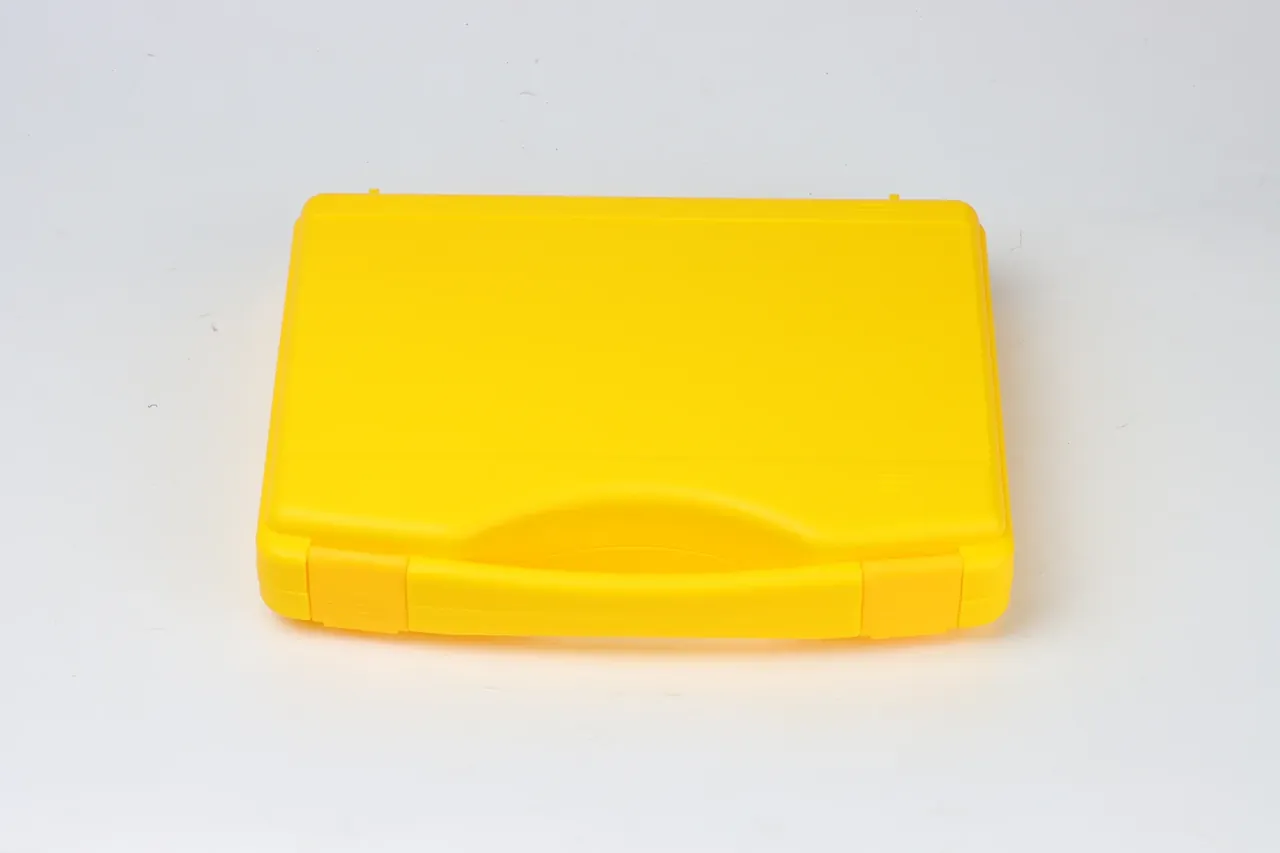
Quick answer: A one-piece moulded case is shot as two single parts, lid and base, so the gasket groove, latch seats and hinge ears form in the same cavity as the walls and the rim carries no joint. An assembled body welds, glues or screws separate panels together, and each joint is a route for water. On a 520 mm body the moulded groove floor holds 0.15 mm flatness against 0.5 to 0.7 mm assembled, worth nine points of gasket compression in the same 4.5 mm groove.
Table of contents
- Where the Joint Disappears
- Three Joints, Three Leak Paths
- Groove Flatness: 0.15 mm vs 0.6 mm
- From -20 °C to 60 °C
- Five Checks Without Cutting a Case
- When an Assembled Body Wins
- FAQ
1. Where the Joint Disappears
The melt fills one cavity and the lid comes out whole; the base follows. Gasket groove, latch bosses and hinge ears are formed in that single shot, so nothing is joined afterwards. A 520 × 380 × 210 mm body runs on a 1,600 t press at 68 s a shot, and the parting line sits at mid-height with a step under 0.08 mm.
Sealing rests on three dimensions: a groove 6.5 mm wide and 4.5 mm deep, its floor flat to 0.15 mm, and a 7 mm hollow silicone cord at 28% compression. Each groove wall gives 0.3 mm, so the cord is squeezed into a rectangle rather than sheared.
2. Three Joints, Three Leak Paths
An assembled body splits lid panel, skirt and base plate into separate shots, then joins them three ways, and each method fails somewhere else.
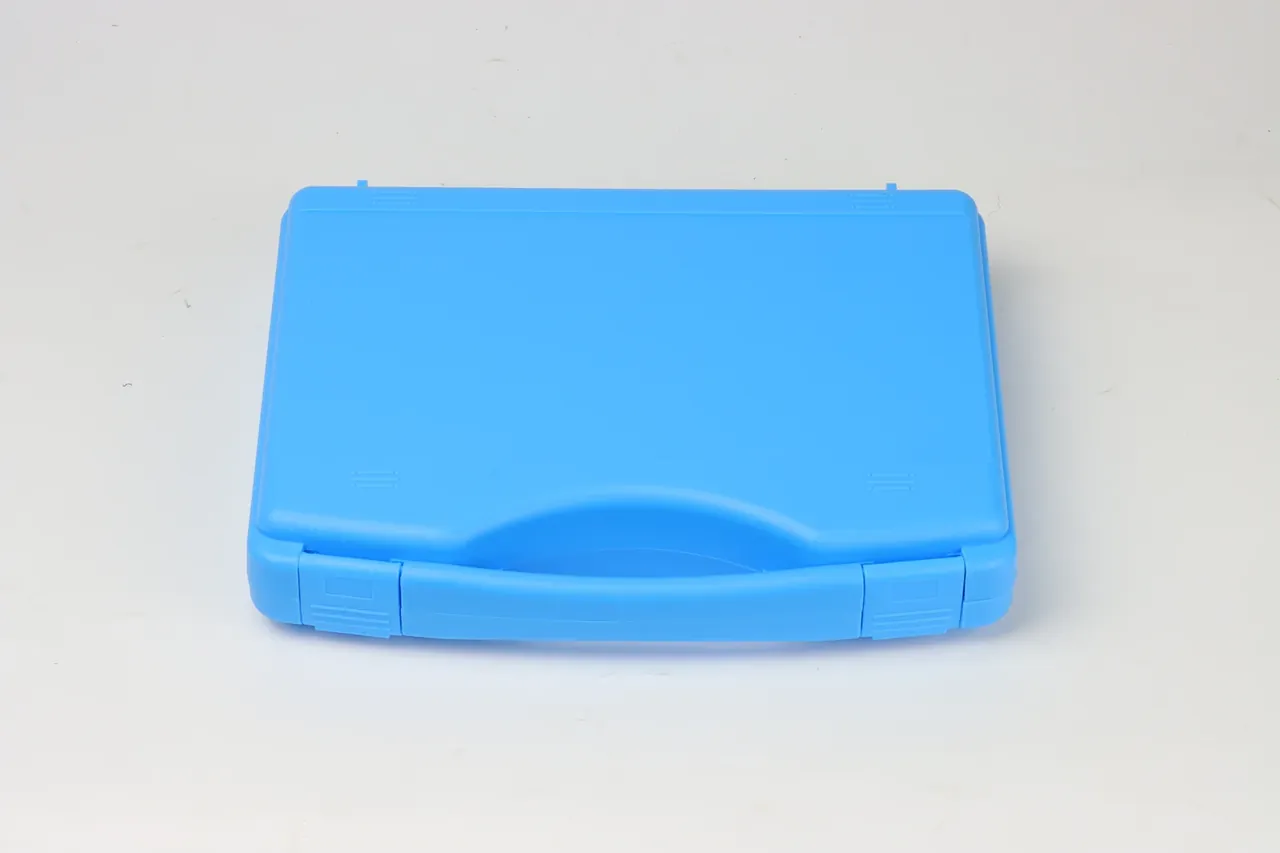
Ultrasonic welding runs a 0.8 mm bead with 1.2 mm melt depth round the skirt and holds 1 m of water for 30 minutes at 92% continuity; break that bead 3 mm at a corner and water enters.
Adhesive bonding cures a 0.3 mm polyurethane layer in 24 hours, and 0.05 mg of oil per square centimetre on the bond face takes 40% off peel strength.
Screws and a gasket rework easiest: M4 screws every 80 mm at 1.2 N·m on a 3 mm EPDM strip, where over-torque punches through and under-torque leaks.
| Joint method | Added cost | Where it leaks | Rework |
|---|---|---|---|
| Ultrasonic weld | 3.8 | Interrupted bead at corners | Re-weld only |
| Polyurethane adhesive | 5.2 | Oil and voids on the bond face | Scrap on opening |
| Screw and gasket | 7.6 | Uneven torque | Strip replaceable |
3. Groove Flatness: 0.15 mm vs 0.6 mm
Moulded in one shot, the groove floor is cut into a single insert and holds 0.15 mm. On an assembled rim it lands on the joint between skirt and lid panel, two operations stack tolerances, and measurement falls between 0.5 and 0.7 mm.
That 0.45 mm splits compression into two zones: the 7 mm cord needs 28% to keep reserve, and where the floor stands high it reaches only 19%. A 1 m immersion leak almost always appears along the highest 30 mm of groove.
| Groove floor flatness | Compression | 1 m immersion, 30 min | Verdict |
|---|---|---|---|
| 0.15 mm | 28% | Dry | Pass |
| 0.35 mm | 23% | Dry, droplets on strip-down | Concession |
| 0.60 mm | 19% | 2 to 4 drops in the arc | Reject |
Moulding is not automatically sound. With the gate at lid centre the melt meets again behind the latch ear, and PP welds at 65% of bulk strength, so a 0.15 mm groove behind a 65% ear still breaks at the ear.
4. From -20 °C to 60 °C
PP expands at 1.5×10⁻⁴ per kelvin and PC at 0.7×10⁻⁴, so splitting the materials between lid and base leaves a 480 mm length 2.3 mm apart over a 60 K swing. Screws constrain it into 0.2 mm of slip, two thirds of a 0.3 mm adhesive layer. Once slip passes the shear limit the bond face opens and water travels along the interface. Cold embrittles the polymer, with notched impact falling from 6 kJ/m² to 2.5 kJ/m² at -20 °C. Boss stress moves too, since a boss contracts and does not return fully on warming, so the gap grows cycle by cycle. Stack those effects and the body creeps forward every cycle rather than failing once, and by cycle 25 most samples show a white stress line along the joint.
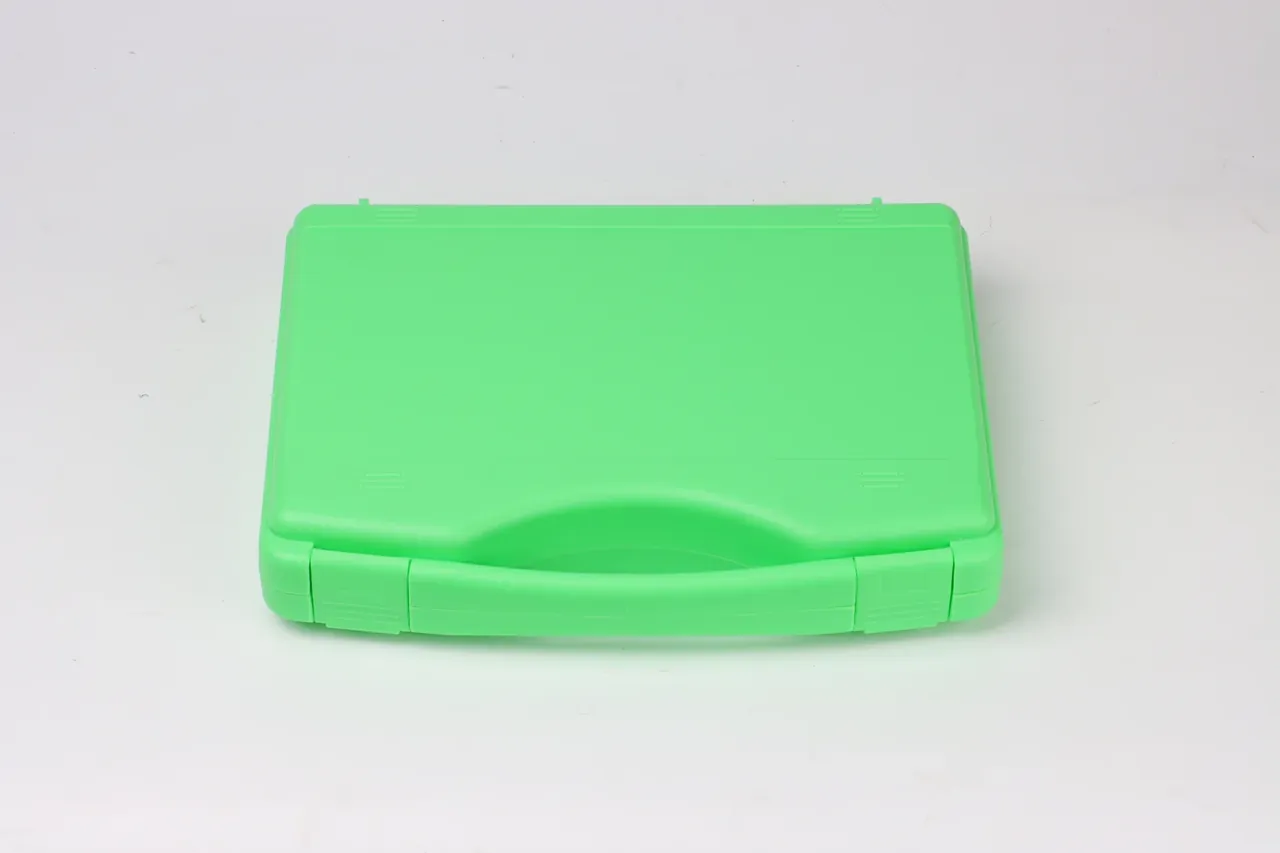
Preload has its own line: 25 cycles of four hours at -20 °C and four at 60 °C cost an M4 screw 18% of its preload in a PP boss, while the washer mark grows from 0.4 mm to 0.55 mm.
A one-piece body has no joint, so the swing only expands it as a whole and change stays inside 0.7 mm. The price is the tool, where a 520 mm body needs an 800 mm mould base.
5. Five Checks Without Cutting a Case
Inspection rarely allows a section cut, and five external features separate the structures:
- Parting line: one loop at mid-height, no step across it
- Inner rim: a 0.2 mm step outside the groove floor means assembly, a continuous curve means moulding
- Latch seat: same colour and compound, no glue smear or flash at the root
- Weld witness: a 0.8 mm band inside the lid in the matching position
- Weight: 0.18 to 0.25 kg heavier at equal outline from the overlapping skirt
Tapping agrees: a short note on a moulded body, a dull one trailing a ring near the joint on an assembled body.
6. When an Assembled Body Wins
The barrier is tooling and tonnage. Two moulds for a 520 mm body cost 46,000 and tie up a 1,600 t press for 68 s a shot, while five small moulds plus a 6,000 welding fixture come to 34,000, dropping tooling per unit from 2,300 to 1,700 on a 200-piece run.
A 1,200 mm body needs a 4,000 t press and tooling from 120,000, which few plants hold stable.
| Condition | One-piece | Assembled |
|---|---|---|
| Volume | Above 1,000 units | 200 to 800 units |
| Outline | Under 900 mm | Over 900 mm |
| Tooling lead time | 45 days | 25 days |
| Design change | Cut the tool, costly | Change a panel, cheap |
Mixed materials force assembly anyway: a clear PC lid over a PP base cannot share a cavity.
Conclusion
The argument ends at the rim. Moulded, the groove comes off one insert at 0.15 mm flatness; assembled, it sits across two operations at 0.5 mm and beyond, compression falls from 28% to 19%, and the leak shows along the highest 30 mm. Moulding is not universal either: over 900 mm, under 200 units, or a lid and base in different materials all favour assembly.
This article discusses only the specification and design intent on the container (case) side, and does not cover any handling, loading or use of the contents.
Related Reading
- How an injection-moulded case is built
- Rotomoulded bodies next to injection-moulded ones
- Steps and takt time on a case assembly line
- Seal construction in waterproof hard cases
Related Products
- 8 Series — Gun Cases; Military Equipment Cases; Camera Equipment Cases; Drone Cases; Watch Cases; Knife Cases; First Aid Cases; Electronics Equipment Cases
- WL8-2812 PP Gun Case — model WL8-2812
- All protective cases and toolboxes: 7 series, 158 models