

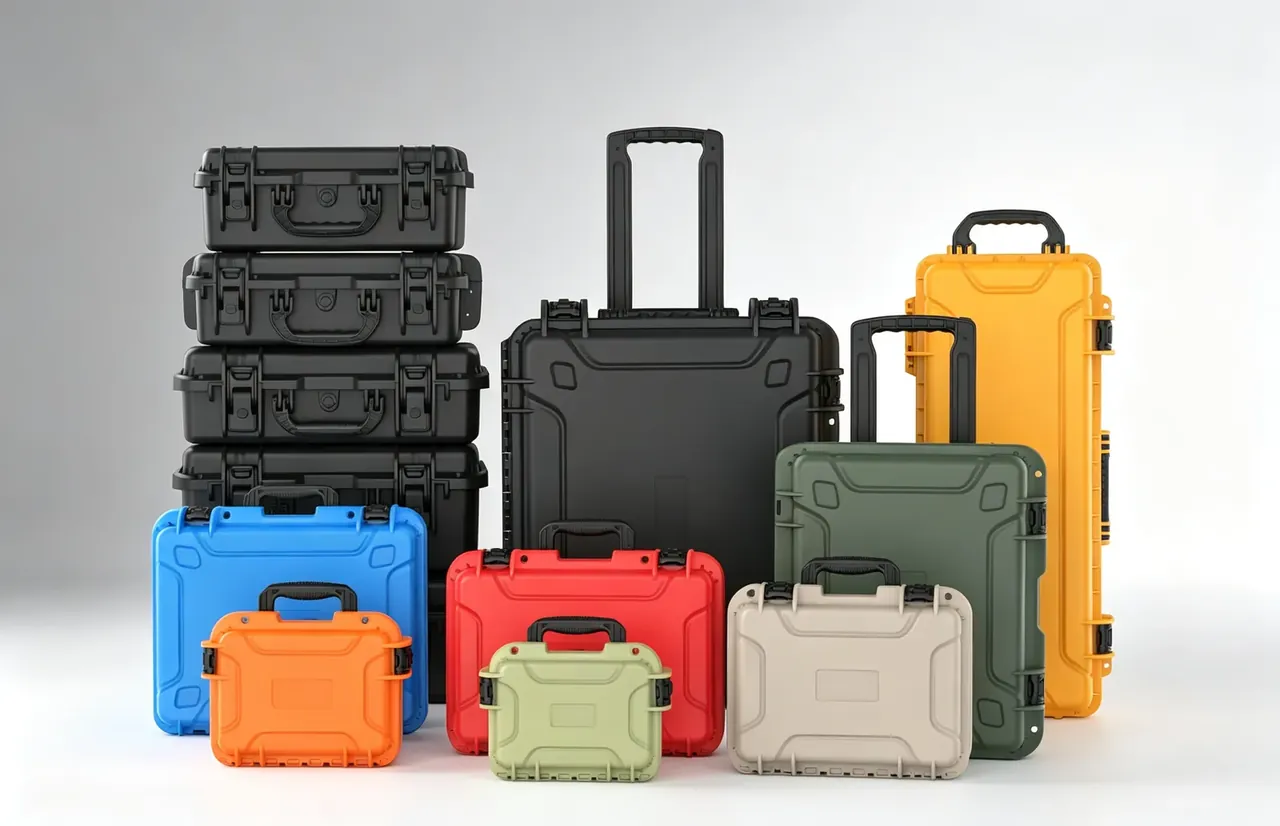
Quick answer:Outdoor cassette stove portable protective hard box holds a 220 g can 40 mm off the burner and vents through six 8 mm holes.
Table of contents
- Canister compartment split of the outdoor cassette stove portable protective hard box
- The 40 mm floor between stove and canister
- Vent holes and the relief path
- Storage order once the hot parts cool
- Transport attitude and the no-inversion rule
- FAQ
Canister compartment split of the outdoor cassette stove portable protective hard box
The stove is still hot and it has to go back in the box. Every camp strike hits that collision: the valve is barely shut, the pan base is still passing heat down the legs, and someone already has the lid up. The outdoor cassette stove portable protective hard box resolves it by cutting the interior into three spaces that share no air, a canister compartment, a stove compartment, and a 40 mm isolation layer between them.
The canister compartment is sized off the 220 g can, which runs about 68 mm across and 195 mm tall. Net size is 72 x 205 mm, so 2 mm per side, and the can lifts straight out of its own hinged end. A 3 mm EVA pad sits underneath, because a moulded floor against a rolled steel rim dents that rim on the first gravel track.
The stove compartment takes 300 x 180 x 110 mm net with 8 mm of foam give on all sides, and it is not sealed: a stove comes back with broth on it, and trapping the moisture only parks it against the shell. Outside, 340 x 230 x 140 mm at 2.6 mm wall, 1.4 kg empty.
The 40 mm floor between stove and canister
Forty millimetres is the first hard number on the outdoor cassette stove portable protective hard box, from the burner skirt to the nearest point of the can. It works backwards from the can limit: a butane mix can is rated to 55 °C surface, and at full output 40 mm of air plus a 1.5 mm divider keeps the skin within about 20 K of ambient. At 30 °C that is a 50 °C can, 5 K in hand.
Close the gap to 30 mm and the same run pushes the skin past 55 °C; pressure climbs with it and the margin is gone. Open it to 60 mm and the box grows, which the 1.4 kg target will not carry.
The divider that makes the 40 mm real is 1.5 mm PP, moulded in the same shot as the shell, with about 19 mm of still air either side. One shot means no glued root to crack on a drop, and it floats 8 mm clear top and bottom so the shell deflects without loading it.
| Spacing item | Value | Basis |
|---|---|---|
| Burner to can | 40 mm | Back-calculated from 55 °C skin |
| Divider | 1.5 mm | Moulded with the shell, one shot |
| Air either side | 19 mm + 19 mm | Sums to the 40 mm gap |
| Can surface | ≤55 °C | 30 °C ambient plus 20 K |
Vent holes and the relief path
Six holes at 8 mm is the second hard number on the outdoor cassette stove portable protective hard box. A fingertip will not pass 8 mm, so edges stay safe and nobody lifts the box by a vent. Three sit low in the canister compartment and three high, forming a chimney.
Total open area lands near 300 mm² against a compartment of about 1.0 L, a ratio that stops a slow leak pooling into a flammable layer. The low three also drain: butane is heavier than air, so a weep leaves downward rather than gathering under the lid.
Each hole carries a 1.5 mm drip lip facing down, which sheds splash without choking the flow. No vent may sit above the stove compartment, since that would route burner heat into the canister and defeat the 40 mm gap through its own venting.
| Hole group | Count | Open area | Duty |
|---|---|---|---|
| Canister, low | 3 | About 150 mm² | Heavy gas out, air in |
| Canister, high | 3 | About 150 mm² | Outflow, relief |
| Single hole | 8 mm | 50 mm² | Finger cannot enter |
Storage order once the hot parts cool
Sixty degrees is the packing threshold, read on metal. A hand rests on 60 °C for about 3 s. A stove just shut down falls from 180 °C to 60 °C in roughly 15 min at 25 °C ambient, quicker in wind.
The outdoor cassette stove portable protective hard box accepts one order only. Shut the valve, lift the can off the burner, lay the stove out for 15 min, load the stove compartment, load the canister, close. The can leaves first because it fears heat most; the stove goes in last because internal air is capped at 55 °C and a 60 °C stove overshoots that before it settles.
The two 55 °C figures are separate limits and get confused. The can limit is about internal pressure; the internal-air limit is about PP softening and a 2.6 mm wall losing stiffness.
Transport attitude and the no-inversion rule
Canister compartment up is the only attitude rule on the outdoor cassette stove portable protective hard box. Standing, the valve sits at the top and any weep leaves through the three high holes. Inverted, liquid butane reaches the valve, and the next lighting pulls liquid instead of vapour. A 2 mm locating boss on one face marks the top by feel.
The 1.0 m six-face drop is the acceptance action for the outdoor cassette stove portable protective hard box: afterwards, check the divider for cracks, the canister walls for dishing, the EVA under the can rim for punch-through. At 1.4 kg the impact rides the corner radii and the 2.6 mm wall, not the latches, which are rated 180 N each.
The reject line sits on three items. If spacing, vent area or residual temperature misses, the box does not ship. Spacing is judged at 40 mm, where a millimetre short recuts the tool; vent area at 300 mm², where one missing hole costs 50 mm² and drops the box out of band; residual temperature at 60 °C, measured on the stove as it goes in. Vent area erodes quietly, since holes are the cheapest thing to change.
Conclusion
The outdoor cassette stove portable protective hard box runs on four lines, a 220 g can, a 40 mm gap, six 8 mm vents totalling 300 mm² and a 60 °C packing limit, with a 15 min cool-down, a 55 °C internal ceiling, a 1.0 m drop and 1.4 kg all-up holding the structure honest. Spacing, vent area and residual temperature are each ship-or-scrap, and none moves for cost.
Case-side specification only; handling and operation of carried items are out of scope.
Related Reading
- Usable ratio of case volume at cavity corners
- Plastic case against wooden crate in transit
- Anti-collision liner for camp tableware
- Stackable camp storage box with a lid
- Material and wall thickness for a heat-resistant drop case
Related Products
- 8 Series — Gun Cases; Military Equipment Cases; Camera Equipment Cases; Drone Cases; Watch Cases; Knife Cases; First Aid Cases; Electronics Equipment Cases
- WL8-2812 PP Gun Case — model WL8-2812
- All protective cases and toolboxes: 7 series, 158 models