

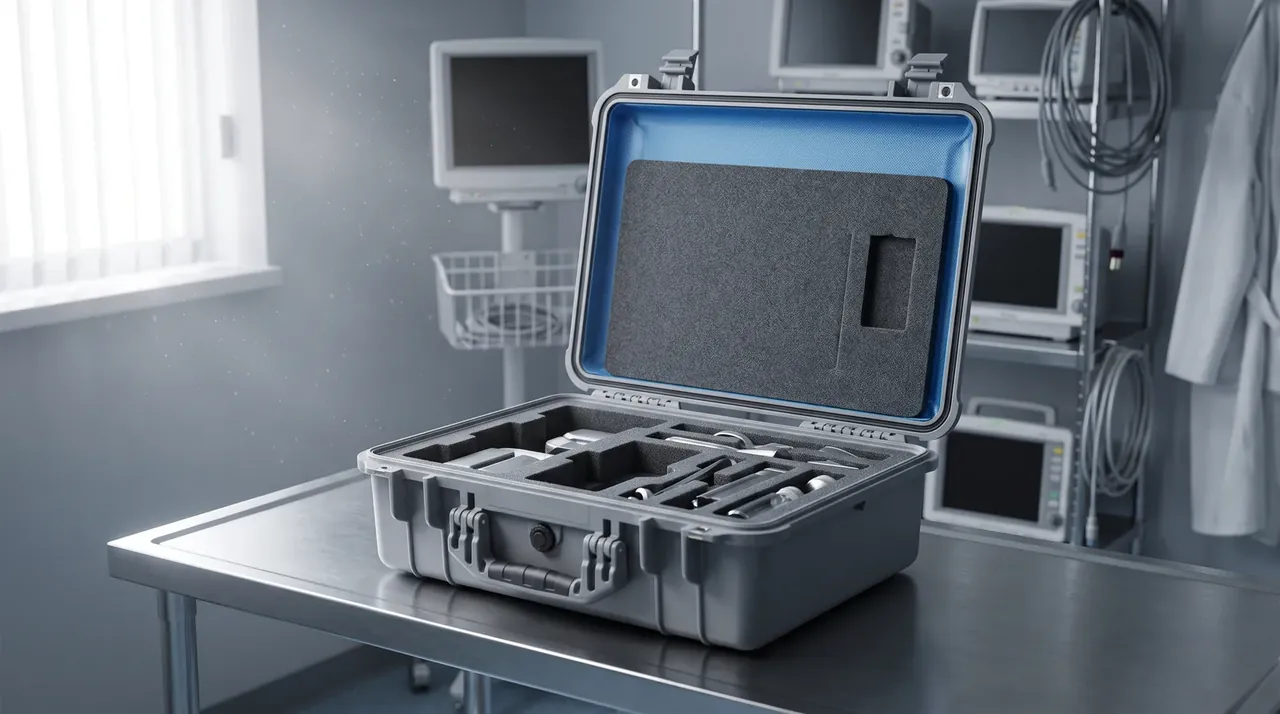
Quick answer: A pharma cleanroom case validation fixes two numbers: a 25 cm² swab template and a 4.0 μg/cm² residue limit, checked at 8 points over 3 batches.
Table of contents
- Running three validation batches
- Swab points and the 25 cm² template
- Turning 10 ppm into a surface limit
- Rotating IPA and hydrogen peroxide
- Four dead corners in the moulding
- FAQ
1. Running three validation batches
One 62 L pharma cleanroom case ran a batch on each of three filling lines. The first two kept all 8 swab points under 1.2 μg/cm²; the third returned 6.8 μg/cm² from the hinge groove. Same procedure, same swab lot, only a new cleaning crew.
The validation broke at the sampling point, not at the box: the cloth turns at the hinge and presses only on the lip of a groove 2 mm deep.
Repeats follow shifts: 1 swab after cleaning, 1 after 8 h of running, 1 before handover, 3 per batch. Eight points across 9 sets give 72 samples, and one out-of-limit result sends the batch back for a re-wipe.
| Batch | Swab sets | Hinge groove (μg/cm²) | Base corners (μg/cm²) | Verdict |
|---|---|---|---|---|
| First | 3 | 0.9 | 0.6 | Pass |
| Second | 3 | 1.1 | 0.8 | Pass |
| Third | 3 | 6.8 | 1.0 | Fail |
The gap matters more than the absolute value: one box, one set of motions, and a groove result 6 times the earlier runs, so the point is tested every batch.
2. Swab points and the 25 cm² template
Points are chosen where a cloth cannot reach and where residue sits longest. The 25 cm² template is a 50 mm × 50 mm stainless frame clamped to the inner wall, so only the framed area is wiped.
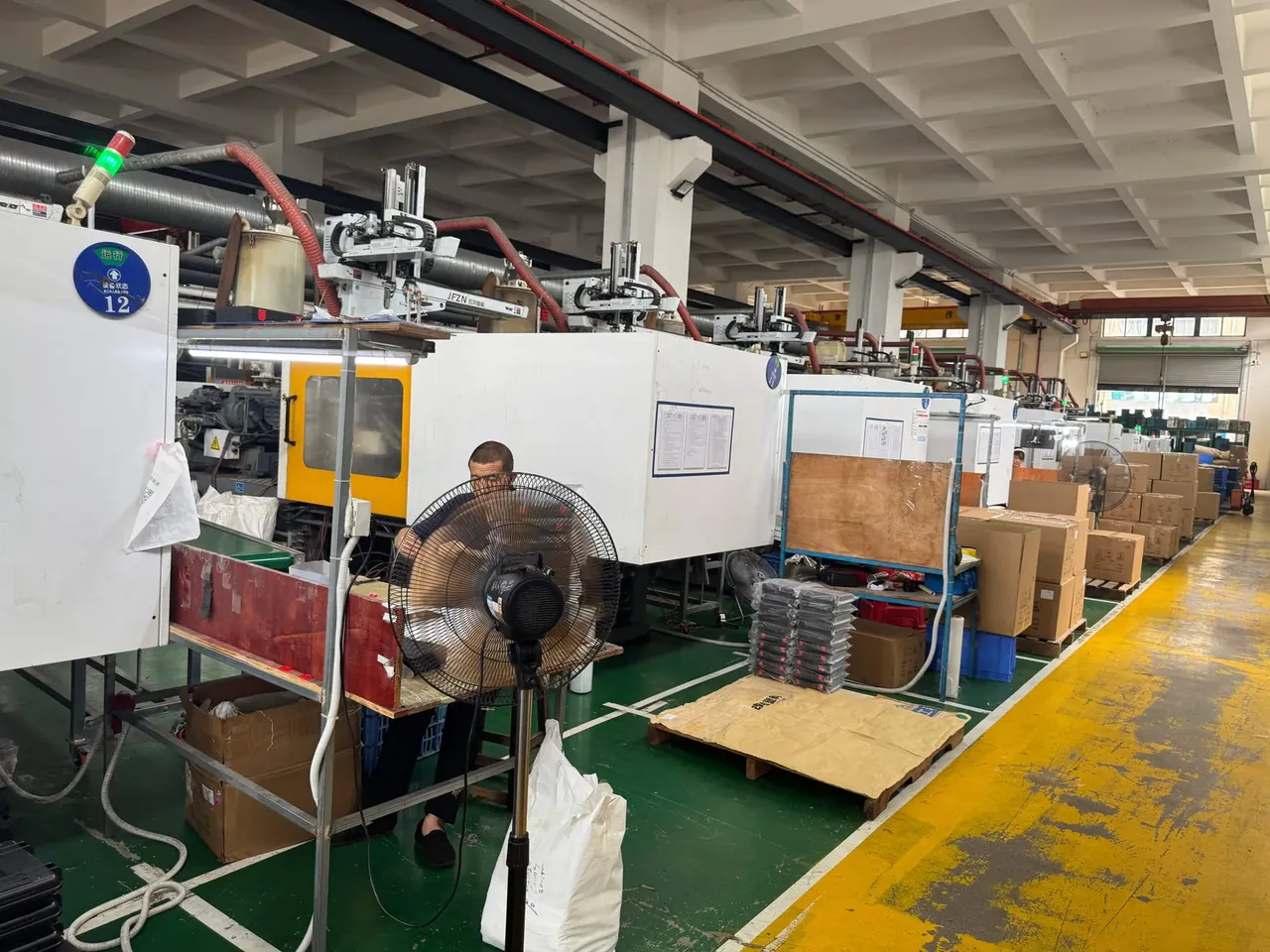
A 62 L pharma cleanroom case gets 8 points: four base corners at R3, hinge groove, latch seat root, gasket groove, lid insert edge, handle inner wall, label face and valve port. The first 3 are dead corners, the rest are flats and gaps.
Each point gets 3 strokes in one direction, a fresh swab face, 5 mL of solvent, and recovery above 80%. The cloth is folded polyester, 4 layers, 20 N, 5 cm/s.
The template normalises area: the same 0.4 mg reads 16 μg/cm² on 25 cm² but 4 μg/cm² on 100 cm². The run then goes from the dirtiest hinge groove to the flat base with no doubling back, so residue never travels to the next point.
3. Turning 10 ppm into a surface limit
Two routes give a limit and the stricter wins. At 10 ppm the next product's 80 kg batch allows 800 mg of carryover, and three filling lines expose 200,000 cm² of case surface, so 800 mg divided by that area gives 4.0 μg/cm² per point.
The dose route is looser: a 2 mg minimum daily dose, a 16 mg maximum downstream and a factor of 1000 yield 10 g, or 50 μg/cm². The routes differ 12-fold, so 4.0 μg/cm² governs.
| Criterion | Calculation | Result | Used |
|---|---|---|---|
| 10 ppm | 80 kg × 10 ppm ÷ 200,000 cm² | 4.0 μg/cm² | Yes |
| Dose | 2 mg × 80 kg ÷ (16 mg × 1000) ÷ 200,000 cm² | 50 μg/cm² | No |
| Visual | No visible residue | No number | Support |
An alert line sits at 60% of 4.0 μg/cm², so 2.4 μg/cm²: a point in between is re-wiped 3 times and re-swabbed, while anything above 4.0 fails the batch.
4. Rotating IPA and hydrogen peroxide
Cleaning uses 70% isopropyl alcohol, disinfection uses 6% hydrogen peroxide, rotated every 7 days, not for potency but to deny one agent selective pressure on the surface.
Contact time belongs in the procedure. IPA stays wet 30 s and flashes off in 15 s; peroxide needs 10 min, then a purified water rinse to remove the film its stabilisers leave.
Rotation ages the material, which validation has to measure. A PC inner wall wiped 200 times in IPA moves from Ra 0.6 μm to Ra 1.4 μm, past the 0.8 μm line. An EPDM gasket soaked 300 h in 6% peroxide gains 8 Shore A and holds residue in the groove.
IPA takes oil but not spores, peroxide kills spores but penetrates dried protein slowly, so the order follows the soil, 2 min apart. Four wipes a day means over 120 contacts a month, which puts gasket replacement near every 7 months.
5. Four dead corners in the moulding
Inner surfaces hold Ra 0.8 μm or better; an as-moulded face sits at Ra 1.6 to 3.2 μm and needs polishing, since halving roughness takes a 25 cm² point from 5 strokes to 3.
The structure must come apart. The hinge pin pulls out, the gasket lifts as one piece, the latch seat sits flush with no 0.5 mm step, and inner corners are R3 or larger, which drops a stock case from 12 dead corners to 3.
| Part | Original | Change | Residue risk |
|---|---|---|---|
| Hinge | Pin riveted, 2 mm groove | Pin removable, groove at R3 | High, failed in batch 3 |
| Gasket | Bonded | 3.2 mm groove, lifts out | Medium, traps residue |
| Latch seat | 0.6 mm proud | Flush insert | Low, step holds dust |
| Base corners | R1 near-square | R3 radius | Medium, cloth misses |
Material is fixed at validation, because a later change repeats all 3 batches. Body in PC or PP, both reaching Ra 0.8 μm; insert in closed-cell EVA that does not shed; gasket in EPDM; label on a flat face, never across a radius.
Conclusion
A pharma cleanroom case validation ends as a two-column table: 8 swab points on the left, their limits on the right. The limit is 10 ppm converted to 4.0 μg/cm², the alert line sits at 2.4 μg/cm², and 72 samples across 3 batches must land inside it. The 6.8 μg/cm² in the third batch hinge groove says one thing plainly: a failed validation usually means the point missed the end of the wipe path, not that the box was dirty. Draw the 8 points and ship the drawing with the case, and write Ra 0.8 μm, R3 corners and a removable pin into the purchase clause.
This article discusses container-side specifications and design implications only, and does not cover any handling, loading or use of the contents.
Related Reading
- Medical case series for clean areas
- Cleaning and sealing items in medical case standards
- Case bodies for cleanroom equipment
- Inserts and removable structures in instrument cases
Related Products
- 8 Series — Gun Cases; Military Equipment Cases; Camera Equipment Cases; Drone Cases; Watch Cases; Knife Cases; First Aid Cases; Electronics Equipment Cases
- WL8-2812 PP Gun Case — model WL8-2812
- All protective cases and toolboxes: 7 series, 158 models