

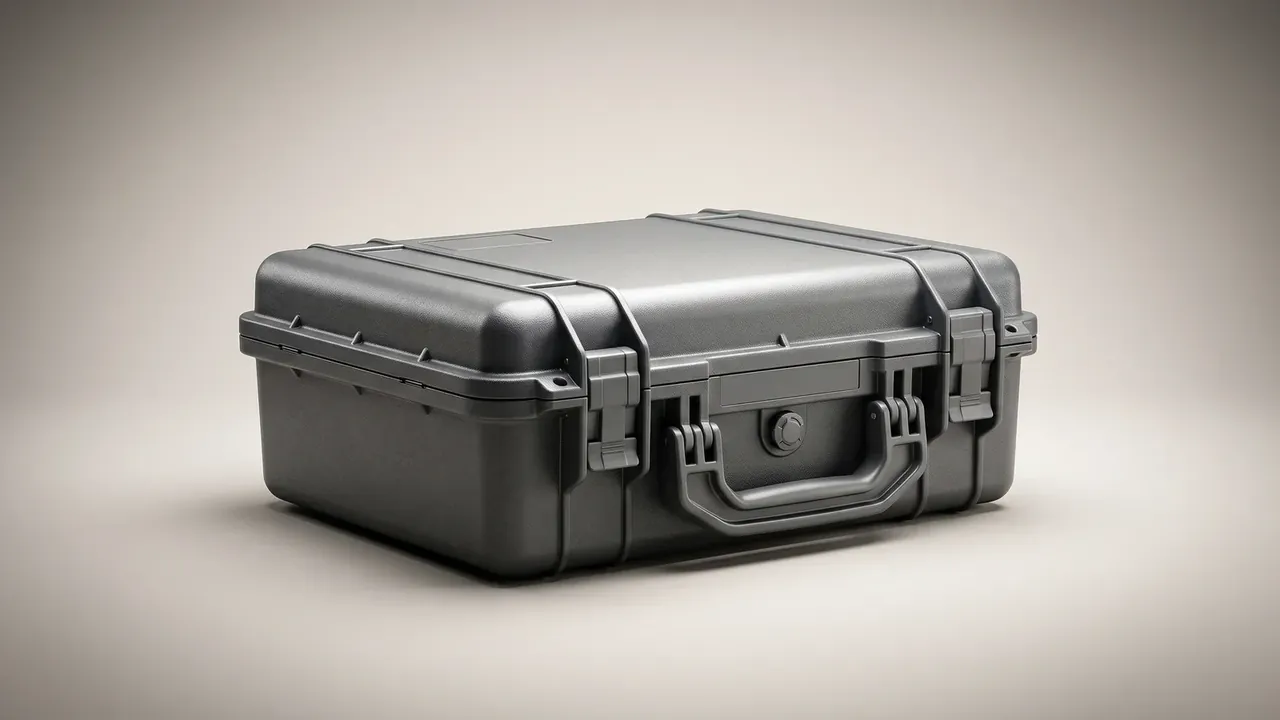
Quick answer: Specify a plastic protective case with custom foam from the payload outward: duty first, cavity from the part's three axes, cut tolerance next, density and thickness from drop energy, then six callouts on the insert drawing.
Table of contents
- Start With the Duty, Not the Box
- From Three Axes to a Net Cavity
- Cut Tolerance Adds Up in Three Places
- Density and Thickness From Drop Energy
- Six Lines on the Insert Drawing
- FAQ
1. Start With the Duty, Not the Box
A relay station in western Sichuan restocks spares each winter: -25°C in the van, 340 km one way with 42 km of broken stone, cases stacked two high, unloaded at a 1.1 m drop. Those conditions decide the specification of a plastic protective case with custom foam.
| Duty condition | Value | Specification it drives |
|---|---|---|
| Lowest temperature | -25°C | foam grade, cold margin |
| Load per case | 3 housings, 11.6 kg | cavity footprint, layers |
| Stacking | 2 high, equal weight | lid ribs, bearing surface |
| Handling drop | 1.1 m, six faces | base and lid thickness |
| Route | 340 km, 42 km stone | cut tolerance, anti-shift |
Temperature and road condition are the rows buyers skip; skip them and the sample feels right while the first trip shakes it loose.
2. From Three Axes to a Net Cavity
A plastic protective case with custom foam starts with the parts. Take three caliper readings per axis, keep the largest, and list every protrusion. The biggest sample measures 386×268×94 mm; a side connector adds 6 mm, so 392×274×94 mm enters the calculation.
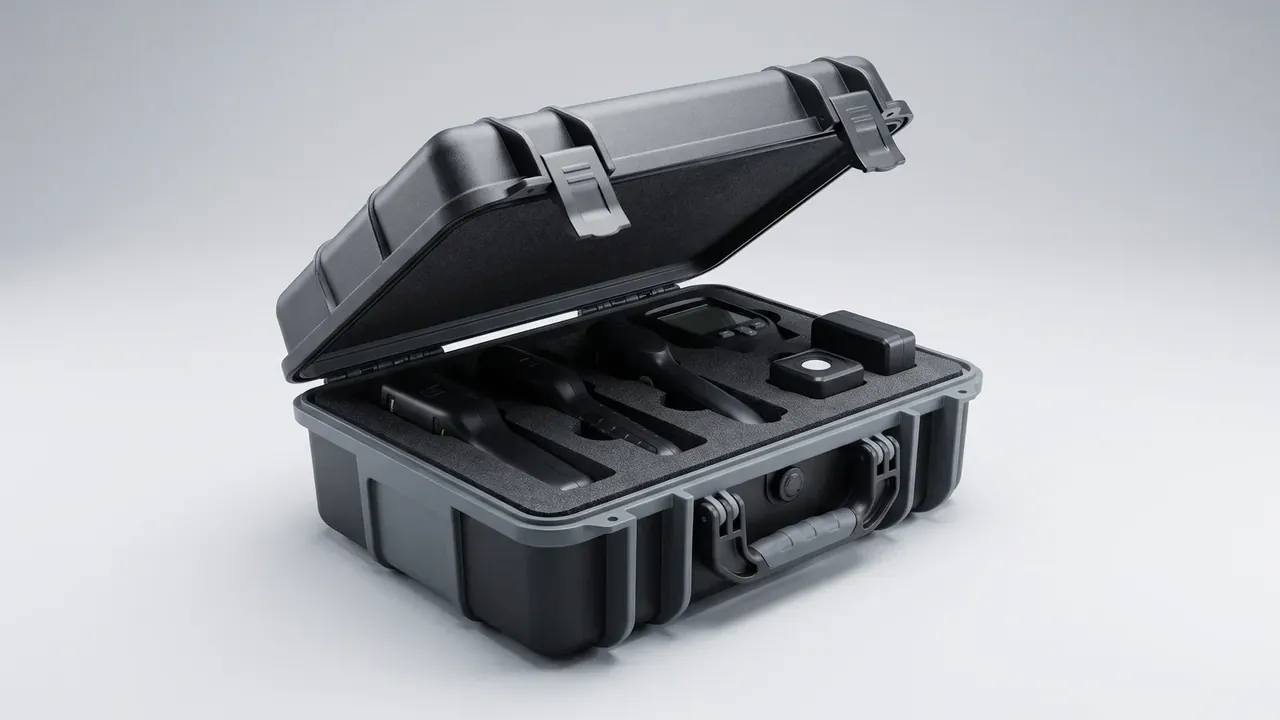
Side walls take 25 mm, the finger gap 15 mm, a 20 mm divider between two parts, so the footprint is 400×282 mm. Depth is four numbers: 28 mm base foam, the 94 mm part, 15 mm lid foam, 13 mm for fingers, totalling 150 mm.
With the cavity fixed the shell follows: a 2.8 mm wall plus 12 mm ribs lands the outside at 520×402×268 mm. At 2.2 mm the lid sags 2.6 mm under a two-high stack instead of 1.1 mm.
3. Cut Tolerance Adds Up in Three Places
A plastic protective case with custom foam never has one tolerance figure; another machine can move the same drawing by over 1 mm.
- CNC routing: a 6 mm cutter deflects 0.4 mm, so each wall loses 0.2 mm.
- Hot wire: 0.8 mm kerf, and the first 1 mm of edge hardens with handling.
- Die cutting: 0.3 mm blade clearance, but any pocket change needs a new die.
Then recovery: PE at 45 kg/m³ compressed 10 percent springs back about 1.2 percent, so a pocket needs 0.6 mm; at 25 kg/m³ recovery reaches 2.4 percent and the pocket sits loose.
The third source is the shell: PP shrinks 1.4 to 1.8 percent, 7 to 9 mm over 520 mm, and the cavity measures 3 mm under drawing. The working figure is ±0.8 mm per side, pocket width opened rather than closed: +0.8/−0 mm.
4. Density and Thickness From Drop Energy
A plastic protective case with custom foam cannot be judged on thickness alone. Dropping 11.6 kg from 1.1 m releases about 125 J, and holding peak acceleration under 40 g depends on density as much as depth: at 30 mm, PE at 25 kg/m³ bottoms out at 60 percent compression while 45 kg/m³ still has 12 mm of travel.
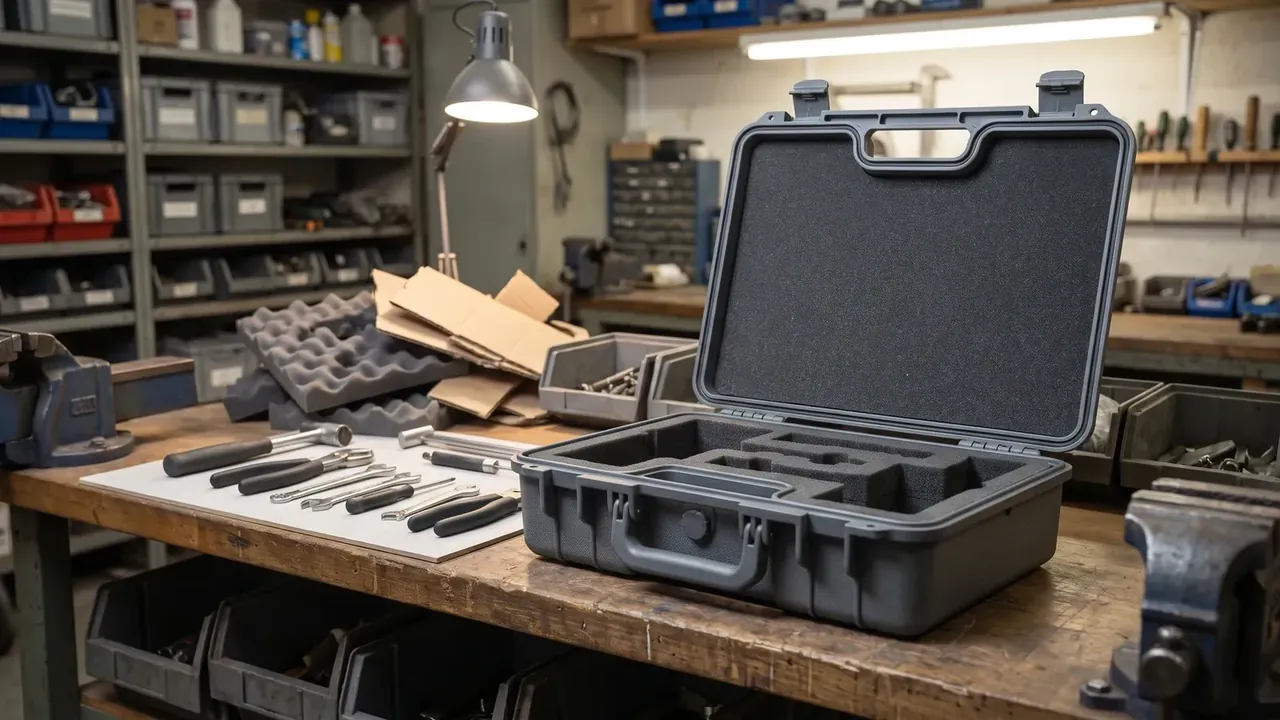
The 28 mm base takes the impact, the 25 mm walls control lateral movement, the 15 mm lid holds the top face. A thin base bottoms out; narrow walls let the part walk under braking.
| Foam | Density | Base thickness | Part weight | Compression set |
|---|---|---|---|---|
| PE | 25 kg/m³ | 35 mm | up to 3 kg | 6.5% |
| PE | 38 kg/m³ | 30 mm | 3–8 kg | 4.8% |
| PE | 45 kg/m³ | 28 mm | 8–15 kg | 3.9% |
| EVA | 60 kg/m³ | 20 mm | up to 6 kg | 2.1% |
The 11.6 kg build sits on the third row: 45 kg/m³, 28 mm base, the divider doubling as cushioning.
5. Six Lines on the Insert Drawing
A plastic protective case with custom foam fails on drawings that read vaguely. A machinist follows callouts; whatever is missing gets filled in from habit.
- Datum: cavity floor lower-left corner as origin, X, Y, Z marked.
- Pockets: length, width, depth, tolerance; width +0.8/−0 mm, depth ±1.0 mm.
- Material: 45 kg/m³ PE, grade named, 100×100×25 mm sample retained.
- Layers: 28 mm base, 25 mm walls, 15 mm lid, each shown in section.
- Radii: R3 at pocket floors, 2° draft so parts lift out without tearing.
- Acceptance: 3 first articles measured, 5 percent per batch, a 0.5 mm feeler that must not enter between foam and part.
Sampling adds compression, the height difference divided by original foam thickness, and anything outside 10 to 15 percent goes back as a batch.
Conclusion
A plastic protective case with custom foam is one directional chain: duty, cavity, cut tolerance, density and thickness, then six callouts on a drawing. Put the four steps into the RFQ and the reply becomes figures you can audit, which is how a plastic protective case with custom foam should be bought.
This article discusses only the container (case body) side of specifications and design intent, and does not cover any handling, loading or use of the contents.
Related Reading
- Custom foam insert specifications: thickness, compression and tolerance
- Heavy-duty protective case wall thickness and load ratings
- Magazine protective box pocket layout and specifications
- Large protective case cavity and transport specifications
Related Products
- 8 Series — Gun Cases; Military Equipment Cases; Camera Equipment Cases; Drone Cases; Watch Cases; Knife Cases; First Aid Cases; Electronics Equipment Cases
- WL8-2812 PP Gun Case — model WL8-2812
- All protective cases and toolboxes: 7 series, 158 models