

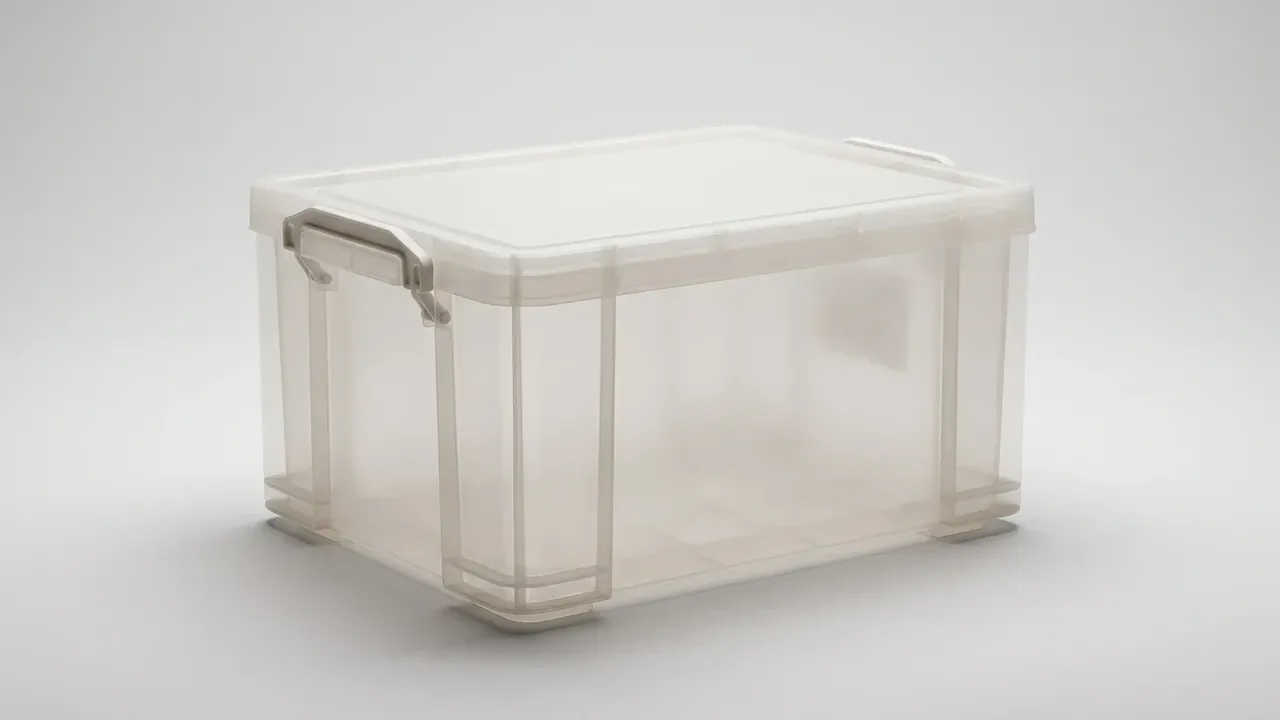
Quick answer: What keeps a plastic waterproof box dry comes down to three measurable things: water absorption of the resin, the dimensions of the lid overlap and seal groove, and the preload the latches apply. A thickness gauge, a look at the overlap and thirty minutes of spraying separate a good batch from a bad one.
Table of contents
- A plastic waterproof box on a rainy site
- Water absorption and wall thickness come first
- Lid overlap and drainage channel dimensions
- Latch preload and three-high stacking
- Seal retention after UV ageing
- Field checks and disposition of failures
- FAQ
1. A plastic waterproof box on a rainy site
In southern China in June, the yard outside the site store has no roof. Cases stand three high, the top lid facing the sky, 1.2 m off the ground. Rain fell at 80 to 110 mm per hour for three days, the yard flooded to 5 cm.
A chamber gives one fixed thirty-minute spray; a site gives seventy-two hours of rain and ground seepage.
| Site condition | Measured value | Demand on the case |
|---|---|---|
| Rain intensity | 80 to 110 mm per hour | No ponding, channel must drain |
| Duration | 72 hours, intermittent | Seal recovers after long compression |
| Standing water | 5 cm | No through-hole at feet or base |
| Stack height | 3 layers | Bottom lid carries the layers above |
The failure surfaced on the third evening: absorbent paper in six bottom cases was damp at the corners but not dripping. Only two paths do that, a seal face that never mated, or water drawn along the overlap joint by capillary action.
2. Water absorption and wall thickness come first
A plastic waterproof box is usually moulded from modified PP or HDPE, both below 0.01% absorption after 24 hours of immersion. At that level the resin stores almost nothing, so leaks start at joints and seal faces.
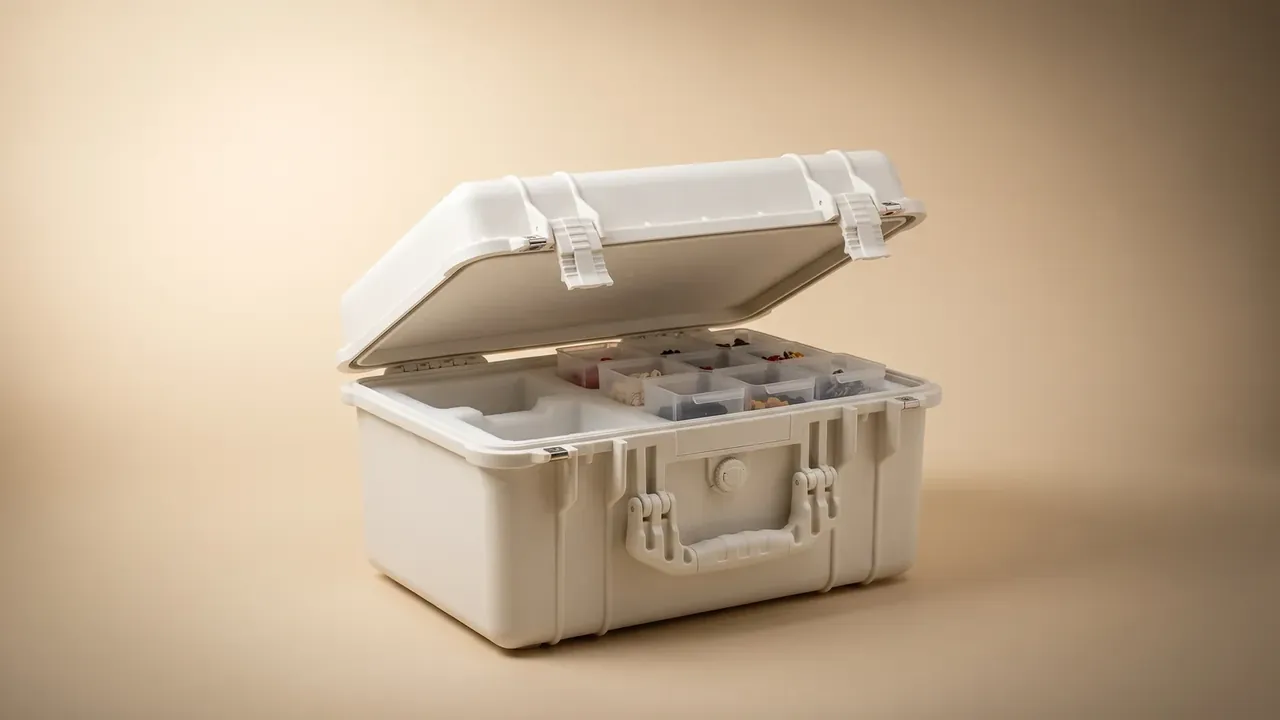
Below 2.5 mm at the side, the rim bulges once the case is three high and the seal face shifts out of line. Below 3.5 mm at the base, the floor dishes within a week under load. Sensible values are 2.5 to 3.0 mm at the side, 3.5 to 4.0 mm at the base, and 3.2 mm at the rim flange, which takes the latch pull.
| Resin | 24-hour absorption | Behaviour when wet | Verdict |
|---|---|---|---|
| Modified PP | below 0.01% | Stable, brittle when cold | Normal wet-season storage |
| HDPE | below 0.01% | Tough, slightly less stiff | Large sizes under load |
An ultrasonic gauge takes five readings per face and the lowest counts. A spread above 0.4 mm points to uneven packing or cooling.
3. Lid overlap and drainage channel dimensions
How the lid grips the body decides whether water reaches the seal. A flat joint leaks first. An overlap makes the skirt wrap down over the rim, so water must climb an 8 to 12 mm step.
The drainage channel is the second line: a ring 4 mm wide and 3 mm deep outside the rim, with two to four outlets. Runoff enters the channel and leaves through the outlets instead of filming across the seal.
The groove must match the gasket: 6.0 mm plus or minus 0.2 mm wide, 4.5 mm deep, with a 5.5 mm hollow gasket, landing at 25% to 30% compression.
- Overlap under 8 mm lets driven rain step over
- A channel without outlets is a reservoir
- A groove 1 mm too narrow extrudes the gasket
4. Latch preload and three-high stacking
A gasket seals only under pressure, and the latches supply it. Four evenly spaced along the long side is the minimum; above 600 mm, go to six. Opening force should read 60 to 90 N.

Bolted designs use M6 stainless fasteners at 2.3 to 2.8 N·m; above 3 N·m the plastic boss cracks.
Stacking is judged loaded: three layers, bottom case at ninety percent of rated load, 48 hours, then read the paper at the rim. Any colour change is a leak.
The load arrives from above, so the seal sees shear. Three layers dry means latch force, flange stiffness and compression work together.
5. Seal retention after UV ageing
Modified PP and HDPE are UV sensitive, so 0.3% to 0.6% hindered amine light stabiliser plus about 0.2% UV absorber is normal. After a year the difference shows at the gasket.
Ageing runs 1000 hours under xenon arc at 65 °C black panel and 0.51 W/m². Three readings decide: impact strength at 80% or better, gasket hardness within 5 Shore A, colour shift within ΔE 3.
A thousand hours is roughly one year outdoors in the south; the aged sample should go back through the spray test.
6. Field checks and disposition of failures
Incoming inspection needs no lab.
- Spray: 12 L per minute at 40 cm, three minutes per face
- Thickness: five points per face, minimum 2.5 mm
- Absorption: 50 mm coupon, 24 hours at 23 °C, under 0.01%
- Stacking: three layers, 48 hours, absorbent paper
- Pull: spring gauge to 60 N, 10 seconds
Disposition has three tiers. One failure means doubled sampling. Two more in the recheck and the batch drops to indoor use. A dimensional failure of overlap, channel or groove means rejection.
Conclusion
A plastic waterproof box survives a wet site because of three groups of numbers: absorption, overlap and groove dimensions, latch preload. Written into the acceptance clause and checked on site, they catch seepage before the goods reach the rack. That is what a plastic waterproof box standard really is.
This article discusses only the container (case body) side of specifications and design intent, and does not cover any handling, loading or use of the contents.
Related Reading
- Waterproof hard case standards: ratings and test conditions
- Airdrop case acceptance items and pass criteria
- Storage conditions for case moulds
- Inspection items for artillery shell case bodies
- Pallet and case marking acceptance rules
Related Products
- 8 Series — Gun Cases; Military Equipment Cases; Camera Equipment Cases; Drone Cases; Watch Cases; Knife Cases; First Aid Cases; Electronics Equipment Cases
- WL8-2812 PP Gun Case — model WL8-2812
- All protective cases and toolboxes: 7 series, 158 models