

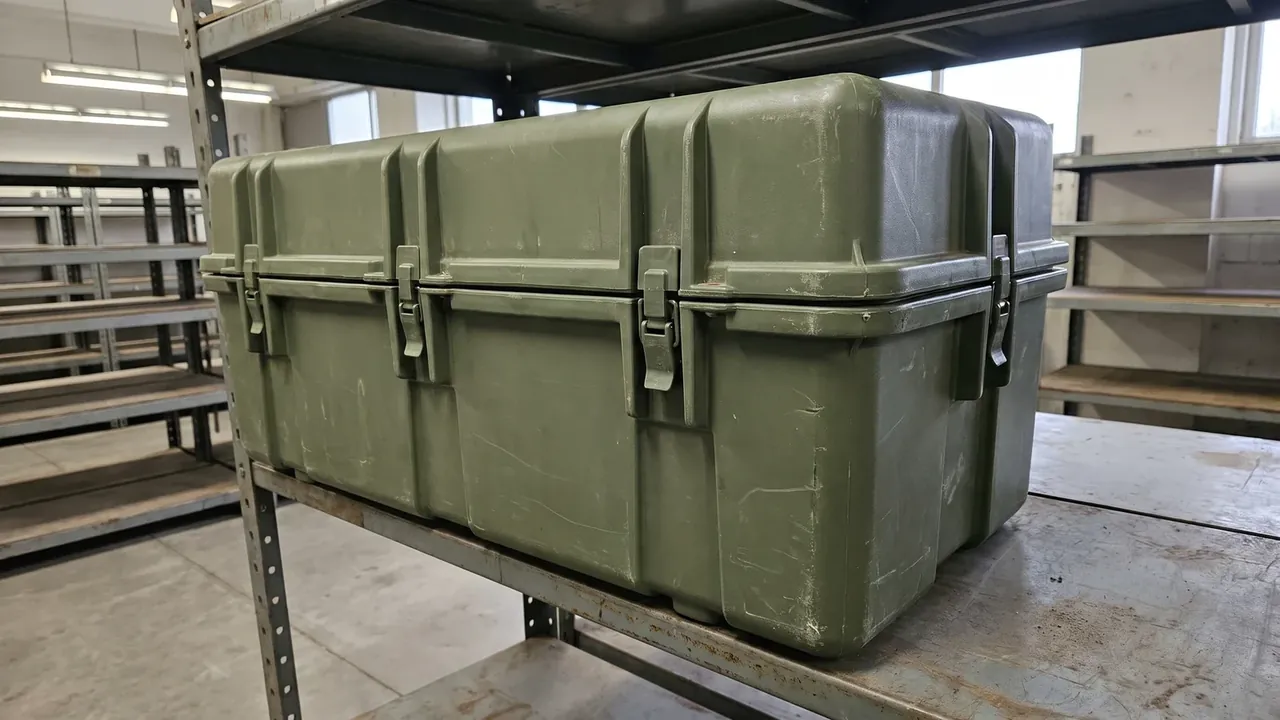
Quick answer: A PP Plastic Case is a polypropylene body and lid molded in one shot, usually 2.5 to 3.5 mm thick, with stiffness from ribs and sealing from a gasket groove at the rim. Three numbers decide the result: melt flow index, shrinkage and clamping force.
Table of contents
- What an injection-molded case actually is
- Four steps from pellet to finished case
- Where the three key numbers land
- Process window, tolerances and batch size
- FAQ
1. What an injection-molded case actually is
The mold opens, the body hangs on the moving half, and four ejector pins push it free at about 60 °C. Body and lid come from two cavity sets in one mold base, both polypropylene, both colored by 2% masterbatch.
The rim is the most expensive 6 mm of the part. A 1.5 mm groove runs inside a 6 mm flange, and a bead on the lid crushes the gasket shut. A 3 mm step sits outboard, so a dropped case lands on the step, not the seal. Side walls carry ribs every 90 mm, 8 mm at the root tapering to 4 mm at the crest.
Nominal wall runs 2.5 to 3.5 mm, with a base 0.5 mm thicker because the corners take the load. Past 4 mm the core cools too slowly, sink reaches the show face, and packing time grows by 20%.
| Stage | Setting | Typical value |
|---|---|---|
| Injection | Pressure | 90–130 MPa |
| Cooling | Mold temperature | 40–60 °C |
| Clamping | Force | 1600 t |
2. Four steps from pellet to finished case
Pellets pass through 80 °C air before the barrel. Polypropylene absorbs only 0.02% water, yet one streak of silver downgrades a large face. Regrind is capped at 20%; above that, impact loss outruns the resin saved.
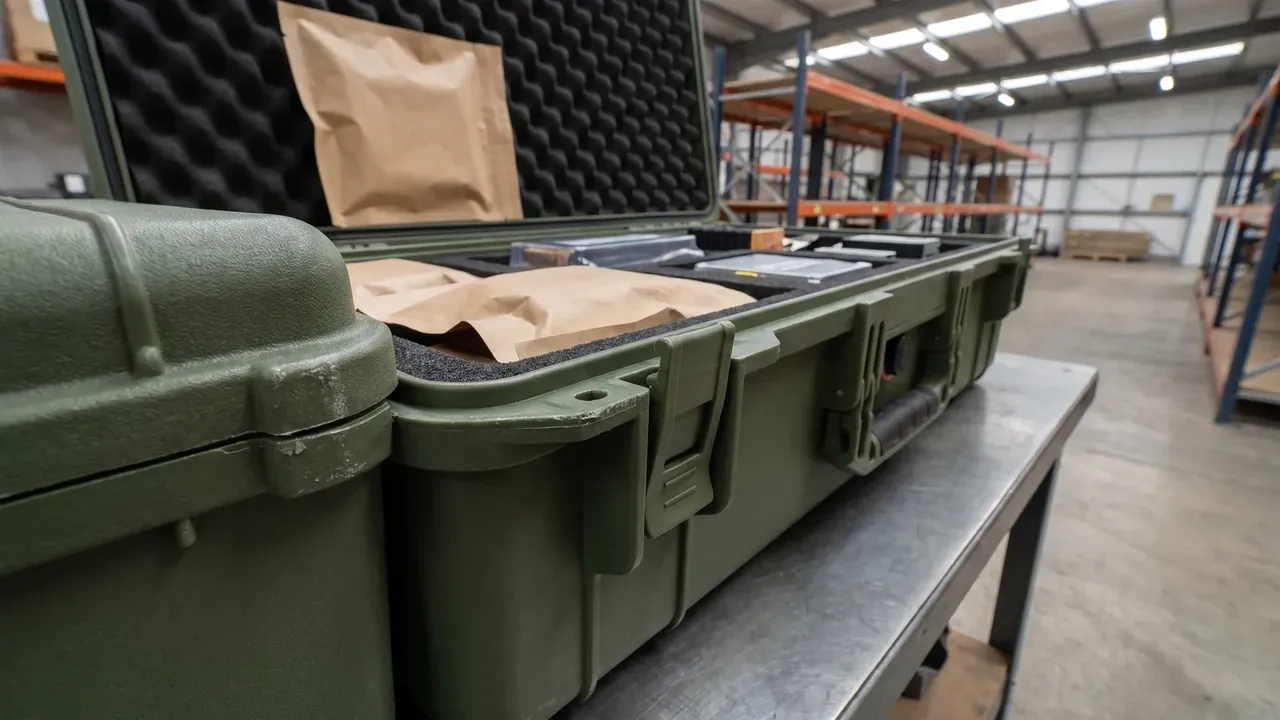
Molding is where the money shows. A 1600 t press closes and the melt travels 1.2 m at 130 MPa, reaching the far end with half the entry pressure. So the gate sits off-center in the base, holding the flow ratio under 200. Packing drops in three stages, the last at 30%, aimed at base sink. One cycle runs 165 s, 90 s of it cooling.
Trimming follows: air nippers cut the gate within 0.2 mm, and latches press in at 4 kN. The case is then charged to 30 kPa and isolated for 60 s; under 0.5 kPa lost passes, 1.5 kPa for vented versions.
3. Where the three key numbers land
Wall is the most expensive millimetre. Moving from 2.8 mm to 3.2 mm raises bending stiffness about 49% for 14% more weight and 9 CNY of resin. Dropping to 2.5 mm lets the lid dish 1.2 mm, and the seam leaks first.
Ribs stop at three times the wall; beyond that the far face sinks. Root radius is 1 mm and spacing stays above 60 mm.
Seal squeeze sits at 25% to 30%. Less leaks, more pushes closing force past 120 N. The assembled case is rated IP67, meaning 30 minutes at 1 m without ingress.
4. Process window, tolerances and batch size
Melt flow index sits between 8 and 25 g/10 min. A low index gives stiffness but cannot carry the flow; a high one fills the tool and gives up impact. Shrinkage splits by direction, 1.2% to 1.8%, plus 0.3% post-shrink over 30 days; miss it and the lid lands 3 mm off.
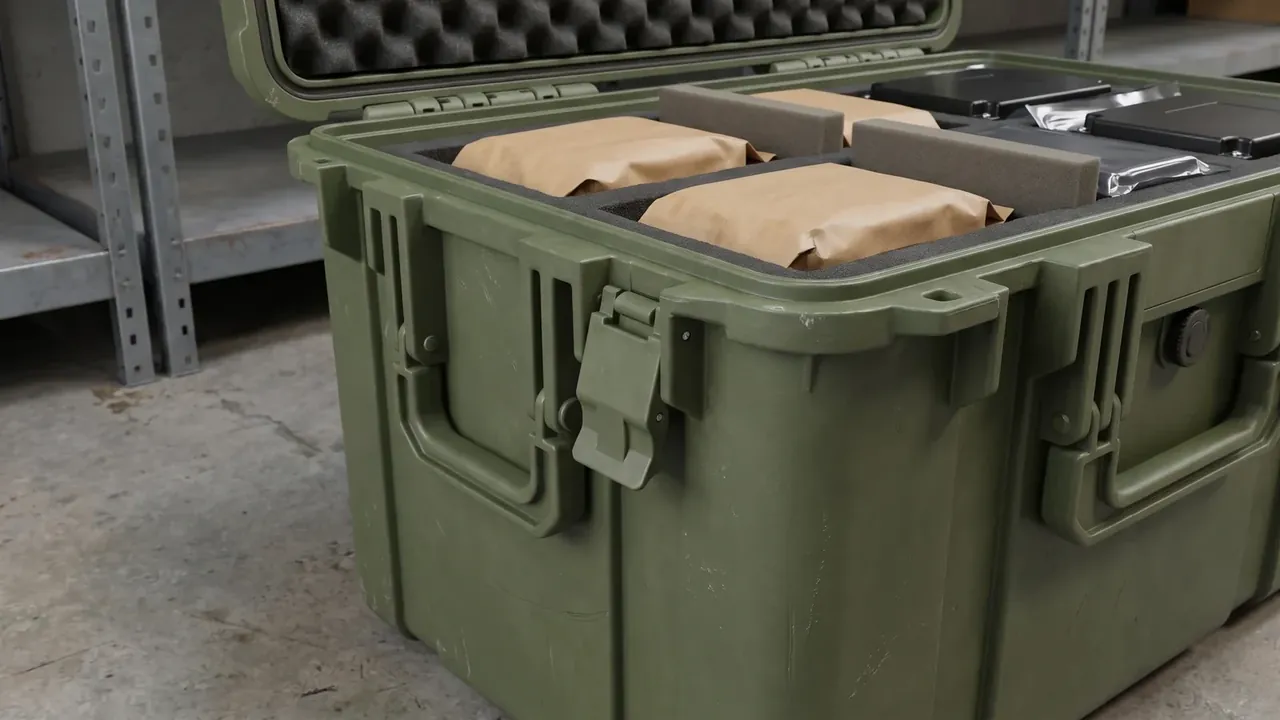
Tolerance follows size: ±0.3 mm at a 600 mm cavity, ±0.6 mm at 1.2 m, ±1 mm beyond. Batch size matters too, since a four-cavity tool spreads 0.2 mm between cavities.
A 46 kg case stacked five high puts 500 kg on the bottom unit, so the center lid rib must reach the rim; halt it halfway and the lid sags 4 mm in 72 hours.
Conclusion
Three places decide the outcome: wall for stiffness, ribs to carry it to the rim, and a groove holding the gap at 1.5 mm. Run body and lid from one base, split shrinkage at 1.6%, check post-shrink after 30 days. A PP Plastic Case is those numbers made physical.
This article discusses only the container (case body) side of specifications and design intent, and does not cover any handling, loading or use of the contents.
Related Reading
- Cavity and stacking design for transit cases
- Rim and hinge structure on equipment cases
- Molding tolerances for long instrument cases
- Sealing and cleanable surfaces on medical cases
Related Products
- 8 Series — Gun Cases; Military Equipment Cases; Camera Equipment Cases; Drone Cases; Watch Cases; Knife Cases; First Aid Cases; Electronics Equipment Cases
- WL8-2812 PP Gun Case — model WL8-2812
- All protective cases and toolboxes: 7 series, 158 models