

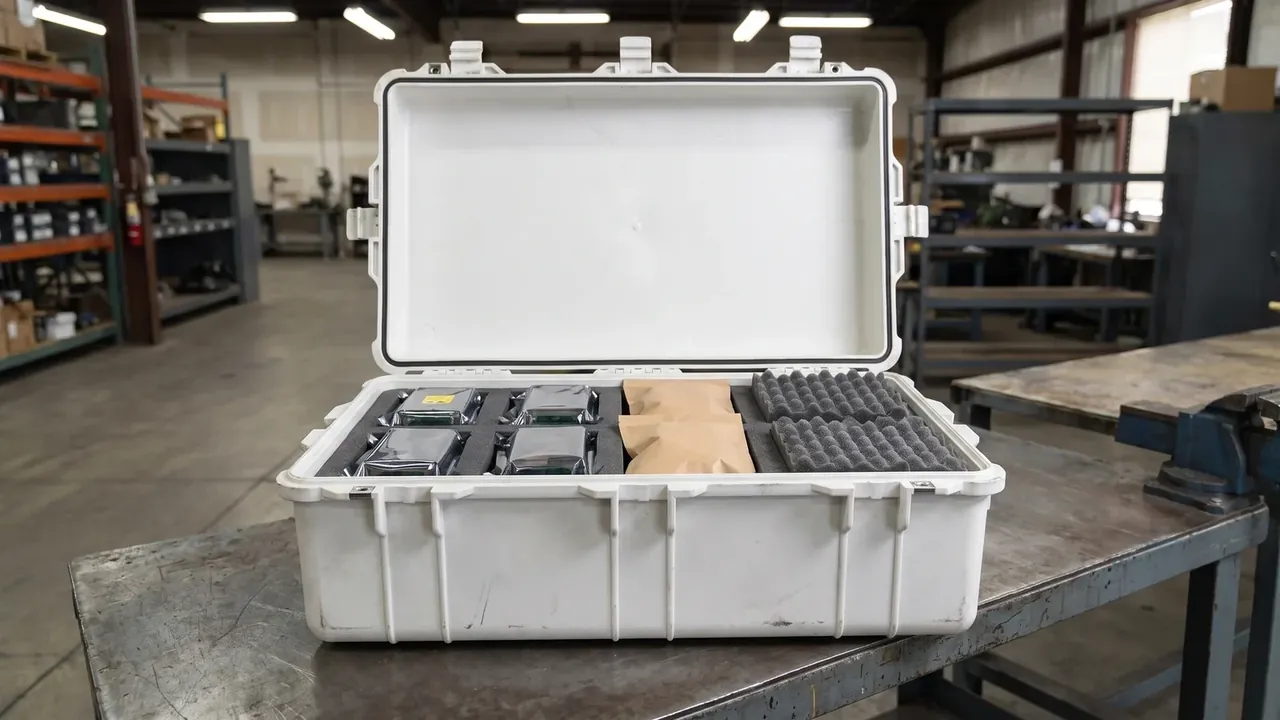
Quick answer: PP vs PE bodies split on one temperature line: HDPE keeps chain mobility to -120 °C, homopolymer PP freezes near 0 °C, and -20 °C costs PP 3.2 kJ/m². Above that line PP wins on stiffness at 1.3–1.6 GPa against 0.9–1.1 GPa, and mass, shrinkage and oven temperature follow the choice.
Table of contents
- Where the two materials part
- Stiffness: flexural modulus and lid sag
- Cold: drop hammer and brittleness
- Process: oven temperature and warp
- Cost and a three-tier screen
- FAQ
1. Where PP vs PE bodies diverge
PP vs PE bodies splits first on crystallinity: HDPE reaches 70%–90% and 0.94–0.96 g/cm³, homopolymer PP 50%–60% and 0.90–0.91 g/cm³. On a 48 L case with 3 mm walls that gap is 6.4 kg against 5.9 kg, or 7.8%.
The glass transition is the second line. HDPE sits near -120 °C, so its segments still move at -40 °C and absorb impact by yielding. Homopolymer PP sits near 0 °C, so by -20 °C it has only crazing and cracking, and notched impact falls from 8 to 3.2 kJ/m².
Copolymer PP is the third route: 5%–8% ethylene pushes the rubber phase below -50 °C and holds 26 kJ/m² at -20 °C, costing flexural modulus, 1.1–1.4 GPa against 1.6 GPa.
| Property | HDPE | PP homopolymer | PP copolymer |
|---|---|---|---|
| Density g/cm³ | 0.94–0.96 | 0.90–0.91 | 0.90–0.91 |
| Glass transition °C | -120 | 0 | rubber -50 |
| Flexural modulus GPa | 0.9–1.1 | 1.3–1.6 | 1.1–1.4 |
| Impact 23 °C kJ/m² | 12, no break | 8 | 45 |
| Impact -20 °C kJ/m² | 9 | 3.2 | 26 |
| Shrinkage % | 1.5–3.0 | 1.2–2.0 | 1.3–2.1 |
Impact values follow GB/T 1843 on 1eA bars and do not convert to ASTM D256 J/m; read the temperature row first.
2. Stiffness: flexural modulus and lid sag
Flexural modulus to GB/T 9341 sets sag. A 600 mm × 400 mm cover with 3 mm walls, carrying 60 kg spread evenly at 25 °C, sags 3.8 mm in HDPE and 2.6 mm in PP.
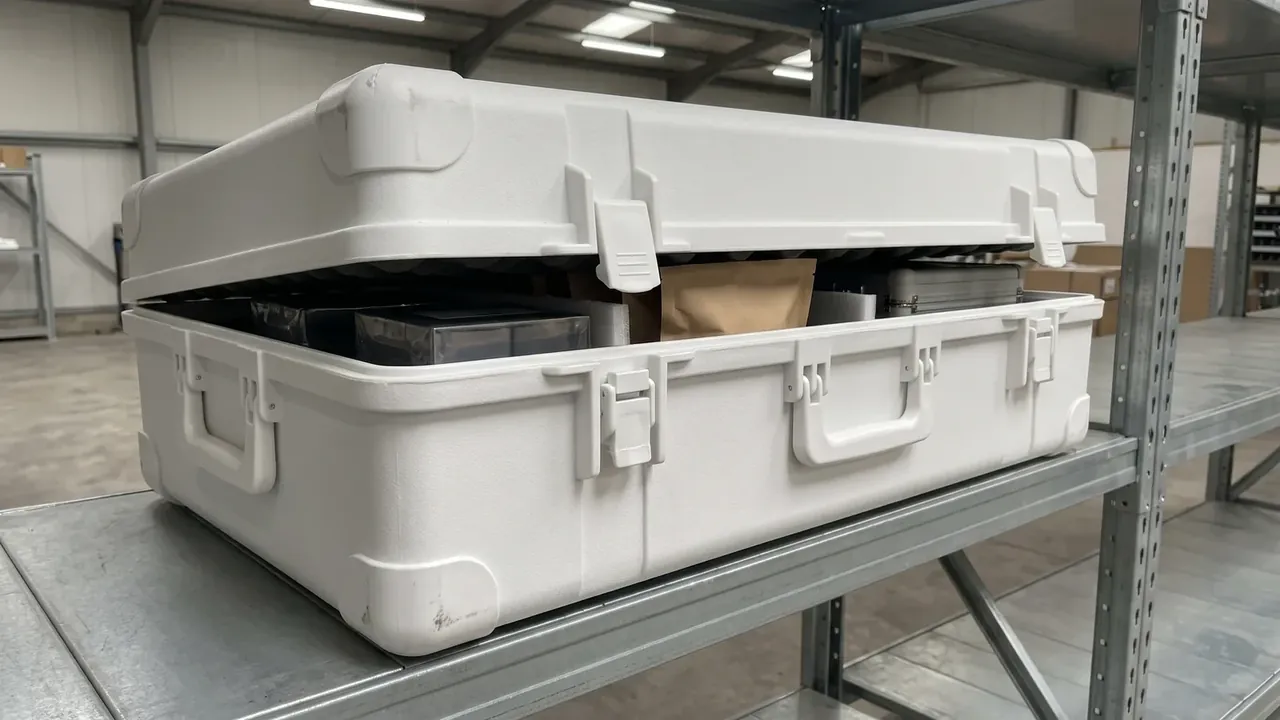
Thicker walls buy stiffness back: 4 mm takes HDPE to 1.6 mm but adds 1.4 kg and 13 CNY, while PP reaches 1.1 mm for 1.3 kg more.
Long loads are a creep question. At 40 °C with 20 kg for 24 h, HDPE deflects 4.6 mm and PP 3.0 mm; two hours after unloading HDPE recovers 62% and PP 78%.
Ribs behave differently in PP vs PE bodies. HDPE ribs at 3× wall height and 0.6× wall thickness recover about 35% of stiffness; PP is stiff enough that dense ribs mainly leave 0.15 mm sink marks at the roots.
3. Cold: drop hammer and brittleness
Cold performance is a drop-hammer question. A 5 kg head from 1 m onto a corner after 4 h at -40 °C leaves HDPE dented 9 mm with no penetration and a whitened edge; homopolymer PP splits in two with no stress whitening; copolymer PP cracks 12 mm. Brittleness temperature traces that line: below -70 °C for HDPE, -5 °C for homopolymer PP, -25 °C for copolymer PP. A -30 °C spec leaves homopolymer PP no margin, copolymer PP 5 K. PP vs PE bodies also fail in different places. Corners at R8 carry a stress concentration near 2.4 and latch post roots near 3.1; HDPE yields locally at -40 °C, while homopolymer PP cracks and runs 40 mm along a weld line.
4. Process: oven temperature and warp
Oven temperature follows melting point: homopolymer PP melts at 160–166 °C and runs at 230–260 °C for 22–28 min, HDPE at 260–290 °C for 18–22 min. PP sinters more slowly, so cycles run 5 min longer and output drops 12%.
Shrinkage sets the cavity in PP vs PE bodies: 1.2%–2.0% for PP against 1.5%–3.0% for HDPE, so a 420 mm body is cut at 426.7 mm and 429.2 mm. Annealing at 80 °C for 2 h recovers 0.3% in HDPE and 0.1% in PP.
Warp runs in different directions. PP drifts to 1.5 mm flatness over 500 mm, forcing a 2 mm joint allowance; balanced cooling within 8 °C pulls HDPE back to 0.8 mm.
Powder follows the resin: PP needs 35 mesh and a 4 mm mould, HDPE a 3 mm mould and 15% less tooling cost.
5. Cost and a three-tier screen
Material runs 9.2 CNY/kg for HDPE and 10.8 CNY/kg for copolymer PP. The 6.4 kg HDPE body carries 59 CNY of compound against 64 CNY for the 5.9 kg PP body, and 5 min more in the mould adds 7 CNY, so landed cost differs by 12 CNY.
| Item | HDPE body | PP copolymer body |
|---|---|---|
| Case mass kg | 6.4 | 5.9 |
| Compound cost CNY | 59 | 64 |
| Mould time min | 20 | 25 |
| −40 °C drop | dent, no split | 12 mm crack |
Screen PP vs PE bodies on minimum service temperature rather than on resin names.
| Minimum service temp | Resin | Wall mm | Governing check |
|---|---|---|---|
| Below -30 °C | HDPE | 3.0–3.5 | drop and brittleness |
| -30 to -10 °C | PP copolymer, 5%–8% ethylene | 2.5–3.0 | impact versus modulus |
| Room temperature | PP homo or copolymer | 2.2–2.8 | lid sag and finish |
Two items get missed: a cracked HDPE body hot-gas welds to 70% of parent strength, while a split PP shell cannot be repaired; at 30% regrind, -20 °C impact drops 18% in HDPE and 15% in PP.
Conclusion
The choice between PP vs PE bodies comes down to the lowest temperature the case will meet, not to which polymer is better. Below -30 °C, HDPE buys margin through ductile tearing. From -30 to -10 °C, copolymer PP holds 26 kJ/m² with most of its stiffness. At room temperature, homopolymer PP wins on 1.6 GPa and 2.6 mm sag. After that, three numbers decide: 7.8% of mass, 2.5 mm of cavity, 7 CNY of cycle time. JUNZHIJIA quotes wall, rib height and grade as one package so the drop result can be checked.
This article discusses only the container (case body) side of specifications and design intent, and does not cover any handling, loading or use of the contents.
Related Reading
- ABS versus PP case bodies in cold weather
- HDPE protective case selection guide
- Case raw material comparison
- Wall thickness versus strength
Related Products
- 8 Series — Gun Cases; Military Equipment Cases; Camera Equipment Cases; Drone Cases; Watch Cases; Knife Cases; First Aid Cases; Electronics Equipment Cases
- WL8-2812 PP Gun Case — model WL8-2812
- All protective cases and toolboxes: 7 series, 158 models