

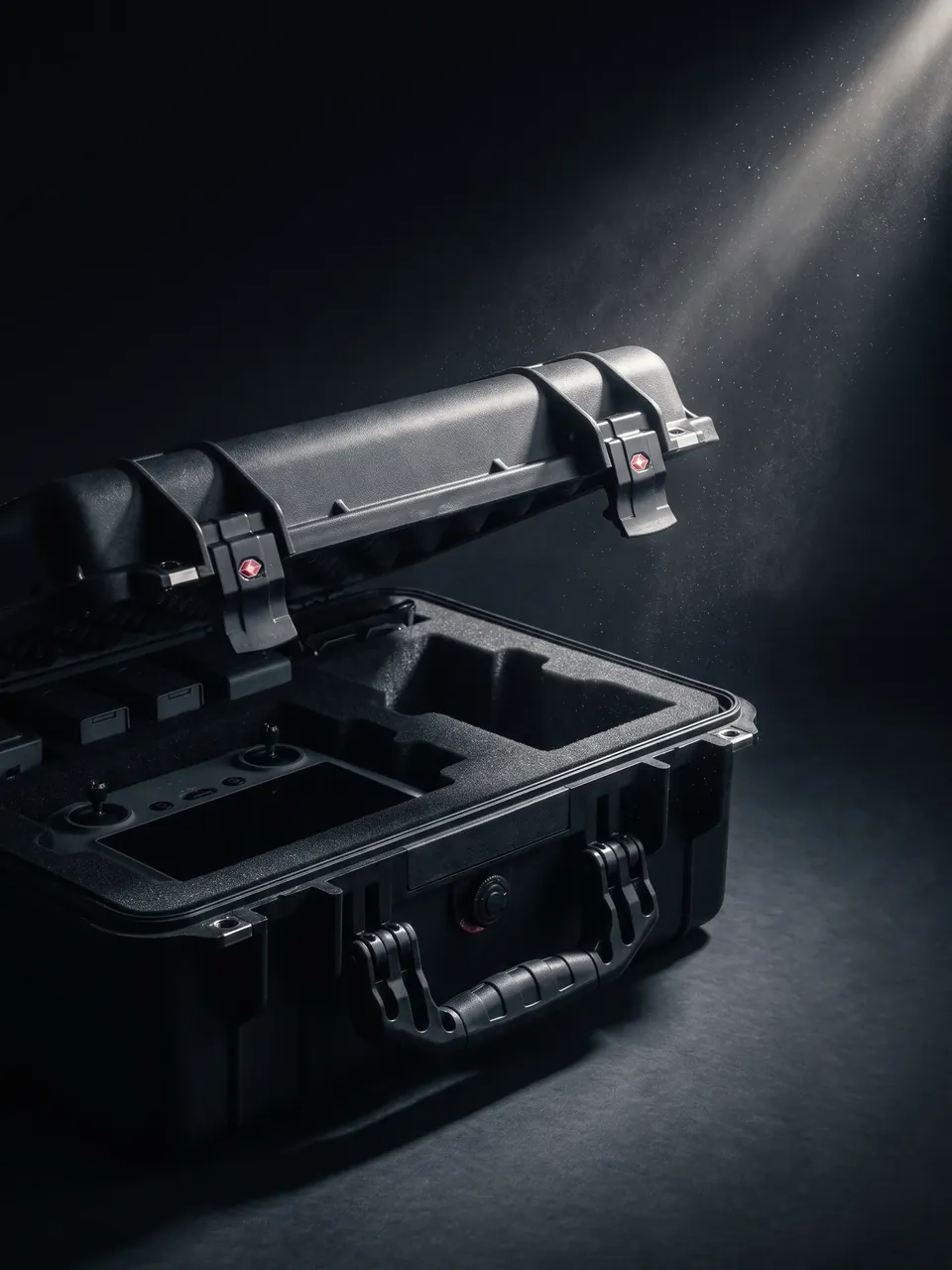
Quick answer: A Professional drone combo multi-battery hard case holds drift under 0.35 mm after 20 cycles from −20 °C to 55 °C, measured on 2.8 mm divider walls.
Table of contents
- Divider wall thickness of the Professional drone combo multi-battery hard case
- The step drop inside the lid
- Spacing readings after thermal cycles
- Cell-position retention in the drop recheck
- Wall-thickness scrap limit for multi-battery batches
- FAQ
1. Divider wall thickness of the Professional drone combo multi-battery hard case
The Professional drone combo multi-battery hard case is moulded to a 560×400×230 mm outer envelope and a 495×340×165 mm inner cavity, with the shell held at a uniform 4.0 mm. Seven bays are cut by six dividers injected in the same shot as the base, each with its own 2.8 mm wall.
2.8 mm is a floor reached after repeated trials: at 2.4 mm a wall bows toward the neighbouring bay in the 55 °C segment and eats into clear width, while at 3.2 mm the root junction piles up material, cools slowly and pulls a sink mark that tilts the spacing datum. JUNZHIJIA takes three readings up each wall on the first article and releases only inside a 0.12 mm spread. The 5.3 kg empty weight is the first witness the Professional drone combo multi-battery hard case has drifted; a reading 0.15 kg off halts the line, and the 11 kg load is spread across four side walls and base ribs, never onto the dividers.
| Wall grade | Root sink mark | Clear-width verdict |
|---|---|---|
| 2.4 mm | none | bows when hot, width lost |
| 2.8 mm | none | drift within 0.35 mm after 20 cycles |
| 3.2 mm | visible | datum tilted, scrap |
2. The step drop inside the lid
Inside the lid of the Professional drone combo multi-battery hard case, an 11 mm limiting step above each divider presses the wall tops down once closed and locks all six vertically. Mould shrinkage leaves the real drop 0.1–0.2 mm short of the steel, so the tool is cut at 11.15 mm and the allowance stays in the steel rather than being shimmed at assembly.
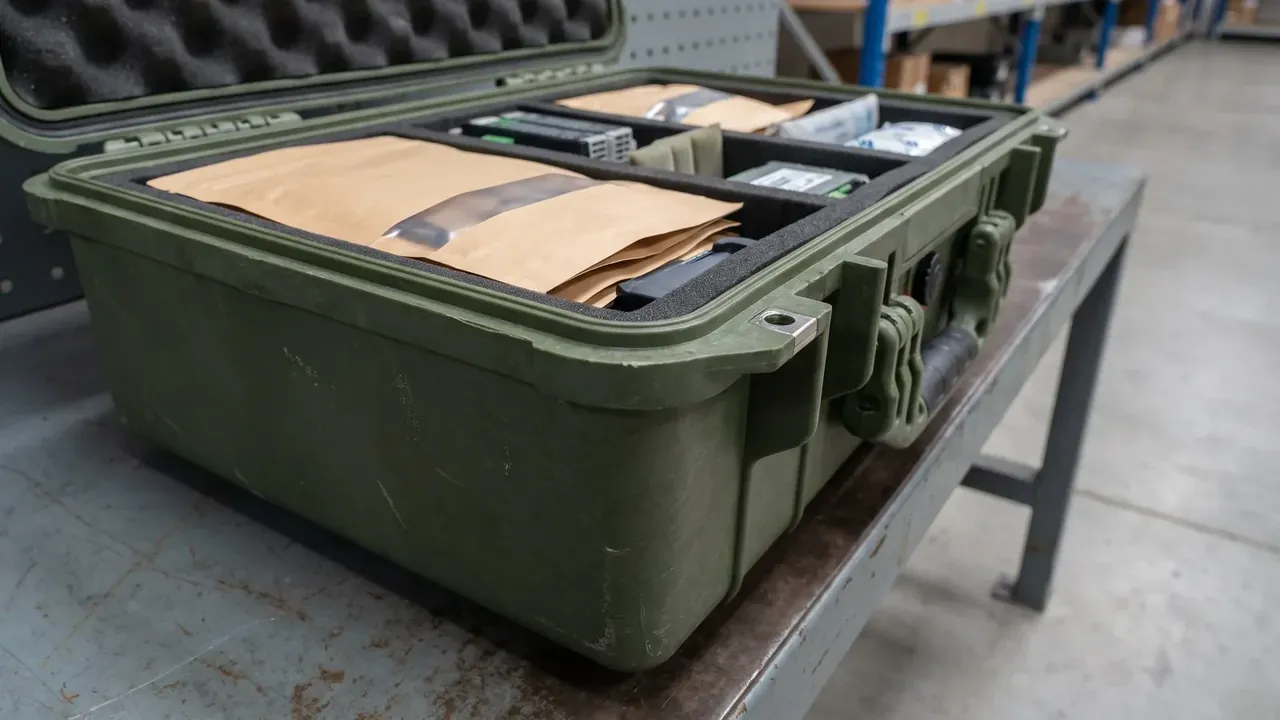
Too little drop leaves a gap that lets a divider rock about its root and scatter the spacing readings; too much stops the lid short of seating, so the two latches cannot finish travel and the gasket never reaches 20 % compression. A depth gauge at the four corners must read 10.95–11.05 mm to pass.
3. Spacing readings after thermal cycles
The Professional drone combo multi-battery hard case runs −20 °C to 55 °C for 20 cycles with a 1 h soak at each segment, excluding transfer time. Clear width between adjacent dividers is taken at the top edge and the root, logged bay by bay to 0.01 mm on a digital caliper; first and last readings are subtracted after 20 cycles to give drift, accepted at 0.35 mm or less.
Drift does not arrive in one step: residual stress bleeds off over the first five cycles, then the curve flattens from the tenth, so closure depends on the last ten cycles' slope rather than the total.
| Thermal cycle | High-segment gain | Cumulative drift |
|---|---|---|
| Cycle 1 | datum | 0 mm |
| Cycle 10 | +0.14 mm | 0.14 mm |
| Cycle 20 | +0.30 mm | 0.30 mm |
4. Cell-position retention in the drop recheck
A sample clearing thermal cycling takes a 1.0 m six-face drop closed with 11 kg ballast and both latches, touching base, lid and all four edges once; dividers are not re-adjusted, and width is measured straight away to see whether impact reopened the flattened spacing. The Professional drone combo multi-battery hard case gets one orientation sequence only — a repeat would whiten the root fillet first and the reading would reflect damage rather than springback.
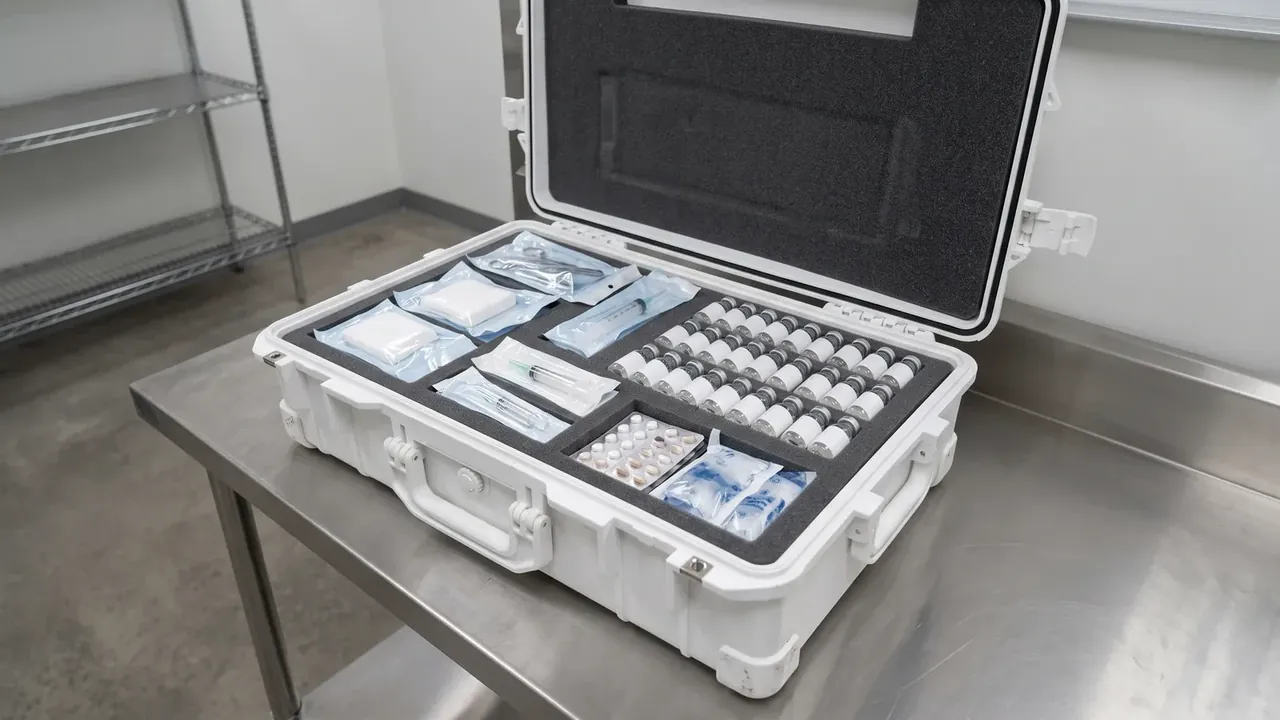
Two features hold attention: whether the root fillet whitened and whether the step impression shifted to one side. Even inside 0.35 mm, a shifted impression means restraint came from friction rather than step location, so the sample is rejected; a scribed datum line on the step face shows the shift. A 4500-cycle open-close run follows the drop on the Professional drone combo multi-battery hard case, with step drop measured every 500 cycles and any fall below 10.90 mm logged, because wear returns the vertical gap and a flattened spacing can scatter again.
| Drift value | After thermal cycling | After drop recheck |
|---|---|---|
| ≤0.25 mm | closes firmly | still closed |
| 0.25–0.35 mm | acceptance edge | check the impression |
| >0.35 mm | scrap | does not enter recheck |
5. Wall-thickness scrap limit for multi-battery batches
Stacking four readings, the Professional drone combo multi-battery hard case sets its scrap limit at three points: a wall spread above 0.12 mm, a step drop more than 0.10 mm off 11 mm, or drift above 0.35 mm after 20 cycles. Any one sends the batch back to the tool rather than being selected into compliance. Selective pairing can pass one case, yet carries the same mould bias into the next batch. Scrap is judged by batch, not by piece: the six dividers from one slide set are judged together, and one out-of-line wall sends all six from that shot back, since the fault is slide position rather than a single cavity.
JUNZHIJIA writes wall thickness, step drop and 20-cycle drift on one release-sheet line. One gasket sits in the lid groove at 20 % compression with groove depth back-calculated from cord diameter, and spray and dust run in the IP65 test order while the case only records whether the lid admitted water or dust, with no certificate number or grade conclusion.
Conclusion
The bay stability of a Professional drone combo multi-battery hard case starts at a 2.8 mm divider wall and an 11 mm limiting step, and lands on drift of 0.35 mm or less after 20 cycles from −20 °C to 55 °C. A 1.0 m drop recheck, 4500 open-close cycles and one gasket at 20 % compression close that chain across a batch. Writing wall thickness, step drop and drift on one release line is what makes multi-battery consistency reproducible.
Related Reading
- Drone battery case bay dimension chain
- Drone accessory case dividers and foam layout
- Drone carry case handle and latch details
- Battery safety case selection by wall and foam
Related Products
- 8 Series — Gun Cases; Military Equipment Cases; Camera Equipment Cases; Drone Cases; Watch Cases; Knife Cases; First Aid Cases; Electronics Equipment Cases
- WL8-2812 PP Gun Case — model WL8-2812
- All protective cases and toolboxes: 7 series, 158 models