


Quick answer: On one mold, a recycled content case at 30% keeps 39 MPa against 42 MPa virgin, while 100% recycled drops to 33 MPa with wider scatter.
Table of contents
- Where 30% and 100% Diverge
- Mechanical Loss in Tensile and Drop Impact
- Batch Consistency: Melt Index and Tolerance
- Odor and Appearance: Specks and Haze
- Traceability and Claim Wording
- FAQ
1. Where 30% and 100% Diverge
Same mold, same press, same holding profile, and the wall still moves 0.2 mm when the resin changes. A 30% recycled content case measured 2.38 to 2.52 mm on the side wall, virgin ran 2.44 to 2.56 mm, and full recycled spread 2.30 to 2.62 mm. A caliper settles it faster than a datasheet: the issue is not wall thickness but wall evenness.
Shrinkage explains the spread: virgin ABS molds at 0.4% to 0.7%, the 30% blend at 0.55% to 0.85%, full recycled at 0.7% to 1.1%, so a 420 mm cavity cut for 0.55% comes out 1.3 mm short on all-recycled resin and the lid joint misaligns.
Weld lines explain the rest. Recycled chains have already been cut once, so weld-line tensile strength holds 82% on virgin, 71% at 30% and 55% at full recycled. With the gate mid-way along the long side, those lines sit either side of the handle boss, the worst place to lose strength.
2. Mechanical Loss in Tensile and Drop Impact
Tensile loss is predictable: 42 MPa yields on virgin, 39 MPa at 30%, down 7%, and 33 MPa at full recycled, down 21%. At 2.5 mm nominal wall the safety factor still comes to 2.1 for a 3 kg case.
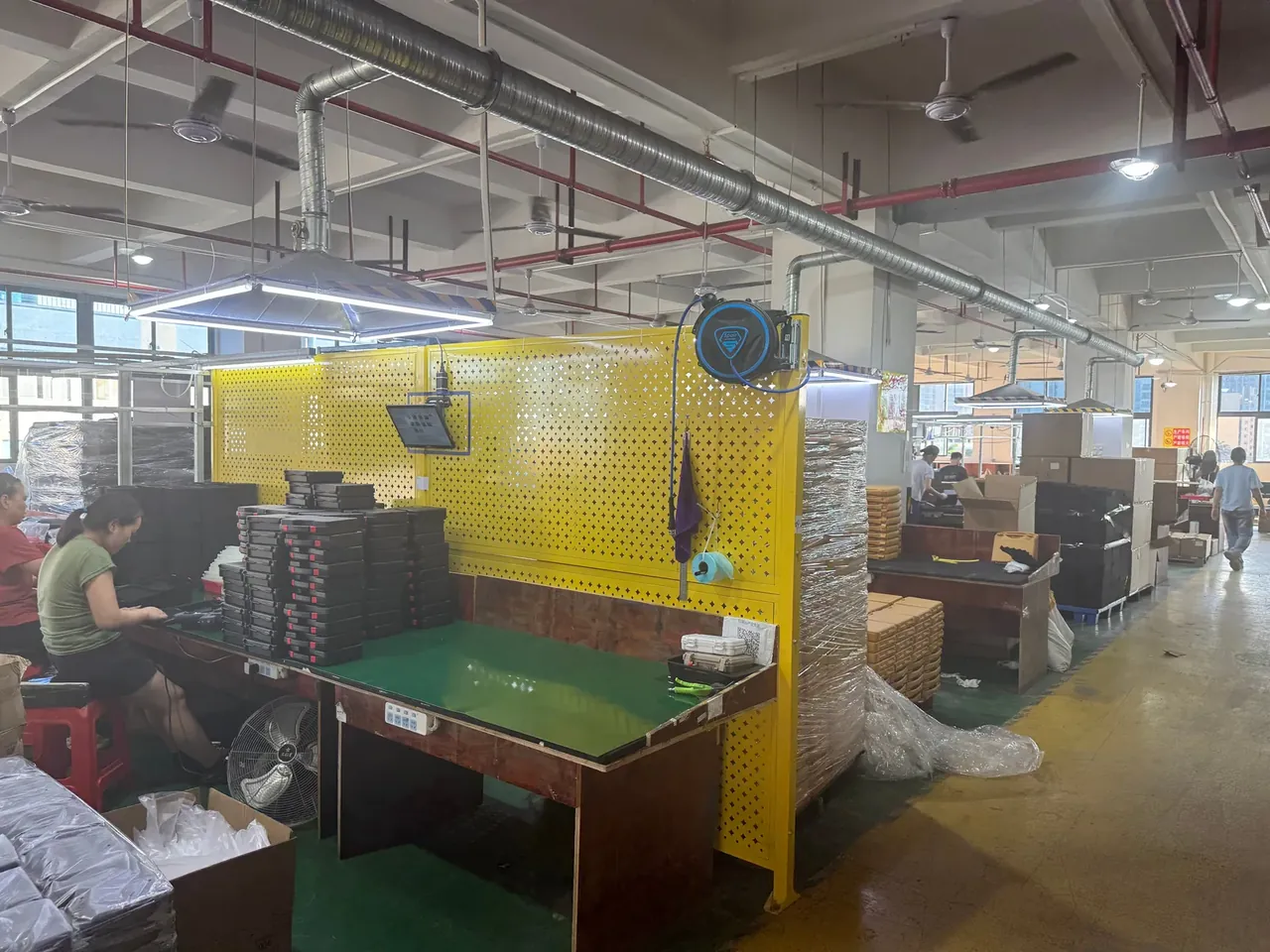
Impact loss is not proportional. Notched Charpy at 23 °C reads 14 kJ/m² on virgin, 11 at 30% and 7 at full recycled, a 50% drop. Impact follows chain length, and each pass through a screw shortens it again.
| Property | Virgin | 30% recycled | 100% recycled |
|---|---|---|---|
| Tensile yield, MPa | 42 | 39 | 33 |
| Notched impact at 23 °C, kJ/m² | 14 | 11 | 7 |
| M4 boss pull-out, N | 1350 | 1180 | 780 |
| Melt index, g/10min | 6.2 | 7.0 | 8.4 |
| Odor grade, 1 to 6 | 2.0 | 2.5 | 3.8 |
| Black specks per 100 cm² | ≤1 | 3 | 12 |
Melt index is measured at 220 °C under 10 kg after 2 hours at 80 °C, and the 30% column sits between the extremes on every row.
Boss pull-out shows up first in service. An M4 boss pulled from a 2.5 mm wall holds 1350 N on virgin and 780 N on full recycled, and at 40 N·m on a door bracket that root turns white.
Drops widen the gap. A 5 kg tup from 300 mm dents virgin 2.1 mm without cracking, the 30% part 3.4 mm, and splits the all-recycled part at 6.8 mm along the weld line.
3. Batch Consistency: Melt Index and Tolerance
Melt index is the most sensitive thermometer for batch consistency. Virgin holds 6.2 g/10min with ±0.3 between lots, the 30% grade runs 7.0 with ±0.8, and full recycled runs 8.4 with ±2.1. That ±2.1 spread means the same holding profile short-shots on the next silo.
Moisture is the second risk: regrind carries more surface area, so 2 hours at 80 °C only brings it to 0.08% against 0.03% for virgin, and wet resin hydrolyses in the barrel for another 15% of impact.
| Acceptance item | 30% grade | 100% grade |
|---|---|---|
| Tensile retention | ≥90% | ≥78% |
| Notched impact retention | ≥70% | ≥50% |
| Melt index drift | ±0.8 g/10min | ±2.1 g/10min |
| Wall tolerance | ±0.15 mm | ±0.28 mm |
| Odor grade | ≤3.0 | ≤4.0 |
| Black specks | ≤5 per 100 cm² | ≤13 per 100 cm² |
The wider tolerance is forced by the material. Full recycled on a 2.5 mm wall leaves ±0.28 mm, so the thinnest point falls to 2.22 mm and compressive stiffness drops 30% on a cube-law basis. Give structural and cosmetic walls separate tolerances.
Retain three samples per lot for five years, tagged with resin code, ratio, melt index and tensile value.
4. Odor and Appearance: Specks and Haze
Odor is graded 1 to 6 after a closed case sits 24 hours. Virgin opens at 2.0, the 30% grade at 2.5, full recycled at 3.8. Above 3.5 the case becomes a standing odor source in a cab or equipment room.
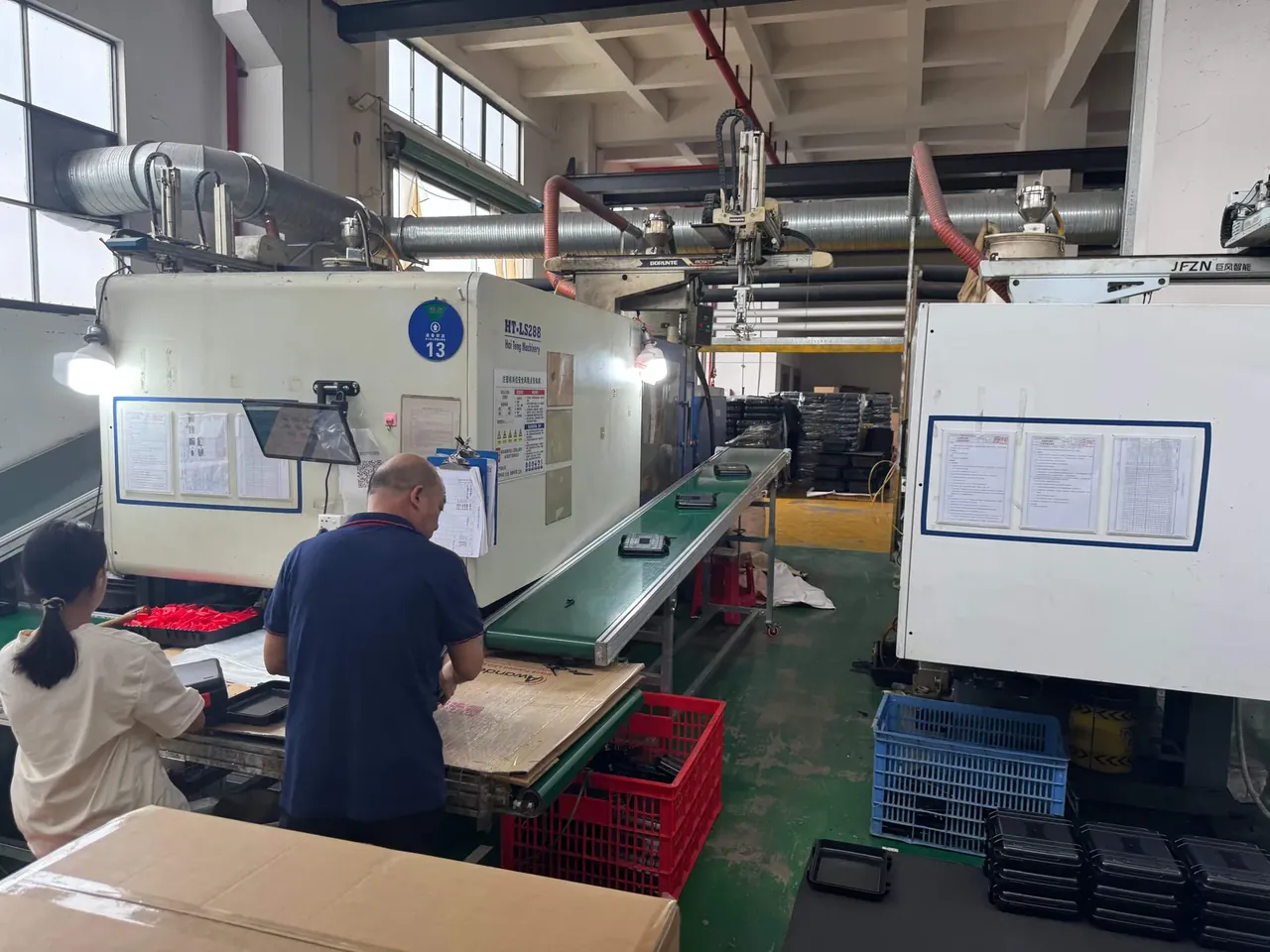
Black specks are the first appearance hurdle. Per 100 cm², virgin stays at 1 or below, the 30% blend shows 3, and full recycled shows 12 or more. Pulling full recycled to 5 takes an 80-mesh screen and two nozzle cleanings per shift, costing 9% of throughput.
Haze reads 8%, 12% and 19% on a 2.5 mm plaque, with ΔE at 0.6, 1.8 and 3.4, a visible yellow cast across a pallet.
Flow marks cluster opposite the gate. The 30% grade clears them at 48 °C mold temperature and 8% lower injection speed; full recycled needs a gate 0.4 mm thicker, adding 5 s of cooling.
5. Traceability and Claim Wording
Two wordings exist. Segregation runs recycled resin on its own line, so a 30% label matches actual content and every case can be checked. Mass balance allocates by total input, so some cases carry 30% and others 12%, and the label states only an average.
The tolerance band is usually written as ±5 percentage points at 30% and ±3 at full recycled. A narrower band forces a single feedstock source, and there is no way around that trade.
Traceability rests on three documents: the upstream origin statement naming post-consumer or industrial scrap, the lot report with melt index and mechanical figures, and the case lot code tracing back to press and shift. Wording follows ISO 14021 and EN 15343, screening density by ISO 1183 and base resin by FTIR.
Conclusion
Treat the recycled ratio as a dimension needing grade-by-grade acceptance. The 30% grade accepts at 90% tensile retention, 70% impact retention, ±0.8 g/10min melt index drift, ±0.15 mm wall tolerance, odor at 3.0 and 5 specks per 100 cm². Full recycled relaxes to 78%, 50%, ±2.1, ±0.28 mm, 4.0 and 13. What separates a recycled content case from a virgin one is not any single number but whether those numbers repeat lot after lot. Put the test method and retention period into the contract. The ratio is negotiable; the acceptance wording is not.
This article discusses container-side specifications and design implications only, and does not cover any handling, loading or use of the contents.
Related Reading
- How wall thickness maps to case strength
- Mold trial run verification steps
- Incoming waterproof inspection procedure
- Packaging carbon footprint accounting
Related Products
- 8 Series — Gun Cases; Military Equipment Cases; Camera Equipment Cases; Drone Cases; Watch Cases; Knife Cases; First Aid Cases; Electronics Equipment Cases
- WL8-2812 PP Gun Case — model WL8-2812
- All protective cases and toolboxes: 7 series, 158 models