

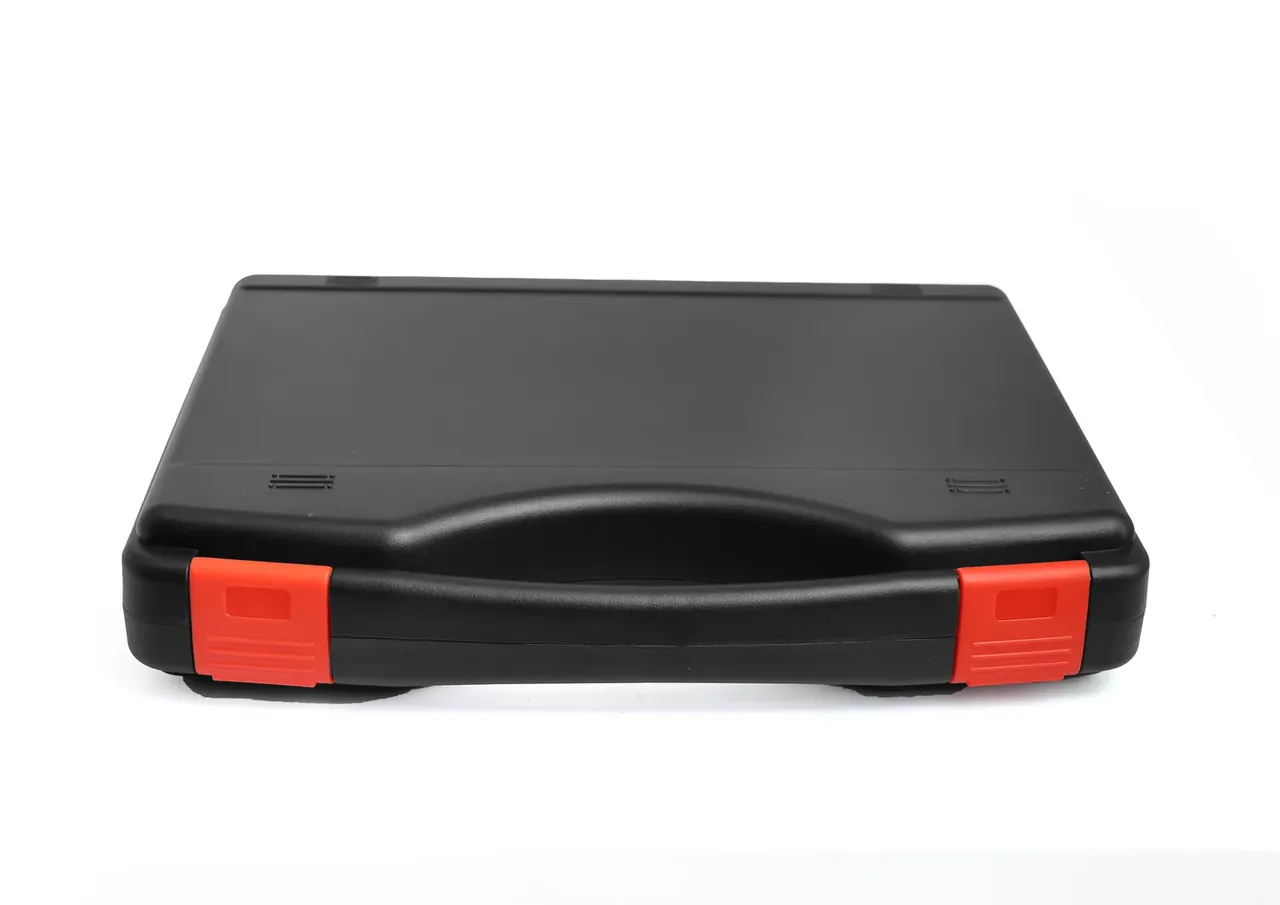
Quick answer: A recycled content protective case stays usable to about 30% post-consumer resin, where notched impact falls 18% and tensile 8%. At 50% the impact value drops 35% and melt index swings 25%, so the ratio is fixed per part and locked by batch traceability.
Table of contents
- PCR Ratios for a Recycled Content Case
- Impact and Tensile Loss Across Three Ratios
- Melt Index Shift, Wall Variation and Colour Drift
- Odour, VOC and RoHS Retesting
- Acceptance Clauses, Cost Gap and Grade by Part
- FAQ
1. PCR Ratios for a Recycled Content Case
The question is never whether recycled content works, but at which ratio it still works. At 10% post-consumer resin in copolymer PP, a 3.0 mm lid keeps 39 kJ/m² against 42 kJ/m² virgin, with no drop or leak difference. At 30% it reads 34 kJ/m² with sink marks behind the latch bosses; at 50% it reads 27 kJ/m² and the 1.2 m drop crack moves to the handle root.
Source sets the starting point. Closed-loop sprue from the same moulder breaks the chain once, so molecular weight falls 5% to 8%. Municipal bales carry 3% to 5% PS and PET, pushing melt index from 8 to above 10 g/10min.
| Ratio | Notched impact retained | Tensile retained | MVI swing | Colour ΔE | Resin price |
|---|---|---|---|---|---|
| 10% | 94% | 97% | ±8% | 1.5–2.0 | -3% to -5% |
| 30% | 82% | 92% | ±14% | 3.0–5.0 | -8% to -10% |
| 50% | 65% | 86% | ±25% | 4.0–6.0 | -12% to -15% |
Retention compares against virgin control parts from the same tool: impact to GB/T 1843 on a 1eA bar, tensile to GB/T 1040.2 on a 1A dumbbell. The ratio column is mass fraction, and regrind scatter is already inside the retained figure.
2. Impact and Tensile Loss Across Three Ratios
The 30% band takes 8% to 10% off the resin bill while the loss stays explainable. At 23 °C, 34 kJ/m² survives a 1.2 m six-face drop; cooled to -20 °C the same batch reads 12 kJ/m² against 18 kJ/m² virgin, so the loss widens from 18% to 33%.
Tensile curves tell the same story: yield drops from 26 to 24 MPa, elongation at break from 320% to 210%, and the fracture turns brittle. A 3.0 mm wall under 500 N reads 4.2 mm deflection at 30% against 3.6 mm virgin. In the drop test a 30% recycled content case cracks at the corner on the third face, a 50% recycled content case splits 15 mm on the second.
Weld lines are the second weak point. With 3% foreign matter, weld strength falls to 45% of bulk against 62% virgin, and latch bosses on that line account for 7 of 10 drop failures at 30%. Moving the gate 40 mm away cuts it to 3 of 10. Five bars from a bale spread 3.5 kJ/m², so acceptance belongs on the lowest bar.
3. Melt Index Shift, Wall Variation and Colour Drift
A ±14% melt index swing changes fill-front speed, so one packing curve no longer holds one wall. On a 30% lid the corners measure 3.18 mm to 3.42 mm against 3.2 mm nominal, and ±0.3 mm eats the tolerance. At 50% sink marks run 0.15 mm to 0.25 mm deep.
Three compensations are standard: add 0.2 mm to the main wall, add 8 s to cooling so the slower crystallising fraction sets, and drop screw speed 15% to cut shear heat by 8 °C.
| Compensation | Virgin | 30% ratio | 50% ratio |
|---|---|---|---|
| Main wall | 3.0 mm | 3.2 mm | 3.4 mm |
| Cooling time | 22 s | 26 s | 30 s |
| Screw speed | 60 r/min | 55 r/min | 51 r/min |
| Packing pressure | 55 MPa | 60 MPa | 66 MPa |
Colour is hardest to hide. On the ISO 105-A02 grey scale, batch variation at 30% sits at grade 3 to 4, ΔE 3.0 to 5.0. Black with 1.5% carbon black passes at ΔE 4.0, off-white separates at ΔE 2.0. Clear regrind yellows to index 8, and 0.3% brightener pulls it back.
4. Odour, VOC and RoHS Retesting
Odour comes from incomplete washing. Ink and label adhesive survive 2 h at 60 °C, and the smell peaks within 24 h of moulding. Drying at 100 °C for 2 h plus 4 h of devolatilising at 80 °C drops volatiles from 1.5% to 0.3% and odour grade from 3 to 1.5.
RoHS risk sits in the source, not the formula. Shredded electronics housings bring lead and cadmium, judged per homogeneous material at 0.1% for lead, mercury, hexavalent chromium, PBB and PBDE, and 0.01% for cadmium. XRF only screens; a suspect lot goes to ICP, one report per lot.
Food-contact surfaces cannot take regrind, with no exception. A recycled content case sold as a catering tote needs virgin resin on the contact face and its own food-contact report; a shell that never touches food is free to carry regrind.
5. Acceptance Clauses, Cost Gap and Grade by Part
Four clauses cover acceptance: the PCR mass fraction and its source class, with ±2% deviation allowed on a 30% claim; a furnace lot tied to the moulded code; third-party reports, RoHS quarterly and impact plus tensile per batch; a first-article plaque at ΔE 3.0 or better.
The cost gap runs 8% to 15%, wider as the ratio rises. A 30% ratio takes 8% off unit cost, minus 2% for the thicker wall, leaving 6% net. A 50% ratio claims 15% and nets 11% once the tool and process are re-set for regrind.
| Part | Ratio ceiling | Criterion |
|---|---|---|
| Non-structural shell and lid | 30% | Notched impact ≥25 kJ/m² at 23 °C |
| Structural parts, hinge bosses | ≤10% | 20,000 open-close cycles, no crack |
| Latch bosses and inserts | 0% | 500 N pull-out without failure |
| Sealing face and groove | 0% | -30 kPa held 5 min, drop ≤1 kPa |
Conclusion
The ratio is the only number that can be negotiated and the only one that disqualifies a part. At 10% the case behaves like virgin, losing under 6%. At 30% it needs compensation: 0.2 mm more wall, 8 s more cooling, weld lines moved 40 mm. At 50% it belongs on non-structural shells, with latch bosses and sealing faces at 0% recycled content.
This article discusses only the container (case body) side of specifications and design intent, and does not cover any handling, loading or use of the contents.
Related Reading
- Raw Material Traceability: From Furnace Lot to Case Code
- Case Raw Materials Compared: PP, ABS and HDPE
- RoHS and REACH Declarations for Case Materials
- Protective Case Cost Structure: Resin, Labour, Tooling
Related Products
- 8 Series — Gun Cases; Military Equipment Cases; Camera Equipment Cases; Drone Cases; Watch Cases; Knife Cases; First Aid Cases; Electronics Equipment Cases
- WL8-2812 PP Gun Case — model WL8-2812
- All protective cases and toolboxes: 7 series, 158 models