

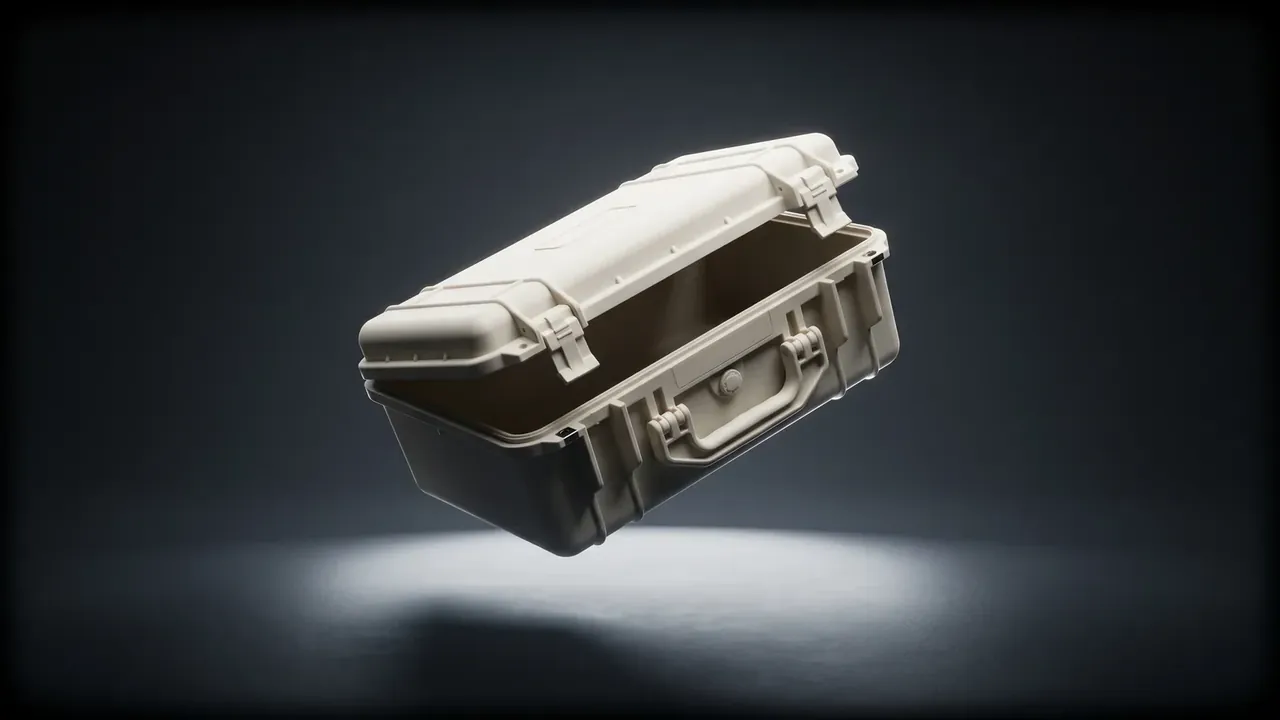
Quick answer: A rifle case in a winter convoy fails from salt, grit and road shock before it cracks. The gasket groove and the latch seats take the damage first, and both can be measured.
Table of contents
- Inspection Rhythm for a Rifle Case in Winter Convoys
- Outer Surfaces and the Gasket Groove
- Latches, Hinges and Handles: Three Loaded Parts
- Post-Trip Check: Three Marks That Bounce Leaves
- Foam and Cavity: Compression, Debonding and Replacement
- Repair or Replace
- FAQ
1. Inspection Rhythm for a Rifle Case in Winter Convoys
At six in the morning the yard sits at minus twenty-five Celsius. A rifle case leaves a heated store, lands on a truck floor, and its skin drops forty degrees in ten minutes; frost turns to water and runs into the lid seam. Grit and de-icing salt stick to the base, and after three hundred kilometres they have ground between the latch seats and the hinge pins. By the third week a latch that once closed with one push needs two hands. That is a scheduled event, not wear.
Halve every interval below for a crew loading five days a week.
| Interval | Action | Pass line |
|---|---|---|
| Before every trip | Shell and four latches | Second notch reached, tongue intact |
| Weekly | Clear groove, wipe salt | No crystals, gasket flexible |
| Monthly | Latch force, hinge pins | 12 N·m minimum, no axial play |
| Quarterly | Foam compression and bond | Full thickness within 3 seconds |
| Yearly | Water spray test | 30 minutes, dry inside the seam |
Only the latch line needs a torque wrench; the rest runs on a spray bottle.
2. Outer Surfaces and the Gasket Groove
The shell fails in a fixed order: grit strips the coating off the base, salt crystallises in the groove, and the crystals lift the gasket into a hairline gap.
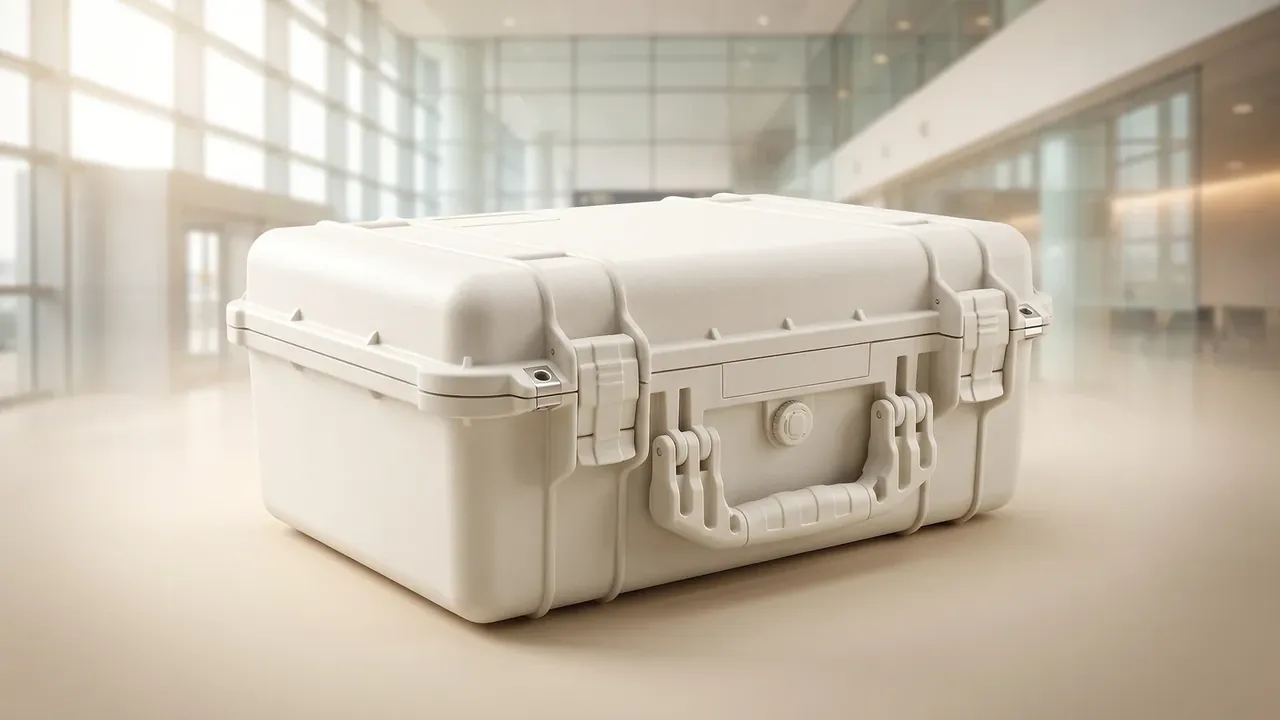
Clean in four steps, in this order:
- Rinse loose salt with water no warmer than forty degrees;
- Brush the groove and lift crystals out;
- Wipe with neutral detergent, never chlorinated solvent;
- Prop the lid open twenty minutes before closing.
Hot water blisters a cold shell, because coating and moulding contract at different rates from minus twenty-five.
A groove closed wet freezes overnight and pushes the gasket out of its seat.
3. Latches, Hinges and Handles: Three Loaded Parts
The three parts fail differently, so they cannot share one gesture.
| Part | Typical failure | Check | Pass line |
|---|---|---|---|
| Latch | Rounded tongue, weak spring | Close, listen, measure force | One clean snap, 12 N·m |
| Hinge | Pin migration, cracked seat | Rock the lid at 90 degrees | End gap under 0.5 mm |
| Handle | Loose rivets, deformed grip | Lift the loaded case ten seconds | No rivet shift, no twist |
On a rifle case the latch goes first.
Tongue wear is gradual: two weeks of feeling soft at the end of the stroke, then two hands are needed.
Handles fail quietly. Lift fourteen kilograms clear of the ground and watch the rivets.
4. Post-Trip Check: Three Marks That Bounce Leaves
A long run leaves three marks on the rifle case, each pointing at a different area.
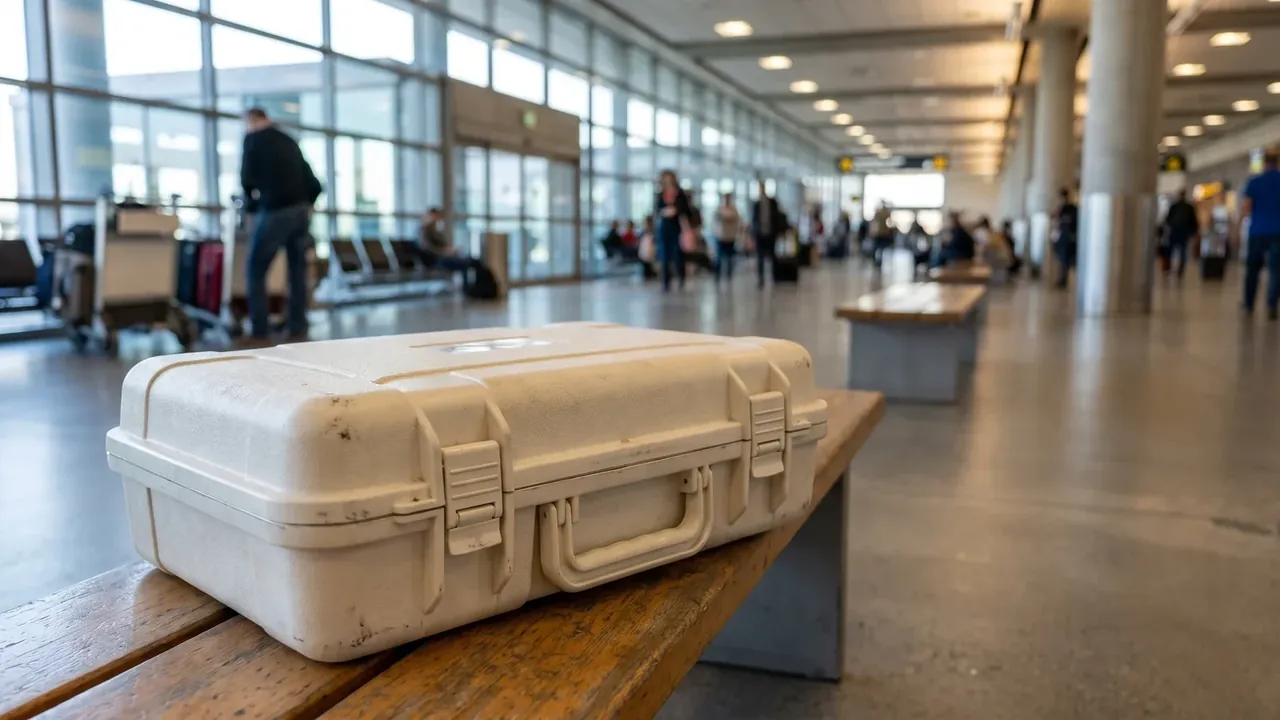
Corner rub is plainest: once the coating is through, a fingernail finds a step near 0.5 mm, and that needs wear tape.
Shallow face scratches are cosmetic. One that catches a nail needs a wall check at that spot, where stress concentrates.
Pale rings around a latch seat mean the shell flexed there repeatedly; check the tie-down before blaming the latch.
5. Foam and Cavity: Compression, Debonding and Replacement
Foam is judged by rebound. Compress a twenty-millimetre strip to half thickness; slower than three seconds means the support is gone.
Debonding starts at the lid insert edge: crumbling adhesive means repeated cold contraction, and a patch lasts one quarter.
Replace foam as a set, or the load shifts onto the new block and flattens it.
6. Repair or Replace
Two questions decide it: can the part be removed, and can the repair be verified?
- Repair when both are yes: latches, hinge pins, gasket, foam, corner tape;
- Replace when either is no: through-cracks, cracked hinge seat, deformed groove.
On that rule a rifle case survives two gasket sets and three foam sets, because its life is set by the replacement line rather than the wall thickness.
Conclusion
Winter care is one table and four points: clear salt, adjust the latch below 12 N·m, tape a corner at 0.5 mm, replace foam past three seconds. Do those on schedule and the life of a rifle case is set by execution, not by wall thickness.
This article discusses only the container (case body) side of specifications and design intent, and does not cover any handling, loading or use of the contents.
Related Reading
- Long-term storage and inspection for reserve cases
- Cleaning and wheel care for hard-shell suitcases
- Derusting and gasket replacement on metal ammunition boxes
- Wheel and handle servicing on wheeled protective cases
- Inspection intervals for explosive storage cases
Related Products
- 8 Series — Gun Cases; Military Equipment Cases; Camera Equipment Cases; Drone Cases; Watch Cases; Knife Cases; First Aid Cases; Electronics Equipment Cases
- WL8-2812 PP Gun Case — model WL8-2812
- All protective cases and toolboxes: 7 series, 158 models