

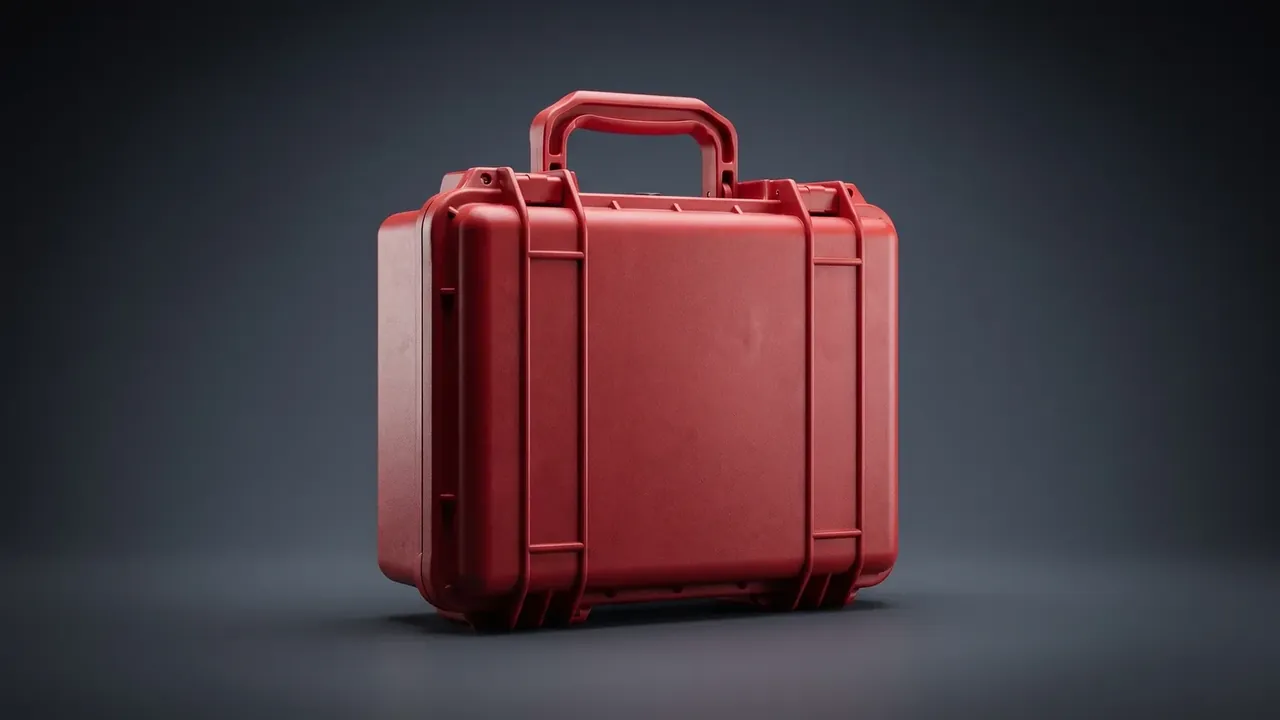
Quick answer: A rolling tool case is not a box with castors bolted on. Weight sits on the base, passes into the wheel housings and lands through the axles, while the handle only carries thrust. This explains the 2.8 mm wall, the 320 mm travel and the 80 kg rating.
Table of contents
- Four modules and one load path
- Rotomoulding: the wall is a floor, not a specification
- Handle and castors: where the bending moment goes
- Latches and seals: what survives repeated opening
- Reading the spec sheet: five numbers
- Stacking and transport: three dimensions
- FAQ
1. Four modules and one load path
A rolling tool case is four modules: body, telescopic handle, castors, latches. Each carries load differently, so one sheet yields the usual wrong answer.
The path is single: contents press the base, the base feeds two housings, the housings load the axles. The handle only transmits push, so housing thickness sets payload.
| Module | Key dimension | Typical failure |
|---|---|---|
| Body, PP or ABS | 2.8 mm wall, 5 mm at housing | Housing root cracks |
| Handle, alloy or steel | Three sections, 320 mm travel | Lock ball wears round |
| Castors, TPU on PP core | 100 mm diameter | Tyre separates |
| Latches, glass-filled PA66 | 250 N pull-off each | Tongue root fatigues |
2. Rotomoulding: the wall is a floor, not a specification
Most rolling tool case bodies are rotomoulded: powder goes in, the mould turns over heat, plastic layers onto the wall. Powder flow is limited, so 2.8 mm is the thinnest wall without voids.
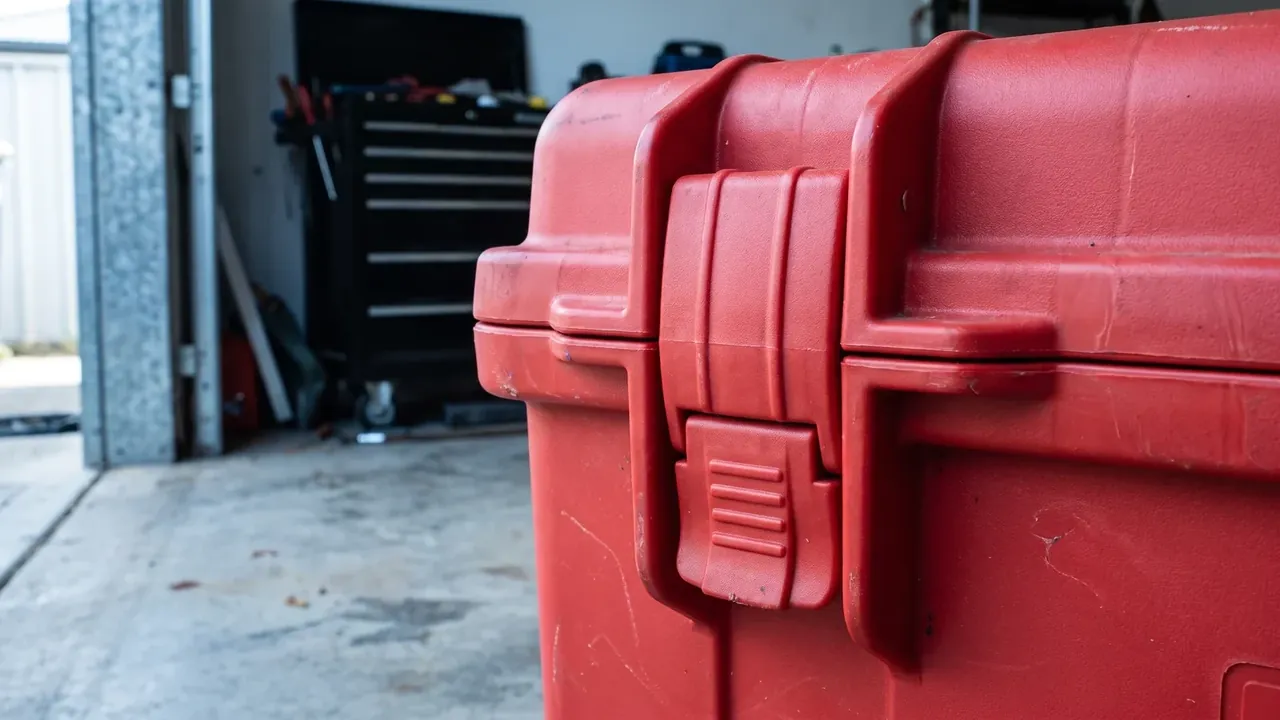
Injection moulding reaches 2.2 mm because ribs stiffen it, but leaves a weld line at the housing root. A rotomoulded interior shows faint flow marks; an injection-moulded one carries a gate scar.
Geometry is the second advantage. Housings can be moulded as recessed pads, and the lid can carry a lip so the halves interlock, resisting side impact by shape rather than by latches.
Thickness varies: 4.5 to 5 mm at the base corners, so measure three points.
3. Handle and castors: where the bending moment goes
The handle is not a beam. It is a tension member, closer to a suitcase than to a shelf.
At a thirty-degree push it carries half the weight horizontally; castors absorb the rest.
- Overlap should not fall below 80 mm at full extension.
- Travel is about 320 mm, tube diameter stepping from 22 mm to 19 mm.
- Rate each castor at 40 kg dynamic, on a two-wheel load case.
- A 100 mm wheel clears a 25 mm threshold; smaller ones jam in joints.
- Brake two castors, or the body pivots about the free axle on a ramp.
Overlap is the item most often cut. Clearance does not photograph.
4. Latches and seals: what survives repeated opening
On a rolling tool case, latches decide whether the lid stays shut and water stays out. Both depend on count, and more is not better.
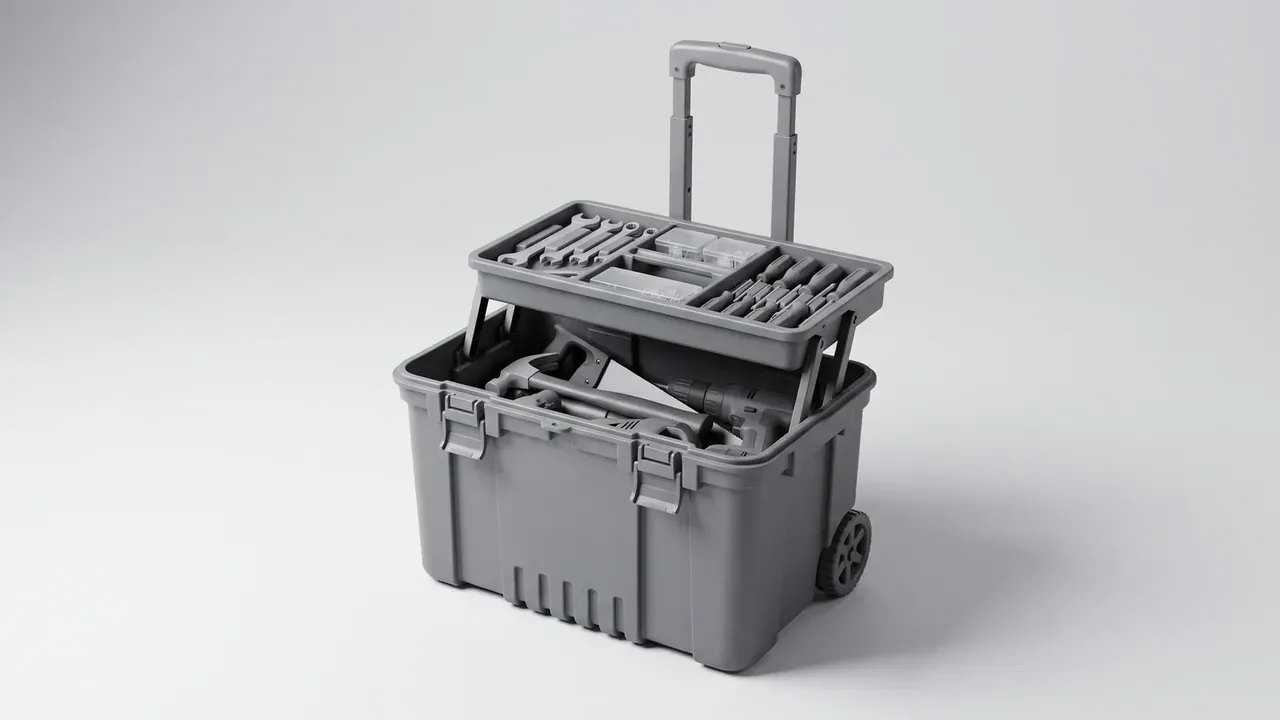
Two latches plus an interlocking lip is the usual arrangement. The lip takes mid-span load, the latches only clamp, and 250 N each is ample. A third latch without a pad behind it concentrates clamping outward, and the seal goes slack in the middle.
Judge a seal by profile, not hardness. A hollow lip seal stiffens at -20 °C. Salt spray of 480 hours is the usual hardware threshold.
5. Reading the spec sheet: five numbers
| Figure | Written as | Verify by |
|---|---|---|
| Payload | 80 kg, usually static | Load, wait 24 hours, measure base deflection |
| Rolling load | 35 kg dynamic | Push loaded over threshold and ramp |
| Wall | 2.8 mm side wall | Caliper at three points |
| Handle travel | 320 mm extended | Lateral rock under 5 mm |
| Ingress | IP67 with pressure valve | Check the valve is serviceable |
An 80 kg static figure means the body will not collapse, not that it rolls at that weight.
6. Stacking and transport: three dimensions
The top recess is usually 8 to 12 mm deep; anything shallower lets a stack of three slide.
Foot spacing decides whether bodies stack; where it differs, load lands on the lid.
Ground clearance below 60 mm keeps a pallet truck out, so the case is lifted by hand.
Temperature matters too: a closed trailer reaches 45 °C, and the bottom lid creeps down over a sea freight.
Conclusion
Performance comes from the path between the numbers: the base hands weight to the housings, the housings to the axles, the handle only passes thrust. A rolling tool case is bought on housing thickness and rolling load.
This article discusses only the container (case body) side of specifications and design intent, and does not cover any handling, loading or use of the contents.
Related Reading
- How tool boxes divide into four forms
- Lid structure and hinge load sharing
- Lid shape and opening clearance
- Layers inside a hand tool case
- What organisers and dividers do
Related Products
- 8 Series — Gun Cases; Military Equipment Cases; Camera Equipment Cases; Drone Cases; Watch Cases; Knife Cases; First Aid Cases; Electronics Equipment Cases
- WL8-2812 PP Gun Case — model WL8-2812
- All protective cases and toolboxes: 7 series, 158 models