

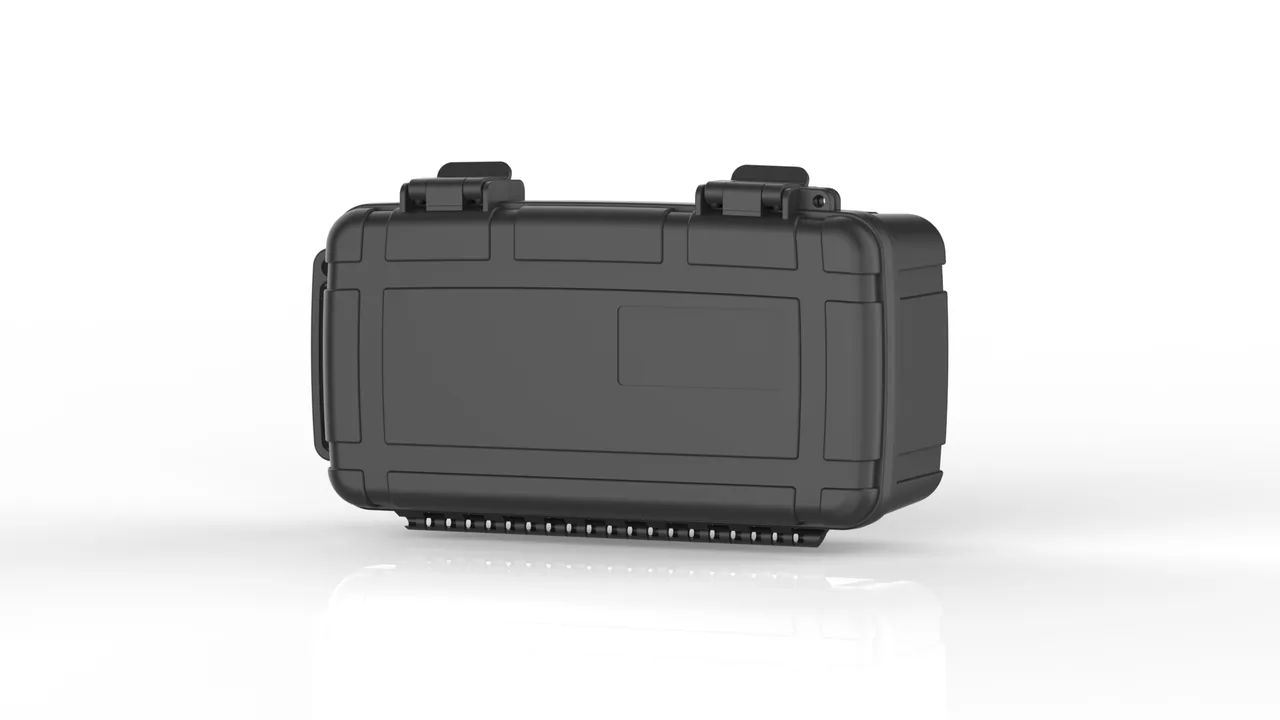
A rotary tiller is a core soil-preparation machine on modern farms, and its rotors, tillage blades, gearbox gears and oil seals are not only relatively expensive but also highly sensitive to geometric accuracy and surface integrity. During the multi-stage journey from the production workshop to the distributor warehouse and finally to the field, these components endure long-haul road transport, open-air storage and repeated loading and unloading. Without purpose-built protective packaging, problems such as rotor weld distortion, tillage blade edge chipping, gearbox gear scarring and oil seal degradation occur frequently, directly driving up after-sales returns and channel inventory loss.
As a protective case manufacturer, JUNZHIJIA has long served agricultural machinery parts suppliers in their packaging upgrade programs. This article begins with the transport damage mechanisms of the key rotary tiller components and systematically explains how heavy-load support structures, anti-rust liners and edge-isolation design can deliver reliable long-distance protection for rotors and tillage blades, then offers practical guidance on selection, customization and quality inspection.
Why rotary tiller parts need dedicated protective cases
Rotary tiller replacement and service parts fall into several families. The first is the long rotor assembly, including the main shaft with welded blade bosses, shaft ends and flanges. The second is the tillage blade, covering L-blades, goose-foot blades and straight blades in several edge profiles. The third is the transmission parts, mainly the gears, bearings and meshing components inside the gearbox housing. The fourth is the rubber and sealing parts, led by oil seals, dust rings and axle seals. These families fail in different ways during logistics, yet they share one trait: none of them tolerates rough naked packing or a simple cardboard carton.
In distributor transfers and cross-border spare-parts export, components often stay in transit for several weeks or more. Micro displacements inside a box accumulate into visible scratches under sustained vibration, and humid air triggers rust on welded bosses and gear surfaces. JUNZHIJIA observes in projects that only about thirty percent of service failures truly originate from the product itself; the majority of damage happens after the product leaves the factory, during handling and storage. This is exactly why a dedicated protective case matters.
Transport damage landscape of rotary tiller components
The failure modes differ by part family but follow predictable patterns. Rotor weld distortion grows when the shaft is laid flat under stacked pressure or supported at the wrong points. Blade edge chipping appears when hardened edges press against weak backing points or suffer lateral impact during loading. Gear surface scarring results from metal-to-metal contact inside an undivided carton. Oil seal degradation comes from compression, heat and friction with metal parts. Each mode is preventable with the right case architecture.
Distribution environments make the risk worse. A single shipment may combine highway vibration, outdoor yard exposure, forklift drops and container condensation. Cardboard offers almost no damping, no water resistance and no load spreading, so it fails on every axis at once. A molded protective case closes those gaps by combining a rigid shell, a cushioned liner and a sealed environment. From a total-cost-of-ownership view, the case price is small next to the value of the parts it protects and the cost of a returned gearbox or a scrapped blade set.
Seasonality adds a second layer of risk that many buyers overlook. Tillage demand concentrates around spring planting and autumn soil preparation, so distributors tend to stock heavily just before the peak, and spare parts may sit in a warehouse for months before they ship. That quiet period is exactly when oil seals take a permanent set, gear flanks develop rust pitting, and rotor weld toes corrode in humid air. Packaging that performs well on a single trip but offers no long-term sealing will fail across a storage season. JUNZHIJIA therefore treats rust prevention and moisture control as primary design targets rather than optional extras, because a case must keep parts deliverable after storage as well as protect them in motion. This is why the specification stage always asks how long the parts will rest before installation and what the warehouse climate looks like through the year.
Rotor weld distortion: causes and risks
The rotor is the load-bearing beam of the tiller, usually built from a seamless steel tube as the parent with dozens of blade bosses welded along a spiral line. Because the boss and the tube are dissimilar welds, residual stress remains after welding. If the shaft is stacked flat or suspended at improper support points, axial bending and local oval distortion amplify gradually under long-distance jolting. A more hidden problem is that a boss weld toe struck by a side impact develops micro cracks that easily grow into fracture under high rotation after assembly.
Traditional wooden crates or sheet-metal boxes barely locate the rotor. In transit the shaft rolls back and forth, bosses collide, damaging weld toes and scratching surfaces. JUNZHIJIA instead sets two high-density support cradles along the box length, suspending the rotor near its neutral plane so the weld toes clear every contact surface. The cradle contact zone is covered with a soft cloth, limiting roll while avoiding hard contact. Even under a full emergency brake, the rotor cannot produce harmful displacement inside the case, which keeps the spiral alignment and the boss weld integrity intact.
Choosing cradle positions follows a simple rule: each support point should land on the stiffest solid section, usually just inside the shaft end and at the flange root, never on the thin-wall tube between two bosses. A support placed on thin wall concentrates pressure and leaves dents over time, while supports set too far apart let the middle sag under its own weight and stretch the welds. During prototyping JUNZHIJIA loads a real rotor, applies static pressure and runs a sweep test, then watches how the shaft runout changes to fine-tune cradle spacing and cloth thickness. Heavier, larger-diameter rotors receive a second elastic layer under the cradle so impact energy spreads further before it reaches the weld toes. After assembly, workers confirm with a feeler gauge that a gap remains between every boss and the case wall, a small check that catches most hidden distortion risk before shipment.
Tillage blade edge chipping challenges
The tillage blade works directly against soil and crop stubble. Its edge is high-frequency hardened, so it is hard yet brittle. A single blade is light, but a case often holds dozens, and when they are stacked, the upper edge presses on the weak point of the lower blade back. Lateral impact during handling easily causes chipping or rolled edges. A chipped blade raises soil-entry resistance after fitting and accelerates gearbox load.
For edge protection, JUNZHIJIA designs an individual slot for each blade position. The blade edge hangs down into a carved EVA pocket, and the blade back is fixed by an elastic divider. Neighboring blades are fully separated by partitions, eliminating edge-on-edge cutting. For goose-foot blades with a pointed front, a thickened guard is added at the front of the slot to absorb impact energy from the case wall. After trials at several blade factories, this scheme raised edge integrity from about seventy percent to nearly one hundred percent, while also speeding picking because each slot maps to the packing list.
Slot depth and angle must be set separately for each blade profile. An L-blade has a long edge line, so a shallow pocket lets the cutting edge rub against the lid interior throughout the journey, while an over-deep pocket forces workers to pull the blade upward on removal and raises the risk of scratching. JUNZHIJIA normally leaves a small elastic allowance between the edge and the pocket floor so impact energy is absorbed by the EVA rather than transferred into the hardened steel. For blades hardened by laser with a steep hardness gradient, a non-woven fabric layer is laid over the pocket mouth to stop the hard rim from forming hidden nicks over repeated contact. When packing in bulk, workers place blades by slot number, so the loaded quantity matches the list automatically and arrival checks become straightforward. Many blade makers report that after switching to slotted liners, customer complaints shift from chipped edges to normal wear, which cuts after-sales communication effort considerably during the busiest weeks of the season.
Gearbox gear precision protection
Gears, synchronizers and bearings inside the rotary tiller gearbox are high-fit-accuracy parts. Once the tooth flank carries a dent or pit, the whole machine shows noticeably higher noise and temperature rise. These parts fear two things above all: direct metal contact that scratches the flank, and humid conditions that cause rust pitting on the meshing surface. Gears packed naked collide with each other, and damage is almost unavoidable.
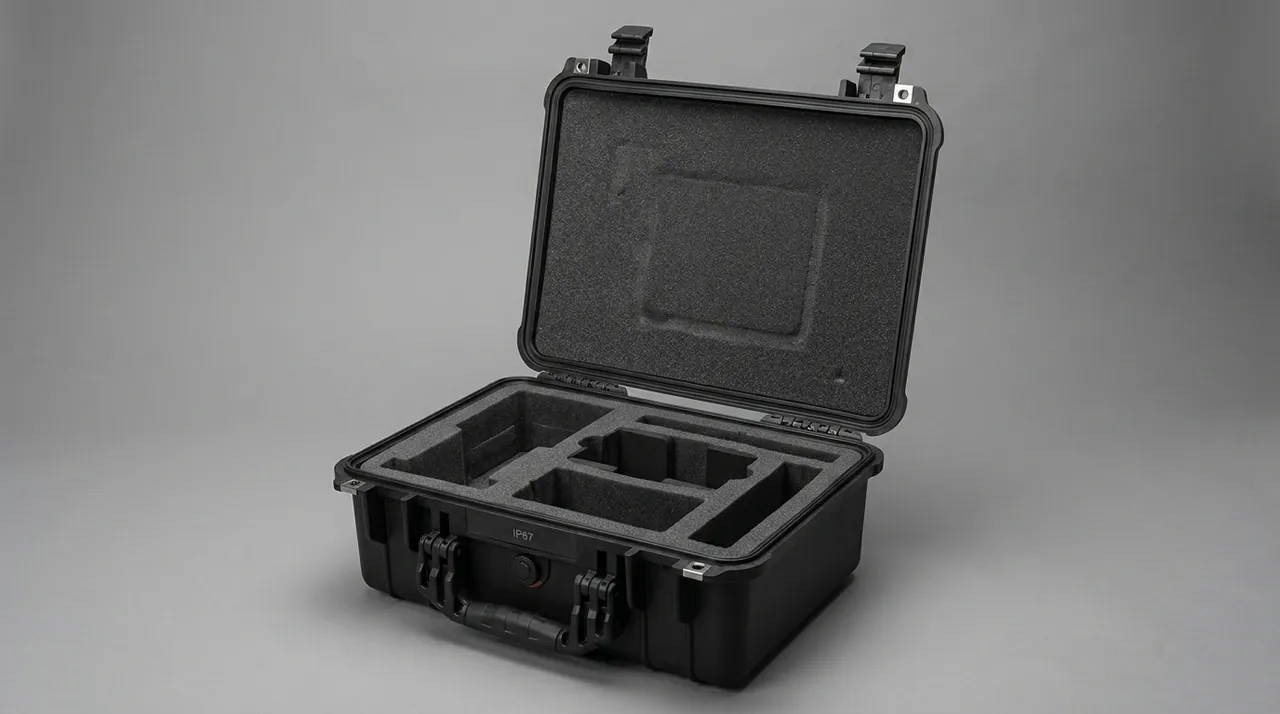
JUNZHIJIA solves this by placing each gear in an anti-static rust-inhibiting bag, then into a molded honeycomb foam cavity where every gear sits alone and never touches another. A sufficient buffer layer between the cavities and the case wall keeps the peak vibration acceleration within a safe threshold. For geared assemblies that include bearings, a VCI vapor corrosion inhibitor tab can be added inside the cavity, forming a protective film on the metal through vapor molecules and enabling maintenance-free storage for months. On opening, the gears are clean and ready to fit without complex degreasing.
One easily overlooked detail is the pairing relationship of meshing gears. Some gearbox gears are lapped as matched pairs, and if they are separated or mismatched during transport or picking, the assembled unit shows abnormal noise and contact patterns. JUNZHIJIA places matched gears in adjacent cavities with a common number so a technician can identify them quickly even during a hurried field repair. Cleanliness matters just as much, because a single grain of sand or metal chip left on a flank acts like an abrasive after assembly and accelerates wear. The liner should therefore avoid materials that shed particles, and closed-cell EVA combined with a clean assembly area is an effective way to control this hidden contamination. For batches that will be stored for a long time, JUNZHIJIA also adds moisture-absorbing material behind the liner to hold cavity humidity in a stable band, keeping the gear deliverable from the factory right up to installation.
Vulnerability of oil seals and gaskets
An oil seal is made of a rubber elastomer vulcanized to a metal skeleton, and it is sensitive to compression, ozone and high temperature. Inside a sealed truck or container, the internal temperature can exceed sixty degrees Celsius in summer, and a plain carton cannot isolate that thermal load, so the seal easily develops permanent set and cracking. Moreover, the seal lip is extremely thin; if mixed with metal parts, slight friction creates a leak path.
Therefore JUNZHIJIA recommends placing oil seals in a top soft compartment of the case to avoid crushing by heavy parts, using closed-cell EVA that does not swell the rubber. For bulk spares, a desiccant pack in the compartment stabilizes relative humidity at a low level and slows rubber aging. The placement direction is unified lip-up, and each seal is wrapped in a flannel sleeve to prevent lip roll from the detail level. This combination of isolation, cooling and cleaning keeps the seal functional through the longest outbound route.
Rubber compounds differ widely in heat and ozone resistance. Nitrile rubber tolerates mineral oil well but offers only moderate weathering resistance, while fluoroelastomer handles high temperature at a higher cost. Purchasing and packaging should record the material marking together with a storage window so that uncontrolled conditions do not age the seals prematurely during long storage. JUNZHIJIA notes a recommended storage period on each compartment label and reminds distributors never to stack seals in the same layer as heavy parts. Even a single indentation in the metal skeleton can make an otherwise perfect seal leak early after installation, contaminating the gearbox oil and triggering a chain of failures. Treating oil seals as precision components rather than ordinary rubber parts is what keeps arrival quality stable for many distributors, and it directly reduces the chance of a machine standing idle during the peak season for want of a small part.
Heavy-load support for rotor assemblies
A rotor assembly alone can weigh dozens of kilograms, and with the full case load the box bottom must bear large concentrated pressure. A thin-wall case easily bulges or even cracks at the bottom during pallet jacking and stacking, letting internal parts scatter. JUNZHIJIA uses a thickened wall with internal longitudinal and transverse reinforcing ribs in heavy-duty cases, and lays load-bearing beams on the base plate to spread the load evenly to the case frame.
For extra-long rotors, multiple lashing-fixed rings are set along the length, with adjustable end stops to fit different shaft lengths. The bearing beams and cradles are bolted so they cannot loosen in transit. After stacking load tests, this structure keeps case deformation within the allowable range at the rated stacking layers, meeting the handling needs of highway and rail combined transport. The result is a case that carries the heaviest tiller component without bottom failure.
A second key point in load design is that the load path must stay continuous. If reinforcing ribs cover only part of the base, the load forms a new stress concentration at the rib ends and the case cracks exactly there. JUNZHIJIA therefore interlocks the base beams with the side-wall ribs into a closed load-bearing skeleton, so pressure travels from the bottom through the walls and straight into the pallet instead of circulating inside the case. Pallet choice matters just as much, because a pallet with insufficient stiffness will bend even under a very rigid case. For heavy spares shipped by the full pallet, JUNZHIJIA supplies pallet selection and lashing guidance together with the case, specifying the orientation and locating method for each layer. Experience shows that designing the case and the pallet as one system lowers arrival damage more effectively than strengthening the case alone, and it is far easier to standardize across warehouse and loading crews.
Rust prevention: VCI vapor corrosion inhibition
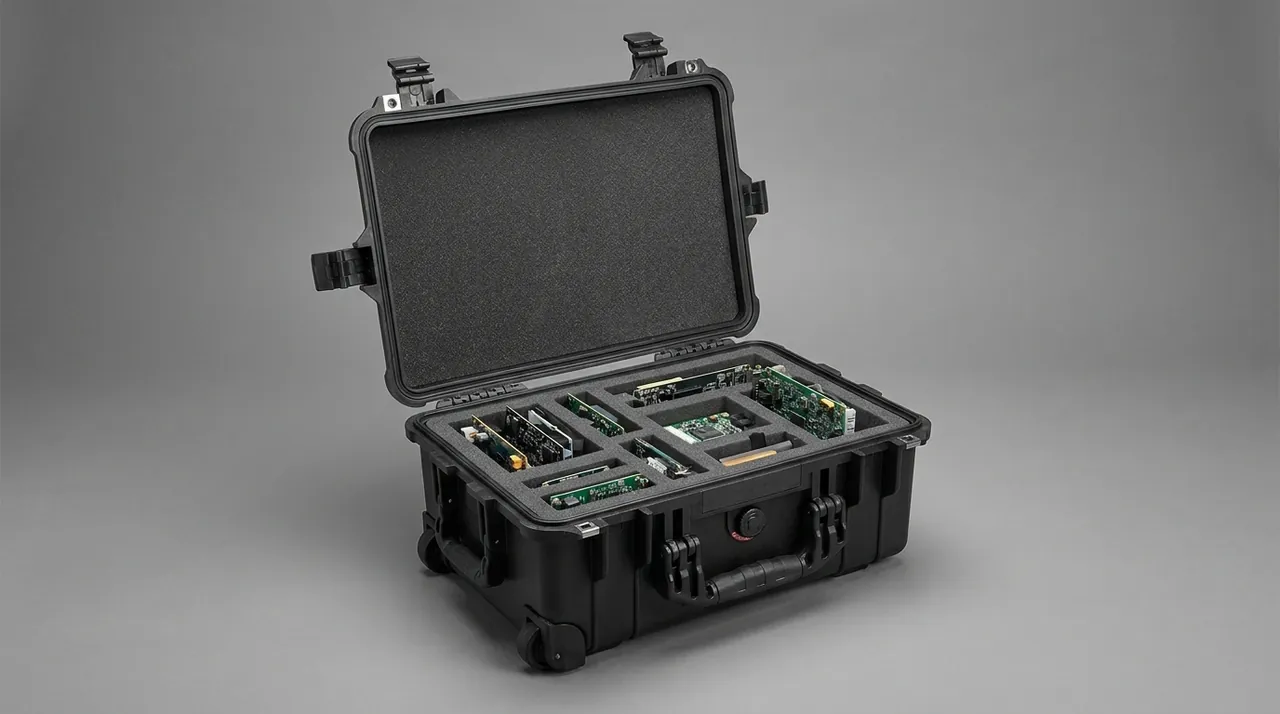
Rotary tiller parts are mostly carbon steel and alloy steel, and the rust risk is extremely high when transported in coastal or high-humidity regions. JUNZHIJIA offers two complementary rust-prevention paths. The first is VCI vapor corrosion inhibition, where a slow-release module inside the case keeps protective molecules adsorbed on the metal surface. The second is a light oil or wax temporary coating applied before leaving the factory, combined with a dry liner to further block moisture.
For water-trapping sites such as boss welds and gear roots, desiccant alone is insufficient, so vapor inhibition is essential. JUNZHIJIA lines the rotor cradle and gear cavity with rust-inhibiting paper, and attaches a rust-inhibiting film to the inside of the lid, forming a relatively enclosed vapor-protected environment. After opening, the part surface is clean with no oily residue, and no complex degreasing is needed before assembly, which markedly improves the distributor arrival experience and cuts workshop preparation time.
IP67 waterproof and moisture control liner
Rotary tiller spares often sit temporarily in open cargo yards, where sudden rain or container condensation can seep into packaging. JUNZHIJIA cases use an IP67-level sealing structure, with a continuous foamed gasket around the lid. Once the latches lock, a closed waterproof loop forms that resists short-time immersion without moisture entry. For long ocean routes, the case also carries a pressure equalization valve to relieve seal fatigue from internal-external pressure differences.
On the liner side, a moisture-absorbing felt is laid at the case bottom, paired with a top drying window to keep the internal dew point in the safe range for parts. Batches sent to humid regions can add a humidity indicator card so the channel side can judge sealing status at a glance. The whole waterproof and moisture-control design lets rotary tiller parts stay clean and dry even in the plum-rain season or during transoceanic shipping, protecting both steel and rubber components.
One common misunderstanding is worth clearing up: waterproofing and moisture control are not the same task. Waterproofing blocks liquid water, while moisture control deals with vapor and condensation, and the two follow different mechanisms that must be handled separately. A fully sealed case stops rain and splash but cannot stop internal condensation caused by day-night temperature swings, so a drying liner and absorbent material remain essential. In its proposals JUNZHIJIA calculates gasket compression, desiccant quantity and the expected temperature range of the route together, avoiding the awkward case of excellent sealing with internal condensation. For warehouses that open cases frequently for sampling, every opening costs the gasket some of its compression, so the seal should be checked for rebound after each inspection and replaced with a spare when needed. Only then does the waterproof rating hold through the whole service life instead of only on the day it leaves the factory.
EVA foam insert and compartmentalized layout
Compartmentalization is the core idea for rotary tiller parts protection: rotors, blades, gears and oil seals are placed in separate chambers by attribute, avoiding metal-on-metal wear and easing channel-side single-order dispatch. JUNZHIJIA uses computer-carved EVA liners, molded from the measured three-dimensional data of the parts, so each cavity fits the part outline with no play after placement.
For regularly shaped tillage blades, a matrix slot is used; for odd-shaped rotor flanges, an outer corner guard plus a bottom block is applied. Hard partitions separate chambers, with thickness matched to part weight so heavy parts cannot collapse the light-part compartment. The compartment layout brings an extra benefit: the packing list maps one-to-one to cavity positions, so picking error drops sharply. This turns the case into a structured kit rather than a loose box of parts.
Machining precision of the liner decides how well it actually protects. If an EVA pocket deviates too far from the part outline, the part still moves inside it, and no amount of cushioning will compensate. JUNZHIJIA builds cavities from measured three-dimensional data supplied by the customer, surveys complex parts on site when necessary, keeps each cavity tolerance band within a sensible range, and loads the first article with real parts for a fit check. Sharp corners on castings and weldments need rounded cavity edges so that handling does not gouge the liner or injure the operator. The buffer gap between liner and case wall also needs design attention: too small a gap transmits impact rigidly, while too large a gap lets the part slide within the cavity. Confirming each of these apparently minor parameters is what makes a compartment layout work under real loading conditions instead of only on the drawing.
Vibration damping and shock control
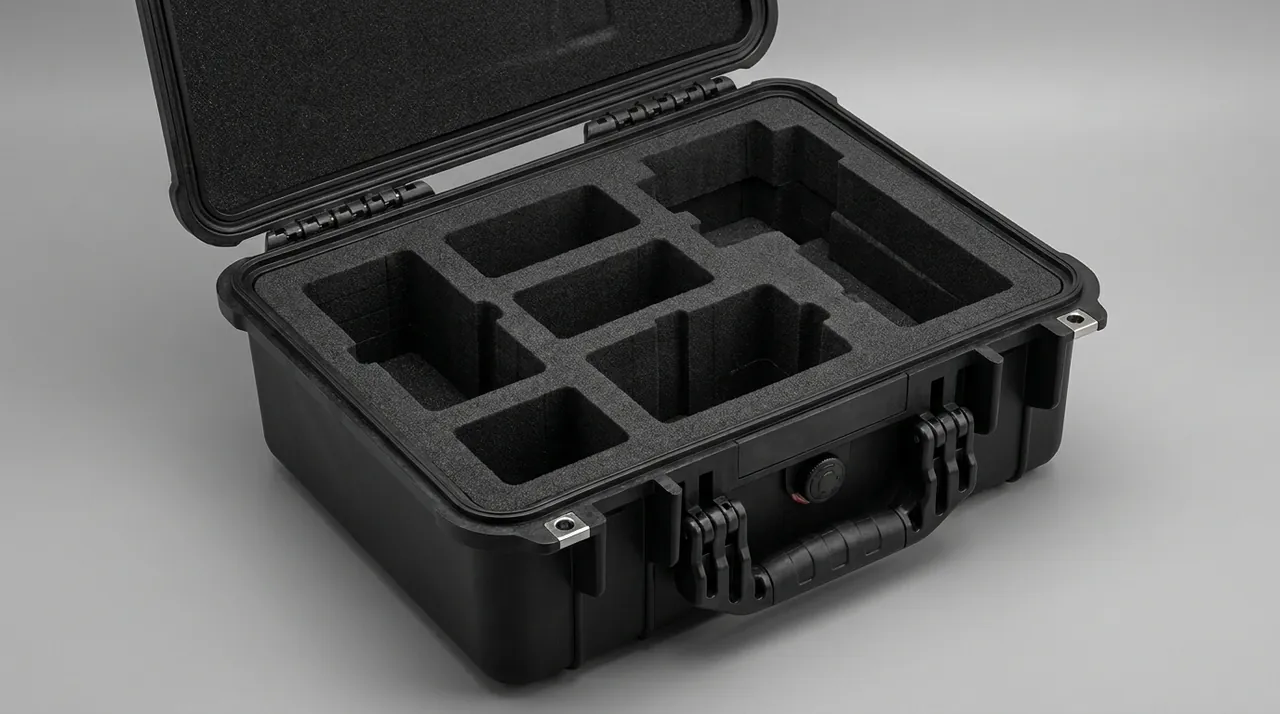
Random road vibration is the main source of fatigue damage to parts, especially at stress-concentration sites such as weld toes and blade edges. JUNZHIJIA sets an elastic damping layer between the case and the liner to absorb vertical and horizontal impact energy. For long cantilever parts like the rotor, elastic end supports are added at both ends to suppress resonance amplification of the bending mode.
In the validation stage, JUNZHIJIA runs sweep and random vibration tests on the sample case following a transport packaging vibration procedure, records the acceleration response at key sites, and adjusts the damping layer thickness and cradle stiffness accordingly. After several iterations, most rotary tiller sample cases bring the vibration transmissibility down to a reasonable band, and the incidence of weld-toe micro cracks and blade edge chipping falls sharply. This test-driven tuning is what separates a real protective case from a padded carton.
Stacking structure and long-haul stability
Spares sent to regional distributors are usually unitized on pallets, with several layers of cases stacked on one pallet. If the stacking structure is unreasonable, the bottom case bulges outward under pressure and squeezes the internal cradle, displacing parts. JUNZHIJIA designs interlocking top and bottom planes so the load transfers vertically to the pallet and the side walls are not stressed.
In addition, anti-impact corner guards are set on the four corners, protecting the shell and providing location during stacking. For container ocean orders, JUNZHIJIA provides stacking height and lashing advice, paired with anti-slip feet to reduce inter-layer slip. The stable stacking structure keeps the whole batch of parts neat through long-distance transport, and scattered or knocked parts after opening almost disappear. The case thus performs as a load unit, not just a container. For neighbouring packaging topics see Heavy-duty protective cases and Metal toolbox rust prevention.
Selection criteria: size, load, material
When choosing a protective case for rotary tiller parts, users should first inventory the parts list and single-piece weight, then determine the internal clear size and rated load. Long rotor parts need end clearance so the shaft end never hits the wall; small blade parts must balance single-case load and compartment density against transport cost and protection effect.
On material, JUNZHIJIA recommends an integrally molded engineering-plastic case that balances light weight with impact resistance; for overweight rotor assemblies, a reinforced shell with a wheeled frame eases short transfers. The sealing grade should be no lower than IP67, and the liner should preferably combine closed-cell EVA with rust-inhibiting paper. Batches for export must also confirm the case material meets the destination's environmental and flame-retardant requirements, which JUNZHIJIA documents in the quotation package. When confirming size, leave a small handling margin so cavities are not too tight; an over-tight pocket forces rough insertion that can damage the blade edge, while an over-loose pocket still allows play in transit. JUNZHIJIA marks the tolerance band of each cavity on the drawing and agrees the per-case load count with the customer to balance protection and cost. For one model with several rotor lengths, a universal case with adjustable end stops is preferred to cut mold variety and stock. Color coding by part family also helps the warehouse separate rotors from blades at a glance, reducing mis-shipments across a busy season.
Beyond size and material, several easily ignored indicators deserve a place on the selection checklist. Latch cycle life determines whether the case survives repeated opening and closing in a busy warehouse. Gasket rebound determines whether the case still seals after many sampling inspections. Case weight affects freight cost and, just as important, whether workers are willing to carry it; an excessively heavy case is often abandoned in the rush of peak season, which defeats the whole design. JUNZHIJIA maps these parameters against the customer's actual working rhythm at the quotation stage rather than issuing a dimension drawing alone. For distributors handling several machine types, standardizing case interfaces and stacking dimensions allows different product lines to be mixed on one pallet and stacked stably, which improves vehicle utilization and cuts unit transport cost directly.
JUNZHIJIA customization and quality control
JUNZHIJIA customization starts with part surveying. The engineering team builds a three-dimensional model from the sample or drawing provided by the customer and outputs the liner layout and case structure plan. In the prototyping stage a physical sample case is made and loaded with real parts for drop and vibration verification before mass production. The whole process supports tooling ownership and intellectual-property clauses to protect the customer's design data.
Mass production executes three-level quality control: incoming inspection, in-process patrol inspection and outgoing sampling. Key items include gasket compression rebound, latch cycle life and case dimension tolerance. Each batch ships with a quality record for channel traceability. For seasonal products like rotary tillers, JUNZHIJIA can also arrange safety stock and flexible delivery aligned with the customer's off-peak and peak rhythm, smoothing the supply of spare parts across the selling season.
Service after delivery belongs to the same quality loop. JUNZHIJIA includes a wear-parts list with every batch, covering spare gaskets, buffer cradles, elastic dividers and latches, so a distributor can replace a small component on site instead of returning a full case to the factory. If a customer finds a problem during arrival sampling, the accompanying quality record lets them trace the batch and process quickly and shorten the time needed to settle responsibility. For models that are revised frequently, JUNZHIJIA rechecks cavity fit whenever a part structure changes, so a customer's existing case does not suddenly become unsuitable. Treating packaging as part of product life-cycle management rather than a one-time purchase is what keeps protection stable over years of use and makes spare-parts supply more predictable for everyone in the chain.
A protective case adds value not only in transit but also in channel dispatch and after-sales picking. JUNZHIJIA recommends printing a cavity map on the lid interior or the liner so the packing list maps one-to-one to each cavity; warehouse staff place and pick by the map, and picking error drops sharply. For distributors that ship by individual order, the compartment structure lets rotors, blades, gears and oil seals be split into independent kits, avoiding mixed parts after a case is broken open.
In pallet unitization, JUNZHIJIA ships the case with a stacking height limit mark and lashing advice, plus anti-slip feet to reduce inter-layer slip. Export batches can add shipping marks and moisture-proof labels for fast identification and customs inspection at the destination port. For returned old-part reverse logistics, the same case is reused, saving packaging and protecting the returned part from secondary damage. Bringing the case into the channel work standard raises the visibility and traceability of the whole spare-parts flow, which modern agricultural service systems value highly.
Over a longer horizon, the packaging choice feeds back into spare-parts pricing and inventory strategy. Once arrival defect rates settle at a low level, distributors are willing to increase order quantities in exchange for lower unit logistics cost, and parts turnover speeds up in step. Manufacturers, meanwhile, spend less on after-sales repair and can direct more resources into product improvement rather than problem handling. When reviewing a project, JUNZHIJIA typically compares arrival defect rate, return handling hours and customer complaint volume before and after the switch to a protective case, and treats those figures as the measure of success. Only when the protection investment is quantified in financial terms does a packaging upgrade move from a one-off trial to a standing supply-chain standard, and only then do the design lessons carry over reliably to the next machine model.
Frequently asked questions
Q: How should a rotary tiller rotor be positioned inside a protective case to avoid weld distortion? A: A rotor is a long cantilever weldment, and the safest position is horizontal suspension along the case length, supported by two buffer cradles near the solid shaft end and flange so the middle welded bosses clear the wall and neighboring parts. Never lay the rotor flat on the case bottom or let the bosses bear pressure, or residual stress turns into bending distortion under jolting. JUNZHIJIA standards cover the cradle contact with flannel and set adjustable end stops to limit axial movement, plus lashing straps that fix the rotor near its neutral plane. Even a full emergency brake cannot create harmful displacement, which preserves both spiral alignment and weld toe integrity through the whole route. The same cradle principle also protects the flange face from impact, so the rotor arrives ready to fit without straightening or rewelding at the service point. Customers who ship several rotor lengths benefit from the adjustable end stops because one case size covers the whole model range, which cuts tooling variety and inventory cost. The cradle material is chosen to avoid staining the machined surface, so the part stays presentable on the distributor shelf.
Q: Tillage blade edges chip easily in transit; how should the liner be designed? A: Tillage blade edges are high-frequency hardened, hard yet brittle, and chipping comes mainly from stacked compression and lateral impact. The liner should be an individual slot where each blade hangs edge-down into a carved EVA pocket, the blade back limited by an elastic divider, and neighboring blades fully separated by a hard partition to stop edge-on-edge cutting. For goose-foot pointed fronts, add a thickened guard at the slot front to absorb impact energy. JUNZHIJIA verified at several blade factories that this slotted isolation raises edge integrity to nearly one hundred percent, while picking by slot also lowers assembly error because each position maps to the list. The slot depth is tuned so the hardened edge never reaches the case wall, and the divider thickness scales with blade weight so a heavy L-blade cannot collapse the pocket of a lighter straight blade sharing the same tray. Slot angle also follows the edge profile, because a shallow pocket on a long L-blade edge lets the cutting edge scrape the lid throughout the journey, while an over-deep pocket forces workers to pull the blade up on removal and risks nicking it. Non-woven fabric is laid over the pocket mouth on laser-hardened blades to keep the hard rim from forming hidden damage through repeated contact, and by numbering every slot the loaded quantity matches the packing list, making arrival checks fast and unambiguous.
Q: Why is a plain carton unacceptable for gearbox gears? A: Gear flank fit accuracy is very high, and a carton has no location or buffer, so gears collide inside and leave dents and pits that raise noise and temperature after fitting; the carton also fails to resist humidity, so flank rust pitting appears in ocean or wet storage. The right method is to put each gear in an anti-static rust-inhibiting bag, then into a molded honeycomb foam cavity as a separate cell, with a buffer layer between cavities and wall to control peak vibration. JUNZHIJIA also places a VCI tab in the cavity for months of maintenance-free storage, so the gear is clean and ready to fit on opening without complex degreasing, which saves workshop preparation time. For paired gear sets that must stay matched, the cavities are adjacent and color-coded, preventing a service technician from mixing a marked pair during a hurried field repair and preserving the original meshing relationship.
Q: What should be watched for rubber oil seals inside a protective case? A: An oil seal is rubber vulcanized to a metal skeleton, and it fears compression, heat and friction with metal. Place seals in a top soft compartment so heavy rotors cannot crush them into permanent set; use closed-cell EVA that does not swell rubber. Summer containers can exceed sixty degrees, so the case must insulate and vent, with a desiccant in the compartment to lower humidity. The lip is extremely thin, so unify lip-up placement and wrap each seal in a flannel sleeve to prevent roll and friction leak paths. This isolation, cooling and cleaning combination keeps the seal functional through the longest outbound route and protects the gearbox from early leakage. Different rubber compounds age at different rates, so JUNZHIJIA labels the compartment with the recommended storage window and avoids stacking seals under any heavy part, because a single crushed skeleton can ruin an otherwise perfect seal long before the machine sees the field.
Q: For overseas rotary tiller spare shipping, which rust plan should I choose? A: Transoceanic routes swing widely in temperature and humidity and run long, so desiccant alone is usually insufficient. JUNZHIJIA recommends a double path of VCI vapor inhibition plus a temporary coating: a light oil or wax coating before leaving the factory, a slow-release inhibitor module inside the case, rust-inhibiting paper on water-trapping welds and gear roots, and a rust film on the lid interior to form a relatively enclosed space. On arrival the surface is clean with no oily residue and needs no complex treatment. Paired with IP67 sealing and a drying window, the parts stay dry and clean even in plum rain or equatorial lanes, protecting both steel and rubber. Note that VCI choice depends on metal type; JUNZHIJIA validates the formula on the customer's actual parts before mass use, and for zinc or alloy-coated surfaces it lowers the inhibitor strength to avoid affecting the coating while keeping the dry liner as the main defense.
Q: What load requirements do heavy rotor assemblies impose on the case? A: A single rotor assembly can reach dozens of kilograms, and the full case load is larger, so the case bottom must take concentrated pressure without bulging or cracking. JUNZHIJIA uses a thickened wall with internal longitudinal and transverse ribs, and lays load-bearing beams on the base to conduct load to the frame; extra-long rotors get multiple lashing rings and adjustable end stops. The case also passes a stacking load test where deformation stays within allowance at rated layers. Only a structure that meets this can protect parts from scattering during pallet jacking, rail combined transport and multi-layer stacking, which are the real stresses of distribution. The base beams are bolted rather than glued so they cannot shift, and the cradle height is set so the rotor center of gravity sits low, which improves pallet stability and reduces the risk of the whole unit tipping when a forklift stops suddenly on a ramp.
Q: What is the difference between EVA and ordinary foam for case liners? A: EVA is a closed-cell material with low water uptake, good rebound and little shedding, suited to long sealing and damp conditions, so JUNZHIJIA often uses computer-carved EVA for fitted compartments. Ordinary open-cell foam cushions well but absorbs moisture and powders, better for one-time short hauls. Rotary tiller spares often face ocean and storage, so closed-cell EVA with rust paper is safer; if the move is only inside the plant, lower-cost open-cell foam is acceptable. Selection should weigh transport distance, humidity and part accuracy together rather than price alone, because the liner decides protection. JUNZHIJIA usually assesses the part's transfer count and storage period first, then proposes the liner combination, adding an anti-static layer at key cavities when needed to balance cushioning, moisture control and cleanliness in one structure that survives the full distribution cycle rather than just the first leg. Field trials in humid provinces confirmed that the closed-cell choice kept blades free of surface rust after three months of open yard storage, which is why it is the default for export batches.
Q: How long is the JUNZHIJIA rotary tiller case customization lead time? A: A standard structure modification usually yields a sample case in two to three weeks, while a full custom project with a new molded compartment liner typically takes four to six weeks, depending on part surveying difficulty and mold complexity. The flow is part surveying, three-dimensional proposal, physical prototyping, drop and vibration verification, mass production and three-level quality control. JUNZHIJIA supports tooling ownership and intellectual-property clauses, and can arrange safety stock and flexible delivery around the customer's peak and off-peak season to smooth supply of season-sensitive rotary tiller spares across the selling window without rush surcharges. Surveying can start from a sample part or a CAD drawing, and the prototype is loaded with real parts for a drop test so the customer sees actual performance before committing to tooling, which keeps the lead time predictable and avoids late redesign after the first production run begins. Customers receive the quality record with every batch, which supports warranty claims and channel traceability from the factory to the field. For urgent season launches, JUNZHIJIA can fast-track the prototype while parallel-running the mold, narrowing the gap between approval and first shipment.
Q: How do I verify a case truly meets IP67 waterproof? A: Do not trust the label alone; ask the maker for the sealing structure description and a third-party or in-house immersion test record. JUNZHIJIA IP67 cases set a continuous foamed gasket around the lid, and once latches lock a closed waterproof loop forms, verified by an immersion procedure against short-time water entry. Also check for a pressure equalization valve that relieves marine pressure-fatigue. On purchase, request the test report and quality record, and do a simple spray check on arrival to confirm the gasket rebounds normally with no permanent indentation. It also helps to understand that waterproofing is not the same as moisture control: a seal blocks liquid water, but internal condensation from day-night temperature swings still needs a drying liner and absorbent material, so inspect gasket rebound and moisture-control elements together rather than separately.
Conclusion and related reading
Rotary tiller parts protection is essentially systematic control of weld distortion, edge chipping, gear scarring and oil seal aging. JUNZHIJIA builds that control from heavy-load support, compartment cushioning, VCI vapor inhibition and IP67 sealing, so rotors, blades, gears and seals arrive field-ready.