

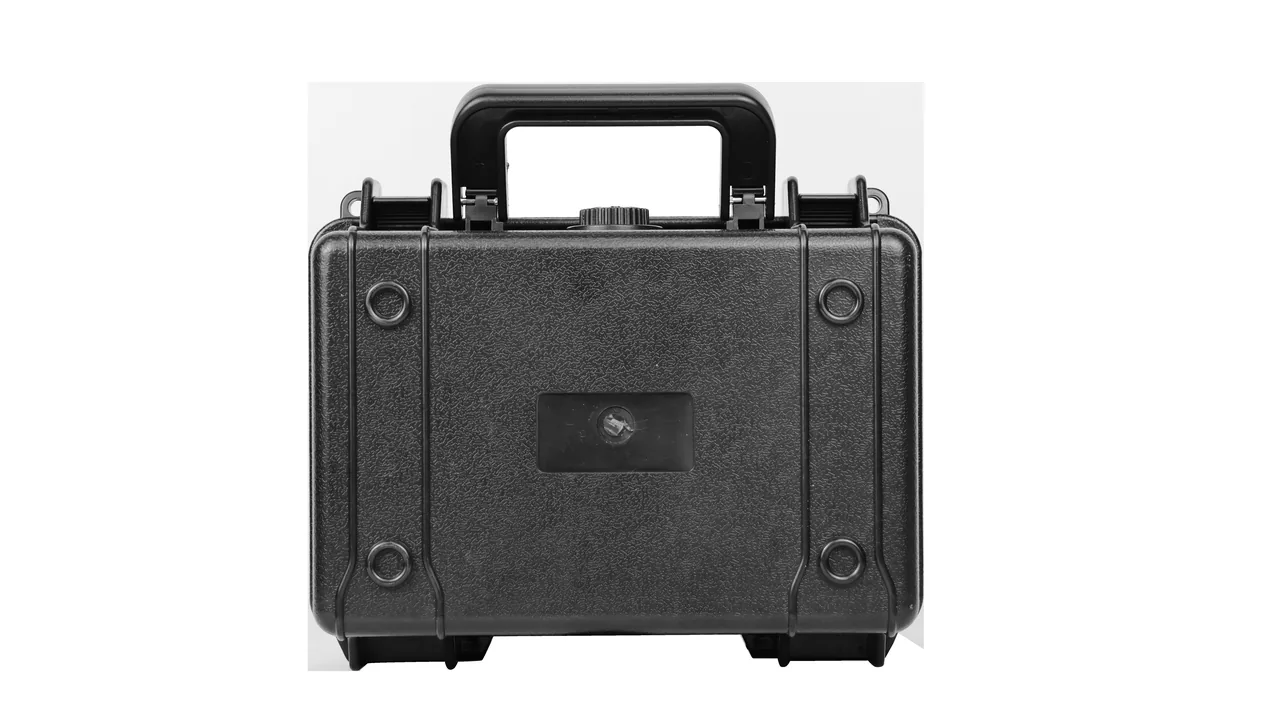
Mounted plows and rotary tillers travel through a long, rough chain before they ever reach a field. They move from the factory floor to regional dealers, from dealers to cross-regional contract crews, from job sites back to winter storage, and between service centers for repair or refurbishment. Unlike a packaged machine, these implements are hybrids of cast steel, manganese steel, and hydraulic components. They are irregular in shape, high in center of gravity, and sharp at the edges. If they knock against each other or sit exposed to mud and moisture during transit, the consequences are predictable: hitch-pin wear, plow-share edge chipping, hydraulic coupler leakage, and three-point linkage bending. As a protective-case manufacturer, JUNZHIJIA builds transport solutions for agricultural machinery distributors, original equipment makers, and service stations. This article explains, from a manufacturing point of view, the real risks these implements face in transit and how a purpose-built case resolves them through compartmentalization, cushioned liners, IP67 sealing, VCI rust prevention, and shock absorption.
Common Pain Points in Transporting Mounted Plows and Rotary Tillers
In the agricultural equipment supply chain, mounted plows and rotary tillers move through three typical scenarios. The first is a manufacturer shipping inventory to provincial dealers. The second is a cross-regional crew returning implements to storage after the planting or tillage season. The third is a service network transferring damaged parts or refurbished replacements between workshops. All three share the same difficulty: heavy single pieces, sharp edges, and many hoses and couplers.
When shipped bare, implements are usually tied down with straw rope, strapping, and wooden blocks. Road vibration causes micro-abrasion between metal surfaces, and edges scrape against each other. During the rainy season or in coastal high-humidity regions, implements left outdoors quickly develop condensation and rust. If a hydraulic quick coupler takes in water, its internal seal and spool can suffer irreversible damage.
JUNZHIJIA has reviewed many returned-unit cases and found that most damage does not come from a single violent impact. It accumulates from repeated small knocks and long-term dampness. Therefore the core of a good solution is not merely "impact resistance" but a four-in-one approach: separation, cushioning, sealing, and rust prevention. Related thinking appears in our agricultural machinery parts case and the same long-part cradle strategy applied there.
The economics also favor a proper case. A qualified case is a one-time purchase reused across dozens or even hundreds of transits, so the amortized per-shipment cost is tiny. By contrast, a chipped share, a worn pin, or a leaking coupler means repair fees plus lost field days during the peak season. Treating the case as standard delivery and after-sales equipment, rather than an optional accessory, is a practical way to cut the total cost of ownership and a sign of maturity in the modern agricultural equipment supply chain.
It helps to map the whole journey before choosing any protection. JUNZHIJIA asks customers to record each node in the chain: how the implement is secured at the factory gate, how many days it sits at a transfer yard, how long it is exposed during the rainy season, what machinery is used for loading, and what storage conditions await it at the destination. Once these facts are written into a simple risk table, most customers discover that their real bottleneck is not a flimsy case but the absence of any reusable fixture at all. Every bare-hand shipment means finding new timber and re-tying everything, and the quality of that job depends entirely on which worker happens to be on shift that day. A purpose-built case converts this variable, person-dependent task into a repeatable procedure: a fixed shell, a fixed liner, and a fixed sealing sequence that produce the same result no matter who performs it.
Another underestimated pain point is the loss of small accessories. A mounted plow or rotary tiller leaves the factory with a surprising number of small items: hitch pins, cotter pins, snap rings, coupler dust caps, and matching bolts. Shipped bare, these parts are usually thrown into a woven sack and arrive short of count. Service stations then buy generic replacements in a hurry, which quietly introduces fit-and-tolerance problems. Bringing accessories into dedicated small cavities inside the case turns counting into a glance on opening. A missing part is spotted immediately and can be traced, a benefit many customers only appreciate after two or three seasons of use.
Hitch-Pin Wear: The Most Overlooked Failure Point in Transit
The hitch pin connects the tractor three-point linkage to the implement. Its surface is hard, but its fit tolerance is tight. During transit, if the pin rubs directly against the metal case wall or other hard objects, fine grooves form on the surface. When reinstalled in the field, the pin becomes loose and noisy, and it accelerates wear across the whole hitch mechanism.
An even more hidden problem is the threaded section. Many handlers simply toss several pins into one woven bag, where the threads chew each other. At installation time they discover the nut will not screw on. JUNZHIJIA solves this by giving each pin its own locating hole or EVA cutout, so every pin stands or lies fixed, with the threaded section isolated from the smooth shank. No two pins touch.
For precision pins with cotter holes or snap-ring grooves, a thin soft-foam layer is added inside the case. It holds the pin while preventing the groove from being crushed. For a systematic view of metal rust control, see our article on rust prevention for metal toolboxes.
The wear mechanism deserves a closer look. A hitch pin normally works as a clearance fit inside the linkage, relying on surface hardness and grease to keep friction low. Wear in transit is dry, unlubricated friction, and its rate is many times higher than in field service. Worse, the metal debris removed by that friction becomes embedded in soft foam. If the liner is not cleaned, those particles act as an abrasive in later shipments and score the pin surface a second time. JUNZHIJIA therefore recommends a removable insert module for the pin cavity. After each long transit, the module can be lifted out, brushed clean, wiped with anhydrous alcohol, and dried before it goes back. This small routine can extend the life of one liner by two or three years.
Storage posture matters too. Hitch pins usually carry a plated or blackened finish. Lying flat in a stack, they press on the same spot continuously until the coating shows a dull pressure mark. Standing the pins upright consumes more height, but it spreads contact around the circumference so pressure never concentrates. If case height forces a flat layout, there must be an individual slot between every pin; they must never be stacked on one another. Service stations that keep many spare pins can divide the cavity by diameter and length and paste a matching chart inside the lid, so both picking and counting can be done without digging through the case.
Plow-Share Edge Chipping: The Direct Result of Heavy-Part Collision
The shares and mouldboards of a mounted plow are usually cast in high-manganese steel. The edge is surface-hardened: hard, but also brittle. In transit, if two implements are stacked and their edges collide, chipping or curling is almost certain. Once an edge is damaged beyond a threshold, field work suffers with poor soil entry and uneven tillage depth, and a return-to-factory repair adds cost.
The case resolves this risk through a "hard shell plus soft liner" combination. The shell is injection-molded from engineering plastic or modified PP to resist external impact. The liner uses EVA or IXPE foam cut to the exact contour of the share, so the edge floats and never touches the wall. Even if the outer case is struck, the foam absorbs the energy and the edge stays in its protected zone.
It must be stressed that the cutout must match the real object. A generic grid foam often fails to hold the part securely. JUNZHIJIA's custom process begins with three-dimensional data or a physical sample, then determines foam density and cut depth so the edge has clearance on all sides. For rotary-blade transport, compare the agricultural machinery parts case guidance on rotor and blade protection.
Edge damage follows recognizable patterns. Among returned parts, three forms dominate: notching, curling, and spalling. Notching comes from a single hard point contact and leaves a clean-edged gap. Curling results from slow compression or friction against soft material, which bends the edge instead of breaking it. Spalling is the most serious because it usually means the hardened layer has detached as a whole, and welding repair rarely restores original performance. Protection should therefore differ: notching is prevented by complete separation, curling by limiting displacement, and spalling by controlling both impact energy and contact-surface hardness. JUNZHIJIA confirms which form the customer fears most before choosing foam density and divider material, rather than applying one design to every part.
The same reasoning applies to mouldboards and plow legs. A mouldboard has a large curved surface and uneven wall thickness, so compression can open fine cracks at the point of maximum curvature. Such cracks are almost invisible to the eye and only propagate under alternating field loads. Beyond a contour cutout, a curved support pad should back the crown of the curve so pressure spreads along the surface instead of concentrating on one ridge line. It is worth adding "inspect the curved surface against the light for fine cracks" to the post-transit checklist, which keeps the defect from reaching the field at all.
The Difficulty of Protecting Hydraulic Quick Couplers
Modern mounted plows and some rotary tillers feature hydraulic flip or hydraulic width adjustment, which inevitably involves quick couplers, hoses, and valve blocks. These components fear two things: first, the coupler thread and O-ring are scratched, creating a leak path after installation; second, long-term moisture causes internal spool rust and seizure.
A quick coupler is a precision-fit part. Even a single scratch on the surface can become a leakage channel. JUNZHIJIA gives the coupler its own small compartment. The compartment floor is lined with compression-resistant foam, and the coupler inserts vertically into a locator so the thread touches no hard object. Hoses follow a routing channel along the wall and are fixed to avoid sharp bends.
For moisture, the whole case is sealed to IP67, and a VCI vapor-corrosion inhibitor paper or module is placed inside the coupler compartment, keeping the metal surface in an inert atmosphere. For broader hydraulic-component protection, review our hydraulic and pneumatic parts case.
A less obvious risk comes from dust caps and plugs. Couplers normally leave the factory with plastic caps, and those caps work loose during long transport. Once the port is exposed, grit can enter and be pushed toward the spool by hydraulic pressure at start-up, causing a slow leak at best and scoring the mating surface at worst. JUNZHIJIA reserves a small pocket for the caps inside the coupler compartment and prints a reminder inside its lid: confirm every cap is in place before the implement is removed. Metal plugs, if the customer supplies them, are located separately so they never strike the coupler threads.
Hose routing also needs design. A hydraulic hose has a rubber outer layer around a steel braid, and it tolerates small bend radii poorly. One sharp bend may not fail immediately, but a few repetitions leave a fatigue point in the braid. The purpose of a routing channel is not to cram the hose in but to hold the bend radius within the hose's allowed limit through continuous curved support. For large-diameter high-pressure hoses, JUNZHIJIA adds a half-round cradle so weight is carried by the cradle face rather than the coupler root, which prevents the hose's own weight from pulling on the fitting over time. If two hose-equipped implements share one case, route them in separate channels so the lines never tangle and no one yanks a coupler while untangling them on site.
Deformation Risk of Three-Point Linkage Members
The three-point linkage includes the top link, lower links, and lift-arm connectors. They are mostly slender rod-shaped structures, weaker in bending than in compression. Shipped bare, if heavier objects are stacked on top, or if they are thrown during loading, the rods bend. The result is an implement that sits unevenly after installation and tilts during work.
The heavy-load support structure of the case addresses this. Reinforcing ribs and load-bearing crossbeams are arranged at the bottom. The rod's lying area uses high-density support foam to spread pressure. At the same time, the corresponding position inside the lid has a limiting strip. After closing, the rod is clamped from both top and bottom and cannot bounce during transport.
For over-length rods, JUNZHIJIA offers extended case sizes or segmented cradles to avoid protrusion that could be struck. When selecting, always measure the total rod length and maximum swing diameter. We detail this in the "Sizing and Planning" section later.
The top link is an adjustable part with a threaded sleeve and lock nut, and its slender profile makes both threaded ends the weak points. Two transit scenarios are dangerous. First, a heavy object pressing on the middle of the shaft bends the rod around the thread root. Second, an impact on the sleeve deforms it so the length can no longer be adjusted. The fix is a ring-shaped support at each threaded end so the load path bypasses the threads, plus a soft collar around the sleeve to stop it touching the case wall. Some users remove the top link and bag it separately, which actually increases the chance of mixed parts; storing it in its own zone of the same case is safer, with labels distinguishing left from right and front from rear.
The lift-arm and lower-link connection deserves equal attention. These joints usually carry ball ends or pin holes, and a ball end pressed into an oval shape will rattle after installation. The liner should use an enveloping cutout so the ball floats in foam without touching the bottom. For larger ball diameters, a half-round seat replaces point contact with surface contact. Some implements use hydraulic lift arms with the cylinder integrated into the member, which is considerably heavier; the cylinder should sit low and near the center so the assembly's center of gravity stays down and cannot topple during a bumpy run. These details look minor, yet they decide whether a protection plan actually works in daily use.
Heavy-Load Support: Case Structure and Load-Bearing Design
A mounted plow as a whole, or a large rotary tiller, often weighs dozens of kilograms and can exceed one hundred. This sets hard requirements for the case's own load capacity and stacking ability. Ordinary storage boxes fall far short in compression resistance and creep behavior.
JUNZHIJIA guarantees load capacity in three ways. First, the shell uses high-rigidity engineering plastic with wall thickness and reinforcing ribs validated by structural simulation, so it does not deform under full load. Second, load-bearing columns are set at the four corners and feet; during stacking, load transfers through the columns rather than relying on the walls. Third, heavy-duty hinges, latches, and metal corner guards raise both opening life and impact resistance.
In heavy-load scenarios, our article on the heavy-duty equipment case explains the relationship between wall thickness, reinforcing ribs, and stacking load, a useful extension for structural selection.
It is worth noting that load support is not only about static shell strength. Dynamic impacts in transit can exceed static weight several times, especially during hard braking on potholed roads or accidental drops at loading. JUNZHIJIA validates structure by simulating both full-load drop and stacked compression, confirming the case will not crack or jam under extreme conditions so the implement stays protected. This is the fundamental reason a standard storage box cannot replace a professional case: the former only solves "fits inside," while the latter solves "travels stable and stores safe" at the same time, which is exactly what agricultural implements demand across a rough logistics chain.
Impact Protection: Liner and Compartment Layout
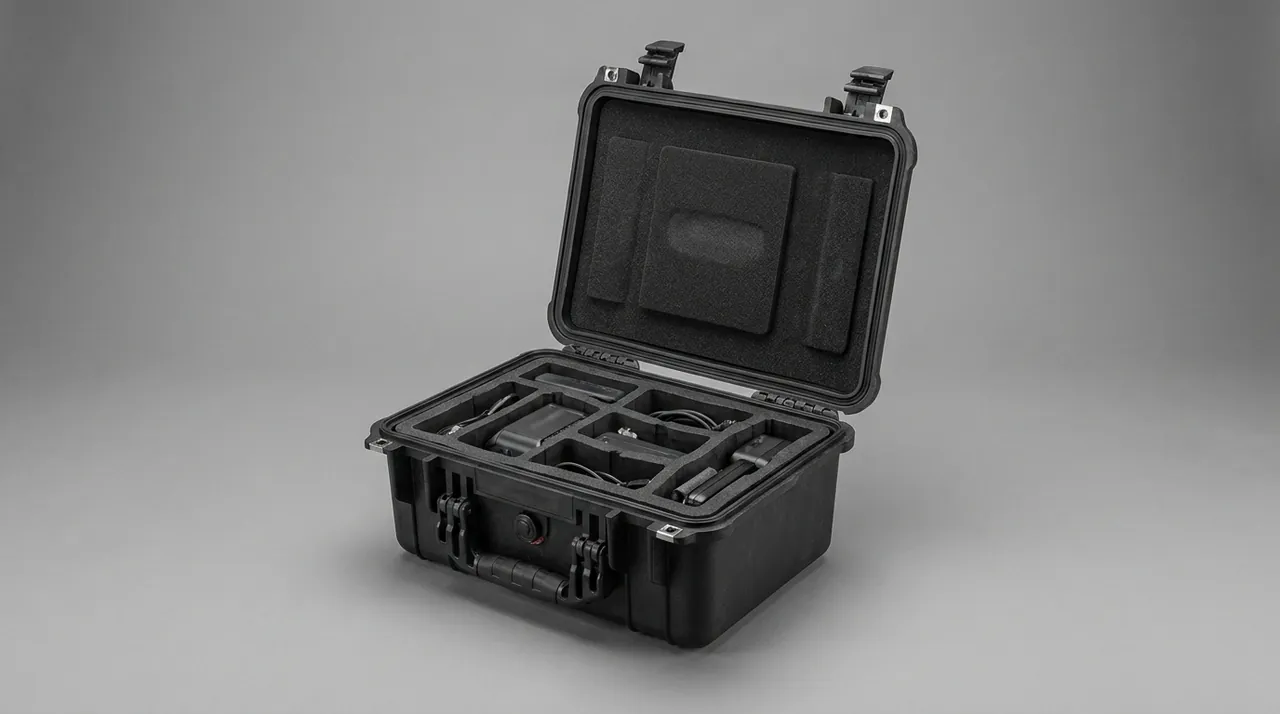
Compartmentalization is the core method to prevent implements from colliding. JUNZHIJIA usually splits one implement into "main body plus accessories." The main body (plow frame, tiller rotor) occupies the primary cavity with a full contour cutout. Accessories (pins, couplers, bolts, spare blades) go into an independent small box or a lid pocket, avoiding friction with the heavy main part.
Liner material choice matters. Heavy main parts use EVA with higher hardness and good rebound, which both shapes and absorbs energy. Precision small parts use IXPE or PU soft foam for a tighter fit. JUNZHIJIA supports custom foam inserts cut to physical objects, and you can review the EVA foam insert custom process for the workflow.
Layout must also consider the order of access: frequently used accessories sit where they are visible on opening; the heavy main body stays centered and low to stabilize handling.
The details of dividers and stops often decide whether a compartment plan stays stable over time. JUNZHIJIA uses three forms of restraint, each with its own role. Cutout location suits regular shapes, wrapping the part in foam for six-sided constraint. Column dividers suit two heavy parts of similar size, using a rigid board to break the collision path completely. Strap-and-pocket restraint suits irregular castings: the part is first banded into a single mass and then placed in a cutout, so a sharp corner cannot puncture the foam. The rule of thumb is simple. Anything with a cutting edge gets a wrapping cutout, anything long and rod-shaped gets a column divider, and anything with a strange, irregular load face gets a strap. Memorize these three mappings and even a last-minute part substitution can be secured correctly on the spot.
Foam density is not a case of higher being better. High-density EVA resists compression well but recovers slowly, so after repeated loading it can take a permanent set and the locating fit loosens. Low-density foam cushions well but supports poorly, and heavy parts gradually sink. JUNZHIJIA's selection rule is that steel parts above twenty kilograms use medium-to-high density EVA with a bottom support block, parts under ten kilograms use medium density EVA alone, and precision small parts use low-density soft foam with a rigid divider outside it. This layered approach lets parts of very different weights share one case on their own terms rather than forcing one material to handle every load condition.
IP67 Waterproofing: Coping with Field Mud and Outdoor Storage
Transit of agricultural implements is rarely "clean workshop to clean workshop." More often it is loaded directly from a muddy field or stored outdoors at a transfer yard for days. Rain, mud, and dew enter through seams, causing rust and electrical failure.
IP67 means the case survives immersion in one meter of water for thirty minutes with no ingress, and it fully prevents dust entry. JUNZHIJIA cases use an integral injection-molded shell with a silicone gasket; when the lid presses down, it forms a continuous sealed line. A pressure-equalization valve uses a waterproof breathable membrane that blocks water while preventing shell bulge under altitude or temperature change.
For smart implements with electronic modules, waterproofing is especially critical. For the standard explanation, read our IP67 protective case and outdoor case waterproof design.
The real difficulty in waterproofing is not surviving immersion once but surviving repeated opening and closing. A gasket is an elastomer, and every compression cycle deforms it. After enough cycles it takes a permanent compression set, rebound weakens, and the sealed line is no longer continuous. JUNZHIJIA therefore treats the gasket as a replaceable part: instead of scrapping the case, the user lifts out the old ring and seats a new one to restore full water resistance. The lid rib and gasket groove are matched to controlled tolerances, so even a slightly worn gasket still has enough compression travel to hold the seal. This matters most for dealer branches, where a case may be opened several times a day and accumulates far more cycles in a year than a typical user would.
Drainage is another easily missed detail. If the outer rim of the lid is completely flat, rainwater lingers near the closing face and can be carried inside at the moment of opening. JUNZHIJIA molds a shallow drain channel around the lid with a slightly inclined outer profile, so standing water runs to the four corners and off. That channel must still be cleaned of leaves and mud, or it turns into a reservoir. Taken together, waterproofing is a system of sealing, drainage, pressure equalization, and maintenance convenience, not just a rating number printed on a label.
VCI Rust Prevention and Vibration Control
Even with a well-sealed case, metal parts in a long-closed, temperature-cycling environment can still rust from residual hand sweat or trace moisture. VCI (vapor corrosion inhibitor) technology forms a protective film in the enclosed space through inhibitor molecules. It works on steel, cast iron, and aluminum alloy, and needs no oil or wax, so parts are ready to install on removal.
JUNZHIJIA places VCI rust-inhibitor bags or paper inside the metal-part cavity and gives high-value precision couplers an extra inhibitor compartment. One caution: VCI has compatibility requirements with non-ferrous metals and certain coatings. JUNZHIJIA confirms the implement material at the planning stage and selects a compatible inhibitor to avoid reactions between the inhibitor and the coating.
For broader corrosion-resistant packing ideas, see our corrosion-resistant enclosure.
When a VCI plan goes into practice, matching inhibitor concentration to the enclosed volume is the key variable. Inhibitor molecules need time to build up to an effective concentration in the sealed space, and the larger the volume or the poorer the seal, the longer that takes and the less certain the protection becomes. JUNZHIJIA therefore deliberately keeps the coupler compartment small rather than oversized, so the inhibitor reaches working concentration quickly inside a limited volume. Going the other way, if the cavity is too large to fill, add more inhibitor modules or insert dividers to break one large space into several small ones. This is consistent with the broader rule that a case should not be left with excessive void.
Customers often ask how to tell when an inhibitor module has expired. A VCI module is not permanent; its release rate depends on temperature, humidity, and how often the case is opened. JUNZHIJIA recommends replacement by transit cycle. For frequent short-haul shipments, check module condition each quarter and replace it when it has visibly thinned or changed color. For long-term sealed storage that is rarely opened, replace modules during the annual off-season inspection. If zinc-plated and blackened parts share one case, place modules in separate zones, because different surface treatments respond to inhibitor atmosphere with different sensitivity and a single location can leave one group under-protected.
It is worth restating that rust prevention and waterproofing are separate functions and cannot substitute for each other. Sealing blocks liquid water and humid air from entering; inhibition deals with the small amount of moisture and hand sweat already present that drives surface reaction. Only both together cover the real agricultural scenario, in which daytime sun heats the case, night cooling condenses vapor on metal surfaces, and the case's own breathing effect generates dew even when no outside water gets in. That is why a well-sealed case still needs inhibitor material inside it.
In practice, the inhibitor works best when the cavity is reasonably full and the seal is intact, because the protective vapor concentration builds faster in a tighter enclosed volume. JUNZHIJIA therefore designs the coupler compartment to be compact rather than oversized, and advises closing the case soon after placing the inhibitor module. Users should also avoid leaving the case open in a dusty yard for long periods, since dust on metal surfaces can trap moisture under the film. A simple wipe before sealing extends both implement life and case life, and keeps the next planting season free of unpleasant surprises at installation time.
Alongside the chemical work of an inhibitor, mechanical vibration also erodes protection, so the two must be planned together. Highway vibration typically concentrates in a frequency band from a few hertz to several tens of hertz. If the case's natural frequency is close to this, vibration is amplified, loosening internal fasteners and fatiguing foam. At the design stage, JUNZHIJIA references typical transport spectra, adjusting foam thickness and density so the system natural frequency avoids the excitation band.
Between case and vehicle, anti-slip pads and straps are recommended to stop the case from sliding and striking inside the compartment. For long cross-border routes, validate the plan using the testing methods in our transport vibration testing cases.
Vibration control is not only about foam. Proper weighting centers the case's gravity and reduces sway. Limiting strips prevent heavy parts from shifting inside the cavity; both are effective ways to lower vibration damage.
JUNZHIJIA's Custom Case Structure Solution
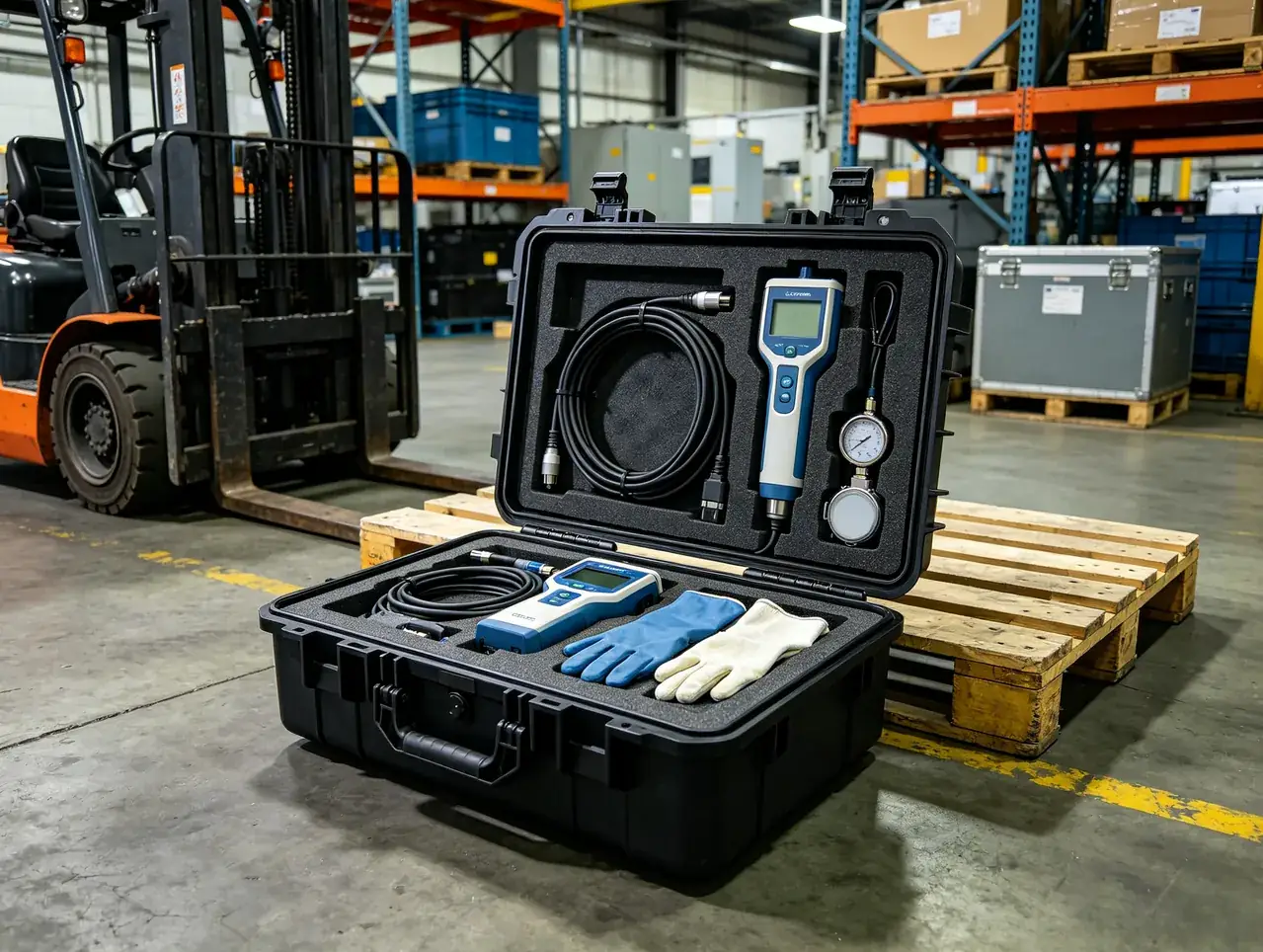
Combining the risks above, JUNZHIJIA's typical solution for mounted plows and rotary tillers contains five modules: an integral injection-molded waterproof shell, a contour-cut compartmentalized EVA liner, an independent rust-prevention coupler cavity, a reinforced load-bearing base frame with metal corner guards, and an optional wheel-and-trolley handle frame for mobility.
The shell comes in multiple sizes covering everything from small mounted plows to wide rotary tillers. The liner is cut piece by piece according to the customer's implement list, so every part has its own position. The accessory box is removable for easy inventory and replenishment. The manufacturer is Kexin New Materials (Guangdong) Co., Ltd., which relies on its own tooling and injection lines to keep quality consistent even at small batch sizes.
For dealers and service networks, this "one implement, one case" approach significantly lowers transit loss and turns previously uncontrolled knocking and rust into a standardized, reusable protection process.
Hinges and latches are high-cycle points that often fail before the shell does. If a plastic case uses an ordinary metal hinge, repeated opening wears the mounting holes, play develops, and once the lid tilts the sealing line fails with it. The heavy-duty hinge in JUNZHIJIA's structure plan uses an extended through-shaft that spreads load along a longer section of the case rim, sharply reducing stress at any single point. Latches are preferably adjustable, so tension can be re-set after some service and the gasket still seals even when it has taken a slight compression set. For a branch that opens a case several times a day, these two investments pay back faster than simply thickening the walls.
Handles and lifting points must likewise be designed for the heaviest condition. The loaded weight of a packed case is often far above the implement itself; adding the shell and liner, the figure can easily double. JUNZHIJIA builds reinforced handles into both sides and reserves mechanical lifting points at the base, so a forklift or hoist can move the case as a unit without crushing the walls. One principle governs here: let the machine do the work, never the human body. Manual handling produces tilting and half-dragging, the two motions most likely to overload a localized area and twist the sealing face out of shape. Designing for mechanical handling protects the case as much as it protects the worker.
Because the shell, liner, and hardware are modular, a customer can start with a base case and later add wheels, a document pouch, or a colored lid for visual management without buying a new unit. Color coding by implement type also speeds up warehouse picking and reduces the chance of shipping the wrong box to a job site. JUNZHIJIA keeps common shell sizes in stock so repeat orders and spare parts stay consistent even years later, which matters for fleets that standardize their whole implement fleet on one protection platform rather than mixing incompatible boxes from different suppliers.
Sizing, Planning, and Risk Mapping
Choosing the right size is half the success. JUNZHIJIA recommends this procedure: first list all implements and accessories to be shipped together, measuring length, width, height, and individual weight; then estimate total stacked height and confirm vehicle and storage height limits; finally reserve foam thickness and safety margin.
A common mistake is "a bigger case is safer," which leaves too much empty space and lets the heavy part sway, increasing damage. The correct approach is a cavity slightly larger than the physical combination, with foam filling the gaps. If the implement is over-length, prefer an extended case or removable end-plate case rather than forcing a diagonal placement.
For general sizing methods, see how to size a protective case and the tolerance guidance in our precision instrument case.
A sizing mistake many buyers make is choosing by outer dimension only and ignoring rated load and stacking layers. To save cost, some pick a smaller case, then overstuff it until the foam cannot close and the seal fails. JUNZHIJIA usually recommends reserving ten to fifteen percent foam compression margin and ensuring the lid, once closed, applies light pre-pressure on the implement so it cannot loosen in transit. When the same implement model is bought in quantity, a unified standard case also simplifies rotation and spare inventory, lowering management complexity across a dealer network or a service fleet that handles many units each season.
Measurement itself follows a method. For parts with a cutting edge, measure the maximum outer envelope rather than the longest single side, because edges commonly sweep outward or inward, and a single-side measurement produces an undersized cutout that will not accept the part. For rods, record the straight length and also the form of both ends; a ball end needs a larger receiving space. For a complex plow frame, trace its projected outline on a flat surface and mark the key points. That communicates far more to a liner designer than three bare dimensions. In real projects JUNZHIJIA often receives a hand-drawn outline from the customer, and as long as the labels are clear it can still be tooled, which is particularly friendly to small-batch buyers.
Stacking layers should be judged against actual storage conditions. If the warehouse uses high racks, the weight of upper cases travels through the corner columns to the rim of the cases below, and compressive strength matters more than impact strength. If cases are simply laid on the floor two or three high, the feet and lid carry the load. JUNZHIJIA asks about the stacking method during planning, because the same case has a different structural check depending on whether it goes on a rack or on the floor. Export orders must also account for multi-layer stacking inside a container and the sustained load of a long sea voyage; in those conditions it is wiser to reduce stacking layers and share load on pallets than to compress the case to its limit.
Loading, Stacking, and Transport Precautions
Even with a qualified case, wrong loading wastes the effort. JUNZHIJIA advises: after packing, weigh and label the case, marking "this side up" and the center of gravity; in the compartment, strap the case to the side rails and place anti-slip boards between layers; when stacking, align the load-bearing columns so upper weight rests on them, not on the lid.
For long cross-regional routes, check strap tension midway, especially after rough road sections. Load and unload under a rain shelter when possible. Although the case itself is IP67, avoid splashing mud into the cavity when opening. For implements with hydraulic parts, wipe the coupler clean before installation and confirm no sand remains, following the clean-assembly tip in our agricultural machinery parts case.
A practical loading habit is to photograph the packed case before sealing and again after strapping in the vehicle, then share the photo with the receiving side. This small step creates a clear record of condition at handover and helps resolve any dispute about damage occurring in transit versus before shipment. For fleets running many cases, a simple numbering system on the shell and a matching record in the workshop log turns protection into a measurable process rather than a matter of chance, which is the real difference between occasional success and consistent, repeatable safety across a busy agricultural calendar.
One more step deserves its own emphasis before loading: verifying that the contents match the packing list. This looks like an administrative task, but it directly affects protection quality. If a part is absent, the cutout reserved for it becomes an empty cavity, and neighboring parts shift toward that void during transit, changing the pressure distribution in the foam. JUNZHIJIA recommends ticking off each item before sealing and writing the part numbers and quantities on the outside label. The receiving side can then verify at a glance when the case is opened, which protects the parts and makes handover responsibility unambiguous.
Inspection along the route can be standardized as well. On a long journey, set at least three checkpoints: confirm the initial strap tension shortly after departure, re-check at a rest stop, and confirm once more before arriving. The check itself is simple. Look for any shift of the case, any slack strap, and whether the lid latches are still under compression. Many customers report that this plain habit let them spot an under-supported compartment after the very first trip, which they then corrected in the next revision of the plan. A protection plan is not fixed forever at handover; it converges, trip by trip, onto the configuration that best fits a specific implement combination.
Storage and Maintenance: Extending Implement and Case Life
During the off-season, the protective case is itself an ideal long-term storage container. Before storage, remove surface mud from the implement, place a VCI module in the coupler cavity, then seal the case and keep it in a dry, ventilated place, not directly on the floor. The case itself needs regular care: check whether the silicone gasket is aged or cracked, clear debris from the lid drain channel, and touch up rust spots on metal corners.
If the foam liner is stained with oil, wipe it with a neutral cleaner and dry it. If severely deformed, contact JUNZHIJIA to replace the specific module rather than scrapping the whole case. For storage rules, see our case warehouse storage rules.
Good maintenance lets one case serve for years. Amortized per transit, the cost is low, far less than one repair for a chipped share edge or a leaking coupler.
Another storage task is controlling sustained stacking load. Three layers being fine for a short trip does not mean three layers are safe for a whole off-season. Continuous compression makes engineering plastic creep slowly, and creep accelerates in high summer heat when material stiffness drops. JUNZHIJIA recommends limiting long-term storage to two layers or less, or using racks to hold cases in batches so each shell carries only the weight of its own contents. For cases that have been in service for several years, inspect the rim for slight bowing before each season, and check whether the gap between lid and body is still even after closing. When those signs appear, reduce the load or retire the shell.
Continuity of spare parts is part of maintenance too. Gaskets, foam modules, latches, and metal corner guards are all replaceable. If the supplier can still provide matching parts years later, the shell can stay in service far longer. JUNZHIJIA keeps tooling and parts inventory for its common case sizes, which supports later repurchase and also means an older customer's shell can adapt to a new implement by changing only the liner. In practice this model of "long-life shell, liner renewed with the part" costs less than buying a complete new case each time, and it moves in the same direction as resource circulation and waste reduction.
Industry Application Scenarios
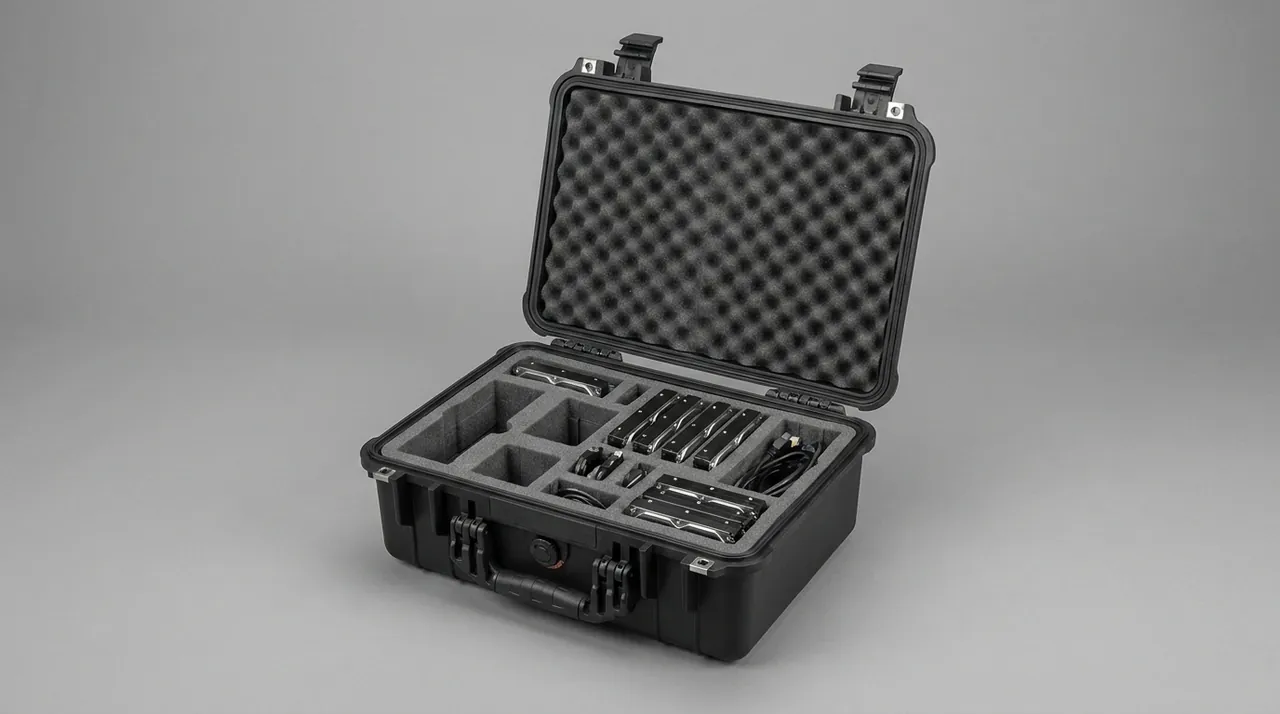
These cases are used widely in practice. Provincial agricultural equipment retailers pair each sold mounted plow with a standard transit case to raise delivery professionalism. Cross-regional service crews seal implements in cases at season end and put them straight to work the next year. Original equipment after-sales networks use them to transfer damaged three-point linkage members and hydraulic couplers, reducing secondary damage.
In the broader agricultural protection system, the agriculture spray equipment case, the same agriculture spray equipment case, and the water treatment equipment case follow the same logic, applying separation, cushioning, sealing, and rust prevention to specific parts.
JUNZHIJIA also accepts non-standard customization. When the implement combination is special and a standard case cannot cover it, we provide end-to-end service from surveying and tooling to small-batch delivery, helping customers minimize transit loss.
Beyond dealers and service networks, large farms and agricultural cooperatives are also important users of these cases. They often own multiple mounted plows and rotary tillers with frequent cross-field and cross-season scheduling, and implements concentrate in storage during the off-season. After unified casing, transit is safer and inventory counting is clearer: each implement maps to a numbered case, and missing accessories are obvious at a glance. For export-oriented businesses, the case also meets cross-border requirements for packaging strength and moisture resistance, reducing claims disputes after the destination port opens the container and finds damaged goods.
The same thinking extends to other implements. The baler parts case in the silage and hay chain, the planter and seeder parts case in precision sowing, and the sprayer boom component case in field protection all face one identical set of conflicts: precision parts fear vibration, edged parts fear collision, and metal parts fear moisture. Only the geometry and weight distribution differ. On cross-category projects JUNZHIJIA reuses the same risk breakdown and validation sequence, then adapts the liner and load structure to the specific part, which is what makes it possible to deliver several non-standard solutions in a short period.
From Risk List to Protection Configuration
Turning the risks above into concrete configurations requires a clear derivation path. JUNZHIJIA starts with a risk list: list the objects down one axis, such as hitch pins, plow-share edges, hydraulic quick couplers, three-point linkage members, and small accessories, and list the failure modes along the other, such as impact, compression, moisture, micro-abrasion, displacement, and mixed parts. Then mark each intersection high, medium, or low. Once the table is filled, the priorities appear on their own. High-risk intersections must be solved first; medium and low risk can be traded off against cost.
The second step is translating risk into structural language. Impact maps to separation and energy absorption, which means rigid dividers and cushioning foam. Compression maps to spreading load, which means support blocks and wider contact faces. Moisture maps to sealing and inhibition, which means gaskets and inhibitor modules. Micro-abrasion maps to eliminating relative movement, which means locating cutouts and pre-pressure. Mixed parts map to compartmentalization and labeling, which means separate pockets and tags. A plan can be checked line by line against these mappings, and whatever is missing can be added deliberately instead of by feel.
The third step is setting priority and allocating budget. Almost no customer can afford every option at the top specification at once, so the essential must be separated from the optional. JUNZHIJIA's guidance is that separation protecting cutting edges and precision mating faces is non-negotiable, because that damage is irreversible. Sealing and rust prevention are equally essential, because the working environment of agricultural machinery makes moisture unavoidable. Vibration control and stacking can be configured to match transport distance and storage conditions. Directing budget first to irreversible damage gives the best overall return. By contrast, spending on appearance and extras while neglecting edge separation means the savings disappear in a single repair once a share chips.
The fourth step is verification and iteration. After delivery, confirm effectiveness through actual shakedown runs: observe foam compression marks, part displacement, the state of sealing faces, and metal surface condition, then feed the findings into the next configuration adjustment. This loop of list, translate, trade off, and verify makes protection configuration a transferable, trainable method rather than something that depends on individual experience. For a multi-branch dealer, that means every location can achieve the same protection quality, and no batch of implements is damaged because one technician happened to overlook a step.
Frequently Asked Questions
Q: Why can't a mounted plow be shipped with just a wooden crate or straw rope? A: A wooden crate and straw rope are soft restraints. On the road, the implement slides and scrapes inside the box, and the plow-share edge and three-point linkage members are the first to chip or bend. A wooden crate does not resist moisture; left outdoors in rain it absorbs water and warps while the implement inside rusts quickly. Straw rope cannot isolate micro-abrasion between metal parts, and pin threads chew each other until the nut will not screw on in the field. There is also a hidden cost in labor. Every transit requires finding new timber and re-tying everything, and the quality of that work depends on which person is on shift. A protective case uses a rigid shell to resist impact, foam to locate and separate parts, IP67 sealing, and VCI rust prevention, turning uncontrolled knocks and dampness into a standardized procedure with the same result every time. Over a season this is far cheaper than repair and downtime, because a single chipped edge or a seized coupler can idle an entire planting window while the crew waits for parts and a workshop slot.
Q: A rotary tiller has hydraulic quick couplers; what should transit protect most? A: Protect against two things above all. First, the coupler thread and O-ring must not be scratched, because even a single scratch can become a leakage channel after installation. Second, long-term moisture must not rust the spool and seals into seizure. The case gives the coupler its own small compartment with compression-resistant foam on the floor; the coupler inserts vertically into a locator so the thread touches no hard object, and hoses follow a wall routing channel to avoid sharp bends. The compartment is sealed to IP67 and holds a VCI module, keeping the metal surface in an inert atmosphere. A third risk is easy to overlook: the plastic dust cap can work loose in transit, and grit entering the exposed port is pushed toward the spool by hydraulic pressure at start-up. Reserve a pocket for the caps and confirm each one is in place before the implement leaves the case. With these measures, return rates drop noticeably and first-time installation success rises sharply across a season.
Q: Three-point linkage members are slender and bend easily; how does the case solve this? A: Rods resist compression better than bending, so the key is two-sided limiting and spread load. JUNZHIJIA places reinforcing ribs and load-bearing crossbeams at the bottom; the rod's lying area uses high-density support foam to spread pressure. The lid interior has a matching limiting strip, so after closing the rod is clamped and cannot bounce in transit. Over-length rods get an extended case or segmented cradle to avoid protrusion that could be struck. During loading and stacking, align the load-bearing columns so upper weight transfers through them rather than pressing on the lid. Pay special attention to the adjustable top link, where both threaded ends are the weakest points: fit a ring support at each end so load bypasses the threads, and add a soft collar around the sleeve. Also inspect ball joints at lift-arm and lower-link connections, since an oval-shaped ball end causes rattle after installation. These steps prevent the permanent set and kinks that ruin field alignment and tillage evenness for a whole working season.
Q: Is IP67 really necessary for implement transit? A: It is highly advisable. Implement transit is rarely a clean environment; loading often happens straight from a muddy field or at an open transfer yard. Rain, mud, and dew enter through seams and cause rust plus electrical faults. IP67 means thirty minutes of immersion at one meter with no ingress and complete dust exclusion. With a silicone gasket and a waterproof breathable valve, it balances internal and external pressure while blocking water. For smart implements with electronic modules this is critical. Even when not submerged, IP67 means daily rain, wash-water, and humid storage no longer threaten the internal metal parts. Remember that the hard part is not surviving immersion once but surviving repeated opening and closing: a gasket takes a permanent compression set after enough cycles, so it should be a replaceable part rather than a sealed-in one. A shallow drain channel around the lid also helps, because it keeps rainwater from pooling at the closing face and being carried inside when the case is opened.
Q: Will VCI vapor rust prevention damage implement coatings or rubber parts? A: Used correctly, no. VCI forms a protective film through inhibitor molecules in the enclosed space, effective on steel, cast iron, and aluminum without oil. But some non-ferrous metals, special coatings, and certain rubbers are sensitive to inhibitors. JUNZHIJIA confirms the implement material at the planning stage and selects a compatible formula. Rubber seals such as coupler O-rings are generally not in direct contact with VCI but sit in a separate isolated cavity. The customer only places the specified inhibitor bag or module before sealing; parts come out ready to install, rust-free and uncontaminated on the mating faces. One practical point is that a module has a finite life, and its release rate depends on temperature, humidity, and how often the case is opened. Check condition each quarter on frequent short-haul runs, replace modules during the annual off-season inspection for long-term storage, and place modules in separate zones when zinc-plated and blackened parts share a case, since sensitivity differs between surface treatments. Sealing and inhibition are also complementary rather than alternative, because a case breathes with day and night temperature swings and can form dew inside even without any water ingress from outside.
Q: Can one case hold both a mounted plow and a rotary tiller? A: It depends on the size and weight combination. If both are small and the total weight and height are within the case's rated range, a compartmentalized liner can give the plow frame and tiller rotor separate zones while accessories go into an independent box, enabling shared transit. But a large wide implement already exceeds a single case; forcing both inside creates excess void and unstable center of gravity. The correct method is to measure every part's length, width, height, and weight first, then choose a cavity slightly larger than the combination with foam filling the gaps. Remember to take the maximum outer envelope for edged parts, not the longest single side, or the cutout will be undersized. Over-length parts should use an extended or removable end-plate case rather than a diagonal squeeze. If two implements are used in rotation instead of together, a shared shell with interchangeable liner modules is often the most economical answer, as long as the heavier implement still sits within the rated load.
Q: How should the case itself be maintained for long service? A: Focus on the seal and metal parts. Before storage, clear surface mud from the implement, place a VCI module in the coupler cavity, then seal and keep the case in a dry ventilated place off the floor. Regularly inspect the silicone gasket for aging or cracking, clear the lid drain channel, and touch up rust on metal corners. If foam is oil-stained, wipe with a neutral cleaner and dry; if severely deformed, replace the specific module rather than scrapping the whole case. Another dimension is sustained stacking load. Three layers may be acceptable for a short trip, yet continuous compression through a whole off-season lets engineering plastic creep slowly, and creep speeds up in summer heat. Limit long-term storage to two layers or less, or use racks so each shell carries only its own contents. Before each season, check the rim for bowing and confirm the lid-to-body gap closes evenly. Under this care one case serves for years, and the per-transit cost stays far below a single repair for a chipped share edge or a leaking coupler.
Q: Can JUNZHIJIA do non-standard customization and small batches? A: Yes. When the implement combination is unusual and a standard case cannot cover it, JUNZHIJIA provides end-to-end customization from surveying and tooling to small-batch delivery. With in-house tooling and injection lines, quality stays consistent even at low volume. The typical flow is: the customer sends a physical sample or three-dimensional data; the engineering team confirms compartment layout, foam density, and load structure; a sample is made and approved before mass production. Custom cases still include IP67, VCI rust prevention, and shock design, helping dealers, service shops, and original equipment makers minimize transit loss. The sample stage should never be skipped, because only a physical trial assembly reveals problems with cutout depth, accessory positions, and the order in which parts are packed and removed. That single round of verification usually saves far more than the higher cost of reworking after mass production has already started, and it also gives the customer a chance to confirm that daily handling feels natural before any tooling is committed.
Related Reading: