

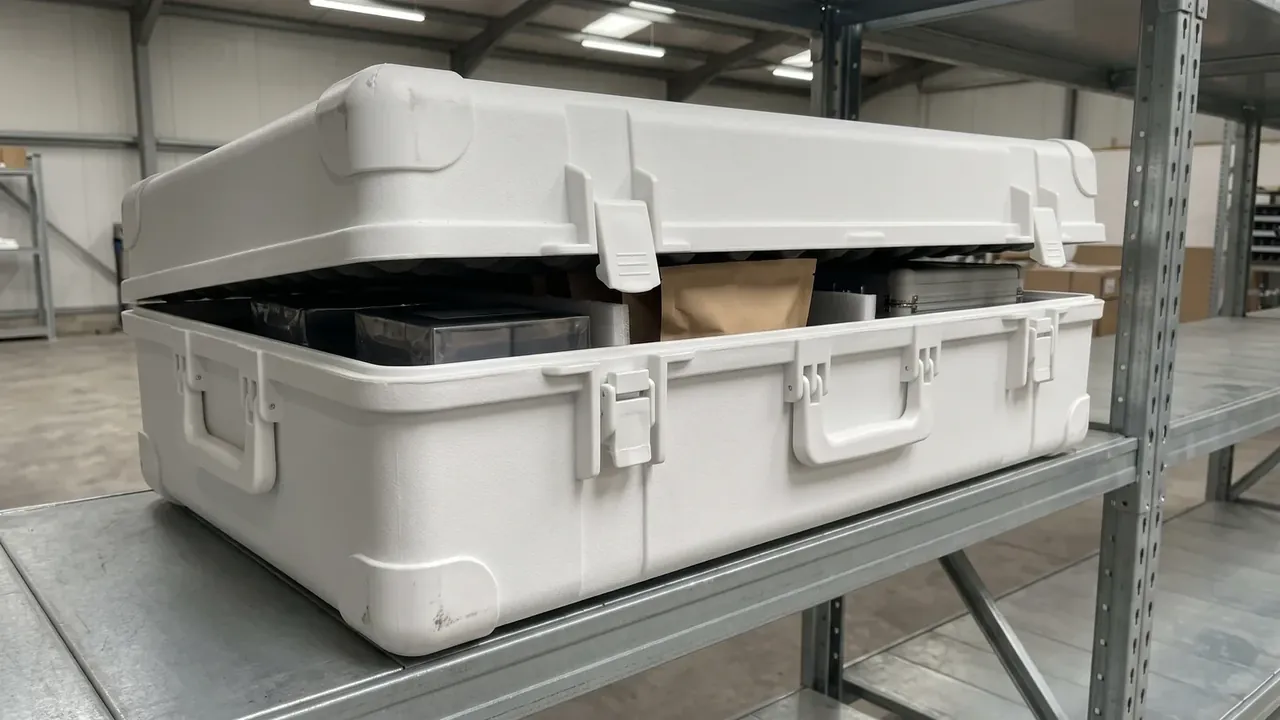
Quick answer: Rotomolded vs injection molded case comes down to three figures: 4 to 8 mm walls against 2.2 to 3.2 mm, a 1.5 m loaded drop at −30 °C that only whitens against 40 percent impact retention at −20 °C, and tooling at EUR 7,000 to 11,000 against EUR 44,000 to 68,000. The third sets the volume at which you switch.
Table of contents
- One Shell or Two Halves
- Wall Thickness, Stiffness and Weight
- Impact: Drop Height and Fracture Face
- Unit Cost and the 8,000-Unit Crossover
- Four Site Conditions That Decide It
- FAQ
1. One Shell or Two Halves
Injection moulding needs two cavities: lid and base are shot separately, then hardware is fitted. Rotational moulding charges powder into one tool, heats it on two axes, and the shell leaves the oven as one piece.
Cycle time decides the rest. Injection runs 60 to 90 seconds per shot, so a 650-tonne press makes about 800 lids a day. Rotomoulding takes 22 to 28 minutes, with a 4:1 axis ratio and 260 to 300 °C oven air. Twenty times the cycle cannot be recovered on machine rate, only on cheap tooling and low volume.
The process also leaves marks on the part. An injection moulded case carries a parting line, a gate mark and a rib grid, and holds ±0.2 mm. A rotomolded case has no weld line and low built-in stress, but wall thickness follows the powder charge, so ±0.8 mm is normal.
| Item | Rotomolded case | Injection molded case |
|---|---|---|
| Forming | Powder fused on two axes, one shell | Lid and base shot separately |
| Cycle | 22 to 28 min per mould | 60 to 90 s per shot |
| Tooling | Welded aluminium, EUR 7k to 11k | Steel mould, EUR 44k to 68k |
| Wall | 4 to 8 mm, set by powder charge | 2.2 to 3.2 mm, set by cavity |
| Tolerance | ±0.8 mm | ±0.2 mm |
2. Wall Thickness, Stiffness and Weight
Two 60-litre cases, same cavity. The rotomolded body runs a 6 mm wall at 8.2 kg; the injection moulded body runs 2.8 mm with 1.4 mm ribs at 4.6 kg. Across 500 units by air, the 3.6 kg gap is 1.8 tonnes of chargeable weight.
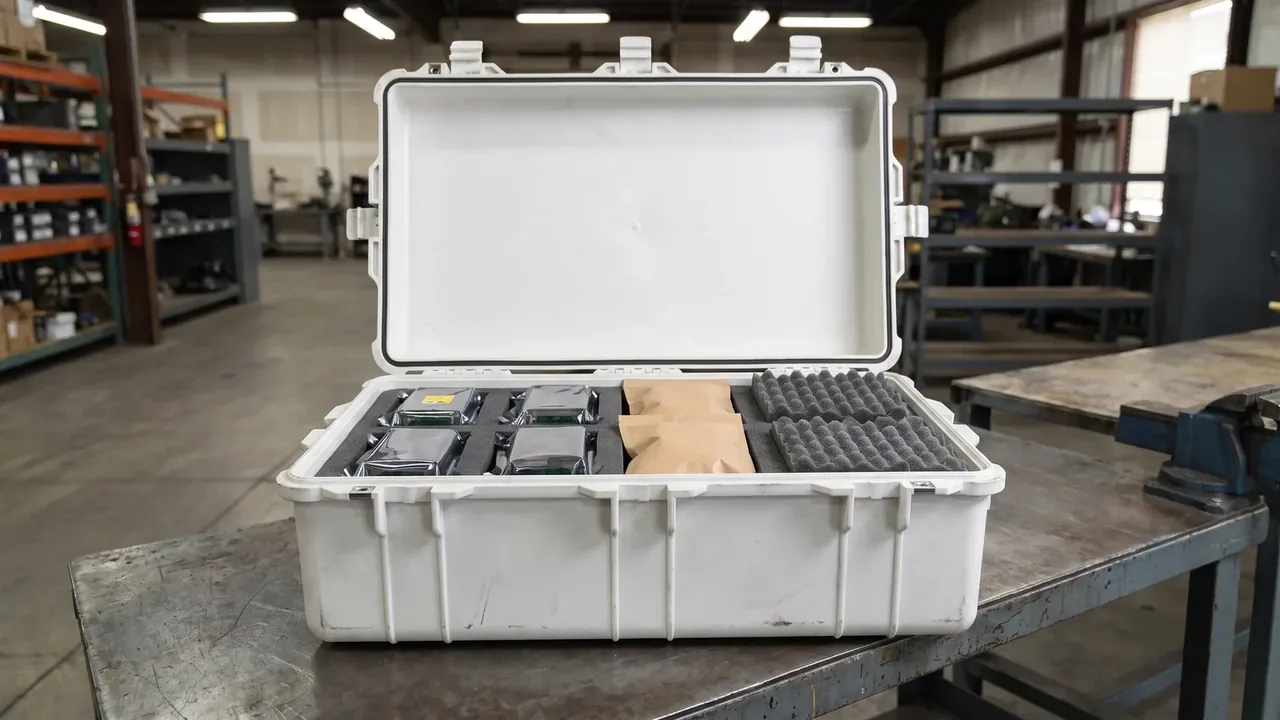
Stiffness is not thickness alone. Second moment of area scales with the cube of wall thickness, so 6 mm against 2.8 mm should be 9.8 times stiffer; the rib grid cuts the panel into 100 mm cells and measured rim deflection differs by two to three times.
Corners are where the rotomolded shell wins for free. An R25 cavity radius lets powder pool, so the corner measures 1 to 1.5 mm thicker than the flat wall — exactly where a dropped case lands. Injection can only thicken a corner with material, which sinks, so the fix is a 2 mm corner rib.
| Same 60-litre format | Rotomolded | Injection molded |
|---|---|---|
| Wall | 6 mm, ±0.8 | 2.8 mm, ±0.2 |
| Empty weight | 8.2 kg | 4.6 kg |
| Rim deflection at 25 kg | 2.1 mm | 4.5 mm |
| Loaded drop passed | 1.5 m | 1.2 m |
Gauge 12 points around the rim and 12 across the base, and judge the minimum: rotomoulded walls run 0.5 mm thin on the cold side, and a 60-litre case under 4 mm bulges by the third tier of a stack.
3. Impact: Drop Height and Fracture Face
Rotomoulded bodies are HDPE or LLDPE, brittle near −70 °C; a loaded 1.5 m drop at −30 °C whitens the corner without splitting it. Injection moulded bodies are usually ABS, which keeps 40 percent of notched impact at −20 °C, and the same drop leaves a flat, glossy face. That is brittle failure, not a scuff.
A drop report means nothing without height, faces and ballast. An empty case at 1.5 m and a 25 kg case at 1.5 m are different tests.
Five criteria belong in the order:
- Height by mode: 1.2 m parcel, 0.9 m sea stacking, 1.5 m air freight
- 4 hours at −25 °C before the drop for northern projects
- Ten drops over six faces, three edges and one corner
- Ballast at 110 percent of load, so 25 kg is dropped at 27.5 kg
- Pass means hardware intact and no ingress; whitening is allowed
One quieter point: a rotomolded shell gives a crack no weld line to follow. On an injection moulded case, the handle and latch bosses sit where melt fronts meet, and those two spots fail first.
4. Unit Cost and the 8,000-Unit Crossover
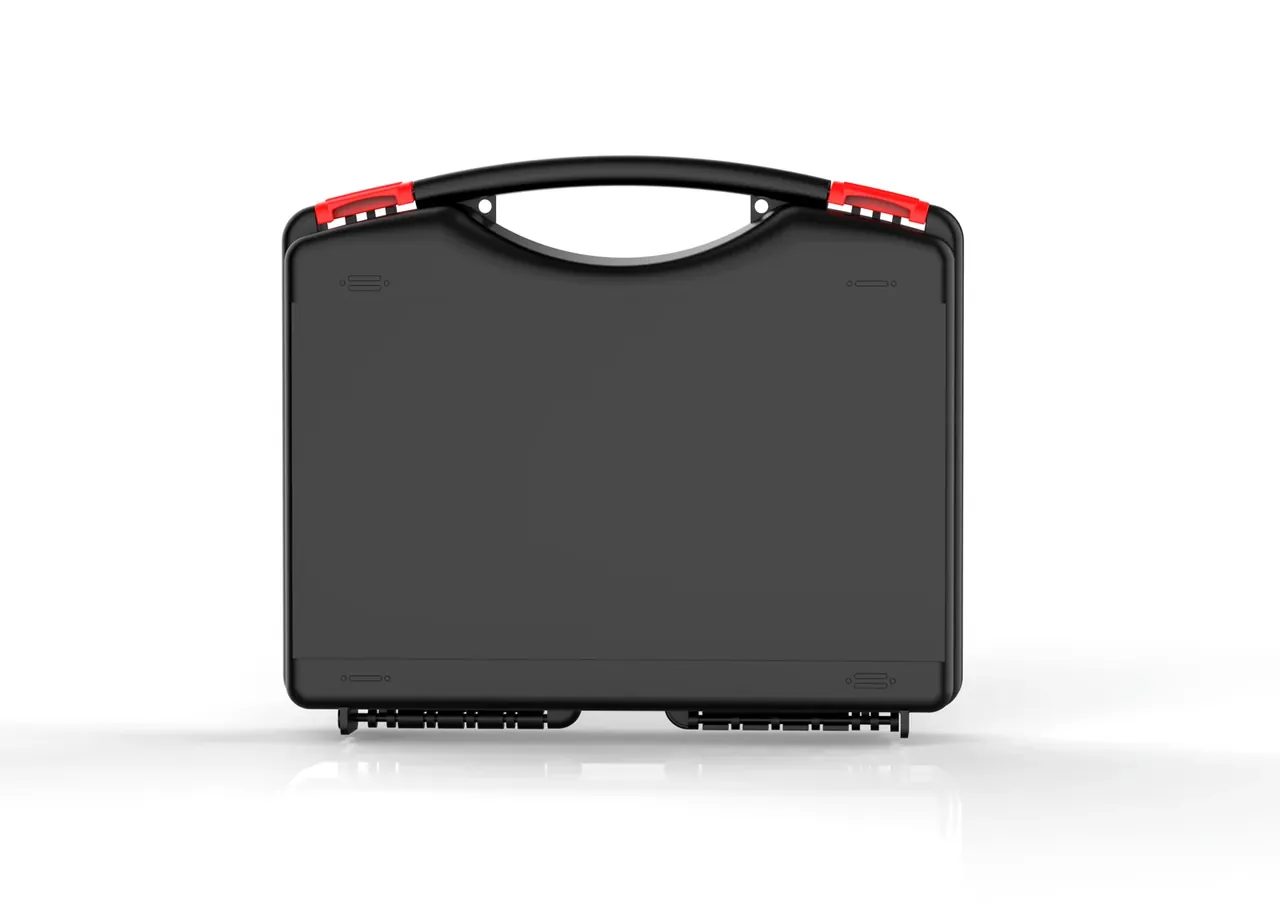
Cost has two halves. Rotomould tooling is welded aluminium at EUR 7,000 to 11,000; an injection mould runs EUR 44,000 to 68,000 and needs a 650-tonne press.
| Cumulative volume | Rotomolded (EUR 7.5k tool, EUR 16/part) | Injection molded (EUR 56k tool, EUR 10.5/part) |
|---|---|---|
| 200 | EUR 53.5 | EUR 291 |
| 1,000 | EUR 23.5 | EUR 66.5 |
| 5,000 | EUR 17.5 | EUR 21.7 |
| 10,000 | EUR 16.8 | EUR 16.1 |
The lines cross near 8,000 units. Below it, tooling pushes injection into three figures per case; above it, 22 minutes of oven time turns from advantage into overhead.
Two costs escape quotes. Moving a rib on an injection mould costs EUR 2,500 to 5,000, against under EUR 400 for a new aluminium plate. Freight adds about EUR 4 per case by air for the heavier body.
5. Four Site Conditions That Decide It
Process choice follows four hard conditions. Miss one and the answer flips:
- Below −25 °C in service: rotomoulded
- Over 8,000 units a year where weight is charged: injection moulded
- ±0.2 mm assembly, metal inserts or a clear window: injection only
- Above 120 litres or 15 kg per unit: rotomoulding, whose tooling grows slowly with size
Never mix hardware across the two. Latch seats are moulded at ±0.15 mm on an injection body and drilled at ±0.5 mm on a rotomolded one; the same latch seals one and sits loose on the other, and the leak appears in the rain, not on the bench.
Sampling settles it faster than a datasheet: three ballasted units each, ten drops.
Conclusion
Wall thickness sets the protection ceiling, impact behaviour decides whether cold and drop conditions are met, and tooling amortisation decides the volume at which you switch. 8,000 units is the cost line, ±0.2 mm against ±0.8 mm the accuracy line, −25 °C the material line.
This article discusses only the container (case body) side of specifications and design intent, and does not cover any handling, loading or use of the contents.
Related Reading
- How rotational moulding forms a case
- The four stages of injection moulding a case
- Rotomolded cases against other options
- Press tonnage versus case projected area
Related Products
- 8 Series — Gun Cases; Military Equipment Cases; Camera Equipment Cases; Drone Cases; Watch Cases; Knife Cases; First Aid Cases; Electronics Equipment Cases
- WL8-2812 PP Gun Case — model WL8-2812
- All protective cases and toolboxes: 7 series, 158 models