

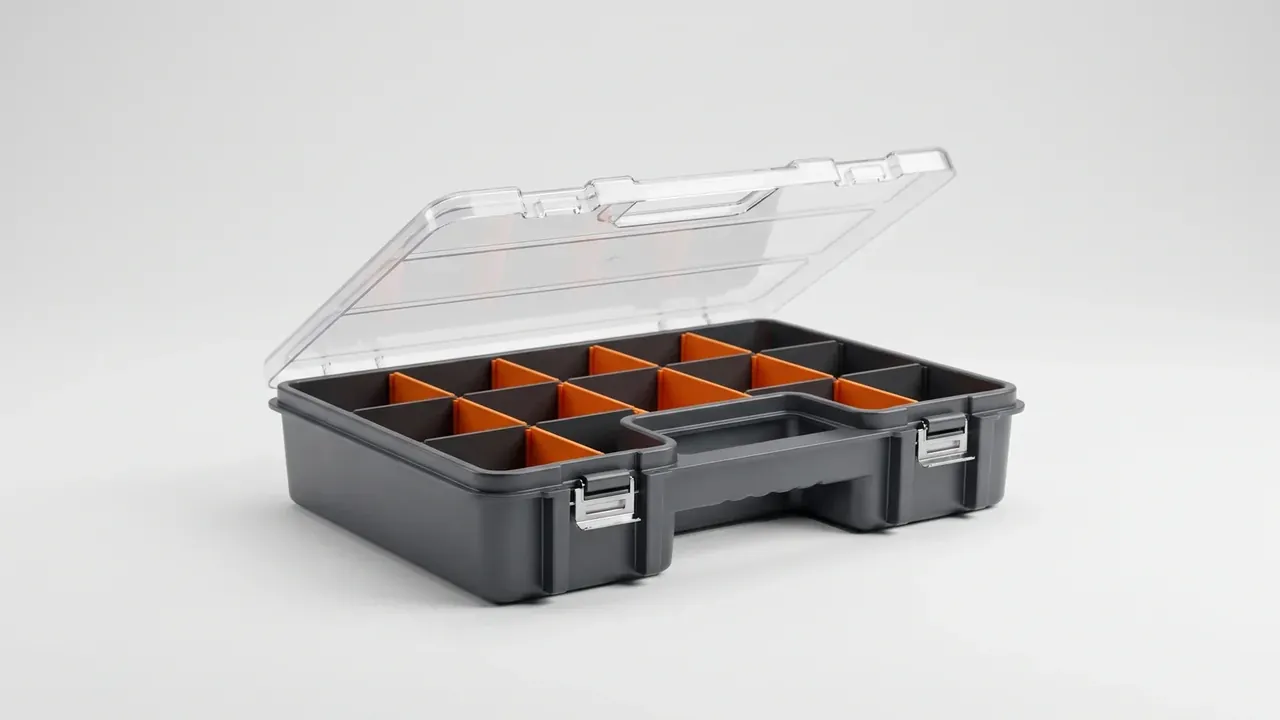
Quick answer: A rotomolded case takes over general tool handling, damp bays and wash-down areas, and it loses to sheet steel wherever gauges, hot parts or shielding are involved, so the decision rests on four figures rather than on material preference.
Table of contents
- Where the replacement boundary sits
- Wall thickness and cold impact: 5–8 mm against 1.5 mm steel
- Damp, salt fog and static: not rusting is not enough
- Load and tolerance: two figures that mislead
- Repair, noise and unit cost
- FAQ
1. Where the replacement boundary sits
A rotomolded case can replace a metal tool box when four readings agree: wall thickness under cold impact, behaviour in damp and static-prone bays, load against a full tray of spanners, and tolerance against gauge location. Pass three and the swap works.
The steel box is 1.0–1.5 mm cold-rolled sheet, folded, spot-welded and powder-coated. A rotomolded case is PE powder turned on two axes at 260 °C inside a mould, then cooled into a 5–8 mm seamless shell.
Replacement comes in three steps: transport boxes first, wheeled heavy-duty boxes second, gauge boxes last.
| Situation | Better fit | Reason |
|---|---|---|
| General shop-floor handling | Rotomolded case | No rust, washable |
| Gauges and calibration tools | Metal tool box | Sheet tolerance ±0.5 mm |
| Welding and grinding bays | Conductive rotomolded case | 10⁶–10⁹ Ω surface |
| Hot parts in transit | Metal tool box | PE softens near 120 °C |
2. Wall thickness and cold impact: 5–8 mm against 1.5 mm steel
Wall thickness is the first reading. The 5–8 mm on a rotomolded case is as-moulded, with floor and lid at the top of the band, side walls at the bottom and a 3 mm spread counted as normal; the 1.5 mm on a steel box is nominal sheet measuring 1.55–1.65 mm once coated.
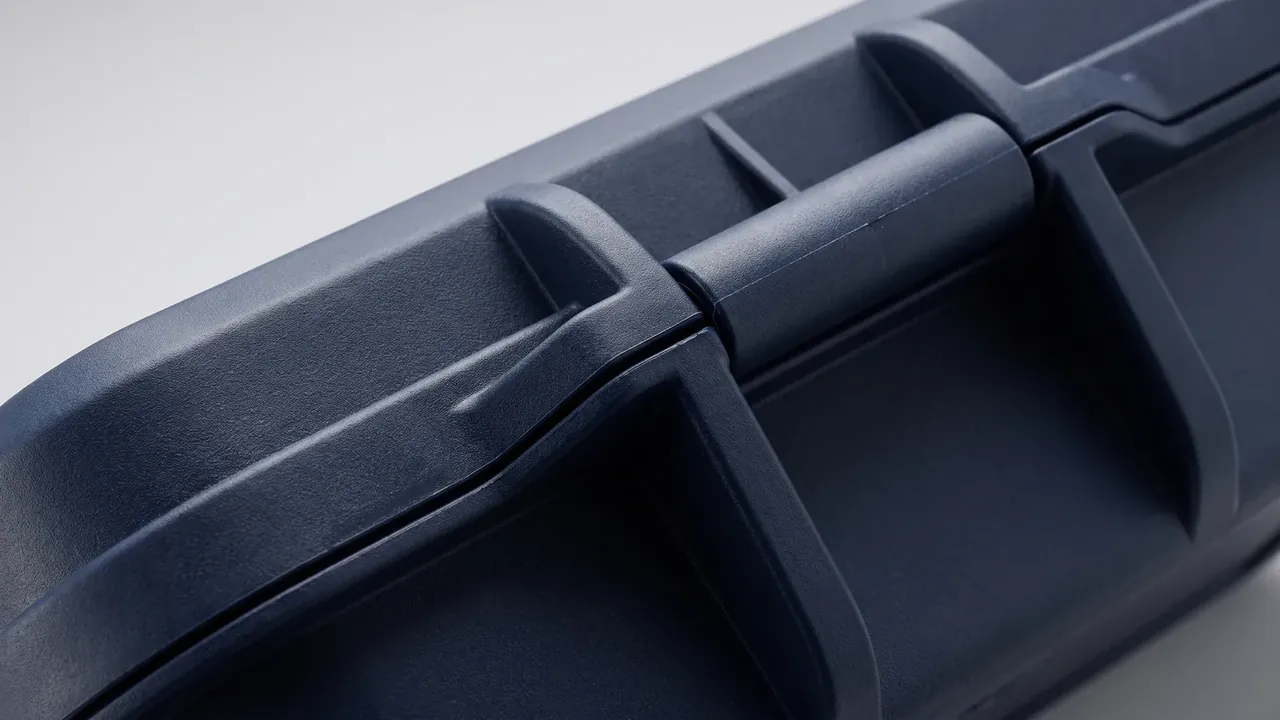
Cold impact turns the comparison: a 5 kg tup dropped 1 m onto an edge at -40 °C leaves an HDPE rotomolded case dented and whole with 0.4–0.8 mm of thinning, while 1.5 mm cold-rolled steel takes an 8–12 mm dent, splits its coating and rusts within 72 hours.
Steel wins on stiffness, not toughness: a folded 1.5 mm section carries 2.6 times the bending modulus of an 8 mm PE panel, so an empty steel box stacks better, yet the impact stays as a dent.
Temperature separates them too: low-carbon steel does not embrittle at -40 °C, it only loses impact energy, while PE keeps about 20 kJ/m² of notched impact strength if the resin is high-density copolymer.
| Item | Rotomolded case | Metal tool box | Check |
|---|---|---|---|
| Wall | 5–8 mm, one piece | 1.0–1.5 mm sheet | Five-point mean |
| Welds | None | Spot welds and folds | Visual, tap test |
| Impact at -40 °C | Dents, no crack | 8–12 mm dent | 5 kg tup, 1 m |
3. Damp, salt fog and static: not rusting is not enough
In damp service the steel box fails from its coating outward: electroplated zinc runs 8–12 μm and, once scribed, creeps 1.5–2 mm per side within 48 hours of salt fog, with rust travelling the fold seam until it lifts the hinge seat. Powder coat covers edges at only 60% of the flat film.
The rotomolded case has no such failure mode: PE does not rust, absorbs under 0.01% water, takes a hose-down and shows no body change after 500 hours of salt fog. What remains is hardware; in 304 stainless the corrosion performance is set by the plastic.
Static is the real weakness. Plain PE sits near 10¹⁴ Ω, an insulator that gathers dust by friction in welding and painting bays and can ignite a flammable atmosphere. Conductive carbon black brings the surface to 10⁶–10⁹ Ω, low enough to bleed charge without spark concentration.
A steel body conducts below 1 Ω but only when bonded to earth, and dragging it across a floor wears that point back to paint.
4. Load and tolerance: two figures that mislead
Load is the most misread figure: 150 kg static over 24 hours with under 3 mm deflection, but only 60 kg dynamic, the level at which the case still opens after a drop, against a steel box quoting 80 kg distributed static that a dented floor ends.
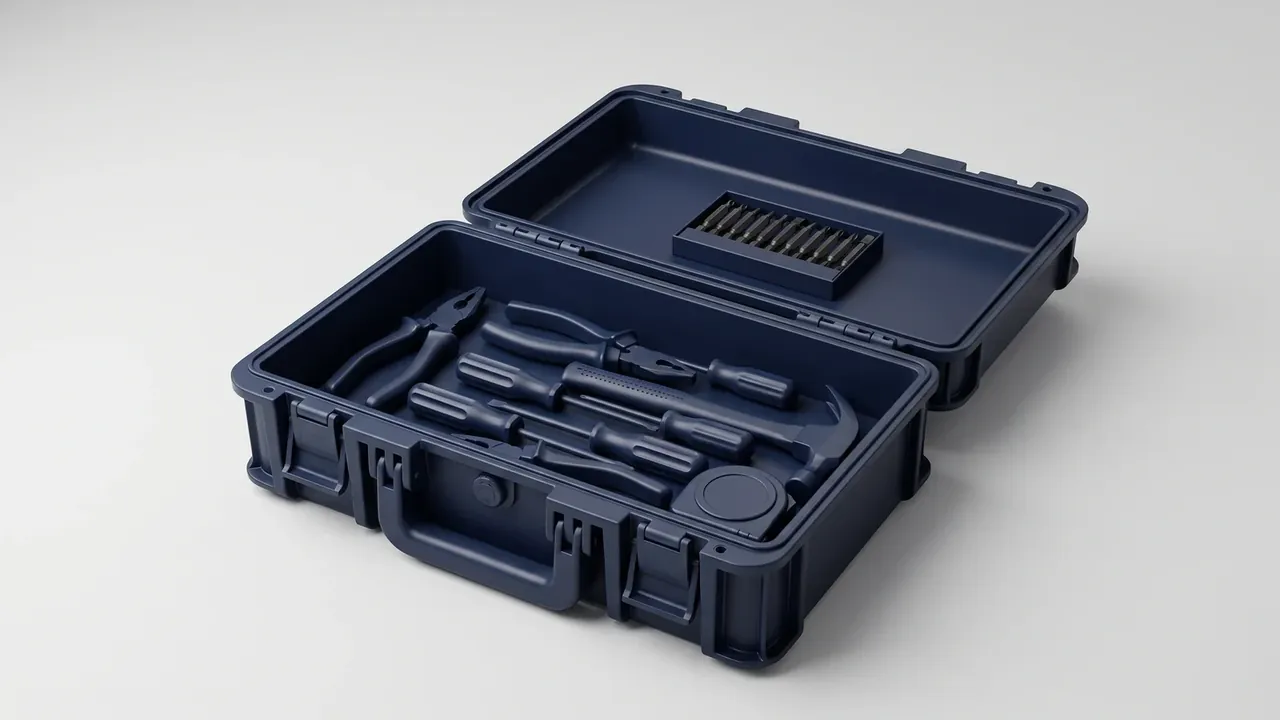
Tolerance is the steel box's moat: punched and folded parts hold holes to ±0.5 mm, so foam cuts at 0.2 mm clearance, while rotomolded parts shrink 2.0%–2.8%, putting a 600 mm body at ±12 mm and 4 mm between two cases from one tool.
5. Repair, noise and unit cost
Repair decides life. A dented steel box is hammered flat and touched up in half an hour, with the fold already fatigued; a cracked rotomolded case is welded with a PE rod at 200–230 °C and recovers about 80% of wall strength.
| Item | Rotomolded case | Metal tool box | Note |
|---|---|---|---|
| Static load | 150 kg / 24 h | 80 kg distributed | ≤3 mm sag |
| Dynamic load | 60 kg | 40 kg | Opens after a drop |
| Tolerance | ±2.0% | ±0.5 mm | 600 mm body |
| Cost crossover | Above 200 units | Below 50 units | Tooling included |
Noise separates them: dragging an empty case across concrete gives 90 dB in steel against 75–80 dB in PE.
Cost follows volume: under 50 units folded steel needs no tool at 260–340 CNY, rotomoulding needs an 18,000–35,000 CNY aluminium tool that doubles unit cost there, and above 200 units the rotomolded case falls to 120–180 CNY.
Conclusion
A rotomolded case replaces a metal tool box when four readings pass together: a 5–8 mm wall surviving the -40 °C tup, 304 hardware removing the last rust path, 150 kg static and 60 kg dynamic covering the real load, and a ±2.0% tolerance the work can live with. Tolerance rarely bends, which is why rotomolded cases took transport while steel kept gauges. Volume is the last gate: below 50 units steel is cheaper, above 200 the rotomolded case is, and between them tooling spreads across three years of replacements.
This article discusses only the container (case body) side of specifications and design intent, and does not cover any handling, loading or use of the contents.
Related Reading
- Tool box hardware compared
- Aluminium versus stainless steel tool boxes
- Hard plastic tool box applications
- Case raw material properties compared
Related Products
- 8 Series — Gun Cases; Military Equipment Cases; Camera Equipment Cases; Drone Cases; Watch Cases; Knife Cases; First Aid Cases; Electronics Equipment Cases
- WL8-2812 PP Gun Case — model WL8-2812
- All protective cases and toolboxes: 7 series, 158 models