

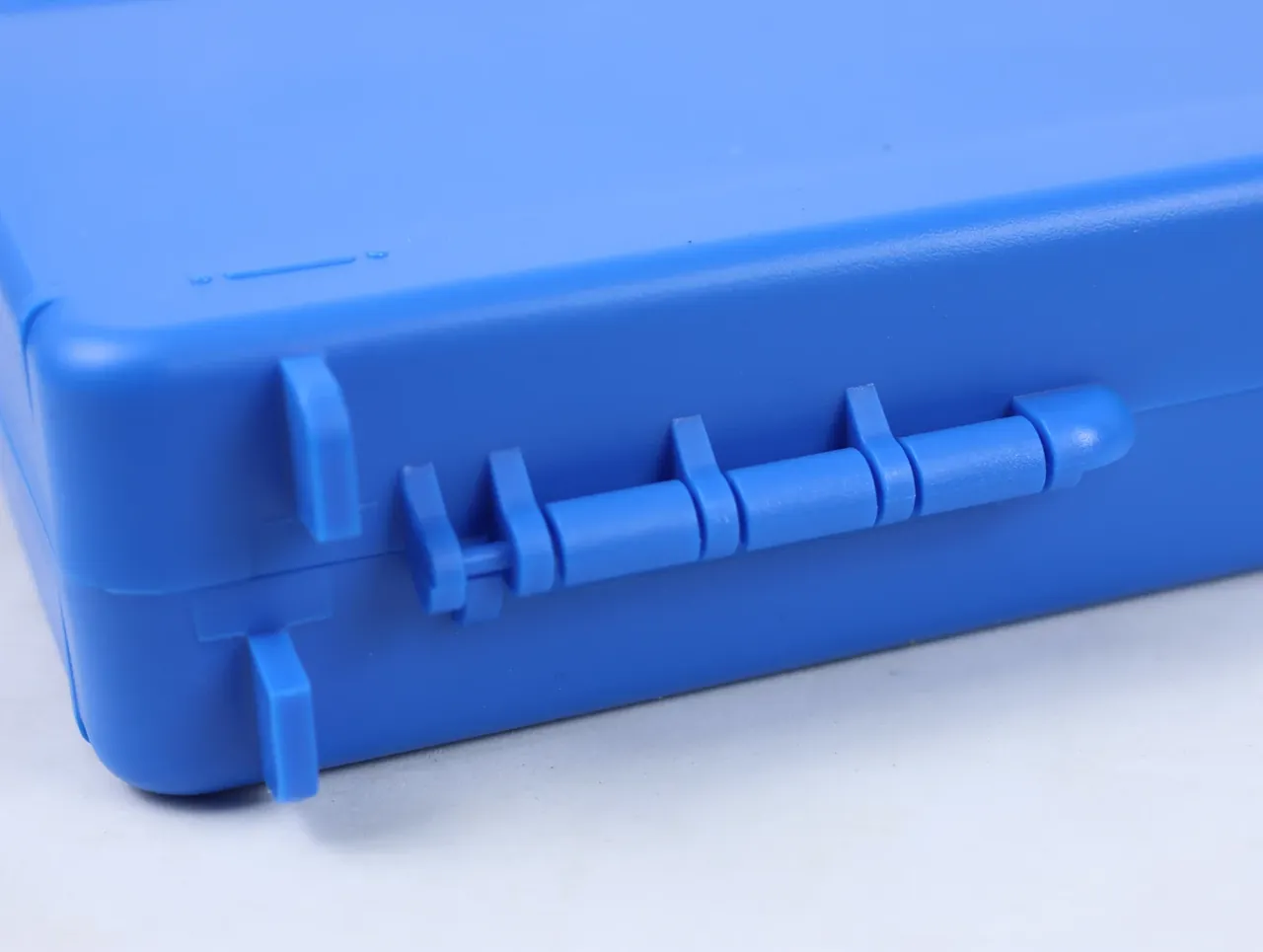
Quick answer: These 240 small plastic cases ran 14 months in a salt-laden hall and 11 came back, all on three points: hinge play, latch retention, chlorine whitening. Looks are checked at 90 days, hinge at 180, the batch at 12 months; replace at 0.35 mm gap, 25 N or ΔE 4.
Table of contents
- How Often a Small Plastic Case Needs Inspection
- Hinge and Latch Fatigue in Numbers
- Cleaner Compatibility and a Whitening Incident
- Colour Shift and Residue Thresholds
- Three Hard Replacement Lines
- Life Extension and Recheck Records
- FAQ
1. How Often a Small Plastic Case Needs Inspection
The batch landed in April 2025: 240 small plastic cases, cavity 196 by 128 by 62 mm, 1.4 mm wall, copolymer PP, six openings a day, roughly 2,500 cycles in 14 months. The schedule only settled in month three, after the first case refused to close squarely.
Humidity there sits at 78 percent at 32 degrees Celsius with salt mist, so whitening shows at the latch roots within a quarter. That sets the 90-day look; wear becomes measurable near 2,500 cycles, which sets the 180-day check.
| Check | Interval | Reject line |
|---|---|---|
| Appearance and colour | 90 days | Whitened area over 10 square mm |
| Hinge gap | 180 days | 0.35 mm, feeler gauge |
| Latch retention | 180 days | Below 25 N, pull gauge |
| Cavity size | 12 months | Any direction shrunk 0.6 mm |
2. Hinge and Latch Fatigue in Numbers
The pin measures 2.5 mm, the bore 2.65 mm, so the gap leaves the mould at 0.15 mm.
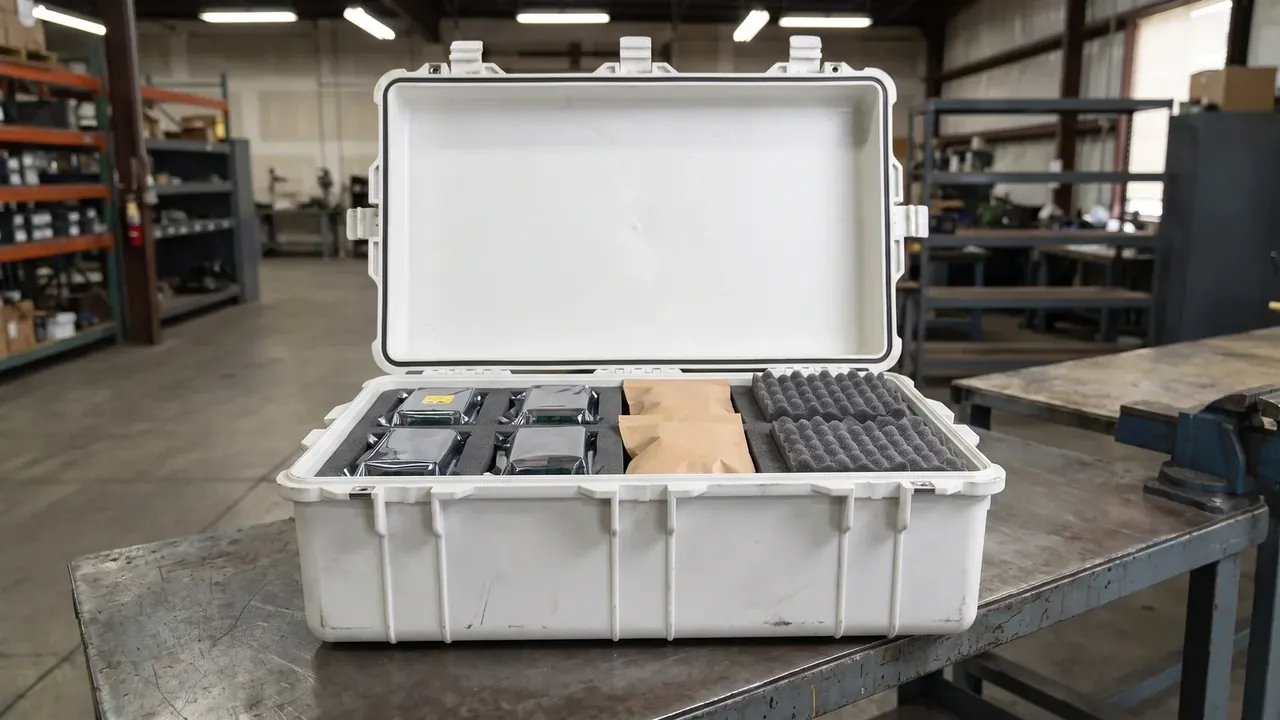
That gap drives every figure below: dry PP on PP scrapes a micron off the bore each cycle.
At 2,500 cycles the feeler reads 0.22 mm and the lid sits square. At 8,000 it reaches 0.35 mm and closing takes two presses. At 12,000 it is 0.60 mm, the lid rocks 1.5 mm and the gasket seals one edge.
Latches fade faster: 45 N at the tool, 34 N at 2,500 cycles, 26 N at 8,000, a 42 percent loss. At 19 N a latch still clicks, but only by over-travelling the tongue, so a 1.5 m drop opens three cases in ten.
| Cycles | Gap | Retention | Action |
|---|---|---|---|
| 2,500 | 0.22 mm | 34 N | Keep, watch list |
| 8,000 | 0.35 mm | 26 N | Lubricate, recheck |
| 12,000 | 0.60 mm | 19 N | Withdraw the case |
Angled lifting wore one side of the pin 0.08 mm more; overfilling pushes retention past 70 N and doubles the decay rate.
3. Cleaner Compatibility and a Whitening Incident
In June 2025 the crew switched to chlorine disinfectant at 500 mg per litre, ten-minute soak, three times a week.
By week three a milky haze covered the lids and a fingernail scraped powder off. Untouched cases survived a 1.5 m drop; whitened ones cracked at 0.8 m. Chlorine breaks polymer chains at the surface, and the chalked layer measured 0.03 mm. Twelve cases were demoted to internal use, at under 40 seconds saved per wash against 504 yuan.
What the material tolerates is short: neutral detergent at pH 6.5 to 7.5 with water below 40 degrees, 75 percent ethanol twice a week, isopropanol kept off printed graphics, and chlorine for emergencies only, three times per case.
A 30-second rinse at 60 degrees lifts the base 0.4 mm where ribs meet the floor, and it never flattens back.
4. Colour Shift and Residue Thresholds
Two cases that look identical read ΔE 2.4 apart under a D65 lamp.
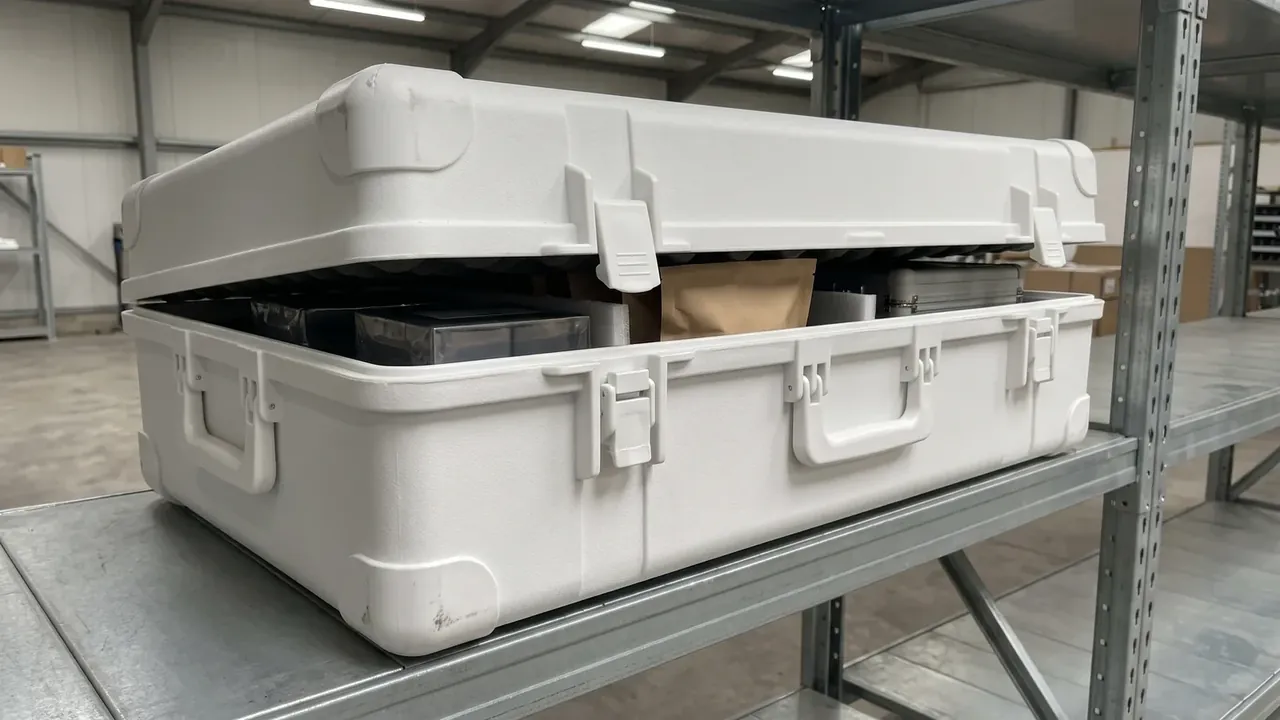
Up to ΔE 2 is normal, 2 to 4 gets a 90-day recheck, above 4 the case is replaced. Read the same face each time.
Oxidative whitening is irreversible. Residue yellowing washes off with two rinses at 40 degrees. UV yellowing appears only near the window, where 20 cases read 1.8 higher after 14 months.
Residue shows on pH paper: mist the inner wall, wait 30 seconds, and above 8 means cleaner stayed behind.
5. Three Hard Replacement Lines
Three lines retire a case: gap 0.35 mm, retention 25 N, colour shift ΔE 4.
Waiting for visible failure is wrong policy, and the latch proves it. A latch at 19 N still clicks shut, but preload is gone the moment it closes, so the case looks fine on the shelf and opens the first time it is dropped.
Money settles it: one case costs 42 yuan, so 11 replacements came to 462 yuan, while a case springing open spills about 900 yuan of parts and stops the line.
6. Life Extension and Recheck Records
Longer life comes from three habits, not a better resin: wash within 30 minutes, close the lid with a 2 mm gap after drying, stack no more than four high.
Leave washing to the next day and detergent dries into a bloom that needs a ten-minute soak, which wets the rim again. Seal the cavity for 48 hours and mould appears, leaving a pale mark that pushes ΔE past 3.
Storage stays between 5 and 35 degrees Celsius; below freezing PP turns brittle and one drop splits a corner. Recheck labels of 60 by 20 mm sit inside the lid, and the 180 cases on this routine averaged 36 months instead of 18.
Conclusion
Fourteen months on these 240 small plastic cases suggest one rule: failure announces itself in a number first. The gap ran from 0.15 to 0.35 mm over 8,000 cycles, retention fell from 45 N to 26 N across the same span, and colour jumped three weeks after the chlorine switch. Put those on an inspection sheet and a small plastic case stops being replaced on feel.
This article discusses only the container (case body) side of specifications and design intent, and does not cover any handling, loading or use of the contents.
Related Reading
- Reserve case maintenance
- Hard shell case care
- Steel box upkeep
- Injection machine care
- Explosion proof gaskets
Related Products
- 8 Series — Gun Cases; Military Equipment Cases; Camera Equipment Cases; Drone Cases; Watch Cases; Knife Cases; First Aid Cases; Electronics Equipment Cases
- WL8-2812 PP Gun Case — model WL8-2812
- All protective cases and toolboxes: 7 series, 158 models