

Quick answer: This sniper rifle case took four drafts in thirty days, and every change landed in three places: cavity length, wall thickness, latch preload. Fix those numbers and a sample can be copied; leave adjectives and the first run drifts.
Table of contents
- Where the First Sniper Rifle Case Draft Went Wrong
- Two Changes to Cavity and Wall
- Tooling: Ribs Cannot Be Moulded Solid
- Assembly: Gasket Groove and Latch Preload
- Whole-Case Testing: Drop, Pressure, Road
- The Five Numbers in the Final Revision
- FAQ
1. Where the First Sniper Rifle Case Draft Went Wrong
The brief was a pencil sketch: 1,380 mm rifle, suppressor fitted. Draft one added 40 mm of clearance and set the cavity at 1,420 mm. The sample closed, the rifle went in, and the muzzle sat 6 mm off the end wall, which is 3 mm of travel each way.
| Draft | Cavity | Wall | Change | Result |
|---|---|---|---|---|
| One | 1,420 mm | 3.6 mm | 40 mm clearance | 6 mm muzzle gap |
| Two | 1,400 mm | 3.6 mm | Clearance to 20 mm, two blocks | Lid tight |
| Three | 1,400 mm | 4.2 mm | Wall up 0.6 mm, 8 mm headroom | Mid-span sags |
| Four | 1,400 mm | 4.2 mm | Two ribs at mid-span | Signed off |
Thirty days, nineteen on cavity work. The record shows what the product is: a shell that survives a drop, blocks that hold the rifle at mid-span, and a seal-and-latch pair.
2. Two Changes to Cavity and Wall
Draft two pulled the cavity to 1,400 mm, leaving 10 mm for the end block.
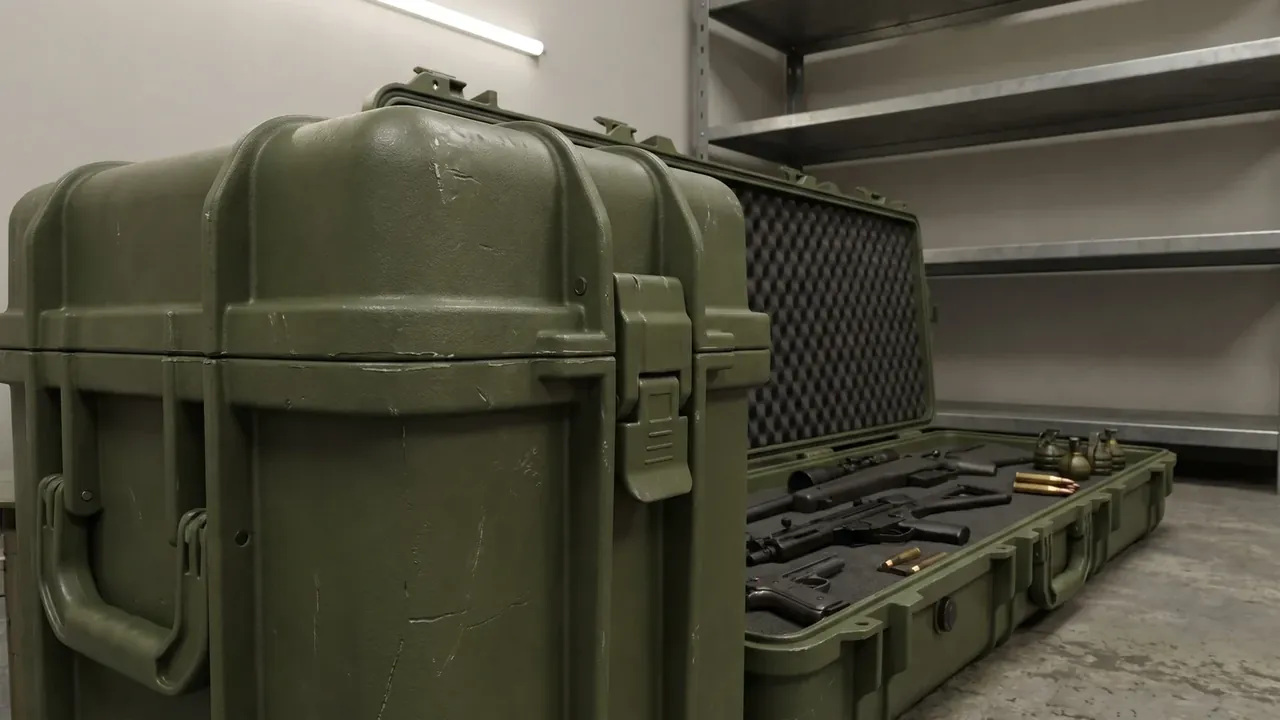
The wall went from 3.6 mm to 4.2 mm for stiffness, not puncture resistance. Loaded to 26 kg across a 1.4 m span, the 3.6 mm version with ribs at 90 mm centres deflected 3.1 mm, opening the sealing face by 0.4 mm and failing the pressure test. Ribs came first: two longitudinal, 12 mm deep, cutting deflection to 0.9 mm for 400 g. The extra 0.6 mm covers corner cracking, and together they buy a 1.2 m six-face drop with no cracks.
3. Tooling: Ribs Cannot Be Moulded Solid
Moulding the ribs solid was the expensive lesson. Trial shots showed 0.4 mm sink marks at every rib root, right where the barrel channel runs.
The cause is a wall step: 4.2 mm at the wall, 7 mm at the root, so the thick section shrinks late and drags the surface in. The fix was a stepped rib, 3 mm at the outer face, 12 mm deep inside. Draft angle went from 1.2 to 1.5 degrees, pulling cooling from 90 to 75 seconds, and flatness came in at 1.2 mm, not 1.8.
4. Assembly: Gasket Groove and Latch Preload
The groove is 9 mm wide, 7 mm deep, carrying a 9.5 mm cord at 26 percent compression. Below 20 percent the case weeps within thirty minutes; above 30 percent the cord takes a set.
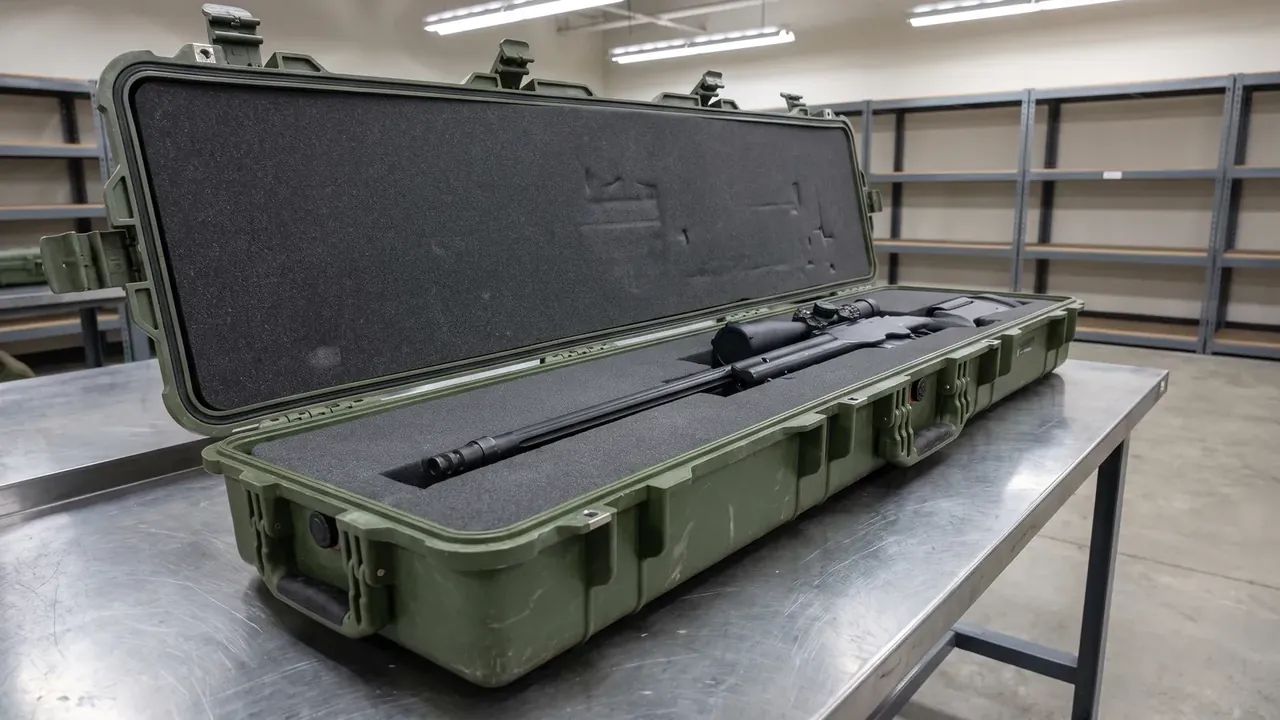
Latch preload cannot be judged by feel. Five latches run along the long side at 62 N, plus or minus 4 N; spread more than 8 N and a corner lifts. Screws go to 4.5 N·m, centre out.
- no flash in the groove, adhesive scraped
- cord joint at mid-length, glued, never butted
- 62 N per latch, 8 N maximum spread
- 4.5 N·m on screws, centre to ends
5. Whole-Case Testing: Drop, Pressure, Road
In order, nothing skipped.
| Test | Condition | Pass | Typical failure |
|---|---|---|---|
| Drop | 1.2 m, six faces, 26 kg | No crack | Rib meets radius |
| Pressure | 0.3 bar, 60 s | 0.02 bar loss | Cord joint |
| Immersion | 0.5 m, 35 min | Dry groove | Flash lifts cord |
| Road | 40 km mixed | Blocks stay put | Case slides in bay |
Two rounds, one month. The first cracked 16 mm at the rear corner; the second opened that radius to 12 mm and passed.
6. The Five Numbers in the Final Revision
The signed drawing carries five numbers into the contract: 1,400 mm cavity, 4.2 mm wall, deflection under 1 mm, 62 N per latch, 0.02 bar loss in sixty seconds.
All five can be measured and penalised. Of the four drafts, two changes paid: clearance from 40 mm to 20 mm, deflection from 3.1 mm to 0.9 mm.
Conclusion
Every change across four drafts was something a gauge reads: cavity length, wall, rib depth, latch pull, pressure loss. A sample alone makes it a rumour; write the five retests into the contract and a sniper rifle case stays reproducible.
This article discusses only the container (case body) side of specifications and design intent, and does not cover any handling, loading or use of the contents.
Related Reading
- Sniper rifle case applications and load-outs
- Sniper rifle case specifications: cavity, blocks, damping
- How a tool box body is built
- Sealing and pressure design in gear cases
- Road case bodies and wheel systems
Related Products
- 8 Series — Gun Cases; Military Equipment Cases; Camera Equipment Cases; Drone Cases; Watch Cases; Knife Cases; First Aid Cases; Electronics Equipment Cases
- WL8-2812 PP Gun Case — model WL8-2812
- All protective cases and toolboxes: 7 series, 158 models