

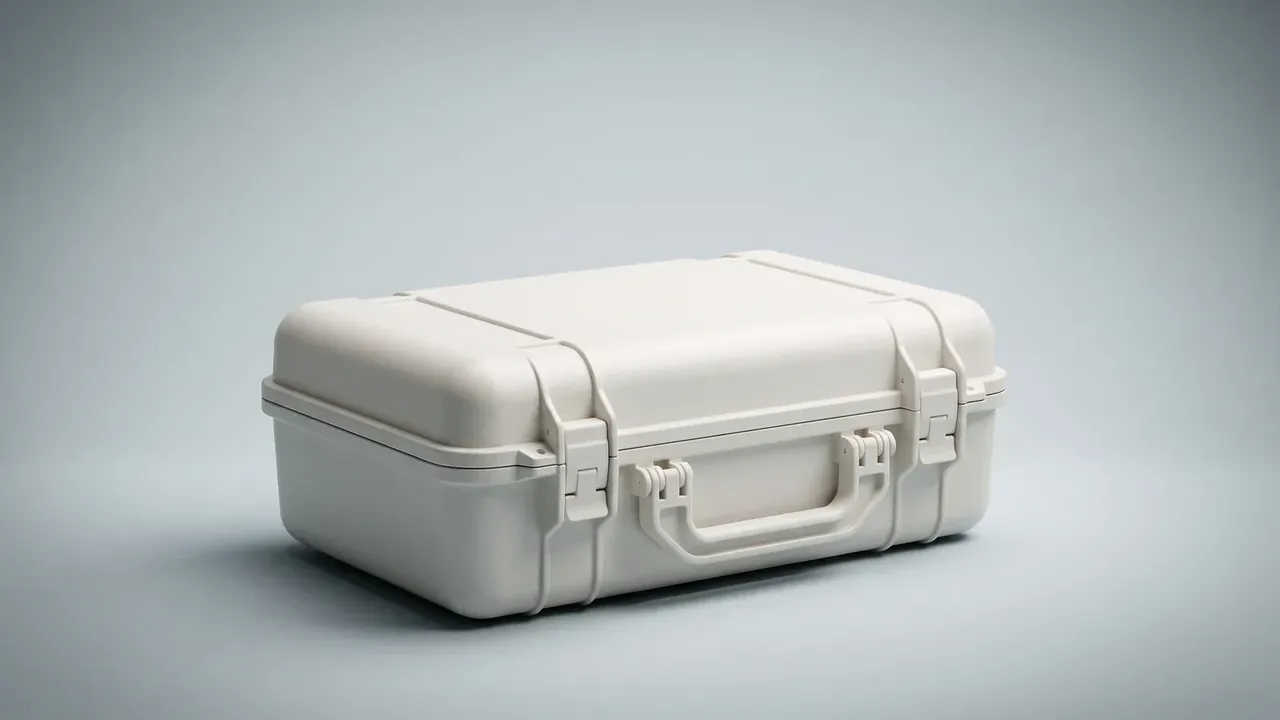
Quick answer: A 24-piece set missing its 10 mm socket costs under 12 in parts and 180 in a second call-out. A socket set plastic case buys layout instead: 26 mm pitch, 18 N clip pull-out, 4.86 kg per case.
Table of contents
- What a Missing Socket Really Costs
- Laying Out by Size: Pitch, Clips and the Size Chain
- Spotting a Gap: Five Ways to Let the Empty Slot Speak
- Holding the Ratchet and Extensions: Three-Point Support
- Kitting Out: Four Counts Before the Case Ships
- Three-Year Cost: Spreading the Price Over Every Call-Out
- FAQ
1. What a Missing Socket Really Costs
In a 24-piece set the missing piece is rarely the 32 mm but the 10 or 13 mm used daily, and it costs under 12 to replace.
Timing sets the cost: before the job, a drive back to the workshop; mid strip-down, a change of plan; at final assembly, the whole order slips.
| Missing item | Found | Action | Cost per event | Frequency |
|---|---|---|---|---|
| Common sizes 10, 13, 17 mm | At start | Drive to workshop | 180 | High |
| Deep socket | Mid strip-down | Change plan | 320 | Medium |
| 1/2 inch ratchet | Before start | Order rescheduled | 900 | Low |
What goes missing is never the socket, only the empty slot nobody looked at.
A socket set plastic case costs about 8 against 180 a rework: twenty-odd cases buy one round trip, a trade that never shows on a purchase order.
2. Laying Out by Size: Pitch, Clips and the Size Chain
In a socket set plastic case, 24 pieces run 4 mm to 32 mm on a 26 mm pitch, each slot cut to socket diameter plus 0.8 mm. Those three numbers turn a missing piece into a break in the staircase.
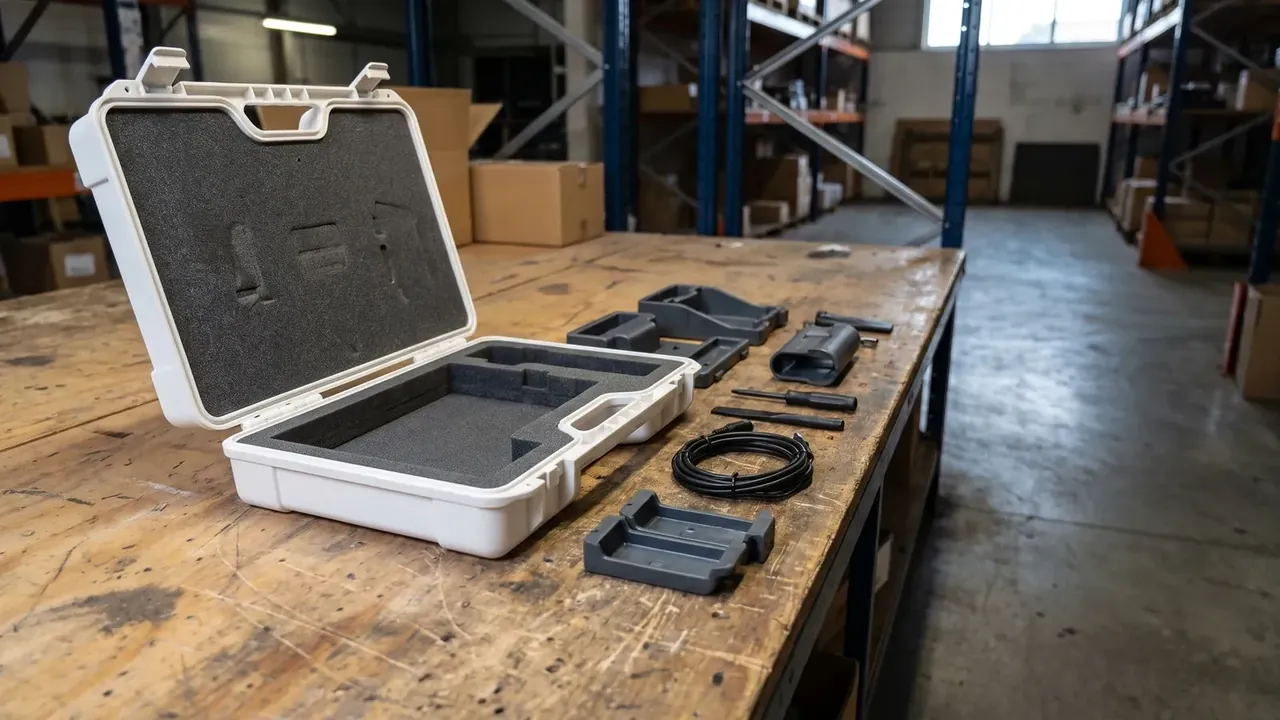
Clip pull-out sits at 18 N: below that, sockets fall out when the case tips; above 30 N, an oily glove cannot pull one free. After 5,000 insertions it decays to 12 N, and the foam gets changed, not the case.
Slot depth runs in two steps, 26 mm standard and 40 mm deep; the deep row sits lower or the lid lands on the square drive.
Common sizes face up when the lid opens. The 32 mm used twice a year goes to the far corner.
3. Spotting a Gap: Five Ways to Let the Empty Slot Speak
Counting is not the point; seeing is. Counting 24 pieces in a socket set plastic case takes ninety seconds, reading a break takes two.
- Staircase layout: 4 mm to 32 mm ascending, so one gap leaves one missing step
- Two-tone foam: dark walls on the eight common sizes, so a gap breaks the colour
- Size printed in the slot floor, so the eye hunts digits, not objects
- Depth difference: deep slots run 14 mm lower and a fingertip finds an empty one
- Weighing: 4.86 kg on the scale, so a 30 g deviation means open the case
4. Holding the Ratchet and Extensions: Three-Point Support
A 1/2 inch ratchet runs 265 mm, with extensions at 125 mm and 250 mm. Held at both ends only, the middle of each is unsupported.
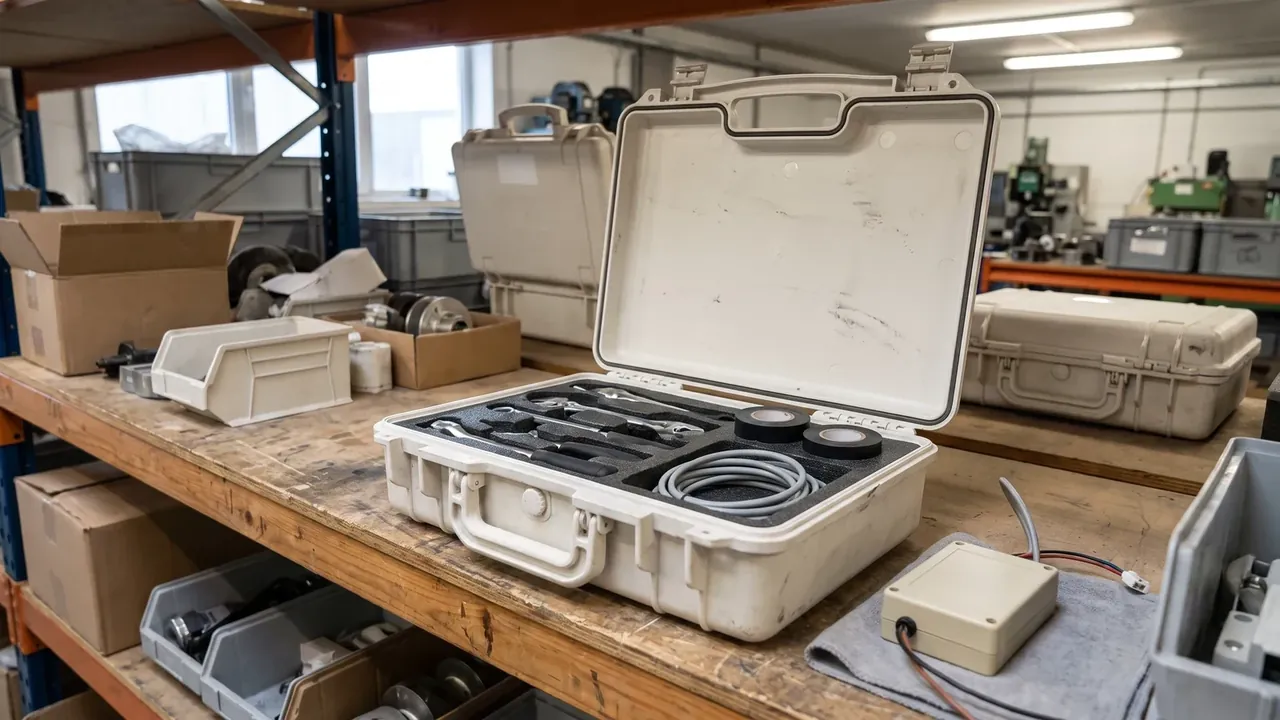
Long items need three points: a clip at each end, a saddle at the middle. The clips are half-round and open upward, so a thumb seats the item. The saddle carries load without locating, standing 3 mm proud, so a drop lands on it first. Spacing is uneven, shorter near the head where a ratchet carries its mass; seventy percent of bent extensions fail forward of centre. Width runs 1.5 mm over the shaft, tight enough not to chatter, loose enough to spare the plating.
5. Kitting Out: Four Counts Before the Case Ships
A socket set plastic case leaves the line after four counts, each with a number attached.
| Count | Owner | Time per case | Record | Misses allowed |
|---|---|---|---|---|
| First-article check | Process | 8 min | Photo on file | 0 |
| Layout and filling | Assembly | 4 min 20 s | Station board | 0 |
| Weight check | QC | 25 s | Scale, plus or minus 30 g | 0 |
| Open-box audit | QC | 3 min | 5 percent sample | 1 |
Only weighing runs on every case; it needs no judgement. The first-article check costs eight minutes and sets the reference.
6. Three-Year Cost: Spreading the Price Over Every Call-Out
At 1,200 sets a year and a 3.1 percent miss rate, 37 jobs come back at 180 each: 6,660 a year.
With layout and weighing in a socket set plastic case, the miss rate falls to 0.4 percent, five events and 900. Saving 5,760, less a 2.5 premium across 1,200 sets, leaves 2,760.
The case price stopped being the variable. The miss rate is.
Conclusion
The economics of a socket set plastic case sit in the layout, not the quote: layout moves a missing piece from the job site to the moment before the lid closes. A 26 mm pitch, an 18 N clip and a 4.86 kg case all say the same thing, so let the slots count.
This article discusses only the container (case body) side of specifications and design intent, and does not cover any handling, loading or use of the contents.
Related Reading
- How a socket wrench set case is configured in an auto workshop
- Slot layout and wall thickness in a socket wrench set case
- How a road case is restrained over long transfers
- Dividers and counting logic in a medical case
- Locating and fit in the insert of a pistol case
Related Products
- 8 Series — Gun Cases; Military Equipment Cases; Camera Equipment Cases; Drone Cases; Watch Cases; Knife Cases; First Aid Cases; Electronics Equipment Cases
- WL8-2812 PP Gun Case — model WL8-2812
- All protective cases and toolboxes: 7 series, 158 models