

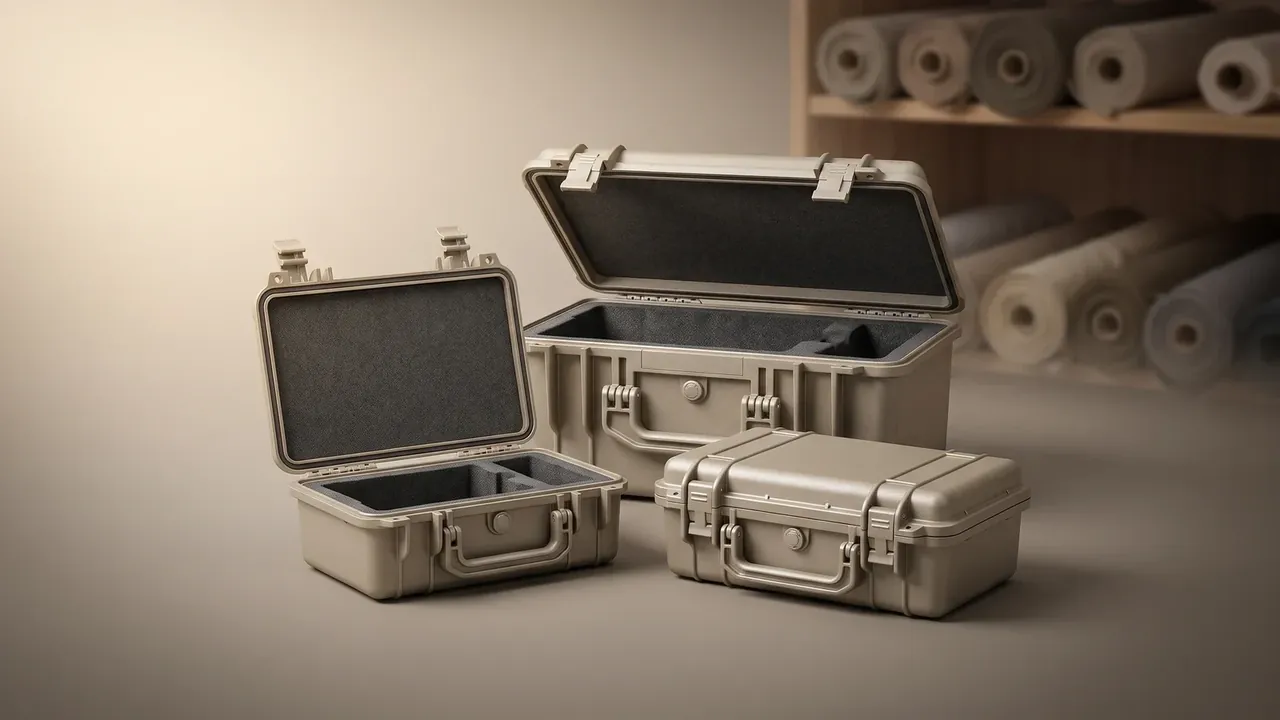
Quick answer: A special forces case earns its keep on impact, sealing and stacking, and pays for all three in weight, unit price and opening speed. That trade is worth it in a narrow band and wasteful outside it. What follows prices the freight, walks the alternatives, and ends with three questions that usually settle the choice before anyone quotes a case.
Table of contents
- Four places a special forces case gets used wrongly
- 55 litres inside, 87 litres outside: which one you ship
- Against the trolley case: wheels win in the terminal
- Against the road case: fixed racks, hundred-kilo loads
- Against rotomoulded crates, steel boxes and soft bags
- Three questions: trips, value, hands
- FAQ
1. Four places a special forces case gets used wrongly
A special forces case maximises impact resistance, rim sealing and base stacking strength. All three are bought with material, and material is weight and money: a 60-litre moulded case runs over six kilograms empty, a soft bag of the same volume under one.
Four situations where it is the wrong tool:
- Light items, short trips, one person carrying — the empty weight is spent before any equipment goes in.
- Equipment that stays put and runs with the lid open; panels and cable runs have to travel with the shell, which is road-case work.
- Loose cargo, wet decks, a forklift on site — the case needs fork pockets, so a rotomoulded crate on a pallet fits better.
- Loads used once in a few years; a foam-lined carton at 45 yuan a set never amortises a moulded case.
One condition brings it straight back: the item is expensive, the route is rough, and the case has to stack under others.
2. 55 litres inside, 87 litres outside: which one you ship
Freight is charged on the outside: air volumetric weight runs at 167 kg per cubic metre, one kilogram per 6,000 cubic centimetres, and express tariffs use the same divisor.
An outside of 62 x 47 x 30 cm works out to 87.4 litres and 14.6 kg of volumetric weight. The cavity of 55 x 40 x 25 cm holds 55 litres. The 32 litres between them are wall, ribs and latch recesses.
| Case type | Cavity | Outside | Fill ratio | Empty weight | Volumetric weight |
|---|---|---|---|---|---|
| Moulded hard case | 55 L | 87.4 L | 63% | 10.2 kg | 14.6 kg |
| 20-inch trolley case | 40 L | 49 L | 82% | 3.4 kg | 8.2 kg |
| 9 mm road case | 55 L | 84 L | 65% | 19 kg | 14 kg |
Twelve flights a year at 6.4 kg extra, at 30 yuan a kilogram, is roughly 200 yuan a trip and 2,400 a year — not dramatic, but paid annually and never shown on a quotation.
3. Against the trolley case: wheels win in the terminal
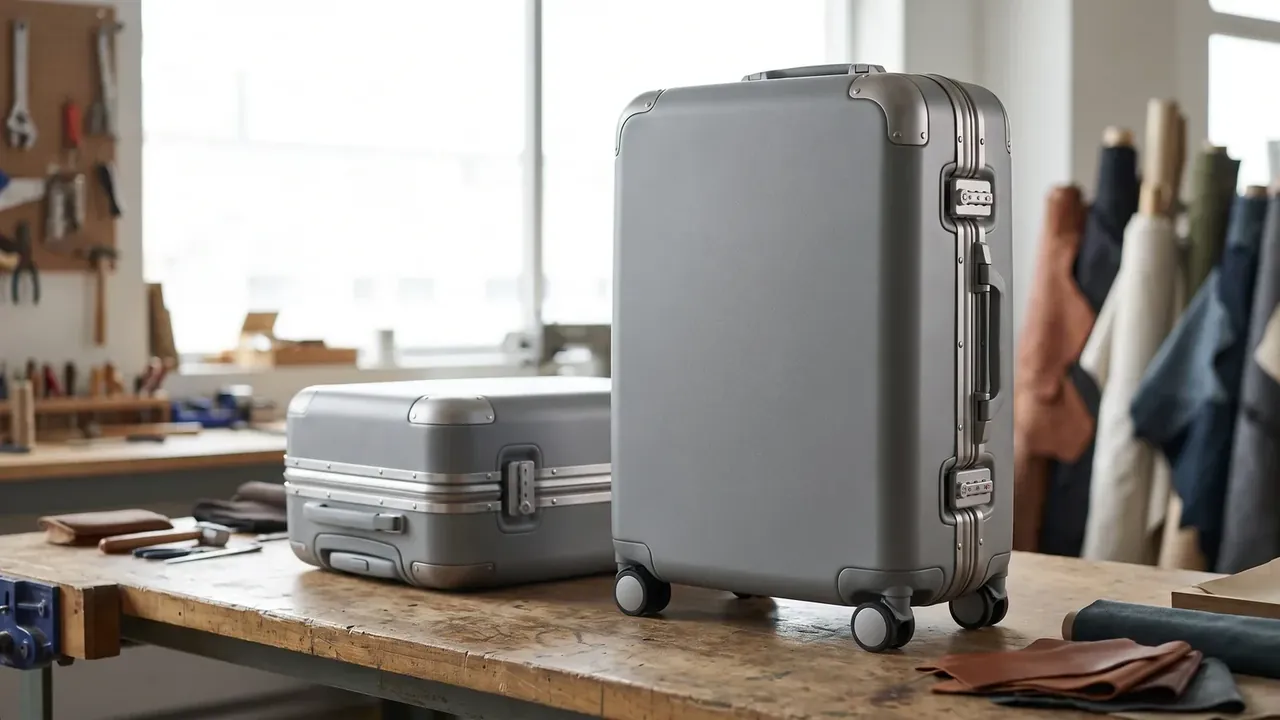
A trolley case is a thermoformed PC or ABS shell, 2.5 to 3 mm thick, on four castors with a telescopic handle. It wins in the terminal: it rolls, it pushes, it goes into an overhead bin.
It loses in three places. No gasket, so ten minutes of loading in rain puts water in at the wheel housings first. No base ribs, so three-high stacking folds the corners. No fixing points, so equipment is held by clothing.
The boundary is clean: commercial flights, hotel nights, single items under 25 kg. Once the route leaves pavement, the lid has to open in rain, or the case travels under others, the six latches and one-piece wall of a special forces case start earning.
4. Against the road case: fixed racks, hundred-kilo loads
A road case is 9 mm birch plywood on six faces, 30 x 30 mm aluminium extrusion, riveted steel corners. An 80-litre example weighs 19 kg, about 1.9 times a moulded case of the same cavity.
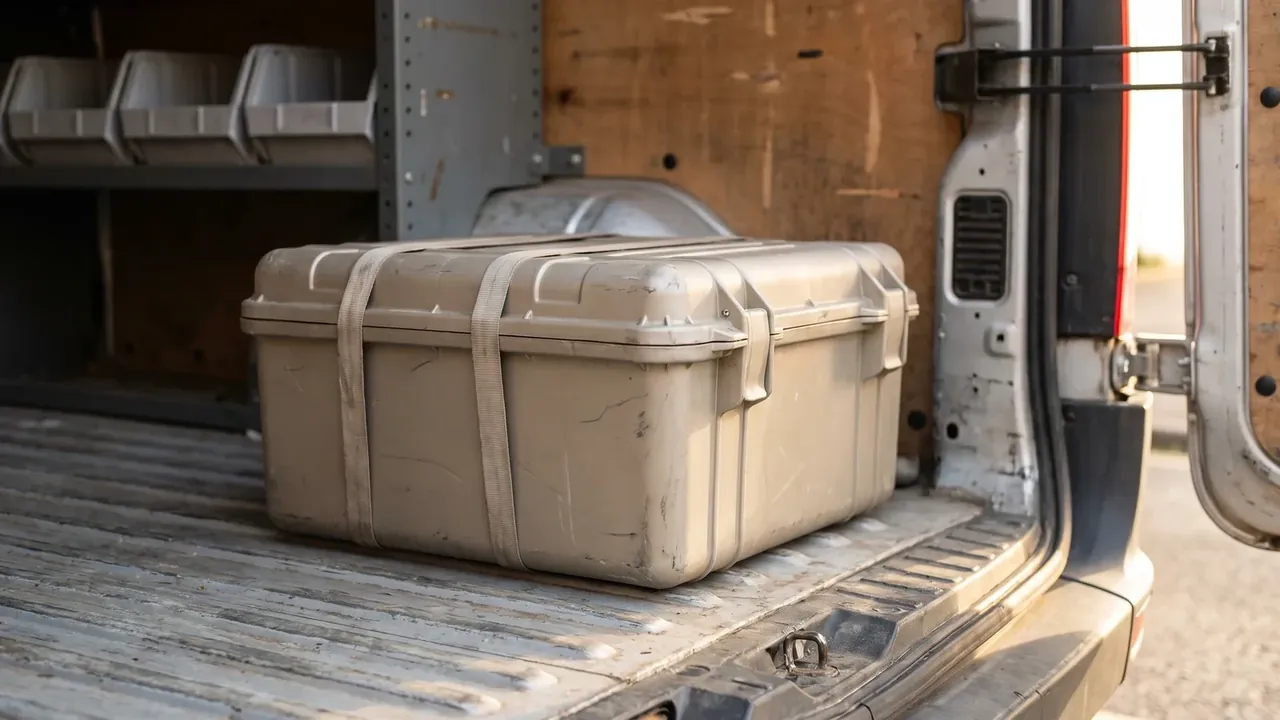
That penalty buys two things: repairability and lid-open operation. Break a panel and it is a 200-yuan swap; crack a moulded shell at the rim and the case is scrap. Panels, slides and racks rivet to the plywood, so equipment runs the moment the lid comes up.
The reverse holds too: loads under 30 kg carried up a ladder exhaust the handler before the case is damaged.
| Item | Moulded hard case | 9 mm road case |
|---|---|---|
| Empty weight, same cavity | 10.2 kg | 19 kg |
| Single panel replacement | not possible | about 200 yuan |
| Stacking | three high as standard | corner-aligned, pallet above five |
| Run with lid open | equipment must come out | panels fixed inside |
| Unit price | 500–900 yuan | 1,200–2,600 yuan |
5. Against rotomoulded crates, steel boxes and soft bags
A rotomoulded crate is a 6 mm polyethylene shell formed in one piece; a 60-litre example weighs 12 kg, takes fork tines, accepts slings and stacks five high on a pallet.
A steel ammunition box sits at the other extreme: 1 mm cold-rolled steel, 4.2 kg, 120 to 260 yuan, shielding and fire resistance included. Moisture is its weakness, and a dent at the rim stops the lid seating.
| Option | Build | Empty weight | Unit price | Strength | Poor fit |
|---|---|---|---|---|---|
| Moulded hard case | one-piece shell, foam | 10.2 kg | 500–900 yuan | sealing, stacking, fixing | loose cargo, forklifts |
| Rotomoulded crate | 6 mm rotomoulded shell | 12 kg | 700–1,200 yuan | impact, fork and sling | light items, frequent opening |
| Road case | 9 mm ply, extrusion | 19 kg | 1,200–2,600 yuan | repairable, rack-ready | manual handling |
| Steel box | 1 mm cold-rolled steel | 4.2 kg | 120–260 yuan | shielding, fire, price | damp sites, precision gear |
| Soft bag | textile with foam | 0.9 kg | 150–400 yuan | light, fast | stacking, water |
The soft bag is not a filler option: at 0.9 kg it goes on a back and stays there, at the price of no stacking strength and no water resistance.
6. Three questions: trips, value, hands
- How many trips a year? Below three, a hard case never amortises: at 620 yuan against 45 yuan for a foam-lined carton, break-even is fourteen trips.
- What is one item worth? Budgets run at two percent of cargo value, so a 3,000-yuan item gets 60 yuan, and a moulded case does not fit.
- Who carries it? Two people and a forklift suit rotomoulded crates and road cases; one person on a ladder rules out anything heavy.
A fourth answer is rent: 80 to 150 yuan a day, so under five days of use a year, renting saves more than half and removes the storage problem.
Conclusion
What a special forces case offers is structural: a one-piece wall, symmetric latches, replaceable foam, no grief after a drop. What it costs is equally structural: weight, outside volume, a price that will not come down. Start the decision from the shipping document, not the catalogue — mode, trips per year, who carries it, cargo value. Once those four are settled, the cases that need a special forces case are obvious, and the rest are better served by a trolley case, a road case, a rotomoulded crate or a foam-lined carton.
This article discusses the case body only — its specifications and design intent. It does not cover any handling, loading or use of the items inside.
Related Reading
- How a special forces case is configured for training, transit and field camps
- Ranking the criteria for a special forces case by load and opening frequency
- Road case structure and transport fit
- Hard-shell suitcase shell materials compared
- Rotomoulded cases on salt-spray decks: when they pay off
Related Products
- 8 Series — Gun Cases; Military Equipment Cases; Camera Equipment Cases; Drone Cases; Watch Cases; Knife Cases; First Aid Cases; Electronics Equipment Cases
- WL8-2812 PP Gun Case — model WL8-2812
- All protective cases and toolboxes: 7 series, 158 models