

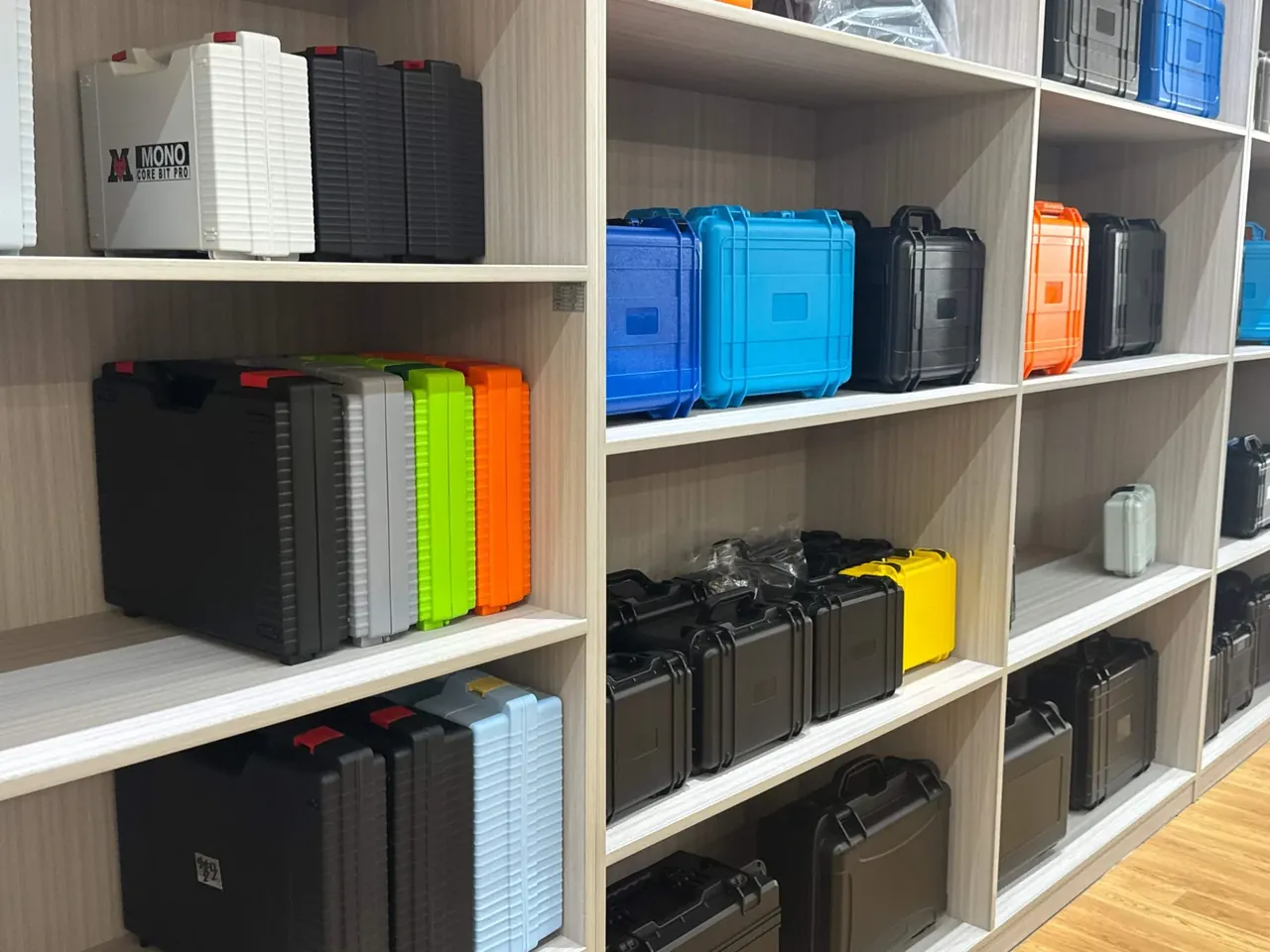
Quick answer: A Stackable Military Storage Case keeps slip under 1.2 mm across 5 layers over 24 h, set by an 8 mm lid boss and 0.7 mm recess clearance.
Table of contents
- Lid-top boss height of the Stackable Military Storage Case
- Fit clearance of the base recesses
- Interlayer slip readings by stack tier
- Compression verdict under off-centre load
- Boss scrap limit for stacking batches
- FAQ
1. Lid-top boss height of the Stackable Military Storage Case
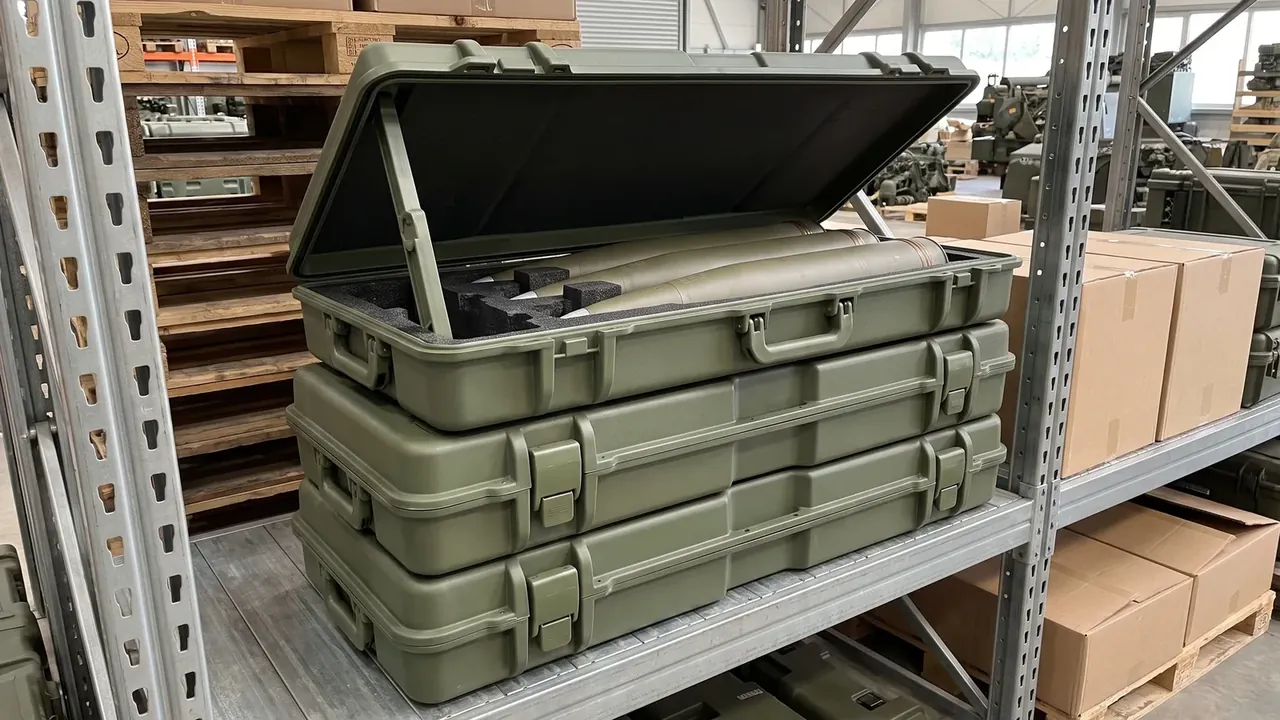
A Stackable Military Storage Case is laid out on a 660×470×290 mm outer envelope with a 590×405×220 mm inner cavity, both walls at 5.0 mm. Four solid bosses stand on the lid, 8 mm high, matched to recesses in the four base feet; stacked, the upper case sits on the lower one's bosses and the vertical load runs down through these four pairs.
Eight millimetres came from repeated trials: at 6 mm the recess grips too shallowly and tiers shift after five layers, while at 10 mm the lid is propped open, the four latches cannot seat, and the gasket misses 24 % compression. JUNZHIJIA checks all four bosses on the first article and holds the spread under 0.15 mm. The 8.0 kg empty weight cross-checks wall and boss, and the 18 kg load is shared among four side walls and base ribs, never taken sideways by a boss.
| Boss height grade | Recess grip | Stack verdict |
|---|---|---|
| 6 mm | shallow | slip exceeds limit after 5 layers |
| 8 mm | seated | slip within 1.2 mm after 24 h |
| 10 mm | lid propped | latch travel short, scrap |
2. Fit clearance of the base recesses
Each of the four feet of a Stackable Military Storage Case carries a recess with 0.7 mm single-side clearance. That allowance absorbs assembly tolerance and long-term creep: at 1.0 mm, five-layer slip crosses 1.2 mm; under 0.4 mm, a shrinkage shift makes the recess refuse the boss and assembly ends with a copper mallet and a whitened datum wall.
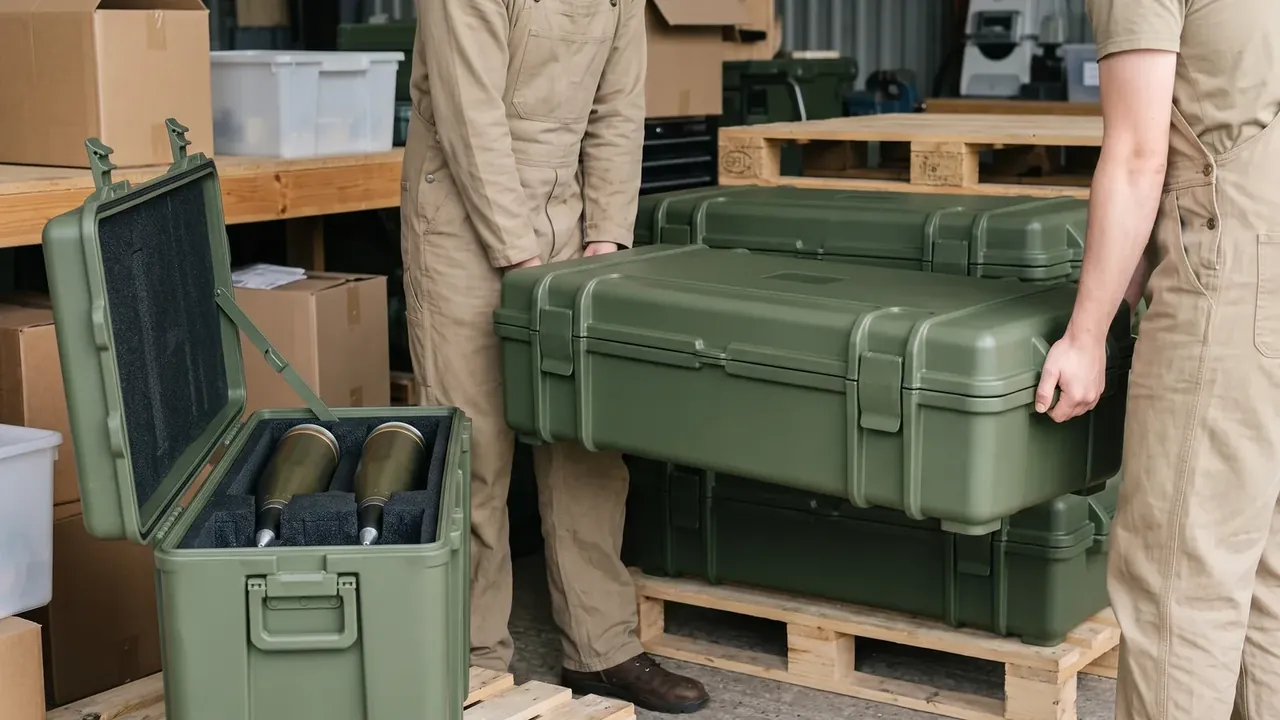
Recess walls use a 0.5° draft with mouth flare inside 0.05 mm, and a feeler gauge logs all four corners to 0.05 mm on the sheet shared with boss height. Lid foam swells with humidity; folding it into fit readings would make a Stackable Military Storage Case measure differently a week later, so foam thickness is filed apart from every scrap rule.
3. Interlayer slip readings by stack tier
The Stackable Military Storage Case is stacked 5 layers for 24 h, each tier closed with 18 kg ballast and four latches, with no shims between. Two adjacent cases are measured for horizontal shift along the long and short edges, logged tier by tier to 0.01 mm on a dial indicator; first and last readings after 24 h give interlayer slip, accepted at 1.2 mm or less.
Slip moves quickly in the first 2 h while faces bed in, then flattens past 8 h, so closure depends on the last 16 h of slope. Five layers carry margin: tier four is flat and tier five confirms an off-centre load stops growing; a tier-five reading 0.10 mm above tier four is treated as root creep and the batch stays in the hold area.
| Stack tier | Long-edge slip | Cumulative interlayer slip |
|---|---|---|
| Tier 1 | datum | 0 mm |
| Tier 3 | +0.5 mm | 0.5 mm |
| Tier 5 | +1.1 mm | 1.1 mm |
Every recheck uses the same indicator and the same inspector; swap either and the datum is re-established.
4. Compression verdict under off-centre load
Cases that pass stacking go onto the drop rig at 1.2 m with 18 kg ballast and four latches, each of the six faces landing once from the base upward. Recesses are not touched afterwards; clearance is re-measured first. A Stackable Military Storage Case takes a single drop sequence, no second pass — a second drop whitens the boss root first and later readings are damage, not springback.
The off-centre check presses 3.2 kN onto one side of the top tier, watching for a sheared boss or whitened recess wall; no collapse under 3.2 kN is the hard line. Even inside 1.2 mm, a whitened boss root says the load rode on friction rather than engagement, and the piece is rejected. A 4300-cycle open-close run follows the drop on the Stackable Military Storage Case, with boss height measured every 500 cycles and any fall below 7.90 mm logged.
| Slip value | After stacking | After off-centre recheck |
|---|---|---|
| ≤0.8 mm | closes firmly | still closed |
| 0.8–1.2 mm | acceptance edge | check the boss mark |
| >1.2 mm | scrap | does not enter recheck |
5. Boss scrap limit for stacking batches
Put four readings together and the Stackable Military Storage Case has three scrap lines: boss spread above 0.15 mm, recess clearance more than 0.10 mm off 0.7 mm, or slip above 1.2 mm after 5 layers over 24 h with compression failing 3.2 kN. Any one sends the batch back to the tool. Selective pairing can assemble one passing case. The same mould bias follows into the next batch though. JUNZHIJIA does not accept pairing as a process step. Scrap is judged by batch, not by piece: the four bosses from one slide set are judged together, and one out-of-line boss sends all four from that shot back.
At batch release, boss height, recess clearance and five-layer slip are registered side by side. Two gaskets sit in the lid groove at 24 % compression with groove depth back-calculated from cord diameter, and spray and immersion run in the IP67 order while the record only answers whether the lid let water in, with no certificate number or grade verdict.
Conclusion
Whether a Stackable Military Storage Case can be built up tier by tier depends first on the 8 mm boss and the 0.7 mm recess clearance, then on slip holding within 1.2 mm after 5 layers over 24 h and compression surviving 3.2 kN. The drop recheck, 4300 open-close cycles and two gaskets at 24 % compression lock that fit chain into the batch. Registering the three figures side by side gives stacking consistency a paper trail.
Related Reading
- Case feet and stacking load ratings
- Case footprint versus pallet module
- ASRS stacker case compatibility
- Case asset tracking label positions
Related Products
- 8 Series — Gun Cases; Military Equipment Cases; Camera Equipment Cases; Drone Cases; Watch Cases; Knife Cases; First Aid Cases; Electronics Equipment Cases
- WL8-2812 PP Gun Case — model WL8-2812
- All protective cases and toolboxes: 7 series, 158 models