

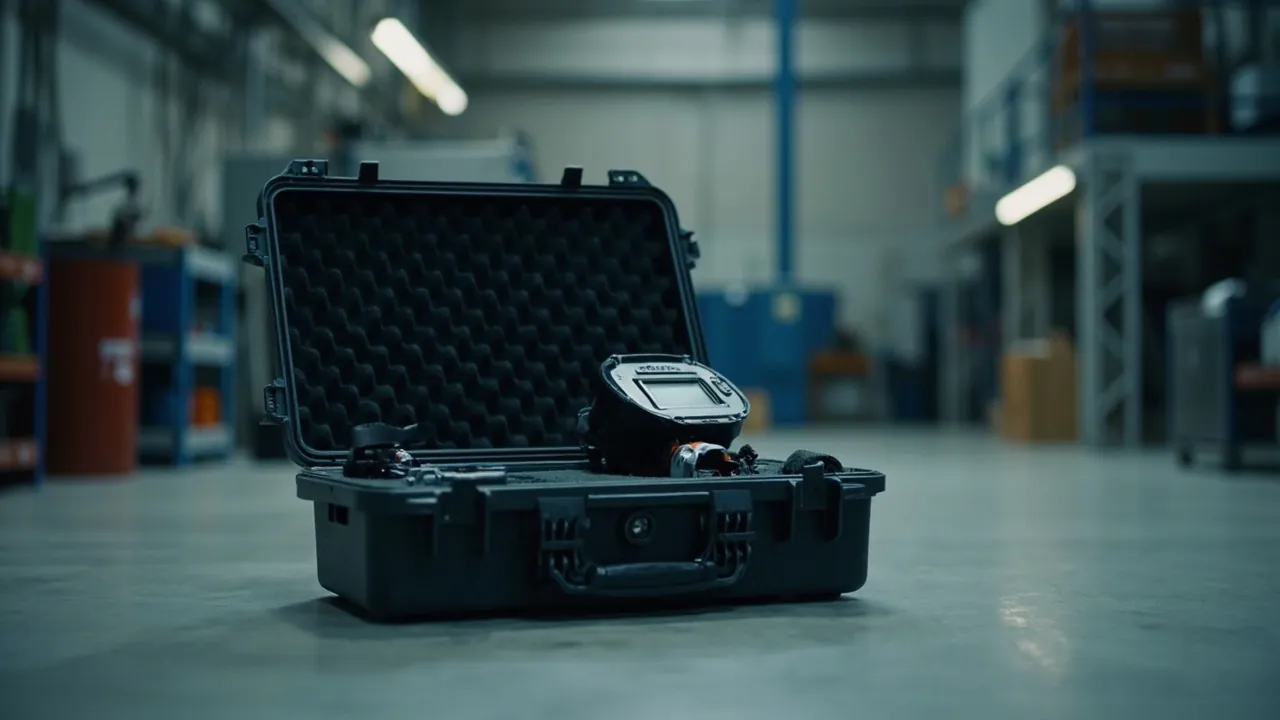
The stacker crane is the core execution mechanism of an automated storage and retrieval system. Shipping its components is fundamentally precision electromechanical component transport, not ordinary steel structure transport. The lower travel rail wheels, upper guide rollers, rack and pinion, servo gearboxes, the three-stage fork telescopic arms, chains or timing belts, guide rollers, and limit switches - any scratch, deformation, contamination, or encoder misalignment can turn on-site commissioning from half a day into two weeks. The conclusion is direct: stacker crane travel and fork components require a custom parts case with rigid location and two-stage vibration isolation, combined with ESD, moisture, and contamination control in a single scheme, because precision loss is effectively irreversible on site.
AS/RS projects usually run on tight schedules with heavy trade overlap, and stacker crane components frequently arrive before civil works and racking installation are complete. Loose shipping and simple timber crating are high risk in this setting. Rail raceway scratches destroy rolling accuracy, rack tooth damage produces meshing noise, and encoder zero-point drift after shock directly produces positioning error. This article is written for AS/RS integrators, stacker crane manufacturers, automated logistics equipment buyers, and project delivery teams. It sets out component risk grading, case and insert design, vibration isolation and ESD protection, standard validation methods, and acceptance rules, and it explains the engineering path behind custom inserts and OEM/ODM supply.
Table of Contents
- 1. Why Stacker Crane Components Need Precision-Class Cases
- 2. Component List and Sensitivity Grading
- 3. Precision Failure Modes: Rail Scoring, Rack Damage, Encoder Drift and Bearing Contamination
- 4. Size and Weight Boundaries: Packing Long Rails and Telescopic Forks
- 5. Case Structure and Material Selection
- 6. Insert and Vibration Isolation Design: Two-Stage Isolation plus Rigid Stops
- 7. Dedicated Protection for Servo Motors and Encoders
- 8. Sealing and Ingress Protection: An IEC 60529 and GB/T 4208 View
- 9. Rust Prevention, Cleanliness and VCI Strategy
- 10. Transport Vibration and Shock Validation: GB/T 4857.23 and ISTA
- 11. Electrostatic and Electromagnetic Protection: ESD and Sensitive Parts
- 12. Stacking, Lifting and Heavy-Load Handling Awareness
- 13. OEM/ODM Customization Workflow and Prototype Validation
- 14. Acceptance, Maintenance and Service Life Management
- Frequently Asked Questions
- Conclusion & Related Reading
1. Why Stacker Crane Components Need Precision-Class Cases
The precision chain in a stacker crane is long. The lower rail provides horizontal guidance, upper guide rollers constrain top sway, rack and pinion or timing belt drive horizontal motion, the hoist handles vertical travel, and the three-stage fork performs the storage and retrieval motion. Damage geometric accuracy at any link and the result is storage positioning error, abnormal noise, excess vibration, or repeated safety interlock trips.
General industrial packaging targets "do not lose it, do not break it." Precision electromechanical components need a higher target: "do not change the fit relationship, do not change preload state, do not introduce contamination." The gap shows up in three ways:
- Micron-scale surfaces. Rail raceways, rack tooth flanks, and roller outer rings are low-roughness precision surfaces. A single hard-object scratch creates stress concentration and early pitting.
- Preload and assembly state. Servo gearbox backlash against the rack, fork chain tension, and guide roller eccentricity are set at the factory. Sustained transport vibration can change them.
- Electrical zero point. Incremental and absolute encoders are sensitive to shock and strong vibration. Severe shock can damage a code disc or shift the zero point, forcing recalibration on site.
Key reminder: AS/RS stacker crane positioning accuracy is often measured in millimetres or less, while a single uncontrolled drop in transit can produce acceleration peaks many times gravity. The job of packaging is to break that shock transmission chain.
For integrators delivering multiple projects a year, the parts case also acts as standardised tooling - the same stacker model uses the same case type and insert, which simplifies warehouse management and inter-project reuse. Reuse assessment methods are described in protective case service life and reuse years.
2. Component List and Sensitivity Grading
Packing planning starts with a component list and a sensitivity matrix. Score each part on three axes: precision sensitivity, shock fragility, and environmental sensitivity.
| Component | Typical material / structure | Critical sensitivity | Environment | Recommended protection |
|---|---|---|---|---|
| --- | --- | --- | --- | --- |
| Lower travel rail | Hot-rolled or ground section | Raceway roughness, straightness | Corrosion | Long-material case, multi-point support, VCI |
| Rack | Quenched and tempered or nitrided carbon steel | Tooth flanks, mounting datum | Corrosion, impact | Tooth-form guards, separated cavities |
| Travel and guide wheels | Alloy steel or polyurethane coated | Outer ring roundness, coating | Contamination, scoring | Individual slots, soft bedding |
| Servo motor | Cast aluminium or steel housing | Shaft extension, flange register | Moisture, ESD | Moisture barrier bag, flange cover |
| Encoder | Precision optical or magnetic | Code disc, shaft, connector | Shock, ESD | Isolated damped cavity, ESD bag |
| Gearbox | Cast iron or aluminium | Output shaft, mounting face | Corrosion | Shaft-end sleeve, desiccant |
| Three-stage fork arm | Extrusion with rollers | Sliding surfaces, roller tracks | Impact, contamination | Layered slots, end stops |
| Fork chain or timing belt | Roller chain or toothed belt | Tension, link condition | Contamination, corrosion | Separate coil, anti-oil paper |
| Top guide rail | Section steel | Straightness, joint end faces | Corrosion | Long-material case, end guards |
| Limit switches and sensors | Electronic components | Trip position, cabling | ESD, moisture | Small-part box, ESD packaging |
| Cable drag chain | Engineering plastic | Link deformation | Low-temperature embrittlement | Flat bundled with temperature note |
Two conclusions emerge. Rails and the fork mechanism dominate physical protection, while servos and encoders dominate environmental and ESD protection. The two require different protection logic, so a typical project configures two case families: rigid long-material cases and sealed, damped precision-parts cases.
3. Precision Failure Modes: Rail Scoring, Rack Damage, Encoder Drift and Bearing Contamination
Failure modes in field practice are highly concentrated, and identifying them is the prerequisite for effective protection design.
Rail scoring. Once a raceway is scored by hard particles or metal edges, rollers generate periodic impact on every pass, which shows up as rising noise and vibration and eventually as pitting and spalling. Scoring typically happens when rails are shipped loose and stacked, rubbing against each other.
Rack tooth damage. A damaged tooth flank creates abnormal meshing backlash, producing a rhythmic knocking sound and, in severe cases, shock loads that damage gearbox bearings. If the rack mounting datum deforms, the straightness of the entire rack cannot be recovered.
Encoder drift and damage. Shock above the acceleration limit can crack an optical code disc, shift magnetic poles, or deform the shaft system. Even without outright damage, severe vibration can cause coupling slip, shifting the zero point and forcing a re-homing procedure on site.
Bearing and rolling element contamination. Dust, metal chips, and packaging debris entering raceways accelerate wear. This kind of contamination often does not appear immediately but surfaces months after commissioning, making root-cause tracing difficult.
Corrosion protection failure. Rails and racks typically rely on black oxide, plating, or protective oil. Once the layer is worn away, rust spots form quickly in humid air, and those spots then act as abrasive particles on the raceway.
Practical judgement: transit damage to stacker crane components splits into visible and hidden categories. Visible damage is seen on arrival; hidden damage - preload change, micro-contamination, zero-point drift - usually surfaces during commissioning or trial running, when troubleshooting costs an order of magnitude more.
4. Size and Weight Boundaries: Packing Long Rails and Telescopic Forks
Stacker crane components span an enormous size range, from centimetre-scale encoders to top rails over ten metres long. Packing strategy must be split by class.
Very long rails and top rails. Common lengths run from 8,000 to 20,000 mm and beyond. Long-material frame cases are used, with multi-point internal supports at spacing that should not exceed roughly 1,500 to 2,000 mm, and with the raceway facing up or kept off direct contact with hard supports by soft pads.
Three-stage fork arms. Complex cross-sections and medium lengths, typically 1,000 to 3,000 mm. Layered slot cases are recommended, one arm per layer, separated by rigid dividers, with end stops preventing axial movement.
Servo motors and gearboxes. Heavy items, from tens to hundreds of kilograms each. They need a load-bearing deck at the base, rigid locating blocks around the perimeter, and restraint against inertia movement that would damage the shaft extension.
Encoders and sensors. Small, high-value parts. Use separate small cavities with ESD shielding, and never place them in the same cavity as heavy parts.
| Component | Size / length | Recommended case | Location method | Vibration requirement |
|---|---|---|---|---|
| --- | --- | --- | --- | --- |
| Top rail / long rail | 8-20 m | Long-material frame case | Multi-point soft supports plus end guards | Medium |
| Fork telescopic arm | 1-3 m | Layered slot case | Conformal slot plus end stops | High |
| Servo motor | Small to medium | Precision parts case | Flange register plus clamping | High |
| Encoder | Small | Isolated cavity case | Conformal slot plus ESD bag | Very high |
| Rack | 2-6 m | Long-material or cavity case | Tooth-form guards plus multi-point support | Medium |
| Travel wheel set | Small | Individual slot case | Bore location | High |
5. Case Structure and Material Selection
Precision parts case selection shares ground with general protective cases but adds specific requirements.
Rotomoulded HDPE cases. Seamless moulding, impact resistant, low-temperature capable, with mature sealing designs that can reach an IP67 protective structure. Suitable for encoders and sensors that are sensitive to the environment. Wall thickness consistency in rotomoulded parts affects sealing face flatness, so confirm how the supplier machines the sealing face.
Injection-moulded PP cases. High dimensional accuracy and batch consistency, ideal for small and medium precision parts cases and line-side integration, and convenient for automated handling and stacking.
Aluminium frame cases. High stiffness, low weight, and repeatedly demountable, suited to sites that need frequent open-case commissioning.
Steel-timber or steel-plastic hybrids. High load capacity for rails and racks, with attention to timber moisture content and phytosanitary compliance.
Selection order: define load and stiffness class from component mass and length, then define sealing and ESD class from environmental sensitivity, then decide material repairability from circulation frequency.
6. Insert and Vibration Isolation Design: Two-Stage Isolation plus Rigid Stops
The core conflict in precision packaging is that the part must be fixed yet isolated from shock. The answer is two-stage isolation with rigid stops.
Stage one: conformal locating layer. CNC-routed EVA or PE foam with slots matching the part outline, achieving zero-clearance fit. This layer solves displacement and converts point contact into surface contact, spreading stress.
Stage two: cushioning and isolation layer. Outside the locating layer, add a low-stiffness foam or elastomer layer as a shock isolation stage. Its stiffness and damping should be chosen with reference to the component's first natural frequency, aiming to place the packaging system's first natural frequency well below the dominant excitation band of transport vibration, roughly 5 to 20 Hz, so the system operates in the isolation region.
Rigid stop layer. Add rigid blocks or metal corner guards on the outside to limit maximum displacement under extreme shock, preventing the part from striking the case wall after the cushion is fully compressed. This is the last line of defence.
Insert material selection must balance density, rebound, compression set, and cleanliness. A detailed comparison is given in case foam material comparison. For high-value, low-volume custom models, pour-in-place PU foam achieves fully conformal fit, but consider the exotherm and mould release residue effects on precision surfaces.
7. Dedicated Protection for Servo Motors and Encoders
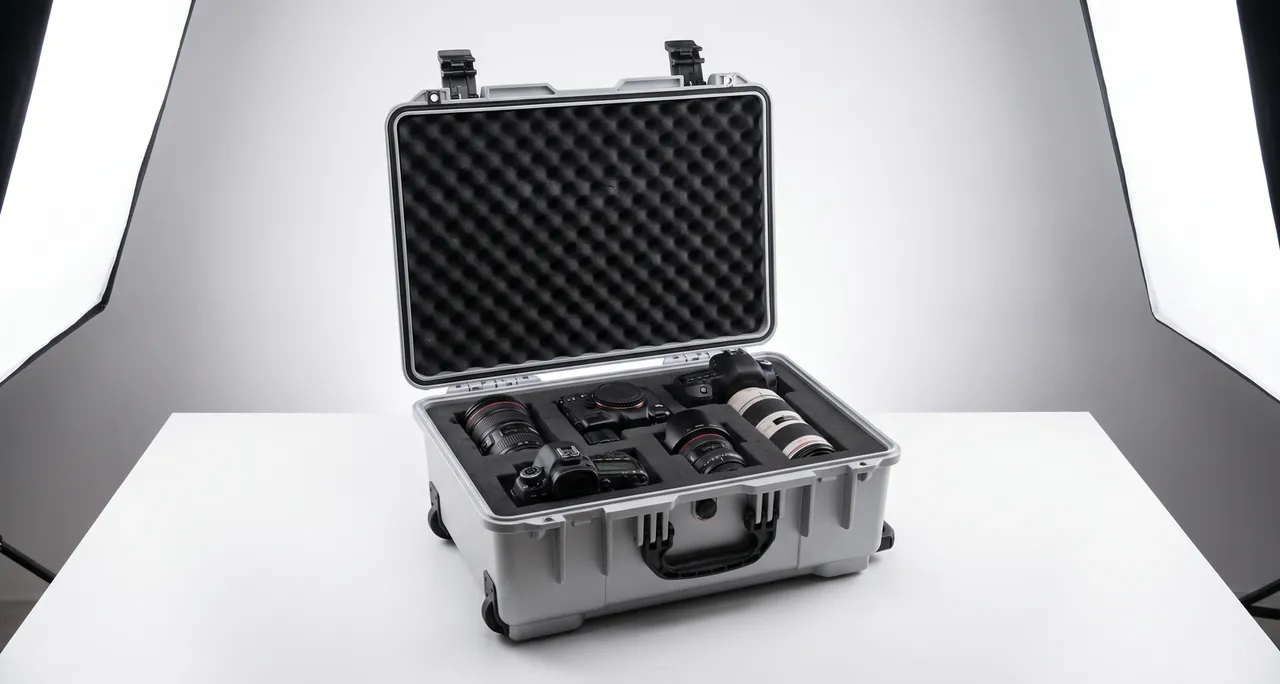
Servo motors and encoders are the highest value-density components in a stacker crane, and their protection needs are the most commonly underestimated.
Servo motor protection points:
- The shaft extension needs a rigid sleeve to prevent radial loading that bends the shaft or damages bearings.
- The flange register is the mounting datum and must not be struck; cover it with a plastic guard.
- Bag the motor with a moisture barrier and add desiccant to prevent winding moisture uptake and falling insulation resistance.
- Point the cable outlet upward or fit a dust plug to keep foreign matter out of the terminal cavity.
Encoder protection points:
- Always give it an isolated cavity; never mix it with heavy or metal parts.
- Use ESD shielding bags to prevent electrostatic breakdown.
- Vibration requirements are the highest; use double-layer foam or an elastic suspension structure.
- Coil and secure cables to avoid pulling damage at the connector.
- Include a shock indicator label in the case so arrival condition can be judged.
| Protection item | Servo motor | Encoder | Gearbox |
|---|---|---|---|
| --- | --- | --- | --- |
| Axial shock limit (empirical) | Medium | Strict | Medium |
| ESD protection | General | Strict | Not required |
| Moisture requirement | High | High | High |
| Location method | Flange register plus clamping | Conformal slot plus suspension | Mounting face plus shaft sleeve |
| Can share a case | With gearbox | Must be isolated | With motor |
8. Sealing and Ingress Protection: An IEC 60529 and GB/T 4208 View
IEC 60529 and the equivalent national standard GB/T 4208 define how IP ratings are judged. For stacker crane parts cases, the recommended baselines are:
| Scenario | Recommended rating | Notes |
|---|---|---|
| --- | --- | --- |
| In-plant circulation and short haul | IP54 | Dust focus, low water requirement |
| Domestic long-haul road transport | IP65 | Dust tight plus jet-water resistant |
| Export sea freight and open storage | IP67 | No ingress after temporary immersion |
| Long-term storage in humid workshops | IP65 plus desiccant | Focus shifts to internal humidity |
The three critical sealing components are the gasket, the latches, and the hinges. Gasket material - silicone, EPDM, or TPE - determines weather resistance and compression set. Latch count and distribution determine clamping uniformity. Hinge stiffness and clearance determine how well the lid seats when closed. When these three are poorly matched, a case rated IP67 may perform like an IP54 in real service. The relevant structural design is discussed in case hinge and latch sealing structure.
For applications where the case is opened frequently and experiences significant barometric and temperature change, such as air freight or high-altitude road transport, fit a case pressure equalization valve to avoid difficult opening or moisture ingress under negative pressure.
9. Rust Prevention, Cleanliness and VCI Strategy
Corrosion risk for stacker crane components concentrates on three surfaces: rail raceways, rack tooth flanks, and mounting datums. These are usually unpainted and protected only by anti-rust oil or a black oxide layer.
Oil film protection. Factory condition normally includes anti-rust oil. Packaging design must avoid insert materials that absorb oil and wipe the film away. Highly absorbent materials such as plain cardboard and low-density foam are unsuitable for direct contact with oiled surfaces.
VCI vapour-phase protection. Vapour-phase corrosion inhibitor film or emitters inside a sealed case form a protective film on complex surfaces, which is especially effective at rack tooth roots and rail flanks where oiling is difficult. Case sealing is mandatory for this to work.
Desiccant. In a well-sealed case, silica gel is typically dosed at roughly 0.5 to 1.0 kg per cubic metre of free volume, adjusted for transit duration, packaging moisture vapour transmission rate, and destination climate.
Cleanliness control. Debris from insert machining must be completely removed. CNC-routed foam should be vacuum-cleaned after cutting. Metal chips entering a raceway do far more damage than surface contamination. Cleaning practice is covered in protective case cleaning and care.
Recommended sea freight combination: VCI film, desiccant, IP67 sealed case, and a humidity indicator card, with a shock indicator label inside to create a traceable transport evidence chain.
10. Transport Vibration and Shock Validation: GB/T 4857.23 and ISTA
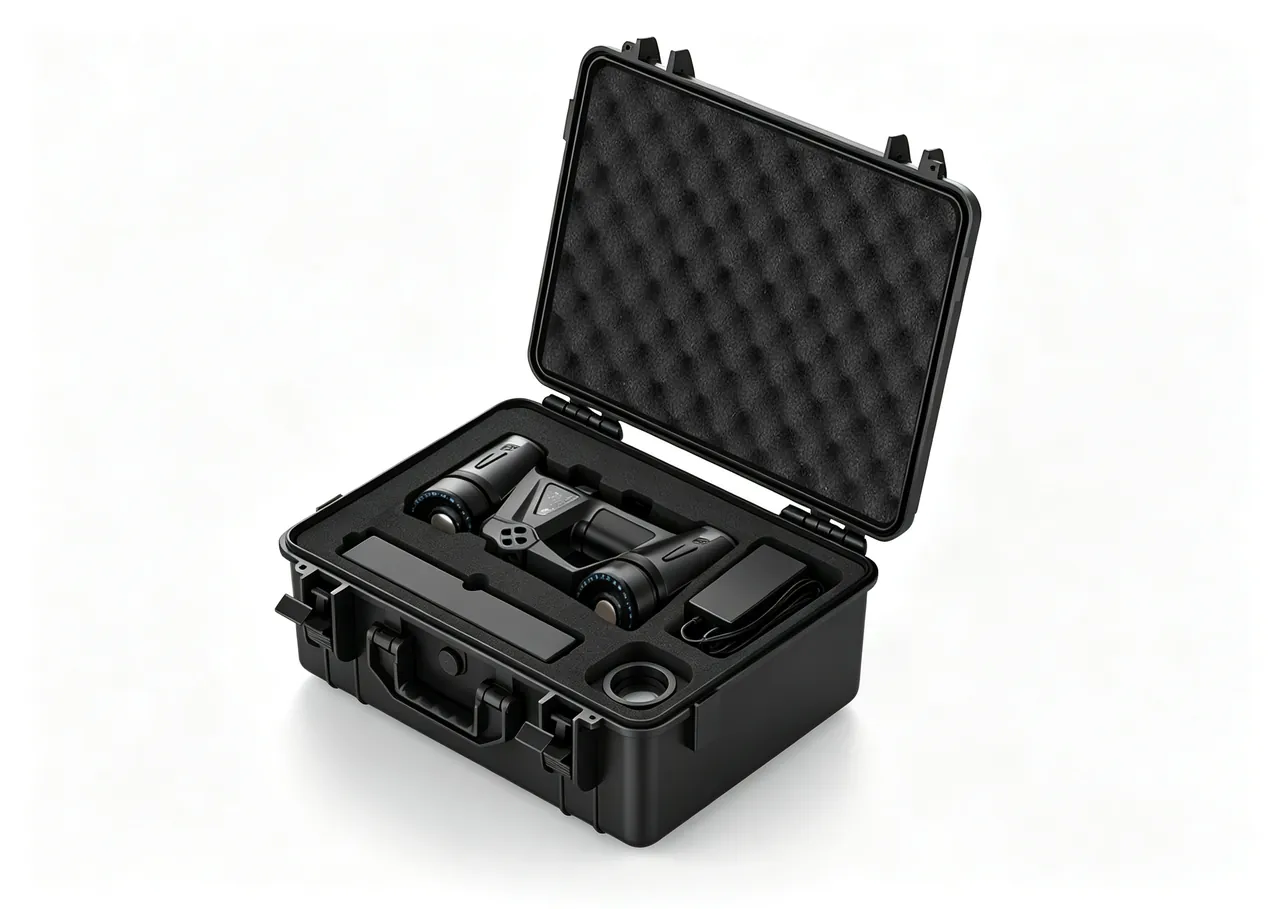
Transport vibration is the primary threat to precision component packaging. Road vibration energy concentrates between 3 and 100 Hz, and the 5 to 20 Hz band is most dangerous for cantilevered components and long rails because it readily excites resonance.
The GB/T 4857 series is the national framework of basic transport package test methods, and GB/T 4857.23 specifies random vibration methods to simulate real spectra. The wider system is explained in GB/T 4857 transport packaging standard explained.
The ISTA series approaches the problem from the distribution chain with Series 1, 2, 3, and 7 programs. For door-to-door delivery of stacker crane components to project sites, ISTA 3A and 3E are a reasonable reference; see choosing ISTA transport test procedures. If a full distribution cycle with multiple transfers and warehousing is required, see ASTM D4169 distribution cycle testing.
| Test | Reference standard | Example condition | Failure of interest |
|---|---|---|---|
| --- | --- | --- | --- |
| Random vibration | GB/T 4857.23 / ASTM D4728 | Road spectrum, duration scaled to distance | Insert collapse, part migration, fastener loosening |
| Drop | GB/T 4857.5 / ISTA 1A | Height set by mass | Case cracking, shaft extension damage |
| Stacking | GB/T 4857.3 / GB/T 4857.4 | Load and duration per stack | Case creep, lower-case deformation |
| Fixed-frequency vibration | GB/T 4857.7 | Selected frequency and acceleration | Resonance amplification, joint loosening |
| Conditioning | GB/T 4857.2 | High humidity and temperature cycling | Gasket ageing, condensation |
| Combined environmental | MIL-STD-810H (test method reference only; not a military certification) | Temperature, humidity, vibration, shock combined | Combined fitness |
MIL-STD-810H provides a systematic environmental test methodology. It must be stated clearly that citing it is a test method reference only; it does not represent a military certification, nor any defence procurement qualification. Compliant wording is discussed in MIL-STD-810H case environmental testing explained.
11. Electrostatic and Electromagnetic Protection: ESD and Sensitive Parts
Stacker crane control systems contain many electronic components, and encoders, sensors, variable frequency drives, and PLC modules are all ESD sensitive. ESD risk in packaging comes from three sources: human contact, triboelectric charging of packaging materials, and friction between the case and pallets during transport.
Remediation points:
- Package sensitive parts in anti-static shielding bags or conductive foam.
- Avoid ordinary foamed plastics that charge easily in direct contact with circuit boards.
- Provide a grounding terminal or conductive liner in the case to create an equipotential environment.
- Perform unpacking at an ESD workstation or while wearing a wrist strap.
For applications with high ESD sensitivity, use an ESD shielding case solution directly, with shielding layer design and surface resistance values conforming to the relevant specification.
12. Stacking, Lifting and Heavy-Load Handling Awareness
A significant share of stacker crane parts cases are heavy-load units. A top rail case may exceed 1,500 kg, and servo gearbox cases commonly fall in the 300 to 800 kg range.
Lifting design. Long-material cases should have four symmetric lifting points with rated load marked; single-point lifting is prohibited. Reinforce the case locally around lifting points.
Forklift handling. Provide standard fork pockets in the base and mark insertion direction on the side. Very long cases must use twin forks or a spreader; single-fork loading is prohibited.
Stacking limits. Maximum stack height follows from top-surface load capacity and base creep behaviour, and must be marked prominently. Precision parts cases should not be stacked in multiple layers as a rule; if stacking is unavoidable, use an interlayer load-bearing frame so pressure is not transmitted to components.
Personnel protection. Mark a lifting exclusion zone, provide safety footwear and gloves, and appoint a single signal person. Heavy packaging failure is single-event and irreversible, so safety rules cannot remain a document on a shelf.
13. OEM/ODM Customization Workflow and Prototype Validation
For AS/RS integrators and stacker crane manufacturers, a parts case is tooling bound tightly to product geometry. A typical workflow has six stages:
- Requirement intake: component list and drawings, transport route and climate, annual volume and circulation count.
- Concept design: case structure, insert layering, vibration isolation scheme, sealing and ESD design.
- Prototype validation: first-article trial fit, clearance checks, and drop or vibration pre-testing as needed.
- Pilot run: confirm process stability and assembly efficiency.
- Volume supply: establish batch traceability and quality records.
- Iteration: refine inserts and labelling from field feedback.
Supplier evaluation should focus on structural design capability, insert machining accuracy, ability to supply test documentation, and delivery reliability. The methodology is set out in how to choose a protective case OEM factory. JUNZHJIA is manufactured by Kexin New Materials (Guangdong) Co., Ltd. and supports AS/RS integrators, equipment manufacturers, and OEM/ODM customers with integrated services from structural design and insert customization through volume delivery. Seals and hardware can be matched per model, and supporting test documentation can be provided for tendering and acceptance. Buyers should also guard against counterfeit products, since differing seals and materials cause protection failure; see identify genuine vs fake protective cases.
14. Acceptance, Maintenance and Service Life Management
Incoming acceptance should cover appearance (case cracks, gasket integrity), tamper evidence, whether the shock indicator has triggered, humidity indicator colour, and sampled components (rail raceways, rack tooth flanks, shaft extensions and flanges, encoder condition).
Cleaning and maintenance. Wipe inserts with a soft cloth and mild detergent; avoid solvents that attack gaskets. After every reuse cycle, inspect gaskets for compression set and ageing. Lubricate and check hinge and latch fasteners periodically.
Life management. Keep a case-number register recording usage counts and repair history, and set mandatory inspection points by cumulative cycle count. Wheels and trolley handles on wheeled cases are wear parts; configuration and replacement are covered in case wheels and trolley handle configuration.
Frequently Asked Questions
Q: Why can't stacker crane components simply use ordinary timber crates?
A: The fundamental reason is a different protection objective. An ordinary timber crate is designed so the item is not lost and not broken; it relies on filling the void to reduce movement, but the fill compresses and collapses, and the crate has no humidity or ESD control. Stacker crane components are precision electromechanical parts and need four higher requirements at once. First, rigid location so rails and forks have zero freedom of movement inside the case. Second, two-stage vibration isolation to bring transport shock acceleration down to a level the component can survive. Third, humidity control to prevent rail and rack corrosion in transit. Fourth, ESD protection for encoders and sensors. A timber crate with bubble wrap fails on essentially all four. Timber also raises moisture content control and export phytosanitary compliance issues. For precision components, use a dedicated parts case with CNC-routed inserts, controlled sealing, and ESD design - upgrading from "it fits" to "it holds precision."
Q: What is the biggest risk for fork telescopic arms in transit, and what specific actions matter when packing?
A: Three problems dominate: scoring of sliding surfaces, damage to rollers and tracks, and a change in chain or belt tension. A scored sliding surface generates periodic impact and noise; a damaged roller outer ring raises running vibration; a change in tension causes the fork to extend out of synchronisation and creates positioning error. Four packing actions matter. First, only one arm per layer, with rigid dividers between layers, and never two arms stacked in direct contact. Second, orient sliding surfaces upward or toward soft insert material so they never touch hard supports directly. Third, fit rigid end stops to limit axial movement, with straps as secondary restraint. Fourth, wrap chain or belt sections in anti-oil paper and secure them so they cannot swing and wear in transit. If an arm exceeds about two metres, add an intermediate support point to prevent self-weight sag from bowing the arm body. Finally, note the arm orientation in the packing documentation so the same method is repeated on every shipment.
Q: An encoder is such a small part. Does it really need a dedicated protection design?
A: Yes, and it is frequently the highest value-density item in the case while being the most overlooked. An encoder contains an optical code disc or magnetic element, and its tolerance for shock and vibration is markedly lower than that of mechanical structures. It is also ESD sensitive: a single human electrostatic discharge can damage internal circuitry, and that damage may not appear in outgoing inspection, only after the equipment is powered up. Protection should include four elements. First, an isolated cavity; never mix it with heavy metal parts, because their inertial shock transmits directly. Second, anti-static shielding bag packaging, with unpacking performed at an ESD workstation or with a wrist strap. Third, the highest vibration requirement, preferably double-layer foam or elastic suspension so the encoder sits in a low-stiffness isolated state. Fourth, coiled and secured cabling to avoid pulling damage at the connector root. Also fit a shock indicator label in the case so an out-of-limit shock can be identified immediately on arrival.
Q: What standard should be used to validate transport vibration effects on stacker crane components?
A: For domestic projects, build on the GB/T 4857 series. GB/T 4857.23 specifies random vibration methods to simulate real transport spectra and is the core method for verifying whether inserts collapse, parts migrate, or fasteners loosen. Fixed-frequency vibration per GB/T 4857.7 assesses resonance amplification at specific frequencies. For international or sea-freight intermodal projects, reference ASTM D4728 for random vibration together with ISTA Series 2 and Series 3 programs, where Series 3 is closer to a real distribution chain. If you want to simulate a full distribution cycle including multiple transfers and warehouse dwell, the ASTM D4169 distribution cycle is a good choice. Standard selection should match the real route rather than chasing the most severe level, and the resulting report should record the actual spectrum, duration, and pass criteria used so it can be reused in future tenders. Where combined temperature, humidity, and vibration apply, MIL-STD-810H methodology can be referenced, but note that it serves here only as an environmental test method reference and is not a military certification.
Q: How should the sealing class for precision parts cases be decided?
A: Decide from the worst condition in the transport and storage chain. For in-plant circulation and covered short-haul delivery, IP54 is usually sufficient, with dust as the main concern. For domestic long-haul road transport, IP65 is recommended, delivering dust tightness and jet-water resistance. For export sea freight, open storage, and quay transfer, IP67 is recommended, requiring no ingress after temporary immersion. For long-term storage in humid workshops, use IP65 with desiccant, shifting the focus from blocking external water to controlling internal humidity. The judgement basis comes from standardised IEC 60529 and GB/T 4208 testing, but real performance also depends on gasket material and compression, latch clamping distribution, and case stiffness. Ask the supplier to describe the sealing architecture and validate a production case as a complete unit. Where significant barometric change occurs in transit, such as air freight or high-altitude road transport, fit a pressure equalization valve to avoid difficult opening or moisture ingress under negative pressure.
Q: Can servo motors and gearboxes share one case?
A: Yes, subject to several conditions. Both are heavy items with significant inertia, so they must be rigidly located rather than wedged with foam. Provide a load-bearing deck at the case base, rigid locating blocks around the perimeter, and a top restraint to stop bouncing. The motor shaft extension needs a rigid sleeve, and the gearbox output shaft needs shaft-end protection so axial or radial loading does not damage bearings. Both should be bagged with desiccant, because winding moisture reduces insulation resistance and cast iron or aluminium mounting faces corrode easily. The flange register and mounting datum are critical locating surfaces and should be covered with plastic guards against impact. Note particularly that encoders should not share their cavity, because the inertial shock from heavy parts exceeds encoder tolerance. If the motor and gearbox are already assembled with backlash set at the factory, the packaging design should preserve that assembled state for transport rather than splitting them and requiring on-site readjustment.
Q: How should case reuse be managed, and when must a case be replaced?
A: Manage by cumulative cycle count, not by calendar age. Keep a case-number register recording each project, transport mode, abnormal events, and repairs. Typical conditions requiring replacement or downgrade include: through-cracks or obvious case deformation; sealing face flatness out of tolerance so the gasket can no longer compress effectively; cracked, plastically deformed, or weakened hinges and latches; hardened, cracked, or permanently compression-set gaskets; and collapsed, fractured, or dimensionally out-of-tolerance inserts. For precision parts cases, add one more criterion: any case that has experienced an out-of-limit shock, indicated by a triggered shock label, should be re-inspected for fit clearance even if it looks undamaged. For routine maintenance, wipe inserts with a soft cloth and mild detergent, keep gaskets away from solvent cleaners, and periodically lubricate and tighten hinges and latches. It also helps to assign each case a designated storage position so that inserts and dividers are not mixed between case types, which is one of the most common causes of degraded fit in reused packaging.
Q: AS/RS project schedules are tight. Will parts case lead time become a bottleneck?
A: It depends on customization depth and how the supplier organises capacity. Three variables drive lead time. First, whether the case requires a new mould, since new tooling adds design and fabrication time. Second, whether inserts need 3D scanning and CNC programming, because complex conformal inserts take significantly longer to machine than standard dividers. Third, whether vibration and drop validation testing is required. Practical ways to shorten lead time include prioritising existing case platforms with dimensional adaptation to avoid new tooling, using modular inserts that combine standard dividers with local conformal pieces to reduce routed area, running validation testing in parallel with production preparation, and delivering in project batches so the first installation wave is served first. JUNZHJIA can provide feasibility assessment of case type and inserts at the concept stage, helping customers balance protection class, lead time, and cost, and supports volume supply with seals and hardware matched per model.
Conclusion & Related Reading
Protecting stacker crane and AS/RS components in transit is essentially moving precision safely from one place to another. The geometric accuracy of rail raceways, rack tooth flanks, fork sliding surfaces, and rollers, together with the electrical state of servos and encoders, are assets that cannot be restored cheaply on site. Get five things right - rigid location, two-stage vibration isolation, controlled sealing, vapour-phase corrosion inhibition, and ESD protection - and the parts case stops being a consumable and becomes a precision assurance system.
The selection path condenses to one sentence: define location and vibration isolation class from component precision and mass first, then define sealing and ESD class from the transport route, and finally define labelling and delivery structure from the way the project is organised. For AS/RS integrators and equipment manufacturers needing custom inserts, OEM/ODM volume supply, or supporting test documentation, JUNZHJIA provides integrated support from structural design through volume delivery.
Related Reading