

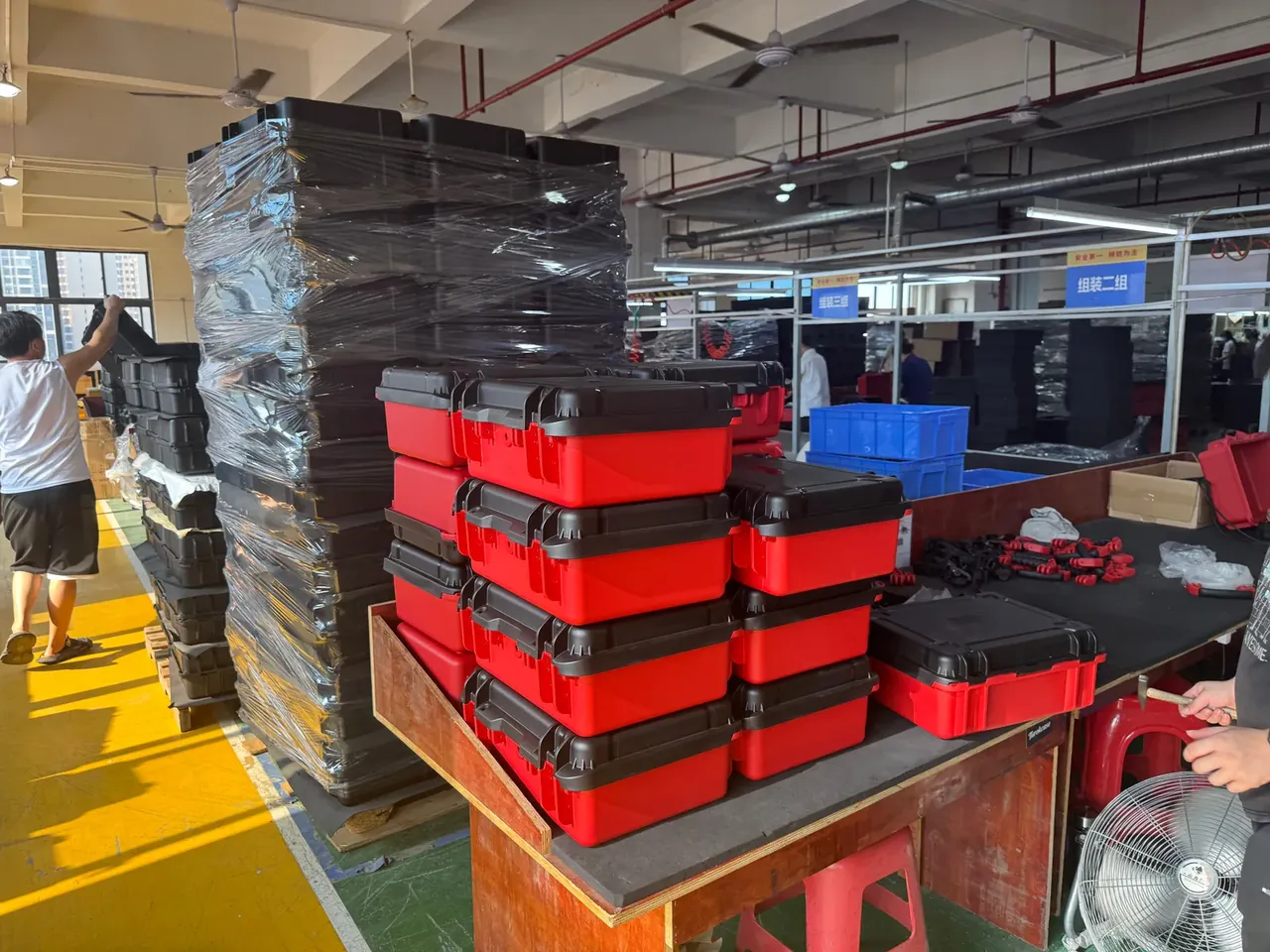
Quick answer: A survey drone case does two jobs: a 1.2 x 1.2 m lid pad flat to 1.5 mm, and six packs run four in rotation with two charging, on a 25 min sortie.
Table of contents
- The lid as a landing pad: 1.2 x 1.2 m, flat to 1.5 mm
- Six packs, 25 mm apart, four in rotation
- 25 min of flight against 45 min of charge
- 30 percent SOC and a 38 C cabin
- A 2 m drop and a 3 km2 block
- FAQ
1. The lid as a landing pad: 1.2 x 1.2 m, flat to 1.5 mm
Rotor span sets the pad: a 550 mm wheelbase puts tips at 1.1 m, and 50 mm of margin each side rounds that to 1.2 m.
The body is 1200 x 600 mm with detachable hinges, so the lid lies flat as a 1.2 m square in 3 min.
The 1.5 mm flatness is its limit: 0.8 mm of hinge step plus 0.7 mm of bulge between ribs, which over 400 mm between skid pads tilts the airframe 0.21 degrees.
Past that the pad fails: at 3 mm the aircraft lands on one skid, the rubber compresses 6 mm, and the frame kicks 40 mm toward the rim; at 3.0 mm it tilts 0.43 degrees.
2. Six packs, 25 mm apart, four in rotation
Six packs at 6S, 22.2 V and 17.3 Ah come to 385 Wh each, 2310 Wh in the case. That is six sorties of energy, but the limit is how fast packs return.

The bay holds six upright slots of 240 x 120 x 80 mm, 25 mm apart. A pack sheds 8 W charging, and 25 mm either side holds the neighbour to a 4 C rise; packed tight it is 11 C, which on a 38 C cabin reads 49 C.
Walls are 3 mm PP, which hold shape over 2000 insertions where 1.5 mm sheet curls at 200. Standing packs up also keeps the bottom pack from carrying 11.4 kg on its tabs.
Four in rotation and two on charge is where six comes from: five breaks the rotation, seven grows the case 120 mm and drags the pad out of square.
| Pack state | SOC % | Where it sits | What happens |
|---|---|---|---|
| Ready | 95 to 100 | Front four upright slots | Straight into the airframe |
| Flying | falling to 20 | Airframe | Swapped on landing |
| Charging | 20 to 95 | Rear two vented slots | Two chargers connected |
| Transit | 30 | All six slots | Damp cover fitted |
3. 25 min of flight against 45 min of charge
A sortie runs 25 min and the swap 90 s, so the cycle is 26.5 min; bringing a pack from 20 to 95 percent on two chargers takes 45 min.
Two chargers deliver a pack every 22.5 min against a 26.5 min burn, so the queue shortens 4 min a sortie; one charger leaves an 18.5 min deficit.
Two chargers are the crossing point, not redundancy: on a soft 220 V supply they fall to 900 W, 45 min becomes 58, one pack every 29 min, and the interval opens to 30.
A 3 km2 block at 0.5 km2 a sortie needs six flights; six times 26.5 min is 159 min, under three hours, so four packs reach only their second cycle.
| SOC % | Pack voltage V | Charge time min | Sorties gained |
|---|---|---|---|
| 20 to 95 | 22.5 to 25.0 | 45 | 1 |
| 30 to 95 | 22.8 to 25.0 | 38 | 1 |
| 50 to 95 | 23.3 to 25.0 | 28 | 1 |
| 95 to 100 | 25.0 to 25.2 | 12 | 0.5 |
4. 30 percent SOC and a 38 C cabin
Transit and storage sit at 30 percent SOC, 22.5 V per pack: 30 days at full costs 6 percent of capacity, at 30 percent it costs 1.5 percent.
A van in the sun reaches 55 C, where a full pack swells within 8 h; at 30 percent it climbs 0.1 V and self-discharges 2 percent.
A 38 C cabin sets the rest: survey vans carry no air conditioning, the cabin reads 42 C after lunch, and the slot floor sits 20 mm up to keep the bay below 40 C.
At 38 C a pack adds 8 W of its own, and six together reach 49 C, so only the two rear vented slots take chargers.
| Where it sits | Gap above floor mm | Gap to next pack mm | Temperature C |
|---|---|---|---|
| Rear charging slots | 20 | 25 | 40 to 45 |
| Front ready slots | 20 | 25 | 38 to 42 |
| Flat on the van floor | 0 | 0 | 45 to 49 |
| Stacked in the boot | 0 | 0 | 48 to 52 |
5. A 2 m drop and a 3 km2 block
An empty case dropped 2 m is judged at the corners: the 1200 x 600 x 400 mm shell weighs 26 kg, the strike carries 510 J, and four corner blocks compress 12 mm at 45 g. Loaded to 37 kg, the 25 mm foam under the bay cuts that to 18 g.
Two metres is a tailgate: a lift at 1.1 m drops a case that far when a grip slips. Blocks are 70A rubber, and every 5A of hardness adds 3 g.
The pad sits 40 m from the van, 80 m round trip; six flights mean six trips, 20 min of carrying, 11 percent of three hours.
At 37 kg the case needs two people or wheels, and wheels lift it from 400 mm to 425 mm; the 1.2 m pad survives untouched.
Conclusion
A survey drone case earns its keep through handling, not volume: a 1.2 x 1.2 m lid flat to 1.5 mm, six packs spaced 25 mm with four in rotation, and a 25 min sortie matched to a 45 min charge. Line those up and a 3 km2 block closes in three hours.
Related Reading
- How a lithium battery transport case is built
- Battery bay and arm fixings inside a drone case
- Foam inserts that protect gimbals and props
- Shipping protection for total stations and RTK kits
Related Products
- 8 Series — Gun Cases; Military Equipment Cases; Camera Equipment Cases; Drone Cases; Watch Cases; Knife Cases; First Aid Cases; Electronics Equipment Cases
- WL8-2812 PP Gun Case — model WL8-2812
- All protective cases and toolboxes: 7 series, 158 models