

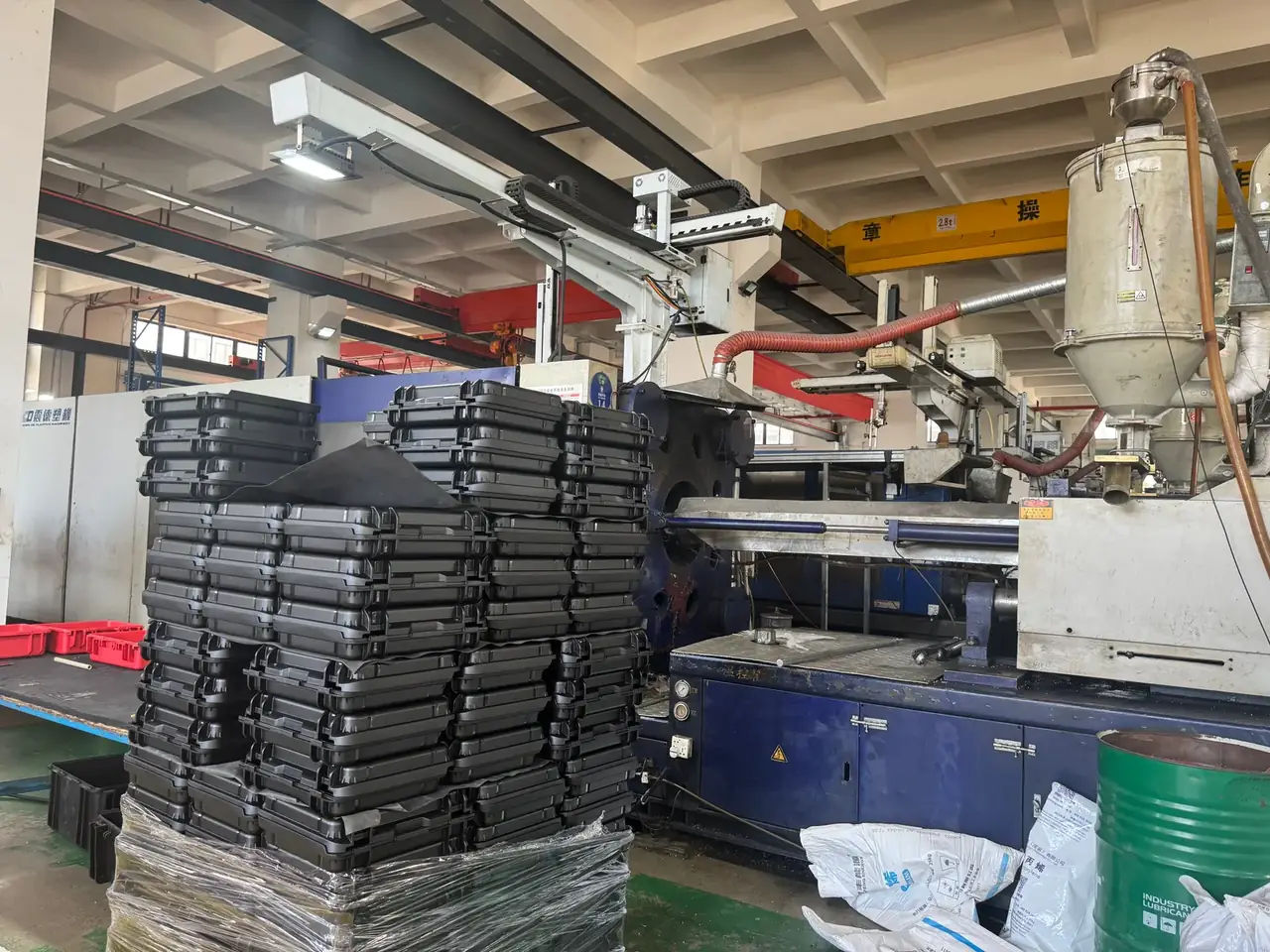
Quick answer: The Tactical patrol vehicle equipment trunk box holds displacement under 1.4 mm with an 8.5 mm cone and a 5.5 mm lid rib after vibration.
Table of contents
- Locating cone depth of a Tactical patrol vehicle equipment trunk box
- Height of the lid compression rib
- Displacement readings across the vibration band
- Foot-seat contact under offset load
- Cone-depth lower bound for vehicle batches
- FAQ
1. Locating cone depth of a Tactical patrol vehicle equipment trunk box
Vehicle carriage differs from static stacking because the excitation is broadband, and every cone-depth step shifts the natural response of the shell. The Tactical patrol vehicle equipment trunk box carries four protruding locating cones under its base, matched to recesses in the rig so all four feet seat together instead of relying on friction. Cone depth is held at 8.5 mm, the step where the cone face meets the recess slope all around without the tip bottoming out.
The outer envelope is 720 x 480 x 320 mm, the inner cavity 650 x 415 x 245 mm, wall thickness 5.2 mm, 9.8 kg empty and 24 kg loaded on the rig. Sizing leaves room for the four corner feet before the cavity depth is fixed, and cone seats sit clear of the lid line so the compression rib never bears over a seat.
Deeper cones are not automatically better. Too much depth lets the tip hit the stop and lifts the base.
| Cone-depth step | Reference reading | Foot seating state |
|---|---|---|
| Below reference | under 8.5 mm | rim contacts first, centre left open |
| Reference | 8.5 mm | four feet seat together, full face contact |
| Above reference | over 8.5 mm | tip meets the stop, base lifts slightly |
2. Height of the lid compression rib
A continuous rib 5.5 mm high runs inside the lid of the Tactical patrol vehicle equipment trunk box, pressing two gasket rings to 24 percent compression against the mouth. Four latches share the closing load at 480 N each, placed symmetrically along the long and short edges, and rib height is matched to latch travel so the mouth stays tight after 3500 open-close cycles. Sealing is checked against IP67 by spray and immersion comparison, and no certification claim is written on the nameplate.
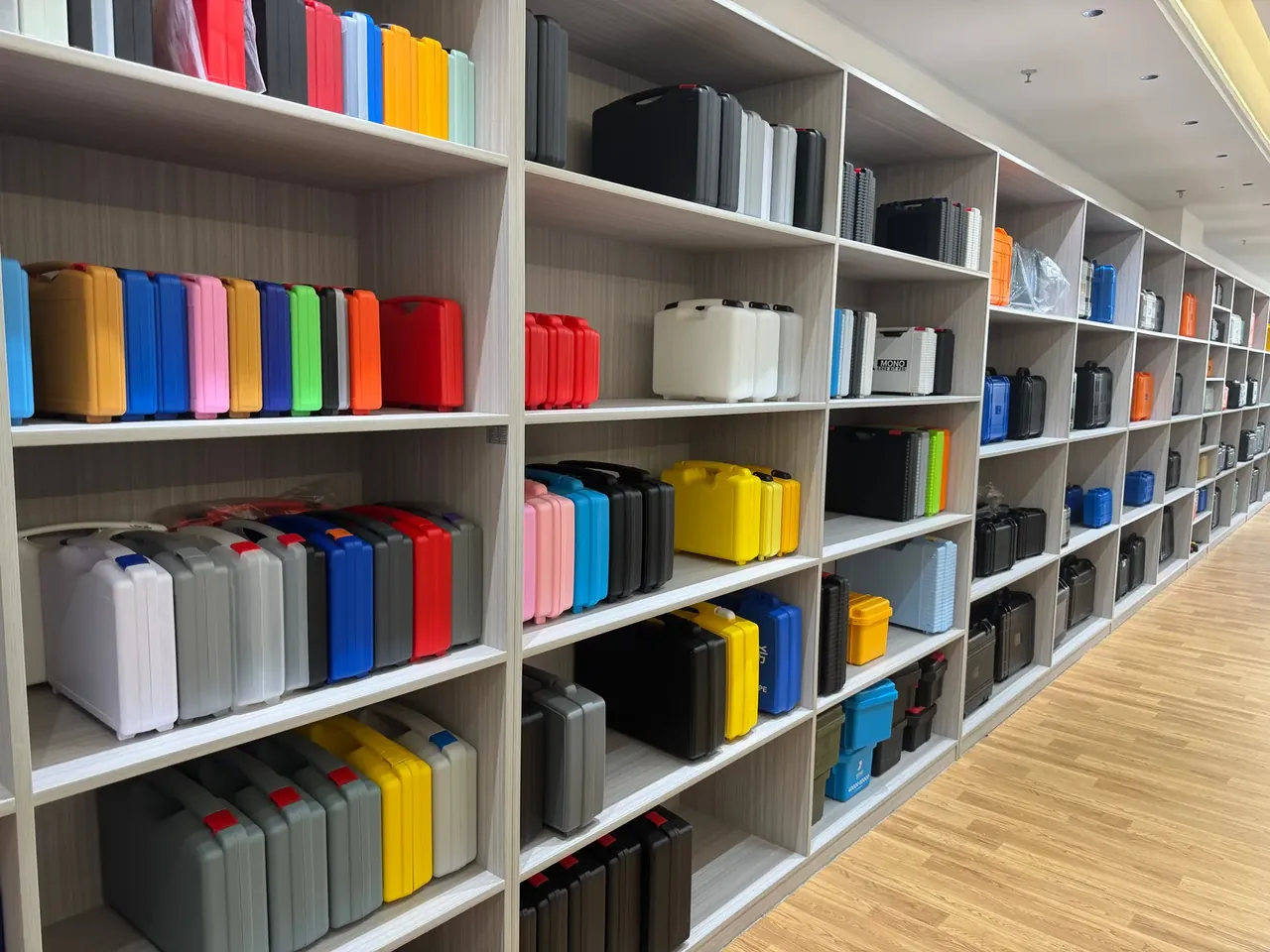
Rib height also decides whether mouth shift can be read cleanly. With the rib at height, the latches lock lid and shell into one body, so the reading reflects only motion between feet and rig. The Tactical patrol vehicle equipment trunk box takes this check before and after each run, using one feeler gauge at all four mouth corners and logging the before-after difference.
3. Displacement readings across the vibration band
The rig sweeps 5-200 Hz over 3 h with four tie-down points at 1.8 kN each, and a sensor on the side wall reads shell movement. The accept line sits at 1.4 mm with no strap loosening.
| Vibration band | Rig condition | Displacement reading |
|---|---|---|
| Low band | 5-200 Hz sweep start | reading climbs slowly |
| Main band | 5-200 Hz / 3 h | displacement under 1.4 mm |
| Closing band | retest after 3 h | falls back to start value |
How the reading is taken matters as much as the number. Each low-band step dwells for a fixed span, the main band runs a full logarithmic sweep, and displacement is the maximum over the whole span rather than a momentary spike. The closing retest happens without retightening any strap, since a mid-run adjustment makes the two ends incomparable. The rig log for the Tactical patrol vehicle equipment trunk box lines up start and stop frequency, dwell time and peak displacement row by row, so a later retest can be matched line for line. Strap condition is a separate column, a yes-or-no note beside the numeric reading, and the two are never converted into each other. After the sweep the four mouth corners are rechecked to confirm the rib was not cyclically lifted before the round is filed.
4. Foot-seat contact under offset load
Moving the ballast toward one cavity corner makes the four feet of the Tactical patrol vehicle equipment trunk box seat unevenly, with a deeper imprint on the loaded side and a lighter one opposite. The retest keeps the same accept line of 1.4 mm and no strap loosening, and only adds a record of how the four contact imprints are spread.

The retest lays a thin transfer film over the rig recesses, seats the case, then lifts it and reads imprint depth and completeness at each corner. The Tactical patrol vehicle equipment trunk box keeps the same four points at 1.8 kN each, with straps neither replaced nor retightened, so both rounds stay comparable.
Offset changes contact, not the accept line.
5. Cone-depth lower bound for vehicle batches
The lower bound is traced back from the band where displacement first crosses 1.4 mm, and readings after that band are trend notes only, not acceptance evidence. Each vehicle batch of the Tactical patrol vehicle equipment trunk box is checked cone by cone against this bound, and any shell below it is left out of the accepted lot. The trace takes the band where the main-band reading first breaks the line, subtracts a moulding allowance from the cone depth at that step, and writes the result as the lot release line.
| Displacement value | Band | Filing method |
|---|---|---|
| under 1.4 mm | whole main band | counted in accepted lot |
| first crossing of 1.4 mm | trace the lower bound | triggers the reject line |
| readings after crossing | trend only | not acceptance evidence |
Beyond the release line, the lot file also pairs the 24 percent compression of two gasket rings, four latches at 480 N each, the 3500-cycle record and the IP67 comparison into one set. Sampling takes the first and last shell of a Tactical patrol vehicle equipment trunk box batch plus fixed-interval pulls, and a cone below the line sends the whole moulding set back for review.
Conclusion
Acceptance of the Tactical patrol vehicle equipment trunk box rests on how four locating cones under the base pair with the lid compression rib. The 8.5 mm cone and 5.5 mm rib map to a reading under 1.4 mm after a 5-200 Hz / 3 h sweep, with no strap loosening as the other half of the same line. JUNZHIJIA checks foot contact and mouth clearance batch by batch against this rig method and writes the cone-depth bound on the release card.
Related Reading
- Securing a protective case in a vehicle: four tie-down points
- Case stacking: four-foot load and stacking layers
- Stacking corners: load bearing and positioning case hardware
- Vehicle and repair tool cases: restraint, oil resistance and space use
Related Products
- 8 Series — Gun Cases; Military Equipment Cases; Camera Equipment Cases; Drone Cases; Watch Cases; Knife Cases; First Aid Cases; Electronics Equipment Cases
- WL8-2812 PP Gun Case — model WL8-2812
- All protective cases and toolboxes: 7 series, 158 models