

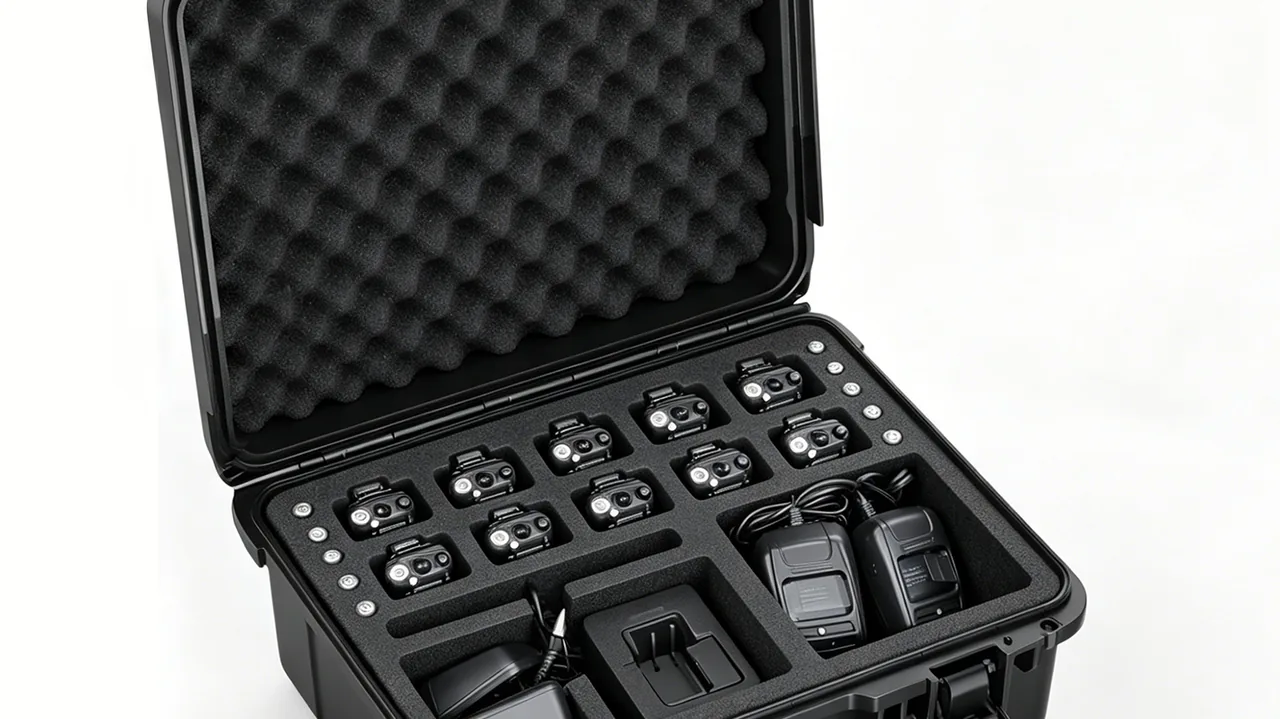
When a firearm travels across state lines, borders or by air, what usually decides whether it can be checked in is not the firearm itself but the case that carries it. Aviation security rules for checked firearms are explicit: the container must be hard-sided and lockable, the firearm must be unloaded and securely fixed, the lock must resist prying, and only the case holder may hold the means to open it. A compliant gun case is therefore both a physical protection carrier and a link in the compliance chain. JUNZHIJIA's protection principle for TSA approved gun cases is organised along four lines: compliant locking, all-direction cushioning, sealed moisture resistance, and traceable identification. Use a locking structure that passes inspection to satisfy compliance, shaped foam compartments to restrain the firearm and accessories, IP-rated sealing to resist moisture and dust in checked baggage, and traceable case markings to support arrival verification, instead of buying a metal box and dropping the firearm inside.
Many first-time firearm shippers stumble at the same point: the case looks fine and the latch is closed, yet they are asked at the counter to change the container or add a lock on the spot. The cause is usually not the firearm but a locking structure and cushioning method that fail the three aviation requirements of hard shell, lockable, and internally fixed. A lock that is not an integral anti-pry design, or a case with only a single latch point, may be refused by the inspector. A firearm that can slide freely inside collides with the case wall in vibration, damaging both the firearm and its fixation. When there is no separate compartment, optics, magazines and cleaning tools crush one another in the same space. This article addresses licensed case holders, firearm dealers, equipment managers in law enforcement and security units, and the case manufacturers and export packaging engineers serving them. It works through compliant locks, case structure, sealing, liner compartments, transport testing and acceptance criteria item by item, with a configuration table and FAQ, so the two thresholds of compliance and protection can be crossed at once.
Table of Contents
- The Dual Challenge of Compliance and Protection in Firearm Transport
- TSA-Compliant Locks and Locking Structure Requirements
- Case Material and Structure: The Shell That Carries Compliant Transport
- Sealing and Protection Rating: Where IP65 and IP67 Apply
- Liner and Compartments: The Logic of Fixing Firearms and Accessories
- Air Checking versus Ground Transport: Packing Differences
- Temperature, Humidity, Corrosion and Long-Term Storage Control
- Transport Test Basis: ISTA, GB/T 4857 and ASTM D4169
- Packing Marks, Traceability and Receiving Inspection
- Configuration Checklist and Selection Table
- Turnaround Maintenance and Compliance Records
- OEM/ODM Customisation and Branded Delivery
- Frequently Asked Questions FAQ
- Conclusion and Related Reading
The Dual Challenge of Compliance and Protection in Firearm Transport
A firearm is a special cargo: it needs physical protection against impact, moisture and dust, and it must satisfy transport requirements that the container be hard, lockable and internally fixed. These two lines overlap heavily in packing design yet each has its own emphasis. Physical protection asks whether the case can protect its contents in drop, stacking and vibration; compliance asks whether the case will be accepted by the carrier and whether its locked and fixed state can be demonstrated at inspection. Designing a compliant gun case is essentially making one structure answer both classes of question.
From refusal and failure statistics, the problems concentrate in four classes. The first is non-compliant locking. Cases using an external combination lock, a soft zipper with a padlock, or a single latch point are judged in many jurisdictions as not meeting the lockable hard container requirement and are changed on the spot. The second is insufficient internal fixation. When the firearm rests on a thin foam sheet with no compartment restraint, it slides along the case length in transport, so the stock, forend or optic strikes the case wall. The third is missing sealing. An ordinary hard case without a gasket experiences cargo-hold temperature and humidity cycling, so condensation forms inside and rust spots appear on metal parts. The fourth is missing identification. A case with no number, no contact details and no content list is hard to trace and claim if it is misrouted or delayed.
Once these four classes are understood, the design logic becomes clear: choose a lock that the carrier recognises as integral and anti-pry, a shell that is hard engineering plastic with a gasket, a liner that is closed-cell foam shaped to the firearm profile with compartments, and markings that are durable and verifiable. None of the four can be omitted; missing any one may cause a stop at check-in or inspection. The table below sets needs, risks and measures side by side as a pre-purchase checklist.
| Requirement | Non-compliant practice | Risk | Correct practice |
|---|---|---|---|
| --- | --- | --- | --- |
| Locking | External soft lock, single latch | Judged non-lockable hard container, easy to pry | Integral anti-pry lock, two or three latch points |
| Fixation | Thin foam sheet only, no compartments | Firearm slides, strikes wall and optics | Profile-shaped closed-cell foam, separate compartments |
| Sealing | Ordinary hard shell without gasket | Condensation rust, dust ingress | IP65/IP67 gasket and pressure-equalisation valve |
| Identification | No number, no list | Hard to trace, hard to claim | Case number, content list, contact details |
TSA-Compliant Locks and Locking Structure Requirements
The lock is the most direct expression of a gun case's compliance. Aviation requirements for checked firearm cases reduce to three points: the container must be hard and lockable by design, it cannot be opened without authorisation once locked, and the means to unlock rests only with the case holder. Against these three points, lock design balances anti-pry strength, closure reliability and the uniqueness of the key or code. A common approach is an integral anti-pry padlock or an integrated latch lock, with the lock body seated in a reinforced pocket in the case so that the shackle diameter and body material meet basic shear and pry strength.
A single latch point is the most easily overlooked hazard. When only the front latch secures the lid, the lid opens a gap on the side away from the latch under torsional load, which both harms sealing and prevents the inspector from confirming reliable closure. A sound design uses two or three latch points arranged symmetrically along the case's long edge, so the lid is loaded evenly and closure rigidity rises. Latch areas should have metal reinforcement plates so the plastic hook does not become brittle and break in cold or after long use.
Combination locks and mechanical key locks each suit different scenarios. A combination lock avoids carrying a key, but in some transport settings the requirement to prove that only the holder knows the code is stricter; a mechanical lock can directly demonstrate that the sole key is with the holder. Whichever is used, the case should have no cover or side door that can be opened by hand once locked. Some cases offer a lockable side hatch for day-to-day access in addition to transport use; then the hatch lock and the main lock should be managed in tiers so there is no contradiction of "main lock compliant, hatch open by hand".
It should be noted that lock compliance is ultimately determined by the carrier, and the specific interpretation of a lockable hard container differs between airlines and countries. During selection, keep the lock's specification and test records so they can be provided to the carrier at check-in or customs. For cross-border transport, also confirm the destination's rules on locks and firearm transport, so the case is not refused because the lock type or unlocking arrangement conflicts with a new regulation.
Case Material and Structure: The Shell That Carries Compliant Transport
The shell is the body that carries both physical protection and compliance. Three shell families are common for gun cases: modified engineering plastics such as PP, ABS or PC alloy; rotationally moulded LLDPE; and aluminium frame with composite panels. Injection-moulded engineering plastic cases have high dimensional precision, even wall thickness and can integrate latch pockets and seal grooves, which suits volume production of small and medium gun cases. Rotomoulded cases have thick walls and strong impact and drop resistance, which suits long guns or heavy configurations. Aluminium cases balance weight and rigidity and are often used where appearance and lightweighting both matter.
Whatever the shell, several structural points are common. First, the mating face between lid and base must have a continuous seal groove with a hollow or solid gasket inside so that closure forms a ring seal. Second, corners and latch pockets should have ribs or local thickening to avoid stress concentration. Third, the case interior should have locating features that mate with the liner so the foam liner does not shift as a whole in vibration. For long-gun cases, a transverse reinforcement at mid-length reduces longitudinal bending.
Handles and casters affect both user experience and the convenience of compliant transport. Air checking requires frequent handling, so the case should have load-bearing handles whose bases join the wall through integral moulding or metal inserts, not just plastic threads. Wheeled cases need casters rated for the load with locking to prevent self-rolling on a conveyor. Because gun cases are mostly hollow thin-wall structures, handle and caster joints are the most likely to crack; design should transfer the load into the case inner wall through a reinforcement plate or through-bolt rather than concentrating it on a single wall thickness.
The compliance value of the shell lies not only in being hard but also in giving the internal fixation and locking a reliable base. A case that is deformed, has a warped lid or a cracked latch pocket will be questioned at inspection even if the lock itself is compliant, because closure is not tight. Material selection and structural design should therefore bring drop, stacking and torsion loads into the check, rather than discovering the problem only at the sample drop test.
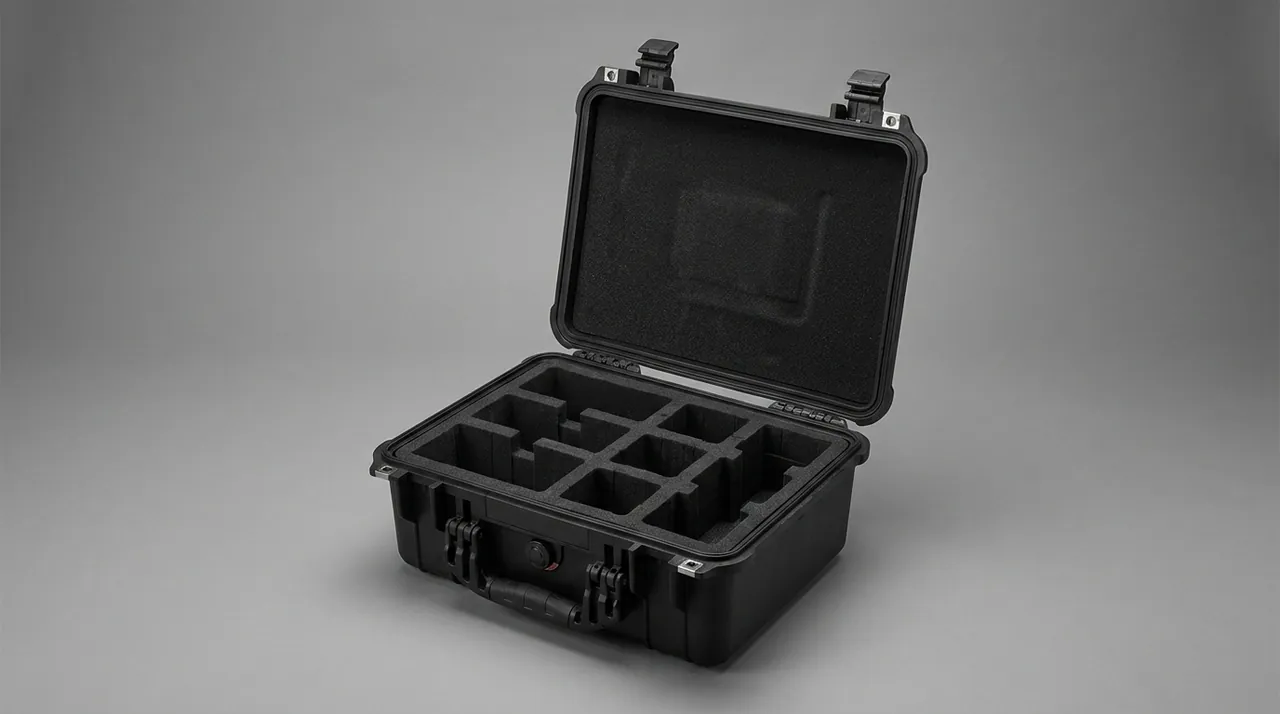
Sealing and Protection Rating: Where IP65 and IP67 Apply
The sealing rating decides how well the case resists dust and water penetration, which for a gun case directly affects whether internal metal parts stay free of rust in the long run. The industry commonly uses the IP code defined by IEC 60529 and GB/T 4208, where IP65 means dust-tight and protected against water jets, and IP67 means dust-tight and protected against short immersion. Understanding the boundary between them allows the right rating to be chosen for each transport scenario rather than blindly chasing a higher number.
IP65 suits scenarios dominated by rain, splash and dust, such as ground transport, open-air handling and short air legs. IP67 suits scenarios where short immersion is possible or the case stays in high humidity for a long time, such as multimodal transport, sea freight, or gun cases stored long-term in damp warehouses. It must be stressed that the IP rating applies to the whole case system: gasket material, groove dimensions, latch clamping force and pressure-equalisation valve sealing together decide the actual result. Any single poor fit defeats the rating.
The first element of sealing design is matching the groove and the gasket. The gasket needs stable compression and rebound, and the ratio of groove depth to gasket diameter must ensure reliable contact after closure without over-compressing into permanent set. Over long use the gasket loses rebound through compression set and aging, which is the most common cause of seal failure and the item most worth checking periodically on a gun case.
The second element is the pressure-equalisation valve. In a well-sealed case, the pressure difference across a cargo-hold altitude change or a transport temperature swing acts on the gasket and walls, either forcing the seal open into a leak or making the lid hard to open. A pressure-equalisation valve uses a waterproof breathable membrane to equalise the pressure slowly while blocking liquid water and dust. For gun cases that routinely travel by air or across climate zones, the valve is almost essential.
The third element is the coordination of sealing and locking. Only when the latches provide sufficient and even clamping force can the gasket be compressed to its working set. A case with a single latch and a gasket often leaks away from the latch point, which is the concrete expression of "the rating is decided by the whole case". During selection, gasket specification, latch count and pressure-equalisation valve should be confirmed as one group of parameters. See IP67 protective case for rating comparison and case pressure-equalisation valve for valve selection points.
Liner and Compartments: The Logic of Fixing Firearms and Accessories
The liner is the core of a gun case's protection and the direct realisation of the compliance requirement for internal fixation. A sound liner does three things: it fixes the firearm in a preset posture, physically separates accessories from the firearm, and provides controlled cushioning under impact. The common liner material is closed-cell foam with low compression set, such as EVA, PE or an IXPE composite, with pockets CNC-cut or moulded to the firearm profile.
The value of a shaped pocket is restraint. A flat foam sheet can only support, not limit movement; only a pocket cut to the firearm profile can restrain the firearm in all directions during drop and vibration. The pocket depth is usually half to two thirds of the firearm section, so the firearm cannot jump out of the pocket as a whole while there is still room to lift it out. For a firearm with an optic, the optic area should be deepened separately so the optic does not become the highest point and be pressed by the lid.
Compartments are the key to handling accessories. Magazines, cleaning tools, optic spares and spare batteries should each occupy a separate cavity, separated by solid material rather than all pushed into one common void. Mixing causes accessories to strike one another in transport and makes it hard to count contents at inspection. For whole-kit transport by law enforcement and security units, compartments can also correspond to the content list so that opening, counting and packing records match one to one.
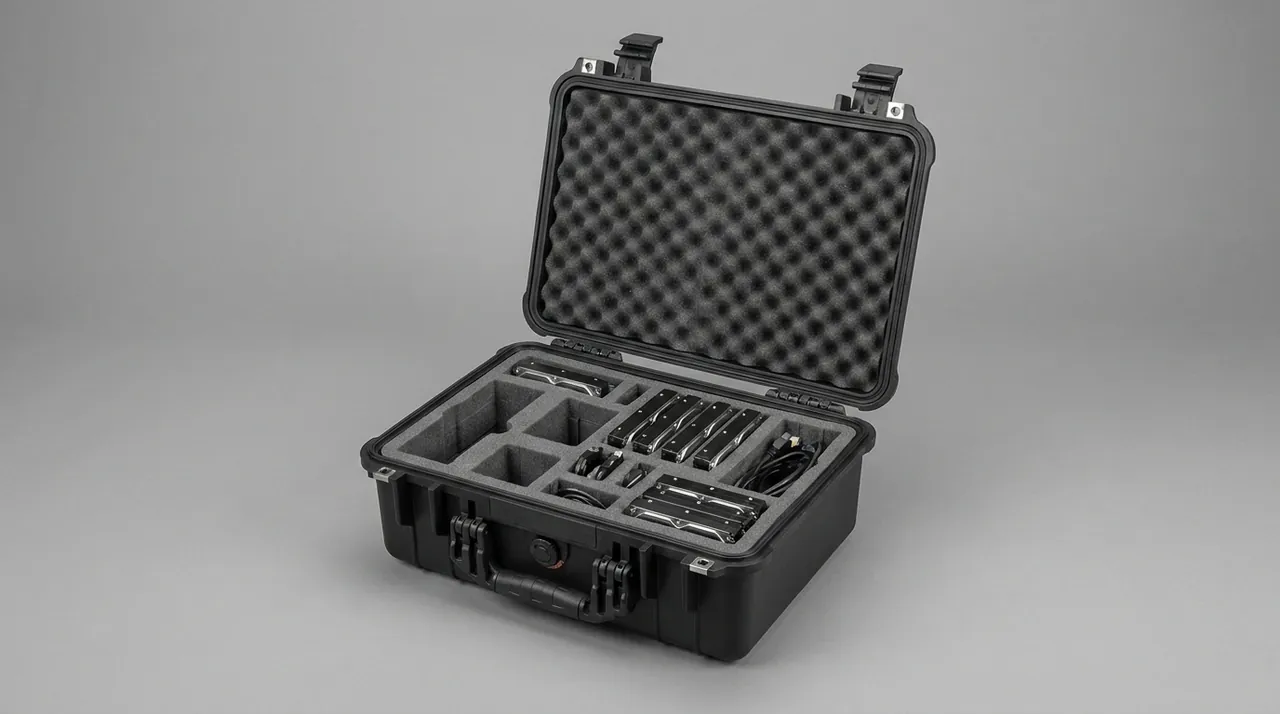
Cushion thickness should be set from the permitted acceleration and the allowable compression of the foam, not simply "thicker is better". Excessively thick soft foam rebounds strongly in a drop, making the contents take a second load. The reasonable approach is a combination of stiffness and softness between the liner and the wall: the layer near the contents is softer for fitting and vibration absorption, and the layer near the wall is firmer to spread the load into the case structure. In its whole-case fixation of long guns and accessories, JUNZHIJIA uses compartment and slot methods consistent with the modular idea of the removable divider system, configuring shaped liner sets by firearm model and accessory list. The figure below shows the packing structure of a firearm with accessories fixed in compartments.
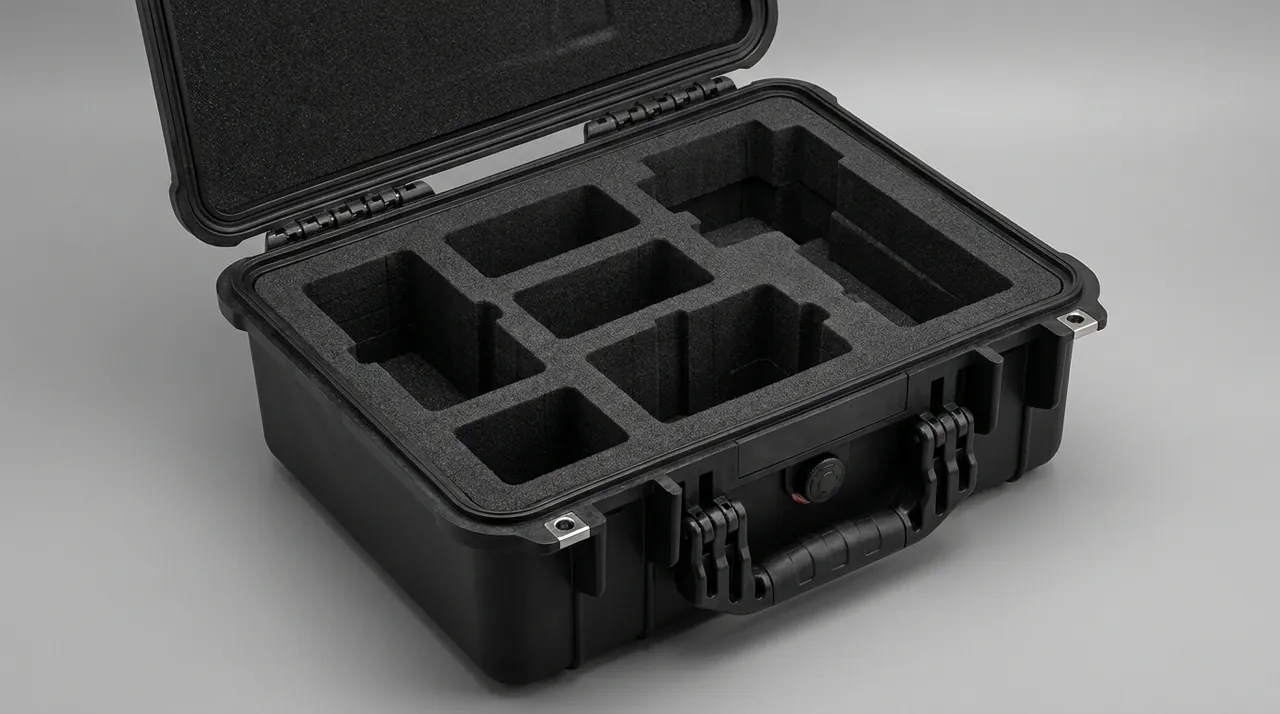
Air Checking versus Ground Transport: Packing Differences
Air checking and ground transport share requirements and differ in others. Both require hard, lockable and internally fixed; they differ in environmental load and inspection procedure. Air checking experiences cargo-hold cold, low pressure and handling impact, so it demands more from sealing and pressure equalisation; ground transport is dominated by continuous vibration and repeated handling, so it demands more from fatigue resistance and handle and caster reliability.
In air checking, the case must withstand the pressure difference from low cargo-hold pressure, so pressure-equalisation valve and gasket stability are especially critical. Air handling is fast and highly automated, so the case outline should be as regular as possible to avoid protruding parts being caught by conveyor equipment. Locks face stricter inspection in the air scenario, so the level of lock integration and anti-pry strength should be a selection priority, and the specification should be kept for explanation at check-in.
In ground transport, continuous vibration gradually shifts the internal foam and repeatedly loads handle and caster joints. A case used mainly on the road should therefore strengthen the locating fit between liner and case and use load-bearing handles and locking casters. After repeated turnover, check latch springs, hinge pins and caster base bolts to prevent long-term vibration from loosening fasteners.
In multimodal scenarios the case must satisfy both air and ground constraints, so design should take the stricter side rather than the looser, that is, set sealing and locking to the more demanding party. Handover and temporary storage should also be considered: a case may sit outdoors briefly at a transfer node, so it should have basic sun and rain resistance. Differences in transport mode ultimately land on one case, so list all stages it may experience and check against the worst combination.
Temperature, Humidity, Corrosion and Long-Term Storage Control
Even with compliant sealing, humidity inside the case should not be neglected. The air humidity at packing, moisture adsorbed by the liner material, and the ambient conditions before sealing all affect the long-term internal humidity. For gun cases stored long-term, rust risk on metal parts comes mainly from residual moisture and condensation caused by temperature swings.
Three coordinated measures control internal humidity: desiccant, humidity indication and structural ventilation. At packing, add enough desiccant for the cavity volume and the expected storage period, and place a humidity indicator card so the holder can judge whether internal humidity is excessive without opening the case. Structurally, avoid closed dead corners so moisture can be adsorbed by the desiccant instead of lingering in a cavity corner.
For gun cases on sea freight or long-term tropical storage, the corrosion resistance of the hardware also matters. Latches, hinges and screws in a humid salt-spray environment easily develop rust spots that then affect locking reliability. The neutral salt spray test of GB/T 10125 can be used to compare surface treatment schemes by the time to red rust under the same conditions. Note that salt spray is for process comparison and screening, not a direct field-life conversion.
Material compatibility matters too. Stainless hardware in direct contact with aluminium or carbon steel forms galvanic corrosion, so insulating washers or coating isolation should be used. The liner should be a grade that does not release plasticisers or corrosive components, so long contact does not affect the firearm surface coating or metal parts. For law enforcement and security units, a periodic record of internal humidity and hardware state should be established, treating storage as a continuation of transport protection.
Transport Test Basis: ISTA, GB/T 4857 and ASTM D4169
A gun case's protection capability should ultimately be verified by transport testing rather than claimed by parameters. By test object and purpose, the basis falls into three groups of thinking. The first is whole-case performance testing, represented by the ISTA series of the International Safe Transit Association, which evaluates a packaged case in real logistics through combined vibration, impact, drop and stacking tests. The second is domestic transport package test methods, represented by the GB/T 4857 series, covering basic tests such as vibration, impact, stacking and drop. The third is distribution cycle testing, represented by ASTM D4169, which combines multi-stage sequences according to the expected transport distribution cycle.
For a gun case, three load classes matter most. The first is drop, simulating slips and throws in manual handling, the most direct way to check the combined cushioning of shell, latch and liner. The second is vibration, simulating continuous vehicle and cargo-hold vibration, checking liner shift, fastener loosening and structural fatigue. The third is stacking, checking the case's compression resistance under upper loads in storage and transport. Air transport also needs attention to the effect of low pressure on a sealed cavity, so the pressure-equalisation valve should work normally under pressure change.
When setting a test plan, first define the case's actual transport route and expected loads, then choose the corresponding sequence rather than applying a uniform template. Test conditions should be written into the purchase technical agreement, defining items, severity levels and criteria. The criteria are not only "the case does not break" but also "contents have no displacement, locking functions normally, no seal leakage". Sample cases should be documented as part of the product consistency proof.
It should be stated honestly that transport testing verifies the packaged case under given conditions; it cannot be converted directly into an absolute guarantee for any real logistics, nor into an excessive performance claim. The purchase contract should position the test purpose as "comparing schemes and verifying design boundaries under repeatable conditions", and choose whole-case performance, basic test method or distribution cycle accordingly. For third-party testing, confirm the laboratory's qualification and the traceability of the report.
Packing Marks, Traceability and Receiving Inspection
The marking and traceability design of a gun case directly relates to traceability in the event of misrouting, delay or dispute. The exterior should carry clear, durable markings that are hard to change without damaging the case, usually including the case number, the owning unit or holder information, a content list note and necessary handling marks. Handling marks can follow convention with "this way up", "keep dry" and "do not roll" symbols, combined with the case number to form a unique identity.
The internal list is a feature that distinguishes a gun case from an ordinary transport case. The list should correspond to the internal compartment layout, itemising firearm model, accessory category and quantity so that opening, counting and packing records can be cross-checked one to one. For law enforcement and security units, the list should also connect with stock-in and stock-out records to form a complete chain from packing through transport to arrival and warehousing.
Receiving inspection should follow a fixed sequence: first check the case exterior and lock state, then check the gasket and pressure-equalisation valve, then open and check the list against the physical contents. The opening sequence matters, because a wrong order can load or lose the contents during removal. Problems found at acceptance should be recorded on the spot and photographed, compared with the packing record, to judge whether damage occurred in transport or at packing. Any nonconformance should be recorded and notified to the sender rather than absorbed on site.
For gun cases that turn around many times, acceptance is not only "arrival inspection" but also "return inspection". The case, liner and lock wear gradually over numerous turns, so each return should check latch springs, gasket compression set, liner pocket shape and hardware rust, and maintain or replace promptly rather than letting a faulty case enter the next transport round.
Configuration Checklist and Selection Table
Selection should proceed through three layers of "use — environment — load". The first layer defines use: a single firearm for short carry, multiple firearms for dealer transport, or batch turnaround of unit equipment. The second defines environment: air travel, cross-climate zones, or long-term storage. The third defines load: frequent handling and stacking needs. Once the three layers are set, case size, lock count, sealing rating, liner type and caster configuration can converge accordingly.
The table below gives configuration suggestions for three typical scenarios as a starting point to be fine-tuned to actual needs.
| Item | Personal short carry | Dealer multi-firearm transport | Unit equipment turnaround |
|---|---|---|---|
| --- | --- | --- | --- |
| Shell material | Injection PP/ABS | Injection PP or rotomoulded LLDPE | Rotomoulded LLDPE |
| Lock | Two-point integral lock | Three-point anti-pry lock | Three-point anti-pry lock + lock records |
| Sealing | IP65 | IP67 | IP67 + pressure-equalisation valve |
| Liner | Profile foam single slot | Multi slot + accessory compartments | Modular compartments + list correspondence |
| Handling | Load-bearing handle | Load-bearing handle + casters | Casters + forklift pockets |
| Traceability | Case number | Number + list | Number + list + stock records |
A common misconception in selection is "compare only size and price". The value of a gun case lies mainly in lock compliance, sealing reliability and liner matching, none of which is easy to judge from appearance. At the procurement stage, ask for the lock specification, sealing rating statement and liner configuration plan, and verify them against the actual transport route, rather than ordering on nominal size alone.
Turnaround Maintenance and Compliance Records
In long-term use, wear concentrates on the latch, gasket, hinge and caster. Latch springs under long compression lose elasticity, showing as loose closure or hard opening; aging gaskets lose rebound, showing as reduced protection rating; worn hinge pins loosen the lid and affect seal compression; worn casters affect rolling smoothness. Maintenance should build a periodic inspection system around these four, with intervals based on use frequency.
Compliance record management is a step many users overlook. Lock specification, sealing rating proof, transport test report, case number and content list should be kept together as one set, with the case or the ledger. When the carrier or inspector asks about the case's compliance, the basis can be produced quickly, avoiding a check-in delay from missing records. For units with long-term batch turnaround, records should also connect with routine inspection logs to form a traceable management loop.
Another meaning of turnaround maintenance is the retirement decision. When the shell cracks, the latch pocket breaks, the seal groove deforms or the caster base tears, the case cannot return to its original protection level even with part replacement, so it should be retired rather than patched. A faulty case entering transport carries far more risk than its residual value. The maintenance system should define retirement criteria so that "use it while it works" does not cause content damage or compliance risk.
OEM/ODM Customisation and Branded Delivery
For firearm dealers, security equipment suppliers and brand owners, gun cases often need customisation for their own product line and brand image. Common dimensions include: tooling the case size and internal layout for specific firearm models and accessory lists; choosing the lock type for the target market's compliance requirements; making colour, silk-screen and packaging marks to the brand standard; shaping the liner to the customer's markings and product profile; and compiling the documents to the customer's template.
The customisation process should proceed as "requirement confirmation — structural design — sample verification — volume delivery". Requirement confirmation should define the target market's transport compliance, especially the lock and the criteria for a lockable hard container; structural design sets case size, lock positions and liner layout; sample verification confirms the design boundary through drop, vibration and sealing tests; volume delivery ensures batch consistency and complete documents. JUNZHIJIA provides firearm dealers and security equipment suppliers with an integrated plan from structural tooling to liner moulding, lock selection and branded delivery, helping to bring compliance requirements forward into design rather than patching them at check-in. For export projects, packing marks and traceability numbers should also be unified so the customer can count and warehouse by one numbering logic at destination. The case file should contain lock specification, sealing rating statement, liner configuration table and transport test records so the customer can provide a compliance basis at customs and check-in.
It must be specially noted that the application and transport of gun case products must strictly comply with the laws and regulations of each jurisdiction, and the product design serves only compliance, safety and protection purposes. The content above concerns the structure, protection and transport management of case products, and does not involve the use or performance of firearms.
Frequently Asked Questions FAQ
Q: What are the hard requirements for the lock on a TSA compliant gun case?
A: The core requirements are that the container must be hard and lockable by design, that it cannot be opened without authorisation once locked, and that only the holder holds the means to unlock. In engineering terms this usually means an integral anti-pry lock or integrated latch lock with the body seated in a reinforced pocket, a shackle diameter and material meeting basic shear and pry strength, and two or three latch points arranged symmetrically along the long edge for closure rigidity. External soft locks, single latch points, or a zipper with a padlock are not recognised as a lockable hard container in most jurisdictions and may be refused on the spot. Because different carriers and countries interpret the requirement differently, keep the lock specification and test records so they can be provided at check-in. The case design and use must also comply strictly with the laws of each jurisdiction. For the carrier to accept the case, the lock must also be tamper-evident, so any forced opening leaves a visible trace; that is why an integral lock seated in a reinforced pocket is preferred over an external padlock that can be cut and replaced without leaving evidence on the case itself.
Q: How should I choose between an IP65 and an IP67 gun case?
A: IP65 means dust-tight and protected against water jets, suited to rain, splash and dust scenarios such as ground transport and brief open-air handling; IP67 means dust-tight and protected against short immersion, suited to possible immersion or long-term high humidity such as multimodal transport, sea freight or damp warehouse storage. Choose by the worst-case transport combination and prefer the higher rating over the lower. More importantly, the IP rating is decided by the whole case system: gasket material, groove dimensions, latch clamping force and pressure-equalisation valve sealing all matter, and any single poor fit defeats the rating. So when comparing options, do not look only at the rating number; check the sealing design and latch count as concrete parameters, and confirm the gasket compression set over time. A practical check is to confirm the gasket sits in a continuous groove with no interruption at the hinge or latch areas, because a groove broken by hardware or a moulding seam becomes the first leak path once the case meets cargo-hold pressure.
Q: Why must the foam inside a gun case be profile-shaped rather than flat?
A: Flat foam can only support weight, not limit movement; only a pocket cut to the firearm profile can restrain the firearm in all directions during drop and vibration. The pocket depth is usually half to two thirds of the firearm section so the firearm cannot jump out as a whole while there is still room to lift it out; for a firearm with an optic, deepen the optic area separately so it does not become the highest point pressed by the lid. Accessories should each occupy a separate cavity separated by solid material to avoid striking one another. Cushion thickness should be set from the permitted acceleration and allowable foam compression, not simply thicker, because overly thick soft foam rebounds strongly in a drop and loads the contents a second time, which can be as damaging as too little cushioning. The foam grade also matters: a closed-cell foam keeps its shape and does not absorb water, while an open-cell foam may hold moisture against the firearm coating, so the pocket material should be specified together with the sealing grade rather than chosen on look and feel alone.
Q: Is a pressure-equalisation valve essential, and what does it do?
A: For gun cases that routinely travel by air or across climate zones, it is nearly essential. In a well-sealed case, a cargo-hold low pressure or a transport temperature swing creates a pressure difference that acts on the gasket and walls, either forcing the seal open into a leak or making the lid hard to open. It works together with the gasket: the gasket handles static sealing and the valve handles dynamic pressure relief, and missing either reduces both protection and the opening experience. During selection, confirm the valve's airflow, waterproof rating and mounting position together, and check that it is not blocked by the liner after assembly. Where a case is used on repeated flights, the valve membrane should be checked for clogging by dust or cleaning agents, since a blocked valve turns a sealed case into a rigid pressure vessel that can be hard to open and can stress the gasket at the seal line.
Q: How do air checking and ground transport requirements differ for a gun case?
A: Both require hard, lockable and internally fixed, and differ in environmental load and inspection procedure. Air checking experiences cargo-hold cold, low pressure and handling impact, so it demands more from sealing and pressure equalisation, its handling is more automated so the case outline should be regular with no protruding parts to be caught, and the lock faces stricter inspection. Ground transport is dominated by continuous vibration and repeated handling, so fatigue resistance and handle and caster reliability matter more, with a stronger locating fit between liner and case and load-bearing handles with locking casters. In multimodal transport, set sealing and locking to the stricter side and check against the worst combination, because a case that fails one leg can still halt the whole shipment. In practice the two transport modes often combine, so the safe rule is to design for the stricter air requirement and then confirm that the ground-handling features such as handles, casters and stacking points still perform under the added weight of a fully loaded case.
Q: What transport tests should a gun case pass, and what are the criteria?
A: Three groups of basis can be used: whole-case performance testing such as the ISTA series, evaluating a packaged case in real logistics through combined vibration, impact, drop and stacking; domestic transport package test methods such as GB/T 4857 covering vibration, impact, stacking and drop; and distribution cycle testing such as ASTM D4169, combining multi-stage sequences per the expected transport cycle. A gun case mainly verifies drop, vibration and stacking, and air transport also needs attention to low pressure on the sealed cavity. Test conditions should be written into the purchase agreement, and the report should honestly state its laboratory nature and applicable boundary. The most useful test evidence names the sequence, the drop height or vibration profile and the pass criteria, so the buyer can match it to the real route instead of accepting a generic claim of rugged construction that cannot be tied to a defined load case. Recording the drop orientation also matters, since a hard case fitted with a single carry handle tends to land on a corner rather than flat, and a corner impact loads the latch and the hinge bosses hardest. Q: How often should a gun case gasket be checked or replaced?
A: The gasket is one of the parts most prone to aging and failure; long compression produces permanent set and loss of rebound, which is the most common cause of seal failure. The interval should follow use frequency and environment: cases with frequent turnaround or use in humid or salt-spray conditions should be checked more often, and even stored cases should be checked periodically. Check whether the gasket still has stable rebound, whether the surface has cracked or hardened, and whether it contacts the groove continuously. When replacing, choose the same specification, same material and compatible gasket, and reassemble to the groove's compression set, avoiding insufficient clamping force from wrong diameter or material. Check hardware rust at the same time, using GB/T 10125 salt spray to compare surface treatment schemes if needed. A simple field method is to close an empty case, submerge it briefly where the rating allows, and watch for bubbles at the seal line, then repeat after a full load to confirm that contents pressure has not lifted the lid away from the gasket.
Q: How is humidity inside the case controlled during long-term firearm storage?
A: Control uses desiccant, humidity indication and structural ventilation together. At packing, add enough desiccant for the cavity volume and expected storage period, and place a humidity indicator card so the holder can judge internal humidity without opening; avoid closed dead corners so moisture can be adsorbed by the desiccant rather than lingering. For sea freight or long-term tropical storage, also watch hardware corrosion resistance, compare surface treatment schemes with neutral salt spray, and avoid stainless steel in direct contact with aluminium or carbon steel, which forms galvanic corrosion. After sealing, keep internal humidity low, but do not mistake "sealed" for "absolutely isolated"; a properly configured pressure-equalisation valve helps handle the pressure difference from temperature swings without letting water in.
Conclusion and Related Reading
Compliance and protection in firearm transport are essentially one structure answering two questions: the locking structure answers "will the carrier accept it".
Related Reading