

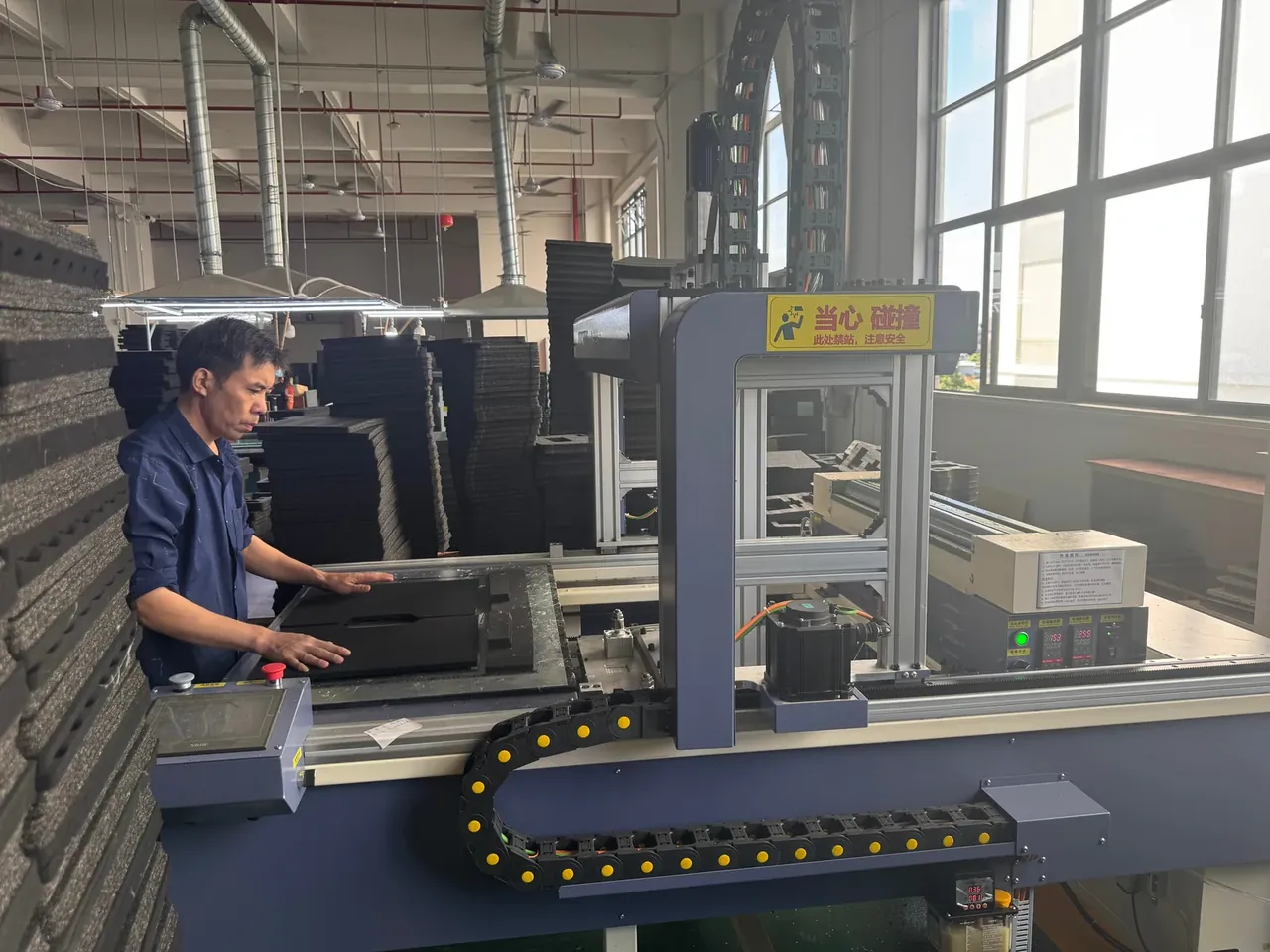
Quick answer: Two-Layer Foam Design fixes the density split first: 30 kg/m3 EVA at 32 kPa over 45 kg/m3 EPE at 103 kPa, plus a 0.15 mm bond line.
Table of contents
- How Two-Layer Foam Design Starts at the Face
- Density Split Between Core and Base
- Hardness Gradient Across Two Scales
- Bond Order: Hard Layer First
- Two Layers or One Thick Sheet
- FAQ
1. How Two-Layer Foam Design Starts at the Face
Two-Layer Foam Design begins at the face, the 5–10 mm sheet at 25–30 kg/m3 that touches the part. Its job is to turn point contact into area contact when the lid closes. EVA at that density reads 16–23 Asker C, so a thumb leaves a dent that recovers in seconds.
The density floor comes from compression set, not from feel. Held at 25% strain and 70 C for 22 hours, EVA at 30 kg/m3 keeps 18–22% permanent set, about 2 mm gone from a 10 mm sheet in a season. Below 25 kg/m3 the cavity edge collapses first.
Lid ribs need clearance. A 3–5 mm rib pressed onto a flat face flattens that band, so the closing load lands on the rib tips and cuts a groove within months; notch the face at each rib instead. Past 15 mm the face bottoms out and passes force down, so most Two-Layer Foam Design builds stop it at 10 mm.
2. Density Split Between Core and Base
The split is what pays for the second layer. A 45 kg/m3 EPE base carries 103 kPa at 25% compression and 172 kPa at 50%, while a 30 kg/m3 EVA face carries 32 kPa at 25%. That factor of three lets the soft layer spread an impact and the firm one catch it.
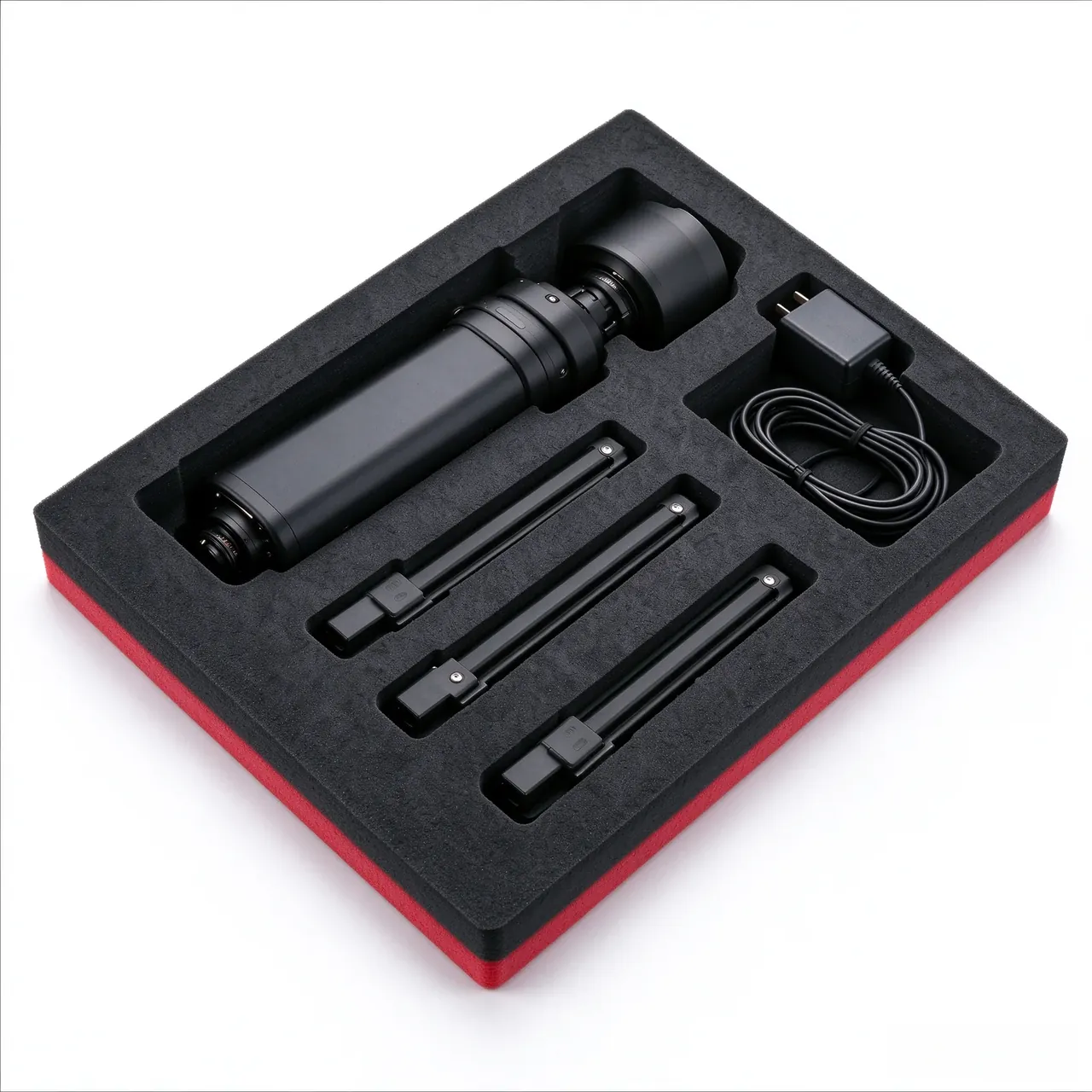
A 15 kg/m3 gap is the usual pairing. Beyond 25 kg/m3 the interface shear fatigues the glue and the stack peels away in one sheet; under 8 kg/m3 the curves overlap, and Two-Layer Foam Design adds a process step with nothing in return.
| Layer | Density | Stress at 25% | What it does |
|---|---|---|---|
| Face, EVA | 25–30 kg/m3 | 32–40 kPa | Follows contour, damps vibration |
| Glue line | 0.10–0.15 mm dry | Takes no load | Carries shear, blocks slip |
| Base, EPE | 45 kg/m3 | 103 kPa | Spreads impact, holds weight |
The base also completes the load path. A 6 kg device on a 300 x 200 mm footprint sits under 1 kPa static, but a 20x drop factor lifts it to 20 kPa, inside the linear band of 45 kg/m3. At 30 kg/m3 the same event reaches 62 kPa and the reserve is gone.
Floor ribs set base thickness. With 4 mm ribs at 40 mm pitch, a 10 mm base sags 0.5 mm between ribs; 15 mm brings the sag under 0.2 mm, which is why Two-Layer Foam Design pairs a thin face with a 15 mm base.
3. Hardness Gradient Across Two Scales
Hardness is harder to align than density, because two scales run side by side. EVA is quoted in Asker C, PE foam in Shore C or Shore OO, and the same sheet reads 2–4 points apart across them. A quote of hardness 20 without a scale says nothing.
| Layer | Scale | Reading | Bench check |
|---|---|---|---|
| Face, EVA 30 kg/m3 | Asker C | 16–23 | A thumb leaves a mark |
| Core, EVA 45 kg/m3 | Shore C | 20–25 | A nail cannot press in |
| Base, EPE 45 kg/m3 | Shore OO | 60–63 | A palm sinks about 2 mm |
Step the gradient 5–10 points per layer. A 20-point jump builds a hard step, and in a drop the stress concentrates there, so the case corner splits first. The gradient is the part of Two-Layer Foam Design that decides where failure starts.
Scale conversion is not a feel thing. Asker C and Shore C track each other at the soft end, but above 40 the Shore C reading runs about 5 points higher on the same sheet, and a quote against the wrong scale delivers an insert one grade harder than the sample.
Hardness also drifts with temperature: EVA stiffens 3–5 points below 0 C and softens 2 points in a 35 C shop, so the acceptance note should name 23 ± 2 C.
4. Bond Order: Hard Layer First
Bond hard to soft. Lay the 45 kg/m3 base onto the case floor, then press the 30 kg/m3 face onto it. The firm layer sets its datum against the floor, while the soft layer absorbs up to 0.3 mm of floor flatness error, the usual tolerance on an injection-moulded shell.
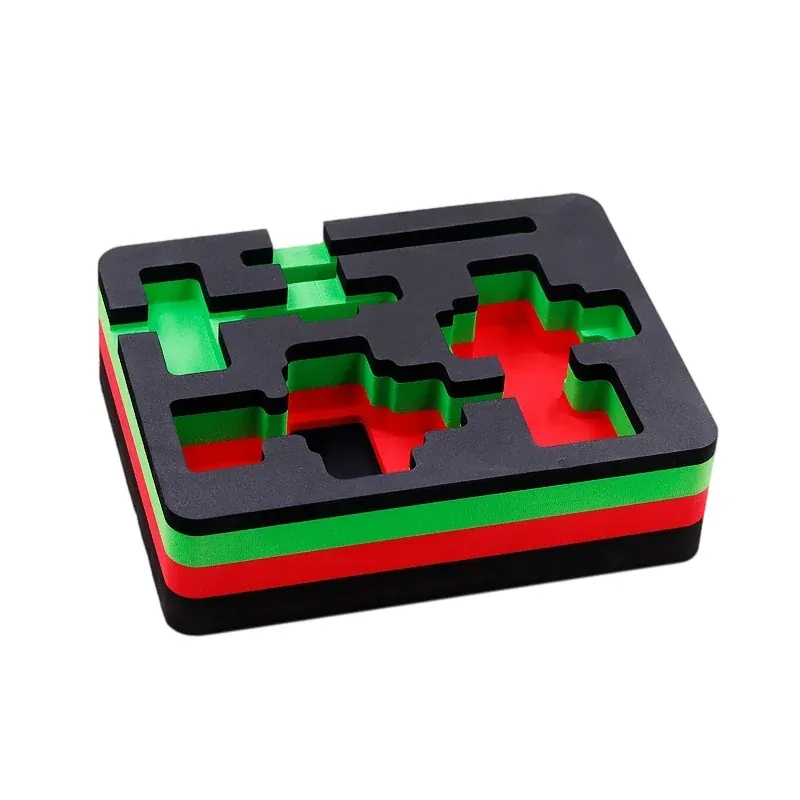
Reverse the order and the trouble shows at the press. The soft layer compresses 10–15%, the glue line is drawn into a thin edge, and 24 hours later it springs back and lifts the corner by about 0.5 mm. Most Two-Layer Foam Design rework starts here.
Adhesive runs 0.10–0.15 mm dry. A water-based spray gives 10–20 minutes of open time at 70–100 g/m2; press at 0.05 MPa for 30 s, handle after 2 hours, and reach full strength at 24. Bond past the open time and initial tack is halved.
For a three-layer build the order holds: hardest against the floor, softest against the part. Stagger the bond lines on the sidewall by 5 mm or more, otherwise a saw cut lifts the whole stack.
5. Two Layers or One Thick Sheet
Three conditions decide it: a cavity deeper than 60 mm with a part that swings sideways, soft contact plus firm support in one case, or one drop direction over a cavity under 40 mm, where a thick sheet is cheaper.
| Option | Interior taken | Stress at 25% | Where it fits |
|---|---|---|---|
| One 20 mm EPE 45 | 20 mm | 103 kPa | Flat impact, regular shape |
| Two 10 + 10 mm | 20 mm plus 0.15 mm glue | 32 kPa face, 103 kPa base | Side impact, odd shapes |
| One 25 mm EPE 30 | 25 mm | 62 kPa | Light parts, shallow cavity |
What the second layer costs is a bonding step and 0.1–0.2 mm of interior height; the outer shell does not change. What it really costs is a wrong call. One layer where two were needed loosens after a single drop, and Two-Layer Foam Design used where one sheet was enough removes 15 mm of net height.
The height budget is easy to forget. Net interior is measured at the tightest point: a 10 mm face, a 10 mm base, 0.15 mm of glue and 2 mm of clearance each side leave a case rated 180 mm inside at 156 mm.
Material cost runs the other way: low-density EVA over high-density EPE is priced by volume, so the pair is not dearer than one 45 kg/m3 slab. Small runs favour a single sheet, while steady runs of several hundred favour Two-Layer Foam Design.
Conclusion
This article covers only the specifications and design meaning on the container (case) side, and does not deal with any handling, loading or use of the contents.
Related Reading
- Foam material comparison: EVA, EPE and PU rebound
- Foam thickness 5, 10 and 15 mm in one case
- Dividers or foam cavities
- How corners eat usable cavity area
- When to replace an insert
Related Products
- 8 Series — Gun Cases; Military Equipment Cases; Camera Equipment Cases; Drone Cases; Watch Cases; Knife Cases; First Aid Cases; Electronics Equipment Cases
- WL8-2812 PP Gun Case — model WL8-2812
- All protective cases and toolboxes: 7 series, 158 models