

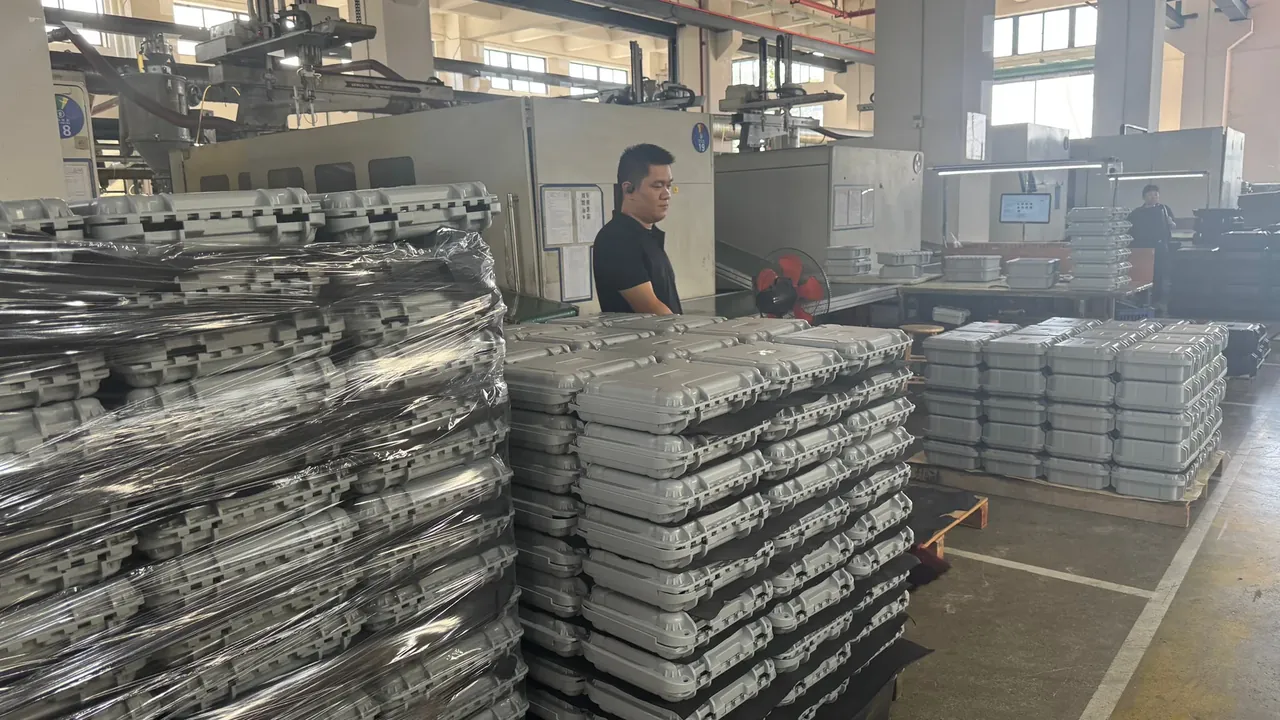
Quick answer: Hot-Off-the-Press Cases leave the tool at 65 ℃ and go 6 high on 2 mm pads, so the load stays under 0.02 MPa and set under 0.6 mm.
Table of contents
- Residual Heat and the Cooling Curve
- Layer Count and Compression Set
- Pad Material and Thickness
- Pad Placement and Load Points
- Post-Cool Inspection and Pallet Transfer
- FAQ
1. Residual Heat and the Cooling Curve
Hot-Off-the-Press Cases still reading 60 ℃ set their base within half an hour. The 65 ℃ comes out of the cavity, and what matters is how fast it falls: a PP wall of 2.5 mm to 3.5 mm sheds 20 ℃ in the first 5 min under natural convection, then 8 ℃ per 10 min, and from about 35 ℃ it drags.
The curve runs in three parts. In the first 5 min six tenths of the shrinkage is gone and the body takes a thumbprint. Between 5 min and 25 min the wall-to-core gap closes under 15 ℃, dimensions settle and the base corners spring back. After 25 min only a few degrees of slow levelling remain.
| Time | Surface | Shrinkage done | Layers allowed |
|---|---|---|---|
| 0–5 min | 65 ℃ to 45 ℃ | six tenths | single, flat |
| 5–25 min | 45 ℃ to 35 ℃ | 85% | 2 high |
| 25–60 min | 35 ℃ to 28 ℃ | set | 4 high |
| past 60 min | near room | stable | 6 high |
Where the infrared gun points matters more than the gun. On the domed lid the reading runs 5 ℃ to 8 ℃ low; on the flat base centre it reads true. A spread above 6 ℃ across three points means the stack has split into warm and cool zones.
Season changes the answer. At 32 ℃ shop temperature, Hot-Off-the-Press Cases need 40 min to reach 35 ℃; at 18 ℃ they need 15 min.
2. Layer Count and Compression Set
Layer count comes from bearing pressure. Above 35 ℃ the modulus sits near seven tenths of its room value, so the same stack loads the base harder than the catalogue figure suggests. At 3.2 kg per unit and six layers, the bottom case carries 16 kg, and over 8000 mm² of lid rib that is about 0.02 MPa.
| Layers | Load on base | Set | Verdict |
|---|---|---|---|
| 2 | 3.2 kg | 0.1 mm | park long term |
| 4 | 9.6 kg | 0.3 mm | 8 h maximum |
| 6 | 16 kg | 0.6 mm | move within 2 h |
| 8 | 22.4 kg | 1.1 mm | never |
Set in Hot-Off-the-Press Cases appears in fixed places: the four base corners sink first, the latch bosses bulge after. Past 0.6 mm the lid closes 1 mm to 2 mm out of line, the gasket stops compressing, and the water resistance of a protective case goes with it.
Direction matters. Once the bottom corners sink, weight drifts inward and the third layer shifts sideways into a shallow barrel curve.
The layer table from a warehouse cannot be borrowed either, because those units stood 24 h at 25 ℃. Above 35 ℃ take seven tenths of it; above 45 ℃ allow 2 high.
3. Pad Material and Thickness
For Hot-Off-the-Press Cases the pad separates two units, turns point contact into area contact and lets the face breathe. At 2 mm it spreads load without becoming a dent of its own.
| Material | Thickness | Behaviour | Use |
|---|---|---|---|
| EVA sheet | 2 mm | springs back, no wicking | up to 6 high |
| PE foam | 3 mm | light, compresses far | single-layer moves |
| Corrugated board | 5 mm | cheap, softens when damp | short transitions |
| Hollow board | 2 mm | stiff, reusable | long-term stacking |
EVA against hollow board is a question of recovery. EVA returns nine tenths of its thickness after 30% compression; hollow board keeps a crease that lands on a lid rib at the second use and doubles local pressure. Retire any pad with a crease over 5 mm.
Thickness pairs with layers. 2 mm suits 4 to 6 high; at 8 high, contact pressure climbs from 0.02 MPa to 0.035 MPa. The footprint wants to be about 10 mm larger than the lid; 30 mm or more hangs down and takes the next base off the bearing face.
4. Pad Placement and Load Points
Hot-Off-the-Press Cases should take the pad on the bearing rib, not on the middle of the lid. The lid is domed there, so load presses on the thinnest panel; the rib runs 12 mm inside the edge and passes load into the side wall.
| Load point | Position | Job |
|---|---|---|
| Four corners | 40 mm from each edge | seven tenths of the load |
| Long-side middle | 60 mm in from midpoint | holds the barrel |
| Short-side middle | 60 mm in from midpoint | holds the corner lift |
A six-high stack takes six pads, four at the corners and one at each long-side middle; the short sides are stiffer and need none. The corner pads carry seven tenths of the load, so a 10 mm offset doubles pressure and pushes set from 0.6 mm toward 1.0 mm.
Never let a pad sit on a latch boss: the base rests at three points, one corner in the air, and that corner sags 0.8 mm as it cools.
Close the lid before stacking. An open case looks cooler but the rim flares while warm, and the gasket no longer lines up with its groove.
5. Post-Cool Inspection and Pallet Transfer
Inspection of Hot-Off-the-Press Cases starts after 25 min on the bottom unit: base flatness, latch engagement, lid-to-body offset.
Flatness takes a 300 mm steel rule and a feeler gauge across a base diagonal; a 0.6 mm blade that slides in sends the unit to a separate pile. Latch engagement means a clear click and no more than 0.5 mm of side play.
A 40-unit stack of Hot-Off-the-Press Cases is wrapped and moved within 30 min. Wrapping warm traps moisture that condenses into a white haze overnight; below 35 ℃ the film stays dry. Forklift tines go in centred, because 50 mm of offset tips the load on the first turn.
Those 30 min are cooling time too. Let the stack stand 2 h in the store before unwrapping, or dew forms on the surface.
Demould, measure, set layers by temperature, place pads, wrap, move, inspect: three months of records replace one operator's memory. On a 60 L body, 1 mm of set is enough to stop the gasket sealing, so Hot-Off-the-Press Cases deserve the wait.
Related Reading
- How a stack of cases shares load
- Feet, bearing area and layer count
- Pallet planning before the first stack
- Storage rules for stacked ammunition boxes
- Plastic cases against wooden crates in a stack
This article discusses container-side specifications and design implications only.
Related Products
- 8 Series — Gun Cases; Military Equipment Cases; Camera Equipment Cases; Drone Cases; Watch Cases; Knife Cases; First Aid Cases; Electronics Equipment Cases
- WL8-2812 PP Gun Case — model WL8-2812
- All protective cases and toolboxes: 7 series, 158 models