

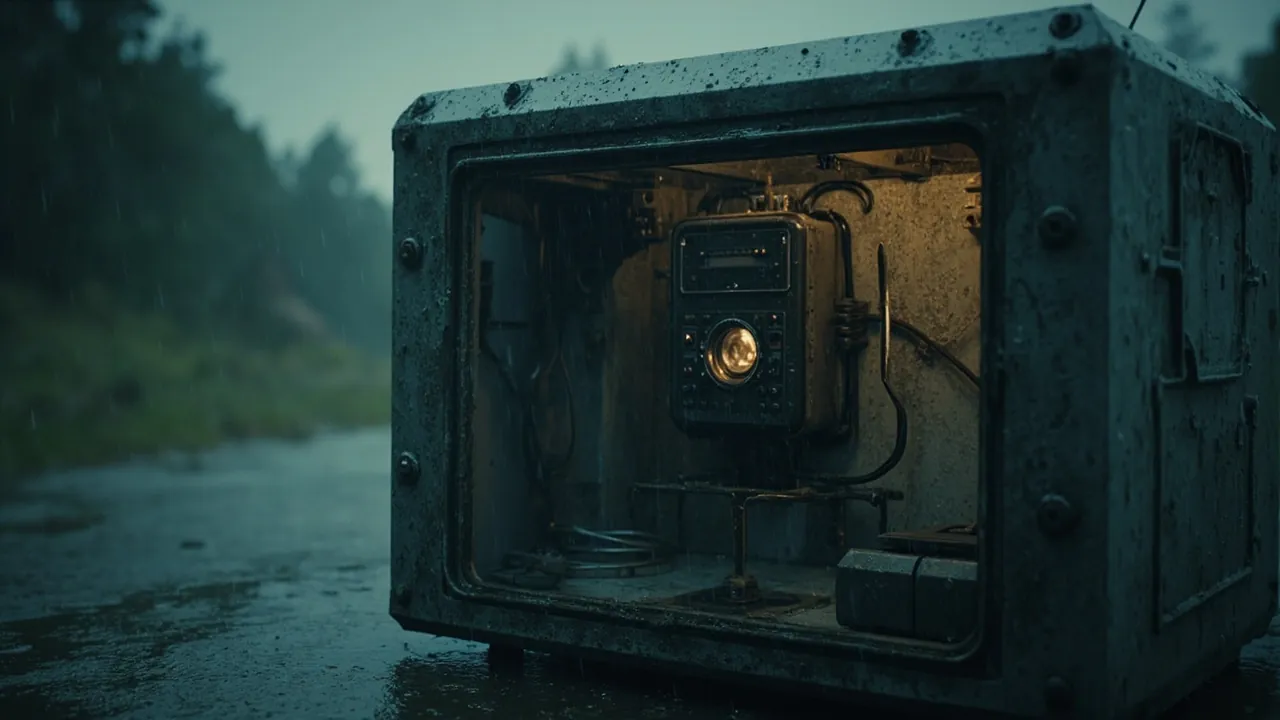
A sentence in a specification becomes a specific invoice on site. This article takes three investigated field failures and turns the question of why outdoor enclosures need IP67 into an economic argument with numbers attached. What the three incidents share is that none of the enclosures involved was cheap. One carried a third-party IP66 certificate. All three failed because selection was made against rain, while the site delivered standing water, hydrostatic pressure or condensation. Those three forms of water behave nothing alike. Rain tests the geometry of a joint; standing water tests whether a sealing interface stays stable under sustained load; condensation is outside the scope of the IP code altogether, governed instead by temperature difference and humidity.
The cases come from a basement car park entrance, a coastal photovoltaic plant and a sewage treatment works. Each is broken down by equipment, sequence of events, direct loss and root cause. From those I extract the four routes by which water enters an enclosure, show how IP54 through IP67 actually differ across those routes, then set out what procurement documents and inspection routines should contain. All test references are to IEC 60529, Degrees of protection provided by enclosures (IP Code), adopted in China as GB/T 4208-2017.
The three cases were reconstructed from multiple field records. Equipment types have been anonymised and amounts represent combined orders of magnitude, intended to illustrate mechanisms and cost structure rather than any single customer's order.
Contents
- What the Three Cases Have in Common
- Case One: Storm Water Backing Up at a Basement Ramp
- Case Two: Top Entry on a Coastal Combiner Box
- Case Three: Condensation in a Treatment Works Control Cabinet
- Four Routes Water Takes to Get Inside
- How IP54 to IP67 Actually Differ
- Counting the Cost of One Ingress Event
- Six Locations That Rule Out IP65
- Three Boundaries of IP67
- Writing It Into Procurement and Acceptance Documents
- Three Preventive Actions Worth Institutionalising
- Frequently Asked Questions (FAQ)
- Closing Notes and Further Reading
What the Three Cases Have in Common
The conclusions come first, so they can be checked against what follows.
The three enclosures were rated IP54, IP65 and IP66 respectively. None was a poor-quality product and all came with documentation. None failed simply because its rating was too low. Each failed because selection assumed rain, and the site produced standing water, pressure or condensation. These three reach the interior by different mechanisms: rain tests a joint's ability to shed or deflect flow; standing water tests whether the seal interface holds under sustained pressure; condensation is not governed by any IP classification at all, being determined by dew point and humidity.
The second shared feature is that repair and downtime dwarfed the cost of the enclosure itself. In the first case, replacing the box cost less than eight hundred yuan, while clearing silt, drying out, re-terminating and replacing equipment came to more than sixty thousand. Compressing budget at the enclosure therefore saves in the wrong place, because the real money is spent afterwards.
The third is timing. The intervals from installation to failure were fourteen months, eight months and nineteen months, all landing in the awkward window where the warranty has either just expired or nearly expired and responsibility has become arguable. That point returns when acceptance documentation is discussed below.
Case One: Storm Water Backing Up at a Basement Ramp
This is the most direct of the three.
Setting and equipment. A residential compound had one low-voltage enclosure at each of two basement entrances, serving the barrier gate, the licence plate recognition cameras and local control of a drainage pump. Each box measured roughly 400 by 500 by 200 millimetres in ABS, rated IP54, mounted on the driveway side wall with its lowest edge about 350 millimetres above floor level. The base carried eight PG threaded entries, five in use, the remainder closed with the plastic plugs supplied with the box.
Sequence. In the fourteenth month after installation, a summer storm delivered more than fifty millimetres of rain in one hour. Municipal drainage could not cope, water ponded to 280 millimetres at the ramp's reverse slope and spread about twenty metres inward. Although the boxes sat 350 millimetres clear of the floor, silt carried by the water built up beneath them, and the water surface reached the underside of both enclosures for roughly forty minutes.
Findings. Three days later the barrier failed to lift and then the cameras went offline. Opening the boxes revealed about fifteen millimetres of muddy water in the base, corroded screws on the lower two rows of terminals, clear tracking marks on the line side of a circuit breaker, and a mud line in the internal corner where base met wall. From its height, internal water had once exceeded twenty-five millimetres.
Path. Working backwards from the mud line, water had not come through the lid joint. That joint was intact and compressed correctly. The real entry was two unused PG plugs in the base. The plugs supplied were solid, without sealing rings, adequate only against direct splashing; under sustained head of twenty-five millimetres or more, the thread clearance permitted slow seepage. A second route was the in-use glands: of five populated holes, two had clamping nuts short of specified torque, leaving insufficient compression on the sealing insert.
Cost. Two replacement enclosures including express freight came to about 1,600 yuan. Replacing breakers, terminals and some cabling about 4,200. Water damage to the barrier controller and two camera boards about 32,000. Three workers over two days for clearing, drying and commissioning about 9,600. Managing traffic manually during two days of barrier outage about 15,000. Total around 62,000 yuan.
What would have avoided it. Moving to an IP67 enclosure, replacing every spare plug with a sealed blanking plug, and raising the mounting height to 600 millimetres together would have added less than 2,000 yuan. Note too that about a quarter of the loss came from manual traffic control during the outage, entirely independent of enclosure price and determined only by whether preventive work had been done before the rainy season.
Case Two: Top Entry on a Coastal Combiner Box
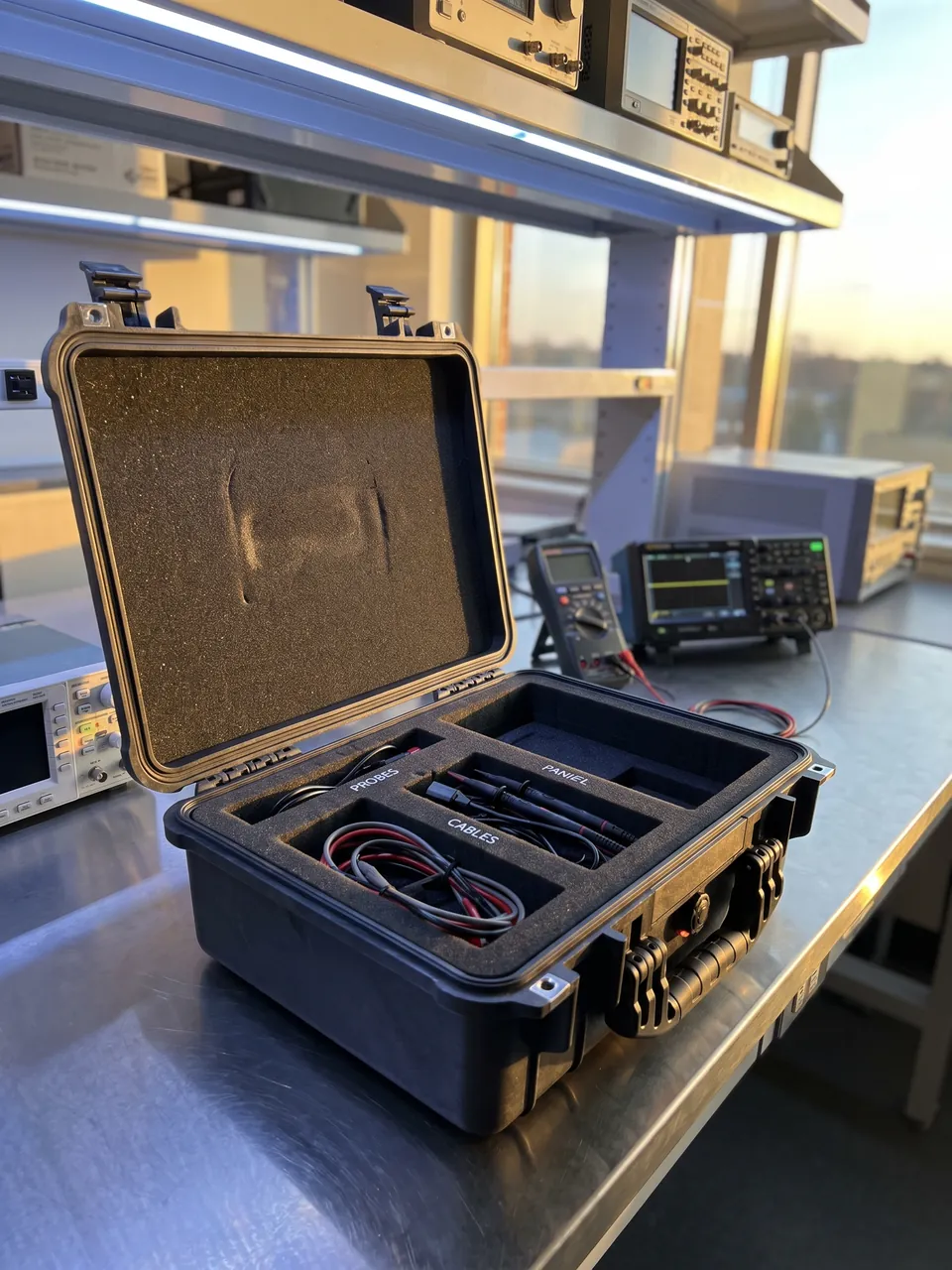
The second mechanism is more subtle and considerably more common.
Setting and equipment. A coastal tidal-flat solar plant used standard sixteen-string combiner boxes in powder-coated cold-rolled steel housings rated IP65, mounted on support posts about 800 millimetres above grade. Each held sixteen fuse holders, surge protection, current sensing modules and a data logger. Cables arrived on a tray above and entered through two prepared holes in the top of the box, fitted with metal cable glands.
Sequence. Typhoon season began in the eighth month, bringing continuous intermittent rain and one severe tropical storm. Internal temperature logging showed abnormal fluctuation at the top of several boxes in the week after lightning activity, after which current readings on two strings began to drift.
Findings. On opening, maintenance staff found a rust trail down the inside of the top plate extending about 120 millimetres from the gland position, passing directly above the fuse bases. The metal oxide varistors looked undamaged, but insulation testing put one circuit below 0.5 megohms against the required ten or more. Further dismantling found corrosion on the data logger's RS485 transceiver with several pins green.
Path. The critical point is that water collected along the cables on the tray and arrived at the gland as a continuous trickle. Passing an IP65 jet test was never in question, but nothing in IP65 covers a top surface receiving sustained running water. Worse, a stable water film had formed between the cable jacket and the gland seal under persistent humidity, and it travelled inward by gravity and capillary action to collect at the lowest point. No storm is needed for this; routine sea mist and dew are enough, and overnight relative humidity at the site routinely exceeded 90 percent.
Cost. Replacing twelve combiner boxes, converting every top entry to a bottom entry and adding rain hoods came to about 78,000 yuan for materials and labour. Lost generation over six days at 500 kilowatts and 0.4 yuan per kilowatt-hour came to about 29,000. Missing data also caused a discrepancy in reported monthly output, consuming roughly two person-weeks reconciling with the purchaser. Total around 110,000 yuan.
What would have avoided it? Fashioning the entry into a drip loop below the box would have cost under eighty yuan each, under a thousand for twelve units. Everything beyond that was spent learning that retrofitting costs far more than getting it right first time.
Case Three: Condensation in a Treatment Works Control Cabinet
The third case is the one most often misdiagnosed, because the enclosure itself was entirely sound.
Setting and equipment. An industrial park sewage works had a PLC control cabinet in its chemical dosing room, controlling dosing pumps, level transmitters and motorised valves. The enclosure was ABS, rated IP66 with third-party certification, 500 by 600 by 250 millimetres. Inside sat the PLC, a 24 volt switch-mode supply of roughly 40 watts, assorted interposing relays and terminal blocks. It was mounted on an internal wall in an atmosphere holding above 75 percent relative humidity year round, with a diurnal temperature swing regularly above ten kelvin.
Sequence. In the first winter, around month nineteen, intermittent communication dropouts began. The initial diagnosis was electromagnetic interference, and adding filters did not resolve it. By the third winter the analogue input module showed clear reading drift, and when maintenance opened the cabinet they found droplets condensed on the inner walls and on top of the PLC, with a small pool in one corner of the floor.
Findings. Removing the analogue module revealed regular white mould spots and light corrosion on its terminal base. The metal case of the power supply carried a rust band near its top edge. The upper three rows of terminal screws were uniformly rusted. Insulation resistance on the analogue loop had fallen to 1.8 megohms.
Path. The key fact here is that the water was generated inside rather than admitted from outside. High humidity, a wide diurnal swing, and a daily heating cycle from the power supply meant that internal air repeatedly dropped below dew point against the cold wall overnight. The better an IP66 seal is, the less exchange occurs with outside air, so damp air stays trapped rather than escaping. Not a single drop of external water had reached any circuit.
Cost. Replacing the analogue module and power supply came to about 7,800 yuan. Fitting a breather vent with hydrophobic membrane, desiccant and a small anti-condensation heater cost about 2,600. Commissioning and verification over eight hours of downtime came to 3,200. Total around 13,600 yuan, far smaller than the other two cases, but the sting was that it took three winters to diagnose correctly, with unquantifiable losses from wasted repairs and damaged trust.
What would have avoided it? Three items at design and installation stage: a breather vent with hydrophobic membrane, desiccant inside the cabinet, and either a conformally coated power supply or a drip ledge above it. Together, well under four hundred yuan.
Four Routes Water Takes to Get Inside
Once the cases are broken down, only four routes remain. Knowing them is what allows you to decide what rating a position actually needs.
| Route | Mechanism | Typical conditions | Covered by IP code |
|---|---|---|---|
| --- | --- | --- | --- |
| Direct through joints | Water carries kinetic energy into a seam | Storms, wash-down, spraying | Yes, codes 5 and 6 |
| Hydrostatic penetration | Water rests against the joint and presses continuously | Ponding, immersion, snowmelt | Yes, code 7 |
| Creep along cable | Water advances by capillary action and gravity between jacket and gland | Top entry, sea mist, persistent humidity | No, resolved by installation practice |
| Internal condensation | Internal air deposits water on a cold wall | Wide diurnal swing, high humidity, internal heat source | No, resolved by venting and desiccant |
The first two are enclosure problems, fixable by raising the rating, and that is precisely why IP67 exists. The last two are system problems where raising the rating achieves nothing and may worsen things: Case Three is the counterexample, where a good IP66 seal simply retained damp air.
With that understood, the order of decisions becomes clear. First establish whether the position has a hydrostatic case at all; if it does, IP67 is mandatory. Then consider whether creep along cable or condensation is plausible, because those two are settled during installation, not during specification.
How do you decide whether a hydrostatic case exists? Three operational tests work well. May the lowest point of the enclosure fall below the highest historically recorded water surface, including storm ponding, drainage backflow or river overspill? Could the enclosure be wholly or partly submerged, including by landscaping flooding or a blocked roof gutter? Is the site somewhere snowmelt will certainly run across? Any one of those three means specifying IP67 rather than IP65. The three-question method set out in How to Choose a Waterproof Junction Box: IP67 vs IP65 Ratings and Use Cases settles this at drawing review stage.
How IP54 to IP67 Actually Differ
Many people assume IP65 to IP67 is simply a little stricter. The table shows that is not remotely true.
| Item | IP54 | IP65 | IP66 | IP67 |
|---|---|---|---|---|
| --- | --- | --- | --- | --- |
| First numeral | 5, dust protected | 6, dust-tight | 6, dust-tight | 6, dust-tight |
| Second numeral meaning | Splashing | Water jets | Powerful water jets | Temporary immersion |
| Principal test | Oscillating tube or spray head | 6.3 millimetre nozzle at 12.5 litres per minute | 12.5 millimetre nozzle at 100 litres per minute | Immersion tank, lowest point 1 metre below surface |
| Duration | By surface area, minimum 5 minutes | 1 minute per square metre, minimum 3 minutes | As above | 30 minutes |
| Pressure level | Low | Around 30 kilopascals | Around 100 kilopascals | Around 10 kilopascals static |
| Tests sustained pressure | No | No | No | Yes |
| Seal type required | Foam strip or simple profile | Solid profile | Solid profile | Solid silicone or EPDM |
| Clamping point spacing | Not tightly specified | 150 to 200 millimetres | 120 to 150 millimetres | 100 to 150 millimetres |
| Housing flatness requirement | Ordinary | Fairly high | Fairly high | High |
| Typical application | Sheltered interiors | Facades with drainage | Wash-down zones, exposed facades | Low ground, anywhere water collects |
The critical row is whether sustained pressure is tested. The first three are dynamic; water arrives and leaves. Only IP67 is static, with water pressing on every joint for thirty minutes. Those are different design problems. Resisting a jet is about geometry that deflects and drains; resisting immersion is about even, stable compression across the whole sealing line. That is why products performing perfectly through occasional storms go down in numbers after a single ponding event.
Note also that IEC 60529 states explicitly that passing one code does not automatically imply passing all lower ones. Where a position faces both driving rain and possible flooding, the purchase specification should read "test data required for both IPX5 or IPX6 and IPX7" rather than simply IP67.
Counting the Cost of One Ingress Event
Merging the loss structure of all three cases produces a table useful for making the argument during tendering.
| Cost element | Case one | Case two | Case three | Comment |
|---|---|---|---|---|
| --- | --- | --- | --- | --- |
| Enclosure replacement | 1,600 yuan | Included in materials | Nil | Usually a tiny share |
| Electrical components | 4,200 yuan | 78,000 yuan | 7,800 yuan | Scales with contents |
| Cable and consumables | Included above | Included above | Included above | Sometimes whole runs need redoing |
| Labour | 9,600 yuan | Included above | 3,200 yuan | Doubles at height or in remote positions |
| Downtime | 15,000 yuan | 29,000 yuan | 8 hours | Frequently the largest item |
| Total | About 62,000 | About 110,000 | About 13,600 | |
| Incremental cost of specifying IP67 at the time | About 2,000 | About 1,000 | About 400 |
Three conclusions follow consistently.
First, the price of the enclosure itself is almost irrelevant in an incident. Shares across the three cases were 2.6 percent, under 1 percent and zero. Saving money on the box is the classic case of being penny wise.
Second, the real losses are downtime and emergency labour: manual traffic control accounted for about 24 percent in Case One and lost generation about 26 percent in Case Two. Neither depends on what the enclosure cost, only on whether anything ever goes wrong.
Third, the ratio between the incremental cost of upgrading early and the eventual loss runs between twenty and one hundred to one. That is not a decision requiring financial analysis; it belongs in the specification as a default. Anywhere a hydrostatic case exists, write IP67 and move on.
Six Locations That Rule Out IP65
The above condenses into a list. Anything falling into one of the following six categories takes IP67 without discussion.
One, below-grade and semi-basement spaces. Pit entrances, subway ventilation shafts, sunken courtyards and anything below external ground level. They share one trait: drainage depends on pumps rather than gravity, so once power fails or rainfall exceeds the design return period, the water does not recede.
Two, road and site low points. Catchment along estate access roads, the bottom of car park ramps, and low-voltage distribution pillars beside municipal roads. Passing vehicles throw waves against the base of anything mounted there, which makes jet resistance meaningless.
Three, beside water. Riverbanks, lakesides, dams, quays, and any installation below flood level. Beyond IP67, the material has to survive persistent humidity and possibly chlorides.
Four, anywhere snow accumulates or meltwater runs. Kerbside pits in northern regions, landscaping edges, and around roof gutters. These are peculiar because infiltration is slow and lasts for weeks, so the pressure persists far longer than the thirty minutes of an IPX7 test, demanding better compression set from the seal.
Five, wash-down areas. Food factories, refuse transfer stations and livestock buildings. Mostly indoors, but a pressure washer close up delivers more than IP65 conditions; IP66 at 100 litres per minute is a reference figure rather than a ceiling in those circumstances. Specify no less than IP67 in practice.
Six, buried or semi-buried handholes and jointing chambers. Design has to assume submersion from the outset. IP67 is the floor rather than the ceiling, usually paired with IP68 or a dedicated chamber design.
There are, conversely, places that genuinely do not need it: dry indoor risers, sheltered facades with drainage, and module boxes mounted inside a cabinet. Specifying IP67 there wastes money that would earn more spent on raising the mounting position or improving site drainage.
Three Boundaries of IP67
Its limits must be stated clearly, otherwise readers carry expectations the rating never promised.
Boundary one: IP67 does not permit permanent submersion. The standard describes temporary immersion, defined as the lowest point one metre below the surface for thirty minutes. Long-term underwater duty calls for IP68, and IP68 requires the manufacturer and user to agree depth and duration, since the standard merely demands something more severe than IPX7 without fixing figures. When buying IP68, state metres, days, and insist on a matching report.
Boundary two: IP67 does not cover joints and openings. Worth repeating: type test reports usually cover the enclosure body. Once a hole is cut and a gland fitted, overall protection depends on assembly quality, so procure either "sample testing with gland fitted" or at minimum "an IP68 report for the gland plus the assembly procedure."
Boundary three: IP67 does not address condensation. Case Three makes the point, and raising the rating makes condensation harder to shed. Manage it with vents, desiccant and by removing moisture sources, as discussed in outdoor enclosure waterproof design essentials.
One further point deserves attention. IP67 is a declaration of capability at a moment in time, not a permanent condition. Seals age, tightening torque decays and housings distort under ultraviolet exposure. Most silicone seals show obvious compression set and hardening after five to eight years outdoors, after which the same housing is no longer IP67. That is precisely why even the highest ratings need an inspection regime.
Writing It Into Procurement and Acceptance Documents
A further common thread across the three cases is that responsibility could not be established afterwards. Contracts said "to IP67" without stating the test basis, the sample configuration or how compliance was verified, so in dispute the manufacturer produced a conforming report while the owner pointed at a flooded box, and neither had any record of acceptance at the time.
A competent technical specification contains the following eight items, best made into a template and ticked off line by line.
- Standard and edition. Write "IEC 60529:2013" or "GB/T 4208-2017" rather than merely "complies with IP67."
- Scope of coverage. State whether the rating covers the enclosure body alone or the finished product including glands, and require verification data from the combination.
- Test parameters. For IPX7 specify "lowest point of sample at least 1 metre below the surface, top at least 0.15 metres below, held 30 minutes, water temperature within 5 kelvin of the sample."
- Sample attitude and quantity. State whether testing follows normal service attitude or another, and how many samples.
- Report requirements. Third-party laboratory name, report number, validity period, and whether the original or a stamped copy follows award.
- Acceptance on delivery. Agree that one or two units per batch undergo a simplified immersion screen on site, or that both parties inspect the sealed reference sample before installation.
- Specification of critical accessories. Gland type and material, form of blanking plugs, vent and desiccant models. These sit off the main thread yet repeatedly become the failure point.
- Post-installation re-inspection milestones. Include the first check one to three months after commissioning plus quarterly and annual items.
Item six deserves emphasis. Many projects stop at checking brand and model, but what actually determines outcome is condition after installation. Writing a spray screen into the acceptance clause costs almost nothing and pays disproportionately.
Three Preventive Actions Worth Institutionalising
Finally, three system-level measures that can be adopted immediately, ordered by value for money.
Action one, a preventive pass before the rainy season. This alone would have avoided two of the three cases. Re-tighten every lid screw to nominal torque, pull-test each gland, confirm blanking plugs are intact, clear drainage around mounting faces and check the base for silt build-up. At fifteen to twenty minutes per enclosure, fifty units take a single working day, well under 5 percent of total enclosure cost.
Action two, monitoring at high-risk positions. Fit low-cost water detection probes or humidity sensors where valuable equipment sits or where ground is low, converting "we noticed water" from a reactive complaint into an active alarm. A probe typically costs tens of yuan against sixty thousand for one incident, making it the cheapest measure available.
Action three, a location register. Record position, rating, installation date, last inspection and photographs for every enclosure. It pays twice: before the next rainy season it identifies exactly which positions need attention first, and in a dispute the register is evidence. Its value is routinely underestimated, yet all three cases show that without a register, the condition at handover cannot be demonstrated at all.
Frequently Asked Questions (FAQ)
Q: Can an IP65 enclosure really be destroyed by one submersion while an IP67 survives it? A: That difference is the whole point, and yes. IP65 is tested with a 6.3 millimetre nozzle at 12.5 litres per minute, so water moves and impact is limited. IP67 is tested with the lowest point one metre below the surface for thirty minutes, where water does not move but presses statically on every joint. The first examines how geometry sheds water; the second examines whether the sealing interface stays stable. Structurally, IP67 products use larger seal cross-sections, closer clamping points and tighter housing flatness. Against standing water the difference is not marginal but measured in orders of magnitude.
Q: With IP66 already specified, is IP67 still necessary? A: It depends on whether a hydrostatic case exists. IP66 is tested at 100 litres per minute through a 12.5 millimetre nozzle, a severe dynamic load, yet the water still arrives and drains. If the position ponds, floods briefly, or sits under snowmelt for extended periods, IP66 does not cover that risk, and the standard explicitly forbids inferring lower codes from higher ones. Conversely, on a facade that gets driven rain but never holds water, IP66 is perfectly adequate and upgrading wastes money. The decision hinges entirely on answering "will water stand against it."
Q: Can an IP67 enclosure be buried permanently? A: Not on that basis alone. IP67 describes temporary immersion, defined as one metre for thirty minutes. Permanent burial belongs under IP68, which has no unified figures in the standard and requires manufacturer and purchaser to agree depth and duration, perhaps two metres for thirty days. Those three numbers belong in the technical enquiry together with a matching third-party report, because the letters IP68 alone carry nothing verifiable. Burial additionally brings soil corrosion, microbial attack and traffic loading, none of which any IP code addresses.
Q: The box is rated IP67, so why did water still get in after installation? A: Nine times out of ten, for one of three reasons. Type testing covered the enclosure body only, and no combination check followed drilling, leaving the gland as the weak link. Or installation went wrong, through insufficient or excessive torque, spare holes plugged with plain screw plugs, or a top entry without a drip loop. Or the seal was already damaged in transit or storage, compressed out of shape or left dusty. Diagnosing is straightforward: find where the water entered. Usually the trail points directly at one of those three rather than at poor product quality.
Q: How do I tell condensation from leakage, and do droplets inside always mean a bad seal? A: No, they do not. Three observations separate them. Position: condensation spreads evenly across internal walls and the underside of the lid, especially on metal surfaces; leakage shows a distinct trail running down from one point and pooling at the lowest place. External cause: condensation appears even in completely dry weather, leakage only follows rain or washing. Cleanliness: condensation is distilled water and clean, while ingress usually carries silt streaks or scale deposits. When it is condensation, service the vent and desiccant rather than replacing the seal, since a new seal traps moisture even more thoroughly and makes matters worse.
Q: For IP65 boxes already installed, is there a way to improve safety without replacing them? A: Yes, and usually cheaper than replacement, in three layers. The first and most effective is removing the hydrostatic case: raise the enclosure above the highest recorded water level, or improve drainage so water does not linger. The second is closing the actual entry routes: fit sealed blanking plugs in spare holes, re-tighten every gland to nominal torque, and add a rain deflector along the upper mounting edge. The third is alarm: place an inexpensive water probe inside. These three usually bring risk to an acceptable level, though only where the structure is sound; a housing distorted by over-tightened screws still has to be replaced.
Q: How often should seals be replaced? A: It depends on material and environment. Silicone profiles outdoors in ordinary urban conditions last roughly five to eight years and EPDM slightly longer, while hot coastal salt atmospheres can shorten that to three to five. Judge by condition rather than by calendar. Press the seal with a finger: if it springs back immediately, elasticity is still sound; if an impression remains, or the surface feels tacky or shows fine cracking, replace it. Always use the same cross-section and hardness as the original. A thicker substitute alters the designed compression and can distort the housing. See how often seals need replacing: ageing intervals and replacement criteria for detailed criteria.
Q: Should every outdoor enclosure get a breather vent? A: The rule is that anything at risk of condensation gets one. A quick test: is there a heat source inside, does the diurnal swing regularly exceed ten kelvin, is relative humidity often above 70 percent, and does the box hold moisture-sensitive electronics? Two or more yes answers mean fit a vent. Remember that the hydrophobic membrane itself has a finite life: replace it every one to two years in coastal or dusty locations rather than fitting and forgetting. Mount it low on a side wall facing downwards, since the top position attracts dust.
Closing Notes and Further Reading
The three incidents say one thing: what failed was never the IP code itself, but the missed question of what form water takes at that position. IP67 is necessary there not because it is a higher number but because it is the only code shaped to fit the lock of standing water pressure. Adding monitoring without addressing hydrostatic pressure simply puts the effort in the wrong place.
If one sentence stays with you, let it be this: first ask whether water will stand outside the box, then whether it will strike the joints, then how much the contents are worth. Answer those three and the rating, the structure and the budget all follow. What remains is writing that judgement into the purchase documents, backing it with one preventive round before the rains, and keeping a simple register of positions.
JUNZHJIA builds its waterproof junction box and sealed enclosure range at its Zhongshan plant covering IP65 through IP68, supplying third-party test documentation matched to project locations, with OEM and ODM service, wholesale volumes and worldwide delivery.
Further reading