

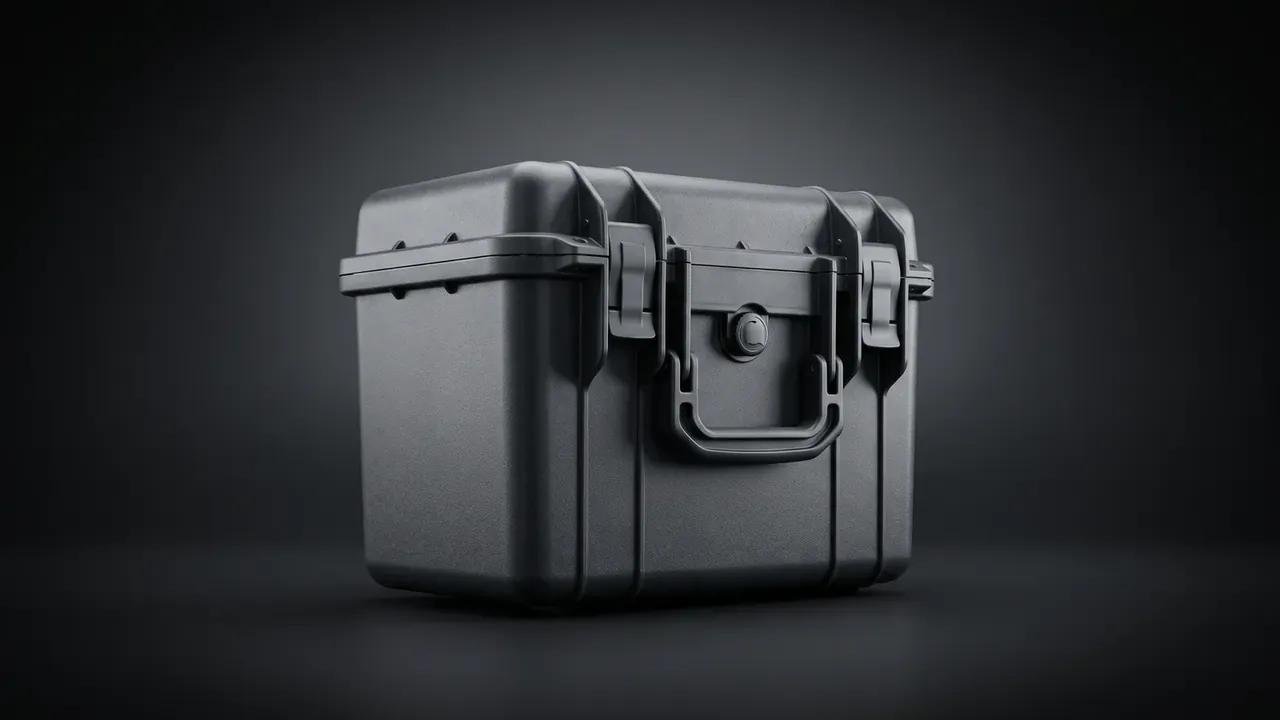
Quick answer: A case factory tour proves machines and moulds are real, not that batches repeat. Under 500 units, video plus samples beats a flight.
Table of contents
- What a factory visit can and cannot verify
- Four ways to check a supplier: video, site visit, audit, samples
- Which workshops to weight: moulding, hardware, assembly, testing
- Press tonnage and order size: when a big plant is the wrong choice
- When to skip the trip
- Costing the trip: travel, downtime and samples
- FAQ
1. What a factory visit can and cannot verify
A plant outside Dongguan runs its route in 40 minutes: past the resin store into moulding, a glance at assembly through glass, then 10 minutes at inspection. One expensive question gets answered fast: does the counterparty own a plant or a trading desk?
Three things survive scrutiny on a case factory tour: machines turning, moulds mounted, staff on the payroll. Lose one and the quote should fall 20 percent. What the aisle cannot show matters as much: wall drift between batches, the shots a mould has run, the purge record at a material change. All of it sits in the controller.
| Item | On the floor | Off the floor | Ask instead |
|---|---|---|---|
| Machines | Tonnage plates | Uptime | Meter readings |
| Moulds | Cavity count | Shots run | Mould log |
| Consistency | First-off parts | Batch drift | Retained batches |
2. Four ways to check a supplier: video, site visit, audit, samples
A video walk-through is the cheap stand-in for a case factory tour. In a 2-hour call, have the host walk past each press and read the plate aloud; exaggeration collapses. The lens still misses the reject bin and an idle press.
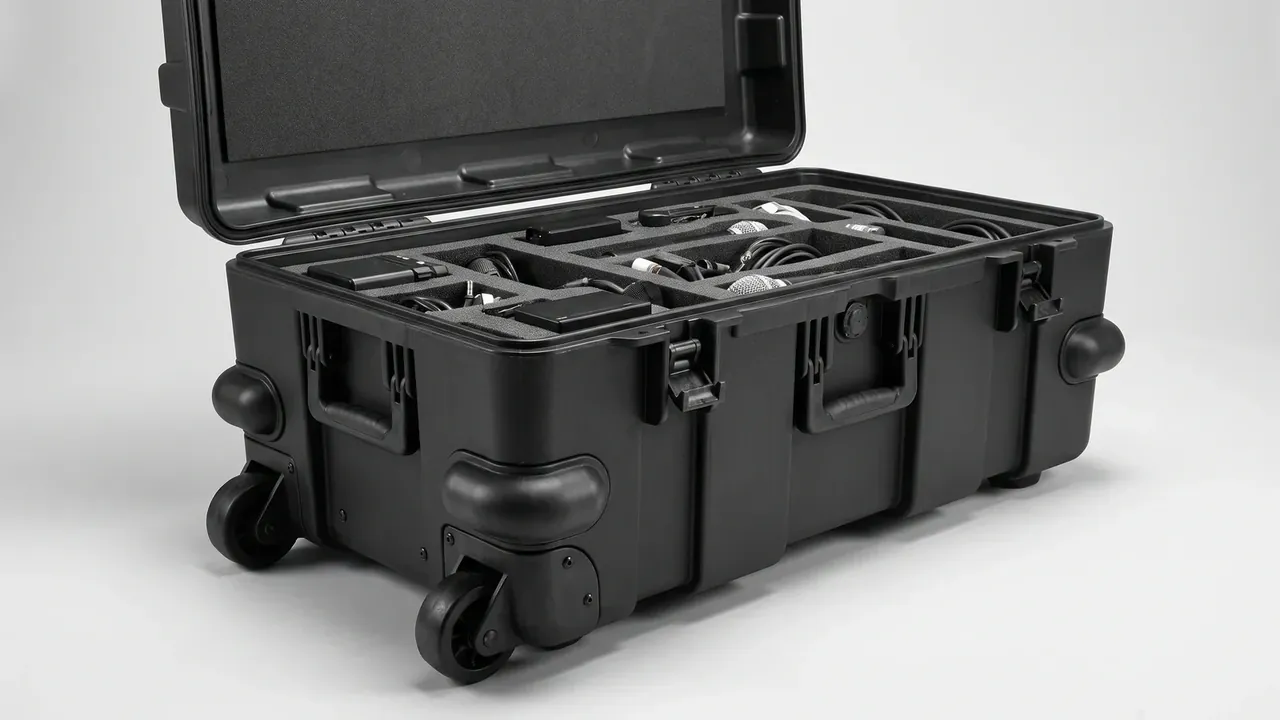
A site visit costs a day in transit and returns feel: lid damping, the heft of an empty case, gasket rebound, though only on a complex model.
An audit follows paper, reporting in 3 to 5 days on compliance and calibration. It proves a system exists, not why two cases feel different.
Samples are cheapest and slowest: 3 cases in 7 to 10 days for drop and rain tests. Performance is verified, volume stability is not.
| Method | Time | Cost | Covers | Misses |
|---|---|---|---|---|
| Video | 2 hours | 0 yuan | Machines | Feel |
| Visit | 1 day | 4800 yuan | Mould, progress | Batch drift |
| Audit | 3 to 5 days | 6000 yuan | Calibration | Feel |
| Samples | 7 to 10 days | 1200 yuan | Performance | Capacity |
Together they approach complete: video plus samples covers about 60 percent of the risk, an audit lifts that to 85, and the visit adds 15 that only pays above 2000 units.
3. Which workshops to weight: moulding, hardware, assembly, testing
Effective time on a case factory tour is 6 hours. Split four ways, that is 90 minutes each, and under 40 minutes are spent at a machine. Fix it in advance, or the host's route decides.
For a protective case the split runs 35 percent assembly, 30 percent testing, 20 percent moulding, 15 percent hardware. Assembly decides whether the case survives rain, testing whether the claim holds.
| Workshop | Stand at | Pass line | Skip when |
|---|---|---|---|
| Assembly | Gasket station | 25 to 30 percent | Flat gasket |
| Testing | Air decay rig | 30 seconds, 0.3 kPa | Storage only |
| Moulding | First-off bench | 0.3 mm wall | 2 years of history |
| Hardware | Rivet line | 45 mm pitch | No metal parts |
At assembly, check whether the gasket is butt-welded into a loop and whether the joint sits mid-side. At testing, separate rain from immersion: 30 minutes of spray proves little, 30 minutes at 1 m depth proves the seal.
4. Press tonnage and order size: when a big plant is the wrong choice
Clamping force sets the size ceiling. A 250-tonne press suits cases under 400 mm, a 600 mm class needs 800 tonnes, a 1.2 m cavity needs 1600 tonnes. Reading the plate is the step to never skip.
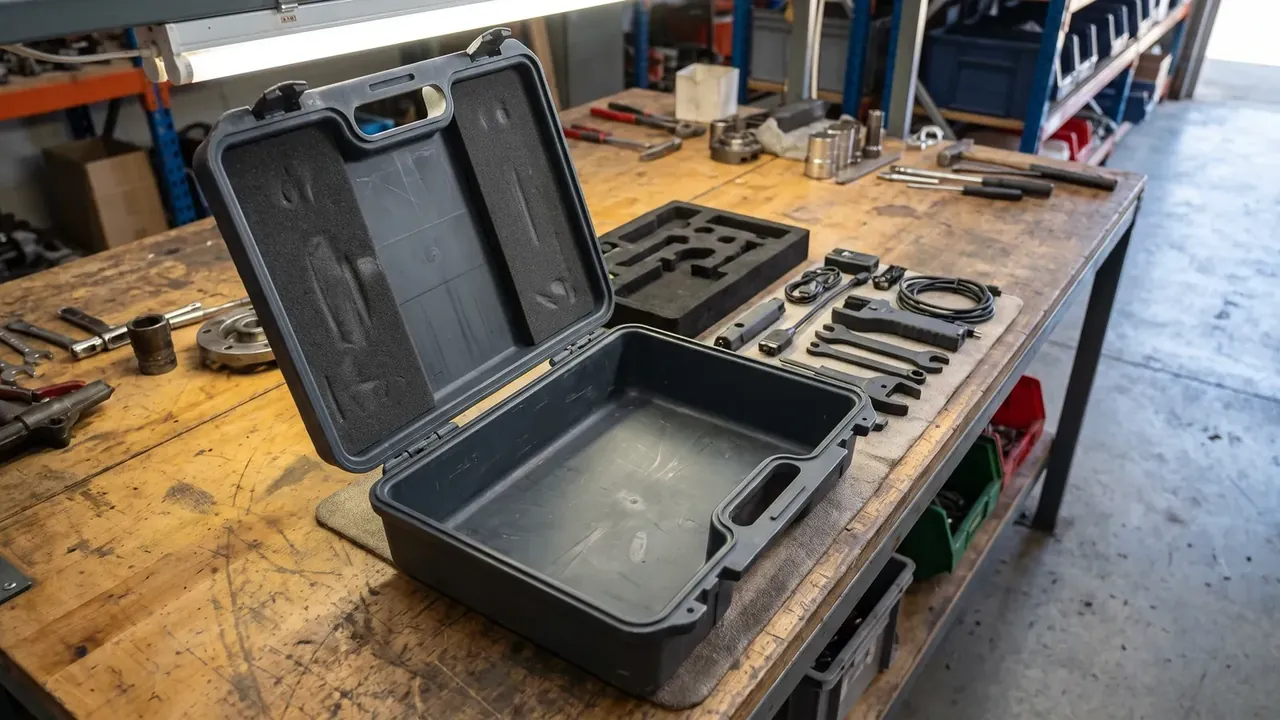
Two rules at a large plant push small orders back: a mould change takes 4 hours or more, and runs under 600 units fit only into the gaps. The quote says 25 days, the board says 45.
| Tonnage | Case size | Weakness | Avoid when |
|---|---|---|---|
| 250 tonnes | Under 400 mm | Few cavities | 1 m cavity |
| 800 tonnes | 600 mm class | 0.3 mm drift | Under 300 units |
| 1600 tonnes | 1.2 m class | 6-hour changes | 20 days |
Small plants fail at the other end: without in-line weighing, tolerance opens from 0.3 mm to 0.8 mm, and the drift hides until unit 300.
5. When to skip the trip
Standard stock comes first. When 300 units sit in the warehouse all year, the floor runs what you would inspect anyway.
A supplier with 2 years of clean history is second: marginal information is near zero, and an annual inspection spends better.
Third is arithmetic. Below 8 times the travel cost, a 500-unit order cannot carry a two-day trip.
6. Costing the trip: travel, downtime and samples
Two people, three days: 2200 yuan airfare, 1200 hotels, 600 transport, 800 meals, 4800 total, or 2.4 yuan per case on 2000 units.
Change one number and the answer flips. On 500 units at 60 yuan and 12 percent margin, total margin is 3600 yuan, or 1200 less than the trip.
The substitute package: 0 yuan for video, 1200 for three sample rounds, 800 for one inspection, 2000 total, close to 80 percent of a visit. The 2800 yuan saved buys 5 sealed first-batch cases.
Conclusion
Each method has a blind spot, and a case factory tour fills the one around feel and work in progress, not batch consistency. Big orders on complex models justify it; small ones at thin margin do not. Spend where the money can change the decision, the only trade-off a case factory tour defends.
This article discusses only the container (case body) side of specifications and design intent, and does not cover any handling, loading or use of the contents.
Related Reading
- What to carry into a plant walk-through
- Twelve questions for the production floor
- How airdrop cases differ in load path
- Stacking rules for ammunition and ordnance boxes
- Comparing three materials on cost per case
Related Products
- 8 Series — Gun Cases; Military Equipment Cases; Camera Equipment Cases; Drone Cases; Watch Cases; Knife Cases; First Aid Cases; Electronics Equipment Cases
- WL8-2812 PP Gun Case — model WL8-2812
- All protective cases and toolboxes: 7 series, 158 models