


An education training kit case is a dedicated container used by vocational schools and training organizations to store, circulate and protect training equipment and teaching sets. Its core value is not merely holding the contents but giving every item a fixed position, making every issue and return countable, and keeping every trip damage-free. Compared with an industrial toolbox, an education training kit case faces four conditions: frequent issue and return, use by many people, circulation between training rooms, and non-specialist operators, so it demands more from compartmentalization, checklist discipline, durability and safety. This article covers the selection and design of education training kit cases, teaching kit cases, vocational school equipment cases, training equipment cases and teaching set cases, breaking down protection ratings (IP / GB/T 4208 / MIL-STD-810H / ISTA), kit-based compartments, liners and positioning, material selection, store issue and return management, electrical safety and ESD, transport fixation, cleaning and marking, and the procurement and acceptance checklist, with tables that can be used directly in tenders and acceptance. The goal is to help vocational schools drive equipment loss and teaching incidents toward zero.
Readers who need the fundamentals of cases and liners should first review Plastic Protective Cases: Material and Structure and Cushion Liner and Custom Cutting Design. For tool and gauge storage see Hardware Toolboxes and Tool Compartment Series and Measuring Tool Cases, and for electrical meter carry see Electrical Meter Protection Solutions.
What Are Education Training Kit Cases
Education training kit cases, also called teaching kit cases, vocational school equipment cases, training equipment cases or teaching set cases, are protective containers for vocational schools, technical colleges, applied universities and vocational training organizations. The essential difference from an industrial toolbox is the user: an industrial toolbox is usually used by specialists at a fixed station, while an education training kit case faces rotating groups of students whose skill levels vary and whose packing habits cannot be standardized. The case and liner must therefore prescribe the correct action through structure rather than rely on personal experience.
In form, an education training kit case usually consists of a rigid shell, a compartmentalized liner, checklist marking and a latch system. The shell provides impact resistance, dust and moisture protection and stackability; the compartmented liner fixes each item in one unique position; checklist marking makes a missing item visible at a glance; and the latch system keeps everything in place during transport. Common options include a handle or shoulder strap, casters, a removable tray, a transparent window and a unified number or QR code position.
Typical users include vocational programs in electrical and electronic engineering, mechatronics, automotive repair, CNC machining, welding, industrial automation, industrial robotics and IoT; technical colleges and vocational skill training centers; corporate internal training and safety training bases; primary and secondary school STEM and labor technology classrooms; and skill competition and practical assessment venues. Wherever equipment must be issued as a complete set, used by many people in turn and moved between sites, that is the application boundary for an education training kit case.
Protection Pain Points in Vocational School Equipment
The first pain point is frequent issue and return combined with shared use. A single practical class often has dozens of students taking turns with the same set, so careless packing, mixed parts and left-behind tools are normal, and the end-of-term count frequently reveals missing items with long replacement lead times. The second is non-specialist operation. Students do not know the value or the fragile points of the equipment, so they force items in, stack them carelessly and carry the case while rushing, which easily causes impact damage. The third is circulation between training rooms. The same set travels between classrooms, workshops and competition venues, and trolleys, lifts, school buses and uneven floors all introduce shock and vibration.
The fourth pain point is electrical and safety risk. Electrical and electronic programs involve multimeters, oscilloscopes, power supplies, soldering irons, power tools and lithium batteries, and if they are mixed or lack insulated compartments, short circuits, overheating and even fire can follow; mixing live equipment with metal tools also creates a shock risk. The fifth is management and traceability. Training equipment is a school asset that must be recorded, counted, issued against a signature and tracked for loss, and without unified numbering and checklist marking the management workload multiplies.
The common conclusion from these pain points is that an education training kit case should be engineered as a teaching equipment management system: define the specialty, the equipment list and the number of users first, then decide the compartment scheme, material, latch and marking, and finally close the loop with an acceptance checklist. Comparing only price or capacity usually exposes missing items, damage and management chaos after a single semester.
Protection Ratings and Referenced Standards (IP / GB/T 4208 / MIL-STD-810H / ISTA)
The protection rating is the foundation of the program. IP rating is judged per IEC 60529 and GB/T 4208: the first digit denotes dust protection from 1 to 6 and the second denotes water protection from 1 to 8. Most education training kit cases are used indoors and require IP54 to IP65, and where outdoor training, rain handling or long-term storage in a damp area is expected, the rating should rise to IP65 or IP67, meaning fully dust-tight and able to survive immersion at 1 meter for 30 minutes.
Mechanical and environmental validation can reference MIL-STD-810H: drop (Method 516.8), random vibration (Method 514.8) and temperature-humidity cycling (Method 507.6) correspond to handling drops, vehicle transport vibration and cross-climate storage. For school bus or parcel shipping, the ISTA series is recommended, for example ISTA 2A for single packages up to about 68 kg, replacing the empirical claim that it survived our own test with a standardized procedure. Flame retardancy is rated per UL94, commonly targeting V-0 or V-1, and impact can be described on the IK scale, typically 0.5 to 20 joules.
| Usage scenario | Suggested IP | Suggested methods | Key focus |
|---|---|---|---|
| --- | --- | --- | --- |
| Indoor training room storage | IP54 to IP65 | Drop, stacking | Compartments and durability |
| Trolley transfer between rooms | IP65 | Random vibration | Fixation and anti-shift |
| School bus or parcel shipping | IP65 to IP67 | ISTA 2A | Cushioning and outer box |
| Outdoor training and competition | IP67 | Drop, dust | Water resistance and load |
| Long-term warehousing | IP65 | Temperature-humidity cycling | Moisture and mold prevention |
Kit-Based Design: Compartments and Checklist Management
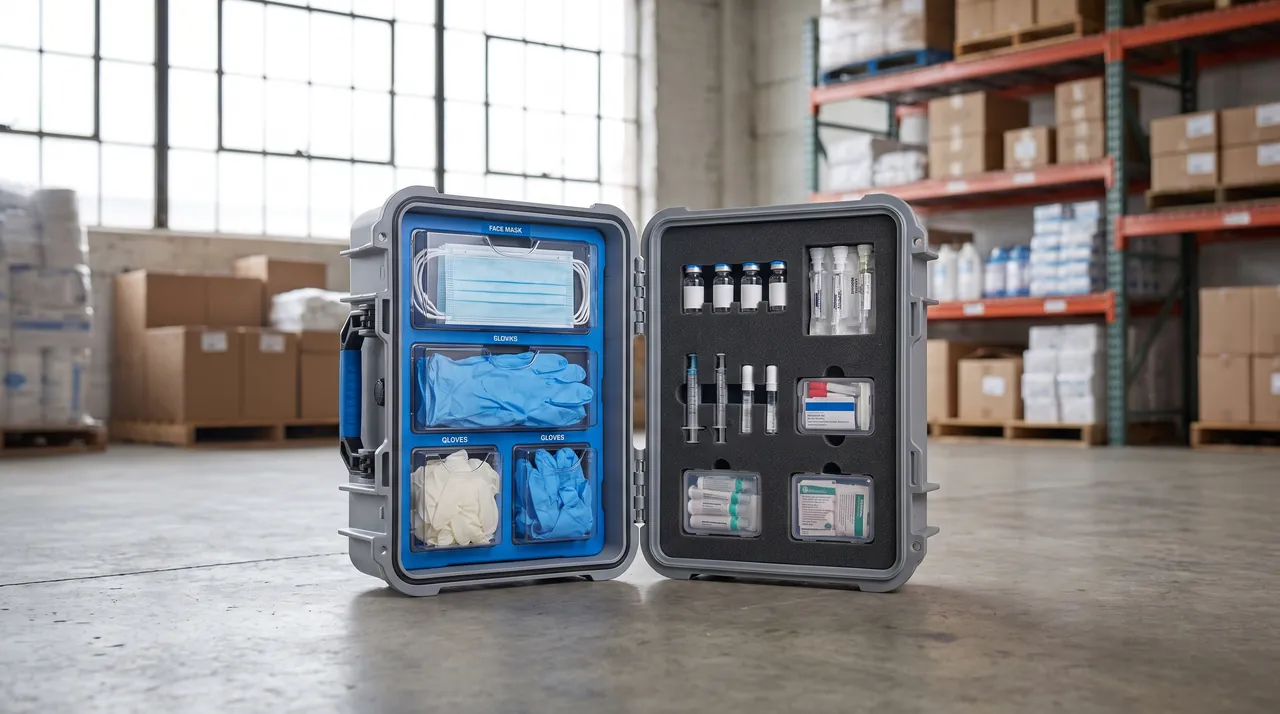
Kit-based design is what separates an education training kit case from an ordinary storage box. It has three layers. First, quantity completeness: all equipment and spares are provided against the teaching task list. Second, positional completeness: every item has one unique position, so packing does not depend on memory. Third, information completeness: the case label, the liner positions and the checklist correspond one to one, so a missing item is immediately visible.
There are three common methods. The first is contour positioning, where the outline of each tool is cut into the liner so that taking and returning are self-aligning. The second is compartment drawers and dividers, suited to small items such as screws, terminals, cables and components. The third is layered trays, with the main items below and accessories on an upper tray separated by a checklist card. The three can be combined, for example a lower tool level, an upper component box and a checklist card inside the lid.
Checklist management should aim for three consistent labels: the external case label, the liner position label and the paper or electronic checklist must all agree, using one numbering rule. For programs with many users, place a check card inside the case and require students to tick each item on issue and return, so a teacher can confirm the state by spot check. For high-value items, attach a QR code to each unit so that issue records and calibration status can be read by scanning. The benefit is that counting changes from an end-of-term exercise into a daily habit, which markedly reduces missing-item rates.
Liner and Equipment Location: EVA, PE Foam and Vacuum Trays
The liner decides whether equipment stays stable inside the case. There are three common approaches. First, high-density machined EVA, cut to the three-dimensional outline of the equipment with dedicated pockets, offering accurate location and good cushioning for gauges, meters, precision parts and irregular tools. Second, layered polyethylene foam, which is inexpensive and flexible and suits many small items and consumables but tends to sag under long compression. Third, vacuum-formed trays, which give a clean impression and can be reproduced in batch, suited to standardized sets and component boxes.
Three engineering rules are worth following. First, place heavy items low and light items high, putting the heaviest equipment at the base and near the center so the center of gravity does not shift during handling. Second, protruding features such as meter displays, caliper beams, soldering tips and lenses must have dedicated clearance and must never press against the case wall or another item. Third, keep frequently used items within easy reach so that students do not have to disturb the whole case to take one tool. For equipment that is packed frequently, a removable tray reduces packing to three steps of place, close and latch, improving efficiency and cutting operator error.
For electrical and instrument contents, insulation and separation also matter: keep metal tools and live parts in separate compartments, and coil cables separately so that friction during transport cannot damage insulation. Related liner and standard practices are described in Cushion Liner and Custom Cutting Design.
Typical Specialties and Equipment Configurations
Equipment varies greatly between specialties, and classifying the specialty before matching a configuration markedly improves hit rate.
| Specialty | Typical equipment | Liner suggestion | Extra requirement |
|---|---|---|---|
| --- | --- | --- | --- |
| Electrical and electronic | Multimeter, oscilloscope, power supply, components | Machined EVA plus component box | Insulated separation, ESD |
| Mechatronics and automation | Servo, PLC, sensors, harnesses | Layered tray plus cable channel | Shock resistance, numbering |
| Automotive repair | Sockets, wrenches, diagnostic tool | Tool pockets plus instrument clearance | Heavy items low |
| CNC and machining | Gauges, cutters, fixtures | High-density EVA with cutter pockets | Cut and knock protection |
| Welding and thermal | Welder parts, face shield, consumables | Large compartments plus drawer | Heat resistance, ventilation |
| Industrial robotics | Control module, teach pendant, tools | Module compartments plus ESD | ESD, moisture protection |
| IoT and communications | Gateways, modules, antennas, patch cords | Component box plus optical module slot | ESD, moisture protection |
For specialties that need on-site testing or outdoor practice, add an industrial detection instrument protection solution so that storage in the training room and practice in the field form one complete configuration.
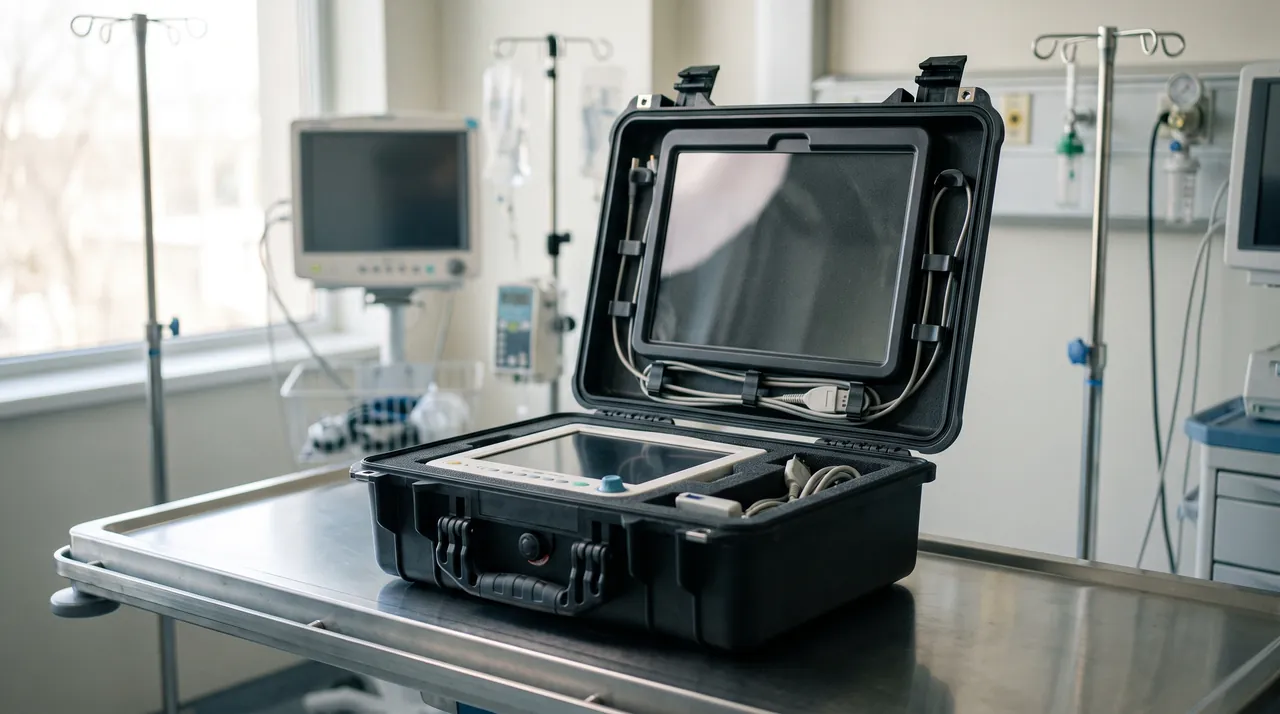
Three lessons from configuration planning are worth keeping. First, design one case per lesson rather than one case per item, so that each class needs only a single issue and the registration and handling workload drops sharply. Second, reserve about ten percent of the liner for spares and fast-wearing consumables, so that a single broken item does not stall the whole lesson and the teacher does not have to raise a separate purchase request. Third, make the liner and the checklist a replaceable revision, so that when the curriculum changes only the liner and checklist are replaced while the case itself continues in service. Applied together, these three habits convert an equipment set from a fixed purchase into a maintainable platform and drive long-term procurement cost to a minimum.
Shell Material Selection: Rotomolded / Injection / Aluminum
The shell material decides weight, strength and cost. A rotomolded case is made in one piece from LLDPE with generous wall thickness, no weld seam and excellent impact and weather resistance, suited to large, heavy sets that are moved often. An injection-molded case is molded from PP, ABS or PC with a thin wall, tight precision, a clean appearance and low cost, suited to mid and small sets issued in bulk. An aluminum case offers high strength, good heat dissipation and EMI shielding, suited to high-value precision instruments and electronic modules that need shielding, but it costs more and resists dents less well than rotomolding.
| Material route | Advantages | Limits | Typical fit |
|---|---|---|---|
| --- | --- | --- | --- |
| Rotomolded | Impact and weather resistant, can be large | Higher self-weight | Large sets, frequent transfer |
| Injection-molded | Light, precise, low cost | Limited load and size | Mid and small sets, bulk issue |
| Aluminum | Strong, can shield | Higher cost, dents | High-value instruments, electronic modules |
| Sheet metal plus liner | Customizable, rack mountable | Sealing depends on design | Fixed training room workstations |
Screen first on four items, namely total equipment weight, maximum size, transfer mode and whether ESD or shielding is needed, then review with total cost of ownership. For most schools the sensible configuration is rotomolding or injection molding for the bulk and aluminum for precision items, balancing durability, cost and specialty needs. For process differences see Rotomolded vs Injection-Molded Cases.
Two practical checks complete the material decision. First, weigh the fully loaded case rather than the empty one and compare it with the manual-handling limit for the students who will actually carry it, because a case that is safe but too heavy to lift properly will be dragged or dropped. Second, confirm where the case will live between classes; a case stored in a damp basement needs desiccant and a well-sealed shell, while one kept on a shelf in an air-conditioned training room can trade some sealing for lower weight. Matching the shell to the real storage routine is usually more valuable than upgrading to the highest rating available.
Laboratory Store Issue and Return Management
Management efficiency often affects the user experience more than the case itself. Bind the process to the case design. First, unified numbering: the case, the liner and the checklist share one coding rule to simplify records and counting. Second, issue as a whole case, registered per case rather than per item, to avoid queues caused by item-by-item signatures. Third, visible status, using a transparent window, colored label or status tag to distinguish available, awaiting repair and incomplete. Fourth, reset design, where every item has one unique position so that a missing position means a missing item and a teacher sees it at a glance.
For specialties shared across several classes, a case plus cart combination works well: cases are stored at workstations in the training room and moved in batches with an instrument cart and lab trolley, reducing lifts and drops. For equipment stored for long periods, place desiccant and a humidity indicator card inside the case and keep the storage area ventilated to prevent mold and corrosion.
Electrical Safety, ESD and Tool Protection
Electrical specialties carry the highest safety requirements. The case design should separate high and low voltage, insulate live parts and separate metal: power equipment and signal equipment in different compartments, live parts behind an insulated divider, and metal tools never mixed with electrical parts. Coil and secure cables so that friction during transport cannot damage insulation. For sets containing circuit boards, sensors and chips, use a conductive or dissipative liner, reserve a grounding terminal on the case, and bag components in anti-static bags before they go into the liner, following the standard thinking of the IEC 61340 series.

For tool protection, edged tools such as cutters, drills, taps and saw blades need dedicated pockets or guards to prevent cuts to students and damage to other equipment. Power tool batteries should be stored separately so they cannot contact metal and short circuit. Hot tools such as soldering irons and heat guns must cool completely before packing, with a heat-resistant zone reserved in the liner. For lithium batteries and chargers, mark the charging and storage requirements clearly on the case and follow the practices in Electronic Component and ESD Protection Solutions.
Transport, School Bus Transfer and Logistics Fixation
Transfer is a high-risk phase for equipment damage. During school bus and trolley transfer the priorities are preventing displacement and preventing tumbling: align anti-slip ribs when stacking, use straps where necessary, place heavy cases at the bottom and light cases on top, and use webbing through lift rings for vehicle fixation. Manual handling should avoid lifting one corner of a case, which twists the body; use two handles or a shoulder strap, and add casters and a tow strap for large cases.
Logistics shipping needs extra attention to outer packaging and single-package weight. Parcel and LTL sorting involves repeated throwing, so add a corrugated outer box and cushioning corners outside the protective case to form a double cushion of inner and outer absorption, validated as a whole following the ISTA 2A approach. On arrival, check the outer box for damage, verify that the liner has not shifted and that the checklist matches, and keep the record for traceability. For competition and off-site training, prepare a spare-parts pack so that a missing screw or patch cord cannot disrupt the assessment.
Cleaning, Marking and Teaching Compliance
The education setting has clear needs for cleaning and marking. The case surface should be easy to wipe and tolerate common cleaners and disinfectants without noticeable aging or fading after frequent wiping, and the liner should resist dust accumulation and have no crevices that trap dirt, ideally removable as one piece for cleaning. For marking, use large, high-contrast labels stating the case number, specialty, equipment checklist and responsible person, with a QR code position reserved for electronic management.
On compliance, training equipment involving electricity and chemicals should follow the relevant safety requirements: power and battery equipment must have clear charging and storage rules, consumables such as solder, adhesives and cleaning agents should be stored separately and labeled, and hazardous materials must never be mixed with ordinary equipment. Internally, keep one file per case recording the case number, compatible specialty, checklist version, and inspection and repair history for handover, counting and accountability. For cases used in skill competitions, prepare a transport list and handover form clarifying what travels in the case and what is carried by hand.
Typical Application Scenarios and Configurations
Bringing the program down to specific scenarios speeds up the configuration list.
| Scenario | Recommended configuration | Key point |
|---|---|---|
| --- | --- | --- |
| Daily practical class | Injection case plus compartment liner plus checklist | Light, easy to count |
| Transfer between training rooms | Rotomolded case plus casters and straps | No shift, no tumbling |
| Off-site skill competition | Rotomolded case plus spare pack plus handover form | Complete and traceable |
| Outdoor training | IP67 case plus moisture package | Water, dust, load |
| Shared high-value instruments | Aluminum case plus EVA liner | Shielding, shock resistance |
| Electronic set storage | ESD case plus component boxes | ESD, moisture protection |
| Long-term warehousing | Injection case plus desiccant and humidity card | Mold and rust prevention |
For specialties that need on-site teaching and testing, add a portable detection protection solution so that training-room storage and field teaching form one integrated configuration.
Procurement and Acceptance Checklist
School procurement usually follows a tender or framework agreement, so technical clauses must be clear and verifiable. The recommended checklist is: first, the specialty and equipment list with dimensions, weights and quantities as the input to liner design; second, the protection rating and governing standard, GB/T 4208 or IEC 60529, stating whether IP67 is required; third, mechanical and environmental validation requirements, including drop height, vibration level, and whether ISTA 2A and MIL-STD-810H method numbers are referenced; fourth, the liner scheme and material, including EVA density and thickness, whether it is dissipative, and whether it is removable; fifth, the compartment and checklist marking scheme, including numbering rule, label form and QR position; sixth, electrical safety and ESD requirements; seventh, accessories such as handle, shoulder strap, casters, latches and desiccant pocket; eighth, documents including test reports, material certificates and sampling plan; and ninth, lead time, packaging and after-sales terms.
At acceptance, use first-article plus sampling: check the liner fit, tongue contact, latch compression and checklist consistency on the first article, then verify the IP rating, representative drop and vibration items, liner dimensional consistency and label durability on sampled units. Only by writing critical metrics into the contract can a good sample be prevented from becoming a drifting production run.
Common Mistakes to Avoid
Mistake one: choosing by capacity alone and ignoring compartments, when a large open box still damages equipment and remains hard to count. Mistake two: a universal liner, where different specialties share one generic foam block that locates and cushions nothing. Mistake three: ignoring electrical safety, mixing high and low voltage or placing metal with live parts and creating short-circuit and shock hazards. Mistake four: keeping no marking or checklist and relying on a teacher's memory, so missing items are not detected in time. Mistake five: comparing only the case price and ignoring liner and marking customization, which leads to repeated rework later. Mistake six: leaving no dedicated position for lithium batteries and hot tools, making charging and cooling rules impossible to implement. Mistake seven: skipping whole-case transport validation and suffering damage during competition or off-site training. Putting these into the review table prevents most usage problems.
JUNZHJIA Customization Capability
JUNZHJIA provides customized and volume supply of education training kit cases for vocational schools, technical colleges and training organizations. We machine high-density EVA liners, compartment drawers and removable trays from the specialty and equipment list, and support dissipative and conductive liners. The shell can follow any of three material routes, namely rotomolding, injection molding and aluminum, and can be supplied with latches, handles, shoulder straps, casters and a unified numbering scheme. We can provide GB/T 4208, MIL-STD-810H and ISTA related test documents and support structural review, sampling and mass production. For schools sharing equipment across specialties, we support a modular program with standard cases and dedicated liners, combining long case reuse with specialty-specific liners to cut long-term procurement and inventory cost.
Frequently Asked Questions (FAQ)
Question: What is the essential difference between an education training kit case and an ordinary toolbox? Answer: The essential difference is the user and the management model. An ordinary toolbox is used by specialists at a fixed station and packing depends on personal experience, while an education training kit case faces rotating groups of students and must prescribe the packing action through structure so that every item has one unique position and a missing item is visible at a glance. An education training kit case therefore must solve not only protection but also compartmentalization, checklist discipline, durability and electrical safety, typically using whole-case issue with missing position equals missing item to support asset counting.
Question: Where does vocational training equipment most often get damaged? Answer: Three phases dominate. First, packing, where students stack carelessly or force items in and cause impact damage. Second, transfer, where trolleys, lifts, school buses and parcel sorting introduce shock and vibration. Third, storage, where damp conditions corrode metal parts, mold optical parts and drain lithium batteries over time. The corresponding measures are compartment liners for fixation, aligned stacking with strap fixation during transport, and desiccant with a humidity indicator card inside the case, plus separate storage and periodic maintenance for battery equipment.
Question: Should the liner be machined EVA, PE foam or a vacuum-formed tray? Answer: Choose by equipment characteristics. Gauges, meters, precision parts and irregular tools favor high-density machined EVA for accurate location and good cushioning. Many small items and consumables favor layered PE foam, which is inexpensive and flexible. Standardized sets and component boxes favor vacuum-formed trays, which give a clean impression and batch reproducibility. Whichever is used, keep heavy items low, give protruding features dedicated clearance and keep frequently used items within reach, and preferably use a removable tray to speed up packing and reduce operator error.
Question: What safety requirements apply to cases for electrical specialties? Answer: Separate high and low voltage, insulate live parts and separate metal. Power equipment and signal equipment go in different compartments, live parts sit behind an insulated divider, metal tools are never mixed with electrical parts, and cables are coiled and fixed so friction cannot damage insulation. Sets containing circuit boards and sensors should use a dissipative liner with a grounding terminal, and components should be bagged in anti-static bags before going into the liner. Edged tools need dedicated pockets or guards, power tool batteries should be stored separately, and hot tools must cool before packing.
Question: How do I prevent damage when moving training equipment between training rooms? Answer: The priorities are preventing displacement and preventing tumbling. Align anti-slip ribs when stacking and use webbing through lift rings where necessary; put heavy cases at the bottom and light cases on top; avoid lifting one corner of a case, which twists the body, and use two handles or a shoulder strap with casters and a tow strap for large cases. For parcel shipping, add a corrugated outer box and cushioning corners outside the protective case to form a double cushion, validated as a whole following the ISTA 2A approach.
Question: How can equipment counting be made less labor intensive? Answer: Turn counting from an end-of-term exercise into a daily habit. Use unified numbering so that case, liner and checklist share one coding rule; issue as a whole case and register per case; make status visible with a transparent window or colored label distinguishing available, awaiting repair and incomplete; and use a reset design where every item has one unique position so that a missing position means a missing item. For high-value items attach a QR code to each unit so that issue and calibration records can be read by scanning. A teacher can then confirm the state by spot check.
Question: Do training kit cases need to be waterproof and moisture proof? Answer: Most indoor training rooms only need IP54 to IP65 for dust and splash resistance, and where outdoor training, rain handling or long-term storage in a damp area is expected, IP65 or IP67 is recommended. For moisture, place desiccant and a humidity indicator card inside the case and keep the storage area ventilated, since metal and optical parts especially need protection from rust and mold. For equipment containing lithium batteries, also control storage temperature and charge level to avoid deep discharge or high-temperature storage.
Question: What is most often overlooked when procuring training kit cases? Answer: Liner customization, checklist marking and transport validation are the three most commonly overlooked items. Comparing only the case price usually leads to extra cost later from poor liner fit, hard-to-count missing items and damage during off-site transport. Write the equipment list with dimensions and weights, the liner material and form, the unified numbering and labeling requirements, the electrical safety and ESD requirements, and the referenced GB/T 4208, MIL-STD-810H and ISTA methods into the tender documents, and agree a first-article confirmation and batch sampling rule so that a good sample does not become a drifting production run.
For further reading, see Hardware Toolboxes and Tool Compartment Series, Measuring Tool Cases for Calipers and Micrometers, Electrical Meter and Multimeter Protection Solutions and Cushion Liner and Custom Cutting Design. JUNZHJIA offers a complete matrix from standard education training kit cases to fully custom teaching set programs; select according to your specialty and equipment list.
This article is SEO/GEO technical content. Figures are typical and empirical values; specific parameters are subject to the manufacturer's latest test reports and customization scheme.