

Quick answer: Price gaps on a missile box come from definitions, not rates. Measure the cavity, wall, weight and latch pull on the sample, split the quote into 5 cost blocks, fix the minimum order and mould ownership, then sign 42 days in 4 stages.
Table of contents
- Start With the Sample on the Table
- Five Cost Blocks Inside One Quote
- Minimum Order and Who Owns the Mould
- Split the 42 Days Into Four Stages
- Sampling and Factory Audit: Three Measurable Moves
- Payment Terms and Retention Written In
- FAQ
1. Start With the Sample on the Table
A buyer sets the sample on the table and reaches for a tape measure before the quotation. Cavity 1180×480×420 mm at 3 cross sections, empty weight 23.6 kg, all 4 latches cycled by hand. One wrong reading and every later comparison runs on two rulers. Copy the 14-digit mould number stamped inside the lid: it is the only evidence of ownership a year later.
Flatness and wall come next. A 2.1 mm feeler gap at the lid rim means the gasket compresses unevenly and the leak test fails. An ultrasonic gauge at 12 points gives a 6.2 mm median and a 5.4 mm low, an 0.8 mm spread already at the process ceiling. On one drawing that spread is 2.3 kg of powder, near 30 per case at 13 per kilogram, so a missile box quote without wall thickness cannot be compared.
| Item | Gauge | Recorded | Effect on price |
|---|---|---|---|
| Cavity | Tape measure | 1180×480×420 mm | Mould size, carriage stroke |
| Wall | Ultrasonic | 12 points, 6.2 mm median | 1 mm ≈ 2.3 kg powder |
| Weight | Floor scale | 23.6 kg | Freight, lifting |
| Flatness | Feeler gauge | 2.1 mm | Gasket grade, test time |
2. Five Cost Blocks Inside One Quote
Open a missile box quotation and 5 blocks appear: rotomolding, mould amortization, hardware, foam, inspection. Judge it by whether each block sits on its own line.
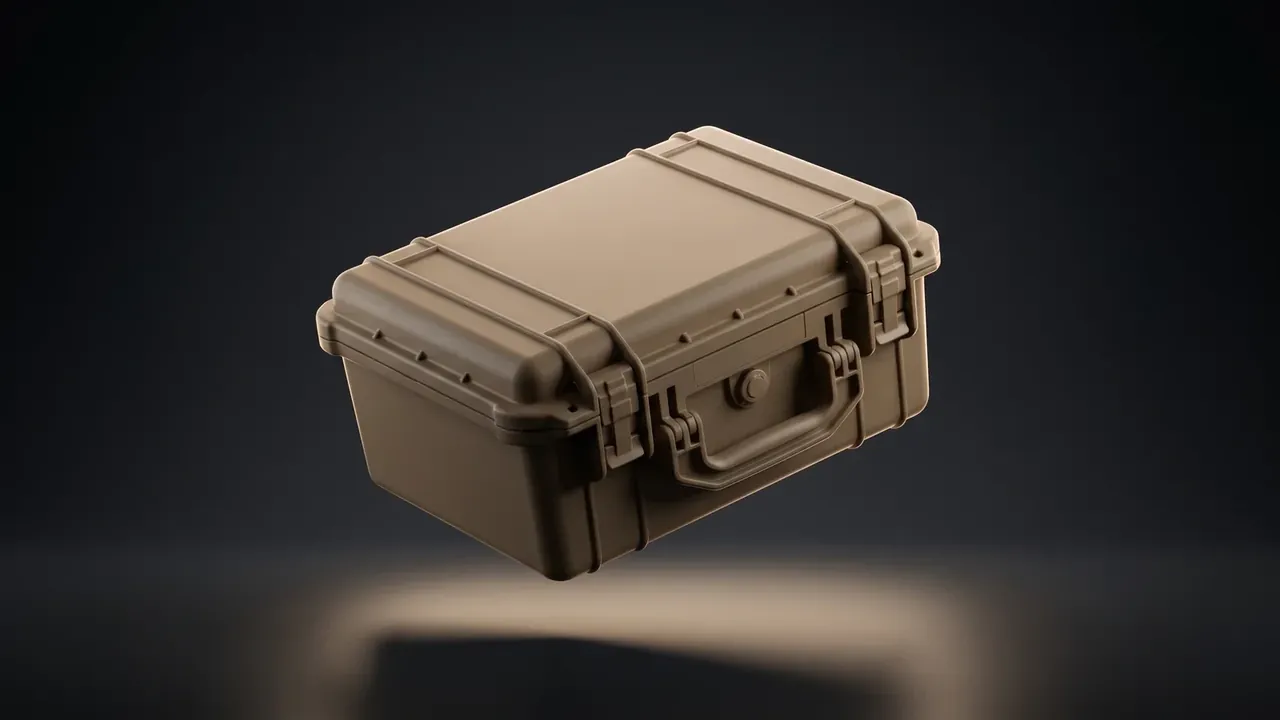
Moulding follows machine time. A 26-minute cycle on dual stations yields 2 cases per 52 minutes; at 380 per machine hour that is 165 a case. Powder runs 14.2 kg at 13, or 185, so the pair totals 350 and reaches 372 with energy and labour. A moulding line under 300 signals a cheaper grade or a thinner wall.
Amortization is the elastic block. A 96,000 aluminium mould adds 1200 at 80 units and 320 at 300, a factor of 3.75, so ask which quantity the figure divides by. Hardware and foam verify easily: 4 stainless latches, 2 hinges and 1 valve at 78; a 30 mm EVA liner at 60 kg/m³ for 120. Inspection hides in one vague line, where a 0.3 bar leak test held 60 seconds plus one 1.2 m drop costs 12 per unit at 300.
| Block | At 80 | At 300 | Basis |
|---|---|---|---|
| Rotomolding | 402 | 372 | 26-minute cycle, 380 per hour |
| Mould | 1200 | 320 | 96,000 divided by batch |
| Hardware | 78 | 71 | 4 latches, 2 hinges, 1 valve |
| Foam | 120 | 108 | 30 mm EVA, 60 kg/m³ |
| Inspection | 19 | 12 | Leak test, 1 drop, 12 points |
3. Minimum Order and Who Owns the Mould
A missile box minimum order is start-up economics, not capacity. Purging, reheating and a first shot cost a fixed 4200; at 30 units that is 140 a case, at 100 units 42, and under 21 only past 200. So 30 units works when the start-up sits on its own line instead of inside the rate.
Who pays for the missile box mould matters more than how much. The norm is buyer pays, buyer owns, evidenced by the 14-digit stamp. Three clauses settle it: mould number and storage location, no repeat charge, and collection 12 months after the last order. Watch for a rename to development fee at 8% per order, and for a tool pledged to a third party.
4. Split the 42 Days Into Four Stages
Ask how long delivery takes and you hear the production figure only. Missile box lead time is safer signed as 4 stages, 42 days total, each with a penalty clause.
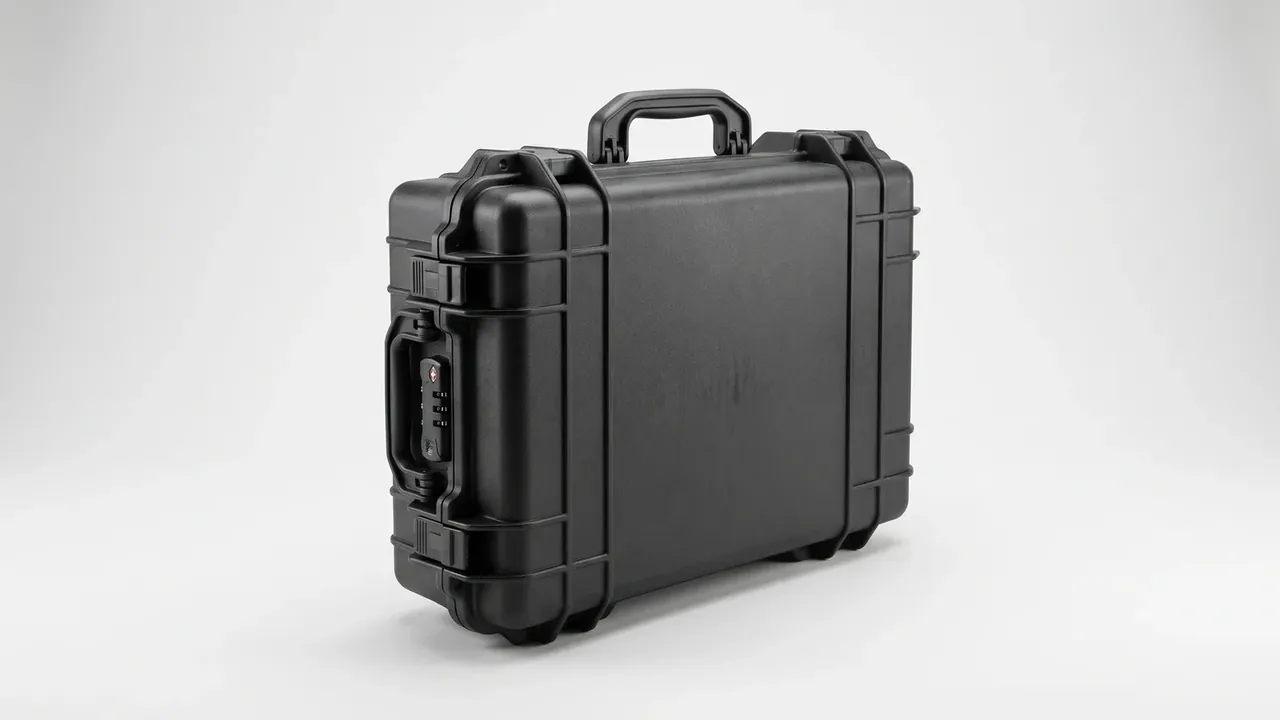
Tooling is 22 days: 15 casting, 6 CNC, 1 pressure check. An insert mould cuts casting to 11 days for 18,000 but leaves 0.3 mm variation at the joint. Trial is 5 days: 12 wall points on the first shot, and a spread beyond 0.8 mm means a 3-day rework.
Production is 11 days, because 200 cases at 26 minutes on dual stations equals 43 machine hours, which fits a 4-hour daily slot. Inspection and packing is 4 days: 100% leak testing, 3 drop samples, labelling.
| Stage | Days | Actions | Delay risk |
|---|---|---|---|
| Tooling | 22 | 15 casting, 6 CNC, 1 test | Sign-off slips 3 to 5 days |
| Trial | 5 | 12 wall points, 4 latches | Rework of 3 days |
| Production | 11 | 200 units, mixed queue | Machine queue 2 days |
| Inspection | 4 | Leak test, 3 drops | Booking of 2 days |
5. Sampling and Factory Audit: Three Measurable Moves
Three things at a missile box factory can be measured. Arm length first: a 2.5 m arm on a 1.6 m frame is what a 1180 mm cavity needs, and anything shorter invites welded half shells whose seam loses wall consistency and tightness. Powder batch second: a melt index of 3.5 against 6.0 pushes the wall spread from 0.8 mm to 1.4 mm, so demand grade and batch on the first-shot report. Third, the sampling routine itself: 12 wall points, one 1.2 m drop, 4 latches at 260 N, all recorded on site.
6. Payment Terms and Retention Written In
Missile box payment hangs on 4 milestones: 30% down, 30% on trial approval, 30% before shipment, 10% retention. Trial approval is the only gate that stops a wall or fit problem before production. Credit terms belong in the price: cash against 60 days sits near 2.5%, so 300 units at 940 carry about 7050. Retention of 90 days covers the first 200 units through real transport, where gasket and latch faults surface within 2 handling cycles.
Conclusion
The decisive work happens before the RFQ leaves: 6 readings on the sample are what make the 5 blocks separable. Write the mould number into the contract, split 42 days into 4 stages, and tie the 30% down payment and 10% retention to real actions. A buyer who can price amortization and changeover negotiates more than a rate on a missile box; next year's price curve comes with it.
This article discusses only the container (case body) side of specifications and design intent, and does not cover any handling, loading or use of the contents.
Related Reading
- What to prepare before a missile box sample ships
- How cavity size and wall thickness constrain each other
- Rotomolding principles and what they mean for tooling
- How the lid gasket and latches work together
- Cost structure compared across tool case types
Related Products
- 8 Series — Gun Cases; Military Equipment Cases; Camera Equipment Cases; Drone Cases; Watch Cases; Knife Cases; First Aid Cases; Electronics Equipment Cases
- WL8-2812 PP Gun Case — model WL8-2812
- All protective cases and toolboxes: 7 series, 158 models