

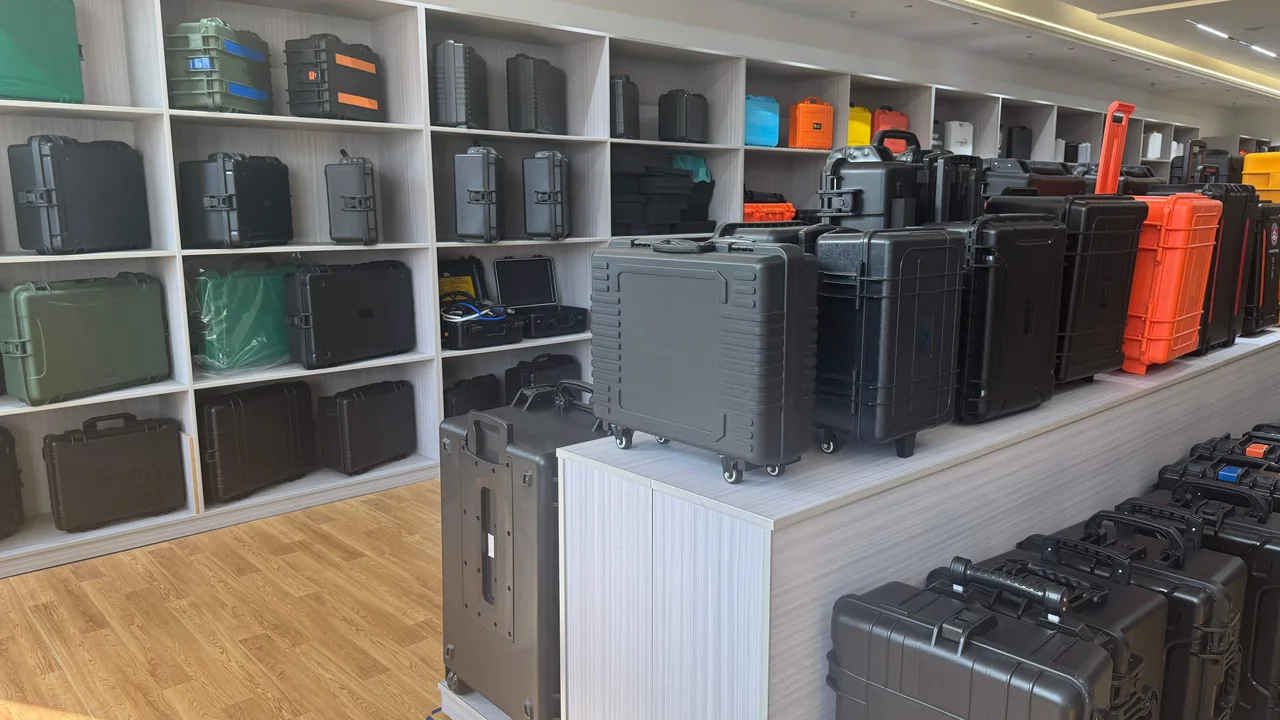
Textiles is one of the few industries where the spare parts are more precise than the machines they fit. A single ring spinning frame carries over a thousand spindles, a thousand rings and the same number of travellers again; a circular knitting machine carries well over a hundred needles and sinkers; card clothing on a carding machine can reach several hundred teeth per square centimetre. These parts share a profile: very small individually, extremely numerous, low unit cost, and disproportionately severe consequences when they fail. One traveller of the wrong number throws yarn tension out of balance across the machine; one deformed needle hook produces a continuous vertical streak in the fabric.
The mill environment makes this harder still. To control ends-down, cotton spinning halls hold relative humidity at 55% to 65% for long periods. Fly, short fibre and oil mist are present in the air. Store a spare part in that atmosphere for a few months and it faces rust, oil contamination and fibre contamination at once.
The protection principle for textile spares is therefore: build the case around compartments and counts, hold the line on cleanliness, and secure the part against rust and fly for the long term. The approach JUNZHIJIA applies in textiles is to make the case a manageable spare-parts tray — every compartment tied to one material number and one quantity, so the case can be verified on opening, drawn against a record, and returned without re-sorting.
Table of Contents
- The Real Environment of a Textile Mill: Humidity, Fly and Oil
- Spindles, Rings and Travellers: Protecting Micron-Level Fits
- Card Clothing, Reeds and Heald Frames: Sharp and Precision Parts Together
- Needles, Sinkers and Cams: Count Control for Grouped Small Parts
- Oil and Fly: The Contamination Sources Unique to Textiles
- Anti-Abrasion Design for Polished and Coated Surfaces
- Compartmentation and Separation of Magnetic Parts
- Rust Risk in Humid Spinning Halls and How to Counter It
- Why Textile Spares Do Not Need ESD but Must Be Clean
- Small-Part Compartments and Count Control: Kanban, FIFO, Kit-per-Machine
- Standardised Trays and a Colour Coding System
- Comparing Liner and Tray Options: EVA, EPE, PP and Flocked
- Frequently Asked Questions FAQ
- Conclusion and Related Reading
The Real Environment of a Textile Mill: Humidity, Fly and Oil
You cannot choose a case material for textile spares without understanding the mill environment, which is controlled for process reasons rather than comfort.
In cotton spinning, blowroom and carding typically run at 50% to 60% relative humidity, combing and drawing at 55% to 65%, and ring spinning at 55% to 60% to reduce ends-down. Wool and silk spinning often run higher, with some processes at 65% to 75%. Summer hall temperatures sit between 28 and 33 °C, so the case lives in a hot, humid combination in which carbon steel corrodes far faster than in an ordinary machine shop.
Fly lint is the second factor: short fibres released from yarn by airflow and mechanical action, broadly 10 µm to 2 mm. It carries static charge, so it clings to plastic and metal surfaces, and it carries oil, because oil mist binds to the fibre and forms a sticky deposit that a dry cloth cannot remove and that becomes a nucleation site for later corrosion.
Oil comes mainly from spindle oil-bath or oil-mist lubrication, ring and traveller lubrication, and drive grease. It matters not only because it is dirty but because it hides defects: a film conceals rust spots and early wear marks, making incoming inspection meaningless.
| Process area | Typical RH | Temperature | Main airborne contaminant | Rust tendency on carbon steel |
|---|---|---|---|---|
| --- | --- | --- | --- | --- |
| Blowroom/carding | 50–60% | 26–32 °C | Short fibre, cotton dust | Medium |
| Combing/drawing | 55–65% | 26–32 °C | Short fibre, oil mist | Medium-high |
| Ring spinning | 55–60% | 28–33 °C | Fly, spindle oil mist | High |
| Winding/twisting | 50–60% | 26–32 °C | Fly, yarn hairiness | Medium |
| Weaving | 65–80% | 24–30 °C | Size dust, oil mist | High |
| Knitting | 55–65% | 24–30 °C | Fly, needle oil | Medium-high |
A textile spare-parts case does not need the highest sealing class, but its liner's cleanliness and oil resistance must be right. IP65 keeps fly and washdown water out; the layer touching the part decides success.
Spindles, Rings and Travellers: Protecting Micron-Level Fits
The three core mating parts of a ring spinning frame — spindle, ring and traveller — form a high-speed friction system. Spindle speed is commonly 15,000 to 20,000 rpm, and taper fit, blade runout, ring roundness and ring surface roughness are all micron-level requirements.
Spindles. Critical parameters include taper fit accuracy (commonly 1:38.5 or 1:64), radial runout (no more than 0.02 mm on high-precision spindles), wharve balance grade and blade hardness. The most common transport damage is not deformation but taper impact damage and bearing contamination: once the taper takes a dent, concentricity after assembly exceeds tolerance and the yarn break rate climbs.
Rings (flange and conical types) commonly run 38 to 54 mm in diameter, with working-face roughness Ra as low as 0.2 to 0.4 µm, often chrome-plated, ceramic-coated or TiN treated. Rings fail through working-face wear and coating spall, so the working face must never touch a hard object or rub against an adjacent ring.
Travellers are the most neglected part. They are formed from shaped wire and weighed in milligrams, commonly about 6 mg to 200 mg, graded by number, with almost no visible difference between grades. The usual problem in transit is spillage, mixed numbers and loss. To a mill, one box of mixed-number travellers is a total write-off.
| Part | Key parameters | Transport sensitivity | Failure consequence |
|---|---|---|---|
| --- | --- | --- | --- |
| Spindle | Taper 1:38.5/1:64, runout ≤0.02 mm | Taper impact, bearing contamination | Higher vibration, more ends-down |
| Ring | 38–54 mm, Ra 0.2–0.4 µm | Working-face scratch, coating spall | Abnormal traveller wear, hairiness |
| Traveller | 6–200 mg each, graded by number | Spillage, mixed numbers, loss | Tension imbalance, whole batch unusable |
| Wharve | Dynamic balance grade | Deformation, eccentric loading | High-speed vibration, energy loss |
| Bobbin | Concentricity, surface finish | Crushing, deformation | Poor winding build |
Protection therefore splits into two routes: rigid location plus zero-contact isolation for spindles and rings, in EVA die-cut cavities or PP compartment trays; and fixed-count, no-mixing handling for travellers, in fixed-pocket trays or pre-counted bags with the number grade marked.
Card Clothing, Reeds and Heald Frames: Sharp and Precision Parts Together
Card clothing, reeds and heald frames are precise and sharp at the same time.
Metallic card clothing is made from toothed wire wound or set into a foundation, with tooth density commonly 300 to 1000 teeth per square inch and tooth height of about 2 to 5 mm. Its core failure is bent or curled teeth: any hard contact rolls a tooth tip, and a curled tooth cannot card fibre properly, producing neps and yarn faults. In transit the toothed face must touch nothing at all, including foam, paper and adjacent clothing strips.
Flexible card clothing, with a fabric foundation and set teeth, is gentler but still deforms under sustained load.
Reeds consist of densely packed dents, commonly 8 to 140 dents per inch. The dents bend or break easily under side load, and reeds are flatness-critical: once the assembly distorts, weft density becomes uneven.
Heald frames and heddles. Heddle wire diameter is typically 0.25 to 0.40 mm, length 250 to 330 mm, with an eyelet at mid-length. Heddles are the classic high-count, fine-individual part, and the main transport risk is mutual tangling and eyelet deformation.
| Part | Density | Main material | Main transport risk | Practical reject threshold |
|---|---|---|---|---|
| --- | --- | --- | --- | --- |
| Metallic card clothing | 300–1000 teeth/in² | Carbon steel toothed wire | Curled or bent teeth | Any curled tooth |
| Flexible card clothing | Per foundation spec | Wire plus foundation | Leaning set teeth, foundation distortion | Lean rate above 2% |
| Reed | 8–140 dents/in | Stainless or carbon steel dents | Bent dents, overall distortion | One bent dent is visible as a reed mark |
| Heddle | 0.25–0.40 mm wire | Stainless or carbon steel | Tangling, eyelet deformation | Eyelet ovality out of tolerance |
| Heald frame | — | Aluminium frame plus heddles | Frame distortion, heddle loss | Flatness out of tolerance |
The general packing method is isolate each item first, then secure the group. Card clothing strips are paired back to back with a closed-cell foam interleaf and seated in a slotted position. Reeds are supported at both ends so the dents stay airborne. Heddles hang from a dedicated comb-like rail that prevents wire-to-wire contact.
Needles, Sinkers and Cams: Count Control for Grouped Small Parts
Knitting spares have their own rhythm. Needles, sinkers and cams are replaced in groups: a single changeover may involve dozens to hundreds of pieces, and one machine may run several specifications at once.
Needles (latch and compound types) are commonly 30 to 90 mm long with a body wire diameter of 0.3 to 1.2 mm; the hook and latch are the functional core. Once the hook deforms or the latch sticks, the needle cannot form a loop. The specific transport risk is hooks catching each other — put two needles together and a hook readily catches the other needle's latch, so pulling them apart deforms one or both.
Sinkers are typically 0.2 to 0.5 mm thick. They bend very easily, and a bent sinker cannot be straightened.
Cams are tooling-class parts with ground or nitrided working faces. They resist impact and corrosion poorly and usually carry high unit value.
All three demand grouped, counted, unmixed handling. The standard method is a compartment tray holding a fixed number per pocket, for example 25 needles per pocket, so one pocket equals one draw and consumption is known immediately. Pocket count is tied to the material number, giving a three-level relationship of tray, pocket and number.
Count control matters not only for convenience but for preventing mis-assembly. Needles for different machine types look similar, and when they are mixed the operator selects by eye. A wrong needle often runs for some time before the error surfaces, and the loss far exceeds the value of the spare part.
Oil and Fly: The Contamination Sources Unique to Textiles
The three harms of oil. It attracts fly, because the film bonds airborne short fibre to the surface and forms an oil-lint mixture that thickens over time. It hides defects, because inspection cannot see rust spots and wear marks through the film. And it accelerates corrosion, because some lubricants absorb water, and water trapped under a film causes localised pitting.
The persistence of fly. Fly carries static charge, and ordinary plastic surfaces hold enough charge to attract short fibre. Surface resistivity therefore hardly matters — textiles do not need ESD protection — but whether a surface holds static and attracts fibre matters a great deal. Three measures work: choose grades with lower surface resistance; keep pockets smooth rather than flocked; and, most importantly, wipe the outside of the case before opening it so fly is not swept inside when the lid comes off.
How to verify cleanliness. Wipe with a black or white nonwoven, as in paper mill practice, but textiles care more about oil than crumbs. Add one step: press clean filter paper against the part for 10 seconds and look for oil transfer. An oil mark means the part fails cleanliness and must be cleaned again.
| Contaminant | Main composition | Effect on parts | Control measure |
|---|---|---|---|
| --- | --- | --- | --- |
| Spindle oil mist | Mineral-oil lubricant | Oil film attracts fly, hides defects | Degrease, then barrier seal |
| Fly/short fibre | Cotton, wool, synthetic fibre | Static cling, entrapment in tooth gaps | Anti-static surfaces, wipe before opening |
| Size dust | Dried sizing powder | Hygroscopic, acidic deposit | Barrier bag isolation |
| Hand sweat and sebum | Salts and oils in sweat | Fingerprint rust on carbon steel | Powder-free gloves during packing |
| Packaging shed | Board fibre, foam crumbs | Inclusions become yarn faults | Closed-cell liner, film-faced board |
Hand sweat deserves a warning. Textile spares are small and handled constantly, so operators pick up carbon steel parts bare-handed very often. Chloride in sweat is a powerful pitting initiator, and a fingerprint on a ring can show rust within days at 60% RH. Use powder-free nitrile gloves throughout packing, and note on the packing list that the mill should wear gloves when opening the case.
Anti-Abrasion Design for Polished and Coated Surfaces
Many textile parts carry polished, chrome-plated, ceramic-sprayed or nitrided surfaces. These share a profile: high surface hardness on a thin layer, and no repair once scratched.
Anti-abrasion design controls three variables: contact pressure, relative movement, and the hardness of the contacting material. Relative movement is the easiest to overlook and the most destructive. Even millimetre-level reciprocation inside the case, accumulated over several hundred kilometres of road transport, produces a friction path long enough to leave a visible mark on a polished face.
Effective structural measures include:
- Individual slots. Each part gets its own slot, with walls at least two thirds of the part height.
- No hard-to-hard contact. A soft layer must sit between parts and against the case wall, softer than the working coating and thick enough to spread local pressure.
- Restrict degrees of freedom. Use an EVA die-cut cavity or PP compartment tray to restrict axial and radial movement rather than relying on clamping.
- Control clamping force. If clamping is unavoidable, apply it through an elastic element and keep contact stress below the coating's allowable value.
| Surface type | Typical hardness/thickness | What it fears | Recommended contact material |
|---|---|---|---|
| --- | --- | --- | --- |
| Chrome-plated working face | 800–1000 HV, 5–25 µm | Scratch, spall, pitting | Closed-cell EVA (45–60 kg/m³) |
| Ceramic spray | 1000–1400 HV | Edge chip, impact cracking | Closed-cell EVA plus elastic pad |
| Nitrided layer | High surface hardness, 0.1–0.3 mm deep | Local indentation, abrasion | Closed-cell EPE or EVA |
| Polished carbon steel | Low hardness, high finish | Scratch, fingerprint rust | Acid-free paper plus closed-cell PE |
| Anodised aluminium | Oxide film 10–25 µm | Scratch through to base, white spots | Closed-cell EVA; never against carbon steel |
Aluminium and carbon steel parts must not touch directly. In a humid environment the pair forms a galvanic couple and the aluminium, as the anode, corrodes preferentially. Textile machines commonly mix aluminium heald frames and yarn guides with carbon steel components, so different metals should go into different pockets or be separated by an insulating layer.
Compartmentation and Separation of Magnetic Parts
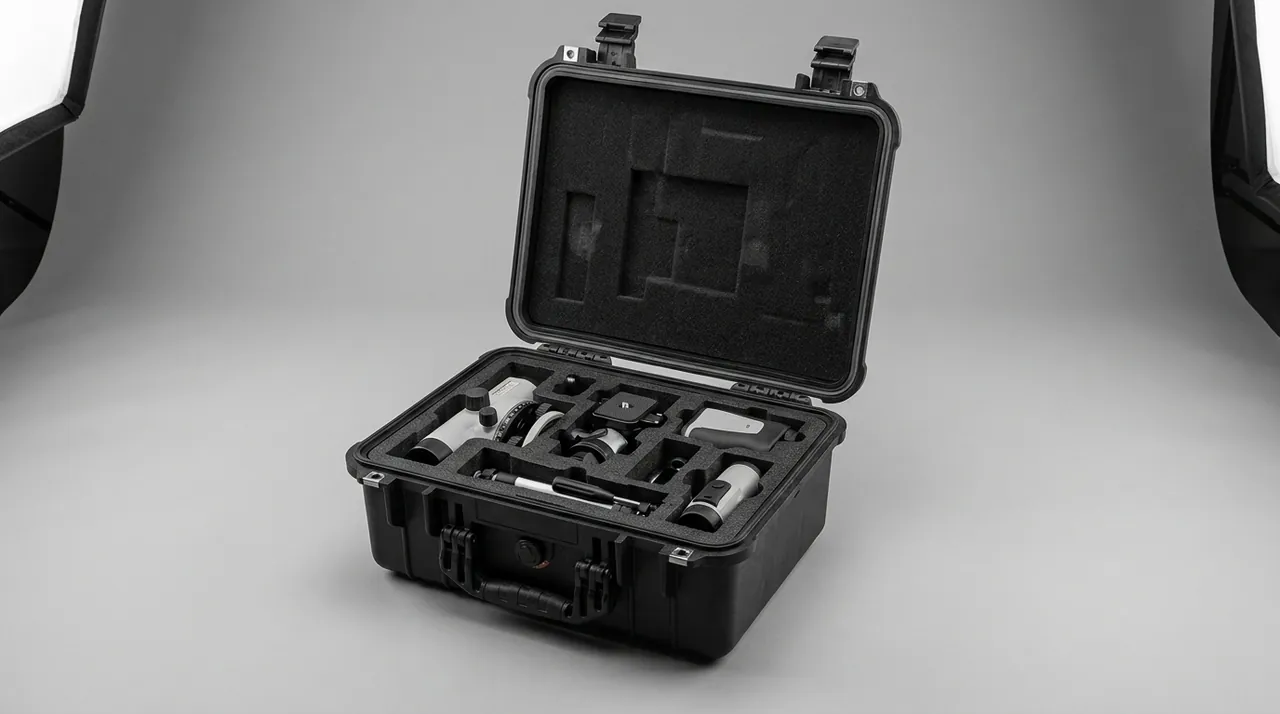
The first group contains magnets by design. Modern textile machinery uses magnetic yarn tensioners, magnetic drive elements, and some electromagnetic needle selectors and sensors containing permanent magnets. The transport risks are that strong magnets attract each other and collide violently, that they collect iron debris which is then hard to remove, and that stray fields disturb electronic components and instruments in the same case.
The second group can become magnetised. Carbon steel rings, reeds, card clothing and needles retain residual magnetism if manufacturing included magnetic particle inspection, magnetic clamping or magnetic conveying. Magnetised parts inside a case attract each other into clusters, and parts within a cluster rub continuously, causing surface abrasion and making counting impossible. Residual magnetism also attracts iron powder and fly, forming a layer that is difficult to clean.
Four measures cover it:
- Demagnetise first. Where residual magnetism matters, demagnetise before dispatch and state a residual limit in the inspection record.
- Use non-magnetic trays. Choose PP, EVA, non-magnetic aluminium or austenitic stainless steel; avoid ferrous trays that complete a magnetic circuit.
- Separate compartments. Keep magnetic and non-magnetic parts apart, and maintain spacing between strong magnets.
- Shield. For field-sensitive components, use a high-permeability alloy shield or a ferrous shielding box as a dedicated enclosure.
| Part type | Source of magnetism | Main risk | Handling |
|---|---|---|---|
| --- | --- | --- | --- |
| Magnetic yarn tensioner | Built-in permanent magnet | Mutual impact, iron debris | Separate compartment plus shield plate |
| Electromagnetic needle selector | Coil and core | Residual magnetism, field interference | Shield can, own pocket |
| Rings/reeds | Residual magnetism from machining | Clustering, counting failure | Demagnetise, non-magnetic tray |
| Card clothing/needles | Residual from magnetic conveying | Attracts iron powder and fly | Demagnetise, closed-cell liner |
| Sensors/encoders | Susceptible to fields | Accuracy drift | Distant compartment plus shielding |
Magnetism is almost invisible at acceptance, and by the time the hall notices clustered parts or an erratic sensor the loss has already happened. Residual magnetism testing should therefore be an outgoing inspection item, with a demagnetisation statement for each batch in the shipping documents.
Rust Risk in Humid Spinning Halls and How to Counter It
Humidity control is good for the process and bad for carbon steel spares. Under ISO 9223 corrosivity categories, a hall held above 60% RH with fibre and oil mist in the air can reach C3 or even C4.
Corrosion on carbon steel has a critical relative humidity, roughly 60% RH on a clean surface. Once chloride or sulphate particles deposit, the critical value drops below 40% RH. The main ion sources in a textile mill are hand sweat (chloride), sizing residue and, in some locations, airborne sea salt. This explains why spares that do not feel damp still rust.
Countermeasures in priority order:
- Control the surface first. Remove oil, fingerprints and sizing residue. Surface cleanliness affects rust prevention more than the choice of inhibitor.
- Use vapour-phase corrosion inhibitor (VCI). Amine carboxylate grades suit carbon steel; assemblies containing copper alloys need a broad-spectrum formulation with benzotriazole. VCI requires an enclosed volume and typically protects for 12 to 24 months.
- Add desiccant. Size against free volume, starting at 20 to 30 g per cubic metre of fine-pore silica gel under good barrier conditions, and double it for sea freight or long storage.
- Do not stack oil and VCI. Rust-preventive oil blocks VCI adsorption; choose one.
- Control packaging materials. Avoid acidic paper, sulphur-bearing rubber and uncured adhesives.
| Protection method | Suitable parts | Protection window | Unpacking burden | Note |
|---|---|---|---|---|
| --- | --- | --- | --- | --- |
| VCI film plus compartment tray | Rings, reeds, needles | 12–24 months | Low | Requires enclosed volume |
| Barrier bag plus desiccant | Assemblies with non-metallic parts | 12–24 months | Low | Avoid VCI near rubber |
| Rust-preventive oil plus barrier bag | Large carbon steel parts | 6–18 months | High; degreasing needed | Never combined with VCI |
| Acid-free paper plus closed-cell PE | Polished and small parts | 3–6 months | Low | Good for short internal moves |
| Compartment tray only | Stainless and aluminium parts | 1–3 months | Lowest | Short internal circulation |
One practical recommendation: store spare-parts cases under cover, away from humidifier nozzles and oil mist sources. Packaging slows corrosion; it does not replace sensible storage. To validate a scheme before committing, the neutral salt spray conditions in the salt spray corrosion test reference — 5% NaCl at 35 °C with continuous spray — give a comparable basis for side-by-side samples.
Why Textile Spares Do Not Need ESD but Must Be Clean
Customers often ask whether textile spares need electrostatic discharge (ESD) packaging. The answer is usually no dedicated ESD protection, but stricter cleanliness.
ESD is unnecessary because textile parts contain no semiconductor devices, and a static discharge will not destroy them. The electrical control sections of spinning frames and looms are normally purchased and transported as separate assemblies and do not need to share a case with mechanical small parts.
The cleanliness requirement is stricter because textile parts touch yarn directly. Rings and travellers form a friction pair, reeds set the warp spacing, needles form the loops, and heddle eyelets control the shed. Any particle attached to those parts — fibre fragments, foam crumbs, board dust, metal powder — transfers to the yarn or fabric and becomes a defect. Mills tolerate defects poorly, because a defect can downgrade an entire piece of cloth.
Cleanliness criteria should therefore be verifiable rather than visual:
- Fibre release: ten wipes with a black nonwoven, no visible fibre.
- Particle contamination: no visually detectable particles on contact faces.
- Oil residue: a 10-second filter paper press leaves no oil mark.
- Metal debris: tape-lift from magnetic surfaces shows no iron particles under magnification.
| Item | Electronics requirement | Textile spare requirement | Reason for the difference |
|---|---|---|---|
| --- | --- | --- | --- |
| ESD protection | Required (surface resistance 10⁴–10¹¹ Ω) | Not required | No semiconductor devices present |
| Fibre release | Monitored | Extremely strict | Fibre directly contaminates yarn |
| Particle contamination | Strict, by cleanliness class | Strict; visible particle fails | Particles become fabric defects |
| Oil residue | Generally ignored | Strictly prohibited | Oil attracts fly |
| Metal debris | Monitored for short-circuit risk | Strictly prohibited | Debris wears friction pairs |
In short, a textile spare-parts case needs clean packaging, not ESD packaging. Settling this at the design stage avoids paying for materials that are not needed and lets the budget go to the closed-cell liners and compartment structures that genuinely matter.
Small-Part Compartments and Count Control: Kanban, FIFO, Kit-per-Machine
Textile mills hold many spare types, each of low unit value, consumed quickly. Management efficiency therefore often decides whether a packaging design survives. A well-built case that is awkward to draw from will be abandoned by the hall.
Kanban replenishment. Set a minimum and maximum stock level per pocket and signal replenishment visually with colour tags or empty pockets. Trigger a request when a pocket is one third empty and replenish to full. The packaging must support whole-tray exchange: the new tray replaces the old one directly, and the old tray goes back for refilling and reuse.
FIFO (first in, first out). Rubber parts, oiled parts and coated parts have shelf lives, and VCI protection has a validity period. FIFO means different batches of the same material number are never mixed in one pocket; they are separated by pocket or layer with batch and date marked on the tray.
Kit-per-machine. Mills organise maintenance by machine, such as ring frame No. 1 or circular knitter No. 3. Assembling all the small parts needed for one routine service into one tray set cuts picking time and mis-assembly risk substantially. Kit-per-machine requires modular trays: a base tray plus plug-in compartment modules, combined differently for different machine types.
| Management dimension | Loose storage | Compartment tray approach | Benefit |
|---|---|---|---|
| --- | --- | --- | --- |
| Picking time | Search item by item | One pocket, one draw | Cut by more than half |
| Mis-assembly risk | High, numbers mix | Low, pocket bound to material number | Substantially lower |
| Stocktaking | Count piece by piece | Count empty pockets | Visual completion |
| Replenishment trigger | Manual judgement | Kanban level | Automatic signal |
| Batch traceability | Difficult | Batch separated by layer and marked | Traceable |
One design detail matters: pocket capacity should match the grouped quantity, for example designed as 25 pieces per pocket rather than "about 30 fit". A fixed number turns counting into counting pockets rather than counting parts, critical for tiny needles and travellers.

Standardised Trays and a Colour Coding System
Everything described above rests on one precondition: the trays are standardised. If every machine has its own tray size and pocket layout, kanban, FIFO and kit-per-machine cannot become a system.
Standardisation should cover four levels:
- Series of outer case sizes. Base the range on the 1200 × 800 mm pallet and the 600 × 400 mm module, with 1/4, 1/2 and 1/1 module cases so cases stack and container-load efficiently.
- Uniform inner tray size. Trays within a series are interchangeable and compartment modules are plug-in.
- Pocket numbering rule. Use a two or three level code of tray, row and column, mapped to material numbers.
- Colour coding. Use colour for function, never for decoration.
A workable colour logic, to be coordinated with existing mill conventions, is:
| Colour | Suggested meaning | Example application |
|---|---|---|
| --- | --- | --- |
| Red | High consumption, frequent replenishment | Travellers, needles |
| Yellow | Periodic inspection or shelf-life control | Rubber parts, oiled parts, VCI items |
| Blue | Precision parts, no impact allowed | Rings, reeds, polished parts |
| Green | General and standard parts | Bolts, gaskets, pins |
| Grey/black | Tools and gauges | Special spanners, plug gauges |
| Orange | Awaiting inspection or quarantined | Returns, parts pending decision |
Colour must always be used with a text label. Colour alone fails for people with colour vision deficiency, and different plants read colours differently, so the label and number are the primary identifier.
For a more systematic asset identification method, see the coding rules in the spare parts labelling and asset tracking reference; for plants that want scan-based stocktaking, the asset QR code tracking reference describes how to carry the code from tray down to material.
Comparing Liner and Tray Options: EVA, EPE, PP and Flocked
Selecting a liner for textile small parts means balancing four dimensions: cleanliness, counting capability, reusability and cost.
| Option | Material and structure | Cleanliness | Counting | Washable | Reuse | Suitable parts |
|---|---|---|---|---|---|---|
| --- | --- | --- | --- | --- | --- | --- |
| EVA die-cut tray | Closed-cell EVA 45–90 kg/m³, CNC die-cut | Excellent, non-shedding | Medium, cavity count | Wipeable | High | Rings, spindles, coated parts |
| EPE layered tray | EPE 20–35 kg/m³, multi-layer routed | Good; crumbs at cut edges | Low; manual count | Fair | Medium | Large parts, heald frames |
| PP compartment tray | Injection-moulded polypropylene, fixed pockets | Excellent, non-shedding | Excellent; fixed pocket count | Washable | Very high | Travellers, needles, heddles |
| Flocked tray | PP/ABS base with short flock | Moderate; flock sheds | Excellent | Not washable | Medium | Grip display, non-clean areas |
Three statements summarise the selection logic.
First, the layer that touches a working face must be closed-cell and wipeable. EVA and PP both qualify; EPE needs an added isolation layer; flocked material should not contact parts in textiles at all, because flock shedding is itself a fibre contamination source.
Second, parts that must be counted belong in a fixed-pocket tray. Travellers, needles and heddles are best served by an injection-moulded PP compartment tray, because pocket count is set by the mould and does not change if the liner deflects. EVA cavities can also support counting, but over long service the cavity can deform and pocket boundaries blur.
Third, choose PP for washed reuse and EVA for contoured location. A PP tray can be washed with neutral detergent and dried, giving the lowest upkeep cost. EVA can be wiped but absorbs water if soaked, so clean it by wiping rather than immersion.
For scenarios needing flexible support and complex contour location, the case dividers versus foam reference discusses where each approach fits best, and the removable divider system reference describes modular tray implementation. Foam grades differ substantially in density, compression set and resilience, and the case foam material comparison reference tabulates those parameters.
Frequently Asked Questions FAQ
Q: Travellers are so small, do they really need dedicated transport packaging?
A: Yes, and more so than most parts. A traveller weighs only 6 to 200 mg and is graded by number, and the difference in shape between adjacent grades is virtually invisible. Once travellers spill and mix, a mill cannot restore the batch by manual sorting and must scrap it entirely. Dedicated packaging solves three problems. The first is counting: use a PP compartment tray with a fixed pocket count, for example 100 pieces per pocket, so counting pockets gives the quantity. The second is preventing mixed numbers: one tray holds one number only, with the same number and batch marked on both tray and lid. The third is preventing loss: pocket depth should exceed the stacked height and a transparent cover plate should be fitted, so that opening the case does not let airflow carry pieces away. Travellers are also a wear item, so packaging must not use shedding materials that could lodge fibre or particles in the small formed section. Despite the low unit price, the return on packaging investment is the highest in the whole textile spare range.
Q: Why do textile spares not need ESD anti-static packaging?
A: Because textile machine spares contain no semiconductor devices that are sensitive to electrostatic discharge. The purpose of ESD protection is to prevent a discharge from rupturing a MOS gate oxide or damaging an integrated circuit, whereas rings, reeds, needles, heddles and card clothing are purely mechanical parts and a discharge cannot cause functional failure. The electrical control sections of spinning frames and looms are normally purchased and shipped as separate assemblies, protected to an electrical-component standard, and they do not need to share a case with mechanical small parts. It is important to distinguish this from the real static problem in a textile hall, which is fly attraction rather than device breakdown. Fly carries charge and readily clings to plastic and metal surfaces, forming a layer that is hard to remove. Packaging design should therefore focus on whether the liner surface resists static and is smooth enough to clean, not on reaching a particular ESD surface resistance grade. Settling this avoids paying for anti-static material that is not needed and directs the budget to closed-cell liners and fixed-count trays.
Q: What damage should be guarded against most when transporting metallic card clothing?
A: The priority is curled and bent teeth. Metallic card clothing reaches 300 to 1000 teeth per square inch with tooth height of about 2 to 5 mm. The tips are extremely sharp and only moderately stiff, so almost any hard contact can roll a tooth tip. A curled tooth cannot card fibre properly and will generate neps during carding, which appear downstream as yarn faults and fabric defects. This is an unrepairable failure. Transport protection rests on three rules. First, zero contact on the toothed face: never let the clothing teeth press against foam, board or an adjacent strip. Second, pair back to back, normally with a closed-cell foam interleaf between the two backing faces, so the tooth tips stay airborne. Third, restrict movement: both axial and lateral freedom of each strip within its slot must be limited so that transport vibration cannot cause rubbing. Card clothing is also magnetisable, so if magnetic conveying or magnetic particle inspection was used in manufacturing, demagnetise before packing.
Q: Which parts of a spindle are most easily damaged in transit?
A: The blade taper and the spindle bearing are the most vulnerable. The blade taper is the mating face between spindle and wharve, commonly ground at 1:38.5 or 1:64, and its fit accuracy directly sets concentricity after assembly. If a hard object dents or scratches the taper, radial runout after assembly will exceed tolerance, the 0.02 mm precision requirement cannot be held, vibration rises and the yarn break rate climbs with it. The bearing is vulnerable to contamination: fly and oil mist entering the bearing change the lubrication condition and cause early wear and temperature rise. Spindle packaging should therefore locate each unit rigidly, using an EVA die-cut cavity or PP compartment tray to restrict movement, with no hard object touching the taper. Seal the assembly in a barrier bag or VCI film to exclude fly and moisture. Degrease and remove fingerprints before packing, and prohibit bare-hand handling, because chloride in sweat is a powerful pitting initiator.
Q: How should carbon steel spares be protected against rust in a humid spinning hall?
A: The essence is to control the surface state, exclude moisture and select the right vapour-phase system. Carbon steel has a critical relative humidity of about 60% RH on a clean surface, below which it effectively does not corrode; once chloride or sulphate deposits form, that critical value falls below 40% RH. Textile halls commonly run at 55% to 65% RH or higher and also present hand sweat and sizing residue, so protection must start at the surface: remove oil, fingerprints and sizing residue before considering any inhibitor. For carbon steel, an amine carboxylate VCI is suitable; assemblies containing copper alloys need a broad-spectrum formulation with benzotriazole; VCI must be used inside an enclosed volume and typically protects for 12 to 24 months. Alternatively use a barrier bag with desiccant sized against free volume, starting at 20 to 30 g per cubic metre of fine-pore silica gel under good barrier conditions. Note that rust-preventive oil and VCI must not be combined, because an oil film blocks VCI adsorption.
Q: How can a small-parts case be made both easy to draw from and impossible to mix up?
A: The key is to make the pocket, not the part, the unit of management. Bind each pocket to one material number so tray number, pocket number and material number form a fixed mapping, and label that mapping on the tray in text and numbers. Design pocket capacity as a fixed quantity, for example 25 needles per pocket or 100 travellers per pocket, so stocktaking counts pockets rather than parts and both speed and accuracy improve substantially. A pocket left empty after a draw is itself the replenishment signal, and combined with kanban levels this triggers replenishment automatically. Where one material number exists in several batches, separate them by layer or pocket and mark batch and date to support first-in, first-out. Similar parts for different machine types should go into different trays with different colour labels so operators cannot select by appearance alone. To reduce manual cross-checking further, apply a QR code to the tray so scanning brings up the pocket list and stock quantity, and binding the code to a work order also records where each part was drawn.
Q: Is EVA or PP better for a compartment tray?
A: It depends on part characteristics and usage, and each has clear boundaries. EVA is a closed-cell foam, commonly 45 to 90 kg/m³, and its advantages are flexibility and the ability to CNC-die-cut a negative cavity that matches an irregular part, which suits rings, spindles and coated parts that need contoured zero-contact isolation. It does not shed and can be wiped, but it absorbs water and swells if soaked, so cleaning should be by wiping rather than washing. An injection-moulded PP compartment tray has pocket count fixed by the mould, does not deform over long service, can be washed with neutral detergent and dried, and offers very high reuse counts, which suits travellers, needles and heddles that are numerous and must be precisely counted. Its disadvantage is a fixed pocket shape that cannot match irregular contours. In practice the common combination uses a PP compartment tray for counting and primary location, with EVA die-cut blocks added inside for individual precision parts. Whichever is chosen, a flocked tray should never contact the parts, because flock shedding is the fibre contamination source textiles most want to avoid.
Q: What storage conditions matter for spare-parts cases kept in a textile hall?
A: Packaging slows deterioration but cannot replace sensible storage, and four points are most often overlooked. First, position the case away from humidifier nozzles, steam pipes and oil mist sources, because local humidity and oil mist accelerate both corrosion and contamination, and a case inside the spray zone can experience internal humidity above the hall average. Second, store under cover and out of direct sunlight, since ultraviolet radiation and heat age the gasket and embrittle plastic components. Third, respect the marked stacking limit and ensure the bottom case is evenly loaded; over-stacking deforms the lids below, breaks the seal, and causes both VCI and desiccant to fail early. Fourth, keep an opening log and manage expiry, since VCI and desiccant have protection periods and rubber and oiled parts have shelf lives; mark the activation date and recommended opening deadline on the case label and check them at stocktaking. For long-stored spares, inspect one case every six months, read the humidity indicator card and look for rust spots.
Conclusion and Related Reading
Textile spare parts need cleanliness, countable compartments and rust control at once. Bind each pocket to a material number and use non-shedding closed-cell contact materials.
Related Reading