

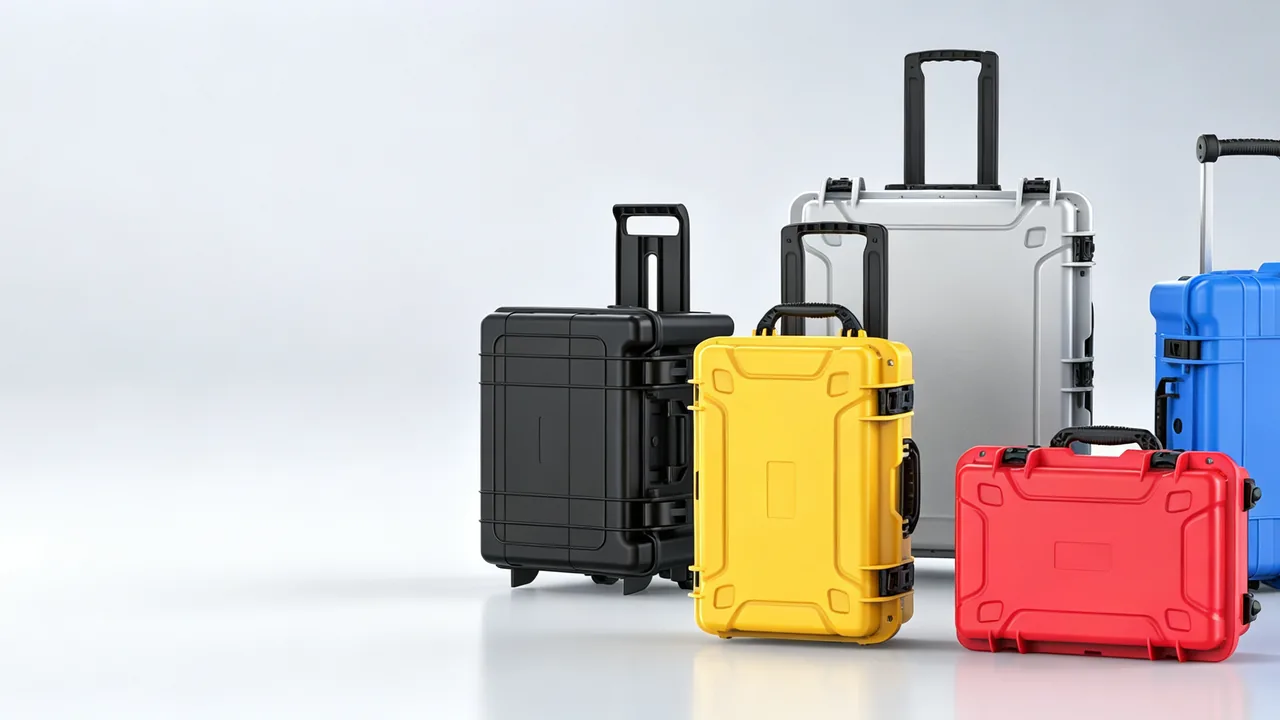
Tire building machines sit at the center of a tire production line. Building drums, stitching rollers, belt drums, servo motors and gearboxes run at high cycle rates under constant tension, so transfers between workshops, full line relocations, export shipments and return-to-factory repairs are unavoidable. When such a part takes impact, moisture, distortion or roller surface damage in transit, the line shows it as out-of-round green tires, misaligned splices, stitching marks and dynamic imbalance, and the pass rate of the whole line begins to swing.
The JUNZHIJIA position is direct: the roundness and coaxiality of a building drum must be locked in by three coordinated layers of case rigidity, locating datum and cushioning, never by stuffing foam into the gaps. The sections below set out the full selection logic, from material, structure, sealing and cushioning to validation testing.
Table of Contents
- Transport Pain Points and Protection Boundaries
- Building Drums: Accuracy and Roundness Retention
- Stitching Roller Surface Protection
- Belt Drums and Servo Components
- Case Materials and Structure
- Sealing and Pressure Equalization
- Cushioning Systems: EPE, EVA, PE and IXPE
- Latches, Hinges, and Operator Ergonomics
- Stacking Load and Warehouse Fit
- Temperature, Humidity, Salt Spray, Corrosion
- Transport Test Validation
- Customization, OEM/ODM, and Tooling
- Acceptance and Incoming Inspection
- Frequently Asked Questions FAQ
- Conclusion and Related Reading
Transport Pain Points and Protection Boundaries
The failure modes of tire building machine parts differ from those of ordinary machined components. A building drum is a large body of revolution whose roundness, coaxiality and face runout determine the geometry of the green tire. A stitching roller carries a rubber or polyurethane cover that takes an irreparable mark from any hard contact. A belt drum and its expansion mechanism contain many guiding surfaces and pneumatic ports. Servo motors, encoders and gearboxes are highly sensitive to shock acceleration and moisture.
Defining the protection boundary before choosing a structure avoids the trap of a solution that is rigid enough to save the frame but not the surface, or soft enough to protect the surface while accuracy drifts.
| Logistics stage | Typical risk | Consequence | Protection layer |
|---|---|---|---|
| --- | --- | --- | --- |
| In-plant lifting | Sling marking the roller | Surface marks, face impact | Locating seat plus soft isolation |
| Inter-plant road freight | Vibration, resonance | Loosened fasteners, drift | Cushion layer plus travel limit |
| Export by sea | Humidity, salt spray, condensation | Rusted guides, electrical faults | Sealing, desiccant, pressure valve |
| Warehouse stacking | Long-term top load | Collapsed lid, compressed liner | Ribs plus stacking columns |
| Return for repair | Repeated handling | Worn latches, worn liner | Long-life latch, replaceable liner |
Drums and stitching rollers are dominated by accuracy retention and surface protection, while belt drums and servo parts are dominated by compartment isolation and electrical sealing. What every part shares is one set of enemies: vibration, humidity and human handling. JUNZHIJIA separates these three risk families into independent verification items instead of handling every part with one generic packaging recipe.
Building Drums: Accuracy and Roundness Retention
A building drum is both heavy and precise. A passenger car drum can weigh several hundred kilograms and exceed one meter in diameter, while permissible roundness deviation may be a fraction of a millimeter. The case cannot simply out-stiffen that problem. It must raise the drum on locating datums so load travels axially into the base load path while external shock stays outside the drum body.
| Locating method | Datum | Suitable drum | Accuracy focus | Cost |
|---|---|---|---|---|
| --- | --- | --- | --- | --- |
| Vertical flange | Flange face | Face runout sensitive | Flatness, perpendicularity | Stiff base plate |
| Horizontal journal | Both journals | Long, high L/D ratio | Coaxiality, deflection | Synchronized ends |
| V-block | Outer generatrix | Rotation limited | Cylindricity, anti-roll | Larger contact area |
| Through center shaft | Center bore | Drums with shaft | Concentricity, axial stop | Fixture shaft |
Weight should be carried by hard load-bearing elements and the surface protected by soft padding, with the two functions kept separate. Blending both into one foam layer looks convenient, but it develops compression set and the locating datum sinks with it. Roundness retention also depends on limiting motion rather than clamping. Excessive clamping leaves the drum under preload and produces spring-back after unloading, while no restraint lets it shift under vibration. JUNZHIJIA uses a hard locating plus elastic preload combination on building drum cases, where the locating pin provides the limit and the padding provides only isolation.
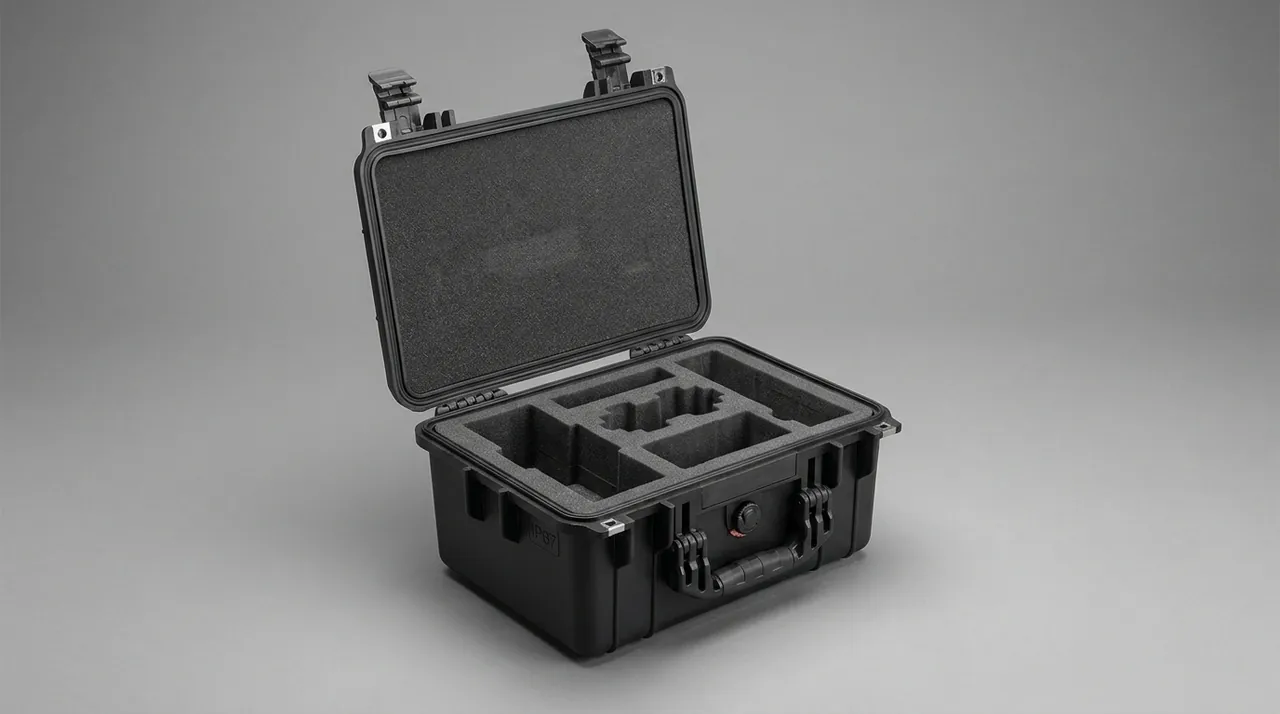
Expansion mechanisms, pneumatic ports and sensor harnesses are protruding and fragile, so they need a dedicated protected zone. If the drum carries segments or shoes, lock them in the retracted position before packing so vibration cannot spread them into each other.
Stitching Roller Surface Protection
Most stitching roller damage comes from contact rather than impact. The rubber or polyurethane cover has limited hardness, and direct contact with a hard liner, a metal fastener or another roller can form a mark within a few hours of driving. On the line that mark shows as uneven stitching, trapped air and displaced cord, and it cannot be repaired without re-covering the roller.
Preventing this means controlling contact surface hardness, contact pressure and contact cleanliness. The liner must be softer than the roller surface and must not shed debris; support points must be distributed so unit pressure stays below the creep threshold of the cover; and the interior must be free of loose metal and sharp corners.
| Liner material | Hardness and resilience | Surface protection | Support stiffness | Typical location |
|---|---|---|---|---|
| --- | --- | --- | --- | --- |
| EPE | Soft, moderate resilience | Good | Low | Large-area isolation, ends |
| EVA | Medium, good resilience | Excellent | Medium | Roller cradles, support faces |
| PE | Firm, low resilience | Fair | High | Structural fill, anti-shift |
| IXPE | Fine, closed cell | Excellent | Medium | Precision surfaces |
| Felt / nonwoven | Very soft | Excellent | Very low | Dust and abrasion barrier |
| Silicone pad | Soft, heat resistant | Excellent | Low | High-temperature residue |
EVA and IXPE are preferred for precision roller surfaces: their closed-cell structure resists shedding and their resilience absorbs vibration. EPE suits large-area isolation and end cushioning but should not run against a roller surface over long distances, because its higher friction coefficient can cause rubbing marks.
Contact pressure should be quantified as n greater than or equal to (W x g x k) / (p_allow x A), where W is part mass, k the dynamic factor, p_allow the allowable surface pressure and A the contact area of one point. For an 80 kg roller, 0.05 MPa allowable pressure, 2000 mm2 contact area and a dynamic factor of 2.5, at least 20 equivalent support points are needed. Practical designs add 30 percent redundancy.

Cleanliness matters as much as material. Case walls, liners and fasteners must be free of burrs and chips, metal fasteners should be recessed below the liner, and journals should carry protective sleeves. For precision roller surfaces JUNZHIJIA applies distributed cradling plus full-wrap isolation, with EVA forming the cradles and IXPE covering the rest, so the roller never touches a hard part.
Belt Drums and Servo Components
When one case must hold a belt drum together with servo motors, encoders, gearboxes and tooling, compartmentalization stops being optional. These parts differ widely in mass, stiffness and sensitivity; mixed in one volume they will collide, and a heavy part can crush a light one under vibration.
The first step is a two-axis classification by mass and sensitivity. Heavy precision parts belong near the base and close to the load path; light sensitive parts go to an upper or side compartment behind an independent divider; cables, encoders and sensors get their own cells, away from metal parts.
| Part category | Mass | Sensitivity | Compartment | Isolation |
|---|---|---|---|---|
| --- | --- | --- | --- | --- |
| Belt drum body | Heavy | Medium-high | Base main bay | Hard divider, base cradle |
| Servo motor / gearbox | Medium-heavy | Medium | Base side bay | Dedicated liner cradle |
| Encoder / sensor | Light | Very high | Upper small cell | ESD pad |
| Pneumatic fittings | Light | Medium | Side vertical cell | End caps |
| Gauges / tooling | Medium | High | Dedicated bay | Purpose-made slot |
| Harness / cable chain | Light | Medium | Top soft bay | Spool plus soft wrap |
Dividers should be removable without dismantling the main cradles and should not create a continuous hard load path, or vibration will travel through them into the neighbouring part. Where sealing requirements are high, metal and precision parts should not share a bay, because micro-movement of metal keeps generating debris. Servo components and encoders are a combined electrical and precision package, so confirm the housing rating, whether a connector is exposed and whether the shaft protrudes. JUNZHIJIA recommends an independent anti-static liner bay with a moisture-absorbing module for these parts.
Layout also affects ergonomics. A practical compromise is to arrange bays in assembly order, with parts installed first in the lowest layer, so picking in sequence matches the build process.
Case Materials and Structure
Cases generally follow one of two material routes: engineering plastics or aluminium profiles. Plastic cases are mainly rotomoulded LLDPE, injection-moulded PP or modified ABS, offering corrosion resistance, complex internal geometry and controllable cost. Aluminium cases use frame-and-panel construction with higher stiffness and field disassembly, at higher cost and weight.
| Case process | Material | Stiffness | Weight | Typical use |
|---|---|---|---|---|
| --- | --- | --- | --- | --- |
| Rotomoulding | LLDPE | Medium-high | Medium | Large size, high impact |
| Injection moulding | PP / modified PP | Medium | Low | Volume, standard cavities |
| Injection moulding | ABS | Medium-high | Low | Appearance-driven cases |
| Die casting / profile | Aluminium | High | Medium | High stiffness, serviceable |
| Composite | FRP / carbon fiber | High | Low | Premium, lightweight |
Structural detail determines service life. Ribs should follow the principal load direction, load-bearing faces of base and lid should form a closed loop so stress does not concentrate at corners, and handle and wheel zones need local thickening because they see repeated concentrated load.
| Structural zone | Design point | Common defect | Improvement |
|---|---|---|---|
| --- | --- | --- | --- |
| Side wall | Vertical ribs plus ring | Bulging, creep | Taller ribs, closed ring |
| Base load face | Aligned with cradles | Local collapse | Thicker base, spread load |
| Lid | Recessed ribs, posts | Deflection under stack | More stacking posts |
| Corners | Radius plus gusset | Cracking | Larger radius, inner shell |
| Handle | Local thickening | Fracture | Wider grip, added ribs |
| Wheels | Load beam | Pull-out, uneven wear | Independent beam |
Wall thickness and strength are not linearly related. Increasing thickness raises weight and cycle time for limited gain against local impact. Adding ribs, inner shells and load beams spreads load over a larger area. Engineering plastics turn brittle when cold, so for sea freight or cold regions choose a grade with stable low-temperature impact performance and verify it by low-temperature drop testing. For tire building machine cases JUNZHIJIA combines a thin shell with locally thickened zones and a closed rib network, so the case stays stable through the high-frequency reuse of a line relocation.
Sealing and Pressure Equalization
Sealing needs fall into two categories: keeping external moisture and dust out, and preventing pressure differences from destroying the seal. The first relies on gaskets and case fit accuracy, the second on a valve. Neither can be omitted.
The IP rating comparison is the common language for sealing capability, defined by IEC 60529 and GB/T 4208.
| Rating | Dust | Water | Typical fit |
|---|---|---|---|
| --- | --- | --- | --- |
| IP54 | Limited | Splash | Indoor short moves |
| IP55 | Limited | Water jets | General plant transfer |
| IP65 | Dust tight | Water jets | Temporary outdoor storage |
| IP66 | Dust tight | Strong jets | Open-air transport |
| IP67 | Dust tight | Short immersion | Sea freight, high risk |
| IP68 | Dust tight | Continuous immersion | Special subsea use |
For these parts IP65 covers most plant and road scenarios, while IP67 suits export by sea, rainy open storage or wash-down areas. An IP rating describes ingress only, not condensation: a fully sealed case can still condense internally when residual moisture meets a large day-night temperature swing. That is why a pressure equalization valve exists. It keeps the case watertight while letting air exchange slowly, preventing temperature and altitude differences from deforming the gasket or making the lid hard to open.
| Parameter | Recommended | Note |
|---|---|---|
| --- | --- | --- |
| Cracking pressure | 1.5 to 5 kPa | Too low leaks, too high is hard to open |
| Airflow | Matched to case volume | Larger cases need more |
| Water rating | Not below the case IP | Otherwise it becomes the weak point |
| Mounting position | Upper side wall | Away from pooling and impact |
| Membrane | Expanded PTFE | Breathes air, blocks water |
Silicone gaskets handle wide temperature ranges, EPDM resists weathering for long outdoor service, and polyurethane wears well but ages faster outdoors. Compression is normally held between 25 and 35 percent; too little leaks, too much accelerates ageing and raises opening resistance.
Cushioning Systems: EPE, EVA, PE and IXPE
Cushioning is the most underrated yet decisive part of a case. Its job is to cut transport shock and vibration energy down to what the part can survive, without adding contamination or distortion. Selection follows part mass, fragility, support area and expected transport conditions.
| Material | Density | Cushioning | Compression set | Main use |
|---|---|---|---|---|
| --- | --- | --- | --- | --- |
| EPE | Low | Tough, good absorption | Medium | Large-area cushioning |
| EVA | Medium-high | Resilient, formable | Low | Formed cradles |
| PE | Medium | Firm, high support | Medium | Structural fill |
| IXPE | Medium | Fine, closed cell | Low | Precision contact |
| PU foam | Medium | Excellent resilience | Low | High-frequency vibration |
| Honeycomb paper | Low | Single-use | Not applicable | One-way export packing |
The logic is staged energy absorption: a stiffer, longer-travel layer outside absorbs large shocks, and a soft layer contacts the part to avoid excessive local pressure. A single thick foam layer looks simple, but under a large shock it compacts quickly and barely recovers.
Cushion thickness can be estimated by the fragility method. If the allowable acceleration is G_allow and the peak transport shock is G_peak, required thickness relates to the dynamic stress-strain curve of the material. Typical starting points are 30 to 50 mm for small precision parts, 50 to 80 mm for medium parts and 80 to 120 mm for heavy drums, corrected by drop and vibration tests.
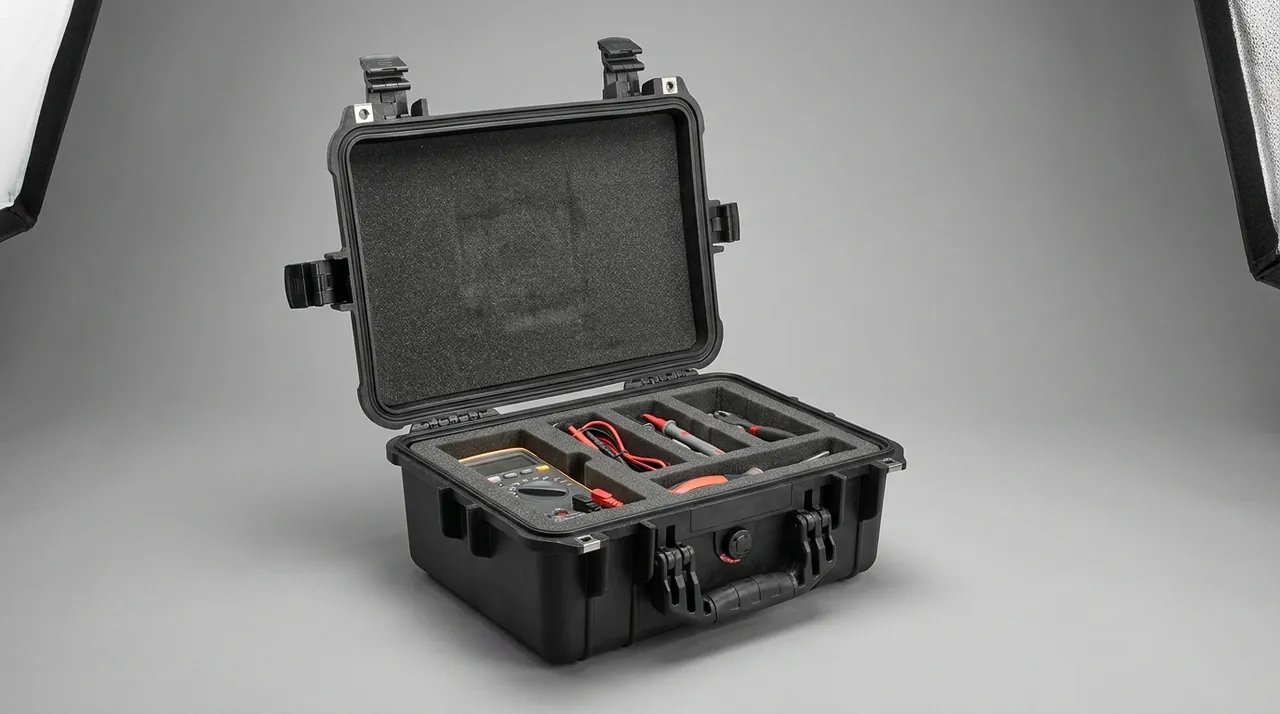
Long-term performance also matters, because foam under continuous load takes compression set and breaks the locating function. Cradle zones should therefore use more resilient EVA or PU with a designed compression margin, and long storage should use replaceable modules. JUNZHIJIA applies a soft-outside, formed-inside staged structure: EPE for energy absorption, EVA for forming, IXPE at the contact layer, so any worn layer can be replaced alone.
Latches, Hinges, and Operator Ergonomics
Latches and hinges are the joints of a case and the first parts to fail. These cases tend to be large and frequently opened, so latches must survive repeated cycles, stacking load and vibration, while hinges must keep the lid aligned.
| Component | Material | Key metric | Failure mode |
|---|---|---|---|
| --- | --- | --- | --- |
| Latch | Nylon with glass fiber | Cycle life, holding force | Fracture, release |
| Hinge | Stainless / reinforced plastic | Open-close life, play | Deformation, noise |
| Gasket | Silicone / EPDM | Compression recovery | Hardening, cracking |
| Handle | Reinforced plastic / aluminium | Static and dynamic load | Fracture |
| Pressure valve | Plastic plus PTFE | Cracking pressure | Blockage, leakage |
Latch cycle life is a selection priority. A latch rated for ten thousand cycles has a real life that depends on load, temperature and how it is operated. Military and industrial latches are cycle and holding-force tested against relevant standards, while ordinary consumer latches lose life quickly in frequent use. Latch operating force should be moderate; too much force makes operators skip latching, leaving a hidden risk. When the lid is heavy, a hinge with a limit or damping feature prevents it from snapping back and pinching fingers. JUNZHIJIA uses modular latches and replaceable hinges, so wear parts are renewed individually rather than scrapping the whole case.
Ergonomics also shows in how a case is moved. Large cases need wheels, handles or forklift openings positioned to match the center of gravity, and very tall cases should be split or fitted with a step. Damping, end stops and self-locking features should aim at reducing misoperation, not chasing extreme numbers.
Stacking Load and Warehouse Fit
Stacking load is the most underestimated condition a case faces. Cases may be stacked two to five high, and the bottom case carries the weight above for a long period while temperature and humidity soften the material. Failure creeps over weeks or months, and by the time it is noticed the liner is already compressed.
| Stacking condition | Load requirement | Structural measure | Check point |
|---|---|---|---|
| --- | --- | --- | --- |
| Warehouse, 3 high | Top load about 2x weight | Posts, thick lid | Strength loss at high temp |
| Warehouse, 5 high | Top load about 4x weight | Ribs, inner support | Long-term creep |
| Container transport | Dynamic load plus vibration | Posts, tie-down points | Cumulative vibration |
| Open storage | Wind and rain load | Drainage, sealing | Pooling and leakage |
| Rack storage | Local support | Aligned load beams | Local crushing |
Stacking posts should align vertically to form a continuous load path; if offset, load concentrates at the middle of the lid and causes deflection. Stack height is also limited by the vehicle and racking, so height limits, weight limits and forklift clearance should be confirmed during design. A damp warehouse raises internal humidity and can corrode parts held for long periods, while rapid temperature change causes condensation. JUNZHIJIA recommends a replaceable moisture-absorbing module for long storage, paired with a pressure equalization valve to form a breathe-and-absorb loop.
Temperature, Humidity, Salt Spray, Corrosion
Metal parts including guiding surfaces, flanges, journals and fasteners corrode easily in hot humid and salt-laden environments. Export by sea, coastal plants and rainy open storage are all high-risk.
Salt spray testing is the common way to assess corrosion resistance, using the neutral salt spray method of GB/T 10125. Test duration and acceptance criteria must follow the surface treatment and transport cycle, not one universal number.
| Surface treatment | Neutral salt spray reference | Suitable environment | Note |
|---|---|---|---|
| --- | --- | --- | --- |
| Plain zinc plating | 24 to 48 h | Dry inland | Low cost, limited protection |
| Blue or yellow zinc | 48 to 96 h | General industry | Yellow zinc slightly better |
| Dacromet | 240 to 480 h | Marine atmosphere | No hydrogen embrittlement |
| Stainless steel | Over 480 h | Severe corrosion | Grade selection matters |
| Anodizing | 240 to 480 h | General aluminium | Film thickness decisive |
| Heavy-duty coating | Over 720 h | Extreme environment | Needs matched primer |
Salt spray hours are a laboratory accelerated result and do not convert simply to real corrosion rates. Coastal corrosion also depends on temperature, humidity, salt deposition, sunlight and wash frequency, so a safety margin should be kept. Moisture control of the case matters too: check whether the material absorbs water, whether the liner can mould and whether the gasket has aged. For long voyages, fit a humidity indicator card and an absorbent module inside, and use vapor corrosion inhibitor material on machined metal faces. On temperature, plastics lose toughness when cold and stiffness when hot, so select grades with both low-temperature impact performance and high-temperature dimensional stability.
Transport Test Validation
Any scheme has to be proven by testing rather than by stacking up parameters. Validation usually covers four families: drop, vibration, stacking and temperature-humidity. Mature standards exist both internationally and domestically, for example the ISTA transport testing procedure.
| Standard system | Test types | Character | Typical use |
|---|---|---|---|
| --- | --- | --- | --- |
| ISTA 1A | Drop, vibration | Basic performance | Package screening |
| ISTA 2A | Drop, vibration, stack | Partial simulation | General transport |
| ISTA 3A | Combined simulation | Full distribution cycle | Parcel delivery |
| GB/T 4857 | Series packaging tests | Domestic general | Domestic logistics |
| ASTM D4169 | Distribution cycle | Graded severity | Export, high risk |
| ASTM D999 | Vibration methods | Method standard | Vibration specific |
Test design should follow the actual route. Road, then sea, then inland delivery means the programme should cover vibration, drop, stacking and thermal cycling; in-plant moves can be simplified. Severity levels should come from part fragility, mass and the logistics provider records, never a default.
| Test item | Key parameters | Pass criterion |
|---|---|---|
| --- | --- | --- |
| Drop | Height, face, count | No damage, accuracy in spec |
| Random vibration | PSD, duration | No loosening, no debris |
| Stacking | Load, temperature, duration | No collapse, no liner set |
| Thermal cycling | Range, humidity, cycles | No condensation, no corrosion |
| Salt spray | Duration, concentration | No visible corrosion |
After testing, functionality and accuracy must be re-checked, not appearance alone. JUNZHIJIA recommends stating test items, severity levels and acceptance criteria in the technical agreement so the definition of a pass is unambiguous at delivery. A test is an approximation of real transport, so packing rules, handling training and shock recorders complete the chain.
Customization, OEM/ODM, and Tooling
Part sizes vary widely and change often, so standard cases rarely cover every need and customization is almost unavoidable.
| Stage | Key input | Key output | Cycle driver |
|---|---|---|---|
| --- | --- | --- | --- |
| Requirement capture | Drawings, mass, accuracy | Design input list | Data completeness |
| Design | Locating, material, sealing | Structure and liner layout | Scheme complexity |
| Prototyping | Sample part, liner, test conditions | Sample case, test report | Number of test items |
| Trial production | Mould, process parameters | Trial cases, records | Mould lead time |
| Volume delivery | Order, packing spec | Batch cases, documents | Order size |
Tooling is the key node. Injection and rotomoulding tools differ widely in cost, precision and life, so the choice should match batch size and product life cycle. Small volumes with many variants suit rotomoulding or profile structures, while a single high-volume product suits injection moulding. Once a tool is cut, later changes are costly, so design review must be rigorous. Under OEM/ODM, ownership of drawings, tooling and liner structures, revision responsibility and cost, and spare part supply cycles should all be agreed in the contract. JUNZHIJIA supports full-scope customization from structure design and liner engineering to logo presentation and accompanying documents.
Accompanying documents are easily overlooked but directly affect acceptance efficiency. A complete set includes a packing list, a part locating drawing, loading and unloading instructions, cushioning replacement guidance, maintenance cycle recommendations and the relevant test reports.
Acceptance and Incoming Inspection
Acceptance is where design intent becomes an executable check, and it should cover appearance, dimensions, structure, sealing, cushioning and documentation.
| Inspection item | Method | Criterion example | Sampling |
|---|---|---|---|
| --- | --- | --- | --- |
| Appearance | Visual | No cracks, no obvious colour variation | Full |
| Dimensions | Tape / CMM | Within drawing tolerance | Sampling |
| Wall thickness | Ultrasonic gauge | Not below design value | Sampling |
| Sealing | Spray / pressure / immersion | Reaches agreed IP level | Sampling |
| Cushioning | Visual, thickness gauge | Intact, thickness on spec | Full |
| Latches and hinges | Function test | Smooth action, holding force | Sampling |
| Stacking | Load test | No collapse, no permanent set | Type test |
| Documentation | Document check | Complete, correct revision | Full |
Incoming inspection should focus on items tied directly to accuracy: the dimensions and position of the locating seat, the thickness and hardness of the liner, and gasket compression. Deviations here are often invisible at the factory but amplify into accuracy drift after several trips. For volume delivery, an AQL sampling plan is recommended with critical, major and minor defect classes defined. Seal failure, cracked locating seats and missing liners are critical or major and should be judged strictly, while slight colour variation may be minor. JUNZHIJIA provides a complete inspection record and accompanying documents at delivery, so incoming inspection can be checked item by item and rework is reduced.
Frequently Asked Questions FAQ
Q: How should the locating method for a building drum case be chosen, and is vertical or horizontal better?
A: The choice follows the geometry of the drum and the accuracy that matters most. If the bottleneck is face runout and flange flatness, vertical flange locating works better, because load travels axially into the base load path and the face is loaded evenly. If the drum has a large length-to-diameter ratio and the journals are the coaxiality datum, horizontal journal locating controls deflection more effectively, since both ends can be supported and aligned together. V-block locating suits drums whose outer diameter is the datum or whose rotation must be limited. Handling also matters, because vertical locating shortens the lifting path but makes the case tall, while horizontal locating lowers the center of gravity and stacks better but needs synchronized support at both ends and a longer load beam. The practical sequence is to define the geometric tolerance to be preserved, work back to the datum and support points, and then verify displacement through transport testing rather than trusting the drawing alone.
Q: What damages a stitching roller surface most, and how should the liner be configured to avoid marking it?
A: A roller surface suffers most from three things: direct contact with hard parts, excessive unit pressure, and rubbing or debris generated under vibration. Liner selection follows the rule that the contact layer must be softer than the roller surface, the support layer must carry the load, and the two functions must stay separate. For the contact layer, IXPE or fine EVA is preferred, because a closed-cell structure resists shedding and presents a smooth surface against the rubber or polyurethane cover. The cradle layer uses formed EVA blocks to spread load, with PU foam where more resilience is needed for high-frequency vibration. EPE suits ends and large-area isolation but should not run against the roller surface over a long distance, since its friction coefficient can cause rubbing marks. The number of support points should be calculated from mass, dynamic factor and allowable surface pressure, with at least thirty percent redundancy, and all metal fasteners inside should be covered or recessed below the liner.
Q: Does a protective case have to reach IP67, or is IP65 enough for a tire plant?
A: Not necessarily; the transport and storage conditions should drive the answer. For in-plant transfer, short-term storage in a covered warehouse and inland road freight, IP65 is usually sufficient, since its dust-tight and water-jet protection handles rain and wash splash without difficulty. For export by sea, rainy open storage, or routes through high-pressure wash-down areas, the short immersion capability of IP67 is more reassuring. Note that an IP rating describes ingress only, not condensation. A case with a very high sealing level can still condense internally if residual moisture is present and the day-night temperature swing is large, which is a real risk in a steel container crossing several climate zones. The usual answer is therefore a combination of a high sealing level, a pressure equalization valve and a desiccant, rather than simply pushing the rating to the maximum. Higher ratings also bring more cost, weight and opening resistance, so a reasonable value that meets the duty is preferable to an inflated one.
Q: Will a pressure equalization valve let moisture into the case, and does it conflict with sealing?
A: No, the two objectives are complementary rather than opposed. A fully sealed case develops a pressure difference as temperature and altitude change, and excessive pressure deforms the gasket locally, makes the lid hard to open and can even damage the sealing structure over time. A pressure equalization valve uses an expanded PTFE membrane to breathe air while blocking water, allowing internal and external pressure to equalize slowly while keeping liquid water and dust outside. At selection, pay attention to cracking pressure, airflow and water protection rating; the membrane rating should not be below the case IP level, or the valve itself becomes the leak point. Mount it on the upper side wall, away from pooling water and impact faces, so it does not sit under a puddle or take a direct hit. For long sea voyages, pair it with a desiccant or moisture-absorbing module, because breathing itself slowly exchanges moisture and the absorbent keeps internal humidity inside a safe band.
Q: How thick should cushioning foam be, and is thicker always safer?
A: Thicker is not always safer. The effectiveness of a cushion layer depends on the dynamic stress-strain behaviour of the material under shock, not on thickness alone. An overly thick soft foam compacts quickly under a large shock, loses its energy-absorbing ability and barely recovers afterwards, while the extra thickness reduces usable volume and raises the center of gravity, which increases tipping risk during handling. Engineering practice is staged cushioning: a stiffer, longer-travel layer outside absorbs large shocks, and a soft layer contacts the part to prevent excessive local pressure. Thickness can be chosen from experience as a starting point, roughly thirty to fifty millimeters for small precision parts, fifty to eighty for medium parts and eighty to one hundred twenty for heavy drums, then corrected by drop and random vibration testing. Long storage also brings compression set into play, so cradle zones should use more resilient materials with a compression margin designed in, and replaceable modules where practical. Thickness alone cannot compensate for poor locating either, so cushioning and locating should be designed together and confirmed against the actual part geometry.
Q: For export by sea, how should metal guiding surfaces and fasteners be protected against corrosion?
A: Sea freight is one of the highest-risk conditions for corrosion and needs both surface treatment and internal environment control. On surface treatment, plain zinc plating offers only limited protection; for a marine atmosphere, Dacromet, stainless steel or heavy-duty coatings are preferable, confirmed by a neutral salt spray test to GB/T 10125. It is worth remembering that salt spray hours are an accelerated result and do not convert simply to real corrosion rates, and coastal conditions are also affected by temperature, humidity, salt deposition and wash frequency, so a safety margin should be kept. For the internal environment, fit a desiccant or replaceable moisture-absorbing module and pair it with a pressure equalization valve to hold humidity steady, and use vapor corrosion inhibitor material on machined metal faces. Before packing, remove chips and moisture thoroughly, since residual oil and fingerprints become corrosion initiation points that show up weeks later in the destination warehouse, far from any chance of quick repair. A final wipe-down in a controlled packing area is an inexpensive step that prevents most of these problems.
Q: Which transport tests are enough, and is passing them a guarantee?
A: The test programme should follow the actual transport route. A full chain of road, sea and inland delivery usually needs to cover random vibration, drop, stacking, thermal cycling and salt spray, while short in-plant transfer can be reduced to vibration and drop. For the standard framework, the ISTA series, GB/T 4857 and ASTM D4169 are common references, and severity levels should be set from part fragility, mass and logistics records rather than a default value copied from a table. More importantly, functionality and accuracy must be re-checked after testing, not appearance alone: drums should have roundness, coaxiality and face runout re-measured, rollers should be inspected for surface marks, and servo parts should pass insulation and function tests. A test is only an approximation of real transport, so packing rules, handling training and shock recorders should be combined into a complete protection chain rather than treated as a substitute for one. Keep the test reports with the case so that repeat shipments can reference the same severity levels and later inspection can be traced back to a known baseline.
Q: What drives tooling lead time and cost for a custom case, and is tooling worthwhile for small volumes?
A: Tooling lead time and cost depend mainly on case size, process route, liner complexity and test requirements. Injection moulds offer high precision and low unit cost but need large upfront investment and are expensive to modify, so they suit a single high-volume product. Rotomoulding tools are comparatively affordable and suit large sizes and many variants at low volume. Profile and aluminium frame structures need no tooling at all and suit prototypes and fast small-batch delivery. Whether tooling is worthwhile depends on annual volume, product life cycle and accuracy requirements. If the product is stable and annual volume is meaningful, tooling amortizes the unit cost and shortens long-run delivery. If the product changes frequently or volume is very small, rotomoulding, profile structures or replaceable liners are preferable. Before committing, ask the supplier for a tooling cost breakdown that separates mould, liner forming and test fixtures, and confirm who owns the tool and how future revisions will be charged.
Conclusion and Related Reading
Accuracy, surface and electrical performance must survive the journey. JUNZHIJIA, manufactured by Kexin New Materials (Guangdong) Co., Ltd., delivers full-scope custom cases, OEM/ODM tooling and accompanying documents for every drum and roller.
Related Reading