

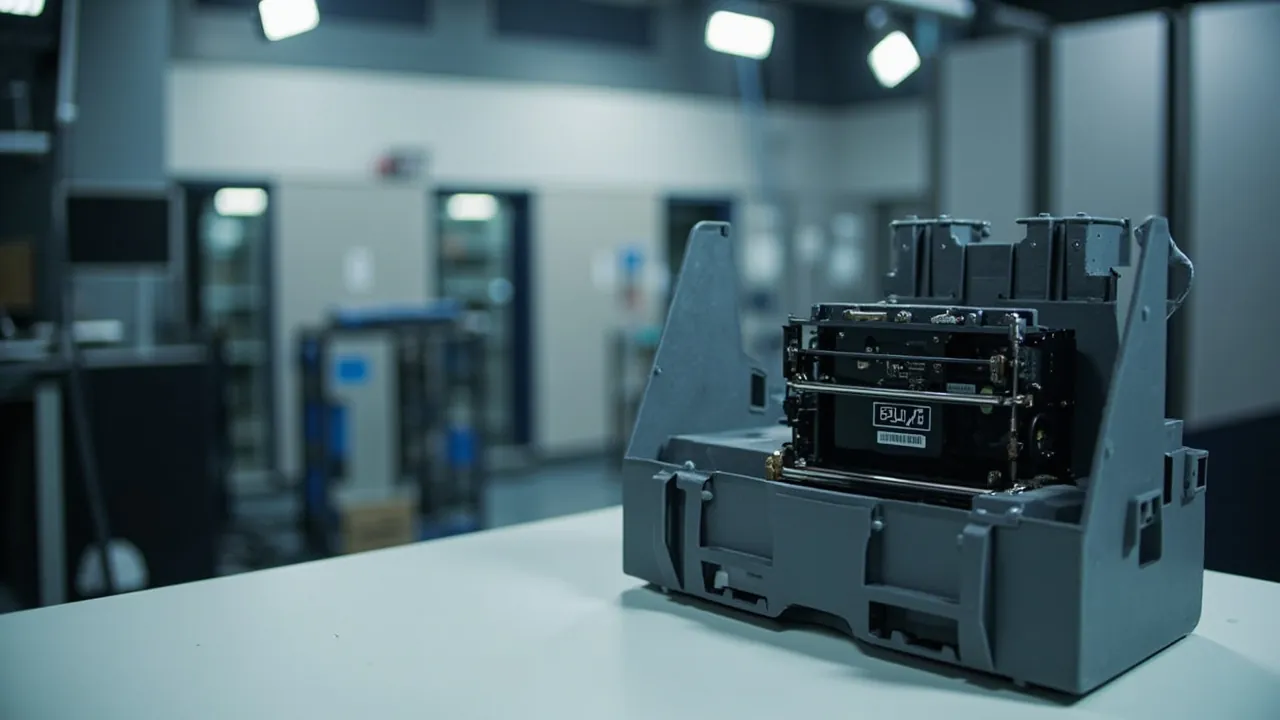
Servo drives and motion controllers are the classic "high value density, low mass, extremely high sensitivity" transport item: they typically account for only 5 to 15 percent of a machine's bill of materials, yet they decide whether the equipment powers up correctly on the first attempt at the customer site. For this class of hardware, a transport case is not packaging consumable - it is an engineered component that controls return rates, delivery schedules and acceptance experience. Across the industry, electronic control units fail in transit for three dominant reasons: sustained vibration and drop shock causing solder-joint fatigue and cracked DC-bus capacitor leads; high humidity and condensation causing terminal-block creepage, PCB surface leakage and corrosion of metal parts; and electrostatic discharge (ESD) destroying I/O chips and encoder interfaces during high-volume handling. None of the three can be solved by wrapping on more bubble film.
This guide is written for industrial automation OEMs, servo brand distributors, system integrators and spare-parts warehouse operators. It breaks transport protection for servo drives, servo motors, motion controllers and commissioning panels into executable engineering items: vulnerability decomposition of the equipment itself, ESD classification, vibration G-level control, moisture management and pressure equalization, IP sealing levels (IEC 60529 / GB/T 4208), enclosure materials and flammability (UL94), transport testing under ISTA and GB/T 4857, acceptance sampling (AQL) and OEM/ODM cost structure. All figures given are typical industry values and empirical ranges; real projects must be confirmed by physical drop and vibration validation.
Contents
- 1. Why servo drives and motion controllers need a dedicated transport case
- 2. Typical equipment list and vulnerability decomposition
- 3. ESD protection: from surface resistivity to packaging classification
- 4. Vibration and shock: the acceleration-sensitive zone of servo electronics
- 5. Moisture, condensation and salt spray
- 6. Enclosure structure and material selection: PP, copolymer and flammability ratings
- 7. Custom foam insert design: from 3D scanning to locating geometry
- 8. Sealing and IP ratings: how to read IEC 60529 and GB/T 4208
- 9. Pressure equalization valves and thermal cycling scenarios
- 10. Latches, hinges, handles and ergonomics
- 11. Transport testing and acceptance: ISTA, GB/T 4857, ASTM D4169, MIL-STD-810H
- 12. Compliance, marking and the dangerous-goods boundary
- 13. Selection checklist and procurement scoring matrix
- 14. Cost, lead time and OEM/ODM collaboration
- Frequently Asked Questions (FAQ)
- Conclusion and Related Reading
1. Why servo drives and motion controllers need a dedicated transport case
Failures of servo electronics are rarely the obvious "it was dropped and broke" type. They are usually latent damage: vibration during transport creates micro-cracks in BGA solder balls, drop shock delaminates the thermal interface between a power module and its heatsink, and DC-bus capacitor leads develop fatigue fractures after repeated flexing. The unit powers up at the receiving dock, passes a self-test, and then two or three months after commissioning produces an intermittent overcurrent alarm or a position deviation. The cost of diagnosing that field failure is far higher than the cost of a proper case.
Along the chain, servo drives and motion controllers pass through at least four transport scenarios, and each has a different load spectrum:
| Transport scenario | Dominant load | Typical risk | Protection focus |
|---|---|---|---|
| --- | --- | --- | --- |
| Factory to machine builder (trunk-road trucking) | Sustained 5 to 200 Hz random vibration | Solder fatigue, connector loosening | Positive location plus cushioning, avoid resonance amplification |
| Spare-parts warehouse to site (multimodal) | Repeated handling, 60 to 90 cm drops | Cracking, terminal-block deformation | Reinforced corners, conforming insert |
| Cross-border sea freight (25 to 45 days) | High humidity, salt spray, container ceiling condensation | Terminal corrosion, PCB leakage | Barrier packaging, desiccant, pressure equalization valve |
| Trade show or customer demo (manual carrying) | One-sided lifting, case tumbling | Panel scratching, display window cracking | Soft facing layer, balanced handles, casters |
The professional procurement test is simple: if a single servo drive costs more than a few hundred US dollars, or if its failure would stop a production line for more than four hours, then equipping it with a reusable case with a custom insert and a proper seal usually pays back within six to twelve months through reduced returns and faster commissioning. The economics of reusable versus single-trip packaging are analysed in portable transport box selection logic.
2. Typical equipment list and vulnerability decomposition
Vulnerabilities differ substantially between servo electronics categories. Before any insert is designed, a "vulnerability decomposition table" must be produced, marking every area that must not be compressed, pulled or sheared.
| Equipment category | Typical mass | Critical vulnerable points | Insert contact strategy |
|---|---|---|---|
| --- | --- | --- | --- |
| Multi-axis servo drive (book or modular type) | 0.8 to 6 kg | Heatsink fins, DC-bus capacitors, terminal block, comms ports | Fins held 3 to 5 mm clear, 8 mm relief on terminal side |
| Single-axis high-power servo drive | 6 to 30 kg | Power module to heatsink interface, fan bracket, handles | Full base support, no point loading |
| Servo motor | 1 to 50 kg | Output shaft, keyway, flange spigot, encoder rear cover | No load on shaft end, flange face seated and centred |
| Motion controller or motion control card | 0.3 to 3 kg | Board-to-board connectors, CFast/eMMC, D-SUB and RJ45 | Full planar support, clearance at mating faces |
| Teaching pendant or commissioning panel | 0.5 to 2 kg | Display, membrane keypad, cable root | Screen against soft liner, cable coiled in its own channel |
| Encoder and linear-scale read head | 0.1 to 1 kg | Glass disc, read-head window | Separate small cavity, never shared with heavy items |
Three hard rules for insert design:
- No rigid clamping. Servo drive housings are usually sheet metal or die-cast aluminium with limited sidewall stiffness; a rigid interference fit transfers force directly into the PCB and terminals. The correct approach is surface contact, controlled soft compression, and deliberate relief.
- No point loading over unsupported areas. Terminal blocks, circular connectors and communications ports must be relieved so that load paths pass through the main housing structure.
- Heavy and light items in separate cavities. If a servo motor (heavy, high inertia) travels in the same case as a motion controller (light, easily crushed), an independent divider is mandatory; otherwise the motor will repeatedly strike the controller under vibration.
The same principle applies when you also ship ultra-clean sensitive items such as wafer transport cases or board-level goods in PCB transport cases: decompose the vulnerabilities first, then discuss materials.
3. ESD protection: from surface resistivity to packaging classification
Servo drives and motion controllers contain CMOS devices, encoder interface chips and high-speed communications PHYs whose human body model (HBM) withstand voltage is often in the 1 to 2 kV range. Repeated friction, tipping the unit out of the case, and peeling liner material away from a housing all generate static charge, so insert materials must be selected by electrostatic classification rather than by appearance.
The industry-standard surface resistivity classification (following the logic of IEC 61340-5-1 and ANSI/ESD S541):
| Material class | Surface resistivity | Purpose | Common materials |
|---|---|---|---|
| --- | --- | --- | --- |
| Conductive | 10^2 to 10^5 ohm | Shielding bags, conductive trays, Faraday-cage structures | Carbon-loaded PE, metallised film |
| Static dissipative | 10^5 to 10^11 ohm | Inserts, handling trays, bench mats | Antistatic EVA, antistatic PE foam |
| Insulative | above 10^11 ohm | Ordinary cushioning, outer enclosure | Standard EVA, standard PE, ABS |
| Temporary antistatic | topical treatment | Single-trip protective film | Antistatic-coated film (limited durability) |
The key conclusion: inserts should be static dissipative, shielding bags should be conductive, and the two are not interchangeable. A common mistake is buying antistatic foam but then transporting the bare drive inside an ordinary PE bag - the friction charging of the PE bag becomes the dominant charge source. The correct combination is: unit inside a shielding bag, or directly in contact with a dissipative insert, then seated in the machined cavity. Where the case itself is designed with a conductive path and reliably bonded to ground, it behaves like a Faraday cage; that design approach is expanded in ESD shielding case construction.
Two additional points that distributors shipping in volume tend to overlook:
- Batch stability of volume resistivity. If the carbon filler in antistatic EVA is unevenly dispersed, surface resistivity can vary by two to three orders of magnitude between batches. Ask the supplier for per-batch surface resistivity records.
- Terminal protection caps. Circular connectors and D-SUB interfaces should receive antistatic caps, which also keep foreign matter out of the pin bores.
4. Vibration and shock: the acceleration-sensitive zone of servo electronics
Transport protection for servo electronics cannot be reduced to "how thick is the foam". Engineering practice requires simultaneous control of three things: peak acceleration (G level), vibration frequency and duration, and whether the natural frequency of the packaging system overlaps the transport excitation spectrum.
Typical empirical ranges (confirm by physical validation):
| Item | Typical requirement | Notes |
|---|---|---|
| --- | --- | --- |
| Allowable peak acceleration | 25 to 40 g short duration | Above this, inspect solder joints and capacitor leads |
| Packaging system natural frequency | Should avoid the 10 to 200 Hz excitation band | Prevent resonance amplification above roughly 3x |
| Drop height by total mass | Under 10 kg: 76 to 90 cm; 10 to 20 kg: 60 to 76 cm; 20 to 40 kg: 45 to 60 cm | Following ISTA and GB/T 4857 logic |
| Insert compression | 15 to 30 percent static compression | Too soft bottoms out, too hard transmits |
| Cushion layer thickness | 20 to 50 mm per side | Scales with mass and drop height |
| Number of drops | 6 to 10 impacts across corners, edges, faces | Corner drops are the most severe |
Cushion material selection directly shapes the G-level curve:
| Material | Density (kg/m3) | Rebound behaviour | Under sustained vibration | Best-fit scenario |
|---|---|---|---|---|
| --- | --- | --- | --- | --- |
| EVA (moulded or CNC-cut) | 38 to 90 | Fast rebound, good set | Low compression set over long use | Preferred for custom inserts |
| PE foam | 25 to 45 | Slow rebound, soft | Collapses after repeated drops | Low-cost cushion layer |
| EPP (expanded polypropylene) | 30 to 60 | Excellent rebound | Strongest against repeated impact | Skeleton filling for heavy cases |
| Polyurethane (PU) | 20 to 60 | Soft and conforming | Moderate fatigue resistance | Conforming layer for odd shapes |
| Air columns or bladders | - | Non-linear | Poor puncture resistance | Single-trip outer packaging |
One underrated fact: sustained vibration is more likely than a single drop to produce a servo drive that works on arrival but fails after installation. Drop damage is usually visible immediately, while micro-cracks from random vibration take time to surface. For high-value multi-axis drives, run at least one 1 to 2 hour vibration test to an ISTA 3A or equivalent road spectrum, then re-measure insulation withstand voltage and terminal torque on the test unit. Related structural approaches are covered in cushion liner case design and sealed shock-resistant case structure.
5. Moisture, condensation and salt spray
The damage humidity does to servo electronics is slow but certain. Inside an ocean container, the day-night temperature swing can exceed 20 degrees C: daytime warmth raises the moisture capacity of the air, and night-time cooling deposits water on metal surfaces. On a drive board without conformal coating, condensation causes terminal-block creepage, optocoupler misbehaviour and, over time, electrochemical migration of copper traces.
Moisture control must be layered:
- Barrier layer. Aluminium foil laminate bag, heat sealed, with a water vapour transmission rate in the region of 0.1 g/(m2 per 24 h). Ordinary PE bags are typically above 5 g/(m2 per 24 h) - an order of magnitude difference.
- Absorption layer. Silica gel (or molecular sieve) sized against the free air volume inside the case. Rule of thumb: 30 to 60 g of silica gel per 30 litres of free volume for a target below 40 percent RH, taking the upper end for 40-day sea freight.
- Indication layer. Include a humidity indicator card or an electronic temperature/humidity logger so the receiver can judge immediately whether limits were exceeded.
- Moisture content of the cushioning. EVA and PE foam have low moisture content, but PU foam absorbs moisture readily; for long sea voyages prefer EVA or EPP, or apply a moisture-barrier treatment to PU surfaces.
Salt spray and corrosion. Coastal and ocean transport can be validated against the salt-spray approach of IEC 60068-2-52. Metal components of the case (hinge pins, latch hardware, caster axles) should be stainless steel 304 or zinc-passivated to avoid pitting that later contaminates the equipment inside.
| Target relative humidity | Application | Suggested desiccant per 30 L free volume |
|---|---|---|
| --- | --- | --- |
| Below 60 percent RH | Domestic trunk routes, short trips | 10 to 20 g |
| Below 40 percent RH | Export sea freight, tropical lanes | 30 to 60 g |
| Below 20 percent RH | Long-term spare-parts storage | 80 to 150 g plus periodic replacement |
| Below 10 percent RH | Highly moisture-sensitive devices | Requires airtight barrier plus molecular sieve |
It must be emphasised that desiccant only works inside a near-airtight case. A case with obvious gaps will equilibrate with ambient humidity within days no matter how much silica gel is added. Moisture strategy and sealing level must therefore be designed together; see IP67 case sealing implementation.
6. Enclosure structure and material selection: PP, copolymer and flammability ratings
The enclosure sets the ceiling on protection performance. Servo electronics cases typically must hold their seal and stiffness across low temperature (-30 degrees C), high temperature (+70 degrees C), ultraviolet exposure, oils and mechanical impact.
| Material | Impact resistance | Low-temperature performance | Achievable flammability | Relative cost | Typical application |
|---|---|---|---|---|---|
| --- | --- | --- | --- | --- | --- |
| Homopolymer PP | Medium | Poor (embrittles) | Requires modification | Low | Single-trip handling |
| Block copolymer PP | High | Good | UL94 HB to V-2 | Medium | Mainstream reusable cases |
| Copolymer PP with glass fibre | Very high | Good | UL94 V-0 depending on formulation | Medium-high | Heavy-duty, large cases |
| ABS | High | Medium | UL94 HB | Medium-high | Cosmetic parts, panels |
| PC | Very high | Good | UL94 V-2 and above | High | Premium small cases |
| HDPE / LLDPE (blow moulded) | High (tough) | Good | UL94 HB | Medium | Large blow-moulded cases |
UL94 flammability is one item procurement frequently misses. For drives with internal batteries, commissioning carts with power modules, or equipment that will fly, the customer or carrier may require the case material to reach UL94 V-2 or even V-0. Two cautions: UL94 evaluates material test specimens, not finished cases; and flame-retardant modification sacrifices some impact performance, so the formulation must be balanced. Ask for a material-level UL94 report (yellow card or equivalent) rather than a verbal assurance that "our material is flame retardant".
Four critical structural details:
- Wall thickness and ribs. Mainstream cases run 2.5 to 5 mm wall thickness; large cases need sidewall ribs or a double-wall structure, otherwise the sidewall bulges under stacking and displaces the seal.
- Parting line and corners. Injection-moulded cases usually part at mid-height; corners are stress concentrations and need thickening or generous radii.
- Stacking load. State the static stacking load explicitly (for example, "bottom case supports three fully loaded cases of the same size"), because it drives both warehouse planning and container fill efficiency.
- Drainage and venting. Do not put a permanently open drain hole in an electronics case; controlled venting should be handled by the pressure equalization valve.
Material compatibility with seal compounds is covered further in case seal material selection and plastic protective case construction.
7. Custom foam insert design: from 3D scanning to locating geometry
For servo electronics, the insert contributes more to overall protection than the enclosure itself. Standard "pick-and-pluck" foam is acceptable only for emergencies; it cannot support long-term reusable service.
A disciplined custom insert development flow has six steps:
- Physical or CAD capture. Prefer the manufacturer's STEP model; if unavailable, 3D scan the physical unit and model with 3 to 5 mm allowance for housing tolerance, cables and protective caps.
- Vulnerability marking. On the model, mark no-compression zones (heatsink fins, display, terminal face), must-stay-clear zones (fan intakes) and must-be-located zones (flange spigot, mounting holes).
- Layer structure. The common stack is base support layer plus locating layer plus top compression layer, 40 to 120 mm total. Heavy items get a double base.
- Finger clearance and assembly tolerance. Finger notches 25 to 35 mm wide and 20 to 30 mm deep; 1 to 2 mm clearance per side against the equipment, plus 3 to 5 mm relief zones.
- CNC carving or mould sampling. Small batches usually use CNC carving, which needs no tooling and is easy to revise; large batches move to compression moulding for consistency and lower unit cost.
- Physical fit validation. After loading, perform tip-over and lift tests to confirm the equipment does not shift or strike anything after the case is rolled through a full rotation at 1 m.
| Insert process | Suitable batch size | Unit cost | Revision flexibility | Consistency | Notes |
|---|---|---|---|---|---|
| --- | --- | --- | --- | --- | --- |
| CNC-carved EVA | 1 to 500 | Medium | Very high | Medium | First choice for sampling, no tooling |
| Compression-moulded EVA | Above 1000 | Low | Low | High | Requires aluminium or steel tool |
| Multi-layer laminated | Any | Medium-high | High | Medium | Suits deep cavities and odd shapes |
| Thermoformed tray | Above 5000 | Very low | Low | High | Suits flat, light components |
On servo and motion controller projects, JUNZHJIA typically develops inserts from customer STEP models or scanned physical units, supports both CNC-carved and moulded EVA routes, and can supply surface resistivity and density records for the insert material so that procurement verifies dimensions and electrostatic performance in the same first-article review. If you are comparing insert options, start with the custom foam inserts guide and the EVA foam insert custom process.
8. Sealing and IP ratings: how to read IEC 60529 and GB/T 4208
IEC 60529, mirrored nationally in China by GB/T 4208, is the international basis for enclosure protection ratings, coded as IPXY: the first digit covers solid particle and dust protection (0 to 6), the second covers water (0 to 9K).
For servo electronics cases, the differences between neighbouring ratings matter:
| Rating | Dust | Water meaning | Transport fit |
|---|---|---|---|
| --- | --- | --- | --- |
| IP54 | 5 (dust protected) | Splashing water from any direction, no harmful effect | Indoor handling |
| IP65 | 6 (dust tight) | 6.3 mm nozzle jet from any direction | Outdoor short exposure, rainy docks |
| IP66 | 6 | 12.5 mm nozzle, powerful jets | Washdown environments |
| IP67 | 6 | Temporary immersion, 1 m for 30 minutes | Sea freight, flooding risk |
| IP68 | 6 | Immersion conditions agreed between supplier and buyer | Requires explicit parameters |
| IP69K | 6 | High-temperature, high-pressure jet (typically 80 degrees C, 80 to 100 bar) | Food and cleaning industries |
Three misconceptions that must be corrected:
- IP67 and IP68 are not equivalent. IP68 immersion depth and duration are not fixed by the standard; they must be agreed between buyer and supplier, otherwise the marking has almost no contractual force.
- Dust and water are tested separately. Passing IP6X does not imply passing IPX7, or the reverse. Request test records addressing the first and second digits separately.
- Seal performance decays over time. EPDM and silicone gaskets age under ultraviolet, ozone, oils and repeated compression; replacement is usually assessed at three to five years, depending on service frequency and storage conditions - see protective case service life and maintenance.
Common seal failure points are insufficient flatness on the case-to-lid mating face, mismatch between the gasket groove cross-section and the gasket, causing over or under compression, and uneven clamping force between the hinge side and the latch side. These are structural problems that cannot be solved by fitting a harder gasket. Details are in waterproof case IP implementation and case hinge, latch and seal structure.
9. Pressure equalization valves and thermal cycling scenarios
Once a case reaches IP65 or better, a side effect appears immediately: the internal air is sealed in, and any temperature change converts directly into a pressure differential.
A typical scenario: the unit is packed in a 25 degrees C workshop, travels on a trailer deck baking at 60 degrees C, and arrives at a warehouse at minus 10 degrees C. With 30 litres of free air and a 70 K swing, the theoretical differential can reach the order of 20 kPa. Consequences include:
- the case is hard to open, or the lid springs up and latches fly off;
- the gasket is pumped out of its groove under repeated differentials and takes a permanent set;
- each pressure cycle exchanges a small amount of gas, drawing moisture in repeatedly and exhausting the desiccant;
- inside a barrier bag, the differential presses the film against the equipment and can rupture it.
The solution is a pressure equalization (breather) valve, whose core is a hydrophobic and oleophobic ePTFE membrane: gas passes slowly, liquid water and dust do not. Selection and validation points:
| Parameter | Suggested value or concern | Notes |
|---|---|---|
| --- | --- | --- |
| Air flow rate | Matched to case volume | Large cases need a higher-flow valve or two valves |
| Opening and closing differential | Lower is more responsive | Typically a few kPa |
| Water protection contribution | Valve body itself should exceed IP67 | Otherwise it becomes the weakest point |
| Membrane temperature range | -40 to +125 degrees C common | Covers sea and air freight |
| Mounting position | High on a sidewall, out of direct water impact | Also keep clear of the equipment |
Note that a sealed case without a breather valve has usually lost its IP67 claim after a single inter-climatic shipment. Valve construction, mounting and validation are described in case pressure equalization valve design.
10. Latches, hinges, handles and ergonomics
Servo electronics cases are often opened on site by a single service engineer, so poor ergonomics will ultimately defeat good protection design.
Latch selection.
| Latch type | Resistance to accidental opening | Opening speed | Cost | Best fit |
|---|---|---|---|---|
| --- | --- | --- | --- | --- |
| Single spring latch | Medium | Fast | Low | Routine handling |
| Double spring latch | High | Fast | Medium | Large cases, resists sidewall bulge |
| Cam lock with key | High | Medium | Medium-high | Spare-parts stores, high-value equipment |
| Slide bolt with padlock eye | Very high | Slow | Medium | Cross-border freight, third-party logistics |
| Numbered seal (single use) | High, traceable | Slow | Low | Tamper evidence, customs inspection |
Hinges and lid support. Metal-pin hinges outperform all-plastic hinges, particularly in cold climates; large lids benefit from a limit strap or gas strut so the lid cannot fall back and topple the case. The hinge area is the weak transition for sealing; confirm the gasket is continuous with no break there.
Handles and casters. Above 15 kg, plan on dual handles plus casters and an extendable handle. Caster selection depends on the surface: hard nylon wheels suit smooth docks, while rubber-tyred wheels last longer on rough ground. The handle assembly should be checked for a fully loaded case subjected to sideways force.
Marking. Affix the following to the outside: equipment model and serial number, contents list, gross weight and external dimensions for freight billing, handling icons (keep dry, this way up, do not step), plus the case's own IP rating and stack limit. For repair loops, add a dedicated return-trip identifier and a recess for travelling documents so paperwork does not get lost.
See also case lock customisation options and case wheels and trolley handle design.
11. Transport testing and acceptance: ISTA, GB/T 4857, ASTM D4169, MIL-STD-810H
The protective capability of a case must ultimately be demonstrated by test, not asserted by a supplier. At minimum, procurement should specify which standard, which test items, and to what level.
| Standard | Nature | Content | Meaning for servo electronics cases |
|---|---|---|---|
| --- | --- | --- | --- |
| ISTA Series 1 | Non-simulation performance test | Drop, vibration, compression basics | Basic screening for new designs |
| ISTA Series 2 | Partial simulation | Drop plus vibration plus compression | Common for single-parcel shipment |
| ISTA Series 3 | General simulation | Tailored to package format and route | Closest to cross-border courier and multimodal |
| GB/T 4857 series | National transport package tests | Stacking, vibration, impact, drop as separate items | Common for domestic projects and customer acceptance |
| ASTM D4169 | Distribution cycle performance test | Test sequence per distribution cycle | When full distribution-cycle evidence is required |
| MIL-STD-810H | Environmental test methods | Vibration, shock, temperature-humidity, salt fog methodology | Borrow quantitative methods and levels; not a military certification |
| IEC 60068-2-52 | Salt spray test | Corrosion environment validation | Sea freight and coastal scenarios |
| IEC 60529 / GB/T 4208 | Enclosure protection | IP test methods and criteria | Shared language for sealing performance |
Wording on MIL-STD-810H must be rigorous. It is a set of environmental test methods; a manufacturer may reference its methods (for example Method 514 vibration, Method 516 shock, Method 507 humidity) to structure a validation programme, but referencing a method does not confer military certification or equipment qualification. External documents should state "tested following MIL-STD-810H methods; not a military certification" to avoid compliance exposure.
A recommended staged validation path:
- Design freeze (sample case): loaded corner, edge and face drops at heights set by mass, plus 1 to 2 hours of random vibration and 24 hours of static stacking; afterwards inspect for cracks, gasket displacement and insert compression set, and power up the sample unit inside.
- Design validation: full ISTA 3A or ASTM D4169 sequence, with the focus on whether the equipment inside still meets its factory specification, not merely whether the box survived.
- Production: first-article confirmation per batch plus key dimension and gasket hardness sampling, combined with an AQL sampling plan.
For servo drives and motion controllers, the post-test re-measurements typically include insulation resistance, terminal torque, connector mating force, encoder zero position and appearance (heatsink deformation, display cracking). Test details are covered in ISTA transport testing procedures, GB/T 4857 transport packaging testing, ASTM D4169 distribution cycle testing and MIL-STD-810H compliance interpretation.
12. Compliance, marking and the dangerous-goods boundary
Servo drives and motion controllers are generally not dangerous goods, but three boundaries must be stated clearly:
- Drives or commissioning terminals containing lithium batteries. If the equipment inside the case contains lithium-ion cells (for example a motion controller with a backup battery, or a wireless teaching pendant), the package may fall under UN38.3 and lithium battery transport rules, with associated packing instruction and state-of-charge requirements. Sea, air and road dangerous-goods regulations (ADR, IMDG, IATA) differ substantially and must be confirmed per transport mode; see hazmat-compliant transport cases.
- Wood packaging and ISPM 15. If wooden pallets or crates are used for reinforcement, exports require ISPM 15 heat treatment or fumigation with the appropriate mark. In most cases a reusable plastic case removes this step entirely.
- Material compliance. Exports to the EU require attention to RoHS and REACH, covering the enclosure, the insert and labelling adhesives. Ask suppliers for material declarations in the contract.
Suggested marking list: case model and serial number, IP rating, stack limit, gross weight and external dimensions, equipment name and quantity, handling icons, desiccant replacement date, and a notice that the case is a reusable transport container and must not be discarded. For repair logistics, add a peelable label to simplify recovery and reuse.
13. Selection checklist and procurement scoring matrix
Compressing the technical items above into a scoring matrix you can carry into supplier negotiations substantially reduces the risk of choosing a case by feel. Adjust the weights to suit the project.
| Scoring dimension | Suggested weight | What to assess | Typical deductions |
|---|---|---|---|
| --- | --- | --- | --- |
| Insert-to-equipment fit | 25 percent | Vulnerability decomposition, relief design, finger notches | Generic pick-and-pluck foam |
| Sealing and IP performance | 20 percent | IP67 with itemised test records, gasket material | "Waterproof" with no data |
| Shock and cushioning design | 15 percent | Material density, thickness, G-level target, drop validation | Wall thickness quoted without insert design |
| ESD performance | 10 percent | Insert surface resistivity, batch consistency | No resistivity records |
| Structure and durability | 10 percent | Hinges, latches, wall thickness, stack load | Plastic hinges, thin walls |
| Ergonomics and marking | 8 percent | Handles, casters, label areas, lid support | No handle, no marking areas |
| Compliance documentation | 7 percent | UL94, RoHS/REACH, test reports | Missing or delayed documents |
| Delivery and after-sales | 5 percent | Lead time, spare parts such as gaskets and inserts | Spares not sold separately |
Three fast field checks:
- Load the equipment, drop the case from 1 m onto a corner, then open it and check whether the unit moved and whether the insert tore.
- Close the lid and check that the latch area carries load evenly and that the gasket is not extruded locally.
- Hold the case at 60 degrees C for four hours, then open it immediately and feel for a pronounced vacuum - if present, the case lacks a pressure equalization valve.
Supplier evaluation and sourcing process are covered in how to choose a case OEM factory and identifying genuine versus counterfeit cases.
14. Cost, lead time and OEM/ODM collaboration
The cost structure of a servo electronics case resembles most injection-moulded products: tooling amortisation plus material plus labour plus insert cost, with inserts and validation frequently underestimated.
| Cost item | Drivers | Reduction levers |
|---|---|---|
| --- | --- | --- |
| Case tooling | Size, structural complexity, cavity count | Use a standard case size plus custom insert |
| Insert processing | Process (CNC or moulded), layers, material density | Move to moulding at higher volumes |
| Test validation | Number of test items, number of samples | Screen with a single case before full validation |
| Packaging accessories | Desiccant, indicator cards, seals, labels | Standardise procurement |
| Logistics | External dimensions and stacking efficiency | Optimise outline to raise container fill rate |
Lead time is usually set by three things: insert sampling and approval (often the longest), tooling fabrication, and test scheduling. Put all three on the project schedule with agreed gates.
OEM/ODM collaboration points:
- Ownership of drawings and data. Clarify ownership and confidentiality for insert models, case drawings and trademark printing.
- Scope of inspection documents. First-article dimension report, material declaration including UL94 and RoHS/REACH, seal performance and drop test records, ESD performance records.
- Spare-part availability. Gaskets, inserts, latches and casters should be orderable separately so the whole case need not be scrapped.
- Capacity flexibility. Confirm peak-season capacity and minimum order quantity to avoid delivery interruption.
JUNZHJIA, manufactured by Kexin New Materials (Guangdong) Co., Ltd., supplies wholesale, distribution and OEM/ODM customers, and can build inserts and seal sets matched to specific servo drive and motion controller models, along with custom screen printing, label areas and seal schemes. For the economics of tooling and amortisation see custom case mould cost analysis, and for batch acceptance sampling see custom case AQL acceptance.
Frequently Asked Questions (FAQ)
Q: Can I ship a servo drive in bubble wrap and a heavy-duty carton? A: For a short, single trip with non-critical hardware, yes. For a servo drive, which combines high value density with board-level fragility, conventional packaging has three clear weaknesses. First, bubble film performance varies with temperature and time, it becomes brittle in the cold, and it has no ability to hold shape, so the unit migrates inside the carton under vibration and eventually strikes the wall. Second, a carton that absorbs moisture can lose more than half of its compression strength, so stacking collapses. Third, there is no sealing and no moisture control, so condensation risk is high on sea freight or during rainy season. The practical rule is: if a drive costs more than a few hundred US dollars, or a field replacement takes more than four hours, or the route includes sea freight or multimodal transfer, use a reusable case with a custom insert. The payoff is reduced returns and a better delivery experience, not a smaller packaging line item.
Q: What surface resistivity should an antistatic insert have? A: Following the classification logic of IEC 61340-5-1 and ANSI/ESD S541, inserts in direct contact with equipment should be static dissipative, with surface resistivity between 10^5 and 10^11 ohm; engineering practice commonly targets 10^6 to 10^9 ohm, balancing discharge speed against safety. Three cautions apply. First, resistivity is strongly humidity dependent, so acceptance should specify test humidity, commonly 12 percent RH and 50 percent RH. Second, batch consistency matters because the dispersion of carbon filler drives stability. Third, an insert cannot replace a shielding bag - bare terminals and interfaces still warrant a shielding bag or protective caps. JUNZHJIA can provide insert surface resistivity records on request so that dimensions and electrostatic performance are verified in the same first-article review.
Q: For shipping servo drives, should I choose IP65 or IP67? A: It depends on whether the route carries a risk of immersion or sustained powerful water jets. IP65 resists water jets from any direction, which is enough for rainy dock handling and brief exposure in washdown areas. IP67 requires no harmful ingress during 1 m immersion for 30 minutes, which suits sea freight, open storage yards and any scenario with standing water. Note that an IP rating describes the enclosure only; it does not mean the interior humidity is controlled. Even in an IP67 case, humidity rises gradually through opening cycles and breathing unless desiccant and a barrier bag are used. The correct combination is an IP67 case plus a pressure equalization valve plus a barrier bag plus desiccant plus a humidity indicator card. If a customer or carrier cites IP68, specify the immersion depth and duration, otherwise the claim cannot be verified.
Q: Is thicker foam always better for vibration protection? A: No. Cushioning works by extending the deceleration distance and keeping peak acceleration below the equipment limit; thickness is only one variable. If the foam is too soft, the equipment compresses it fully on impact and bottoms out, at which point peak acceleration rises sharply. If the foam is too hard, it barely compresses and shock transmits directly to the equipment. The correct method is to fix a target G level - typically 25 to 40 g for servo electronics - along with drop height and equipment mass, then select density and thickness and confirm by drop testing. Also consider the natural frequency of the packaging system: if the combination of insert and case lands inside the 10 to 200 Hz transport excitation band, resonance amplification occurs, which is more dangerous than a single drop. Thickness, density and geometry must therefore be optimised together rather than judged by thickness alone.
Q: Why does a sealed case need a pressure equalization valve? A: Because sealing and temperature change are in unavoidable conflict. Packaging temperature and in-transit temperature can differ by 40 to 70 K, so enclosed air expands when warm and contracts when cold, producing differentials from several kPa to tens of kPa. There are four consequences: the lid may spring open or be very hard to open, creating an injury risk; the gasket is pumped out of its groove and takes a permanent set; each pressure cycle exchanges a small volume of gas, continuously pumping moisture in and exhausting the desiccant; and inside a barrier bag, the differential presses the film against the equipment and may rupture it. A pressure equalization valve uses a hydrophobic and oleophobic microporous membrane so gas passes slowly while liquid water and dust cannot, removing the differential without sacrificing the IP rating. Confirm that the valve body itself reaches IP67 or better, that flow matches case volume, and that it is mounted high on a sidewall away from direct water impact.
Q: Which transport tests should a servo drive case undergo, and how far should they go? A: Use three stages. At design freeze, perform loaded corner, edge and face drops with heights set by total mass - commonly 76 to 90 cm below 10 kg, 60 to 76 cm for 10 to 20 kg, and 45 to 60 cm for 20 to 40 kg - followed by 1 to 2 hours of random vibration and 24 hours of static stacking; afterwards inspect for cracks, gasket displacement and insert compression set. At design validation, run the full ISTA 3A or ASTM D4169 sequence, with the focus on whether the equipment still meets its factory specification, including insulation resistance, terminal torque, connector mating force and encoder zero position. In production, combine first-article confirmation with sampling of key dimensions, gasket hardness and insert surface resistivity under an AQL plan. If a customer requires MIL-STD-810H, its vibration and shock methods may be followed, but documentation must state that testing follows the methods and is not a military certification.
Q: Should the insert be EVA or PE foam? A: For a reusable servo electronics case, EVA is usually the better choice because of low compression set, stable rebound, suitability for fine carving and conforming to odd geometry, and the ability to tune surface resistivity through formulation. PE foam is cheaper and softer, which suits a secondary cushion layer or low-cost short-trip handling, but it collapses after repeated drops and has poor long-term dimensional stability. EPP offers the strongest repeated-impact performance and suits skeleton filling in heavy cases, but is hard to machine into fine locating features. Polyurethane conforms well for odd shapes, but absorbs moisture more readily, so it needs care on long sea voyages. Real projects often use a hybrid: an EVA locating layer over an EPP or PE base, combining locating precision with impact margin. Evaluate density - EVA is commonly 38 to 90 kg/m3 - thickness and target G level together.
Q: What extra requirements apply when a servo system or pendant contains a battery? A: Once lithium-ion cells are inside the case, packaging stops being purely a protection question and enters dangerous-goods compliance. Items to confirm include whether the cells meet UN38.3 test requirements; the packing instruction and labelling requirements applicable to the transport mode (road ADR, sea IMDG, air IATA); state-of-charge limits; and whether short-circuit protection is needed, covering terminal insulation, separate cavities and preventing contact with metal parts. In case design, put the battery and the control electronics in separate cavities so the battery cannot press on the control board under vibration, and consider a temperature logger in the battery cavity so an abnormal heat event can be identified on arrival. For cross-border shipments, wood packaging must meet ISPM 15, while a reusable plastic case normally avoids that step. Final compliance conclusions depend on the actual cell specification and carrier requirements.
Q: What lead time and cost should I expect for a custom insert? A: For a servo drive project with a customer STEP model, the typical flow is model confirmation and vulnerability marking in 1 to 3 days, insert design and rendering approval in 2 to 4 days, CNC-carved sample in 3 to 5 days, and physical fit validation in 1 to 2 days, totalling roughly one to two weeks; add 2 to 4 days if 3D scanning is required first. On cost, CNC carving needs no tooling and suits batches of 1 to 500 pieces and repeated revisions; above roughly 1000 pieces, compression moulding cuts unit cost significantly but requires a tool investment. Include test validation, drop and vibration, and accessories such as desiccant, indicator cards and seals in the project budget. Write insert model ownership, the number of permitted revisions and spare-part availability into the purchase agreement to avoid cost disputes when the equipment is revised later.
Conclusion and Related Reading
Transport protection for servo drives and motion controllers is fundamentally a multi-physics co-design problem: electrostatics, vibration, humidity, pressure differential, mechanical strength, ergonomics and compliance documentation. Any missing item eventually surfaces at the customer as a failure or a return. For engineers and buyers, the most effective approach is not to maximise every parameter, but to decompose the equipment's vulnerabilities first and then set the protection level against the actual load spectrum of the route. Short domestic trips allow a leaner specification; cross-border sea freight and long-term spare-parts storage demand disciplined sealing, moisture control and pressure equalization.
A well-designed servo electronics case typically pays back within two to three years through lower return rates, shorter on-site commissioning and reduced spare-part attrition. The hidden benefit - the customer's confidence that equipment works on arrival - often matters more than the direct cost saving. Start the insert, sealing, testing and compliance workstreams in parallel at project kickoff, and keep complete design and validation records so later equipment models can reuse them.
Related Reading