

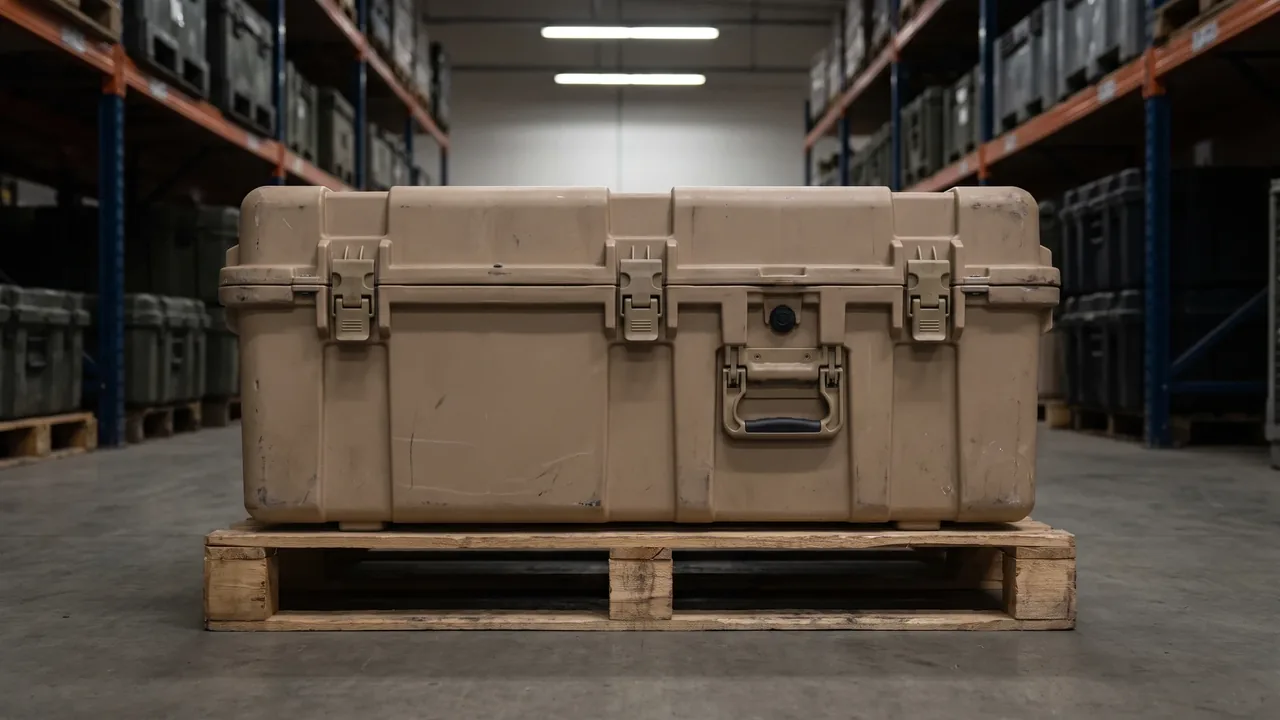
Of every logistics method available to a supply planner, airdrop is the one that pushes packaging closest to its physical limits. Cargo leaves an aircraft, passes through descent, and finally meets the ground at a speed that no human handler could ever reproduce with a manual drop. When buyers evaluate an Airdrop Case, therefore, they should not be judging its appearance or even its ruggedness in the ordinary sense. The real question is how well the container manages energy during the instant of touchdown. As a common form of Air-Deliverable Container, the airdrop case has exactly one core mission: to dissipate the impact energy of landing inside its own cushioning architecture, so that rations, equipment, and supplies arrive in the hands of ground crews in fully serviceable condition.
JUNZHJIA approaches this problem from a packaging manufacturer's perspective, and that perspective changes the design logic completely. An ordinary transit case faces predictable hazards: limited-height handling drops, sustained vehicle vibration, static stacking loads. An airdrop container faces a single, violent, mostly vertical energy event whose magnitude and ground conditions cannot be controlled, while still having to satisfy requirements for stacking, tie-down, waterproofing, rapid opening, and post-mission recovery. This article discusses only the container side of the problem: cushioning structures, restraint systems, shell engineering, and test verification. It does not cover parachute systems or suspension hardware. Where military trade and export scenarios are mentioned, all such transactions remain subject to local regulations and export control requirements; this article discusses packaging containers only.
Why Airdrop Is the Harshest Landing Scenario in Packaging
Breaking an airdrop mission down into working conditions reveals almost every severe condition a packaging engineer must ever plan for. First comes speed: even after deceleration devices have done their work, supplies touch down at a vertical velocity far above what manual handling can produce. Because kinetic energy scales with the square of velocity, the energy that must be absorbed at touchdown is of a completely different order than in warehouse handling. Second, the ground is uncontrollable. The same mission profile may deliver cargo onto soft grassland, frozen soil, loose rock, or a hard paved surface, and the cushioning system must remain effective on the least forgiving of these surfaces. Third, attitude is only partially controlled. A container may strike the ground with some tilt or sway, so the energy absorption must work in several directions rather than being optimized for a single vertical axis.
A fourth factor is often overlooked: the event is singular and brief. The entire energy exchange happens within tens of milliseconds, and afterwards the container must remain structurally intact so that crews can open it, move it, and ideally reuse it. This rules out a purely sacrificial design philosophy. Modern supply doctrine increasingly favors reusable airdrop packaging, which directly shapes material and structural choices. When JUNZHJIA engineers configure a container for airdrop duty, the governing objective is always twofold: absorb the energy of the event, and survive the event in a condition that allows continued service. Every decision that follows, from foam density to lashing geometry, flows from that dual requirement. These constraints also interact, and the interactions are what make the discipline demanding: a cushioning layout optimized for vertical energy may perform poorly against tilt; a shell light enough for the aircraft may lack the thickness its stacking duty requires; a seal tight enough for immersion may slow the opening the ground crew needs. Resolving these tensions one by one, with calculations rather than instincts, is what separates a purpose-built airdrop container from a rugged general-purpose case with an ambitious spec sheet.
Quantifying Landing Impact: Energy, Fragility, and Materials
The first engineering task in specifying an airdrop container is translating touchdown shock into packaging language. The standard translation is the equivalent drop height: the touchdown velocity is converted into the free-fall height that would produce the same impact, which allows a drop tower to reproduce airdrop conditions in a laboratory. For ordinary human handling, the equivalent height typically sits around one meter. Airdrop touchdown conditions correspond to much greater equivalent heights, with exact values depending on the delivery method, platform type, and terrain assumptions; procuring agencies normally state the required value in their technical specification. The designer's job is to take the stated equivalent height together with the payload mass, compute the total energy to be absorbed, and then distribute that absorption across the cushioning system.
The second key parameter is fragility, the acceleration limit the contents themselves can survive. Rations, bedding, and general consumables tolerate relatively high g-levels; precision instruments, electronics, and optics tolerate very little. When a single container carries mixed cargo, the cushioning design must be verified against the most fragile category, because the most common failure mode is not a broken box but a broken item inside an intact box. The third parameter is the energy-absorption behavior of the cushioning material itself. Honeycomb paperboard, closed-cell foams, and elastomeric pads each have an optimal working range, and they only control acceleration effectively when compressed within their designed stroke and strain-rate window. Equivalent drop height, fragility, and material curves: these three quantities are the complete starting point for airdrop cushioning design, and every later decision traces back to them. In practice the calculation is iterative rather than linear. The designer proposes a material and thickness, computes the deceleration the payload would see, compares it against the fragility limit, and adjusts until the margin is adequate on every axis. Temperature derating, aging effects, and manufacturing tolerance all consume part of that margin, so a design that looks correct on nominal data often needs another pass before it is safe to release for testing.
Cushioning Structures: External Pallet Layers and Internal Foam
Cushioning is what separates an airdrop case from an ordinary transport case, and practice has developed two families of solutions. External cushioning places energy-absorbing layers between the container and the platform. The common materials are stacked honeycomb paperboard, molded foam blocks, or corrugated-honeycomb hybrid pads. These crush layer by layer at touchdown, converting impact energy into deformation work. Honeycomb paperboard is popular because its crush behavior is stable and predictable, its thickness can be tuned to the payload, and its cost suits single-mission palletized deliveries. Its weaknesses are equally clear: it is single-use, it loses performance when wet, and a damp landing zone can erode its protection significantly.
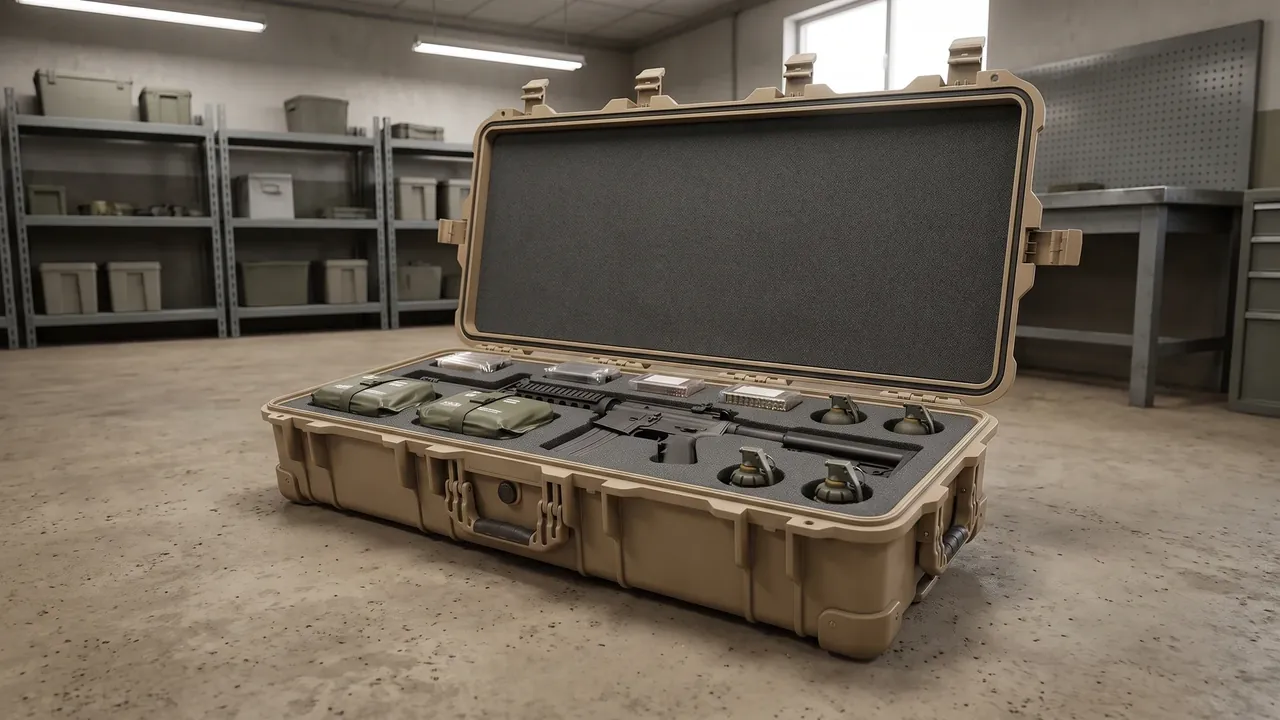
Internal cushioning builds the protection into the container itself: layers of closed-cell foam, polyurethane foam, or EPDM pads are placed between the shell and the interior liner, creating a controlled suspension space around the cargo. This approach suits reusable containers, because the outer layers can be replaced after a mission while the shell structure and seals remain untouched. JUNZHJIA's standard practice on rotomolded bodies is to zone the foam by fragility: thicker, denser padding where the contents are delicate, larger working stroke where they are robust, so that the cushioning map matches the cargo map instead of averaging it. Two further disciplines apply. First, low-temperature performance must be verified, because some foams embrittle at altitude and winter temperatures and lose part of their energy-absorbing capacity; selection decisions made on room-temperature data alone are unsafe. Second, the cushioning path must be kept clear of stacking loads, which is addressed in the next section. One practical note belongs here as well: cushioning materials are specified together with their compression set behavior, because a pad that never fully recovers between missions quietly becomes a different, thinner pad by the second or third drop. Reusable internal systems therefore favor materials with strong recovery characteristics, while single-use external pads can be selected purely for their first-drop energy curve.
Restraint Straps and Suspended Liners: Decoupling Payload from Shell
Cushioning layers absorb energy in the vertical sense, but touchdown loads are three-dimensional. A container may pitch forward or slide sideways as it settles, and the cargo will move relative to the shell under its own inertia. Restraint straps and suspended liners exist to manage exactly this. Restraint straps are high-strength webbing assemblies that secure cargo along the X, Y, and Z axes. Their elongation is a deliberate choice: webbing that is too stiff transmits shock directly into the payload, while webbing that is too soft allows travel and secondary strikes. Sound practice pairs low-elongation webbing with metal hardware, pre-tensioning the load against its cushioning bed so that contact is maintained throughout handling and descent, and no gap exists in which a second impact can develop.
Suspended liners go a step further: the liner hangs inside the shell on elastic connections, so that when the shell receives the impact, the liner and cargo execute a short, controlled displacement that stretches the acceleration pulse and lowers its peak. For very fragile equipment, this decoupling achieves what crushed padding alone cannot, because the suspension provides a longer energy-absorbing stroke. The price is real: more internal volume consumed, more complexity, higher unit cost, and fatigue life that must enter the maintenance schedule. The selection logic is candid rather than complicated. Missions with high-fragility cargo and frequent reuse justify suspended liners. Missions with tolerant cargo and modest budgets are fully served by padding plus restraint straps. Matching the mechanism to the fragility and the mission tempo is the whole discipline. Hardware details repay attention too: buckle styles, edge protection at contact points, and the routing of straps around internal corners all influence whether the restraint system survives repeated missions, because a restraint plan that looks tidy in drawings can fail early if webbing runs unprotected across a sharp interior edge.
Stacking Design: Load Paths on the Airdrop Platform
Airdrop containers almost never travel alone. They are grouped onto platforms and delivered as palletized units, which makes stacking a first-order design problem rather than an afterthought. The upper containers press down through their contact faces onto the lower ones, and at the moment of touchdown the lower container must absorb its own cargo impact while also carrying the inertial load added by the containers above it. The first principle of stacking design is to route stress along the paths that carry it best: corners, columns, and rib reinforcements are the primary load-bearing features, and the stacking interface must positively locate the containers into each other instead of relying on flat-surface friction.
The second principle governs the relationship between contact area and cushioning. Large contact areas handle static loads comfortably, but if the stacking face shares its surface with a cushioning layer, the contact pressure will compromise that layer's energy absorption. Small contact areas need local reinforcement, because HDPE shells creep under sustained load, especially in heat, and creep deformation slowly destroys stacking geometry. JUNZHJIA's airdrop containers therefore carry separate, dedicated stacking faces on top and bottom, structurally independent of the cushioning faces: one set of surfaces manages static load transfer, the other manages impact energy, and neither interferes with the other. Lashing channels and anti-slip texture also belong on the stacking surfaces, so the stack remains stable on the platform, on the truck, and in the marshaling area. Tolerance accumulation deserves mention too: a stack of several containers with even small dimensional variation will load its contact points unevenly, and the design must tolerate the worst container in the stack rather than the average one. For the general methodology behind stacking and pallet planning, the article on case stackability and pallet planning is a useful companion read.
Tie-Down Points and Lashing Interfaces: Joining the Load System
However well a container's cushioning is engineered, the design fails completely if the container has no reliable tie-down points, because on the platform the container becomes part of an integrated lashed system, joined to the deck by straps, wire lashings, or netting. At touchdown the whole system moves together, and the tie-down points are the container's only structural membership in that system. The first requirement is strength margin: each point must be rated for the fully loaded container weight multiplied by an impact factor, because strap tension at touchdown reaches several times the static value. The second requirement is a sound load path: anchor points belong on the shell's primary structure, integrated through metal inserts or thickened zones, so that webbing under shock cannot simply slice through a thin wall.
The third requirement is compatibility. Different forces and different platform systems lash cargo differently, so the anchor layout should accommodate the mainstream geometries: top-ring fittings, bottom hooks, and side webbing slots. JUNZHJIA's export-configured containers use multiple symmetrically arranged lashing rings, each independently rated, so that any combination completes a secure lash and the loss of a single fitting never collapses the stack. Tie-down points also lead a double life: on the ground, the same fittings serve as lifting and towing points, which means lifting-angle load cases must be checked during design to prevent shear failures at unintended angles. A properly engineered Air-Deliverable Container is, in this sense, not cargo that needs protection on the platform. It is the platform's load itself, structurally qualified to be part of the delivery system. Inspection discipline belongs in the same design conversation: anchor points should be visible and reachable so that a pre-mission check can actually be performed, and any fitting whose condition cannot be verified in the field is a fitting the crew must assume is degraded.
Why Rotomolded Shells Suit Airdrop Duty
Rotomolded HDPE dominates the shell material discussion for airdrop containers, and the reasons are structural rather than fashionable. First is seamless monolithic construction: rotational molding produces the shell as one piece, with no welded joints and no riveted seams, which means the impact load has no local weakness to concentrate around. Airdrop shock is precisely the kind of transient, high-magnitude event that turns any stress raiser into a crack initiation site, and a rotomolded shell distributes stress uniformly by its very nature. Second is toughness: HDPE retains useful fracture toughness at low temperature, and with proper wall design it absorbs repeated impacts without carrying excessive weight. Third is design freedom: the process accepts metal inserts molded into the shell, so lashing rings, hinge seats, and latch bases become integral structural features rather than bolted-on accessories that can loosen under shock.
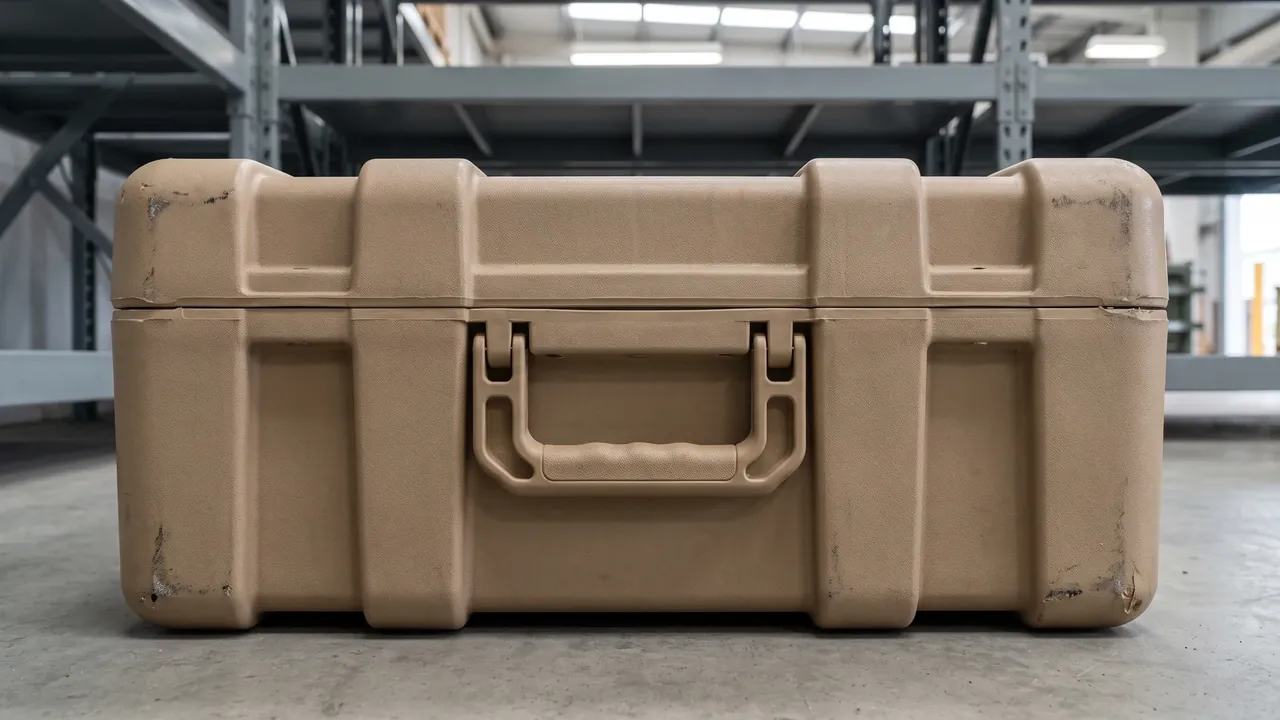
Against timber and steel, the rotomolded shell's weight advantage is magnified in airdrop service, where every kilogram of packaging is a kilogram of payload surrendered; rotomolded construction keeps the packaging fraction low. Against injection molding, the process avoids the cost of very large tools and suits the multi-variant, moderate-volume character of military procurement, while allowing wall thickness to vary by region: thicker where loads concentrate, thinner where they do not. The honest ledger also records weaknesses. Surface hardness is lower than metal, scratch resistance is modest, and long ultraviolet exposure must be countered with UV-stabilized compounds. The correct response is compensation, not denial: replaceable metal corner protectors in wear zones, and material formulations validated for the service climate. Process control completes the picture: wall thickness in rotational molding is set by powder distribution, rotation speed, and oven profile rather than by a tool, so a manufacturer's process discipline shows up directly in the shell's consistency, and buyers evaluating suppliers should weight oven records and thickness audit data accordingly. For a fuller comparison of the processes, see the rotomolded versus injection-molded case article and the rotomolded protective case overview.
Waterproofing and Rapid Opening at the Landing Zone
Landing-zone weather and ground state are outside anyone's control, so the container must carry its own water defense, and this is where an airdrop case visibly diverges from a standard transit case. The governing metric is the IP protection rating: a body built with twin-lip gaskets, latches that compress the seal evenly around the perimeter, and an automatic pressure-equalization valve can reach IP67 and short-duration immersion capability. The pressure valve is a small part with an outsized role. Moving between altitude and ground, or from sun into cold, creates a pressure differential across the shell; without equalization, the gasket is deformed by the differential and weeps, and opening the case becomes a fight against vacuum. Drainage belongs in the same conversation: if water does enter through an open lid or a compromised latch during ground handling, the floor should channel it away from the lowest point of the cargo so that contents do not sit in standing water between the landing zone and the depot.
The other half of the requirement is rapid opening. After touchdown, ground crews need contents in the shortest possible time, sometimes in poor light, wearing gloves, under pressure. Latch hardware must therefore open with one gloved hand, close-and-lock in a single motion, and still resist accidental release under vibration and shock. JUNZHJIA uses wide-body compression latches on stainless hinges, with adjustable latch engagement so that an aging gasket can be re-compressed instead of replaced prematurely. Waterproofing and quick opening are a genuine tension in engineering: the case must seal tightly and yet open immediately. The only meaningful proof is combined cyclic-opening plus water-spray testing, because no single static number demonstrates how the sealing system will behave at a real landing zone. Gasket material selection matters as much as geometry: the compound must resist compression set across the full temperature range, and it should tolerate the ozone and ultraviolet exposure that comes with outdoor storage, because a seal that passes every bench test can still age out of specification within a few seasons if the compound is wrong.
Ground Handling, Recovery, and Reuse Cycles
Touchdown ends the violent part of the mission, not the work of the container. On the ground the case faces manual carries, forklift moves, vehicle transport, and warehouse stacking, conditions gentler than airdrop but far more sustained. Handling design starts with grips and lifting points: a large airdrop container can weigh tens of kilograms empty, so carry handles must accommodate gloved hands, and their positions must balance a two-person lift. Forklift handling requires clear fork channels in the base with entry guides, positioned so that the forks cannot crush the cushioning structure during insertion.
Recovery and reuse have become a growing priority in modern supply doctrine. Single-use timber boxes and honeycomb pallet pads are written off at the landing zone, generating waste and a fresh procurement bill for every mission; a reusable rotomolded container is recovered, cleaned, inspected, and returned to service, and across several cycles the average packaging cost per mission falls substantially. Reusability must be designed in from the first sketch: cushioning built as replaceable modules, so a crushed pad is swapped rather than a case retired; wearing hardware such as latches, hinges, and lashing rings specified as standard parts so that field repairs need only common tools; and designated marking areas on the shell for mission numbers and inspection records that keep the asset traceable. Where the container supports ammunition resupply chains, its footprint should also align with established ammunition transit container dimensions, a point covered further in the ammunition transit case certification article. A quieter benefit follows: stable external geometry allows loading plans to be frozen into standing procedures, removing improvised calculation from every subsequent mission. Training materials close the loop: a container whose features are labeled, whose inspection points are documented, and whose repair procedures fit on a single page will actually be maintained, while an identical container without those supports will drift into undocumented improvisation.
Test Verification: From Drop Towers to System Trials
Whether an airdrop case design is qualified is ultimately a question answered by testing, and the sequence runs in layers. The first laboratory gate is the drop test: the container, loaded with ballast or real cargo, falls freely from the specified equivalent height onto a rigid surface, executing the standardized attitude sequence of flat drops, edge drops, and corner drops, after which both cargo function and container integrity are inspected. The relationship between drop height and payload weight is treated in the dedicated drop-test height by weight article. The second gate is vibration and rebound testing, which simulates the sustained transport phase and exposes latches that loosen, straps that creep, and foam that fatigues. The third gate is environmental testing: high-low temperature cycling, cold brittleness, water spray and immersion, and salt fog, covering the full climatic window the mission may encounter.
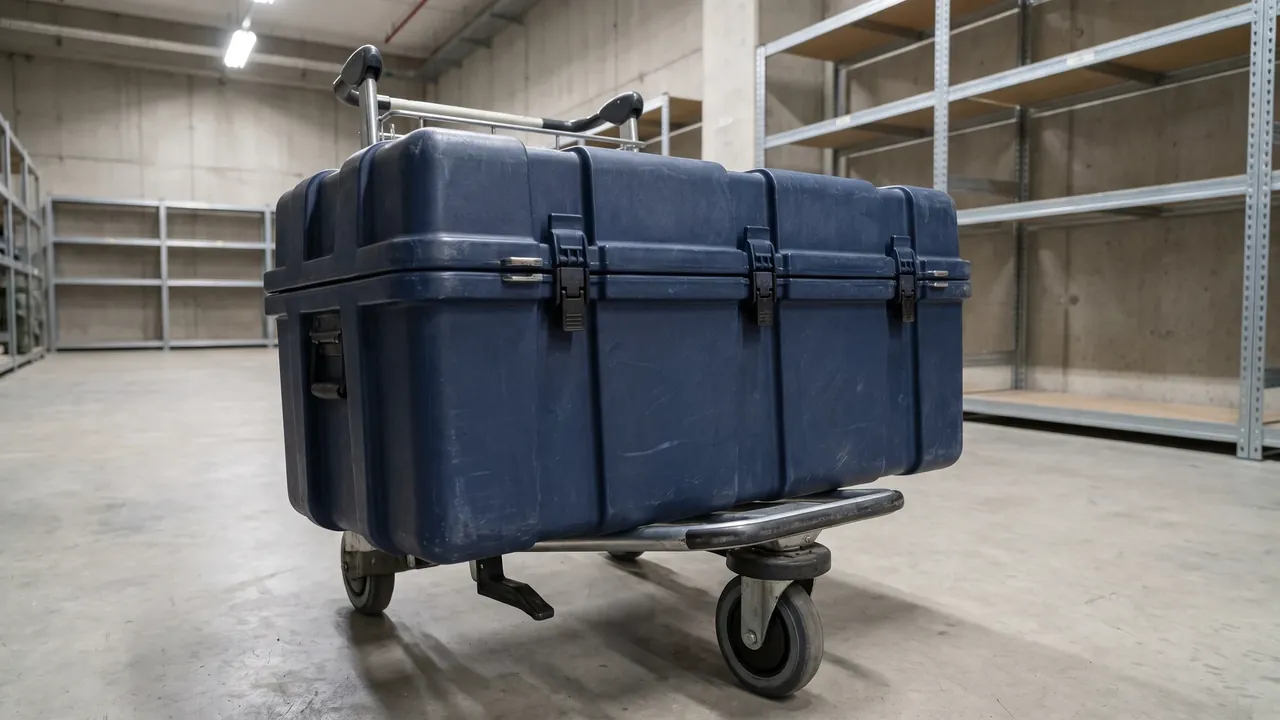
Beyond the laboratory comes system-level verification: the container is lashed to a representative platform, suspended, released, and recovered, and its behavior is inspected under real system constraints. This stage routinely reveals problems no tower test can show, such as webbing fouling against the shell, or cushioning layers loaded off-axis by the true landing attitude. Military and export programs generally add qualification testing to GJB or to the customer's specified military standard, with test items and acceptance criteria fixed in the contract's technical annex. Manufacturers should treat this data as a feedback loop rather than a formality: every recorded peak acceleration and measured deformation calibrates the next cushioning calculation. JUNZHJIA archives test records against each production batch, so every delivered container carries a traceable verification history. For the general framework of military-standard test programs, the GJB military standard case article provides a structured overview. Sample selection for qualification testing deserves care as well: testing a hand-finished prototype rather than a production-line container verifies the design but not the process, and the strongest programs test articles drawn at random from normal production runs. Instrumentation standard matters too: accelerometers must be calibrated, and data channels sampled fast enough to capture the true peak of a millisecond-scale pulse, or the reported numbers will flatter the design.
How Airdrop Cases Differ from Ordinary Transit Cases
A common misconception treats an airdrop case as a transit case made thicker and heavier. In reality the two products are designed against different failure modes. An ordinary transit case faces limited-height handling drops and sustained vibration across many repetitions, and its design objective is long-term environmental protection plus survival of a bounded number of impacts. An airdrop container faces one high-energy touchdown, and its objective is to hold the transmitted acceleration below the cargo's fragility limit while keeping its own structure and function intact. Simply thickening a wall does not buy equivalent energy absorption, because absorption comes from controlled deformation stroke, not from stiffness; over-stiffening transmits more shock into the cargo and achieves the opposite of the intent.
The second difference lies in system interfaces. A transit case answers only to handlers and warehouse racks. An airdrop container must answer to the platform, the lashing system, the aircraft restraint envelope, and the ground recovery chain, and each interface needs verification: anchor layouts, platform footprint compatibility, stacking geometry, lifting suitability. The third difference is traceability and batch discipline. Military procurement imposes depth of documentation, marking, and production consistency that civilian logistics packaging never encounters. Buyers should therefore evaluate suppliers directly against airdrop-grade requirements instead of down-selecting a rugged transit case and hoping it survives. For readers comparing selection logic across product families, the military protective case selection guide and the outdoor case air transport article both provide useful counterpoints to the airdrop-specific criteria described here. The cost comparison follows the same logic: an airdrop-grade container carries a higher unit price, but a mission failure at the landing zone carries a higher price still, and procurement evaluations that weigh the two honestly tend to favor purpose-built packaging over repeated compromises.
A Procurement Checklist for Airdrop Case Selection
For procurement and logistics staff, a structured checklist converts the vague question "is this airdrop case good enough" into a series of verifiable engineering items. Group one is impact protection: does the stated equivalent drop height cover the mission requirement; is the cushioning external, internal, or hybrid; are the cushioning elements replaceable; and are there drop-test reports covering the relevant payload range? Group two is structural interface: how many tie-down points, where are they, what is each point's rated load, and do they fit the buyer's platform and lashing doctrine? Are the stacking faces separate from the cushioning faces? Are lifting points and fork channels present and rated? Group three is environmental protection: which IP rating, what sealing construction, is a pressure-equalization valve fitted, and is there low-temperature test evidence behind the material selection?
Group four covers service and sustainment: can latches be operated quickly with gloves on, are spare cushioning modules and hardware available through a standing channel, and what does the cost-per-mission look like across the reuse cycles? Group five, most easily overlooked, is documentation and compliance: qualification reports, material certificates, batch traceability, and, for cross-border military trade programs, regulatory conformity statements. The same disclaimer applies here as throughout this article: transactions remain subject to local regulations and export control requirements, and this article discusses packaging containers only. A disciplined checklist of this kind reduces airdrop packaging to a dozen checkable engineering questions. JUNZHJIA supplies a complete documentation package with its airdrop projects, including cushioning calculations, test outlines and records, maintenance manuals, and spare-part lists, so that acceptance rests on evidence and the reuse cycles run on procedures rather than improvisation. One further habit separates strong procurement teams: they score candidates against the checklist before negotiations rather than after, because discovering a missing tie-down rating during contract review costs weeks, while discovering it in a comparison table costs nothing.
Closing Perspective: Intact at the Instant of Landing
The essence of airdrop case design is to tame a violent landing event using the language of packaging engineering: cushioning structures to absorb energy, restraints and suspensions to control the cargo, tie-down interfaces to join the delivery system, a rotomolded shell to carry load without weak points, and layered test verification to turn design promises into deliverable evidence. When these elements work together, the instant of touchdown becomes nothing more dramatic than a brief, well-managed energy exchange in a longer logistics chain, and the rations, equipment, and supplies inside arrive in the hands of their users exactly as they left the packing line. For airdrop supply procurement and military logistics organizations alike, choosing a properly engineered airdrop case is the most reliable insurance available for the last meters of the delivery.
Frequently Asked Questions
Q: What is the main difference between an airdrop case and an ordinary military transport case? A: The two products are designed against fundamentally different working conditions and failure logic. An ordinary transport case faces predictable, repetitive hazards: handling drops of limited height, vehicle vibration, and static stacking loads, so its design emphasis is long-term environmental protection and survival across a bounded number of impacts. An airdrop case faces a single high-energy touchdown whose equivalent drop height greatly exceeds manual handling, with ground conditions and landing attitude beyond anyone's control. Consequently the airdrop design carries dedicated engineering in three dimensions: cushioning layers calculated against payload fragility and impact energy, tie-down points rated with impact factors rather than static weight, and stacking faces structurally separated from cushioning faces. Airdrop cases also typically demand higher waterproofing and immediate opening at the landing zone, because the ground environment is uncontrolled and handling time is short. Simply thickening an ordinary transport case does not produce equivalent energy absorption and may transmit more shock into the contents. The correct procurement approach is to assess candidate containers specifically against airdrop-grade technical requirements, rather than substituting a heavier transit case and hoping it performs. A side-by-side comparison table covering equivalent drop height, tie-down rating, IP rating, and stacking duty will expose within minutes whether a proposed case was engineered for airdrop duty or merely ruggedized for general logistics.
Q: Should the cushioning layer be honeycomb paperboard or foam? A: The choice follows mission frequency, reuse requirements, and cost constraints. Honeycomb paperboard offers low cost per unit of absorbed energy, a stable and predictable crush stroke, and thickness that can be tailored to the load, which suits one-way palletized deliveries; its weaknesses are single-use economics and water sensitivity, and performance degrades on damp landing zones. Closed-cell or molded foam layers built inside the container create a reusable cushioning system: when the exterior layers crush, the pads are replaced and the container returns to service, so the cost per mission falls over multiple cycles; the drawbacks are higher initial cost and the need for low-temperature verification, because some foams lose energy-absorbing capacity when cold. JUNZHJIA's usual guidance is straightforward. High-volume, single-mission, budget-sensitive programs suit external honeycomb pallet pads. Recurring equipment deliveries, or cargo with low fragility limits, justify internal foam cushioning with restraint straps. Hybrid schemes are also common and effective, pairing an external honeycomb pallet pad with internal foam liners so that external impact and internal cargo movement are handled by separate, optimized mechanisms. Either way, the pad properties should be validated with drop testing on the finished assembly, not taken from supplier datasheets alone, and the validation should be repeated after environmental conditioning.
Q: Why does a rotomolded shell outperform timber and steel for airdrop use? A: Three reasons dominate. First, structural integrity: rotational molding forms the shell as a seamless single piece, with no welds or rivets to act as stress concentrators, and airdrop shock is exactly the transient high-load event that turns such connection weaknesses into cracks, so the monolithic structure is inherently more impact-reliable. Second, weight efficiency: airdrop missions are acutely weight-sensitive, and rotomolded HDPE delivers good strength-to-weight performance, especially with wall thickness tuned by region, thicker under concentrated loads and thinner elsewhere, which keeps packaging weight low and preserves payload capacity. Third, integration capability: the process accepts molded-in metal inserts for lashing rings, hinge seats, and latch bases, so load-bearing hardware becomes part of the shell rather than an attachment that can loosen under repeated shock. Timber boxes absorb water, attract pests, and vary between batches; steel cases are rigid and durable but heavy and maintenance-hungry. Rotomolded construction closes its remaining gaps through UV-stabilized compounds and replaceable metal corner protectors, holding performance stable across the container's full service life rather than only on delivery day. Across a fleet, the consistency advantage compounds as well: shells from the same tool share geometry closely, which keeps palletized loading plans and lashing procedures valid across the whole inventory.
Q: What goes wrong most often in airdrop tie-down point design? A: Three failures recur. First, inadequate strength verification: designers select fittings against fully loaded static weight and forget that strap tension at touchdown reaches several times the static value, so anchors deform or tear out during the impact they were installed for. Second, poor load paths: an anchor fixed to a thin wall region lets webbing slice the shell under shock; the sound method is to integrate each point through metal inserts or thickened zones into the shell's primary load-bearing structure. Third, neglected compatibility: platform systems and lashing doctrines differ, and an anchor layout fixed to a single geometry produces the frustrating outcome of rings that exist but cannot be lashed in the user's system. JUNZHJIA's export-configured containers use multiple symmetrically arranged lashing rings, each independently rated, with any combination capable of completing a secure lash, and every ring verified for the impact factor plus the lifting-angle load case. Buyers are advised to request load test evidence or engineering calculations for the tie-down points at acceptance, rather than accepting drawing annotations alone, because this single document reveals most design shortfalls before the first mission.
Q: How should the waterproofing rating be interpreted, and how far does it need to go? A: The IP rating has two digits, the first covering solid objects and the second water. For airdrop service the common requirement is IP67, meaning complete dust protection plus the ability to survive short-duration immersion without ingress, because landing zones may be wet ground, shallow water, or rain-soaked terrain and the container may sit there for some time. Altitude-to-ground transitions and sudden cooling after sun exposure create pressure differentials across the shell, which is why a pressure-equalization valve matters: without one, the differential deforms the gasket and causes weeping, and opening the case becomes difficult against vacuum. Buyers should also understand that IP ratings are static laboratory figures, while real airdrops impose shock during which shell deflection can momentarily break the sealing interface. A reliable system therefore combines twin-lip gaskets with latches compressing the seal evenly around the perimeter, validated by combined water-spray and shock testing rather than static immersion alone. Adjustable latch engagement is worth confirming at acceptance, because it lets an aged gasket be re-compressed in service, keeping the waterproofing functional across the container's entire service life. It is also worth asking the supplier which immersion depth and duration the rating reflects, since short-duration immersion tolerances can vary between test houses.
Q: Can the container be reused after airdrop, and what maintenance does reuse require? A: A well-designed rotomolded airdrop case is planned for multiple reuse cycles, but the cycles depend on a post-mission inspection and maintenance routine. Four checks are recommended after every recovery. First, visual inspection of the shell for cracks, deep scratches, and deformation, with particular attention to tie-down points and corners. Second, the cushioning system: external honeycomb pads are scrapped and replaced once crushed, while internal foam pads are checked for permanent compression set and replaced when beyond limit. Third, hardware: latches, hinges, and lashing rings are checked for deformation and looseness, and fastener torque verified. Fourth, sealing: gaskets are inspected for damage and aging, with a water-spray test when condition is in doubt. Maintainability is decided at the design stage, which is why replaceable cushioning modules, standardized hardware, and provisioned inspection space all matter; container layouts that anticipate inspection, with wide openings and reachable fasteners, dramatically lower life-cycle cost and keep turnaround short between missions. Units that run a disciplined inspection regime typically return their rotomolded airdrop containers to service for many cycles, and the average packaging cost per mission declines with each reuse, a decisive economic advantage over single-use timber packaging.
Q: Which tests must an airdrop case pass to prove the design? A: The qualification chain has three layers. The first is laboratory performance testing, led by the drop test: loaded with ballast or real cargo, the container falls from the specified equivalent height onto a rigid surface through the standardized attitude sequence of flat, edge, and corner drops, with acceptance judged on both cargo condition and container integrity. Vibration testing follows, reproducing the transport phase to expose loosening latches, creeping straps, and fatiguing foam. Environmental testing completes the layer: high-low temperature cycling, cold brittleness, water spray and immersion, and salt fog, spanning the mission's climatic window. The second layer is system compatibility testing: the container is lashed to a representative platform, suspended, released, and recovered, revealing interference and off-axis loading problems that no tower test can show. The third layer is documentation: military and export programs complete qualification to GJB or the customer's designated standard, with items and criteria fixed in the contract annex. When reviewing reports, buyers should check three things: whether the ballast simulated the real cargo's center of gravity, whether the attitude sequence was complete, and whether acceptance criteria were quantified, because these determine how much confidence the report deserves.
Q: For cross-border procurement of airdrop cases, what compliance items should be confirmed early? A: Early confirmation is best organized into three categories. The first is regulation and control: cross-border delivery of defense-related items is subject to export control, and licensing paths, end-user documentation, and filing requirements for any specific program remain governed by local regulations and export control requirements; this article discusses packaging containers only, and while packaging containers often carry lower control intensity than the contents in many jurisdictions, the classification judgment belongs to professional compliance staff, so procurement should bring compliance review in at project initiation rather than after contract award. The second is standards systems: national military packaging standards differ in test items, acceptance criteria, and documentation format, and a container entering a foreign procurement catalog may need qualification to the customer's designated standard, whose cycle and cost belong in the project plan from the start. The third is interfaces and sustainment: lashing geometry, pallet modulus, marking language, and spare-part supply must align with the user's existing systems, or delivery produces containers that are compliant yet unusable. JUNZHJIA's practice on trade programs is to deliver a complete technical file with each container and confirm the interface checklist item by item at contract stage, minimizing post-delivery friction.