

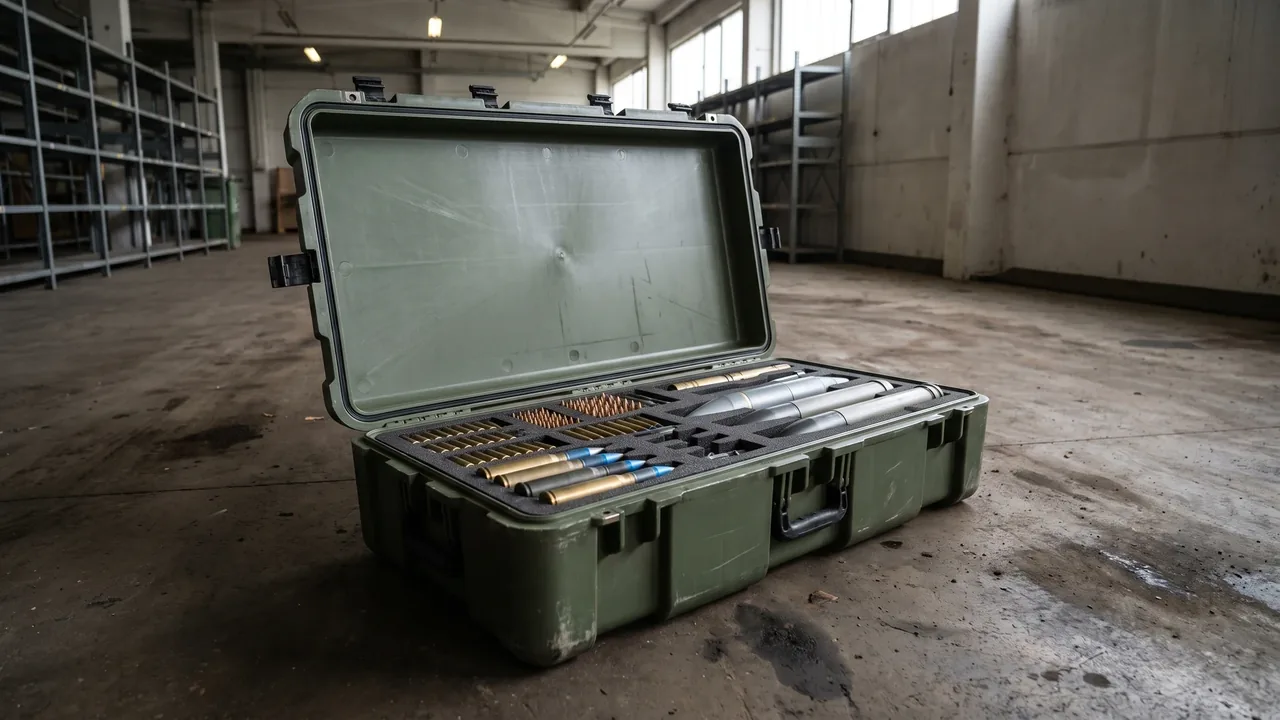
In a multi-stage logistics chain, an Ammunition Transit Case and the ammunition transit box it is often paired with do not exist to store goods for months. Their job is narrower and harder: to carry the same consignment between nodes — from a first-level depot to a second-level store, from a transshipment hub to a last-mile delivery point, from a truck bed to a pallet, from a pallet to a racking bay — so that every handover in that journey stays intact, undamaged and accountable. Seen from the packaging-engineering side at JUNZHIJIA, the transit leg is the most mechanically complex and the least forgiving part of the chain, because it must cushion and restrain the contents on the inside while simultaneously interfacing with lifting gear, forklifts, pallets and shipping containers on the outside. This article treats transit as a standalone engineering scenario and gives procurement teams in ammunition logistics contracting and defence trade a set of criteria they can write straight into a technical agreement.
Transit deserves its own treatment because it fails differently from storage and from over-the-road haulage. Storage is governed by long-term static load, creep and seal ageing. Line-haul transport is governed by sustained vibration and stacking compression. Transit is governed by a different mix: repeated short-duration impacts, frequent opening and closing for verification, repeated lifting and forklift handling, and abrupt temperature and humidity swings at the handover points. A case that performs perfectly in a warehouse can fail during transshipment because a sling was attached at the wrong point, because a forklift tine punched through the base, because a gasket was pushed aside under low ambient pressure at altitude, or because a seal was opened and not correctly re-latched. The sections below move from roles, through chain stages, case engineering, handling interfaces, stowage, certification and checklists, aiming to give criteria that can actually be applied.
Compliance note: this article discusses only packaging-container engineering — material, structure, sealing, liners, latches and stowage. It does not address the properties, composition or handling of any regulated contents. All purchasing, packing, transport and storage must comply with local law and export-control requirements; this article only discusses the packaging container.
What Are an Ammunition Transit Case and an Ammunition Transit Box
An Ammunition Transit Case is a reusable rigid protective container used in a multi-stage chain for movement between nodes, handover and short-term holding; its design emphasis is resistance to repeated handling and support for handover management. An ammunition transit box is usually the same object described from the line-haul standpoint, where load-bearing capacity and secure immobilisation matter most. In real procurement the two terms frequently point at one physical case: it is a transit case while goods are consolidated inside a facility and a transport box once the vehicle is loaded.
In engineering terms, an acceptable transit case satisfies three layers of requirement at once. The first layer protects the contents: shell stiffness plus a restraining liner stop the load from shifting and knocking against itself during drops, impacts and vibration. The second layer protects the case itself, so that after repeated lifting, forklifting and stacking it still holds its dimensions and its seal. The third layer keeps the movement auditable, through latches, tamper-evident seals, unique serial numbers and traceability marking, so that every handover leaves a record. Remove any one layer and the object is merely a rigid box rather than an engineered element of a transit plan.
It is worth separating this from two neighbours. A long-term storage box is optimised for static load and seal ageing. An ordinary utility tote is optimised for cost and loose containment. A transit case is optimised for repeated handling and handover reliability, which is why wall-thickness distribution, rib placement, base structure and latch form all differ. Procure a storage box for a transit task and the first consequence tends to appear on the second lift, when the base deforms or the seal-tab site cracks.
Multi-Stage Logistics: Why the Transit Leg Fails Most Often
Multi-stage logistics means a consignment passes through two or more storage and transport nodes before it reaches its destination: typically consolidation, a short shuttle, line haul, hub transshipment, last-mile delivery and on-site handover. The longer the chain, the more handovers it contains, and every handover brings an opening for verification, a re-palletisation and a lift or a forklift movement. The transit leg is the weak point for four structural reasons.
First, the load pattern keeps changing. Line haul is dominated by sustained vibration in a fairly consistent direction; transit is dominated by short, high-rate impacts arriving from random directions — an angled sling, a single-point forklift lift, a dropped pallet, a side slide into a bulkhead. These create local stresses far above the static load. Second, the case is opened constantly. Latches and gaskets wear faster under repeated cycling, and if a case is closed without full engagement the seal is lost immediately. Third, the environment jumps. Hubs are often open or semi-open, so a case moving from a climate-controlled store to a sunlit dock experiences a rapid change in internal pressure and temperature, which tests the pressure-management design. Fourth, accountability changes hands. Transit involves carriers, warehouses and receiving sites, and without seal and serial control a deficiency is very hard to localise.
The conclusion is that a transit plan is not about making the case thicker. It is about keeping the case controllable at the moments when it is most likely to be treated roughly: local reinforcement at high-stress points, standardised lifting and forklift interfaces, seal ports and latches that resist mis-operation, and marking that stays legible after rain, abrasion and washing.
Transit Case, Transport Box, Storage Box: Three Distinct Roles
Placing the three roles side by side makes the differences obvious. Every entry below describes the container's own engineering characteristics and says nothing about what may be carried inside.
| Dimension | Transit case | Transport box | Storage box |
|---|---|---|---|
| --- | --- | --- | --- |
| Primary task | Movement, handover, short holding | Line-haul load bearing and fixing | Long-term static storage |
| Key index | Repeated lifting and forklift cycling, handover control | Vibration and stacking resistance | Creep and seal ageing |
| Structural focus | Lift points, fork access, latch and seal ports | Base bearing, stack location, tie-down points | Wall thickness, gasket life, dunnage |
| Closure form | Compression latches + padlock eyes + seal | Compression latches + lashing points | Compression latches + serial marking |
| Typical setting | Docks, yards, vehicle-to-vehicle transfer | Road, rail, sea, air legs | Temperature-controlled or ambient store |
| Common failure | Torn lift point, cracked seal port | Crushed base, stack slip | Aged gasket, bulged shell |
Read the table and the point is not that one role outranks another; it is that each is fit for a particular job. Defence-trade projects often use one case family across roles, adapting liner, latch configuration and lifting fittings, but only where the structure was designed for transit loads from the outset. Buy to a storage specification and later add lifting points, and the additions are likely to be bolt-on accessories whose reliability and uniformity both suffer.
Six Stages of the Multi-Stage Chain and What the Case Must Do
To turn a transit plan into structure, split the chain into six stages and map the case requirements to each.
At consolidation, goods move from a line or a first-level store to a dispatch area, usually by forklift or hand indoors. The base is the most overlooked part: repeated tine entry and withdrawal scores the underside and concentrates stress, so the base should carry continuous ribs or a metal insert. At the shuttle and loading stage, the case is lifted from ground to truck bed — a modest drop but very high frequency — which tests the handle and lift points; a handle fixed by screws into a thin wall will work loose after a few heavy lifts.
During line haul, sustained vibration and stacking compression dominate, so the case needs reliable stack locating features and enough stiffness; the palletisation and container-stowage section below covers the planning method. At hub transshipment, the environment is worst: sun and rain on an open dock plus day-night temperature swings attack both seal and pressure management at once. During last-mile delivery, vehicles manoeuvre in tight yards and reversing areas, so side impacts and drops become likely, and corner radius plus a cushioning liner earn their keep.
Finally, on-site handover and empty-case return close the loop. Once the case has been opened for verification it must be re-latched and sent back, and if the latch is awkward to operate people will improvise a partial close that plants a fault for the next leg. Each stage has its own emphasis, yet all six are sensitive to handling friendliness. A good case still delivers nothing if the people on site will not follow the procedure.
Shell and Structure: Strength and Stiffness Under Transit Loads
Transit loads ask a shell to be both stiff and tough. It needs enough stiffness to resist stacking and forklift compression, and enough toughness to absorb drops and impacts without brittle fracture. Common materials are modified PP, ABS, PC and metal alloys, each with trade-offs. Modified PP offers good impact and chemical resistance at moderate cost. ABS gives better surface hardness and rigidity and takes fine cosmetic detail. PC has outstanding impact strength but needs care under prolonged UV and stress. Alloy cases give the best rigidity and load capacity but weigh more, which works against frequent manual handling. JUNZHIJIA's practice is to match material to the load spectrum of the specific transit stage rather than always reaching for the hardest option.
Several details dominate transit life. The base corners and base ribs take the direct hit from drops and tine contact and normally need local thickening or a metal part. Lifting and forklift load points must sit over structural support rather than in the middle of a thin wall, or a single lift can tear them out. A generous corner radius spreads impact stress and removes the sharp-corner concentration. Stack locating steps let the case above key into the one below, preventing the whole stack from sliding during transit.
Wall-thickness uniformity is another easily missed factor. Where a moulding is lightened unevenly, differential shrinkage during cooling leaves internal stress, and repeated transit loading starts a crack exactly there. So judging whether a case suits transit means looking past a nominal wall figure to whether high-stress regions are continuously reinforced and whether regrind has diluted the resin. Asking a supplier for the shell material grade, a wall-thickness map and a structural description of critical zones is worth more than remembering the adjective "reinforced."
Sealing and the Pressure Equalization Valve
Transit crosses altitude and temperature bands, producing an effect that is muted in storage — a pressure differential across the shell. Move a case from a warm, low-altitude area to high altitude or cold, and external pressure falls or the internal air contracts, creating internal negative pressure. A well-sealed case then experiences an inward pull that can displace the gasket, slightly deform the lid and even make opening difficult. Move in the other direction, or climb quickly in an aircraft, and internal positive pressure can push the seal open. This is why cases intended for multi-stage transit normally carry a pressure equalization valve.
A pressure equalization valve lets gas pass slowly while blocking liquid water and dust: a hydrophobic membrane equalises internal and external pressure while preserving the case's ingress rating. The selection must match the valve's air-flow rate to the case volume, because a large case needs more venting capacity or the differential dissipates too slowly. The mounting position should avoid dead zones where water can pool or dust can accumulate, and the outer face must not be covered by labels or tape.
The seal itself is normally a full-perimeter elastic gasket with multi-point mechanical compression. Gasket compound must suit the operating temperature range and any media it may contact, with EPDM or TPE common for wide-temperature service. Judging a seal means checking three things rather than noting that a gasket exists: whether the gasket is continuous or has a sound joint, whether the lid gap after closing is even and visibly compressed, and whether the latches apply continuous, even compression. For deeper reading on seal retention and on the test standards that back a claim, see the linked articles on ammunition storage box sealing and on ammunition transport box certifications.
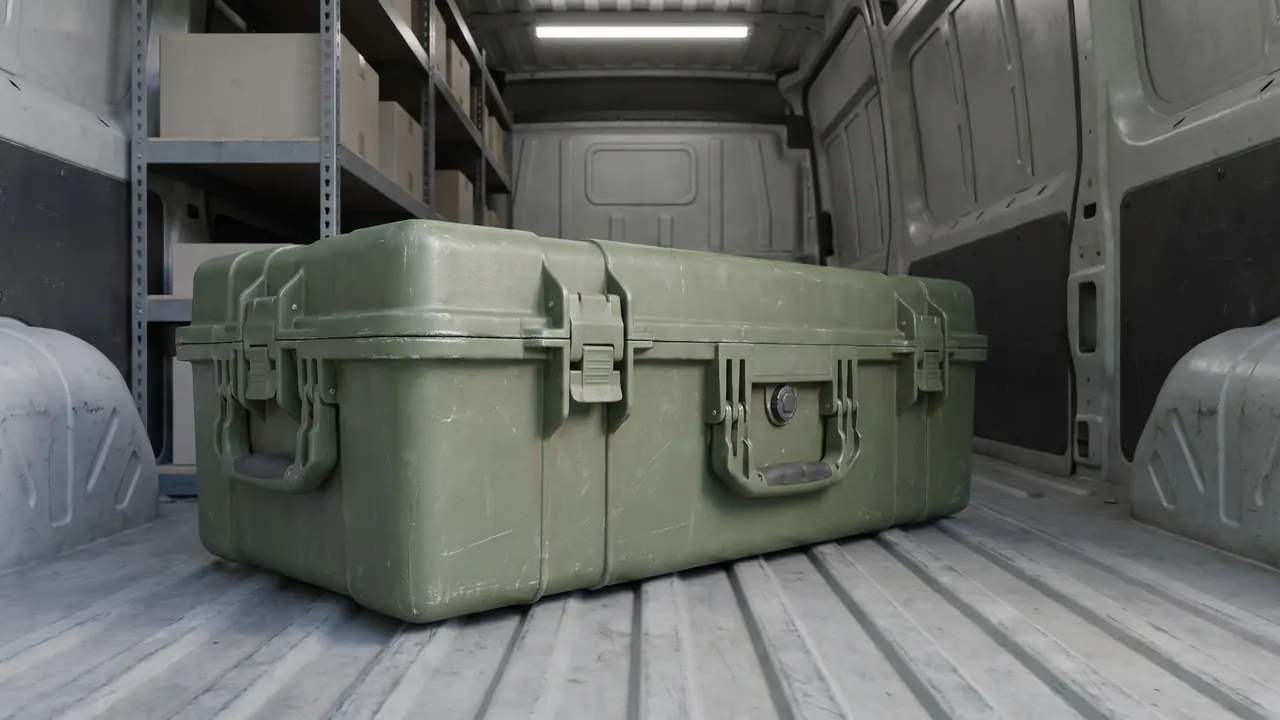
Liner and Restraint: Keeping Contents From Shifting
The shell protects the outside; the liner protects the inside. Under transit conditions the greatest enemy is not a single heavy blow but repeated small movement: every bump lets an item shift slightly inside the case, and accumulated over a journey that can abrade surfaces, blur marking and eventually loosen structure. The goal of an insert is therefore not to be soft but to restrain, holding each item in a fixed position and cutting the relative motion between item and shell and between neighbouring items.
The usual approach is a custom-moulded EVA or EPE insert with cavities cut to the item outline and a slight interference fit at the cavity wall. For similar-shaped items that need compartmentalised control, a movable divider plus soft lining works well. Heavy single items need the insert mechanically fixed to the case so that liner and load cannot slide as a unit, typically through screws, clips or a dual-layer structural part anchoring the insert to the base. Bear in mind that the more elaborate the insert, the slower the verification, so a transit plan should balance restraint against throughput: at frequently opened nodes, use zoning plus clear marking so a check can be completed at a glance.
User-facing military packaging practice verifies cushioning and restraint by test rather than by impression, and the linked comparison article describes the wording around environmental-adaptation verification. Passing a laboratory test is not a guarantee in the field: an insert that is torn or deformed through repeated opening loses restraint capacity, so treating the insert as a replaceable part and supplying spares with the case is standard practice in a transit plan.
Locks, Tamper-Evident Seals and Traceability Marking
Because transit involves multiple parties, a case must not only lock but also prove it has not been opened. Compression latches handle closure and compression, padlock eyes handle theft deterrence, and a single-use tamper-evident seal is what makes handover auditable: once broken, a seal leaves an irreversible trace, so every party in the chain can confirm from the seal number whether the goods were touched during a particular handover. For a logistics contractor the seal is not only security, it is evidence for allocating responsibility. For more on selecting latch forms, see the article on military ammo box lock selection.
The seal port is itself a structural element. A poorly designed port snags and snaps during transit, producing the nuisance of a false "opened in transit" reading. The port should therefore sit in a protected position, be sized to common seal specifications, have adequate wall strength, and be deburred and rounded at the edge. The case should also reserve a label area for a unique serial, a QR code or an RFID tag. That area must be flat, wear-resistant and clear of high-friction zones, and it must stay readable after rain and washing. Where automatic identification is required, the tag position must also avoid the signal shielding caused by a metal insert or a heavy rib.
Treating latch, seal and marking as one handover kit is more reliable than buying them separately and assembling on site. In OEM and ODM projects JUNZHIJIA normally fixes the numbering rule, seal specification and label area together, so cases from different batches can be exchanged directly in the handover procedure and site teams are spared improvised workarounds such as forcing an oversize seal into an undersize port.
Lifting and Forklift Interfaces: Ergonomics of Transit Handling
A transit case is lifted and forklifted repeatedly, so its interfaces decide whether it can be handled correctly. The key to a lift point is a clear load path: it must sit over structural support, the sling angle should not be so wide as to impose a large horizontal component on the wall, and the number and location of points should be symmetric so the case cannot tilt or slip off the sling. Heavy cases generally need dedicated lifting eyes or ports rather than a field lashing.
A forklift interface should allow easy tine entry and spread the load. Fork pockets or channels must match the height and depth of common tines, and the base needs a continuous reinforcing structure that distributes load into the case skeleton rather than concentrating it on a thin base panel. Where the base is flat with no pockets, the case is normally used on a pallet or with a base plate. In every configuration, mark the entry direction and the prohibition on single-point lifting, and make that marking resistant to wear.
Handles and casters are part of the same picture. A handle must withstand a fully loaded multi-person lift, with a grip and height that suit different operators; casters must match the ground, since a rigid small wheel suits hard floors, a large load-bearing wheel suits rough yards, and a poor surface demands reliable braking and locking. The aim of interface design is to make correct handling easier than the shortcut, because only then will the procedure be followed.
Palletization and Container Stowage
Once transit volume reaches a certain scale, moving cases one at a time stops being realistic, and palletisation plus container stowage become unavoidable. The first step is to standardise the unit footprint so case length and width match the pallet, maximising area use and minimising overhang. A case that overhangs the pallet edge concentrates load at the unsupported edge during lifting and forklifting, and it is a common cause of transit damage; the linked planning article sets out the method.
Container stowage must consider weight distribution and restraint together. Weight should be spread evenly with a low centre of gravity to avoid the roll that follows an off-centre load. Restraint usually combines lashing straps, bulkheads and dunnage bags so that no free space allows cargo to slide. The number of stacked layers in transit should be derived from case compressive strength, total contents weight and ambient temperature rather than rule of thumb, and the same applies to temporary warehouse stacking, covered further in the linked warehouse storage rules.
Air and sea freight weight different factors. Air freight is constrained by door dimensions, floor loading and height limits, so unit height and total weight must stay controllable. Sea freight faces prolonged humidity, so besides liner and seal a vapour-phase corrosion measure is often added. The linked articles on air transport and sea freight of outdoor cases cover these two settings; defence-trade projects frequently mix modes within one consignment, so the stowage plan should be agreed with the carrier before dispatch rather than improvised on the dock.
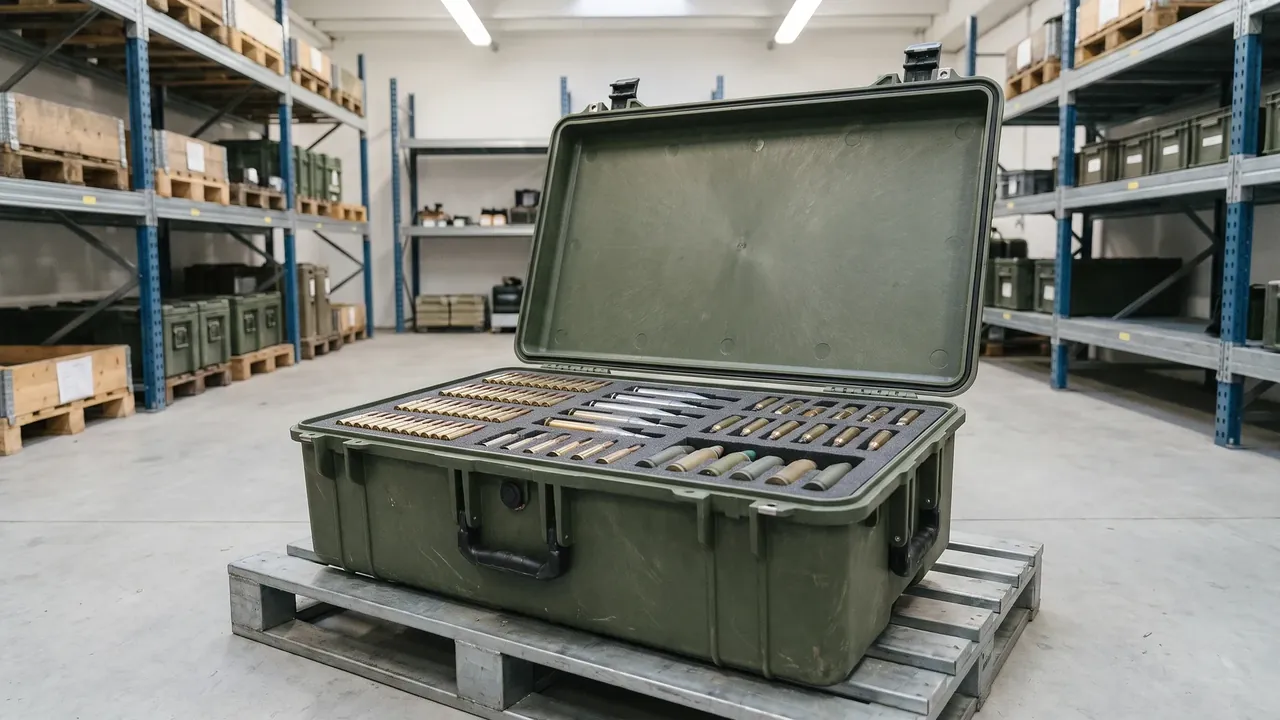
Transshipment and Temporary Stacking: The Warehouse Handoff
Transit does not only happen on the road. Temporary stacking inside a node warehouse is part of the transit plan and is frequently where damage occurs. What separates temporary stacking from long-term storage is that it is short in time but poor in conditions: goods sit on a dock or in a staging area where the floor is uneven, dunnage may be missing and stack height is arbitrary, and because the dwell time is uncertain the case can exceed its long-term permitted load without anyone noticing. A plastic shell is viscoelastic, so nothing shows at first, but once the dwell stretches, the bottom cases can develop irreversible bulging and rim distortion.
Three controls matter. First, cap the height, and grade the cap by contents weight so heavy loads stack lower and light loads higher. Second, secure the floor and dunnage condition, using a flat pallet or dunnage to spread load and prevent a case from sitting on an uneven floor with local point loading. Third, shorten the dwell, using the operation plan to keep goods moving through the staging area and removing the risk at source.
A transshipment node should also build in a stacking check: before onward movement, confirm that the bottom case shows no visible deformation, that the seal is still effective and that the seal tag is intact. Fixing the check into the handover procedure beats investigating after the fact. For movements across seasons or climate zones, also consider temperature, because heat accelerates creep and can turn a previously safe stack height into an unsafe one; in summer or tropical service, reduce the stacking cap deliberately.
VCI Rust Prevention for Long Transit Cycles
When a transit cycle is long, and especially when it involves sea freight or intermodal movement, the corrosion risk to metal parts rises materially with time. Besides sealing and desiccant, vapour-phase corrosion inhibitor (VCI) material is a common supplementary barrier. VCI material slowly releases a corrosion-inhibiting vapour at ambient temperature, which adsorbs onto metal surfaces inside an enclosed space and forms a protective layer that suppresses the electrochemical corrosion process. Its advantage is reach into complex geometry that is hard to coat, which suits whole-case protection.
VCI is used in three main ways: VCI film or bags wrap individual items or a whole pallet; VCI emitters (sheet or block) are placed in the case volume; VCI paper provides lining and interleaving. Selection must match the compound to the metal family, since formulations for ferrous and non-ferrous metals are not interchangeable and mixed loads need a compatible formulation. VCI also only works in a reasonably enclosed space, so case sealing and the VCI measure have to be designed together; neither alone will deliver long-cycle protection.
Desiccant quantity must likewise be calculated rather than guessed. The amount follows from case volume, the moisture absorbed by the liner, the seal rating and the transit duration, and where the cycle is long a re-checkable humidity indicator card should be included. Treating corrosion prevention, moisture control and sealing as one system is the baseline for a long transit plan, rather than adding a few desiccant bags just before dispatch.
Certification and Export-Control Boundaries for Transit Packaging
A transit case for defence trade and cross-border projects usually needs valid tests and documents to support its protection claims. Common frameworks include MIL-STD-810H and its national equivalents for environmental test methods; ASTM D4169, ISO 4180 and the ISTA series for transport-package performance; the GB/T 4857 series for basic package tests; and IEC 60529 for ingress ratings. Their natures differ — some are environmental-adaptation test methods, others are transport-package performance programmes — so procurement should match the standard to the purpose rather than demanding "all certifications" as a blanket requirement. The linked article on ammunition transport box certifications sets out a full certification matrix.
Cross-border transit also brings export-packing and customs requirements, including package marking, phytosanitary treatment of wood packaging and carrier rules for specific goods. These vary by destination and mode and can change as regulations are updated, so the current rules and the carrier's own requirements always govern. For defence-trade projects, confirm in advance the destination country's import requirements for the packaging itself, so that material or marking non-compliance does not cause the consignment to be held at the border.
This article's boundary bears repeating: it discusses only how the packaging container is designed and verified, and says nothing about the properties, classification or handling of any contents. All purchasing and use must comply with local law and export-control requirements; this article only discusses the packaging container. For the cross-border operational handoff, the linked cross-border logistics guide is a useful extension.
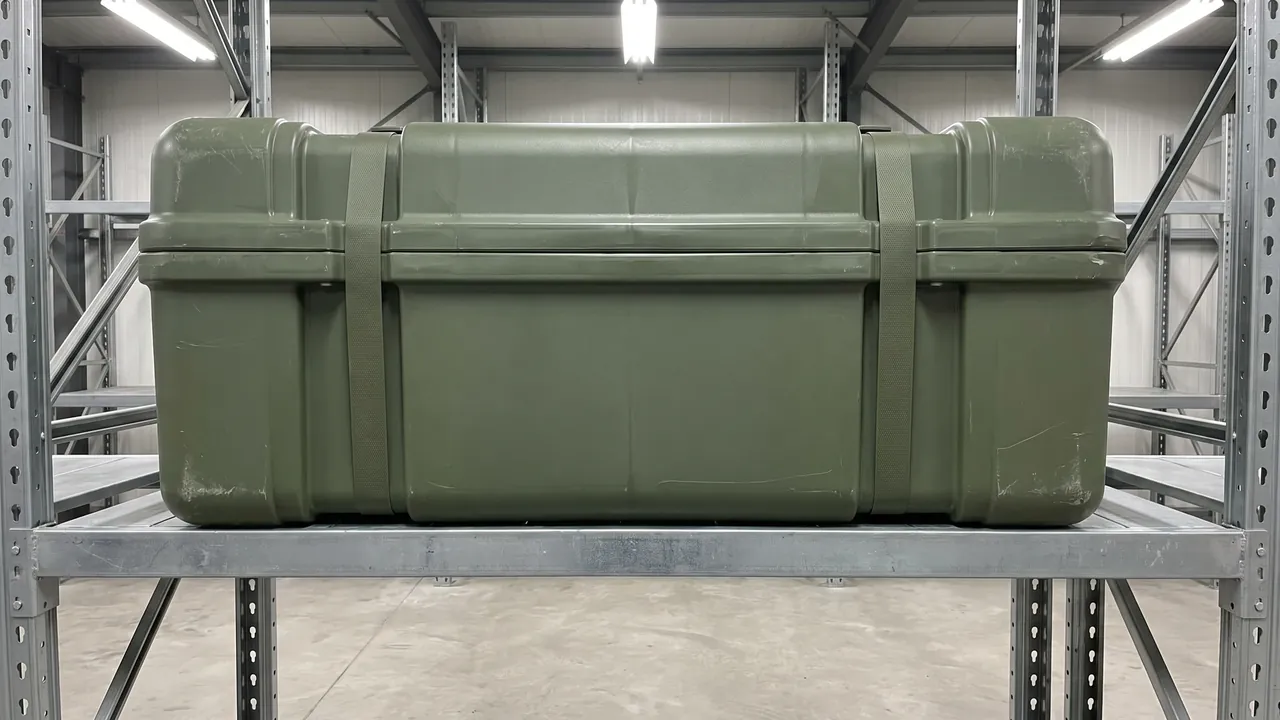
Putting the Transit Plan to Work: An Actionable Checklist
Condense everything above into a checklist that can go straight into an enquiry or a technical agreement.
First, define the chain: list the number of nodes, the handling method at each (manual, forklift, crane) and the dwell time. Second, define the load spectrum: identify where drop, stacking and side-impact risk exists, and specify reinforcement accordingly. Third, define the environment spectrum: maximum and minimum temperature, humidity, altitude span and exposure, and specify sealing and pressure management accordingly. Fourth, define the liner: restraint method, whether compartmentalisation is needed, whether the insert is replaceable. Fifth, define the handover method: latch form, seal specification, numbering rule and label-area position.
Sixth, define the handling interfaces: number and position of lift points, fork-pocket specification, handle and caster requirements. Seventh, define the stowage plan: pallet size, stack height, lashing and restraint method, and whether loads are mixed. Eighth, define the protective measures: seal rating, pressure equalization valve, desiccant quantity and VCI measure. Ninth, define the verification requirement: which tests, to which standard, and who issues the report. Tenth, define after-sales and spares: whether gaskets, inserts and seals ship with the case, and what the replacement interval is.
Fill in this checklist before sending it to a supplier and what comes back is a testable, calculable, accountable transit plan rather than the claim that "our cases are strong." For an ammunition logistics contractor or a defence-trade buyer, the value of the transit leg is precisely that every handover stays controllable, and that can only be secured by fixing interfaces, marking and verification at the design stage.
Ammunition Transit Case Frequently Asked Questions (FAQ)
Q: A: In most real projects they are the same case described from different stages of the chain, not two products that must be bought separately. A transit case emphasises movement, handover and short-term holding between nodes, while a transit box emphasises load bearing and secure fixing on the line-haul leg. Because one case usually does both jobs, the more sensible approach is to merge the load and handling requirements of both scenarios into a single technical agreement so that the structure is designed once and designed properly. Where a genuine division of labour exists, the transit case should lean towards lift points, fork access, latches and seal ports, while the transport box should lean towards base bearing, stack location and tie-down points. Treating the two as opposites tends to produce, within the same consignment, cases that do not share a specification and cannot be interchanged when a node runs short. Write the accepted term into the purchase order and the drawing title, so every quotation, inspection report and customs document refers to the same article and no consignment is delayed by a vocabulary dispute at a hub. Q: Across a multi-stage chain, which leg is most likely to cause a transit case to fail?
A: Engineering experience points not at the line-haul leg but at hub transshipment and temporary stacking. Transshipment often happens in the open or semi-open, so the case must absorb sun and rain, day-night temperature swings and frequent lifting and forklifting at the same time, which is where sealing and pressure management are pushed hardest. Temporary stacking is risky because of poor conditions, uneven floors and an uncertain dwell time, so the case can quietly exceed its long-term permitted load. On top of that, a case that is not correctly re-latched after each verification loses its seal immediately, and handover nodes are exactly where opening and closing is most frequent. A sound transit plan therefore treats transshipment and stacking as priority control points rather than concentrating only on the vibration of the road leg, and it builds a quick stacking and seal check into the handover routine so a problem is caught before the next movement begins.
Q: Why does a case crossing altitude or a large temperature range need a pressure equalization valve?
A: Because a well-sealed case becomes a pressurised vessel when an internal-external pressure differential appears. Move it from a warm, low-altitude area to high altitude or cold, and outside pressure falls or the internal air contracts, producing negative pressure that can displace the gasket, slightly deform the lid and even make the case hard to open. Move in the other direction, or climb rapidly in an aircraft, and positive internal pressure can push the seal open. A pressure equalization valve uses a hydrophobic breathable membrane to let gas pass slowly while blocking liquid water and dust, equalising pressure without sacrificing the ingress rating. When specifying it, match its air-flow rate to case volume, because a large case needs more venting capacity or the differential lingers too long. Position matters too: the valve must sit clear of dead zones where water pools or dust settles, and its outer face must stay free of labels and tape so it can breathe.
Q: Why do transit-case inserts emphasise restraint rather than softness?
A: Because under transit conditions the greatest threat is not a single heavy impact but repeated small movement. Every bump shifts an item slightly if it is free to move, and over a journey that accumulates into surface abrasion, blurred marking and eventually loosened structure. Soft material alone absorbs part of an impact but cannot stop an item sliding inside the case, and once the soft material is itself compressed and deformed it leaves even more room to move. A moulded insert cut to the item outline with a slight interference fit constrains the item in a fixed position and cuts the relative motion between item and shell and between neighbouring items. For heavy single items the insert also needs to be mechanically anchored to the case, otherwise the liner and its load can slide together as one unit and the restraint is lost at the worst possible moment during a hard braking event or a dropped pallet.
Q: What does a tamper-evident seal actually contribute to transit management?
A: Its contribution is accountability as much as security. A compression latch handles closure and compression, and padlock eyes deter theft, but a single-use tamper-evident seal is what makes the handover auditable: once opened, it leaves an irreversible trace, so every party in the chain can confirm from the seal number whether the goods were touched during a given handover. For a project with multiple custodians this is effectively evidence attached to each change of hands, and it allows a deficiency to be localised quickly instead of triggering a dispute across the whole route. The seal port is also a structural part in its own right: it should be positioned in a protected area, sized to common seal specifications, strong enough at the wall, and deburred at the edge. A weak or exposed port snags and snaps during transit, producing a false reading of unauthorised opening and undermining confidence in the whole control system.
Q: What is most often overlooked when palletising transit cases?
A: The most common oversight is allowing a case to overhang the pallet edge. When the case footprint exceeds the pallet, the overhanging portion has no support, so during lifting and forklifting the edge load rises sharply, which is a frequent cause of transit damage. The second oversight is weight distribution and centre-of-gravity height, because an off-centre load encourages roll in transit and a high centre of gravity reduces stability further. The third is the restraint method: relying on self-weight or simple stacking is not reliable on the road, so a combination of lashing straps, bulkheads and dunnage bags is normally needed to eliminate free space that would let cargo slide. Palletisation should be agreed with the carrier before dispatch rather than improvised on the dock, because otherwise non-compliant loading tends to be discovered at the final and least forgiving stage of the movement, when there is no time left to correct it.
Q: How should corrosion and moisture be controlled on a long cross-border movement? A: Design sealing, desiccant and vapour-phase corrosion inhibition as one system. Sealing is the foundation, because it determines whether external moisture can enter at all. Desiccant absorbs residual internal moisture, and its quantity must be calculated from case volume, the moisture taken up by the liner, the seal rating and the transit duration rather than guessed. Vapour-phase corrosion inhibitor then releases a slow, corrosion-inhibiting vapour that adsorbs onto metal surfaces inside the enclosed space, reaching complex geometry that is hard to coat. All three have to work together, since no single measure will deliver protection over a long cycle. Also match the VCI formulation to the metal family present, choose a compatible variant for mixed loads, and include a humidity indicator card so the condition can be re-checked partway through a long movement instead of being assumed.
Agree the inspection points before the first consignment moves, and put them in the transit plan rather than in a quality manual nobody opens at a hub. A five-minute check of indicator cards and seal condition at each node costs almost nothing and converts a long chain from an act of faith into a series of verified handovers.
Q: Which verifications should be required for a case used in defence trade shipments? A: The key is to match the standard to the purpose instead of demanding every certification at once. For environmental adaptation, methods from MIL-STD-810H and its national equivalents are a common reference. For transport-package performance, ASTM D4169, ISO 4180 and the ISTA series apply. For basic package testing, the GB/T 4857 series is widely used, and for ingress rating IEC 60529 defines the IP scale. Cross-border transit additionally involves export package marking, phytosanitary treatment of wood packaging and carrier rules for particular goods, and these vary by destination and mode and can be updated at any time. Because this article discusses only the packaging container, any purchasing or use must still comply with local law and export-control requirements, and the current regulations plus the carrier's own conditions remain the governing documents for the specific movement being planned.
Insist on seeing the actual test reports behind each claim, and check that the tested configuration resembles the case you are buying, including liner, hardware and any pallet adapter. Certificates describe a sample, so your purchase order should name the configuration, preventing the certified article and the delivered article from quietly drifting apart.
Q: How should the consumable parts of a transit case be managed?
A: The main consumables are the gasket, the insert, the seals and the casters, and together they determine how much protection the case actually delivers over its service life, so they should be managed as replaceable parts rather than sourced in a hurry after a failure. A gasket ages over time and can be pinched by debris during repeated cycling, so once it cracks or loses resilience it should be replaced with a part of the same specification. An insert can be torn or deformed through repeated opening, and its restraining ability decays gradually, so a spare insert should ship with the case. Seals are single-use items and must be stocked to match the number of transit batches. Casters wear faster on rough ground, so their braking and locking functions need periodic checking. Writing replacement intervals and a spare-parts list into the purchase agreement is what keeps a transit plan effective over several years of service.
Related Reading
- Ammunition Transport Box Certifications: Shock and Vibration Standards
- Cross-Border Logistics Guide for Protective Cases
- Shipping and Loading Precautions for Protective Cases
- Sea Freight for Outdoor Protective Cases
- Air Transport for Outdoor Protective Cases
- Military Ammo Case vs Ordinary Storage Box: A Full Comparison
- Stackability and Pallet Planning for Protective Cases
- Warehouse Storage Rules for Protective Cases