

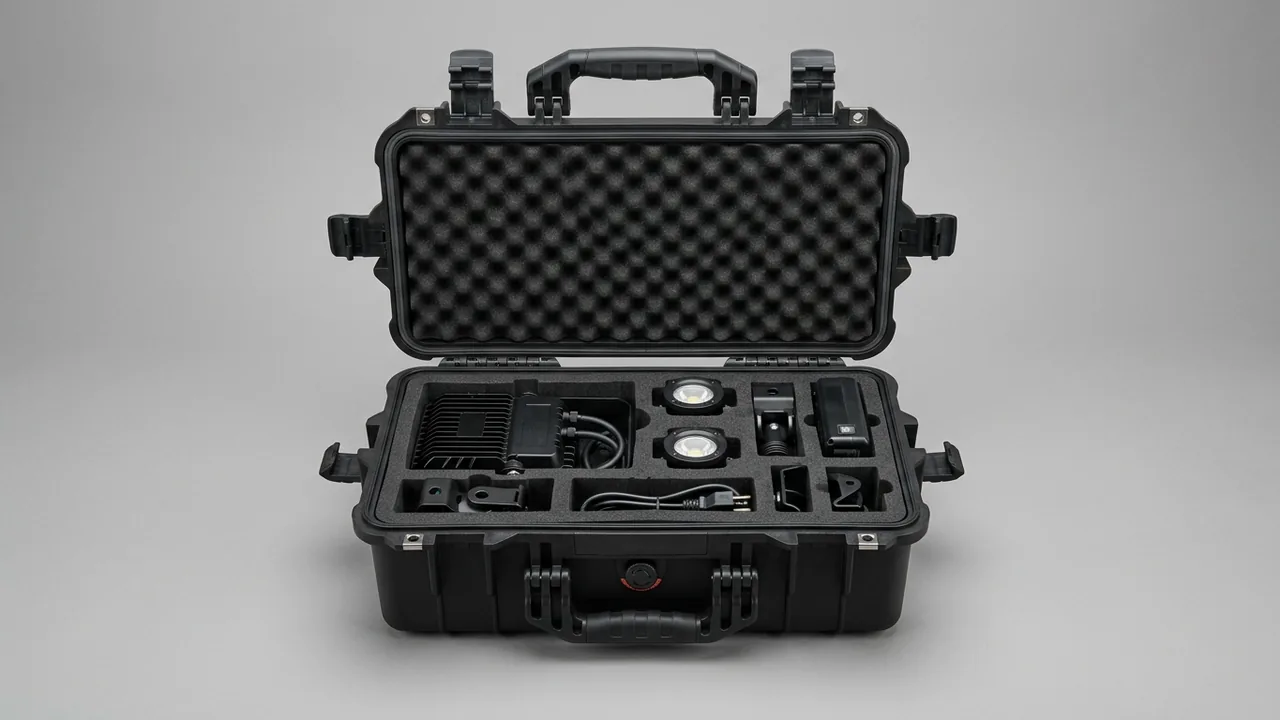
When an instrument travels with a technician, is lifted many times a day, or is shipped under a rate structure that prices by weight, the case itself stops being a secondary parameter and becomes the first constraint in selection. A 25 kg spectrometer packed into a 15 kg case imposes a handling burden and a freight cost that the case alone creates; packed into a 6 kg case, both the gross weight and the practical working radius improve markedly. That is the purpose of an aluminium protective case: to bring shell weight down to a level that plastics and steel cannot reach simultaneously while retaining adequate stiffness and ingress protection.
The principle JUNZHIJIA applies to aluminium case design is: lightweighting is not a matter of thinning panels, it is a matter of letting the extrusion frame carry bending, the panels carry face loads and the corner castings carry impact, so that each material does only what it does best. Separating those three structural roles is what allows weight to fall without sacrificing rigidity.
Table of Contents
- Positioning an Aluminium Case: Balancing Weight Against Rigidity
- Case Structure: Frame Extrusions, Panels and Corner Castings
- Alloy Grades and Tempers: 5052, 6061 and 7075
- Surface Finishing: Anodising, Hard Anodising and Paint
- Quantifying Lightweighting: Specific Stiffness and Weight Budget
- Sealing and Ingress Ratings: Why IP65 and IP67 Are Harder in Aluminium
- Liner Design: Milled EVA and Instrument Faceplate Mounting
- Hardware Selection: Latches, Hinges, Handles and Castors
- Cross-Comparison with Stainless Steel, Rotomoulded and Injection-Moulded Cases
- Additional Requirements in ESD and Electromagnetic Environments
- Manufacturing Processes: Extrusion, Bending, Riveting and Welding
- Acceptance Criteria and Common Failure Modes
- Frequently Asked Questions FAQ
- Conclusion and Related Reading
Positioning an Aluminium Case: Balancing Weight Against Rigidity
Aluminium cases are used where three conditions appear together: the instrument must move with a person, transport involves air freight or manual handling, and unit value is high enough that appearance grade forms part of acceptance. Once all three hold, the selection balance tilts toward a metal frame construction.
From a materials standpoint, the elastic modulus of aluminium is roughly 70 GPa, about one third that of steel, while its density of about 2.7 g/cm³ is also roughly one third. This means that for equal weight, an aluminium section can be given a considerably larger second moment of area, so it does not necessarily lose on bending stiffness. The engineering point is to compare on an equal-stiffness basis rather than an equal-section basis: make the extrusion walls thicker and the section deeper, and a meaningful weight saving can be retained at the same bending stiffness.
The boundaries of aluminium are equally clear. First, material and processing costs exceed those of plastic cases, particularly where welding or extensive riveting is involved. Second, a metal shell conducts heat rapidly, so internal condensation is more likely under large temperature swings. Third, in salt-laden air, aluminium in direct contact with stainless steel hardware suffers galvanic corrosion unless insulated. Understanding these three limits prevents forcing an aluminium case into an application where it does not belong.
| Scenario characteristic | Favours aluminium | Favours rotomoulded or injection-moulded |
|---|---|---|
| --- | --- | --- |
| Weight requirement | Strict, weight reduction prioritised | Flexible |
| Transport mode | Air freight, frequent manual handling | Full vehicle loads, palletised |
| Usage frequency | High, carried constantly | Low, fixed installation |
| Appearance requirement | High, metal finish and flatness | Moderate |
| Budget | Higher | Constrained |
| Environment | Indoor, dry, clean | Coastal, outdoor, chemical |
Case Structure: Frame Extrusions, Panels and Corner Castings
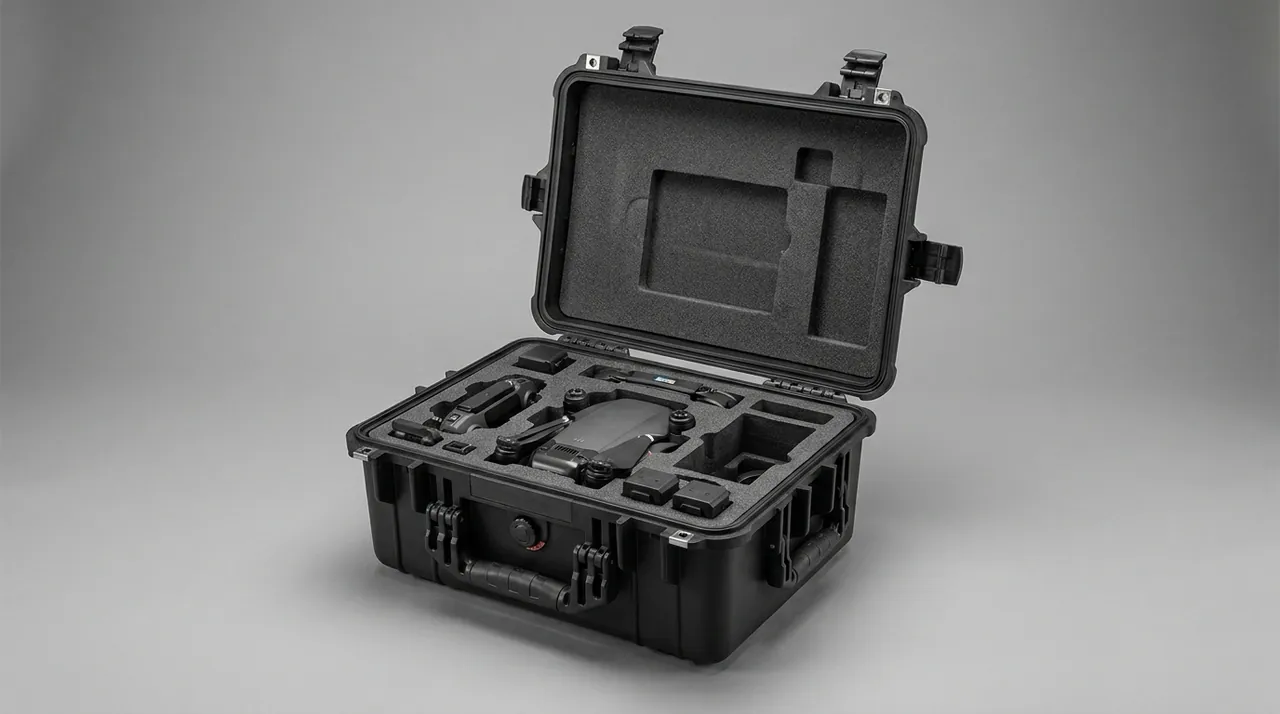
The classic aluminium case architecture is frame plus panels. Extruded aluminium profiles form the frame and carry overall bending and torsion; panels fixed inside and outside the frame carry out-of-plane loads and provide the sealing face; corner castings sit at the eight vertices, absorbing drop impact and distributing it into the adjacent profiles.
Profile cross-section design determines overall efficiency. A typical section incorporates internal stiffening webs and screw channels so that panels can be fastened directly with self-tapping screws or clamping strips, without separate mounting brackets. The value lies in part count reduction: every additional connector adds weight, an assembly operation and a loosening risk. For background on how extrusion-based architecture is applied in component cases, see the structural notes on aluminium extrusion die cases.
Corner castings should be designed to absorb before they transmit. Ideally the casting deforms in a controlled way during a drop, dissipating part of the energy before passing the remainder into the profiles. A casting that is too rigid sends the full impact into the frame, which frequently initiates a crack at a profile joint. A casting that is too soft collapses under high load and loses its protective function. Die-cast corners with internal ribs, or thick-walled moulded corners, are the usual compromise between energy absorption and load transfer.
| Structural layer | Typical material | Primary function | Weight strategy |
|---|---|---|---|
| --- | --- | --- | --- |
| Frame extrusions | 6061-T6 extruded profile | Carry bending and torsion | Increase section depth, thin non-critical walls |
| Outer panels | 5052 sheet, 1.0–2.0 mm | Carry face loads, provide appearance | Minimum thickness by span, add corrugation |
| Inner panels | 5052 or composite sheet | Retain liner, form sandwich | Offset stiffeners against outer panel |
| Corner castings | Die-cast aluminium or glass-filled polymer | Absorb and distribute drop impact | Local thickening, cored-out non-load zones |
| Seal groove | Formed into the extrusion | Retain the gasket | Excluded from weight reduction |
Alloy Grades and Tempers: 5052, 6061 and 7075
Three alloy families dominate aluminium case construction, each suited to a different part of the assembly.
5052 is an aluminium-magnesium alloy. It cannot be strengthened by heat treatment but offers excellent corrosion resistance, good formability and good weldability, which makes it the natural choice for panels and bent parts. Tensile strength sits around 200 MPa with high elongation, so under impact it tends to deform before it fractures, a toughness-first behaviour that suits protective cases well.
6061 is an aluminium-magnesium-silicon alloy that responds to T6 heat treatment, lifting tensile strength above 300 MPa while retaining good extrudability and machinability. It is the standard choice for frame profiles. The drawback is that welding degrades strength in the heat-affected zone, so frames are normally assembled with corner castings plus rivets or bolts rather than welded.
7075 is an aluminium-zinc-magnesium-copper alloy and among the strongest common aluminium grades, with tensile strength above 500 MPa. It has poorer corrosion resistance, higher cost and very poor weldability, so it is reserved for small, highly stressed load-bearing parts such as special corner castings or latch seats, not for full panels.
| Grade | Tensile strength MPa | Corrosion resistance | Extrudability | Weldability | Typical use |
|---|---|---|---|---|---|
| --- | --- | --- | --- | --- | --- |
| 5052-H32 | 200–230 | Excellent | Fair | Excellent | Panels, bent parts, liner backing |
| 6061-T6 | 290–310 | Good | Excellent | Poor | Frame profiles, load beams |
| 6063-T5 | 170–210 | Good | Excellent | Fair | Cosmetic profiles, trim frames |
| 7075-T6 | 500–560 | Poor | Poor | Very poor | High-strength corners, latch seats |
Grade selection must be matched to the finishing route. Both 5052 and 6061 anodise well, but the oxide colour depends on alloy chemistry: 6061 trends grey after anodising while 5052 trends bright. Where a uniform colour across the whole case is required, either process the parts separately to match, or move to a painted finish. For broader context on aluminium case materials and processes, see the overview of aluminium alloy protective cases.
Surface Finishing: Anodising, Hard Anodising and Paint
Surface finishing on an aluminium case affects not only appearance but corrosion resistance and wear resistance. The three mainstream routes differ substantially.
Sulphuric anodising is the most common. Coating thickness is typically 5 to 20 micrometres and the film accepts dyes, giving black, silver, blue and other colours. It balances corrosion resistance and decorative quality at moderate cost, but film hardness is limited to roughly 300 HV, so it scratches readily in rubbing service.
Hard anodising raises thickness to 25 to 60 micrometres and hardness to 400 to 500 HV, substantially improving wear resistance and dielectric strength. It suits bases and frames that regularly contact the ground or a vehicle floor. The trade-offs are a more brittle film, a narrow colour range usually between dark grey and black, and a reduction in substrate fatigue strength, which makes it unsuitable for thin sections that flex repeatedly.
Painting delivers the widest colour range at the lowest cosmetic cost, covering both powder and liquid systems. Wear resistance exceeds standard anodising but falls short of hard anodising, and adhesion depends entirely on pretreatment quality; inadequate pretreatment leads to blistering and peeling in damp conditions.
| Route | Thickness | Hardness | Colour freedom | Corrosion resistance | Suitable areas |
|---|---|---|---|---|---|
| --- | --- | --- | --- | --- | --- |
| Sulphuric anodising | 5–20 μm | About 300 HV | High, dyeable | Good | Panels, cosmetic frames |
| Hard anodising | 25–60 μm | 400–500 HV | Low, dark shades | Excellent | Base, corners, sliding surfaces |
| Powder coating | 60–100 μm | Coating dependent | Very high | Good | Cases needing specific appearance or marking |
| Chemical conversion | 0.5–3 μm | Low | Low | Moderate | Paint pretreatment, internal surfaces |
Quantifying Lightweighting: Specific Stiffness and Weight Budget
Lightweighting cannot proceed on feel; it needs a quantifiable budget. Specific stiffness, the ratio of bending stiffness to mass per unit length, is the usual metric. For a uniform beam it scales with the product of elastic modulus and second moment of area divided by cross-sectional area, so once the material is fixed the entire optimisation space lies in section geometry.
The method has three steps. First, set the allowable deflection: for example, mid-span deflection under a loaded lift should not exceed 1/300 of the span. Second, back-calculate the required second moment of area and determine wall thickness from the available section depth. Third, sum component weights and compare against the overall budget, iterating as required.
| Component | Target weight | Governing constraint | Weight reduction method |
|---|---|---|---|
| --- | --- | --- | --- |
| Frame profiles | 2.4 kg | Mid-span deflection, torsional stiffness | Deeper section, thin non-critical walls |
| Outer panels | 1.1 kg | Out-of-plane deflection, puncture | Minimum thickness by span, corrugation |
| Inner panels | 0.9 kg | Liner retention, flatness | Composite sheet or reduced thickness |
| Corner castings | 0.6 kg | Drop impact | Cored non-load zones alongside local thickening |
| Hardware | 1.0 kg | Opening force, seal compression | High-strength stainless, fewer parts |
| Total | 6.0 kg | Whole-case target | — |
Returns diminish as weight falls. Once shell weight is below about 25 percent of the payload weight, further reduction yields little practical handling benefit while structural margin falls quickly. At that point the better investment is refining the liner and the loading procedure rather than removing more metal.
Sealing and Ingress Ratings: Why IP65 and IP67 Are Harder in Aluminium
The sealing principle is the same as in any case, but the difficulty in aluminium comes from high stiffness combined with a long tolerance stack. A sealed interface in an aluminium case accumulates extrusion tolerance, frame assembly tolerance and panel mounting tolerance. The resulting flatness deviation at the lip can exceed 0.5 mm, while the effective compression window of the gasket is typically only 0.3 to 0.5 mm.
Three approaches address this. First, extrude the seal groove directly into the profile so that the dimension chain at the sealing interface shortens to profile section accuracy plus gasket tolerance, keeping panel-to-frame assembly error out of the seal path. Second, combine a rigid frame with a compliant gasket section, choosing a form with a thicker section and a wide compression tolerance envelope, such as a hollow-chamber silicone or dual-lip gasket. Third, control the closing stiffness of the lid, so that panel deflection in the central region does not create local under-compression.
For an IP67 target, five additional paths must be handled beyond the primary interface: profile joints, panel fixing screw holes, handle mounting holes, latch seats and the pressure equalisation valve. Profile joints are a risk unique to aluminium frames. If the corner connection is not continuously sealed, water enters the profile cavity and migrates along its length to other locations. Two remedies are standard: seal the corner with both adhesive and gasket, or insert end caps into the profile cavity so that any water is confined to a single profile.
Liner Design: Milled EVA and Instrument Faceplate Mounting
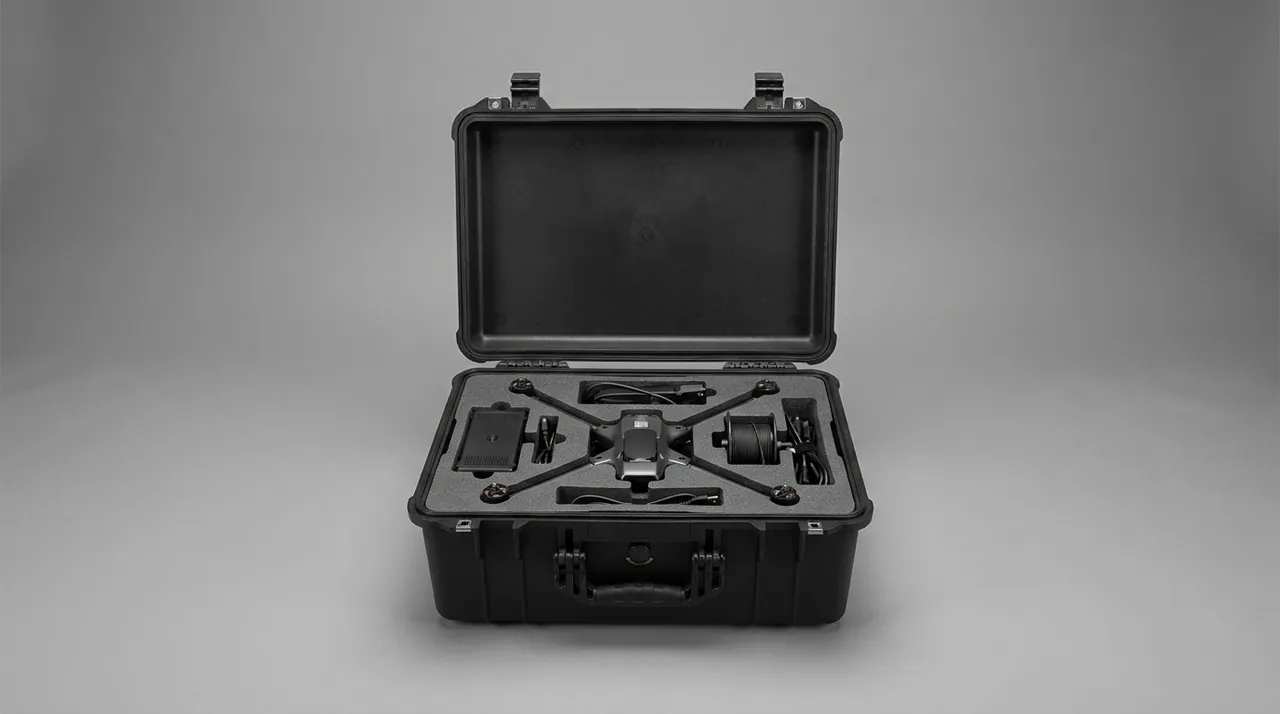
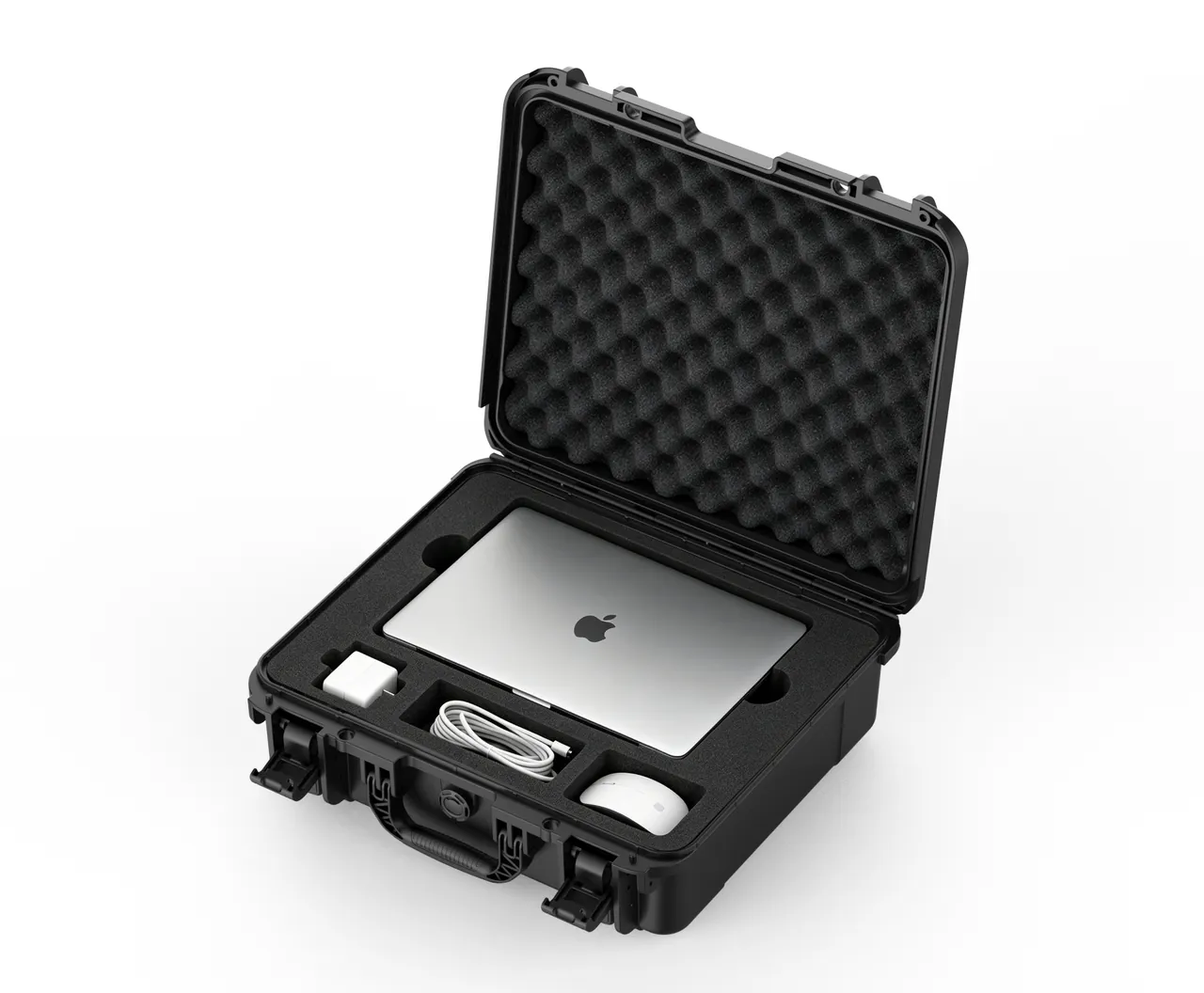
Liner design in an aluminium case places more emphasis on flatness than in a plastic case, because the internal wall is far flatter than a rotomoulded interior, allowing smaller clearances and higher locating accuracy. The usual approach is a single block of EVA at 60 to 90 kg/m³, milled to the instrument profile, combined with local IXPE pads.
For instruments with a front faceplate, a better arrangement is a floating design: the faceplate does not contact the liner directly but is carried on metal brackets fixed to the frame, while the liner provides only isolation and lateral cushioning. This prevents panel distortion and allows readings to be taken or cables connected without removing the instrument. For a full comparison of liner materials, see the analysis of foam materials for case liners.
A 2 to 3 mm vibration isolation pad should sit between liner and internal wall. Direct contact makes the metal wall a transmission path, and although the natural frequency of an aluminium case is usually above that of a plastic case, resonance can still occur in specific bands. An isolating pad reduces transmissibility and also keeps foam debris out of the profile cavities.
| Mounting method | Suited instrument | Advantage | Caution |
|---|---|---|---|
| --- | --- | --- | --- |
| Milled EVA block | Regular portable instruments | High locating accuracy, even cushioning | Obsolete when the model changes |
| Floating faceplate bracket | Bench instruments with front panels | Panel unstressed, easy to read | Requires metal brackets and damping pads |
| Locating blocks and straps | Irregular shapes | Adaptable, fast loading | Depends on operator consistency |
| Drawer trays | Multiple small items | Fast access | Adds slides and weight |
Hardware Selection: Latches, Hinges, Handles and Castors
Hardware must meet functional requirements while avoiding galvanic corrosion. The governing rule is that metal parts in direct contact with aluminium should be type 304 or 316 stainless steel with an insulating washer, and fasteners should be stainless with nylon locking elements so that vibration does not loosen them.
Latches should be adjustable draw latches, so that preload can be compensated as the gasket ages rather than triggering immediate gasket replacement. Adjustment range is typically 1 to 3 mm, and about 1 mm of reserve should be left at the factory setting.
Hinges on aluminium cases are usually external for easy replacement. The design points are a limited opening angle and a positive stop, preventing the lid from acting as a lever against the frame. Where the lid must be removed entirely, detachable hinges or quick-release pins are appropriate.
Handles divide into fixed and folding types. Fixed handles are simple and stiff but protrude beyond the case envelope. Folding handles lower the overall height for storage and suit cases that will be stacked or packed, but the pivot is a weak point requiring local thickening and lubrication.
Castors should be matched to case weight and floor conditions. Because an aluminium case is light, small-diameter low-centre-of-gravity castors are usually sufficient; where floor flatness is poor, larger castors with damping pads are preferable.
| Hardware | Suggested material | Key parameters | Maintenance |
|---|---|---|---|
| --- | --- | --- | --- |
| Latch | 304 stainless with insulating washer | Preload 0.8–1.2 mm, adjustable | Check preload quarterly |
| Hinge | External 304 stainless | Opening limited to 95–105 degrees | Re-grease, check axial play |
| Handle | Aluminium or glass-filled nylon | Rated to at least twice payload | Inspect pivot pin wear |
| Castor | Glass-filled nylon wheel, stainless axle | Diameter by floor condition | Clear wound debris |
| Pressure vent | Polymer housing, hydrophobic membrane | Airflow matched to volume | Clean the membrane |
Cross-Comparison with Stainless Steel, Rotomoulded and Injection-Moulded Cases
Selection should compare four families across the six dimensions that matter most in case procurement.
| Dimension | Aluminium case | Stainless steel case | Rotomoulded case | Injection-moulded case |
|---|---|---|---|---|
| --- | --- | --- | --- | --- |
| Weight for equal volume | Lowest | Highest | Medium to high | Low |
| Bending stiffness | High | Very high | Medium | Medium to high |
| Impact behaviour | Moderate, dents easily | High | High | Moderate |
| Corrosion resistance | Moderate, needs finishing | Excellent | Excellent | Moderate |
| Surface flatness | Excellent | Excellent | Moderate | Good |
| Tooling investment | Low, no large mould | Low | Medium | High |
| Small-batch economics | Excellent | Excellent | Moderate | Poor |
An aluminium case is the best fit for the combination of light weight, high usage frequency and small-batch customisation. Stainless steel suits applications where impact and corrosion resistance dominate and weight can be accepted. Rotomoulding suits large, high-volume, cost-sensitive projects. Injection moulding suits small to medium sizes at very high volume with tight dimensional requirements. The trade-offs between the metal options are examined further in the comparison of aluminium versus stainless steel toolboxes.
Additional Requirements in ESD and Electromagnetic Environments
Where a case carries electronic equipment, imaging devices or precision measuring instruments, electrostatic and electromagnetic conditions impose extra requirements. Aluminium is a good conductor and provides inherent shielding, but shielding effectiveness depends on structural continuity. If lid and body connect only through point contact at the latches, contact resistance is high and shielding effectiveness collapses. The remedy is a conductive gasket running the full perimeter, creating a continuous low-resistance path.
ESD control centres on liner materials. Standard EVA and EPE are insulators and can accumulate several thousand volts of static charge through friction. For static-sensitive devices, conductive or dissipative foam should be specified, with volume resistivity in the range of 10 to the fourth power up to 10 to the ninth power ohm-centimetres, and a discharge path provided through a metallised liner or a grounding terminal. Where connectors are plugged and unplugged frequently, the liner should include cable routing channels and tie points so that cables are not repeatedly flexed in transit. For imaging equipment specifically, see the design notes on machine vision camera cases.
Manufacturing Processes: Extrusion, Bending, Riveting and Welding
Process selection drives cost, precision and appearance.
Extrusion produces the profiles. Tooling investment is moderate, unit cost is low and section consistency is high, making it the standard route for frame profiles. Designs must respect extrusion constraints: uniform wall thickness, no excessively deep narrow slots, and generous internal radii, otherwise die life falls and the section distorts.
Bending forms panels and skirts. It is fast and inexpensive, but the minimum bend radius depends on alloy and temper. For 5052-H32 the minimum radius is roughly 1 to 1.5 times sheet thickness; a tighter radius produces micro-cracks on the outside of the bend that become corrosion initiation sites later.
Riveting is the standard frame assembly method and includes blind rivets, solid rivets and rivet nuts. It does not disturb the material structure and permits dissimilar material combinations, but it is not watertight, so rivet locations must be kept away from the sealing path or sealed rivets used.
Welding gives the strongest, most watertight joint, but it degrades heat-affected zone strength in aluminium and produces distortion that is difficult to control. Unless a specific sealing or strength need exists, aluminium cases are normally built with rivets and corner castings rather than welds.
| Process | Applied to | Advantage | Limitation |
|---|---|---|---|
| --- | --- | --- | --- |
| Extrusion | Frame profiles | Consistent section, low unit cost | Wall uniformity limits, die lead time |
| Bending | Panels and skirts | Fast and inexpensive | Minimum bend radius |
| Riveting | Frame joints, hardware mounting | Handles dissimilar materials, stable process | Not watertight, must avoid seal path |
| Welding | Local high-seal or high-strength joints | Strong and watertight | Weaker heat-affected zone, distortion |
| Machining | Corner castings, latch seats | High precision, complex features | Low material yield, higher cost |
Acceptance Criteria and Common Failure Modes
Acceptance should cover dimensions, appearance, function and ingress protection, with criteria written into the contract to avoid disputes at delivery.
| Acceptance dimension | Example criterion | Verification method |
|---|---|---|
| --- | --- | --- |
| External dimensions | Nominal plus or minus 2 mm | Tape measure at three positions |
| Flatness | Seal lip flatness 0.3 mm or less | Surface plate with feeler gauge |
| Sealing | No ingress under IP65 jet test | Sampled jet test |
| Liner fit | No movement with instrument loaded, gap 1 mm or less | Visual plus feeler gauge |
| Surface finish | Film thickness in range, colour within agreed tolerance | Thickness gauge plus colour card |
| Hardware | Opening force at or below 120 N, no binding | Sampled force gauge |
| Weight | Not exceeding design value by more than 5 percent | Weighing |
Field failures cluster at four locations: corner denting where drop energy exceeds the casting's absorption capacity; joint leakage where profile sealing is inadequate; local seal lip distortion caused by panel deflection or assembly stress; and galvanic corrosion where aluminium contacts stainless steel in damp conditions. Each mode should be traced to a confirmed countermeasure at the design stage rather than corrected after a field incident.
| Failure mode | Trigger | Mechanism | Countermeasure |
|---|---|---|---|
| --- | --- | --- | --- |
| Corner denting | Loaded drop | Casting deforms beyond design intent | Thicker casting or energy-absorbing geometry |
| Joint leakage | Prolonged rain exposure | Profile joint seal fails | Adhesive seal plus cavity end caps |
| Seal lip distortion | Panel mounting stress | Local under-compression | Stiffer frame, controlled assembly torque |
| Galvanic corrosion | Damp coastal air | Dissimilar metals form a galvanic cell | Insulating washers, matched materials |
| Finish wear-through | Frequent abrasion | Anodic film worn through | Hard anodising at critical zones |
| Hardware loosening | Sustained vibration | Thread preload decays | Nylon locking elements, periodic retorque |
Frequently Asked Questions FAQ
Q: How much lighter is an aluminium case than a rotomoulded case, and is the extra cost justified?
A: For the same internal volume, an aluminium case is typically 30 to 50 percent lighter. Taking a case with roughly 60 litres of internal volume as an example, a rotomoulded shell might weigh 9 to 12 kg, while an aluminium case built from extrusions and sheet panels can be brought to 5 to 7 kg, and further optimisation of the section can reduce it more. Whether the extra cost is justified depends on three variables. First, the freight tariff: where air freight or express carriage priced by weight is a large share of trips, weight reduction converts directly into cost savings. Second, handling frequency: in high-frequency carrying duty, saving even 3 kg noticeably improves the working experience. Third, payload weight: when the contents themselves weigh only a few kilograms, the relative benefit of shell weight reduction is greatest. Economically, aluminium material and processing costs are usually two to three times those of a rotomoulded case, so the difference is recovered only where freight and labour savings over a five-year cycle exceed it. For palletised transport, low-frequency use and cost-sensitive projects, rotomoulding remains the more rational choice.
Q: Can an aluminium case genuinely achieve IP67?
A: Yes, but it is harder than in a plastic case, and the main difficulty is the accumulated tolerance stack. The sealing interface of an aluminium case passes through extrusion tolerance, frame assembly tolerance and panel mounting tolerance, so flatness deviation at the lip can exceed 0.5 mm while the gasket's effective compression window is often only 0.3 to 0.5 mm. Achieving IP67 under those conditions requires shortening the chain structurally, and the preferred approach is to extrude the seal groove directly into the profile so that sealing depends only on section accuracy and gasket tolerance. Five additional ingress paths must then be managed: profile joints, panel fixing screw holes, handle mounting holes, latch seats and the pressure equalisation valve. Profile cavities are the most commonly overlooked risk, since water entering a joint travels along the profile and emerges elsewhere, so either double-seal the corners or insert end caps to create confined chambers. Finally, an actual immersion test to IEC 60529 is essential; design calculations alone cannot establish compliance.
Q: Where should 5052, 6061 and 7075 each be used?
A: The three grades are oriented quite differently and should not be substituted casually. 5052 is an aluminium-magnesium alloy that cannot be strengthened by heat treatment, with tensile strength around 200 to 230 MPa, but it offers excellent corrosion resistance together with good formability and weldability, making it the right choice for panels, skirts and liner backing plates; under impact it tends to deform rather than fracture, a toughness-first behaviour that benefits a protective case. 6061 reaches 290 to 310 MPa through T6 heat treatment and combines good extrudability with good machinability, so it is the standard material for frame profiles and load beams; its weakness is a marked loss of strength in the heat-affected zone after welding, which is why frames should be assembled with corner castings plus rivets or bolts. 7075 is the strongest of the common grades at over 500 MPa, but its corrosion resistance is poor, cost is high and weldability is very limited, so it suits only small local load-bearing parts such as special corner castings and latch seats rather than full panels. Finishing must also be considered, since 6061 anodises grey and 5052 anodises bright.
Q: Should the surface finish be anodising or paint?
A: The answer depends on location and cosmetic requirement. Sulphuric anodising produces a film of typically 5 to 20 micrometres at about 300 HV, accepts dyes to give black, silver, blue and other colours, and balances corrosion resistance against decorative quality at moderate cost, making it suitable for visible panels and frames, though it scratches readily where parts rub together. Hard anodising raises thickness to 25 to 60 micrometres and hardness to 400 to 500 HV, significantly improving wear and dielectric performance, and suits bases, corner castings and sliding faces; the trade-offs are a limited colour range, a more brittle film and reduced substrate fatigue strength, so it is unsuitable for thin sections that flex. Paint offers the widest colour range at the lowest cosmetic cost, with wear resistance better than standard anodising but below hard anodising, and its performance depends almost entirely on pretreatment quality, since inadequate pretreatment causes blistering and peeling in damp conditions. The practical recommendation is to combine all three: anodising for visible faces, hard anodising at wear-prone zones and paint where specific appearance or branding is required.
Q: Why does aluminium case hardware corrode so easily, and how can it be prevented?
A: The root cause is galvanic corrosion. The standard electrode potential of aluminium is markedly lower than that of stainless steel, so when the two are in direct contact in a damp environment with an electrolyte path, aluminium becomes the anode and corrodes preferentially. Corrosion products accumulate at the contact face as white or grey pitting, bolt preload falls and latch operation becomes stiff. Four preventive measures apply. The first is isolation: fit nylon or rubber insulating washers between stainless parts and aluminium, and ensure fasteners include insulating sleeves. The second is material matching: make parts that contact aluminium from aluminium as well, for example an aluminium hinge block with an aluminium pin, sacrificing some wear resistance to remove the galvanic couple. The third is surface finishing, since anodising or coating the aluminium significantly delays the onset of corrosion, although local attack can still occur once the film is scratched through. The fourth is environmental control: after use in coastal or chemical environments, clean and dry the case so that salt and chemical residues do not remain on the surface. Where stainless steel is unavoidable at highly stressed points, prefer 316 over 304.
Q: Can ordinary polyethylene foam be used as the liner in an aluminium case?
A: It is technically possible but not advisable for precision instruments. Expanded polyethylene has low density, good rebound and low cost, and short-term service is unproblematic, but it gradually loses thickness under sustained compression, and after a few dozen clamping cycles the cavity becomes noticeably loose. The instrument then gains extra travel during a drop, and measured acceleration can rise by more than 30 percent. For an aluminium case carrying precision instruments over several years, the better solution is a single block of EVA at 60 to 90 kg/m³ milled to the instrument profile; its compression set is very low, and cavity fit tolerance can be held between 0.5 and 1.5 mm. Where cost pressure is significant, a hybrid works: EVA in load-bearing and locating regions, EPE filling non-load-bearing voids and a layer of IXPE at the base for moisture isolation. Never place EPE on a primary load path, because the durability of the whole liner is then determined by its softest layer. Since aluminium interiors are flat, add a 2 to 3 mm isolation pad between liner and wall.
Q: Can an aluminium case be made suitable for electrostatic-sensitive devices?
A: Yes, but the case body and the liner must both be designed for it. At the case level, aluminium is a good conductor and provides inherent electromagnetic shielding, but shielding effectiveness depends on electrical continuity. If lid and body connect only through point contact at the latches, contact resistance is high and shielding performance drops sharply, so a conductive gasket should run the full perimeter to form a continuous low-resistance path. At the liner level, standard EVA and EPE are insulators and can accumulate several thousand volts of static charge through friction, which presents a real risk to static-sensitive devices, so conductive or dissipative foam should be specified with volume resistivity typically between 10 to the fourth power and 10 to the ninth power ohm-centimetres. A discharge path is also needed, provided by a metallised liner, a grounding terminal or the conductive gasket itself. Where connectors are frequently mated and unmated, the liner should include routing channels and tie points so cables are not repeatedly flexed in transit.
Q: If a corner of an aluminium case is dented, can the case still be used?
A: It depends on the depth and location of the dent. Corner castings exist to absorb drop energy and distribute load into adjacent profiles, so plastic deformation is to some extent expected and a shallow dent does not by itself mean failure. Three checks determine continued serviceability. First, is the sealing interface still sound: with the lid closed, use a feeler gauge around the full lip to confirm there is no out-of-tolerance gap. Second, is the case still square: place it on a surface plate and check for twist, and measure diagonals for a difference greater than 2 mm. Third, is the liner still gripping the instrument: confirm the gap has not grown beyond 1 mm. If all three are satisfactory, the case can continue in service with increased inspection frequency. If the lip shows a local gap or the body is visibly twisted, stop using it for precision instruments and either downgrade it to carrying tools and consumables or replace the affected corner castings. Because aluminium corner castings are usually removable, replacing a casting is far more economical than replacing the whole case, which is a genuine maintainability advantage over one-piece shells.
Conclusion and Related Reading
The value of an aluminium protective case comes from resolving the conflict between weight and rigidity at different structural levels: the extrusion.
Related Reading