

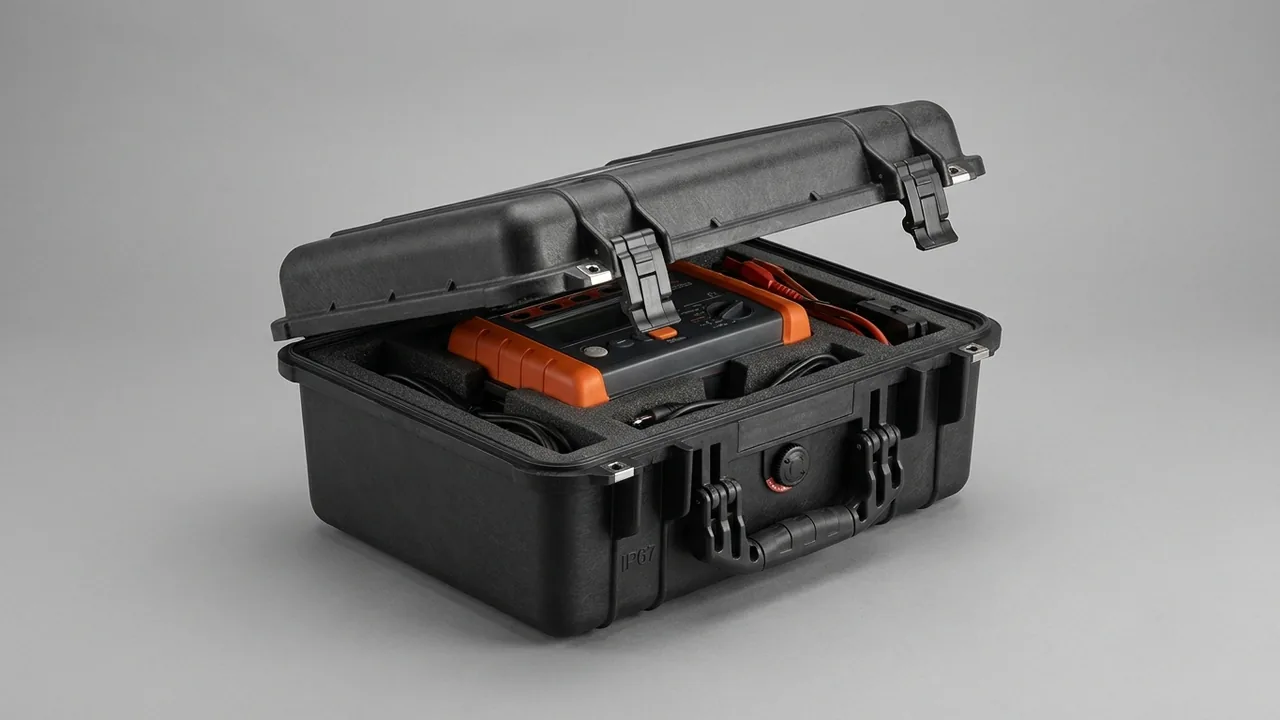
Shipping protection for desalination components is fundamentally a three-front defensive problem: chloride attack, residual moisture, and transport vibration. Reverse osmosis membrane elements cannot dry out, cannot be crushed and cannot be contaminated by organics. High-pressure pump mechanical seals and bearings cannot tolerate dampness or sustained vibration. Energy recovery device rotors and their sliding interfaces cannot survive impacts or embedded particles. Corrosion-resistant valves must arrive with flange and sealing faces at their original tolerances after weeks in a saline atmosphere. The practical conclusion is that desalination parts should not be packed with the generic crate-plus-bubble-wrap logic used for ordinary industrial goods. Membrane, pump and valve items each need their own cleanliness, humidity and vibration thresholds, and a custom insert that restrains every piece so it cannot touch its neighbours. JUNZHIJIA, manufactured by Kexin New Materials (Guangdong) Co., Ltd., builds this class of verifiable protective case for desalination and energy equipment buyers.
In real desalination projects, components are usually pre-assembled and tested at the equipment works, then broken down for shipment and re-assembled on site after a land journey of hundreds of kilometres or an ocean crossing. The most common claim triggers along the way are deformed membrane end caps, scratched internal coatings inside pressure vessels, corroded pump couplings and shaft ends, seized energy recovery rotors, and bruised flange sealing faces. None of these is necessarily fatal on arrival, yet each can amplify into lower salt rejection, higher specific energy consumption and unplanned shutdown after commissioning. The sections below follow a sequence of classification, threshold, insert, enclosure, testing and acceptance, and are written to be dropped directly into a purchase technical agreement.
Table of Contents
- Why desalination components are harder to protect than general industrial parts
- Transport protection for RO membrane elements and pressure vessels
- Moisture, vibration and oil seal protection for high-pressure pump internals
- Impact packaging for energy recovery rotors and sealing faces
- Chloride corrosion protection for corrosion-resistant valves and fittings
- Insert material selection and cross-contamination control
- Enclosure construction, IP ratings and the salt-laden environment
- Vibration and shock: applying environmental test methods to desalination hardware
- Hot and humid ocean freight: container temperature, humidity and condensation
- Lifting, stacking and packaging marking practice
- Cleaning, drying and residual water criteria before sealing
- Delivery acceptance: sampling plans and shipping documentation
- Frequently Asked Questions
- Conclusion and Further Reading
Why desalination components are harder to protect than general industrial parts
Three shared characteristics of desalination plant items rule out ordinary industrial packaging practice. First, material grades are high: pressure vessels are commonly filament-wound FRP or duplex stainless steel 2205 and 2507, wetted pump parts may be super austenitic or duplex, and valves and fittings often use titanium or nickel alloys. These materials are strong, but their surface condition is extremely sensitive. Once a passive film is scratched or contaminated by free iron, pitting propagates quickly under chloride service. Second, fit tolerances are tight: the rotor-to-end-cover clearance in an energy recovery device is often measured in tens of microns, so any particle or fragment released in transit can cause seizure. Third, the logistics chain is long. Large desalination projects sit on coastlines or overseas, so components pass through works transfer, road haulage, open yard storage, container shipping and a second handling cycle at site.
Looking at failure mechanisms, transit damage travels along four paths. The first is chloride corrosion, where marine atmosphere and salt accumulated inside a container accelerate pitting and crevice corrosion of stainless steel; neutral salt spray methods such as GB/T 10125 are a reasonable screening reference for materials and platings. The second is condensation, where day and night temperature swings push the internal relative humidity back and forth across the dew point and produce repeating wetting cycles. The third is mechanical shock and resonance, where heavy items shift, strike the case wall, or resonate at a frequency excited by road transport. The fourth is crushing and stacking load, which membrane elements and lined valves are least able to resist.
It is worth noting that desalination hardware and conventional pressure vessel components do not share the same priority list. The latter is mainly about shell lifting, head protection and weld integrity, as discussed in moisture control and lifting design for pressure vessel component cases. Desalination items invert that order: cleanliness of membrane and sealing surfaces comes first, moisture control second, and structural strength third. Get the order wrong and even high specifications deliver no real protection.
There is also a cost perspective that buyers often overlook. Membrane elements, ERD rotors and high-pressure pump mechanical seals are high-value, long-lead items, and overseas sites rarely hold spares. A single transit failure costs more than the replacement part, because it drags schedule claims behind it. Writing packaging requirements into the technical agreement at purchase stage is usually cheaper than arguing about liability after arrival.
Transport protection for RO membrane elements and pressure vessels
Reverse osmosis membrane elements normally leave the factory wet, soaked in a sodium bisulfite preservation solution. That state creates three packaging constraints: they must not dry out, must not freeze, and must not carry compressive load. If the packaging seal fails and the preservation liquid migrates away, the membrane leaves dehydrate and lose performance irreversibly. If the shipment passes through sub-zero conditions, residual water freezes and expands, damaging the membrane leaves and the end cap structure. Industry practice is to maintain internal humidity, avoid cold routing where possible, and add temperature and humidity indicator cards together with an insulating liner when exposure is unavoidable.
Crushing is the second most frequent damage source. An eight-inch element weighs roughly sixteen to twenty kilograms, and the radial stiffness of the wound leaf pack is far lower than its axial stiffness. Stacked upright or side-loaded, the roll tends to ovalise, which later shows up as poor seal seating and concentrate bypass. The sound arrangement is to keep elements horizontal and axial inside the case, with each piece supported by an arc-shaped cradle formed in closed-cell foam or EVA, wrapped radially, limited axially on one side only, and separated from its neighbours by a ten to twenty millimetre cushion gap. Total stack height should be verified against the compressive strength of the insert and is typically kept to three layers or fewer.
Pressure vessels shift the focus to the bore and the end plates. The resin-rich internal surface of an FRP vessel must not be scratched by tools or fasteners, so both ends should carry blind flanges or dedicated end-cap guards during shipment, and loose bolts or clamps should never be dropped inside the shell cavity. Vessels should travel horizontally, restrained by at least two straps positioned across the span rather than at the ends, so a long unsupported length cannot bend in the middle. End plates and retaining rings belong in separate compartments by model, and seals for a given model stay in their own bag with the size and quantity marked outside.
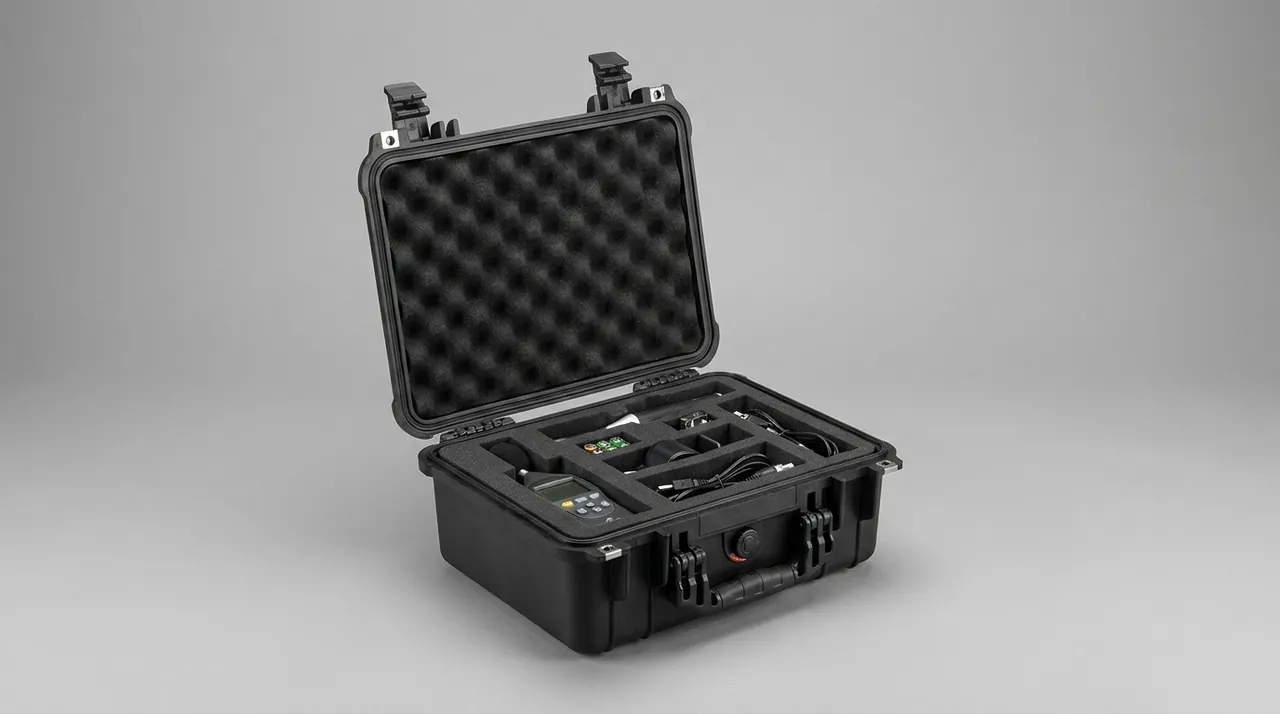
On insert design, JUNZHIJIA normally produces a single-piece EVA or PE insert from the customer's 3D models of the elements and vessels, combining cradles, limit blocks and tool pockets into one part so there is no chance of a different arrangement being improvised on site. For elements that will be returned or re-exported, we recommend cutting handle reliefs into the insert so operators cannot be tempted to lift the assembly by its end cap.
Moisture, vibration and oil seal protection for high-pressure pump internals
High-pressure pumps in seawater reverse osmosis service are usually multistage centrifugal machines or high-pressure plunger pumps with discharge pressures commonly between 55 and 70 bar. They frequently ship in a broken-down state: shaft, impellers, diffusers, mechanical seals, bearing housings, couplings and foundation bolts each packed separately and assembled on site. Break-down shipping reduces lifting weight but exposes every precision item individually to corrosion and shock.
Moisture control is the first gate. Machined shaft and impeller surfaces, silicon carbide and tungsten carbide seal rings, and bearing raceways are all mirror or near-mirror finishes, and even a short condensing cycle can leave rust stains behind. Workable practice is to apply a dewatering rust preventive oil or wrap in vapour corrosion inhibitor film, size the desiccant charge to the case volume, and use a humidity indicator card as the final inspection evidence. One caution: VCI performs predictably on carbon steel and cast iron, but its behaviour on duplex stainless and titanium needs separate evaluation rather than an assumption of universal suitability.
Vibration control is the second gate. An impeller is a thin-walled cantilever with low natural frequency, easily excited into bending vibration on gradients and broken road surfaces. Each impeller should therefore occupy its own insert cavity with a V-shaped or curved base support, closed by a top pressure plate so the part is restrained in both directions. The pump shaft should be supported at two points located close to the journals, with medium-hardness EVA shims rather than hard-on-hard contact. Couplings and keys are easily lost and belong together in a lidded compartment of their own.
The third constraint concerns elastomers. Oil seals, O-rings and gaskets degrade under ultraviolet light and heat, and permanent compression set destroys their sealing function. They should not be stored under heavy parts or left in a flattened state, but laid flat in shallow divided trays with material and hardness marked, so the site team cannot mix grades during assembly.
The table below lists a typical protection configuration for broken-down high-pressure pump parts. Treat it as a starting point for the technical agreement and confirm the actual parameters against pump model and routing.
| Broken-down item | Main risk | Recommended insert and restraint | Humidity control |
|---|---|---|---|
| --- | --- | --- | --- |
| Pump shaft | Bending, journal rust, impact damage | Two-point support on medium EVA blocks, axial lock | VCI film plus desiccant |
| Impeller | Cantilever resonance, blade distortion | Dedicated cavity, V-base plus top clamp | Wrapped in VCI film |
| Mechanical seal | Silicon carbide fracture, mirror scratching | Flat divided tray, release liner between faces | Desiccant and humidity card |
| Bearings | Raceway brinelling, rust | Original packaging retained, paired retention | Original pack plus desiccant |
| Coupling and keys | Loss, impact damage | Lidded compartment, quantity marked | Thin rust preventive film |
| O-rings and gaskets | Compression set, ageing | Flat divided tray, away from heat and light | Not applicable |
Note: the packing list for pump parts should mirror the assembly process card, and the loading sequence should follow the reverse of the site assembly order so crews are not digging through the case on site.
Impact packaging for energy recovery rotors and sealing faces
The energy recovery device is among the most transport-sensitive items in a desalination plant. Whether centrifugal, rotary or turbine type, the shared characteristic is that axial and radial clearances between rotor and end cover are minimal, typically in the tens of microns. If foreign matter enters the interface during transit, or if the case takes an impact large enough to cause plastic deformation, the rotor can seize. Field repair of these units is expensive and often means a return to the factory.
The protection logic has four parts. First, rigid support combined with elastic damping: a pallet or base plate provides the rigid datum, while rotor support uses a hardness-gradient insert in which a firmer layer carries the load and a softer layer absorbs high-frequency vibration. Second, attitude control: many ERDs can travel horizontally, but some designs with rolling supports require the rotor axis to stay vertical. The manufacturer's technical documentation governs here, and guesswork is not acceptable. Third, cleanliness control: the packing area should not run grinding, blasting or cutting operations at the same time, inserts should be wiped and particle-checked before use, and cleanliness levels can be described using the vocabulary of ISO 4406. Fourth, moisture and rust prevention: wetted parts are largely stainless and ceramic, yet shaft ends, keyways and threaded holes still need corrosion protection.
Ceramic and silicon carbide sliding faces are brittle materials that resist compression poorly in tension and are highly sensitive to local point contact. Two mating faces must never travel in direct contact: a polymer release liner goes between them, and metal tools must never be used to pry them apart. Locating pins, retaining rings and adjustment shims should be compartmentalised by part number, because an incorrect shim thickness discovered only at assembly creates a clearance problem that has nothing to do with shipping damage.
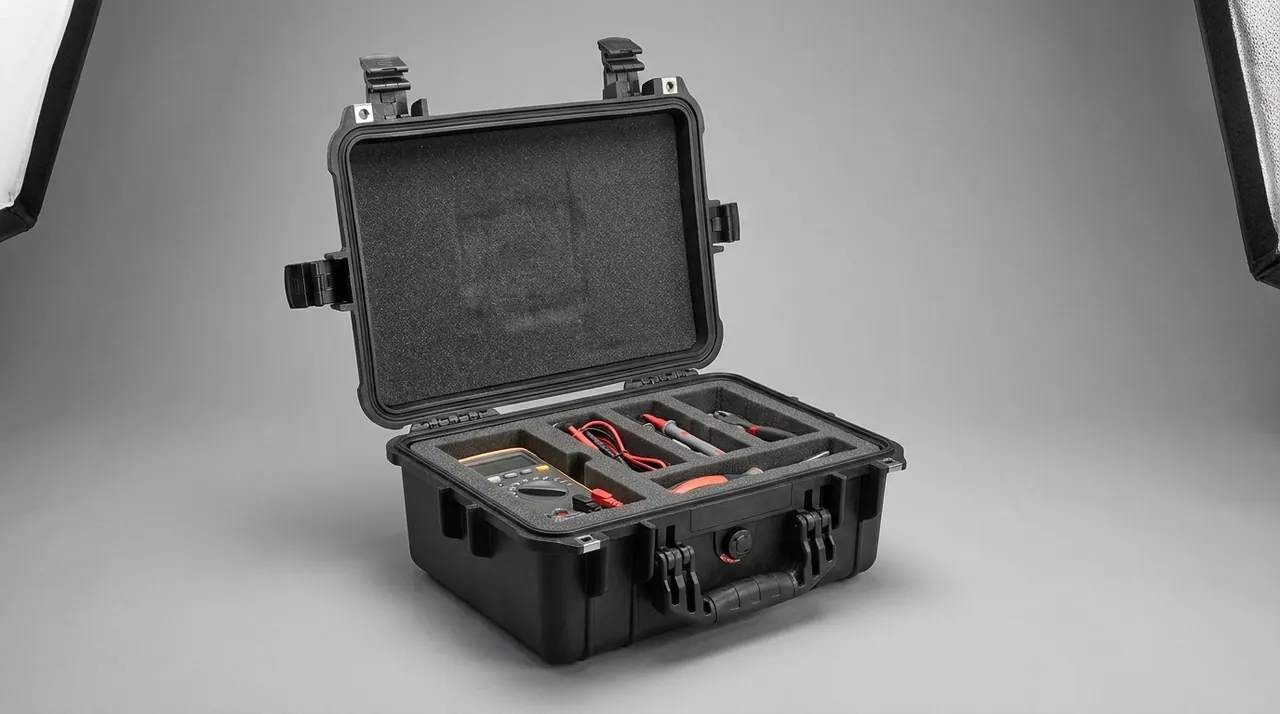
For projects shipping complete units, fit a three-axis shock indicator label inside the case so arrival condition can be judged objectively. Data loggers and indicators are not mandatory, but on a high-value ERD their cost is trivial next to a claim where responsibility cannot be established.
Chloride corrosion protection for corrosion-resistant valves and fittings
Valves and fittings in a desalination plant are typically duplex stainless, super austenitic, titanium, or lined carbon steel bodies. Their corrosion resistance depends on a passive surface film, and that film is vulnerable to three things: mechanical scratching, free iron contamination, and prolonged wet chloride exposure. Transport protection therefore concentrates on flange faces, sealing surfaces and threads.
Flange faces are the easiest to injure. Both raised-face and ring-joint geometries require controlled flatness and roughness, and a single strike from a wire rope, hook or neighbouring part can force re-machining or replacement on site. Fit plastic protective caps or rigid plastic rings to flange faces, keep two flange faces from touching directly, and separate parts from each other with dividers. Use nylon slings or dedicated lifting gear, and never wrap wire rope directly around stainless components.
Crevice corrosion under chloride exposure tends to start around flange gaskets, threaded joints and weld heat-affected zones. Before packing, these areas should receive a neutral rust preventive or vapour phase inhibitor film. Never clean with chlorine-containing solvents, and never mix carbon steel parts into the same case: iron-rich corrosion debris from carbon steel is enough to initiate pitting on stainless surfaces. This matters especially on export projects, where container salt loading can far exceed anything seen inside the works.
For material and coating screening, neutral salt spray is the most widely used accelerated method, and the exposure duration should follow the project environment and the customer specification, with 480 hours and 720 hours being common acceptance references. Salt spray results support relative comparison only and cannot be converted into field life. Related thinking appears in transport and storage protection for corrosion-resistant valves and in seal material selection for seawater and high humidity duty.
Lined valves, whether PTFE, EPDM or rubber, need extra care against permanent deformation. A lined valve should not be stacked upright, and no concentrated load should be applied to the lining. The disc should be left slightly open or set to the position the manufacturer specifies, so transport vibration cannot rub the sealing surfaces against each other.
Insert material selection and cross-contamination control
The insert carries the actual protective duty, and the wrong material is worse than no insert at all. Selection has to satisfy mechanical performance, chemical compatibility and cleanliness at the same time. Mechanical criteria cover density, compression set, resilience and compressive strength. Chemical criteria cover plasticiser migration and compatibility with oils and seawater. Cleanliness criteria cover particle shedding and migratable halogens.
| Insert material | Density and hardness | Suitable items | Points to watch |
|---|---|---|---|
| --- | --- | --- | --- |
| Moulded EVA | Low to medium density, tunable hardness | Membrane cradles, precision part dividers | Verify compression set under long heavy loads |
| Closed-cell PE foam | Medium density, good resilience | Valves, fittings, general metal parts | Lower temperature ceiling, keep away from heat |
| EPDM rubber pad | High density, weather and water resistant | Heavy bases, anti-slip lining | Confirm compatibility with the specific grease |
| Cross-linked XLPE foam | Medium to high density, load bearing | Base cushioning under heavy items | Not suitable against precision mirror finishes |
| Anti-static foam | Controlled surface resistivity | Items carrying instruments and controls | Earthing path must be designed with the case |
| PP honeycomb board | High stiffness, low water uptake | Dividers and structural supports | Edges must be sealed to prevent cuts |
Cross-contamination is a risk specific to desalination hardware. Membrane elements are extremely sensitive to organics, and an insert that releases plasticiser or mould release agent will deposit it on the membrane surface and reduce flux. Membrane inserts should therefore use low-migration formulations and be allowed to ventilate thoroughly after moulding. VCI film works well on carbon steel, but its vapour phase chemistry needs assessment before long contact with certain alloys and polymers; for stainless and titanium, physical isolation plus desiccant is the safer route than relying on vapour phase inhibition.
Inserts also serve a mistake-proofing function. Moulding the seals, fasteners and locating pins of one pump into position saves list-checking time on site and lowers the chance of wrong assembly. For projects mixing several sizes, we generally recommend that each case carry parts from a single work station or system, with part numbers embossed into the insert itself.
Enclosure construction, IP ratings and the salt-laden environment
The case is the last barrier, but a higher rating is not automatically a better choice. Desalination projects need to separate two scenarios: works storage and short local transfer, which require only dust and splash protection, and intercontinental sea freight with long open-yard storage, which justifies a higher dust and water rating. Choosing IP67 indiscriminately creates pressure differential problems, difficult opening and unnecessary cost.
Under IEC 60529 and GB/T 4208, IP54 resists splashing from all directions, IP55 tolerates low-pressure water jets, IP65 combines jet resistance with complete dust sealing, and IP67 permits brief immersion. For component cases travelling inside a freight container, IP55 to IP65 is normally sufficient, because the case itself is not immersed; the real adversary is condensation and thermal cycling inside the container. When a case must cross routes with large temperature swings, fit a pressure equalisation valve so internal and external pressure equalise slowly, rather than letting the gasket be forced open by differential pressure or drawing damp air in at the moment of opening.
Hinge and latch design must deliver both strength and durability. Heavy cases are better served by metal hinges with bushings, twin latches, or catches with padlock holes, and by gaskets in moulded silicone or extruded EPDM with moulded corners or thermally welded joints instead of butt seams that leak. Design detail for hinges, latches and gaskets is covered in hinge, latch and seal design for protective cases and in the IP67 protective case rating explained guide.
Enclosure material follows from unit weight and handling method. Rotationally moulded polyethylene resists impact and corrosion and can be produced as a large one-piece body, suiting heavy pump assemblies and pressure vessels. Injection moulded polypropylene holds tighter dimensional tolerance, which suits precision parts and divided inserts. Very heavy items often call for a steel frame with composite panels, letting the frame carry stiffness and the shell carry sealing. Whatever the construction, provide forklift pockets or a pallet interface, and mark centre of gravity and lifting points on the sides.
Vibration and shock: applying environmental test methods to desalination hardware
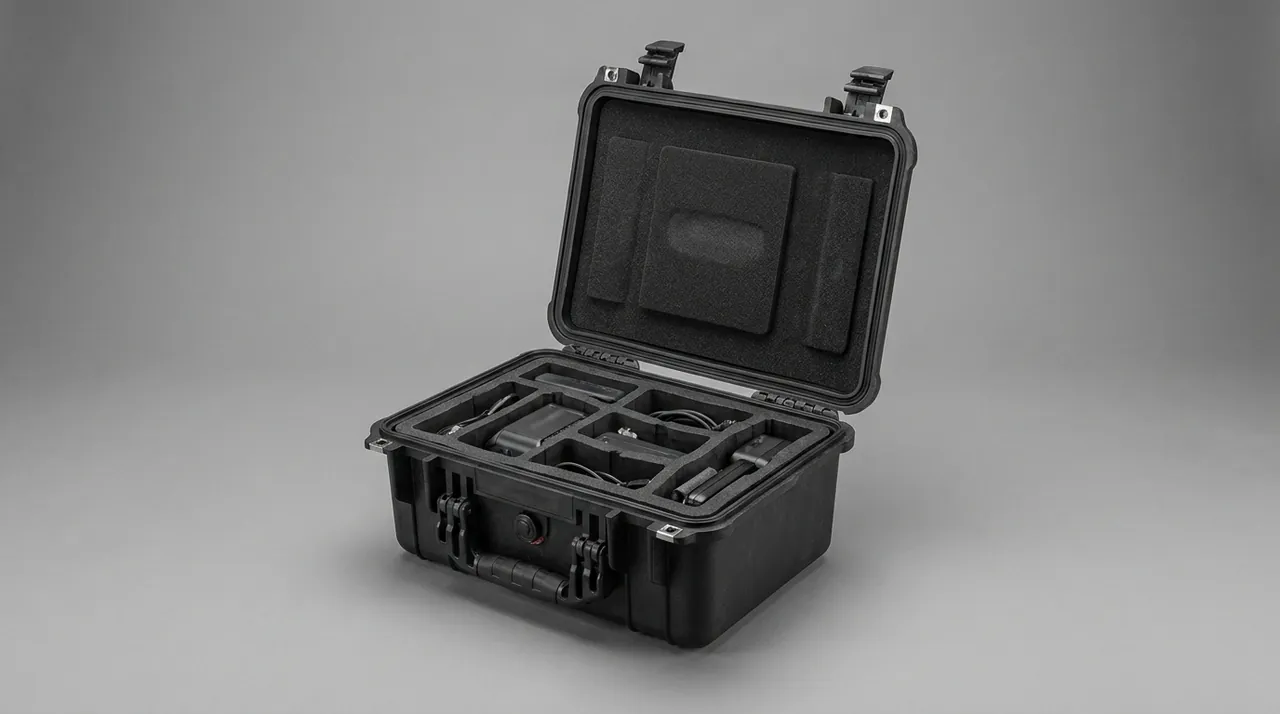
Transport vibration causes harm in two ways: direct damage from a single shock event, and fatigue damage accumulated during sustained resonance. For desalination hardware, ceramic sealing faces and FRP pressure vessels are the typical victims of the first, while impellers, rotors and long shafts suffer the second.
On methods, MIL-STD-810H Method 514 for vibration and Method 516 for shock are frequently cited as methodological references for environmental testing. It should be stated plainly that citing a test method is not the same as holding a military certification, and project acceptance should follow the conditions agreed between the customer and the third-party laboratory. In commercial logistics, ASTM D4169 offers a framework for selecting test sequences according to the distribution cycle, while the ISTA series suits whole-case simulated transport validation. In the Chinese standards system, the GB/T 4857 series covers drop, stacking, fixed-frequency and random vibration methods separately.
In practice we recommend the following order. Identify the weakest element of the assembly and its natural frequency, either from the manufacturer or by modal testing. Then choose a random vibration spectrum that covers that frequency band. Finally, use drop or shock testing to verify the restraining capability of the case and insert. Where natural frequency data is unavailable, widen the frequency coverage and reduce the acceleration level rather than risk damaging the article during the test itself.
Experience shows three problems surface most often in testing. First, the insert cavity is oversized, so the part shifts and strikes the cavity wall. Second, restraint is applied on one side only, so the part lifts on the return stroke. Third, strap anchor points are too far apart, leaving a long item with significant mid-span amplitude. Fixing these during design and sampling costs far less than reworking a production batch.
Hot and humid ocean freight: container temperature, humidity and condensation
Desalination components crossing an ocean do not face steady high humidity but cyclical condensation. Container internal temperatures on equatorial routes can reach 55 to 65 degrees Celsius and fall below 20 degrees at night, so relative humidity repeatedly crosses the dew point and water vapour condenses on the coolest metal surfaces. That film of condensation is where corrosion begins, and if membrane packaging does not seal properly, moisture migration also dilutes the preservation solution.
Control operates at three levels. The first is to lower the initial internal humidity: confirm parts are dry before packing, avoid open-case work in rain or during humid hours, and aim for an internal relative humidity below roughly 40 percent at closing. The second is desiccant selection: estimate the charge from internal volume, voyage duration and vapour transmission rate. Montmorillonite clay is economical but has limited capacity, while silica gel and calcium chloride absorb more but must be prevented from leaking liquid. Bagged desiccant with absorption indicators plus a humidity indicator card is a practical combination. The third level is blocking moisture ingress: for high-value precision items, aluminium foil laminate with vacuum or partial vacuum packaging cuts the vapour path entirely.
One reminder: a perfectly sealed case is not always better. A completely airtight box develops a pressure differential as temperature changes, and the gasket may deform or fail under that load, a point discussed at length in case material selection for extreme temperature environments. Fitting a pressure equalisation valve, charging sufficient desiccant, and evaluating gasket resilience at low temperature is the more reliable combination.
For items containing hydraulic oil, preservation fluid or residual water, assess viscosity change and freezing risk at low temperature. Where routing crosses cold regions, confirm that the liquid freezing point sits below the lowest route temperature, or switch to dry shipment and fill on site.
Lifting, stacking and packaging marking practice
Desalination component weights span a wide range, from a few kilograms of valve trim to tonne-class pump bodies and vessel assemblies. Lifting safety and case strength must be checked against the heaviest item, and the case lifting provisions designed around the heaviest item's centre of gravity.
For lifting, mark lifting point positions and permitted sling angles on the case sides, and fit four lifting eyes or two through-type sling channels on heavy cases. Never push a case sideways with forklift tines, and avoid inserting tines beyond two thirds of the case length, which concentrates load and distorts the base. Where internal parts are cantilevered, keep lifting acceleration within the design allowance.
For stacking, determine the maximum number of tiers from insert compressive strength and case wall stiffness. As a rule of thumb, precision-part cases should not exceed three tiers and heavy-part cases should not exceed two, with a stacking limit marked on the case. When palletising for sea freight, add anti-slip pads between pallet and case so the assembly cannot slide during vessel roll.
Packaging marks should follow GB/T 191 and GB/T 13384 and include at minimum: this way up, keep dry, centre of gravity, do not roll, stacking limit, and item number. Marks belong on two adjacent sides, not one, so yard staff can read them from either approach. Attach a packing list and a short lifting instruction sheet to every case.
Cleaning, drying and residual water criteria before sealing
Many corrosion problems in transit are not packaging defects at all but incomplete cleaning and drying before the case is closed. Desalination parts frequently retain rinse water after factory testing, and if that water carries a high chloride content and is not fully dried, the result is a concentrated salt film sealed inside the case.
Cleaning practice rests on three points. First, control the chloride content of rinse and wipe water, with a working target below roughly 20 ppm for rinse water and a final wipe using deionised water or a chlorine-free solvent. Second, never blow stainless surfaces with oil-contaminated compressed air; the oil film becomes a crevice corrosion initiation site. Third, draw off standing water from flange faces, seal grooves and threaded holes with lint-free cloth, and use dry nitrogen where a blind cavity makes wiping impractical.
Drying judgement should be recorded, not estimated. Common practice is to measure internal relative humidity with a portable meter before closing and to place a humidity indicator card inside. For parts with complex internal cavities, spot-check cavity air with a dew point meter. Closing should not take place in rain or during humid periods; where that is unavoidable, work inside a sealed dry room.
Packing records matter just as much. Keep photographs or video covering the insert and cavity, the restrained state of each item, indicator labels and desiccant placement, and the humidity reading before closure. Those records are the most direct evidence in a claim and also help improve the next batch.
Delivery acceptance: sampling plans and shipping documentation
The purpose of acceptance is not to find faults but to confirm that the packaging plan has been executed under the design conditions. We suggest three layers: appearance and marking, structure and sealing, and contents and protection state.
Appearance and marking checks cover pre-shipment damage to the case, completeness of marks, and item numbers matching the list. Structure and sealing checks cover hinge and latch operation, gasket continuity, pressure equalisation valve function, and absence of case deformation. Contents and protection checks cover insert assembly to drawing, absence of part-to-part contact, strap tension, desiccant and indicator quantities, and humidity readings within the specified range.
Batch deliveries normally use sampling inspection. Sampling plans can follow the general inspection levels and acceptable quality limits of GB/T 2828.1 or ISO 2859-1, with critical characteristics such as insert dimensions, restraint geometry and humidity readings handled by tightened or full inspection, and minor characteristics such as print content and surface colour handled at general level. For a first collaboration or a new mould, first-article confirmation with retained photographs is advisable.
Shipping documentation should include at minimum: packing list, insert material and specification note, seal configuration list, desiccant type and quantity, a summary of packaging test reports where available, and recommendations for site opening and interim storage. For export projects, state the quarantine treatment status of any wood packaging. Solid wood must meet ISPM 15 heat treatment or fumigation requirements and carry the IPPC mark; plywood, laminated board or non-quarantine composite materials avoid the issue entirely and are the simpler route.
On long-lead projects such as desalination plants, packaging documents are best archived alongside equipment technical files, so that when a case is opened years later the site team can still find insert materials, desiccant replacement intervals and recommended storage conditions. Related acceptance thinking appears in transport test procedures and validation methods and in custom foam insert design and acceptance.
Frequently Asked Questions
Q: Can RO membrane elements be shipped dry to reduce freight cost? A: Usually not advisable. Membrane elements leave the factory soaked in a sodium bisulfite preservation solution, and the leaves keep stable performance while wet. Once dehydrated, the surface structure and desalination layer degrade irreversibly. Dry packaging requires a dedicated factory process and a documented re-wetting procedure that ordinary projects cannot reproduce on site. Where a customer wants to cut freight by reducing weight, the practical route is to optimise the structural density of vessels and cradles, or to consolidate elements of the same size into one packing unit, rather than draining the preservation fluid. If dry shipment is genuinely required, the technical agreement should state the manufacturer's re-wetting sequence, the permitted dehydration window and the acceptance criteria, and the goods must be processed immediately on arrival rather than stored. Wet or dry, avoid routing below zero degrees Celsius, because freezing and expansion of residual water damages both the leaves and the end cap. Where a project stages elements in a temperature controlled store before installation, log the store readings and rotate stock so the oldest preservation charge is installed first rather than left on the shelf.
Q: Should a desalination high-pressure pump ship broken down or as a complete unit? A: It depends on project conditions. Complete-unit shipping reduces site assembly work and the risk of wrong assembly, but raises lifting weight, demands a stronger case and greater crane capacity, and cannot fully eliminate mechanical seal risk under transport vibration. Break-down shipping keeps individual weights manageable and lets every piece be cushioned independently, but seals and fasteners are easily lost or mixed up, and site alignment and levelling work increases. Most large overseas projects take a middle path: the pump casing and baseplate ship assembled, while shaft, impellers, mechanical seals, bearings and coupling travel in separate cases. Either way, the technical agreement should state the shipment state, the accompanying list and the site assembly requirements, and the pump maker should confirm the permitted rotor attitude and support arrangement inside the case. One further practical point applies to either choice: label every case with the pump serial number and the assembly stage it belongs to, because a desalination plant may run four or six parallel trains whose components are visually identical but not dimensionally interchangeable after wear allowances are applied.
Q: Must an energy recovery device be kept vertical during transport? A: Not universally, and the manufacturer's technical documentation must govern. Sensitivity to attitude varies widely between designs. Some rotary configurations tolerate horizontal shipment provided the rotor does not carry a gravity-induced offset load, while designs with rolling supports or special axial location may require a vertical attitude. At packaging design stage, request three pieces of information: the permitted transport attitude, the maximum permitted acceleration, and whether the rotor needs a dedicated anti-rotation lock. If no clear answer is available, default to the conservative arrangement, which means vertical stowage, a locked rotor, a three-axis shock indicator on the case, and inspection of that indicator before opening on arrival. Also ask whether the unit was shipped with a temporary transport lock fitted at the factory, since a lock left in place by mistake causes exactly the seizure the lock was meant to prevent once the pump starts. Above all, record the answer in the case documentation so the site team is not left guessing at unpacking.
Q: How many hours of salt spray testing qualify a desalination component? A: There is no single answer, because the result depends on material, surface treatment and service environment. Neutral salt spray testing, such as the method specified in GB/T 10125, is a screening and comparison tool, with 240, 480 and 720 hours being common acceptance checkpoints. Components for coastal or ocean-freight projects are usually expected to show no significant corrosion after 480 hours. For titanium and duplex stainless, which are inherently corrosion resistant, the test mainly validates platings, coatings and fasteners rather than the parent metal. One important caution: salt spray results cannot be converted directly into field life and do not replace a real service-condition assessment. The sound approach is to write the test conditions, acceptance criteria and specimen surface condition into the technical agreement, and to set separate requirements for fasteners and marking components. Note also that the salt spray chamber is a comparative tool, not a transit simulation: a case that passes 480 hours in the chamber can still rust in a container if a carbon steel part was packed alongside it, which is why mixed-material packing is worth prohibiting in writing.
Q: Can solid wood crates be used on export projects? A: Yes, subject to wood packaging quarantine requirements. Under ISPM 15, solid wood packaging material must be heat treated or fumigated by an approved method and carry the IPPC compliant mark, otherwise destination customs may detain, return or destroy the shipment and charge the costs to the exporter. For high-value equipment such as desalination hardware, the schedule risk from a detained container usually far exceeds the price difference in packaging material. We therefore recommend plywood, laminated board, honeycomb composite panels or non-quarantine composite cases for export items, since these fall outside the solid wood category and clear customs more smoothly. If a customer still requires solid wood, confirm that the supplier holds the treatment qualification and can provide certificates and photographs of the applied marks. Reusable heavy cases are another way to reduce wood consumption altogether, and they also remove the repeated inspection burden that fresh timber crates create on every shipment.
Q: How much desiccant belongs in a case, and how often should it be replaced? A: The charge depends on internal volume, sealing class, voyage duration and ambient temperature and humidity, and there is no universal formula. Engineering practice is to estimate from the free air volume inside the case, apply a safety factor for the transport period, and verify the result with a humidity indicator card. On long ocean voyages, the working approach is to size the design absorption capacity well above the expected moisture ingress, with a factor of two or more. Note that aged gaskets, a permanently open equalisation valve or a hairline crack in the case wall all increase vapour ingress sharply, and simply adding desiccant will not solve that. Run a simulated transport with humidity tracking during the trial stage to establish the real ingress rate for that case type, then fix the charge and write the replacement interval into the accompanying instructions. For components held in an open yard for months before installation, plan a periodic desiccant service visit rather than assuming the original charge will hold until commissioning.
Q: Can insert materials release substances that contaminate membrane elements? A: The risk is real, which is why membrane inserts are specified more strictly than inserts for general metal parts. There are three main sources: plasticisers, foaming aids and mould release agents in the foam formulation migrating as temperature rises; low-molecular volatiles from the material itself accumulating in a closed case and depositing on the membrane surface; and particle shedding from the insert. Controls include selecting low-migration EVA or PE grades and requesting volatiles and migratable substance data from the material supplier; ventilating moulded parts thoroughly so residual volatiles escape first; placing a clean barrier film between element and insert; and preventing direct contact between the insert and greases or release agents. For higher cleanliness projects, the packing area dust class can be specified using the vocabulary of ISO 14644. When a supplier cannot provide migration data, request a sample of the finished insert and run a simple odour and weight-loss check after conditioning at elevated temperature before approving the mould.
Q: Can desalination component cases be reused, and how is their life assessed? A: Yes, provided inspection and scrapping criteria are defined for the actual service. Rotationally moulded polyethylene case bodies last a long time in normal use, but hinges, latches, gaskets and pressure equalisation valves are wearing items with far shorter lives than the shell. Reusable cases should have a checklist applied after each return: gasket permanent set or nicks, hinge looseness, case cracks or permanent deformation, and whether the insert still restrains the contents. Inserts usually fail before the case body, especially cradles that carry heavy items continuously and take compression set; once an item can visibly shift inside its cavity, the insert must be replaced. For the repeated round trips common in desalination projects, list the wearing parts as line-item spares with the shipment and engrave a unique serial number on each case so usage cycles can be tracked. Re-verify humidity performance before every re-dispatch, and if a case is reassigned to a different item type, cut and verify a new insert rather than trimming foam on site.
Conclusion and Further Reading
No single packaging formula covers desalination hardware. Membrane elements must hold their humidity and crush limits, pump internals need moisture and vibration controlled together, energy recovery devices depend on preserved clearance, and valves must balance salt spray exposure against process cleanliness.
JUNZHIJIA provides custom inserts, model-matched seals and OEM or ODM programmes for desalination buyers.
Further Reading