


Dredging pumps move high-density, sand- and gravel-laden slurries in river, lake, harbor and reclamation projects, and their impellers, casings, liners and shaft seals are the wear-exposed flow components that decide uptime. Most of these parts are cast from high-chrome iron, Ni-Hard iron or duplex stainless steel, with unit masses ranging from a few tens of kilograms to several tonnes, irregular geometry, thin walls, sharp edges and cantilevered structures that make them vulnerable to impact cracking, edge chipping and salt-spray corrosion during long-haul trucking, port handling and ocean container shipping. JUNZHIJIA holds that transport protection for dredging pump wear parts must not follow the uniform-cushion logic of a generic equipment case; instead it must treat the brittle hardness of high-chrome castings, the lifting-center-of-gravity of large casings and the salt-spray corrosion of sand-laden environments as three separate design problems solved by compartmentalized location, compression-resistant liners and repeatable seals. This article works from the failure mechanisms of each component and lays out a quantifiable, executable protection scheme for factory shipment, spare-parts logistics and maintenance turnaround.
A frequently underestimated loss in dredging operations sits in the spare-parts logistics chain rather than on site. Impellers and liners are surface-hardened to above HRC58, which makes them harder yet far more brittle and far more sensitive to local impact; loose straw or crushed foam in a wooden crate cannot restrain the off-center mass, so hard braking, ship roll and forklift jolts let the casting strike its neighbors, producing chipped edges, lost material and even invisible through-microcracks that later propagate into fractures under water-side stress. Large casings exceeding three meters in size, if the case lacks rigid support and lift-point guidance during turning, let box deformation press directly on flange sealing faces and ruin flatness. The most hidden risk is the shaft seal and mechanical seal: nitrile and fluoroelastomer rubber and tungsten-carbide rings are extremely sensitive to humidity and dust, and once the seal fails in sand-laden sea air the precision mating faces are already scrap before arrival. This article gives procurement, warehouse and overseas project-logistics staff a measurable plan that avoids the trap of saving on packaging while losing the part.
Transport Risk Profile of Dredging Pump Wear Parts
A dredging pump is a classic heavy-abrasive machine, and its flow components rub at high speed against sand, shell and coral debris, so the protection case must first answer what it protects and where it fails. Transport-stage damage concentrates in four categories: brittle edge chipping, collision from lost center-of-gravity control, salt-spray rust, and contamination of precision seal faces. High-chrome iron such as Cr26 or Cr30 grades offers excellent erosion resistance but low fracture toughness, with impact energy in drop-ball tests only about half that of ordinary carbon steel, meaning the same drop height is far more likely to shatter it. Ni-Hard iron behaves similarly and is hard to weld-repair, so on-arrival material loss is rarely field-recoverable. Duplex stainless casings are tougher but large thin-wall castings easily take permanent deformation under bending, and once flange flatness exceeds tolerance the whole machine assembly suffers. Stack these risks onto the sand-heavy, humid, salt-spray dredging environment and transport protection becomes a system covering material understanding, structural fixation, environmental isolation and document traceability rather than merely putting a part in a box.
Impeller: Impact Protection and Mass Centering for High-Chrome Castings
The impeller is the most critical and most fragile rotating component, with common forms including closed, semi-open and the double- or triple-vane structures favored by slurry pumps. Unit weight runs from tens of kilograms to over a tonne, with a center of gravity clearly offset from the geometric center, so a large-passage, back-shrouded impeller that is only edge-foam-padded in the case will swing under braking and drive blade tips into the wall. JUNZHIJIA first determines the impeller center of gravity from 3D scan or factory drawings, then configures CNC-machined EVA or XLPE location blocks that fit the hub bore and vane gaps precisely so the impeller is embedded rather than placed; cantilevered blade ends receive adjustable nylon restraints that absorb lateral shock. For high-chrome impellers the locator hardness must be lower than the casting to avoid reverse scoring, and the contact face carries non-woven or PE film to stop transport micro-motion wear from embedding metal powder into hardened-layer microcracks. See the custom foam inserts guide for the general method of molded location. The figure below shows compartmentalized fixation molded to an impeller model.
In practice the impeller is first re-checked for airtight and balance marks before boxing, and inlet and outlet edges are wrapped with corner guards; the case floor carries a 15 to 25 mm closed-cell foam layer to spread vertical forklift shock. For impellers beyond 1.2 m diameter, use bidirectional top-press and bottom-support constraint, where the top block is pre-tensioned through four corner screws with torque graded by casting mass, avoiding both crush-cracking the hub and losing stability from looseness. On long ocean voyages a moisture plug is seated in the hub bore to stop salt spray entering the keyway through the shaft hole.
Casing: Lifting and Load-Bearing Design for Large Castings
The dredging pump casing, including volute, suction cover and discharge elbow, is mostly a large thin-wall iron or duplex stainless casting with irregular shape, offset center of gravity and demanding flange flatness. The transport difficulty here is less about cushioning than about load bearing and lifting: the case must carry several tonnes of static load without collapse, and during port turning the internal rigid frame must not impose extra bending moment on the casting. JUNZHIJIA embeds a steel load tray or aluminum profile skeleton in the case floor so the casting weight distributes through legs to the outer frame rather than the bottom foam; contact points with the tray get epoxy pads to spread pressure and avoid local foam crush. For casings exceeding the door opening, a split lid or top lift port is used with shop crane and external guide slings, eliminating in-box prying.
Load design needs static check: the rated stacking load should be at least unit mass times a 1.5 safety factor, plus the compaction load of stacked containers above. In the logic of shock and seal transport cases, impact resistance and static compression are two independent metrics; a large-casing case should prioritize static compression with impact as secondary, and the inner foam only needs to absorb a 0.3 to 0.5 m free drop, since over-thick foam steals load space. Lift points are marked on the four outer corners with color rings distinguishing single-point from four-point lifts, and a center-of-gravity symbol is posted so port handlers read the correct method at a glance.
Liners and Volute: Isolation Protection for Heavy-Abrasive Wear Faces
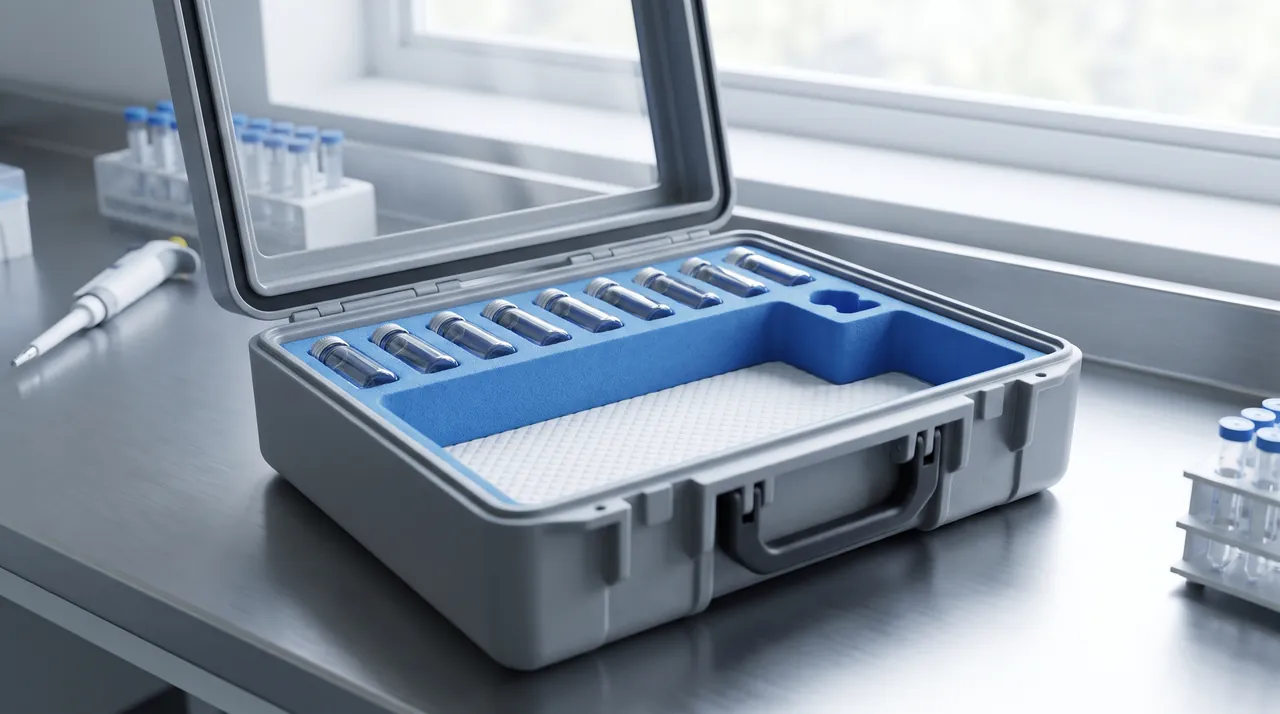
Liners, front and rear wear plates and volute liners are the most frequently replaced wear parts, again mainly high-chrome iron, relatively flat but sharp-edged and surface-quenched to hard and brittle. The typical transport problem is stacked crushing and edge chipping: if several plates are stacked directly, the bottom edge cuts into the upper surface under vibration and arrives as stepped material loss; if wire rope binds them directly, the tightening point creates stress-concentration cracks at the edge. The correct method isolates each plate with corrugated or HDPE spacers at least 5 mm thick with rounded corners to avoid puncture; for large volute liners, vertical slots in the case let plates stand like files in molded foam, preventing both crushing and swaying. The figure below shows the vertical separator slots for multiple liners.
Isolation of heavy-abrasive faces must also consider reverse abrasive damage: if quartz sand or shell debris remains on the liner surface, transport vibration lets grains scratch the hardened layer repeatedly, weakening the corrosion layer after installation even if no immediate damage shows. Therefore before boxing the part must be flushed with high-pressure air or fresh water and fully dried, then oil-sealed after residual sediment is cleared. For located liners with bolt holes, plastic plugs block the holes to stop sand entering threads and causing tap slip on installation. The single-piece isolation and hole-plugging principle that JUNZHIJIA summarized in ball mill liner cases applies equally to dredging pump liner turnaround.
Shaft Seal and Mechanical Seal: Moisture and Dust Control for Precision Parts
The shaft seal and mechanical seal are the most delicate parts of a dredging pump: the tungsten-carbide or silicon-carbide rings of a mechanical seal, together with rubber O-rings and spring elements, are extremely sensitive to humidity, dust and temperature swing. In sand-laden sea air, if seals are mixed with castings, grains entering the seal face scratch it before arrival and guarantee leakage after installation. JUNZHIJIA separates the shaft seal into a precision sub-case placed inside an independent compartment of the main case; the sub-case uses full-wrap anti-static EVA and built-in silica desiccant at 50 to 80 g per cubic meter of cavity, combined with the IP67 protective case body seal to keep relative humidity below 50 percent long term. Desiccant is packed separately and dated, and ocean transit beyond 60 days should prompt mid-voyage replacement or destination inspection.
Mechanical seal springs and drive parts cannot take side compression, so the seal is laid axially horizontal and never stacked; O-rings and rubber must avoid oil and ultraviolet light, and the case carries a keep-out-of-light label. A cartridge mechanical seal travels as one unit fixed in place, never disassembled and scattered, to avoid losing spring preload. On arrival the seal face is inspected in a clean environment with a brightness meter or white-cloth wipe, and any scratch is rejected. Once contaminated, cleaning cost often exceeds the part itself, so isolation protection has an exceptionally high return on investment.
Rust Prevention and Salt-Spray Protection in Sand-Laden Environments
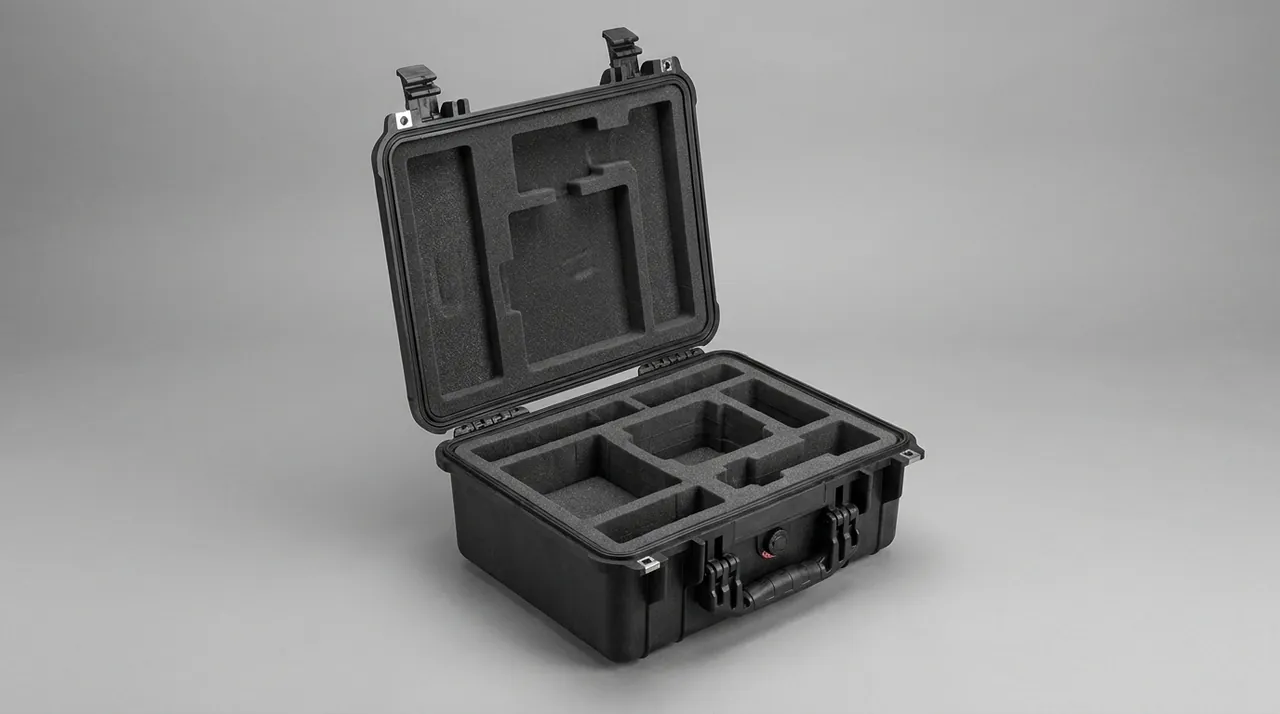
Dredging pump parts often end their journey at coastlines, estuaries or offshore platforms where chloride concentration is high and humidity is large; high-chrome iron resists wear but is not stainless, and under chloride it still suffers pitting and crevice corrosion, especially at exposed grain boundaries after riser and flash grinding. Rust prevention starts with surface cleaning: after removing residual sand, oil and water, spray hard-film rust oil or water-based inhibitor on non-mating faces and wrap with VCI paper, whose vapor forms a protective film effective on both iron and stainless steel. Mating faces, seal faces and threads must not be oiled and instead use rust paper alone to avoid oil film harming assembly precision. The figure below shows the in-case rust-proof packaging flow for sand-laden sea air.
Salt-spray protection is directly tied to case sealing. JUNZHIJIA recommends IP65 or above for dredging pump cases bound for offshore projects, with dual nitrile rubber seals around the lid and the clamping structure of toolbox hinge latch seal to isolate the interior from salt-spray air; latches need anti-loosening design to stop the lid popping open during ship roll. For spare parts stored longer than three months, even with VCI inside, keep the warehouse ventilated on dunnage away from direct sea wind and check desiccant and seal condition every 30 days. Salt-spray testing can sample against GB/T 10125 neutral salt spray, where typical iron castings should show no base red rust after 96 hours.
Liner Material Selection: EVA, PE and Wear-Layer Comparison
The dredging pump case liner must trade off cushioning, load bearing, wear resistance and moisture resistance, and common materials differ sharply. The table below compares frequently used liners to aid selection by component type.
| Liner material | Cushioning | Compression load | Wear resistance | Moisture | Typical use |
|---|---|---|---|---|---|
| --- | --- | --- | --- | --- | --- |
| EVA foam | Medium | Low | Medium | Good | Impeller location, precision wrap |
| XLPE foam | Good | Medium | Medium | Excellent | Medium casting buffer |
| PE / HDPE board | Low | High | Excellent | Excellent | Liner spacer, load tray face |
| PU pour | Excellent | Medium | Good | Medium | Irregular part wrap |
| EPP molded | Excellent | Medium | Medium | Good | Reusable case core |
Real configuration is usually composite: a load layer of HDPE board or aluminum skeleton, a buffer layer of XLPE, a location layer of CNC-carved EVA, and a dust-free EVA full wrap for precision parts. JUNZHIJIA emphasizes in the EVA foam insert custom process that dredging pump case EVA must be anti-static and anti-micro-wear treated, because metal powder mixed into the high-chrome surface becomes a later corrosion source. For project cases opened repeatedly, make liners quick-release so a worn piece is replaced singly rather than scrapping the whole box.
Compartmentalized Location and Cushioning Structure
Compartmentalization is what distinguishes a dredging pump case from a generic case: impeller, casing, liner and shaft seal differ completely in size and vulnerability, and mixed loading inevitably hurts them, so physical separation is mandatory. A typical layout puts the casing in a bottom load compartment, the impeller in a middle location compartment, liners in side vertical slots and the shaft seal in an independent sub-compartment. Compartments are separated by HDPE boards or aluminum frames, which may carry lightening holes without sacrificing stiffness. The cushioning structure follows vertical energy absorption and lateral limit: top and bottom each carry a closed-cell foam layer to absorb drop and stacking shock, and perimeter restraints stop horizontal sliding. For off-center impellers the restraints are chamfered to guide the part naturally into position, lowering manual alignment difficulty. JUNZHIJIA model-specific customization completes this 3D fit before shipment, detailed in the OEM section later.
Lifting, Handling and Stacking Rules
Dredging pump cases are lifted frequently at ports and shipyards, and poor rules directly crush the protection result. The case should mark rated lift weight and center-of-gravity projection on the four outer corners; lifting prefers a four-point equalizer beam over a single-hook slant pull, and slings get corner guards at case contact to avoid cutting. Forklift handling fully inserts forks into the pallet slot to avoid point-pressing the bottom; short manual moves use side handles, never lifting by latches. Stacking follows heavy-low and light-high with aligned same-type boxes, normally no more than three layers per rated stacking load, with flat dunnage between layers to stop the upper bottom pressing into lower foam. For heavy pump-casing boxes the center-of-gravity projection must stay inside the support face with tilt under five degrees to avoid overturning during ship roll. Before any lift, visually check latches, lift points and seals, and take a deformed case out of service immediately.
Ocean Shipping and Container Loading Points
Ocean transport is the harshest link for dredging pump parts: high humidity, salt spray, day-night condensation and the sustained low-frequency vibration of ship roll. In container loading the case is best placed mid-bay away from doors and sidewalls to reduce impact and temperature swing during berth handling; inflate bags or wood blocks fix case-to-case to stop sliding collision. If mixed with other engineering cargo, the dredging pump case must not share a container with acid, alkali or organic solvent that could corrode castings and seals by vapor. The container should carry container desiccant rods at about 1.5 to 2 kg per twenty-foot unit to offset condensation. JUNZHIJIA export-project cases, on top of the compliance basis of GB/T 4857 transport packaging, add anti-salt-spray seal and dual VCI protection suited to Southeast Asia, Middle East and African coastal sites.
IP Rating and Seal Selection
The IP rating decides how well the case blocks external sand dust and seawater. Dredging pump part cases should be no lower than IP65: the first digit six means full dust protection against suspended particles in sand-laden air, and the second digit five means water spray protection against deck wash and rain. For offshore platform open storage it can rise to IP66 or IP67. Seal selection is tightly linked to latch structure; JUNZHIJIA adopts the toolbox hinge latch seal scheme, where multi-point compression makes the lid perimeter seal evenly stressed and avoids single-point over-pressure leaks; seal strips prefer nitrile rubber for oil and aging resistance or fluoroelastomer for wider temperature, at Shore 60 to 70 for both fit and durability. Lid open-close life should reach the thousand level without failure to match repeated site access. Note that IP rating is an as-shipped indicator, and if a latch loosens or a strip is caught by debris the rating drops sharply, so every boxing needs a closure check.
Vibration and Drop Test Basis
Whether a protection case survives real transport must be backed by standard tests rather than claims. JUNZHIJIA dredging pump cases can be verified against the standards below.
| Standard | Applicable stage | Key items | Pass criteria |
|---|---|---|---|
| --- | --- | --- | --- |
| ISTA 3E / 3H | Containerized transport | Vibration, drop, impact | No part shift or damage |
| GB/T 4857 series | Domestic road packaging | Stacking, drop, sine vibration | No box deformation, liner valid |
| MIL-STD-810H | Environmental test method ref | Random vibration, temp-humid | Method reference only, not military cert |
| ASTM D4169 | Distribution cycle risk | DC level drop | Select level by actual logistics |
It must be stated that MIL-STD-810H is only an environmental test method reference and JUNZHIJIA claims no military certification; the mention only explains the vibration and temp-humid cyclic test method. For heavy dredging parts the drop height is usually 0.3 to 0.6 m limited by unit mass, and the focus is internal location rather than box appearance; vibration testing simulates road and ship spectra in duration and magnitude per the transport test procedure. Retain third-party or in-house test reports as quality evidence for overseas spare-part delivery.
Labels, Packaging Marks, Traceability and Acceptance
Clear marking is the silent commander of transport safety. At least the end and side faces should carry part name and model, unit and total mass, center-of-gravity symbol, lift points, this-way-up, and moisture and light-avoidance signs. Marking drawing and wording should meet GB/T 191 and GB/T 13384 packaging illustrations, with export cases adding English and destination information. For traceability JUNZHIJIA recommends a unique serial number and QR code per case, scannable to the contents list, production batch, rust-proof validity and matched pump model, helping overseas warehouse staff verify quickly. For a multi-case pump set, mark total X cases number Y and the master order number to prevent missing boxes on arrival. Fragile and anti-collision signs use high-visibility color with edge anti-bump strips to lower rough-handling risk.
Arrival acceptance should run in three layers: outer case, liner and part. The outer case checks latches, lift points and seals for deformation and cracks and the body for severe dents; after opening, check liner location for looseness, desiccant for saturation color change and VCI paper for completeness; the part layer focuses on high-chrome edge chipping, casing flange flatness, thread sand ingress and seal scratches or hardening. A inspection instruction with AQL sampling is advised, with key parts like impeller and mechanical seal fully inspected. JUNZHIJIA can supply material report, rust treatment record, liner 3D drawing and the custom case acceptance AQL sampling table so overseas projects complete customs and inbound quality control; found transport damage should be photographed immediately and split between packaging responsibility and manufacturing defect to avoid claim disputes.
OEM/ODM Customization, Selection Checklist and Maintenance
Dredging pump models are numerous, such as horizontal centrifugal slurry pumps, dredger dedicated mud pumps and submersible cutter pumps, and impeller and liner dimensions vary by year even within one model, so standard cases rarely fit. JUNZHIJIA OEM/ODM flow is: customer provides drawings or physical part, 3D scan modeling, liner compartment scheme review, prototype boxing and drop verification, then batch production with model-matched seals. Model-matched sealing is the core value-add: different pumps have different shaft-seal specs such as shaft diameter, seal-chamber depth and spring pressure, and JUNZHIJIA pre-sets backup seal sub-parts and adapted VCI packaging by model list to cut on-site procurement lead time. For long-term dredging suppliers a model-to-case database lets repeat orders call historical fit directly, shortening delivery and keeping consistent protection grade.
For fast procurement decisions, the dredging pump case selection and use checklist is: first choose liner by part type, impeller with CNC EVA location, casing with load skeleton, liner with HDPE spacer and shaft seal with independent moisture sub-case; second set seal grade by transport mode, IP54 minimum for road and IP65 plus for ocean; third verify case stacking load against unit mass with 1.5 safety factor; fourth confirm whether fumigated wood or fumigation-free plywood or plastic case matches destination quarantine; fifth verify accompanying quality documents such as material, rust-proof and test reports are complete. In maintenance, return cases should be opened to air-dry, seals checked for trapped sand and desiccant for failure; spare-part cases in long storage get a rust check every 30 days and expired VCI paper replaced. Managing the protection case as a reusable asset rather than single-use consumable stabilizes low arrival defect rates for dredging pump spares.
Frequently Asked Questions FAQ
Q: Why cannot an impeller ship in a ordinary wooden crate with straw padding? A: High-chrome iron impellers commonly reach above HRC58 in hardness yet show fracture toughness only about half that of ordinary carbon steel, making them extremely sensitive to local impact during dredger transit. A common wooden crate with straw or crushed foam cannot restrain the off-center mass, so hard braking or ship roll lets the impeller swing with a torque-like motion and drive blade tips straight into the wall, arriving with chipped edges, lost material or even invisible through-microcracks. More hidden is the fact that straw rubbing against loose metal powder leaves micro-scratches on the hardened surface that later become crack sources under high-pressure water-side service. JUNZHIJIA instead uses CNC-carved EVA location blocks so the impeller is embedded rather than merely placed, adds adjustable nylon restraints on cantilevered blade ends to absorb lateral shock, and lines every contact face with non-woven cloth to stop micro-motion wear. This structurally removes all swing room in a way loose padding never can achieve for dredging pump spares, and it also protects the balance mark from being knocked off during rough port handling before the part reaches the vessel.
Q: How is the center of gravity controlled when a large casing is boxed and turned? A: Large dredging pump casings exceed three meters, carry offset centers of gravity and demand high flange flatness, so boxing must first mark the center-of-gravity projection on all relevant faces. JUNZHIJIA embeds a steel or aluminum load skeleton in the case floor so casting weight distributes through supporting legs to the outer frame instead of crushing the bottom foam, with epoxy pads at every contact point to spread pressure and avoid local foam collapse. Turning at the port uses a four-point equalizer beam rather than a single-hook slant pull, and the four outer corners mark rated lift weight and a center-of-gravity symbol, with corner guards on sling contact to protect edges. Inside, the casing gets bidirectional top-press and bottom-support constraint, where the top block is pre-tensioned through four corner screws graded by mass, preventing slide without crushing thin walls. Port lifts must visually confirm latches and lift points intact, taking any deformed case out of service before turning, because a twisted frame can transfer bending moment straight onto the casting flange.
Q: If a high-chrome liner arrives with a chipped edge, can it still be installed? A: As a rule it should not be installed directly. Liner surfaces are quenched high-chrome alloy, hard yet brittle, and a chipped edge forms a stress concentration that easily propagates into fracture under high-speed sand slurry underwater, dropping pump efficiency or stopping the dredger entirely. If the chip sits in a non-flow or non-mating region and lost-material depth is within drawing tolerance, the maker or an authorized repairer may assess and weld-repair it, though high-chrome weld repair needs careful preheat and temperature control rarely available at a remote site. The safer move is single-piece isolation before shipment: each liner inserts into HDPE spacers or vertical foam slots with rounded corners, edge corner guards, and threaded holes plugged after wash and dry, eliminating chip risk at dispatch rather than discovering it on arrival. JUNZHIJIA also recommends flushing residual quartz sand from the wear face before boxing, because embedded grit vibrating against the hardened layer quietly scratches the erosion-resistant surface that the liner was bought to provide in the first place.
Q: How are shaft-seal rubber parts kept moisture- and sand-free in sand-laden sea air? A: Shaft seals and mechanical seals fear humidity and dust most, so the correct method separates them into a precision sub-case placed in an independent main-case compartment away from castings. The sub-case uses full-wrap anti-static EVA, with silica desiccant at 50 to 80 grams per cubic meter keeping relative humidity below 50 percent under an IP65 or better body seal; desiccant is packed and dated separately, and ocean transit beyond 60 days warrants mid-voyage replacement at a transshipment port. O-rings and rubber must avoid oil and ultraviolet light, with a keep-out-of-light label on the case, while the mechanical seal lies axially horizontal and is never stacked, and a cartridge unit stays fixed as one piece to preserve spring preload. On arrival the seal face is white-cloth wiped in clean conditions, and any scratch means rejection because once contaminated cleaning often costs more than the part itself. For dredging duty the seal must also survive the same chloride-laden air as the pump, so JUNZHIJIA wraps the sub-case with VCI paper in addition to desiccant for double protection during long tropical voyages.
Q: Can JUNZHIJIA mold the case liner to our specific impeller model? A: Yes, model-specific molding is the core of JUNZHIJIA OEM/ODM for dredging pumps. The flow is: customer provides impeller drawings or a physical part, then 3D scan modeling, liner compartment scheme review, prototype boxing and drop verification, then batch production. The molded location block is CNC-carved from the impeller center of gravity and vane gaps so the impeller fits precisely rather than sitting loosely, with adjustable nylon restraints on cantilevered blade ends to absorb shock. For same-model year-to-year size differences JUNZHIJIA keeps a model-to-case database so repeat orders call historical fit directly and shorten delivery lead time. Customers may also request pre-set backup seal sub-parts matched to shaft diameter with VCI packaging to cut on-site procurement, and mold cost and minimum order are confirmed during the selection stage with full transparency. Because dredger spare impellers often share a platform with several pump sizes, the database also flags cross-compatible cases so a single case type can serve more than one impeller variant in the warehouse.
Q: Does ocean container shipping require fumigation and salt-spray treatment? A: Fumigation depends on case material and destination quarantine rules: solid wood packaging usually needs an IPPC fumigation mark, while fumigation-free plywood or plastic cases avoid it entirely and are preferred for dredging projects in strict markets. Salt-spray treatment applies to the part rather than the case; JUNZHIJIA offshore-project cases offer a dual scheme where the body reaches IP65-plus sealing to block salt-spray air and the part uses VCI paper with desiccant, sampled against GB/T 10125 neutral salt spray where typical iron castings show no base red rust after 96 hours. The container also carries desiccant rods to offset day-night condensation that forms when the vessel moves between climate zones. What must be avoided is shipping acid, alkali or organic solvent in the same container as pump parts, since vapor can corrode castings and seals during the long voyage to the dredging site. JUNZHIJIA documentation lists the case material and treatment clearly so customs at the destination port clears the shipment without delay.
Q: What IP rating is enough for the protection case? A: Dredging pump part cases should be no lower than IP65, where the first digit six means full dust protection against suspended sand-air particles and the second digit five means spray protection against deck wash and rain. For offshore platform open storage or decks taking direct sea waves it should rise to IP66 or IP67, and the lid should use a reinforced clamp pattern. IP rating is an as-shipped indicator relying on even latch and seal compression, and JUNZHIJIA uses the multi-point compressed toolbox hinge latch seal structure to avoid single-point leaks that sand can exploit. Be reminded that if a latch loosens or a strip is caught by sand during transport the rating drops sharply, so every boxing needs a closure check and aging strips need periodic replacement to keep the dredging pump parts safe through the journey. For spare parts stored on a barge or near the waterline, JUNZHIJIA also adds a drainage weep hole with a one-way valve so any trapped spray can escape without letting new water enter the compartment.
Q: How can arrival casting transport damage be quickly accepted? A: Acceptance should run in three layers. The outer layer checks latches, lift points and seals for deformation or cracks and the body for severe dents; after opening, check whether liner location is loose, desiccant saturated and discolored, and VCI paper complete; the part layer focuses on high-chrome edge chipping, casing flange flatness, thread sand ingress and seal scratches or hardening. Key parts such as impeller and mechanical seal deserve full inspection while ordinary liners may use AQL sampling. Found damage should be photographed immediately to separate packaging responsibility from manufacturing defect for claims. JUNZHIJIA supplies material report, rust record and liner 3D drawing so overseas projects finish customs and inbound quality control quickly, resolving disputes at the acceptance stage rather than after installation at the dredging site begins.
Conclusion
Dredging pump impeller, casing, liner and shaft-seal protection is a system of compartmentalizing by failure mode, sealing by environmental corrosion and load-bearing by lifting center of gravity. JUNZHIJIA custom liners, model-matched seals and repeatable sealed cases help dredging operators and overseas projects minimize arrival defect rates and protect component value in sand-heavy, high-salt-spray conditions.