

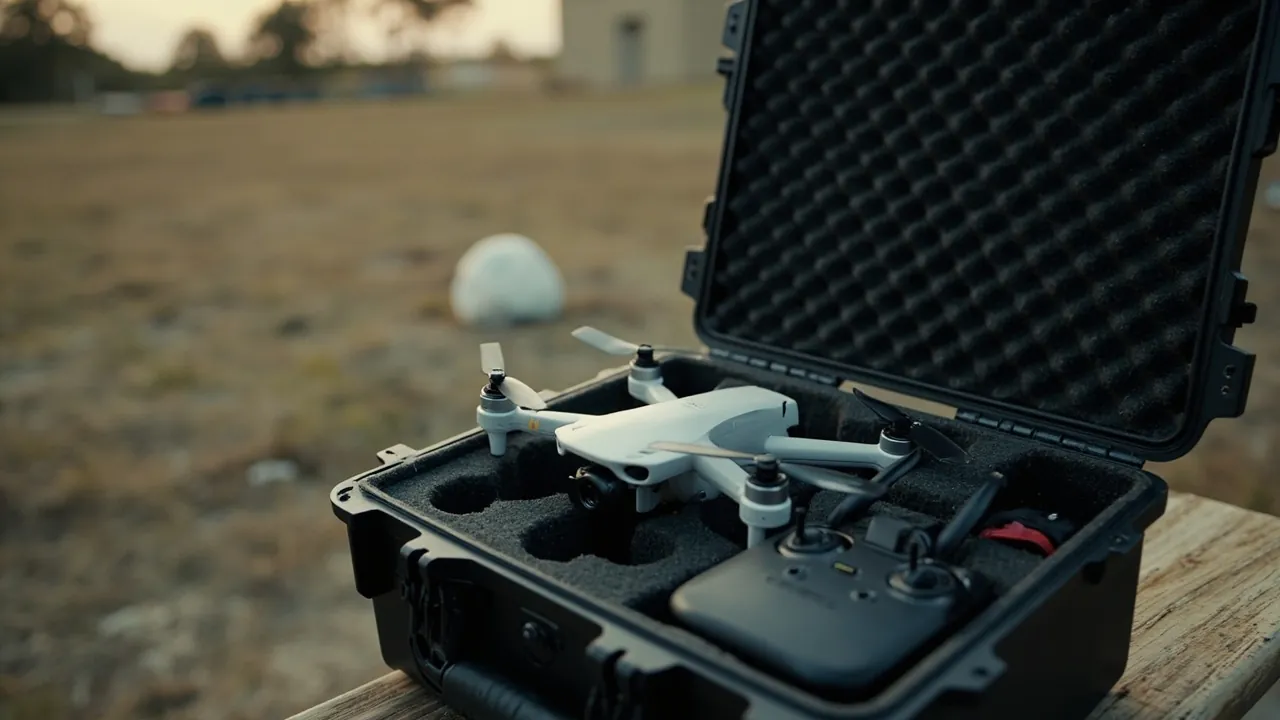
The biggest difference between a drone protective case and a general equipment case is that it does not carry "one drop-sensitive device" but an entire system that fears compression, moisture, heat and short circuits, and that must be unpacked and airborne within a few minutes. A drone protective case therefore carries four special requirements. First, the arms, gimbal and propellers of the aircraft must be independently supported and constrained, and the weight of the airframe must never rest on any deformable cantilever or gimbal structure. Second, lithium batteries must be isolated in their own compartments to satisfy transport safety rules and fast security screening. Third, beyond shock absorption, moisture resistance and crush resistance, the case needs pressure equalization to cover air freight and high-altitude transfers. Fourth, the internal layout has to serve fast access, because an aerial window may last only minutes and searching time is lost flight time. Below we work through this in the order of what makes drones different, airframe storage, battery storage, accessory storage, transport requirements and common mistakes.
Table of Contents
- Where a Drone Case Differs from a General Protective Case
- How to Store the Airframe: Arms, Gimbal, Propellers and Body
- Why Lithium Batteries and Charging Gear Must Be Isolated
- Storing and Fast-Accessing Controllers, Tablets, Cards and Accessories
- Extra Transport Requirements: Air Freight, Altitude, Water and Vehicles
- Frequently Asked Questions (FAQ)
- Conclusion
- Further Reading
Where a Drone Case Differs from a General Protective Case
Many people assume that a waterproof case of roughly the right size will do for a drone, and then months later discover a rattling gimbal, warped propellers or a swollen battery. That is not because the shell is not hard enough; it is because the structure and risk distribution of a drone are fundamentally different from ordinary gear.
Difference One: Irregular Shape and Fragile Projecting Structure
A folded drone is close to a rectangular block, but once unfolded it has arms, propellers, a gimbal camera, antennas and landing gear, all projecting outward. These parts share one characteristic: they are slender, thin-walled and limited in stiffness. Arms carry bending moments, propellers are thin aerodynamic surfaces, and the gimbal is a multi-axis suspended mechanism on damping balls. What they fear most is not impact but long-term compression and squeezing. Put a whole aircraft into an undivided case and the airframe weight will rest on one set of propellers or on the gimbal for months, after which the damping balls take a permanent set.
Difference Two: Safety and Compliance Constraints from Lithium Batteries
Drones almost always travel with several lithium polymer packs. Lithium cells can enter thermal runaway when crushed, punctured, short-circuited or overheated, so transport rules generally require batteries to be stored separately, kept away from metal objects, and limited in quantity and state of charge. That means a drone case cannot be one big open bay; it must have dedicated battery bays.
Difference Three: Extremity of the Working Environment
Drone work is far more extreme than ordinary photography: plateaus, coasts, deserts, rainforests, boats, long vehicle transfers and air freight. These bring combinations of low pressure, salt spray, dust, high temperature and continuous vibration, all of which place demands on sealing, pressure equalization and temperature resistance.
Difference Four: The High Demand on Access Speed
Aerial work is constrained by light, weather and airspace windows. From parking to takeoff may be only a few minutes, and a storage scheme that requires digging through layers will simply be abandoned in the field, after which the gear is dumped loosely and protection becomes meaningless. A drone case layout must therefore be designed around the launch sequence, not around maximum packing density.
String these four together and the statement becomes: a drone protective case equals a precisely locating insert plus isolated battery bays plus a pressure-equalizing sealed shell plus a workflow-ordered layout. Miss any one of them and protection fails at that point.
How to Store the Airframe: Arms, Gimbal, Propellers and Body
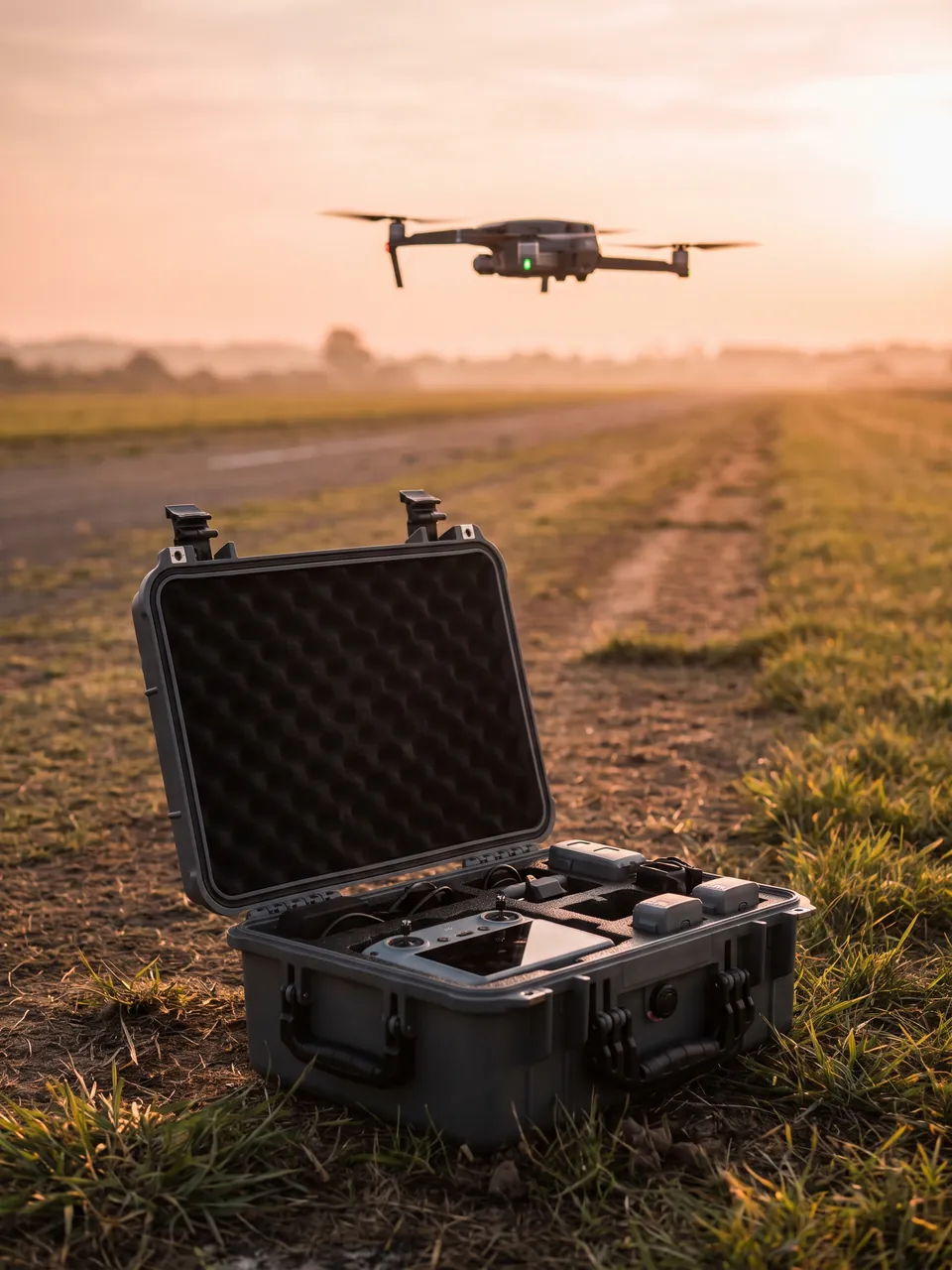
The aircraft is the most valuable and most fragile part of the kit. The core principle of storage is: let the body be supported and let the projecting parts be constrained without being loaded.
Folding Versus Non-Folding Airframes
| Type | Folded shape | Storage focus | Insert design points |
|---|---|---|---|
| --- | --- | --- | --- |
| Folding drone (common consumer class) | Near rectangular block | Arm fold joints, gimbal face, propellers | Bottom cavity supports the body, grooves beside the arms, gimbal left floating |
| Non-folding multirotor | Arms projecting, large footprint | Full-length arm support, propellers off the floor | Support under the full arm length, separate propeller slots or hangers |
| VTOL fixed wing | Wing and fuselage separated | Wing laid flat, root unloaded | Flat wing layer plus fuselage cavity, tiered design |
| Small FPV or cinewhoop | Compact with many exposed parts | Antennas, camera, propellers | Separate small bays plus antenna routing channels, no folding of antennas |
Six Hard Rules of Drone Storage
- Support the body from the bottom cavity: Let the weight sit on the stiffest part of the airframe, usually the frame below the battery bay, rather than on the gimbal or arms.
- The gimbal must float: The gimbal is a multi-axis suspended mechanism; damping balls take a permanent set under continuous load, causing shaky footage. The cavity should leave a non-contact void where the gimbal sits.
- Store propellers separately: Propellers are thin-walled and deform under stacking load. Provide dedicated propeller slots or bags so they never share pressure with the body or batteries.
- Constrain arms without bending them: On a folding drone, sideways pressure on folded arms puts a bending moment on the folding hinge. The cavity should leave lateral clearance and only limit vertical movement.
- Never fold antennas or ribbon cables: Transmission and GPS antennas folded for long periods lose signal performance; provide routing channels or let them extend naturally.
- Keep sensor faces clear and unscratched: Obstacle-avoidance cameras, vision sensors and infrared windows must stay clean; the insert must not cover them, and any contact surface should be soft flocked material.
Choosing Insert Material and Form
Drone case inserts follow the same logic as camera cases and prefer closed-cell materials:
- Molded EVA tray: High forming accuracy, able to produce precise arm channels and gimbal voids, durable, suited to batch and standard airframes.
- CNC-carved EVA or EPE: No tooling needed, suited to fast-changing models and small batches; accuracy approaches molding at a cost between the two.
- Pick and pluck foam: Fine as a temporary solution or while the fleet is still being defined, but cube edges tear with frequent access and it is hard to create a true gimbal void.
- Dividers plus EPE filler: Suited to mixed fleets and accessory-heavy crews, flexible but less positive in fixation than a custom tray.
The acceptance criterion is simple: with the lid closed and the case shaken gently, the aircraft must not visibly move; and lifting the aircraft out must be smooth, without prying or yanking. An awkward insert will be bypassed in real work.
Why Lithium Batteries and Charging Gear Must Be Isolated
Batteries deserve separate treatment in a drone case. This is not a recommendation, it is a safety and compliance requirement.
Why Isolation Matters
- Short-circuit prevention: If cell tabs contact metal tools, propellers, screws or keys, an external short can cause heating or thermal runaway.
- Crush and puncture prevention: Lithium polymer cells are pouch cells; puncture or sustained pressure can damage internal structure, and the risk is delayed rather than immediate.
- Faster security screening: Aviation and rail rules set clear limits on the number, rated energy and packaging of lithium cells, and a dedicated bay lets you present them quickly.
- Easier state management: Packs need cycle counts, state of charge and visual checks for swelling recorded, and central storage makes that practical.
Battery Bay Design Points
| Point | Practice | Reason |
|---|---|---|
| --- | --- | --- |
| Individual bays | One groove per pack with walls between | Prevents pack-to-pack impact and tab contact |
| Non-conductive walls | No metal liners; use foam or plastic dividers | Lowers short-circuit risk |
| No compression | Leave 1 to 2 mm clearance so packs lift out easily | Crushing damages pouch cells |
| Visibility and ventilation | Lay packs flat, labels up, so swelling is visible | Swollen packs must be retired |
| Charge management | Store long term at partial charge, not full | Long-term full charge accelerates aging |
| Charger co-location | Keep charger and hub in the same zone, away from the aircraft | Speeds field resupply |
Storing Charging Equipment
Charging hubs, multi-port chargers and power adapters are bulky and vented, so they collect dust. Recommended practice:
- Give the charger its own bay and keep it away from foam debris that could block vents.
- Store cables separately in mesh pockets or zip bags to avoid tangles and plug scratching.
- When charging in a vehicle or on location, keep the case open for ventilation; never charge packs inside a fully sealed case.
Storing and Fast-Accessing Controllers, Tablets, Cards and Accessories
The tempo of drone work means storage has to serve the workflow. A typical field sequence is: open case, unfold aircraft, fit propellers, insert battery, power the controller, mount the tablet, take off. A good layout makes that sequence linear in space as well.
Layering by Workflow
| Layer | Contents | Rationale |
|---|---|---|
| --- | --- | --- |
| Lid interior mesh | Memory cards, filters, card reader, screwdriver, spare props | Thin items, available the moment the lid opens |
| Top layer | Aircraft, or controller | First thing you reach for |
| Middle layer | Batteries and charging hub | Second step, and easy to check charge level |
| Bottom layer | Spare props, tools, sunshade, landing pad | Low frequency, ballast, lowers center of gravity |
| Side bay | Tablet, phone, cables | Tablets are large and easier to lift from the side |
Controller and Gimbal Sticks
Controller sticks protrude and take load when the unit lies flat. Either hollow out the stick area in the insert or store the controller sticks-up, and leave space for folded antennas rather than forcing them down. For controllers with integrated screens or tablet mounts, keep the screen face up with a soft layer over it so it never touches hard objects.
Tablets and Monitors
Field tablets often wear a sunshade, making them bulky and fragile. Give them a dedicated shallow bay with the screen facing inward and the back shell outward, surrounded by soft material. If space is tight, a separate tablet sleeve hung on the lid interior works, provided the lid cannot press on it when closed.
Managing Small Parts
Memory cards, ND filters, screws and spare prop bolts are the easiest things to lose. Recommended practice:
- Use one standard size of small-parts box or zip bag, all stored in the lid mesh.
- Give each category a fixed location so muscle memory replaces searching.
- Run a pre- and post-flight checklist so nothing is left behind in the field.
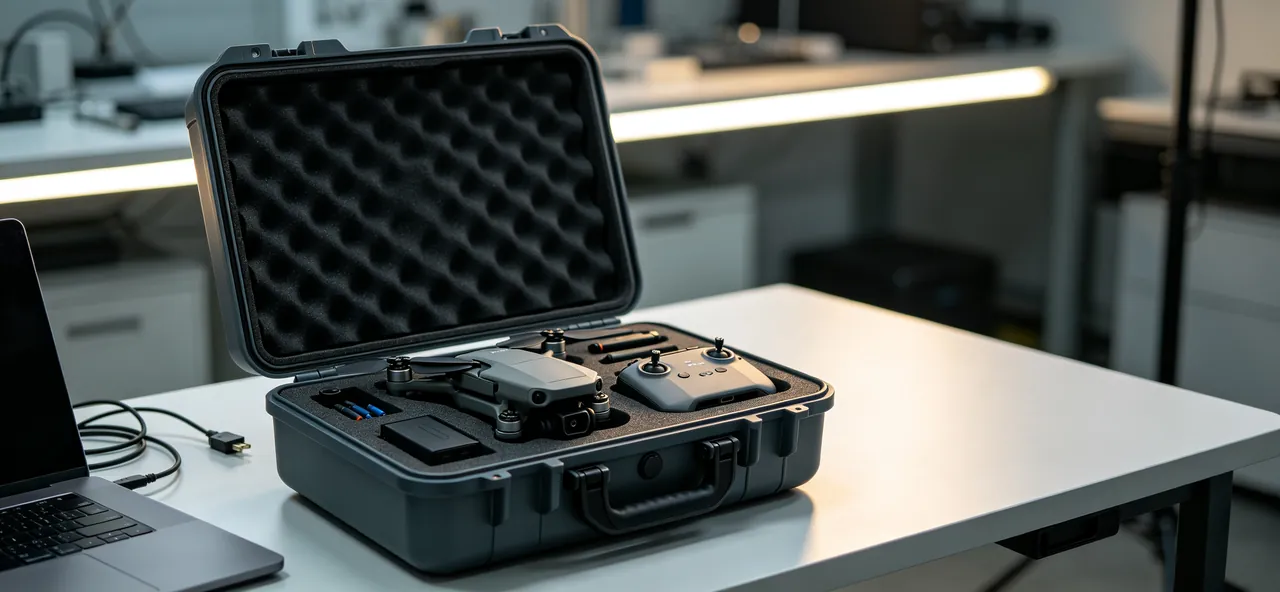
Extra Transport Requirements: Air Freight, Altitude, Water and Vehicles
The value of a drone means it often travels between regions, and transport conditions are frequently harsher than the operating environment.
Air Freight and Altitude: The Pressure Valve Is Mandatory
When ambient pressure drops, whether from an aircraft climbing or from driving up to altitude, a perfectly rigid sealed case develops a pressure differential. The consequences include extra load on the lid that overloads the gasket, a lid that is hard to open once back at low altitude, and in extreme cases shell deformation. A pressure equalization valve uses a microporous membrane that passes gas while blocking liquid water and dust, balancing pressure automatically.
The conclusion: as soon as a drone case will be flown or used at altitude, a pressure equalization valve is a required item. Alongside it:
- Keep the gasket in good condition and the latches properly compressed, otherwise pressure leaks through unsealed paths and internal humidity swings sharply.
- Plateaus have large day-to-night temperature swings, so plan for condensation and let the case acclimatize before opening.
- Learn and follow the carrier's lithium battery rules; packs normally travel in the cabin and in limited numbers.
Water and Boats: IP Rating and Corrosion-Resistant Hardware
Water takeoff and landing, boat operations and coastal shoots expose the case to water and salt spray. Focus on:
- Protection rating: Choose a case with IP67 capability to cover temporary immersion and powerful spray.
- Corrosion-resistant hardware: Latches, hinges and screws should be stainless steel or properly treated for marine use.
- Rinseable design: After each outing, rinse the exterior with fresh water and dry it, especially in latch and hinge crevices where salt accumulates.
- Floatation and tethering: For boat work, add tie-down points so a case that goes overboard does not drift away.
Vehicles and Field Work: Vibration Resistance and Securing
Long overland transfers produce sustained vibration that loosens screws, fatigues gimbal dampers and wears battery connectors. Countermeasures:
- Use an insert with adequate damping, preferably closed-cell EVA or EPE systems.
- For multi-case shipping, choose cases with stacking locators so they cannot slide in the cargo area.
- Prefer a trolley-wheeled format when total weight is high, to cut handling strain and drop risk.
- Avoid prolonged sun exposure in vehicles; heat accelerates both cell aging and foam aging.
How High and Low Temperature Affect Shell Materials
High and low temperatures push materials in different directions. In the cold, some plastics lose toughness and become brittle, raising the cracking risk on impact. In the heat, stiffness drops, so stacked cases creep and deform more easily, and the gasket's compression recovery degrades faster. Choose the shell material to match the temperature span of your operating environment: prioritize low-temperature toughness for cold regions and plateau work, and in hot vehicle storage limit stack height and avoid long-term load. Gaskets also have a service temperature range; exceeding it accelerates aging, so confirm the seal material and its temperature range with the manufacturer.
Sizing and Format: Working Backward from Aircraft Plus Accessories
The correct order is still list first, then derive. A drone kit usually includes the aircraft, batteries in a quantity set by flight time, the controller, a tablet or a screen-equipped controller, the charger and hub, spare propellers, filters, memory cards, tools and a landing pad. Compute the bounding volume of each item, add them, and multiply by a margin factor of 1.5 to 2.0. Drone cases need a larger factor than camera cases because gimbal voids, arm clearances and battery dividers all consume space, and easy access itself requires finger room.
There are three common format directions. A hand-carry case suits single aircraft, single controller work at a total weight generally kept under 15 kg. A trolley-wheeled case suits cinema-class multirotors, VTOL fixed wings and multi-crew transfers, sharply reducing strain and drop risk over long carries. A deep format suits field crews carrying landing pads, large chargers and many battery sets, but deep cases make bottom-layer access awkward, so use tiered inserts or a removable tray. When several cases deploy together, standardize the format so they stack and strap down as one load.
Weight Budget: What You Carry Versus What You Fly
Weight deserves explicit attention because a drone case is both checked baggage and a field-carry item. Start by separating the fixed weight of the case and insert from the variable weight of batteries and accessories, then compare the total against the two limits that actually bind: airline baggage allowances and what one person can carry over rough ground. Every kilogram spent on the case is a kilogram unavailable for batteries, so the useful question is not "how strong is the case" but "what is the lightest case that survives this route." In practice that means choosing a shell thickness and rib density matched to the transport mode rather than defaulting to the heaviest option, and using wheeled formats when the total exceeds what a crew member should shoulder on a long walk-in. For teams that fly several sorties per day, reducing case weight often buys an extra battery set, which is worth more operationally than marginal gains in shell thickness.
Identification, Asset Management and Team Coordination
Crews often run several aircraft and several cases at once, so a label area on the outside is a low-cost, high-return feature. Put a contents list and a case number on the side, and pair it with an internal checklist so you can verify once before departure and once after recovery, cutting loss and mis-packing. When several teams share a pool of cases, a padlockable security latch clarifies responsibility and keeps unauthorized people out. For teams tracking assets long term, record battery cycle counts and retirement dates on the in-case checklist so consumables are managed on evidence rather than memory.
Common Mistakes
- Mistake one: packing the aircraft with propellers still fitted. Propellers are thin-walled and deform under sustained load; a warped propeller adds vibration and hurts flight stability. Remove them and store them in propeller slots or bags.
- Mistake two: storing the aircraft gimbal-down. Gimbal damping balls take a permanent set under one-directional load, causing shaky footage or gimbal errors. Leave the gimbal floating or facing up.
- Mistake three: storing packs at full charge for long periods. Full charge accelerates cell aging and widens the risk window during transport. Store at partial charge and inspect appearance regularly.
- Mistake four: putting batteries in the same bay as metal tools. Screwdrivers, prop bolts and keys that bridge cell tabs can cause an external short. Batteries need their own bay.
- Mistake five: assuming a waterproof case removes the need for desiccant. Every opening admits humid air, especially on coasts and in rainforests. Keep desiccant and a hygrometer on board and replace them on schedule.
- Mistake six: ignoring how cases are secured in a vehicle. Unsecured cases strike each other under hard braking and rough roads, and the resulting impact can exceed drop-test conditions. Use stacking locators and straps.
- Mistake seven: relying on the original soft bag with no locating support. The aircraft shifts as a whole inside the case, accelerating gimbal and arm fatigue, and the bag holds moisture.
Incoming Inspection and Routine Maintenance Checklist
- Closed-lid check: Confirm the gasket is compressed evenly around the whole perimeter, latches seat with a clear self-lock, and the lid does not warp.
- Insert conformity: With the aircraft loaded, shake the case gently; the airframe must not visibly move. Removal must be smooth, with no prying or yanking.
- Gimbal clearance check: With the lid closed, confirm the gimbal is not in contact with foam and that a void is preserved.
- Battery bay check: Groove dimensions correct, dividers complete, packs lift out smoothly and tabs cannot reach metal.
- Pressure equalization valve: Confirm the body is intact and unblocked; a gentle puff of air confirms it breathes.
- Hardware and feet: Metal parts free of rust, screws tight, anti-slip feet complete.
- Routine care: After every field day, clear sand and salt from the case and dry it before closing; wipe the gasket with clean water periodically; retire batteries by cycle count and swelling; avoid long-term sun exposure and heavy stacking.
Frequently Asked Questions (FAQ)
Q: Can I keep a drone in its original soft bag and put the bag in a protective case? A: You can, but it is not recommended as a long-term approach. A soft bag gives some scratch and cushioning protection, but it provides no location function, so the aircraft shifts as a whole inside the case and gimbal and arm fatigue worsen over time. The bag also absorbs and holds moisture, which works against humidity control in damp climates. A better solution is a model-specific insert that fixes the aircraft directly in the case. If a soft bag must be used as a transition, add locating blocks around it so nothing moves when the lid is closed.
Q: Does a drone case need a custom insert, or is pick and pluck enough? A: It depends on whether the fleet is fixed and how often you access it. For a fixed model with high-frequency use, a custom insert is clearly better on fixation, access speed and durability, and details such as a floating gimbal and constrained arms can only be reliably achieved with a custom tray. If models are still changing or volumes are small, pick and pluck is a low-cost transition, but cube edges tear under frequent access and it is hard to form a true gimbal void. A middle path is CNC-carved EVA, which needs no tooling yet approaches custom results.
Q: Do batteries need to be taken out of the case for transport? A: For air travel, lithium cells are normally required in the cabin with limits on rated energy and quantity, so packs should be removed and carried with you rather than left in a checked case. For ground transport the limits are looser, but still keep packs in individual bays, tabs away from metal, and check for swelling. Either way, the case's battery bays should provide individual grooves, non-conductive dividers, no compression, and labels facing up.
Q: Why does a drone case need a pressure equalization valve? A: Because drone work regularly involves air freight and high-altitude transfers. When ambient pressure falls, a perfectly rigid sealed case builds internal positive pressure that presses the lid harder and overloads the gasket; on return to low altitude, internal negative pressure can make the lid hard to open, and in extreme cases the shell deforms. A pressure equalization valve uses a microporous membrane to pass gas while blocking liquid water and dust, balancing pressure while keeping the seal. With any air or altitude use, this component should not be omitted.
Q: How should the case be maintained for sea or lake operations? A: Focus on salt-spray corrosion and prompt rinsing. After every water operation, rinse the exterior, latches and hinge crevices with fresh water and dry before storage; check metal parts regularly for rust and use stainless or confirmed corrosion grades where needed; wipe the gasket with clean water and keep it away from strong solvents and oil. Even with IP67 capability, if the case goes overboard, open it and check for water ingress, verify the desiccant, and dry any metal connectors.
Q: How do I stop cases from colliding in a vehicle during transfers? A: Prefer cases with stacking locators, meaning mating bosses and recesses on top and bottom shells that resist sliding once stacked. Then strap the cases to anchor points in the cargo area so they cannot shift under hard braking. Put heavy cases low and light ones high to lower the center of gravity, and add non-slip mats between cases for friction. For frequent multi-case transfers, reserve an external label area so contents and owning crew are visible without opening the case.
Q: Should a drone case shell be PP or ABS? A: Both are proven choices. PP offers toughness, low-temperature resistance, impact resistance and low weight, suiting plateaus, cold regions and field work, and it is the lighter choice when the case is carried often. ABS offers rigidity, dimensional stability and a better surface finish, suiting cases where stack stability and appearance matter. If the temperature span is large or you work in cold regions, a PP-based system is safer; if use is mostly at normal temperatures with multi-case stacking, ABS holds its rigidity more consistently.
Conclusion
The special character of a drone protective case comes from the combination of four properties: delicate projecting structures, high-energy lithium batteries, extreme operating environments and a minute-scale launch window. Ignore any one of them and protection fails in real work. In practice the order should be: first fix the insert form to the airframe so the body is supported by a bottom cavity, the gimbal floats, propellers sit separately and arms are constrained without load, using a custom or CNC-carved tray for fixed fleets and pick and pluck only as a transition; then provide batteries with individual grooves, non-conductive dividers, no compression and labels facing up, with chargers and cables co-located; then layer the layout by launch sequence, keeping high-frequency items on top and in the lid mesh and heavy low-frequency ballast at the bottom; finally add the shell capabilities the transport scenario demands, a pressure equalization valve for air and altitude, IP67 plus corrosion-resistant hardware for water and boats, and damped inserts plus stacking locators for long vehicle moves. Maintenance matters just as much: rinse with fresh water and dry after water operations, inspect the gasket, latches and battery condition regularly, and avoid storing packs at full charge or leaving cases in the sun. KeXin New Materials (Guangdong) Co., Ltd. was founded in 2014 and its factory is in Zhongshan City, Guangdong Province, covering about 18,000 square meters with more than 80 machines and over 100 staff. The protective-case line is marketed globally under the brand kexinMaterials and domestically under the JUNZHJIA product-line brand, with more than 150 specifications available, IP67 capability, and environmental suitability validation against MIL-STD-810H. The company operates under ISO9001 and meets REACH, California Prop 65 and RoHS requirements, holds more than 20 utility model and design patents, and offers one-stop OEM and ODM customization covering product design, mold manufacturing, injection molding, LOGO printing and tray and liner fabrication, including insert development matched to specific aircraft and accessory lists. For bulk quotation, specification sheets or customization cooperation, please book through the contact page or inquiry form on this site.
Further Reading
- Is an Outdoor Protective Case Suitable for Air Transport?
- What Should You Watch for When Shipping a Protective Case at High Altitude?
- Why Does an Outdoor Protective Case Need a Pressure Equalization Valve?
- How Does a Protective Case Balance Weight Against Strength?
- How Do Outdoor Protective Cases Handle High and Low Temperatures?
- What Factors Matter When Customizing Protective-Case Foam?
- What Does IP67 Mean for a Protective Case and Where Does It Apply?