

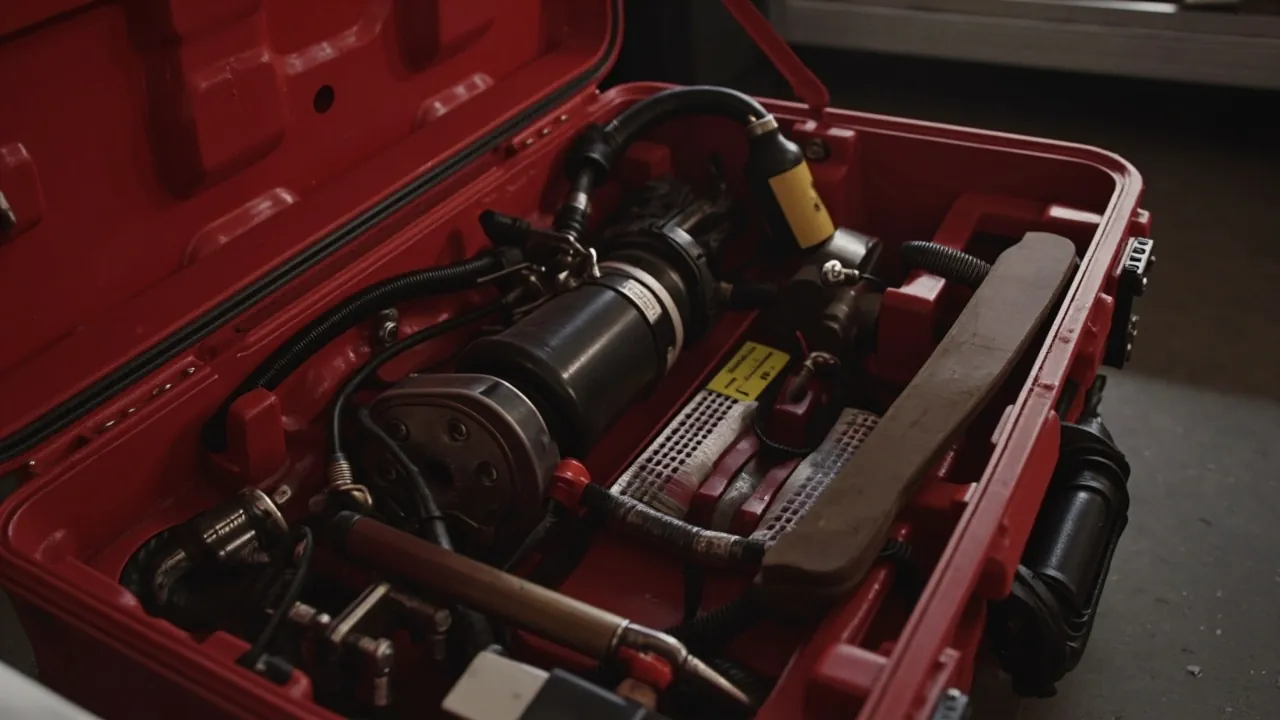
The selection criteria for a fire rescue equipment case can be condensed into three sentences: it must open and yield the right tool under smoke, low visibility and thick gloves; it must protect the equipment through heat, water spray, falling debris and mud; and it must be rinsed, inventoried, restocked and returned to standby after every call. Unlike general industrial use, a fire scene has three defining characteristics: time is measured in seconds and the environment is uncontrollable, thick protective gloves sharply limit fine motor skills, and the case rides in a vehicle through constant vibration and hard braking. The priority in choosing a rescue case is therefore not how much it holds but whether it works reliably under the worst conditions. Below we work through this in the order of scene demands, fast access, performance baselines, categorized storage, vehicle securing and handling, and common mistakes.
Table of Contents
- The Four Extreme Demands a Rescue Scene Places on an Equipment Case
- Fast-Access Design: Visible on Opening, One-Hand Opening and Zone Coding
- Performance Baselines: Temperature, Sealing and Impact Resistance
- Categorized Storage: Breaching, Detection, Communications, Lighting and Consumables
- Vehicle Securing, Handling and Multi-Case Coordination
- Frequently Asked Questions (FAQ)
- Conclusion
- Further Reading
The Four Extreme Demands a Rescue Scene Places on an Equipment Case
To understand a fire rescue case, start from the environment it serves. These conditions differ fundamentally from an ordinary industrial site.
Demand One: Extreme Time and Visibility Conditions
Rescue scenes involve smoke, power loss, darkness and airborne dust, and visibility can drop to the point where only outlines are discernible. A responder cannot rely on reading a label before choosing a tool; retrieval must run on position memory and touch. At the same time the tempo is measured in seconds, so any step that needs two hands, an unlocking action or a search gets skipped. The result is a case forced open with equipment scattered on the ground, and every later use becomes harder.
Demand Two: Operating Constraint of Thick Gloves
Fire rescue gloves are thick and severely reduce dexterity. That directly affects three steps: whether the latch can be opened, whether zips and small catches can be operated, and whether small items can be picked out. A case built around small catches, tiny zip pulls or pinch motions is effectively unusable on scene.
Demand Three: Heat, Water Spray and Falling Debris
The scene may involve radiant heat, water curtains, falling fragments and muddy ground. The case exterior takes heat and water, may be struck by debris, and may sit in standing water. It therefore needs adequate impact resistance, water resistance and the ability to hold its shape under elevated temperature. One point must be stated plainly: the job of a protective case is protecting the equipment inside, not surviving fire. No plastic case should be placed in direct flame or under prolonged radiant heat, and the case should always be positioned away from heat sources.
Demand Four: High-Frequency Vehicle Deployment and Fast Turnaround
Fire apparatus deploys frequently, so cases live with constant vibration and hard braking, and after every call they must be inventoried and restocked quickly to return to standby. That means the case has to survive long-term vehicle vibration while its internal layout stays easy to verify, so a single glance shows what is missing.
String these together and the statement becomes: a fire rescue equipment case equals a structure that opens under the worst conditions plus a shell that survives the physical scene plus a layout built for fast verification plus a maintenance routine that rinses and restores quickly. Miss any one and it surfaces during a real call.
Fast-Access Design: Visible on Opening, One-Hand Opening and Zone Coding
Fast access is the biggest divide between a rescue case and an ordinary industrial case. It is not an accessory but a system running through structure, liner and marking.
Four Structural Requirements
- Latches openable with one gloved hand: Prefer large latches with a generous operating face, such as a large two-piece over-center latch or a spring latch. Opening force should be moderate, because too tight means a gloved hand cannot work it and too loose means vibration pops it open. The ideal is a clear over-center self-lock that a thumb or the heel of the hand can release.
- The lid stays put once open: The lid must not spring back or trap fingers within its working range, and ideally holds at any angle. If it falls back under its own weight, the responder has to prop it with a shoulder or a second hand, which is unrealistic on scene.
- No tools, no keys: Never depend on a key, a zip tie or any tool to open the case. If anti-accidental-opening is needed, use a latch with a secondary safety catch that still works by hand.
- No sharp protrusions on the outside: Protruding latches and hinges snag in tight vehicle compartments and in debris, which can lever the lid open or injure someone. Recessed latches and recessed hinges suit vehicle and scene work better.
Three Liner Principles
- Visible on opening: The first field of view after the lid opens should cover the highest-frequency equipment, not a layer of foam or a cover panel. Shallow bays laid flat beat deep cavities.
- Shape is the label: Cut a cavity matching each item's outline so the responder confirms it by silhouette and feel rather than by reading, which is what works in smoke and low light.
- No digging to reach anything: Removing any one item must not require moving another. Avoid stacked arrangements in favor of side-by-side bays.
Marking and Color
- High-contrast exterior: Use high-visibility colors with reflective strips so the case is identifiable in smoke and at night.
- Large text marking: Mark the major category on the outside, such as breaching, detection, communications or lighting, in a large size visible from several directions.
- Color-coded internal zones: Use a different liner color per functional zone with pictographic labels to reduce dependence on reading text.
- Reflective or luminous elements: Add reflective or glow markings at case edges and at the latch so the opening point can be found in low light.
Checklist and Verification
- Put a checklist card on the lid interior listing each item, its quantity and its position number.
- Use open cavities or a contrasting base liner so a missing item is obvious at a glance, which is faster than reading a list.
- Restock against the list after every call and log it, closing the loop.
Performance Baselines: Temperature, Sealing and Impact Resistance
The performance requirement can be reduced to three baselines, and failing any one of them leaves equipment unusable on scene.
Baseline One: Water and Dust Resistance
Fire scenes use enormous volumes of water. Cases get hit by water curtains, sit in standing water and get coated in mud. A case needs full-perimeter sealing, and IP67 capability is the preferred choice. Points to understand:
- Sealing comes from compression, not from covering: The seal only exists when latches press the lid evenly onto the gasket, so latch count and distribution must be reasonable, roughly two on a small case, four on a medium one and six or more on a large one.
- The gasket needs maintenance: Grit, aging and deformation all defeat the seal. Clean the gasket after every call and check its elasticity.
- Consider a pressure equalization valve: For air transfer or routes with significant elevation change, a valve balances the differential so the lid opens normally. It is not required for ordinary urban and suburban use.
Baseline Two: Impact and Crush Resistance
The scene may include falling debris, being stepped on and vehicle run-over risk, so the case needs:
- Reinforcement ribs: The rib network on the side walls and lid raises bending stiffness without a big weight penalty, and is the basis of crush and drop resistance.
- Radiused transitions: A sharp corner is a stress concentrator; a radius spreads impact energy along an arc and reduces corner cracking.
- Adequate wall thickness and material toughness: Engineering plastics such as PP, ABS and their modified grades offer good toughness and impact resistance. In cold conditions, watch low-temperature toughness to avoid brittleness.
- Stacking locators: Mating bosses and recesses on the top and bottom shells keep stacked cases from sliding and colliding while the vehicle moves.
Baseline Three: Temperature Behavior and Placement Discipline
Plastics lose stiffness when hot and lose toughness when cold. That is a basic material property, unrelated to any question of fire performance. Therefore:
- Keep the case away from heat sources: Never place it in direct flame, under prolonged radiant heat, or near an exhaust pipe.
- Avoid long-term stacking load in the heat: Elevated temperature reduces stiffness, so stacked cases creep and deform more readily.
- Watch brittleness in the cold: For cold regions and winter work, choose material systems with better low-temperature toughness to avoid cracking on impact.
- Watch condensation across temperature swings: After coming in from cold outdoors, let the case acclimatize before opening, so internal condensation does not affect electronic equipment.
Material Comparison
| Material | Toughness | Low-temperature behavior | Rigidity | Weight | Suitability for a rescue case |
|---|---|---|---|---|---|
| --- | --- | --- | --- | --- | --- |
| PP (polypropylene) | Good | Retains toughness well when cold | Medium | Light | Field use, cold regions, weight-sensitive vehicle cases |
| ABS | Medium | Tends to become brittle when cold | Good | Medium | Normal temperatures, cases where stack stability matters |
| PC | Very good | Good when cold | Good | Medium | High-strength areas, at higher cost |
| Glass-fiber reinforced systems | Depends on base resin | Depends on base resin | Very good | Slightly heavier | Large cases needing high rigidity |
Categorized Storage: Breaching, Detection, Communications, Lighting and Consumables
Rescue equipment spans many types, widely different shapes and a large weight range, so storage should be organized by deployment scenario rather than by item property.
Categorized Storage Table
| Category | Typical equipment | Storage difficulty | Liner solution |
|---|---|---|---|
| --- | --- | --- | --- |
| Breaching | Hydraulic cutters, spreaders, cut-off saws, pry bars | Heavy, irregular, sharp edges | Bottom-supporting cavity plus straps, corner guards on edges |
| Detection | Gas detectors, thermal imagers, rangefinders | Precision electronics, sensitive to shock and moisture | Custom foam cavity, soft layer over the screen, desiccant |
| Communications | Radios, repeaters, antennas, headsets | Antennas dislike folding, batteries dislike shorts | Antenna routing channels, isolated battery bays |
| Lighting | Scene lights, headlamps, portable light towers, batteries | Bulky, heat-generating parts | Dedicated bays, kept away from heat-sensitive items |
| Ropes and slings | Safety rope, webbing, carabiners | Tangling, abrasion | Dedicated bag or coil bay, never with sharp tools |
| Consumables and spares | Saw blades, batteries, gloves, tape | Many types, frequent restocking | Compartment boxes plus clear pouches, managed by list |
| Medical and first aid | Tourniquets, dressings, drugs | Expiry management | Standalone module in a small hard case or soft bag |
Special Handling for Heavy and Sharp Items
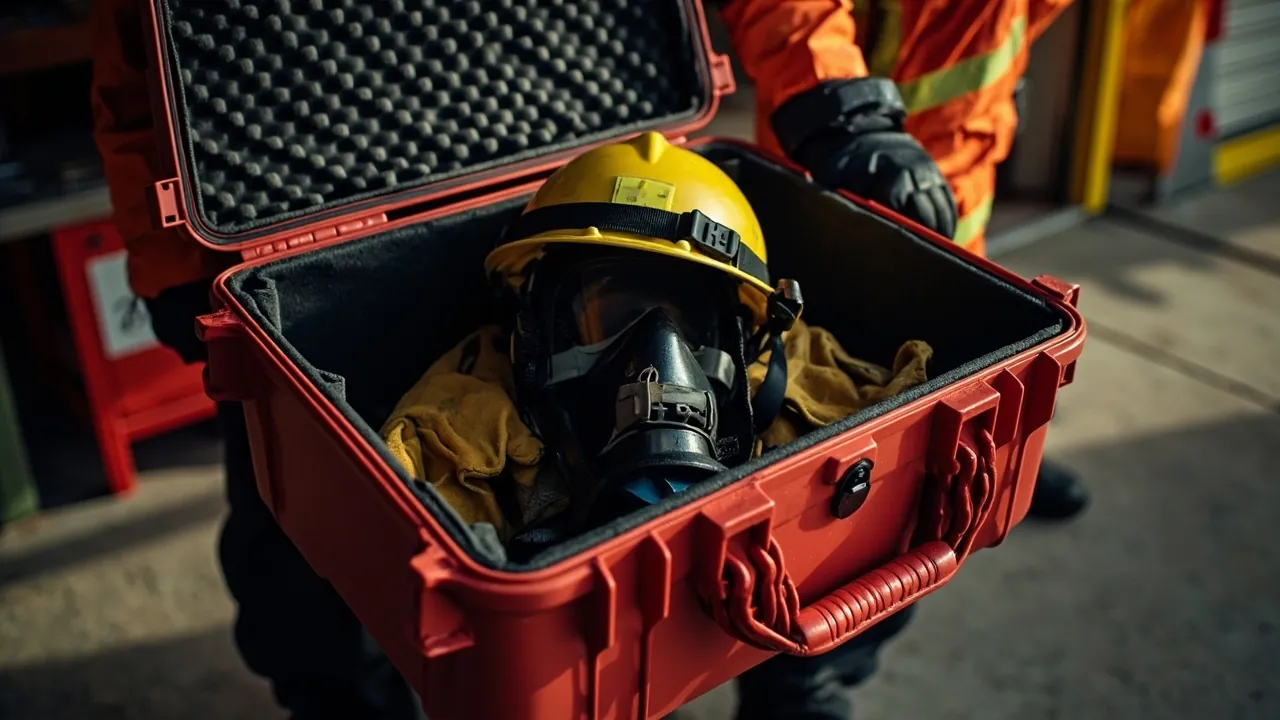
- Heavy items low: Hydraulic tools, battery packs and lighting go in the lower part of the case to lower the center of gravity and reduce tip-over risk during carrying and cornering.
- Guards on sharp edges: Blades on saws, pry bars and breaching tools need sleeves or corner guards to protect the liner and personnel, and to protect the edge itself.
- Straps for heavy loads: Foam cavities alone do not reliably retain heavy equipment; add straps or clamps so nothing shifts under hard braking.
- Isolate oil contamination: Hydraulic tools may carry oil, so give them a separate bay or a containment bag to keep other equipment and the liner clean.
Protecting Precision Electronics
Thermal imagers, gas detectors and communication repeaters are the most valuable and most fragile items in the case:
- Secure them in custom foam cavities with the screen facing inward behind a soft layer and clearance all round.
- Add desiccant and a hygrometer so sustained humidity does not affect circuitry.
- Keep batteries in isolated bays where terminals cannot reach metal.
- Never share a bay with heavy or sharp items, and never place them at the bottom where they carry the load from above.
Vehicle Securing, Handling and Multi-Case Coordination
Securing in the Vehicle
- Place cases in dedicated racks or strap them to anchor points so they do not shift under hard braking. An unsecured case becomes a projectile that endangers the crew.
- When stacking, use formats with stacking locators so mating features prevent sliding.
- Heavy cases low, light cases high, to lower the combined center of gravity.
- Frequently used cases go outermost and easiest to reach, minimizing how often others must be moved.
Handling Formats
| Format | Suitable total weight | Typical use | Watch points |
|---|---|---|---|
| --- | --- | --- | --- |
| Hand carry | Under 15 kg | Short distance, one person | Handle ergonomics, soft overmold |
| Shoulder carry | Under 10 kg | Climbing, crossing debris | Strap anchor strength, metal inserts |
| Trolley-wheeled | Over 15 kg | Station and level ground, long turnaround | Quiet wear-resistant wheels, recessed handle, stackable |
| Two-person carry | Over 30 kg | Heavy breaching equipment | Clearly defined symmetric grips |
Matching Case Size to Vehicle Space
Compartments on fire apparatus are limited and irregularly shaped, so measure before selecting. Take the compartment's length, width and height, the clear door width and the clear height available for opening, then subtract the working clearance needed between cases; what remains is the maximum envelope for a single case. Derive internal volume and zoning inside that constraint rather than fixing the contents first and then hunting for a location. Three further checks matter: can the latches still be operated once the case is in the compartment, since two cases butted together that block a latch make an otherwise correct size a failure; is the removal path clear, so a frequently used case is not blocked by another; and can cases be swapped between vehicles, since a common envelope greatly reduces scheduling and spare-case pressure.
Load Weight and Human Factors
Rescue personnel already carry breathing apparatus and protective gear, so case weight must be tightly controlled. Separate the fixed weight of shell and liner from the variable weight of equipment and consumables, and compare the total against what one person can carry safely. Beyond that limit, split the load into two lighter cases rather than building one that cannot be carried. Handle ergonomics matter just as much as the number: a wide, soft-overmolded grip that keeps the load close to the body sharply reduces fatigue and drops, and heavy cases meant for two people need clearly defined symmetric grips. Weight control has a second payoff in braking distance, because a heavier vehicle load raises inertial risk under hard braking, so saving weight is itself a safety measure.
Multi-Case Coordination and Standardization
- Standardize the external envelope so racks, straps and stacking all work uniformly and cases can be swapped between vehicles.
- Standardize color and marking rules so the same category has the same zones and positions on every vehicle.
- Give each case a checklist card and an inspection record with a named responsible person, closing the loop at handover.
Handover and Post-Call Recovery Routine
Whether a case is at full strength for the next call depends on routine, not memory. Give each case a card recording its number, assigned vehicle, responsible person, last inspection date and equipment list. After every return, follow a fixed order: rinse, dry, inventory, restock, replace consumables, log. At handover, confirm that the card matches the contents and that batteries and consumables are serviceable. Replenish any shortage immediately rather than deferring, which matters most during consecutive calls and multi-shift operation. Fixing recovery as a sequence of actions that can be performed on the spot is far more reliable than batch cleanups later.
Decontamination and Drying After the Call
Post-call handling deserves as much attention as selection, because most long-term case failures start here rather than on scene. Begin by rinsing the exterior with clean water to remove mud, ash and any residues picked up at the incident, paying particular attention to latch recesses, hinge gaps and stacking features where grit collects and later defeats the seal. Open the case and wipe the gasket with a damp cloth, then dry both the gasket and the seal groove thoroughly, because trapped moisture inside a closed case creates exactly the humid environment that damages electronics and promotes corrosion on metal hardware. Remove wet consumables, dry or replace them, and check batteries for water exposure before returning them to their bays. Finish by logging what was used, restocking against the checklist card and closing the lid only once everything is dry. A case that is put away wet will fail its next inspection long before it fails on scene.
Common Mistakes
- Mistake one: judging by capacity instead of access. Fitting everything in is not the same as getting it out. The real test is whether a responder can retrieve the target item within seconds while gloved and in low visibility.
- Mistake two: treating the case as a fire-resistant container. Plastic protective cases shield contents from impact, water and dust; they are not meant for flame or prolonged radiant heat. Always stage them away from heat sources.
- Mistake three: ignoring glove operability of the latch. Latches that require pinching, twisting or a tool cannot be used on scene; specify a large operating face that releases with one hand.
- Mistake four: putting heavy items on top. Weight up high raises the center of gravity, so the case tips during carrying and cornering, and it crushes what sits underneath.
- Mistake five: mixing precision electronics with breaching tools. Vibration, crushing and sharp edges destroy thermal imagers and detectors; zone them separately and protect them independently.
- Mistake six: leaving cases unsecured in the vehicle. An unsecured case damages equipment and endangers the crew when the vehicle brakes hard.
- Mistake seven: restocking major items but not consumables. Saw blades, batteries and tape are the easiest things to run out of and they directly affect the next call.
Incoming Inspection and Routine Maintenance Checklist
- Shell inspection: Ribs complete, corners properly radiused, no visible deflection when pressing the side wall, no cracks or sink marks.
- Seal inspection: With the lid closed, the gasket compresses evenly with no local gaps, and it is free of grit and aging cracks.
- Gloved latch test: Actually operate the latches wearing rescue gloves, confirming one-hand opening with a clear self-lock.
- Lid stability: At the working angle the lid does not spring back and does not trap fingers.
- Liner and securing: Cavities hold reliably, heavy items are strapped, sharp edges guarded, precision equipment in its own bay.
- Marking check: External category marking, reflective strips, internal color coding and checklist card all present.
- Routine care: After every call, rinse the exterior, remove mud, dry and check the seal; restock equipment and consumables against the list; periodically check battery charge and appearance, gasket elasticity, and latch and hinge tightness; run a full inventory and function test quarterly.
Frequently Asked Questions (FAQ)
Q: What is the essential difference between a fire rescue case and a general industrial tool box? A: The difference lies in the operating conditions and the design priorities. A general industrial box prioritizes capacity, cost and durability with a relatively controlled access frequency. A rescue case has to open reliably and yield equipment under smoke, low visibility, thick gloves and a seconds-long timeline, so its priorities are fast access, scene reliability and quick recovery. Concretely, latches need a large operating face that opens one-handed in gloves, the lid must stay put without springing back, the liner needs cavities matching each outline so items are identified by feel, the layout must avoid stacking that forces digging, and the exterior needs high-visibility color and reflective marking.
Q: Can a plastic protective case be used in a high-temperature fire environment? A: No. The role of a plastic protective case is protecting equipment from impact, drops, water and dust; it does not hold its structure in flame or under prolonged radiant heat. At elevated temperature the stiffness of plastics drops markedly, which can cause deformation or melting and will also damage the contents. On scene, keep the case away from heat sources, open flame and radiant heat, and in the vehicle keep it away from exhaust components. Where equipment must be staged near high-temperature zones, evaluate a dedicated high-temperature container separately.
Q: What water protection rating should a rescue case have? A: Choose a case with IP67 capability. Fire scenes use large volumes of water, and a case may be hit by a water curtain, briefly submerged or coated in mud; IP67 covers temporary immersion under standard test conditions, going beyond the spray protection of IP65. Note that an IP rating is a result on a new product under standard conditions, and real protection depends on the gasket being clean and intact and on the latches compressing evenly, so gasket inspection belongs in routine maintenance.
Q: How do you let responders find equipment quickly in smoke? A: Through three layers of redundancy. First, fixed positions: keep every category in the same place long term so the crew builds muscle memory, which is the most reliable layer. Second, shape recognition: cut cavities matching each item's outline so it can be confirmed by silhouette and feel without reading a label. Third, color and reflective marking: use distinct colors per functional zone and add reflective or luminous elements at case edges and at the latch so the opening point can be located in low light. Combine that with a lid-interior checklist card and open cavities that make missing items visible for fast checks before and after a call.
Q: How should heavy breaching tools be secured in the case? A: Foam cavities alone are not enough. Use three measures together: a bottom-supporting cavity so the weight rests on the case floor rather than hanging; straps or clamps to prevent movement under hard braking; and a low position, placing heavy tools in the lower level to lower the center of gravity. In addition, fit sleeves or corner guards over blades and sharp edges to protect the liner and personnel, give hydraulic tools their own bay or containment bag because they may carry oil, and keep heavy items in a separate zone from precision electronics.
Q: PP or ABS for a rescue case? A: It depends on the working environment. PP offers good toughness, retains toughness well in the cold and is light, suiting cold regions, field work and weight-sensitive vehicle cases. ABS offers good rigidity, dimensional stability and surface finish, suiting normal-temperature cases where stack stability matters. For cold winters or frequent low-temperature field work, a PP-based system is safer; for mainly urban use at normal temperatures with multi-case stacking, ABS holds rigidity more consistently. Either way, check low-temperature toughness and stiffness retention at elevated temperature.
Q: How do you manage several cases deploying on one vehicle without errors? A: Standardize three things. First, the envelope: one external size so racks, straps and stacking are common and cases swap between vehicles. Second, marking: one color coding, one category text style and one checklist format, so the same category has the same zones and positions everywhere. Third, process: a checklist card and inspection record per case with a named owner, restocked after every call and verified at every handover. The biggest risk in multi-case work is every vehicle being different, and standardization is what minimizes human error.
Conclusion
Choosing a fire rescue equipment case is very far from buying a strong box. It is system design built around the worst operating conditions: under smoke, low visibility, thick gloves and a seconds-long timeline, the case must open reliably, the equipment must be reachable instantly, and positions must stay fixed long enough to become muscle memory. In practice, confirm four structural requirements first: a large-operating-face latch that releases one-handed in gloves, a lid that holds its angle without springing back or trapping fingers, tool-free and keyless opening, and recessed latches and hinges to avoid snagging. Then verify the shell against three performance baselines: full-perimeter sealing with IP67 capability against water curtains and mud, an impact-resistant structure with ribs and radiused corners, and clear heat discipline, keeping the case away from heat sources, avoiding high-temperature stacking, watching brittleness in the cold and managing condensation across temperature swings. Then store by deployment scenario: heavy items low and strapped, sharp edges guarded, precision electronics in their own bays with desiccant, and consumables in compartment boxes against a checklist. Finally, make vehicle securing, multi-case standardization and handover verification routine. Rinsing, drying, inventorying and restocking after each call matters as much as the selection itself, because a case that returns to full strength after every deployment is the only kind that is genuinely reliable. KeXin New Materials (Guangdong) Co., Ltd. was founded in 2014 and its factory is in Zhongshan City, Guangdong Province, covering about 18,000 square meters with more than 80 machines and over 100 staff. The protective-case line is marketed globally under the brand kexinMaterials and domestically under the JUNZHJIA product-line brand, with more than 150 specifications available, IP67 capability, and environmental suitability validation against MIL-STD-810H. The company operates under ISO9001 and meets REACH, California Prop 65 and RoHS requirements, holds more than 20 utility model and design patents, and offers one-stop OEM and ODM customization covering product design, mold manufacturing, injection molding, LOGO printing and tray and liner fabrication, including inserts, marking and color-coding schemes developed against specific equipment lists and vehicle mounting dimensions. For bulk quotation, specification sheets or customization cooperation, please book through the contact page or inquiry form on this site.
Further Reading
- How Do Outdoor Protective Cases Handle High and Low Temperatures?
- What Does IP67 Mean for a Protective Case and Where Does It Apply?
- Which Suits a Protective Case Better: Dividers or Foam?
- Why Does a Protective Case Need Anti-Slip Feet?
- Why Does a Protective Case Need a Stacking Structure?
- Which Structural Details Reveal a High-Quality Protective Case?
- How to Choose a Protective-Case Latch?