

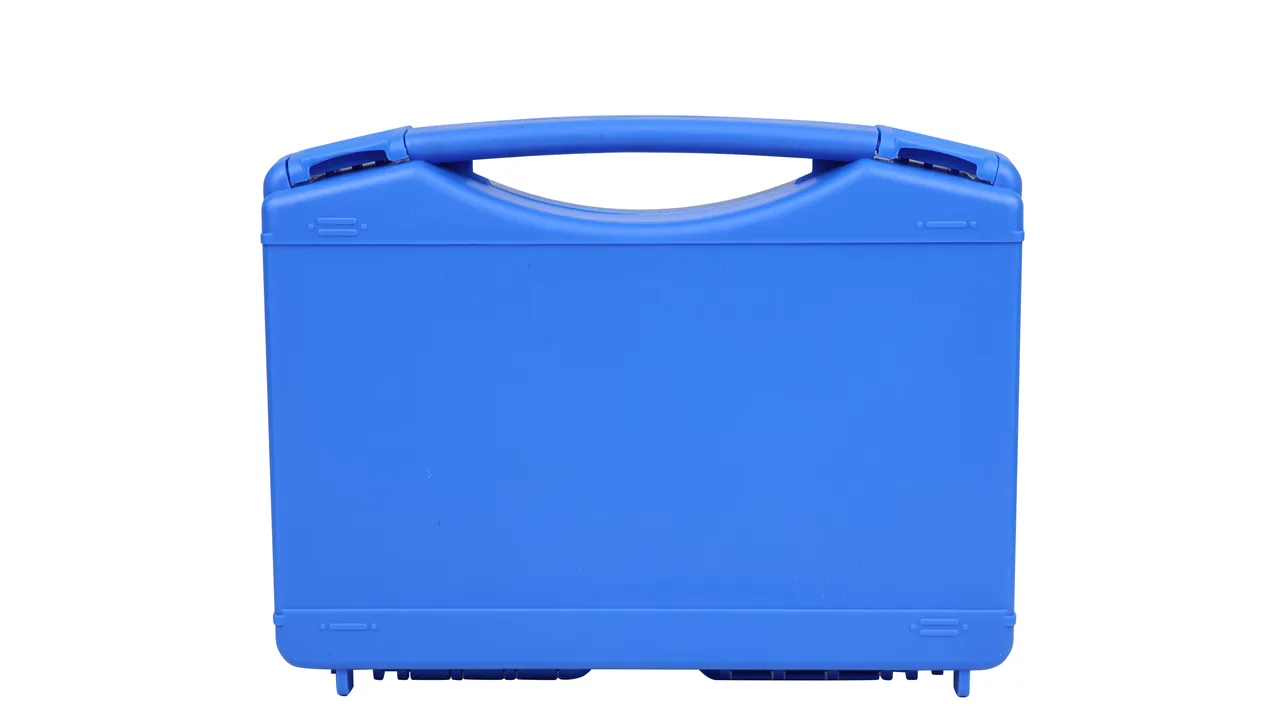
Gelatin is a natural polymer extracted by hydrolysing the collagen in animal skin and bone, and it is used in hard capsules, pharmaceutical excipients, food additives and photographic materials. Its production line is a continuous process chain that is unusually demanding in temperature, acid-base chemistry and cleanliness. Raw material passes through liming, degreasing and neutralisation before entering extraction tanks, where rising temperatures and successive extractions hydrolyse collagen into gelatin liquor; the liquor is then filtered, demineralised by ion exchange, concentrated under multi-effect vacuum, sterilised, dried on a long-mesh belt, milled, sieved and packed into grades with different bloom strength and viscosity.
The critical parts along this chain are almost all thin-walled, mirror-polished, dead-leg-free structures with micron-level accuracy that must satisfy GMP hygiene requirements: the stainless liner and screen plate of the extraction tank, the liming vat agitator, the ion-exchange distributor, the heating tube bundle and plate heat exchanger plates of the concentrator, the filter plates and stainless screens, the long-mesh dryer belt and rollers, and the mill blades and screens. A scratched liner or a distorted screen plate is rarely obvious on arrival, appearing only after assembly and trial running.
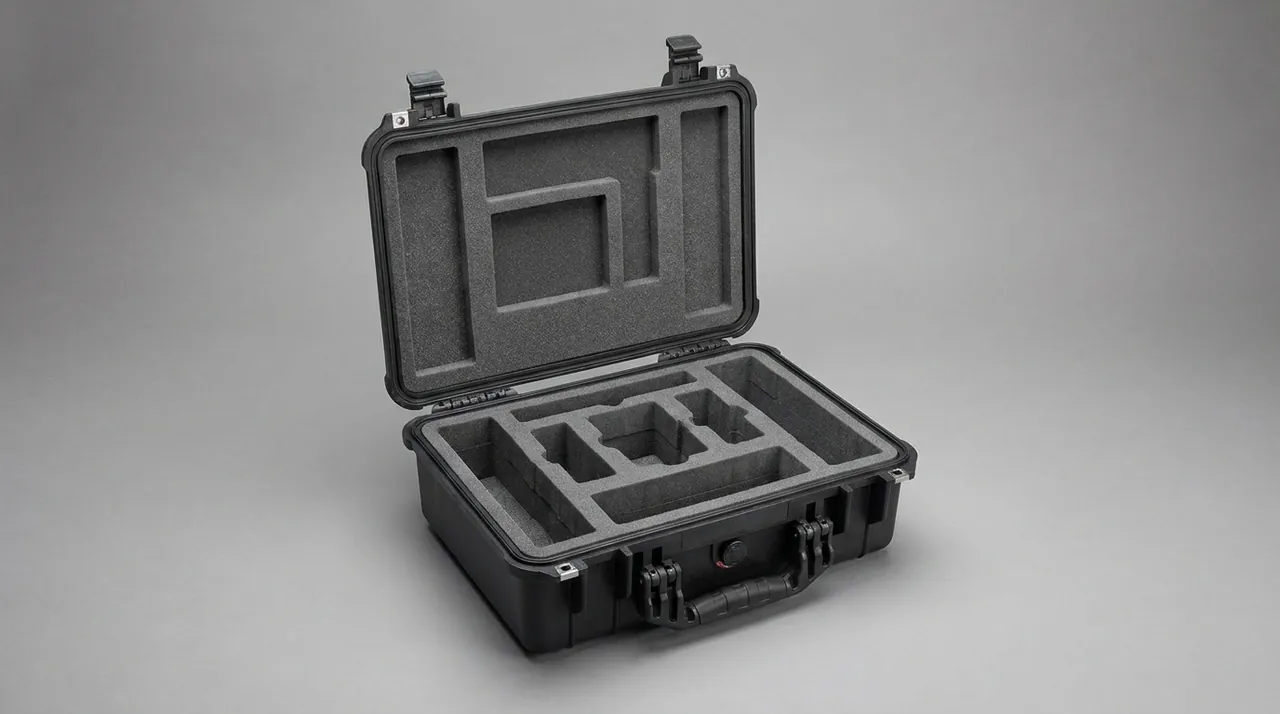
JUNZHIJIA's protection principle: gelatin equipment parts are not ordinary stainless components but hygienic surfaces that must be packed around four rules, zero damage to the hygienic face, load carried by structure, environment fully isolated, and every step traceable, using engineering-plastic cases, lint-free cushioning liners and a complete case file to compress transport risk into a measurable, repeatable range.
Table of Contents
- The Gelatin Process Chain and the Transport Risk Profile of Its Parts
- Extraction Tank Liner and Screen Plate: Thin Wall, Mirror Finish and Dead-Leg-Free Protection
- Liming, Neutralisation and Ion-Exchange Parts: Resistance to Strong Alkali and Acid
- Concentrator Components: Heating Tube Bundle, Separator and Plate Heat Exchanger Plates
- Filtration Parts: Filter Plates, Screens and Diatomaceous Earth Components
- Long-Mesh Drying, Milling and Sieving Parts: Belt, Rollers, Blades and Screens
- Corrosion and Material Selection in Collagen Hydrolysis and Cleaning Chemicals
- Hygienic Liner Design: Lint-Free, Cleanable and Dead-Leg-Free
- Quantified Cushioning Design and Material Combinations
- Compartmentalisation, Lifting and Case-Floor Load Capacity
- Sealing and Humidity Control: IP Ratings, Pressure Equalisation Valves and Desiccant
- Transport Testing and Receiving Criteria: ISTA, GB/T 4857 and ASTM D4169
- Stacking, Storage, Reuse and Custom OEM/ODM
The Gelatin Process Chain and the Transport Risk Profile of Its Parts
The raw material route decides which of two mainstream processes is used: the alkaline route, steeping skin or bone in lime milk, and the acid route, using dilute acid. The alkaline route is slow and runs hot; the acid route hydrolyses faster at pH two to four. Either way, the parts share the same requirements: resistance to alkali or acid, cleanability in place, dead-leg-free internal surfaces, and tolerance of repeated thermal cycling.
- Mechanical: dents and ovalisation of thin-walled liners and screen plates during lifting, road shock and stacking; mid-span sag of long heating bundles; edge warping of plate heat exchanger plates; creasing of stainless screens.
- Environmental: alkalinity from lime milk residue, low pH from acid hydrolysis liquor, pitting from high-chloride process water, sea-freight salt spray, and condensation that lets protein residue absorb moisture and grow mould.
- Management: no record of hygienic-surface contact, unclear centre-of-gravity and lifting-point marks, and damage on arrival that cannot be attributed to a stage.
| Part category | Main damage mode | Direct consequence | Protection priority |
|---|---|---|---|
| --- | --- | --- | --- |
| Extraction tank liner / screen plate | Liner scratches, screen distortion, manway flange impact | Lower hygienic class, uneven water distribution | Soft mirror-face shield, multi-point screen support, blinded ports |
| Concentrator heating bundle | Tube bending, tube-sheet face contamination | Lower heat transfer, insufficient concentration | Continuous rigid bearers, tube-sheet shield, internal dehumidification |
| Plate heat exchanger plates | Plate warping, gasket groove impact | Leakage on reassembly, cannot restack | Shaped pallets, layered stacking, interleaves |
| Filter plates / screens | Plate warping, screen creasing | Lower filtration accuracy, product loss | Flat pallets, flatness restraint, corner guards |
| Long-mesh dryer belt / rollers | Belt creasing, roller face and journal damage | Uneven drying, tracking drift | Large-diameter winding core, independent journal support |
| Milling blades / screens | Blade edge chipping, screen hole distortion | Loss of particle-size control | Individual blade packing, screens laid flat |
Extraction Tank Liner and Screen Plate: Thin Wall, Mirror Finish and Dead-Leg-Free Protection
The shell of the extraction tank is normally 316L stainless steel, the liner three to six millimetres thick, and the internal surface polished to Ra 0.4 to 0.8 micrometres so material does not cling and can be cleaned. The bottom is dished with generous radii, and all ports are dead-leg-free. The screen plate, or false bottom, is a perforated thin plate with millimetre-scale holes that may number in the thousands, supporting the material bed while distributing liquid.
The main risk to the liner is scratching and ovalisation. Once the passive film on a mirror surface breaks, that spot holds product and hides microorganisms; if the tank is squeezed during lifting, the roundness deviation changes the clearance between screen plate and wall and upsets distribution. The screen plate risks bending and hole distortion, because a thin plate has low stiffness and support at both ends alone lets its own weight and vibration sag the centre.
Packing follows three rules: soft face contact, rigid shape retention and port blinding. The inner wall is covered with a lint-free, closed-cell IXPE or fine PE shield that only isolates and excludes dust; the shell is restrained against ovalisation with removable rings or spreader bars; the screen plate is laid flat on a shaped pallet with multi-point support, never sharing a compartment with metal parts. Every manway, nozzle and sight glass is blinded, desiccant is added inside, and the closing humidity is recorded. The same thinking for thin-walled hygienic vessels appears in Bioreactor & Fermentation Parts Cases: Agitator & Sensor Component Protection.
Liming, Neutralisation and Ion-Exchange Parts: Resistance to Strong Alkali and Acid
Liming is the key pre-treatment of the alkaline route, and lime milk stays above pH twelve all year round with high calcium and suspended solids. Ion-exchange columns remove salts from the liquor, and resin regeneration also flushes with alternating acid and alkali, so their distributors, collectors and screens are precision fine-mesh structures.
Corrosion here takes unusual forms. Carbon steel under concentrated alkali and tensile stress can suffer caustic embrittlement, a stress corrosion cracking mode, so critical load-bearing parts are usually stainless or duplex steel. Seals in contact with alkali and acid should be EPDM or perfluoroelastomer rather than ordinary nitrile rubber, and bare aluminium must not contact residue for long. Fine-mesh parts should be laid between clamping plates or wound on a large-diameter core with end guards to prevent rubbing in transit.
| Corrosion source | Mechanism | Protection measure |
|---|---|---|
| --- | --- | --- |
| Lime milk and strong alkali | Caustic embrittlement of carbon steel, swelling of seals | Stainless load-bearing parts, EPDM seals, no bare aluminium |
| Acid neutraliser and hydrolysis liquor | Low-pH uniform corrosion, preferential attack at welds | Confirmed material with post-weld passivation, acid assessment of liners |
| High-chloride process water | Passive film breakdown, pitting and crevice corrosion | Full sealing, humidity control, periodic chloride review |
| Sea-freight salt spray | Continuous chloride action over the sea cycle | Sealed case, protected hardware, desiccant with humidity indicator |
Concentrator Components: Heating Tube Bundle, Separator and Plate Heat Exchanger Plates
Gelatin liquor is usually concentrated in multi-effect vacuum evaporators so the boiling point is lowered and bloom strength and viscosity are protected. The core is the heating tube bundle, in which several hundred fine stainless tubes are welded to a tube sheet at each end and the assembly may be four to eight metres long; separators between effects split secondary vapour from droplets; and plate heat exchangers, with plates only 0.5 to 0.8 millimetres thick, are often used for preheating and cooling.
The bundle's stiffness comes from tube sheets and tubes acting together, not from any single tube. With support only at both ends, the centre flexes repeatedly under self-weight and vibration, and if slings pass directly between the two tube sheets during lifting, the concentrated force instantly bends the tube ends. Plate heat exchanger plates fail by warping when stacked without a flat pallet under the centre. The bundle should therefore be packed on continuous rigid bearers with evenly spaced supports near the tube sheets and at mid-span, with soft shields on the tube-sheet faces and axial restraint at both ends. Plates must be interleaved on shaped pallets, never stood upright. For vacuum sealing faces, the approach in Freeze Dryer Cases: Cold Trap & Vacuum Component Protection is a useful reference.
| Component | Critical precision area | Main risk | Packing approach |
|---|---|---|---|
| --- | --- | --- | --- |
| Heating tube bundle | Tube-sheet face, tube ends | Overall bending, bent tube ends | Continuous bearers, multi-point support, tube-sheet shield, axial limit |
| Vapour-liquid separator | Inner wall, tangential inlet | Inner-wall scratches, shell ovalisation | Shape-retaining rings, internal shield, blinded ports |
| Plate heat exchanger plates | Plate face, gasket groove | Warping, groove impact | Shaped pallets, layered, interleaves |
| Vacuum pump and valves | Seat, sealing face | Scratched sealing face, foreign matter ingress | Separate compartment, end caps, dry sealing |
Filtration Parts: Filter Plates, Screens and Diatomaceous Earth Components
Clarification of gelatin liquor usually uses a plate-and-frame filter, a pulp filter or a diatomaceous earth filter to remove suspended matter and improve clarity and purity. Plates are mostly polypropylene or aluminium alloy, with diaphragm plates for squeezing; filter cloth and stainless screens do the retaining; and a diatomaceous earth system adds a pre-coat tank, a metering pump and precision nozzles.
Polypropylene filter plates creep after heating and loading anyway, and if stacked too high in transit, the flatness deviation stops adjacent plates pressing tightly and the unit leaks along the edges in service. Stainless screens are extremely thin woven parts, and a single crease distorts the mesh locally and makes filtration resistance uneven; curling or wrinkling also forces operators to flatten the screen during installation, creating residual stress and local damage.
Filter plates should be packed on flat pallets, either stood vertically or laid flat with thin interleaves, and must not be stacked too high; large diaphragm plates should be stood in slots so the centre is not loaded. Stainless screens should be wound on a large-diameter core with end guards, or laid flat between two plates, and must not contact hard parts directly. Precision nozzles and plungers should have their own compartments, fixed with shaped foam, with rigid partitions breaking the load path between compartments. The protection of filter plates and hydraulic closing parts is covered further in Filter Press Cases: Plate & Hydraulic Closing Protection.
Long-Mesh Drying, Milling and Sieving Parts: Belt, Rollers, Blades and Screens
After concentration and sterilisation, a long-mesh dryer spreads gelatin liquor as a thin layer on a continuous stainless belt, dries it in zones to form a film, and passes it to milling and sieving. The core parts are a fine-mesh stainless belt several tens of metres long, multiple conveyor rollers and a tensioning mechanism; the mill has high-speed blades and perforated screens; and sieving uses the frames and screens of multi-deck vibrating sieves.
The belt is the most fragile and most expensive part of this stage. Woven from fine wire, it is thin, large and sensitive to creasing; any crushed mesh cell makes material pile up and dry unevenly. Milling blades are hard-edged parts, and chipping one edge changes the cutting condition and lets particle-size distribution drift.
The belt is cleaned and dried, wound on a large-diameter core, given rigid end guards, and secured on a pallet inside the case to limit rolling. Conveyor rollers should be supported by their journals with soft protection on the faces, never resting directly on the case floor. Milling blades should each be sleeved and placed in separate compartments with edges touching nothing hard; screens are laid flat between shaped plates and must not be folded. The packing of hygienic pump and valve parts is covered in Dairy Processing Equipment Cases: Protection for Pumps, Valves & Hygienic Parts.
Corrosion and Material Selection in Collagen Hydrolysis and Cleaning Chemicals
The corrosion environment in gelatin production is a stack of protein hydrolysis liquor, strong alkali, acid, high-chloride water and high temperature, more complex than typical food or pharmaceutical duty. The liquor contains organic acids and amino acids that absorb moisture and acidify locally on metal surfaces; liming brings continuous strong-alkali exposure; acid hydrolysis and neutralisation push pH down to two or four; and clean-in-place often uses one to two percent sodium hydroxide at about eighty degrees Celsius together with nitric or phosphoric acid based detergents.
The three most common failures are pitting, crevice corrosion and caustic embrittlement. Chloride ions can penetrate the passive film of stainless steel even at modest concentration, and gaps under flange gaskets, weld caps, threads and rolled edges are the most likely initiation sites because of oxygen concentration differences. In material selection, wetted parts are mainly 316L, with 2205 duplex steel for high-chloride duty; seals are chosen by medium as EPDM, perfluoroelastomer or PTFE; and case hardware is always stainless or corrosion-protected.
| Failure mode | Trigger condition | High-risk location | Selection and protection |
|---|---|---|---|
| --- | --- | --- | --- |
| Pitting | Chloride penetration of the passive film | Welds, gasket edges, rolled edges | 316L or duplex steel, full sealing, humidity control |
| Crevice corrosion | Local oxygen depletion, stagnant medium | Under flange gaskets, threads, stacked layers | Dead-leg-free design, thorough cleaning and drying before packing |
| Caustic embrittlement | Concentrated alkali plus residual tensile stress | Carbon steel load-bearing parts, weld heat-affected zone | Switch to stainless, relieve stress after welding |
| Microbially influenced corrosion | Hygroscopic protein residue supporting colonies | Inner walls, screen plates, fine mesh | Wash and dry before packing, non-hygroscopic liner, sealed humidity control |
Salt spray and immersion tests rank different schemes and support process screening, but cannot be extrapolated into field service life or any certification claim.
Hygienic Liner Design: Lint-Free, Cleanable and Dead-Leg-Free
Gelatin is a material in direct contact with pharmaceutical and food products, so the packing of its equipment parts cannot simply follow general industrial practice. The core GMP requirement is to introduce no contamination source, which sets three hard rules for the liner. First, it must not shed particles or fibres, so pulp, corrugated board, wood shavings or open-cell polyurethane must not be opened directly in a clean area. Second, it must not absorb moisture or grow mould, so the material should be closed-cell. Third, it must not form dirt-trapping dead legs, so the liner surface should be smooth and wipeable with no exposed adhesive.
In practice a three-layer arrangement is common: outer industrial case, middle moisture barrier, inner clean bag. The outer case carries load, the middle closed-cell PE or IXPE foam shapes and cushions without shedding lint, and the inner clean-grade PE bag with desiccant keeps the part controlled at unpacking. All labels and inks should sit on the outer case face, never on the inner layers or in contact with the part.
| Liner material | Shedding | Hygroscopicity | Clean-area suitability | Typical position |
|---|---|---|---|---|
| --- | --- | --- | --- | --- |
| Closed-cell PE foam | Very low | Non-hygroscopic | High | Clean-layer shaping and cushioning |
| IXPE chemically cross-linked | Very low | Non-hygroscopic | High | Mirror face and sealing-face shield |
| EVA foam (closed-cell) | Low | Low | Medium to high | Load-bearing shaped blocks |
| Open-cell polyurethane | Relatively high | Hygroscopic | Not for hygienic contact | Outer coarse cushioning only |
| Pulp / corrugated / wood shavings | High | Hygroscopic and mould-prone | Prohibited in clean areas | Must not contact parts |
Parts should be cleaned, desalted and dried before packing and allowed to equilibrate before closing; packing and unpacking areas should be graded so the outer case is opened in a buffer zone and the inner bag enters the clean area; and reusable liners need a cleaning and replacement cycle so surface scratches do not become dirt traps.
Quantified Cushioning Design and Material Combinations
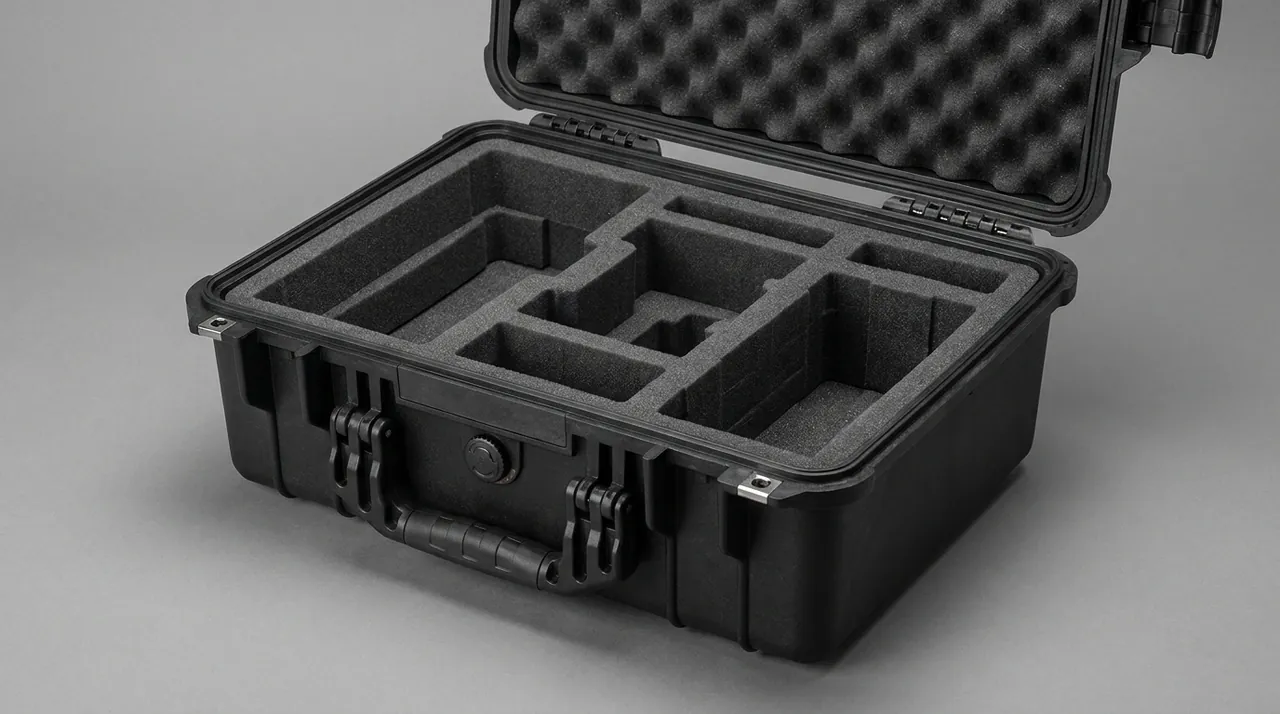
The liner is the part that actually holds the component and determines the forces it sees, while the case only carries external load, so the two must be designed together. The liner's roles must be separated: the contact layer isolates, prevents rubbing and excludes dust, while the load-bearing layer and rigid bearers carry gravity and inertia. Low-density foam compacts quickly under self-weight and shock, so a part buried in foam still reaches the case floor directly.
Cushion thickness should be estimated from permitted acceleration and allowable foam compression rather than chosen as a round number. The method is to determine the shock acceleration the part can tolerate from transport tests or historical data, combine that with the foam stress-strain curve at the target strain to back-calculate contact area and thickness, and then verify against stacking and drop conditions. For thin-walled mirror-finish parts, surface pressure must also be controlled, because excessive pressure per unit area leaves permanent dents; here the contact area should be increased rather than the foam simply thickened.
| Liner material | Density and hardness | Rebound behaviour | Application in gelatin equipment |
|---|---|---|---|
| --- | --- | --- | --- |
| EPE pearl foam | Low density, soft | Fast rebound, long cushioning travel | Full wrap on light and medium parts, anti-rub isolation |
| EVA foam | Medium to high density, tunable | Good shape retention, high load capacity | Tube bundle blocks, filter plate and roller load layers |
| PE foam | Medium density, firm | Resists repeated compression, durable | Reusable liners for returnable cases |
| IXPE chemically cross-linked | Fine and uniform | Smooth surface, no shedding | Liner mirror face, tube-sheet and sealing-face shields |
A composite liner is the standard solution: the side touching the part uses IXPE or fine closed-cell PE to protect the hygienic face, while EVA shaped blocks outside it provide rigid location and spread the load, all set into rigid bearers or a case-floor load beam. A first-article trial fit should then quantify insertion force, clamping force and ease of removal.
Compartmentalisation, Lifting and Case-Floor Load Capacity
Gelatin spares are often shipped as a small batch of many types: one heating tube bundle, several plate heat exchanger plates, and a number of filter plates and precision nozzles on the same dispatch. Compartmentalisation is then not a matter of appearance but of load path. If parts of different mass classes share one compartment, the heavy part presses continuously on the light one during vibration, and the light part is damaged even inside foam. The correct approach is to separate mass classes with rigid partitions that also support, so loads do not cross between compartments.
The case exterior should clearly mark the centre of gravity, total mass, lifting points and maximum stacking tiers; lifting points should align vertically with the internal centre of gravity, otherwise the case tilts at lift-off and the contents take a lateral shock. Case-floor capacity should be checked against the heaviest single part plus the stacking load, adding load beams or a base pallet where needed.
| Packing step | Common error | Consequence | Correct practice |
|---|---|---|---|
| --- | --- | --- | --- |
| Compartmentalisation | Heavy and precision parts in one compartment | Precision part pressed continuously | Rigid partitions, loads do not cross |
| Lifting | Sling around the shell or through the bundle | Thin wall flattened, tube ends bent | Dedicated gear on bearers or spreader bars |
| Securing | Strap tightened on the hygienic face | Mirror scratches, local dents | Soft pads under straps, clear of the surface |
| Load bearing | Heavy part supported by foam alone | Hard contact after foam compacts | Continuous bearers, four-point floor support |
Sealing and Humidity Control: IP Ratings, Pressure Equalisation Valves and Desiccant
Whether gelatin equipment parts need a sealed case depends on how much environment they are exposed to. Under IEC 60529 and GB/T 4208, IP65 resists water jets and suits in-plant transfer and short open storage where rain or wash-down is possible; IP67 withstands short immersion and suits long sea freight, intermodal transport and quayside storage where water may accumulate. The higher the rating, the more prominent the pressure difference becomes: temperature swings at sea and cabin pressure changes in air freight push internal pressure away from ambient, and without a relief path the gasket can be pressed in or blown out.
The remedy is a waterproof breathable pressure equalisation valve, which lets gas pass slowly while blocking liquid water, so internal and external pressure stay close and the gasket carries only assembly compression. Humidity control should proceed in the order dry first, seal second, monitor third: parts and liner equilibrate in a dry environment before closing, sufficient desiccant and a humidity indicator card go inside, the closing date and initial humidity are recorded, and the indicator is read on arrival. For protein-based parts, residual protein absorbs moisture and feeds microorganisms, so drying is also a hygiene measure.
| Exposure scenario | Recommended rating | Pressure management | Humidity management |
|---|---|---|---|
| --- | --- | --- | --- |
| In-plant transfer | IP54 to IP65 | No dedicated valve usually needed | Gasket plus simple desiccant |
| Open yard storage | IP65 | Valve recommended | Desiccant plus humidity indicator card |
| Long road and rail | IP65 | Valve recommended | Desiccant sized to transit duration |
| Sea freight and intermodal | IP67 | Valve mandatory | Ample desiccant, closing humidity record, arrival review |
Transport Testing and Receiving Criteria: ISTA, GB/T 4857 and ASTM D4169
Whether a packing scheme is acceptable must ultimately be proved by transport testing rather than by feel. The thin walls and hygienic nature of gelatin equipment parts mean testing must cover four basic conditions, vibration, shock, stacking and drop, and add an extra contact check on hygienic surfaces.
| Test category | Common standard | Main objective | Judging focus |
|---|---|---|---|
| --- | --- | --- | --- |
| Fixed-frequency and random vibration | GB/T 4857, ASTM D4169 | Liner shift and resonance under long vibration | No shift, abrasion or loosening |
| Drop and shock | ISTA 1A / 2A | Cushioning under handling shock | Case may be slightly scuffed, part must not be damaged |
| Stacking load | GB/T 4857 stacking test | Creep under long static load | No case collapse, no distortion of thin-walled parts |
| Incline and horizontal impact | ASTM D4169 distribution cycle | Start-stop and marshalling shock | Locking does not fail, part does not shift |
Criteria should be set in layers: the case may be slightly scratched and dented, the liner may compress to a limited extent, while the part itself must show no shift, no abrasion and no functional damage; for mirror and sealing faces a surface-quality recheck should be added, and for tube bundles a tube-sheet flatness and tube-end roundness recheck.

Receiving should check the case exterior, latches and valve first, then the gasket and humidity indicator, then the packing list against the contents, and finally record each area with photographs. Any anomaly should be logged on the spot and reported to the sender rather than absorbed on site. Any standard test only simulates specific conditions, so the report supports comparison and acceptance but promises no absolute zero damage.
Stacking, Storage, Reuse and Custom OEM/ODM
Without clear stacking rules the upper case transfers its weight through the lid onto the internal parts, and long static load can creep the case material so the lid slowly sinks. Cases should be marked with maximum stacking tiers and single-part mass, yards arranged by the principle that heavy never sits on light, large never on small and high never on low, and ventilation and inspection lanes left clear. Storage should be ventilated, rain-sheltered and sun-sheltered, with regular checks of desiccant and humidity indicator cards.
For returnable cases, each recovery should be checked for gasket elasticity, hardware corrosion, permanent liner compression and latch tightness, and a case number and usage record allow responsibility to be traced when damage occurs. Gelatin spares come in many types, with varied drawings and small batch sizes, so standard cases rarely fit and customisation is the key to a workable project. JUNZHIJIA starts from drawings and physical data, confirming part dimensions, mass, centre of gravity, fragile areas and hygienic-face accuracy before fixing case size, liner compartments, bearer form and lifting points, then moving to sampling and first-article trial fit. Manufacturing is handled by Kexin New Materials (Guangdong) Co., Ltd., which provides tooling, injection moulding, rotational moulding and foam forming and completes basic sealing, stacking and vibration verification before volume production. JUNZHIJIA offers both OEM and ODM cooperation: OEM builds to the customer's drawings with the customer's brand, while ODM involves us in structural and liner design, and both deliver a complete case file covering the packing drawing, liner drawings, lifting and unpacking instructions, material and humidity records and the test report summary.
Frequently Asked Questions FAQ
Q: The extraction tank liner is 316L mirror stainless steel, so why can it not simply be wrapped in bubble film or cardboard?
A: Bubble film and cardboard have three problems that are hard to avoid in a gelatin clean environment. First is shedding and fibre: cardboard releases paper dust once damp, and bubble film can burst under friction and leave fragments, both of which become foreign matter if they enter the liner. Second is moisture absorption and microbial growth: cardboard absorbs water readily and becomes a substrate for mould and bacteria on a humid sea voyage, while gelatin production is extremely strict about microbiological control. Third is insufficient corrosion protection: ordinary cardboard can be acidic, and long contact with a mirror finish increases the risk to the passive film. The correct method is to cover the internal wall first with lint-free, closed-cell, non-hygroscopic IXPE or fine PE foam for isolation and dust exclusion, then restrain the shell against ovalisation with removable rings or spreader bars, blind every manway, nozzle and sight glass, and add desiccant inside with the closing humidity recorded. Where a part must be opened in a clean area, a clean-grade PE bag keeps it controlled at unpacking.
Q: The extraction tank screen plate is only a perforated thin plate, so can it really distort in transit?
A: Yes, and it is one of the most underestimated risks in gelatin equipment. The stiffness of a screen plate comes from its own face and its support boundary, and a single thin plate supported only at both ends sags at the centre and flexes repeatedly under self-weight and transport vibration, shifting the hole pattern by an amount that is hard to see. Once the holes move, the uniformity of liquid distribution and collection changes, the material bed is heated unevenly, and the visible result is lower extraction efficiency and poorer batch consistency. If a concentrated force is also applied during lifting, the narrow ligaments between holes can collapse or crack. There are three ways to prevent this: use multi-point, evenly spaced supports whose number is set by span and plate thickness so the centre is never unsupported; lay the plate flat on a shaped pallet, or stand it in a dedicated slot, never sharing a compartment with metal parts; and supply a hole-position datum or flatness record with the case so that on arrival the plate is checked before installation.
Q: Gelatin production uses both strong alkali and dilute acid, so how should case seals and hardware be selected?
A: Selection must be made by medium rather than using one material for everything. For sealing points repeatedly exposed to strong alkali and most acids, EPDM or perfluoroelastomer is preferred, as both are stable in alkali and oxidising media and withstand high-temperature cleaning; ordinary nitrile rubber swells and hardens in concentrated alkali at high temperature and is not recommended for the liming and neutralisation areas. For parts such as plate heat exchangers that are frequently dismantled and contact several media, PTFE-coated or solid PTFE seals offer the best chemical inertness, though their elastic recovery is limited and groove fit needs care at assembly. Case hardware, hinges, latches and bolts should all be stainless or corrosion-protected, and bare aluminium should be kept away from long contact with alkali and residue because aluminium corrodes quickly in alkaline media. One easily overlooked combined risk is that stainless steel, while resisting acid and alkali, is sensitive to chlorides, so seal selection must be combined with full sealing, ample desiccant and an arrival humidity check.
Q: The concentrator heating tube bundle is very long, so which damage is most likely in transit and how is it prevented?
A: Overall bending and tube-sheet face damage are the most common, and both directly affect vacuum concentration performance. A bundle can be four to eight metres long, and its stiffness comes mainly from the tube sheets and tubes acting together, so the centre is relatively weak; with support only at both ends the centre sags noticeably and flexes repeatedly, the relative positions of the tube-sheet holes shift, and on site the tube insertion, expansion and welding become difficult. If slings are passed directly between the two tube sheets during lifting, the concentrated force also bends the tube ends near the sheets and creates a hidden leak path. The tube-sheet face is the sealing datum, and once scratched or contaminated it leaks on reassembly so vacuum cannot be established, the concentration temperature rises, and gelatin bloom strength and viscosity are affected. Prevention rests on three points: continuous rigid bearers with evenly spaced supports near the sheets and at mid-span; soft shields over the tube-sheet faces with axial restraint; and internal cleaning and drying followed by desiccant and a recorded closing humidity.
Q: Plate heat exchanger plates are very thin, so why must they be separated individually rather than stacked as a block?
A: Because the failure modes of the plates are warping and gasket-groove impact, and block stacking aggravates both at once. The plates are commonly only 0.5 to 0.8 millimetres thick, large in area and low in stiffness, so when stacked without a flat pallet under the centre, the weight above bends the middle plates permanently; once flatness is out of tolerance the gasket compression is uneven and the unit leaks along the edges in service. At the same time the gasket groove at the plate edge is the most precision-critical area, and if plates touch directly, transport vibration makes them rub and leaves scratches or burrs at the groove, which become the starting point of a seal failure. The correct method is to interleave each plate with a thin separator and lay them flat in layers on a shaped pallet that is itself flat and rigid, then restrain horizontal movement with EVA shaped blocks. Plates must never be stood upright, inserted at an angle or bundled together, and must not share a compartment with flanges, bolts or other hard items.
Q: Gelatin is strongly hygroscopic, so does part packing need extra humidity control?
A: Because gelatin protein residue absorbs moisture, humidity control here is not only a rust issue but a hygiene issue. Residual protein softens as it takes up water in high humidity and forms a substrate suitable for microbial growth, and once mould or bacteria have grown it is very hard to remove completely even by later cleaning, so the endotoxin risk remains. Humidity control should therefore be stricter than for ordinary metal parts, and it works in three layers. The first is thorough drying before packing: after cleaning and desalting, parts should equilibrate fully in a dry environment and internal cavities and fine mesh passages should be confirmed free of liquid. The second is dehumidification and sealing at closing time: size the desiccant to the cavity volume and expected transit duration, fit a humidity indicator card, and record the closing date and initial reading. The third is the arrival review: read the indicator before opening, and if it is out of limit assess whether further drying or a hygienic re-wash is needed.
Q: How should hard small parts such as mill blades and screens be shipped together with large components?
A: The core rule is to separate compartments, cases and mass classes, and never to let hard small parts share a compartment with large components. Milling blade edges are hard but brittle, so once they contact heavy items such as tube bundles or filter plates they knock against each other in vibration, chipping the edges or even starting cracks; a chipped edge changes the cutting condition and particle-size distribution drifts immediately. Screens are thin perforated parts that distort under local pressure, and a deviation in hole size directly affects finished particle size. The recommended handling is to sleeve each blade individually in its own compartment with edges touching nothing, fixed with shaped foam to stop movement; to lay screens flat between two shaped plates with corner guards; and, if a shared case is unavoidable, to break the load path between the heavy and precision compartments with rigid partitions and to number each compartment with a position map on the lid. The case file should state the contents of each compartment and the removal sequence.
Q: Which items in the case file matter most for reducing responsibility disputes on a gelatin project?
A: The value of the case file is that it turns packing execution into a checkable chain of evidence, which matters especially in an industry as demanding on hygiene and accuracy as gelatin. The most important items include the packing drawing and liner drawings, which show the position and fixing method of every part and compartment so return shipments can be repacked to the same scheme; the lifting and unpacking instructions, which state lifting points, centre-of-gravity direction and opening sequence so that on-site forces cannot cause secondary damage; the material and anti-corrosion records, covering the cleaning and drying process, protection material specification, desiccant quantity, closing humidity and date; the transport test report summary, which states the conditions and criteria the scheme was verified against; and the factory accuracy records, such as tube-sheet flatness, filter plate flatness or screen hole-position datum, for arrival comparison. Receiving should check the case exterior and humidity indicator first, then verify parts against the list, and finally record the actual condition with photographs.
Conclusion and Related Reading
Transport protection for gelatin equipment parts turns hidden, hard-to-repair damage into a designed, verified and traceable engineering problem. Hygienic faces only isolate, loads go to structure, the environment is sealed and dried, and execution is documented.
Related Reading