

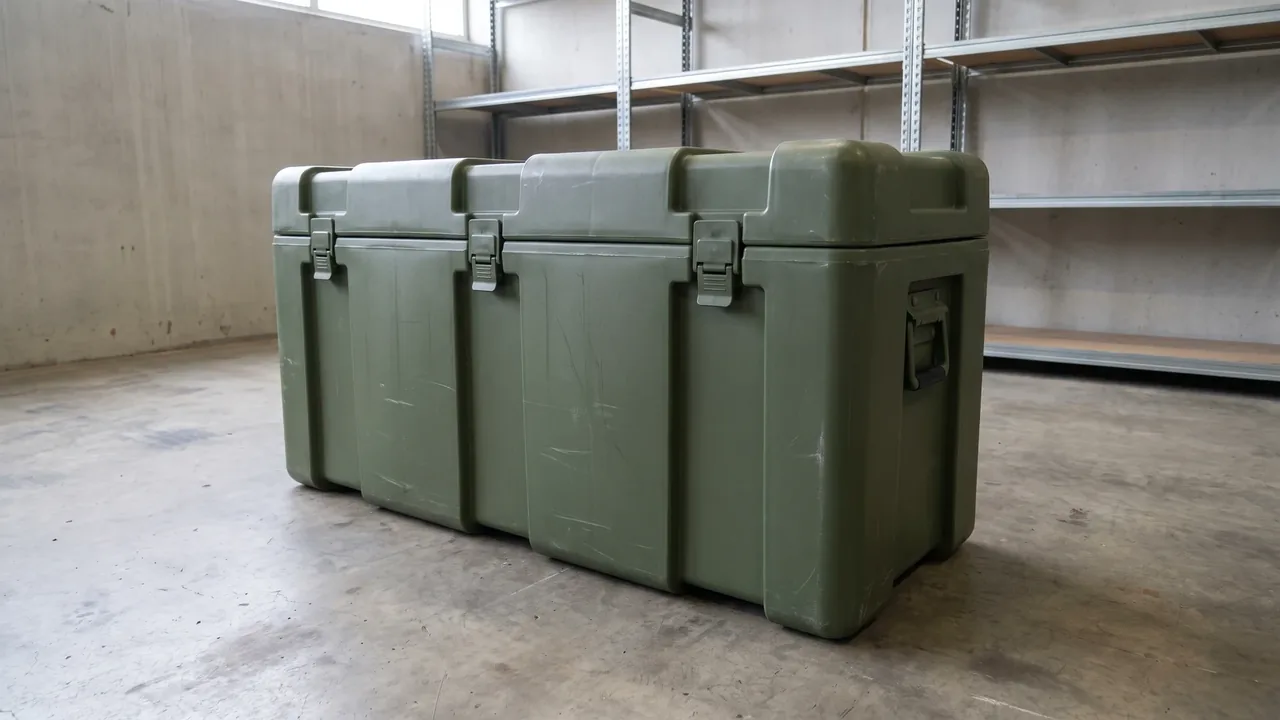
The most underrated cost in any workshop is the walk between the workstation and wherever the tools are kept. When a single wrench is picked up dozens of times a day, and each round trip wastes ten or fifteen seconds, the loss compounds across a production line, a shift team, and an entire year into a visible amount of time. The tool cabinet and the mobile tool cabinet became fundamental shop-floor infrastructure precisely because they turn the casual question of where tools live into something that can be engineered.
This article approaches the subject from the perspective of a protective-container and sheet-metal structure manufacturer. It covers cabinet bodies, drawers, slides, casters, liners, locks, surface treatment, and acceptance testing, all organized around one idea: the physical form of the cabinet should serve the flow of the workshop. Standards mentioned here are cited as test methods only and do not represent any certification. JUNZHIJIA's practical experience on these projects is straightforward — map the process sequence first, then decide the cabinet format. Doing it in the opposite order costs far more in the long run.
Why Workflow Determines Cabinet Format
Workflow is the path that people, materials, and tools travel through a workshop. When planning it, engineers really care about three quantities: retrieval distance, retrieval frequency, and retrieval posture. Retrieval distance decides whether a cabinet stands beside the station or sits in a corner of the shop. Frequency decides whether frequently used tools belong on the most reachable level. Posture decides opening height, drawer pull direction, and whether a work surface needs to be within arm's reach. Draw those three quantities onto the same floor plan and half the placement and format decisions make themselves.
The real problems usually begin with the habit of centralized storage. Many workshops start by chasing visual order, gather every tool into a tool room, and then have every station repeat a walk-find-return loop all day long. A better approach is layered placement: high-frequency, light tools go into a mobile cabinet beside the station; medium-frequency tools go into a shared fixed cabinet for the team; low-frequency specialist tools and spares live in the tool room. This layering does not chase absolute tidiness on the surface. It matches each tool's storage location to its retrieval rhythm, and in the long run the shop looks tidier anyway, because every tool has a clear home to return to.
The Three Basic Cabinet Formats
By mounting method, tool cabinets divide into fixed, modular, and mobile types, and each has a completely different structural emphasis. A fixed cabinet stands on the floor or is anchored to a wall. It pursues maximum storage density and the lowest cost per unit of volume, draws can be deep, the body can be tall, and the trade-off is a retrieval distance that can only be compensated by layout.
A modular cabinet uses a shared dimensional grid to assemble several bodies, side units, and overhead units into one workstation. Its value is elasticity. Within the same grid you can swap drawer banks of different heights, bodies of different depths, and back panels of different functions, so a line expansion or reconfiguration means reorganization rather than replacement. The price is strict demand for grid consistency: mounting holes and work-surface heights across batches must actually mate, so the module parameters belong in the technical specification at order stage.
A mobile cabinet adds casters and a handle to the fixed format, turning the body itself into a movable carrier. It gives up some stability and single-unit volume in exchange for letting the tools come to the job. For maintenance crews, assembly lines that rotate across stations, and inspection work that shuttles between machines, the mobile format is usually the best value, and the full selection logic is developed in Tool Cart and Cabinet: Mobile Tool Workstation and Shop Storage.
Drawer Layout: Layering by Frequency, Height, and Load
Drawers define the daily experience of a cabinet, and the layout logic reduces to layering by frequency, sorting by height, and matching slides to weight. Layering by frequency means putting the most-used tools at waist level, avoiding repeated bending or reaching, while low-frequency items go to the top or bottom. The principle sounds obvious, yet it is routinely ignored because many teams allocate drawers by tool size rather than by how often a tool is actually touched.
Sorting by height means matching net drawer height to tool geometry. Shallow drawers suit flat items such as wrenches, screwdrivers, and measuring tools. Medium heights suit sockets and pliers. Deep drawers hold power tools, spare-part boxes, or complete kits. Once a height combination is fixed it is hard to change in service, so the tool list should be laid out during configuration, item by item, by thickness and stacking layer, rather than leaving gaps by feel.
Matching slides to weight means the drawer's rated load must suit its slide. A common mistake is placing the heaviest tools in the lowest large drawer while keeping standard-duty slides, so the balls fatigue early, the drawer sags, and travel turns stiff. The sound approach rates each drawer against its fully loaded weight, uses thicker steel or twin-row ball slides for heavy drawers, and adds matching ribs to the cabinet side panels. The weight differences between castor-mounted and static bodies are covered in Wheeled vs Standard Toolboxes: What Is the Difference?.
Slide Selection: Full Extension, Rated Load, and Cycle Life
The three key parameters of a slide are full extension, rated load, and cycle life, and they constrain one another. Full extension means the drawer pulls completely clear of the body, so the deepest tools can be seen and reached, at the cost of longer slides and greater resistance to tipping for the same load. A three-quarter or half-extension slide is more compact and cheaper, but the rear of the drawer cannot be seen or reached, so that space is usually wasted in practice.
Rated load is normally quoted as the weight a pair of slides can carry long-term in the fully extended state, and it must be read together with the extension length and mounting method. The same pair carries more when partly extended and the least when fully extended, so procurement should verify the worst case. Cycle life reflects how many open-close cycles the slide survives at rated load. For a station that opens a drawer dozens of times a day, this figure predicts service behavior far better than the initial feel of the mechanism.
Two details beyond the slide itself are easily overlooked. The first is drawer retention, which prevents a drawer from sliding open when the body tilts or is being moved. The second is an anti-drop feature, so a drawer cannot fall out as a whole after being over-extended. Both are safety functions and both matter especially on mobile cabinets, which accelerate and decelerate constantly while being pushed. The hardware interaction behind these features is examined in What Do the Hinge, Latch and Gasket on a Toolbox Actually Do?.
Choosing Cabinet Material and Structure
Cabinet material governs the load ceiling, weight, and weather resistance of the whole unit. Cold-rolled steel is the mainstream choice, formed by bending, welding, and spot welding into a box structure and finished with powder coating. The strengths of steel are stiffness, high single-unit load capacity, and the ability to weld in reinforcing structure. The weaknesses are weight, plus paint that chips at corners on impact and then begins to rust, which is why edge protection belongs in the structural design.
An aluminum extrusion frame with panels suits situations that relocate frequently or are weight-sensitive. The extrusion slots are themselves a mounting interface, so back panels, hooks, dividers, and side units attach directly, and reconfiguration needs no re-drilling. Stiffness is lower than steel, usually compensated by larger section sizes and diagonal bracing, which fits medium loads and workstations that emphasize reconfigurability.
Engineering-plastic and composite bodies lean toward clean, damp, or chemically aggressive environments. They resist corrosion, never rust, can be washed as a whole, and can integrate drawer and body into one molded structure with fewer metal parts. Their weakness is creep under sustained load, so heavy drawers need denser support or metal reinforcement. The worst approach is optimizing a single objective — chasing low weight and ignoring load, or chasing low price and ignoring how fast the body rusts in a damp shop. Conditions vary enormously between stations, so material choices should be made per station rather than applied uniformly across a whole facility.
Casters and Braking: Rolling and Parking a Mobile Cabinet
The usability of a mobile cabinet depends heavily on its caster system. The key parameters are per-caster rated load, wheel diameter, tread material, and bearing type. Per-caster rating must match the fully loaded cabinet weight with a margin, because vibration and bumps during travel make transient loads noticeably higher than static weight. Wheel diameter determines obstacle clearance: cables, thresholds, and floor rails common in workshops all need sufficient diameter to roll through smoothly.
Tread material balances rolling resistance against floor protection. Hard wheels such as nylon roll easily and wear slowly but are harsh on floors and noisy. Soft wheels such as polyurethane or rubber are gentler on floors and absorb vibration better, at slightly higher rolling resistance. Many workshops combine soft front casters with harder rear ones, or use polyurethane all round, to balance steering and rolling.
Braking is a safety priority. At least two casters should carry brakes, and the brake should act on the wheel face or hub rather than merely locking the swivel axis. Parking reliability also depends on the release mechanism: a rocker design that locks when stepped on and releases on a second step suits a busy shop far better than a tab that requires bending down. For routes with a slope or a nearby vibration source, add an anti-roll device so an unattended cabinet cannot drift. When a body must interface with carts or pallet systems, the matching method is described in Can a Protective Case Be Fitted with Wheels? Matching Trolley Handle and Castor Load Capacity.
Work Surfaces, Handles, and Ergonomics
The work surface is what turns a cabinet from a storage device into a workstation. Material follows the task performed on it. A timber top feels warm, costs little, and suits assembly and inspection, though it swells when exposed to water and oil. A composite top resists oil and water and suits machining environments, making it the most universal choice in a shop. A stainless-steel top resists corrosion, cleans easily, and tolerates disinfectants, so it fits food, medical, and chemical processes, at higher cost and with a surface that scratches and loses appearance. Edges should be rounded or capped to prevent arm injuries during long tasks.
Handle position and shape shape the pushing experience. An ideal pull handle sits at natural wrist height when standing, on the narrow side of the body, so the view ahead is not blocked while pushing. Some designs integrate the handle with the work surface, acting as a push bar in motion and a guard rail when parked, a composite solution that saves space in a tight shop.
Ergonomics also appears in how the cabinet opens. Drawer handles must be operable with gloves, pullable with one hand. Doors should use a large pull rather than a small knob. If the body exceeds about 1.8 metres, the top drawer should carry an explicit load limit or be converted to a door, avoiding the tipping risk of climbing to reach it. Work-surface height should match the primary operator, and the practical solution is several adjustable feet rather than a single universal height.
Zoning and Liners: By Process Sequence, Not by Tool Category
Liners and dividers solve the problem of locating tools inside a drawer. A widely underestimated principle is that the zones within a drawer should follow the process sequence rather than the tool category. If the tools needed to service a machine are arranged left to right in order of use, the operator retrieves them without thinking. If they are grouped by type — wrenches together, pliers together, screwdrivers together — the operator switches repeatedly between drawers for every step of the job.
Liner materials fall into three families: molded foam, die-cut sponge, and injection-molded compartment trays. Foam pockets cut to the tool outline locate precisely and resist movement, suiting precision measuring tools and dedicated fixtures. Die-cut sponge is cheap and quick to cut, suiting stations that reconfigure often. Injection-molded trays are rigid and oil-resistant, suiting standardized items such as sockets and drill bits. Selection must consider oil and cutting fluid: some foams swell or deform after prolonged contact with oil, so oil-resistant grades are needed.
Making good use of drawer depth is part of liner design too. A common failure is zoning only the top layer and ignoring the space below, wasting much of the drawer volume. A workable solution is a removable tray inside a deep drawer, storing tools in layers so that pulling the upper tray halfway reveals the layer beneath. Once zoning is fixed, a printed tool list on the drawer inner wall makes the return standard visible and removes the daily friction of wondering where a tool went.
Locks and Access Management
A cabinet lock is not only an anti-theft device; it is a device for assigning responsibility. In a workshop, losses from misplaced or lost tools are often more frequent than theft, so one design priority is who can open which level. Centralized key management is simple but coarse, suiting a team-shared cabinet. Layer or unit locks separate high-value tools from general tools and tie responsibility to a specific post.
Among lock types, mechanical locks are reliable, maintenance-free, and independent of power, fitting most shops. A padlock and hasp combination lets users bring their own lock and transfer authority flexibly. Electronic and card locks ease recording and audit but require power and network support and fail more often in dusty, damp, or high-vibration environments. Choose according to environment rather than feature count.
The lock itself needs protection too. A lock cylinder exposed to cutting dust jams easily, so a dust cover is advisable, and the strike plate should be reinforced so that prying deforms the door panel last. For high-cycle stations the life of a mechanical lock deserves attention as well; procurement can ask for cycle-life data and define a backup access method in the technical specification. Where a sealed environment is required, for example at a station with oil mist, the structural verification logic described in How to Run a Stacking Load Test on Protective Cases is a useful reference.
Load Capacity, Center of Gravity, and Tipping Resistance
A cabinet's load capacity is set jointly by body structure, slide rating, and support arrangement, and the weakest link defines the whole. A frequent procurement error is reading only a single total-load number without knowing the load distribution it assumes. Two cabinets both rated at three hundred kilograms impose completely different structural demands when one carries its load evenly across all drawers and the other concentrates it in a single top drawer.
Center of gravity is the key to tipping resistance. A mobile cabinet's center of gravity shifts while rolling, while parked, and while drawers are open. With every heavy drawer extended, the center moves forward, and a narrow base creates a tipping risk. Sound design includes placing heavy items in lower drawers, limiting how many heavy drawers open at once, adding ballast at the back or widening the base, and providing an optional restraint between the body and a wall.
One more practice matters: a cabinet should not rely on caster brakes alone to resist horizontal thrust. On a shop floor a cabinet may be brushed by a forklift or struck by a cart, and caster brakes cannot supply enough anti-tipping force on their own. For a mobile cabinet parked long-term in one place, adding adjustable leveling feet so the body bears on the feet while casters serve only for transport is a small detail that prevents many tipping incidents.
Surface Treatment and Rust Prevention
The service life of a steel cabinet depends largely on the integrity of its surface treatment. A typical process chain is degreasing, phosphating or zirconium conversion, powder coating, and curing. Powder coating offers a thick film, good mechanical strength, and wide color choice, but coverage at corners and holes is less uniform, and shop-floor rust almost always starts at exactly those points. Good structural design therefore avoids sharp corners, closed cavities, and fluid-trapping recesses so that coating reaches every exposed surface.
The second line of defence is material and structure working together. The bottom of a body, in contact with the floor, accumulates water, so a raised base or a moisture barrier helps. Drawer inner walls that hold wet tools benefit from a water-resistant coating or a liner that isolates them. Cuts, welds, and drilled holes should be dressed before coating to prevent crevice corrosion. Environments differ widely: machining bays concern themselves with cutting-fluid mist, plating and washing areas with acid and alkaline atmospheres, and humid regions with condensation. Relevant treatment thinking appears in Rust on a Metal Toolbox: How to Remove It and How to Stop It Coming Back.
Stainless steel and galvanized sheet are the two paths to higher corrosion resistance. Stainless suits aggressive environments but costs more, is harder to work, and needs grade selection matched to the specific medium. Galvanized sheet costs less but may show white rust at cut edges and usually needs touch-up. The sensible approach is a per-zone decision based on the actual station environment rather than upgrading an entire production line to a premium material.
Inspection and Acceptance
A tool cabinet is a low-unit-cost, high-frequency asset, so acceptance is easily reduced to pulling a drawer and pushing a caster. A fuller acceptance covers structure, function, and safety. The structure group checks overall dimensions against the module drawing, the soundness of welds and fasteners, rib placement, and the deflection of the body under full load.
The function group checks smooth drawer travel, absence of abnormal noise, even full-extension motion, effective retention and anti-drop features, reliable lock action, work-surface flatness, and free caster swivelling. The safety group checks loaded travel stability, parking reliability under brake, tipping resistance with a heavy drawer fully open, and the dressing of corners and burrs.
Acceptance should also include a loaded test. An empty-cabinet check cannot reveal slide, caster, or body problems under real load, so loaded travel, parking, and full-drawer-opening tests at rated load should be performed and anomalies recorded. For volume orders, run the full test on the first article and audit subsequent batches by sampling. Differences between product grades are described in Industrial vs Household Toolboxes: How Load Capacity and Structural Design Really Differ.
Common Failure Modes
Cabinet failures rarely happen suddenly; they accumulate from a few recognizable patterns. The first is slide fatigue, showing as stiff pulls, a gritty feel, and self-closing. The cause is usually sustained overload or offset loading that dents the slide raceway, and once it appears the slide is effectively unrepairable and must be replaced as a unit.
The second is body deformation, showing as uneven gaps between drawer and body and a sticking door. The cause is lateral impact during handling or long-term offset load bowing the side panel. Prevention is diagonal bracing between side and back panels, and using proper lifting points during handling rather than dragging on drawers.
The third is spreading corrosion, starting at a paint chip and creeping outward. The cause is a broken coating that is never touched up. Prevention includes metal corner protectors, protective strips at impact-prone locations, and a habit of small-area touch-up.
The fourth is caster failure, showing as wandering travel, noise, and stiff swivelling. It usually comes from overloading over an obstacle or debris embedded in the tread. Prevention is selecting wheels by real load, clearing wound material from treads regularly, and avoiding taking thresholds on one side.
Procurement Pitfalls Worth Avoiding
The first pitfall is a load figure divorced from its conditions. Load must be read together with distribution, support, and state of use; a maximum value without conditions means little. Ask for the rating with all drawers fully extended and loaded.
The second is inconsistent modularity. The core value of a modular cabinet is expansion, and if holes and work-surface heights do not mate between batches and models, that value is imaginary. Write module parameters and mounting interfaces into the specification.
The third is a configuration quoted without materials. Steel thickness, slide brand, and tread material drive service life far more than the drawer count. Put critical material specifications into the contract rather than accepting phrases such as heavy-duty body.
The fourth is ignoring the environment. Humid, oily, chemically aggressive, and clean-room settings demand completely different bodies, and one standard configuration covering the whole site will fail quickly in specific stations.
The fifth is neglecting maintenance and spares. Slides, casters, and locks are wear items, and whether spares are easy to buy and can be replaced individually determines long-term cost. Confirm the wear-part list and its supply route at order stage rather than hunting for substitutes later.
Closing Perspective: Let the Tools Follow the Process
The design goal of a tool cabinet comes down to one sentence: make every tool appear exactly where it should. A fixed cabinet solves storage density, a modular cabinet solves expansion elasticity, a mobile cabinet solves retrieval distance. Drawers and slides convert nominal volume into usable volume, while casters and locks turn a body into a managed workstation. When these elements are organized around the shop's real workflow, movements get shorter, tools return on their own, and the invisible time losses of the floor are gradually recovered. JUNZHIJIA's habit on such projects is to walk the complete job sequence on site before defining the cabinet format, because the workflow is always closer to reality than a catalogue.
Frequently Asked Questions
Q: How should a workshop choose between a static tool cabinet and a mobile tool cabinet — is a wheeled one always more flexible and therefore better? A: Not necessarily; the choice follows the retrieval pattern and load requirements of the station. A mobile cabinet brings tools to the point of work, which suits maintenance crews, rotating assembly stations, and inspection work that shuttles between machines. Its cost is that casters consume height and load margin, tipping resistance is lower than a floor-standing body, and single-unit capacity is usually smaller. A static cabinet offers high storage density, good stability, and low cost per unit of volume, so it fits medium and low frequency tools and spares held centrally. A modular cabinet sits between the two and delivers expansion through a shared grid. In practice, layered placement works best: high-frequency light tools in a mobile unit, medium-frequency tools in a team-shared static unit, and low-frequency specialist items in a store. The deciding measure is not flexibility but the product of retrieval distance and retrieval frequency — put whichever tools score highest on that product closest to the station, and the layout is broadly right.
Q: Why do drawer slides fail early, and how can their service life be extended? A: The most common cause is sustained overload combined with offset loading. Many workshops follow a rule of putting in whatever fits, so the real weight of a drawer far exceeds the slide rating, the balls and raceway develop dents under repeated cycling, and the result is stiff travel, a gritty feel, and a drawer that rolls itself closed. A second cause is poor installation alignment: slides that are not parallel impose extra torque on the drawer as it travels. Three measures extend life. First, rate each drawer by its fully loaded weight and specify thicker steel or twin-row ball slides for heavy drawers. Second, add ribs to the cabinet side panels so they cannot bow outward under load. Third, place heavy items in lower drawers and avoid pulling several heavy drawers at once. Because slides are wear items, procurement should also confirm that they can be replaced individually and that spares remain available, rather than searching for substitute sizes after a failure.
Q: What is the most commonly overlooked safety issue when a mobile tool cabinet is moved around a workshop? A: The overlooked issue is the combined failure of braking and tipping resistance. Most purchases check that casters have brakes, but few verify actual parking capability under full load and on a slope, and fewer still consider how the center of gravity shifts when heavy drawers are open. With all heavy drawers extended, the center moves forward and a narrow-base body can tip; if the brake locks only the swivel axis and not the wheel face, the cabinet may still drift under floor vibration or an external push. Sound practice includes at least two casters with wheel-face brakes, a rocker step-on release, heavy items in lower drawers, a limit on how many heavy drawers open simultaneously, and adjustable feet on cabinets parked long-term so the feet carry the weight while casters serve transport only. A habit of checking the travel route also helps, avoiding the temptation to force one side of the cabinet over a floor rail or threshold.
Q: What exactly does modular compatibility mean for a modular tool cabinet, and which parameters should go into the specification? A: Modular compatibility means that bodies, side units, overhead units, and accessories within one system can interface by a shared rule, on three levels. The first is dimensional: baseline width, depth, and work-surface height must be consistent, drawer banks of different heights must be interchangeable without altering the outer envelope, and adjoining tops must stay flush. The second is mounting interface: hole positions, hook spacing, and fastener sizes must be unified so accessories interchange across batches and expansion or reconfiguration means reorganization rather than replacement. The third is functional interface: positions reserved for power, air, lighting, and back-panel mounting should be standardized for later additions. Procurement should put these parameter groups into the technical specification as a table, with interchangeability requirements and tolerances stated explicitly. Many projects look only at appearance and price early on, then discover at expansion time that new bodies do not match old hole patterns, and the whole system loses its expansion value.
Q: How should the work surface material of a tool cabinet be chosen? A: Work surface material follows what will actually be done on it rather than appearance. A timber top feels warm, costs little, and is kind to component surfaces, suiting assembly, inspection, and light manual work, but it dislikes water and oil and swells under prolonged cutting-fluid contact. A composite top resists oil, water, and scratching, suits machining and oily environments, and is the most general-purpose choice on a shop floor. A stainless-steel top resists corrosion, cleans easily, and tolerates disinfectants, so it fits food, medical, chemical, and clean processes, though it costs more and its surface scratches and loses appearance. There is also the ESD top for electronics assembly, which bleeds static through conductive material and a grounding terminal to protect sensitive components. Selection should also consider edge treatment, preferably rounded or capped, and confirm that the surface's load capacity matches the supporting structure, so the top does not take a permanent set under a local heavy load.
Q: How should rust prevention be designed for a tool cabinet used in a damp or chemically aggressive workshop? A: Rust prevention should advance on four lines at once — material, coating, structure, and maintenance — rather than relying on coating alone. On material, aggressive stations can use stainless steel or galvanized sheet, while an ordinary shop is well served by cold-rolled steel with powder coating. On coating, the complete chain is degreasing, phosphating or zirconium conversion, spraying, and curing, and the critical point is coverage at corners, holes, and welds, which is why the structure should avoid sharp corners, closed cavities, and fluid traps. Structurally, the base should be raised or fitted with a moisture barrier so it does not sit in water for long periods, and drawer inner walls can use a water-resistant coating or liner to isolate wet tools. On maintenance, establish the habit of touching up paint immediately after a knock, because corrosion almost always starts at a coating break and spreads outward. Procurement can ask the supplier to describe the coating process and the coverage criterion for exposed surfaces, and write the treatment plan for rust-prone areas into the technical file.
Q: Why is an empty-cabinet check not enough when accepting tool cabinets? A: An empty-cabinet check verifies only overall dimensions, appearance, and no-load motion, and it cannot reveal the problems that appear in real service. Most slide issues emerge only under load: a slide that moves smoothly when empty may stiffen, rattle, or sag as it approaches its rated load. The difference in rolling resistance and swivel freedom of casters is obvious only when the body is loaded. Tipping resistance is genuinely tested only when a heavy drawer is fully open. Acceptance should therefore include a loaded test, with rated load distributed as specified, followed by travel, parking, and full-drawer-opening checks and a record of any anomaly. For volume orders, run the complete test on the first article and audit later batches by sampling, and treat critical material specifications, slide ratings, and caster parameters as traceable items in the acceptance record. This adds a little front-end work but sharply reduces the chance of concentrated rework after delivery.
Q: How should cabinet locks be configured, and what access-management practices are common? A: Lock configuration should be designed together with responsibility assignment rather than treated purely as anti-theft. Losses from misplaced or missing tools in a workshop are usually more frequent than theft, so who can open which level often matters more than the strength of the lock. Three practices are common. Centralized key management is structurally simple and suits a team-shared general cabinet. Layer or unit locks separate high-value tools, measuring instruments, and general tools, tying responsibility to specific posts. User-supplied padlocks through a hasp give the most flexible transfer of authority. Among lock types, mechanical locks are maintenance-free and independent of power, suiting dusty, damp, and high-vibration settings, while electronic locks ease recording and audit but add requirements for environment and power. Selection should also address cylinder dust protection, a reinforcing plate at the strike point, and a backup access method, so that losing a key never leaves a whole cabinet unreachable.
Q: What are the most common failure modes in daily tool cabinet use, and how can they be prevented? A: Four dominate. Slide fatigue appears as stiff pulls, a gritty feel, or self-closing, usually caused by sustained overload or offset loading, and once present it normally requires unit replacement, so prevention means rating slides to load and limiting single-drawer weight. Body deformation appears as uneven drawer-to-body gaps and a sticking door, caused by lateral impact in handling or long-term offset load bowing the side panel, and prevention means adding diagonal bracing and using proper lifting points. Corrosion spread begins at a paint chip and creeps outward, and prevention means metal corner protectors, protective strips at impact points, and routine touch-up. Caster damage appears as wandering, noise, and stiff swivelling, usually from overload over an obstacle or debris wound into the tread, and prevention means selecting wheels by real load and clearing wound material regularly. Writing these four patterns into a patrol checklist for the team costs little and saves far more than reactive repair.