

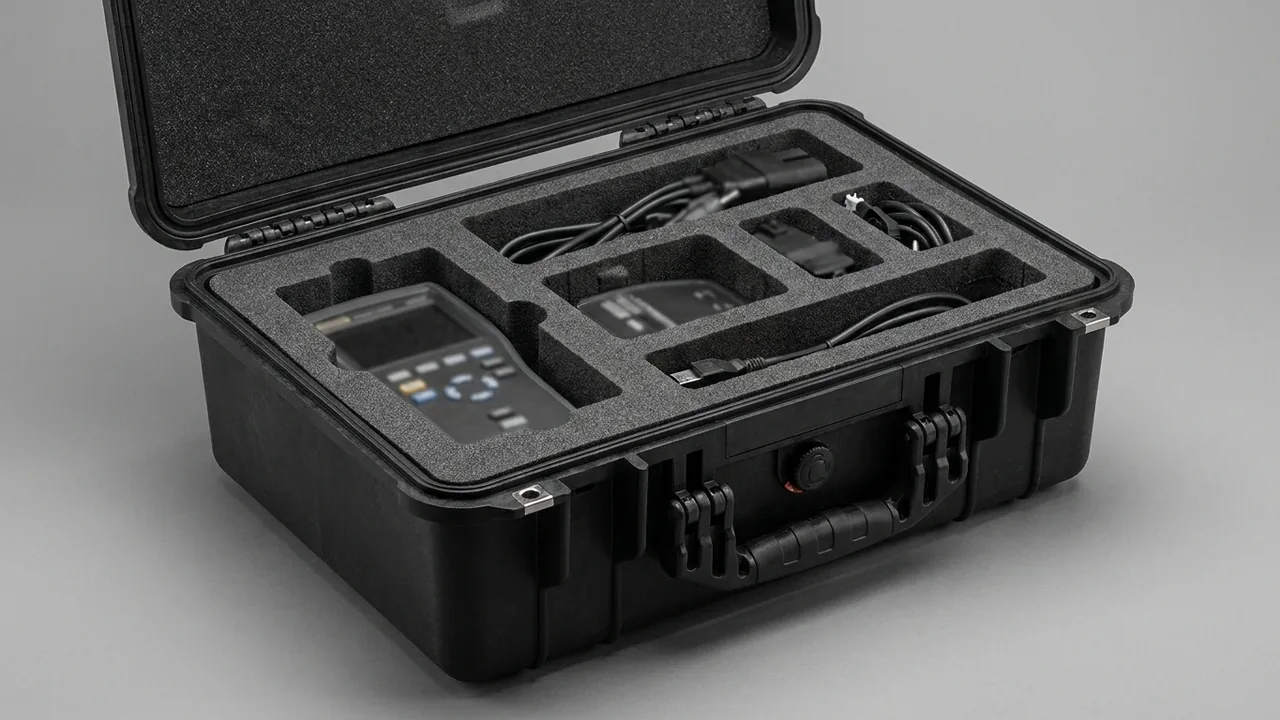
A piano is one of the few objects that is at the same time a heavy structural item and an acoustic precision instrument. A conventional upright weighs roughly 200 to 300 kg, a grand can exceed 300 to 500 kg depending on model, and the cast iron plate carries total string tension in the range of tens of tonnes. The parts that actually determine tone, the soundboard, ribs, action and keyboard, are thin-walled wooden structures that are highly sensitive to relative humidity. The goal of a piano transport case is not compressive strength. It is holding internal relative humidity between 45% and 65%, keeping deformation and condensation caused by temperature difference to a minimum, and isolating the soundboard and strings from compression and vibration inside their permitted window, because losing control of any one of the three tends to surface only weeks after delivery as drifting pitch, unwanted noise, a cracked soundboard or sluggish keys. This article works through uprights, grands, action and keyboard assemblies, and soundboard components, and gives executable answers on humidity control, tip-over prevention, vibration isolation and liner materials.
The shipping chain for a piano usually crosses a dealer warehouse, line-haul freight, a lift and a domestic staircase, with an uncontrolled period of temporary storage in the middle. Most field complaints do not originate in the tuning appointment but in that invisible leg: a warehouse during the rainy season lets the soundboard absorb moisture, a heated truck in winter swings the finish between hot and cold, and one tilted move shifts the felt hammers out of line. This article translates the rule of thumb that pianos dislike damp and dislike shock into a relative humidity band, a tilt limit, a cushioning G level and a liner bill of materials that can be written directly into a procurement technical agreement.
Contents
- Why Piano Shipping Is Both a Heavy-Structure and an Acoustic-Precision Problem
- Upright versus Grand: Form, Centre of Gravity and Transport Attitude
- Soundboard and Ribs: Why Relative Humidity Must Stay Between 45% and 65%
- Action and Keyboard: Tolerances and Deformation in a Wooden Part System
- Cast Iron Plate and Strings: No Compression, No Vibration Under String Tension
- Delivering Constant Humidity: Sealing, Conditioning Media and Data Logging
- Temperature Difference and Dew Point: Design Across Seasons and Climate Zones
- Tip-Over Prevention and Centre-of-Gravity Restraint: Three-Point Support and Tilt Limits
- Felt Pads, Acid-Free Liners and Finish Protection
- Case Structure and Rigging: Upright Cases versus Grand Cases
- Cushioning and Vibration Isolation: Shock Pulse, G Level and Liner Build
- Testing and Standards: GB/T 4857, ASTM D4169, ISTA and MIL-STD-810H
- Unpacking, Acclimatisation and Tuning Handover, Plus a Selection Checklist
- Frequently Asked Questions (FAQ)
- Conclusion and Related Reading
Why Piano Shipping Is Both a Heavy-Structure and an Acoustic-Precision Problem
Moving a piano as if it were ordinary furniture usually does not produce an immediate disaster, but it leaves a trail of problems that emerge slowly. The reason is that a piano contains two sets of constraints that pull in opposite directions.
One set comes from mass and structure. The cast iron plate alone weighs several tens of kilograms, and once the pin block, strings, hammers and wooden frame are added, the mass sits low and towards the back or the straight side. Any drop or impact therefore carries a large amount of kinetic energy, which padding alone cannot absorb. It has to be managed by a cushioning system that deforms in a controlled way, reducing peak acceleration and channelling the load into the primary structure of the case.
The other set comes from acoustic precision. The soundboard is a spruce panel around 8 mm thick that maintains its pre-loaded state through a crowned curvature and a set of ribs. Each key drives a linkage of several parts, so a single instrument contains thousands of wooden and felt components, and the flatness of the key frame is measured in fractions of a millimetre. These structures hold their dimensions through wood moisture content, and moisture content follows ambient relative humidity. Between 20% and 80% relative humidity, wood moves measurably more across the grain than along it, and that anisotropy is what builds internal stress into a soundboard during a severe wet-dry cycle.
Putting the two sets together gives a clear conclusion: a piano transport case has to do two jobs at once, resisting mechanical load on the outside while holding a stable microclimate on the inside. Solve only the first and the case arrives intact with an instrument out of tune. Solve only the second and the instrument can be damaged during handling. This is why, in a piano case quotation, liners, conditioning media and data loggers often account for more of the cost than the shell itself.
Upright versus Grand: Form, Centre of Gravity and Transport Attitude
Uprights and grands need different protection logic because their best transport attitudes are fundamentally different.
An upright is normally shipped lying on its back, with the keyboard facing up and the back posts facing down, resting on a dedicated piano board. The advantage is that the most delicate assembly, the keyboard and action, faces upwards away from ground shock, while the mass is carried by the stiffest part of the instrument, the back posts. The attitude also creates two risks. First, the top lid and music desk can swing open during the rotation if they are not secured. Second, the pedals and pedal rods will bend if they are still connected when the instrument is laid down. The correct packing sequence is therefore: remove detachable parts, secure the lid, disconnect the pedal rods, rotate onto the board, then strap down.
A grand is normally shipped on its side, resting on the straight edge known as the spine, with the curved side facing up, and it must be fully on its side rather than partly tilted. The partly tilted state is the most dangerous condition for a grand, because the weight of the plate and soundboard induces torsion between the curved rim and the spine. Sustained exposure to that state can change the uniformity of the relationship between plate and soundboard. The standard practice is to remove the three legs, the pedal lyre, the lid and the front fallboard, then lay the body fully on its side on a grand board with the curved side up and positive anti-roll stops in place.
| Shipped item | Recommended attitude | Main risk | Restraint focus |
|---|---|---|---|
| --- | --- | --- | --- |
| Upright piano, complete | On its back, keyboard up, back posts down | Lid opening, pedal rods crushed, finish scuffing | Full-length face support on back posts, four-point strapping, separate lid lock |
| Grand piano, complete | Fully on its side, spine down, curved side up | Torsion from partial tilt, rolling on the curve, leg loss | Contoured board, anti-roll stops, slip limited to millimetres |
| Action assembly | Flat, hammers facing up | Jack misalignment, felt hammer compression, dust ingress | Layered trays, each layer restrained separately, dust covers |
| Keyboard and key frame | Flat, key tops facing up | Balance rail bowing, key warping, debris in gaps | Full planar support, soft edge protection, no stacking |
| Soundboard and rib assembly | As specified by the maker, crown up or suspended | Drying cracks, moisture swelling, local dents | Contoured cradle, acid-free interlayer, no point contact |
It is worth stressing that the convention of uprights on their back and grands on their side is common industry practice rather than the only correct answer, and some makers specify otherwise for particular models. Any transport attitude must follow the handling instructions supplied with the instrument, and a packaging plan can only be optimised inside that framework.
Soundboard and Ribs: Why Relative Humidity Must Stay Between 45% and 65%
The soundboard is the acoustic heart of the piano and the part most easily damaged by the shipping environment. It is built from spruce panels joined edge to edge, with ribs glued to the back and a bridge glued to the front. The maker brings the timber to equilibrium moisture content in a humidity-controlled shop before gluing and assembly, so the finished soundboard's dimensions and internal stress state are tied to one specific humidity environment.
When relative humidity stays above 65% for a long period, the soundboard absorbs moisture. It expands more across the grain than along it, the ribs restrain that expansion, and the panel is pressed into a reversed curvature so the crown flattens or inverts. The result is reduced volume, a duller tone, and changed contact pressure between strings and bridge. When relative humidity stays below 45%, the soundboard loses moisture, tensile stress rises, and in extreme cases a drying crack opens along the grain, which is irreversible once formed. Both cases share one property: the process is slow and may not be visible at delivery. Some deformation recovers gradually once humidity returns to normal, but cracks and glue-line damage do not.
| Internal RH | Typical consequence of sustained exposure | Protective action |
|---|---|---|
| --- | --- | --- |
| Above 75% | Soundboard swelling, felt taking on moisture, string and tuning pin corrosion, softening glue lines | Strengthen sealing, increase conditioning capacity, add data logging, shorten transit |
| 65% to 75% | Slow soundboard moisture uptake, rising action friction, hazing on plated parts | Top up conditioning media, cap storage duration, avoid reopening and reclosing the case |
| 45% to 65% | Dimensions and internal stress inside the design window, lowest risk | Maintain routine control, inspect the logger periodically |
| 35% to 45% | Soundboard and keyboard shrink, gaps open, key tops loosen | Add humidifying capacity, avoid direct heated air, avoid long high-altitude dry segments |
| Below 35% | Drying cracks, key top detachment, glue line separation | Add humidification and sealing, cap transit time, rehumidify slowly on arrival |
The 45% to 65% band is used because it sits in the middle of the typical equilibrium moisture content curve, leaving margin in both the wetting and drying directions. In engineering terms, the practice is to install replaceable conditioning units inside a sealed case, combining moisture-absorbing and moisture-releasing media, to suspend an exportable temperature and humidity logger inside, and to provide a viewing port or a data extraction interface through the wall. The higher the sealing class of the case, the slower the conditioning media are consumed and the longer control can be sustained. This is also why the gasket design of a piano case cannot simply copy the profile used on a general-purpose tool case. It has to follow sealed-enclosure logic, in which compression set, joint detail and lid stiffness are evaluated together, as discussed in case hinge, latch and seal selection.
Action and Keyboard: Tolerances and Deformation in a Wooden Part System
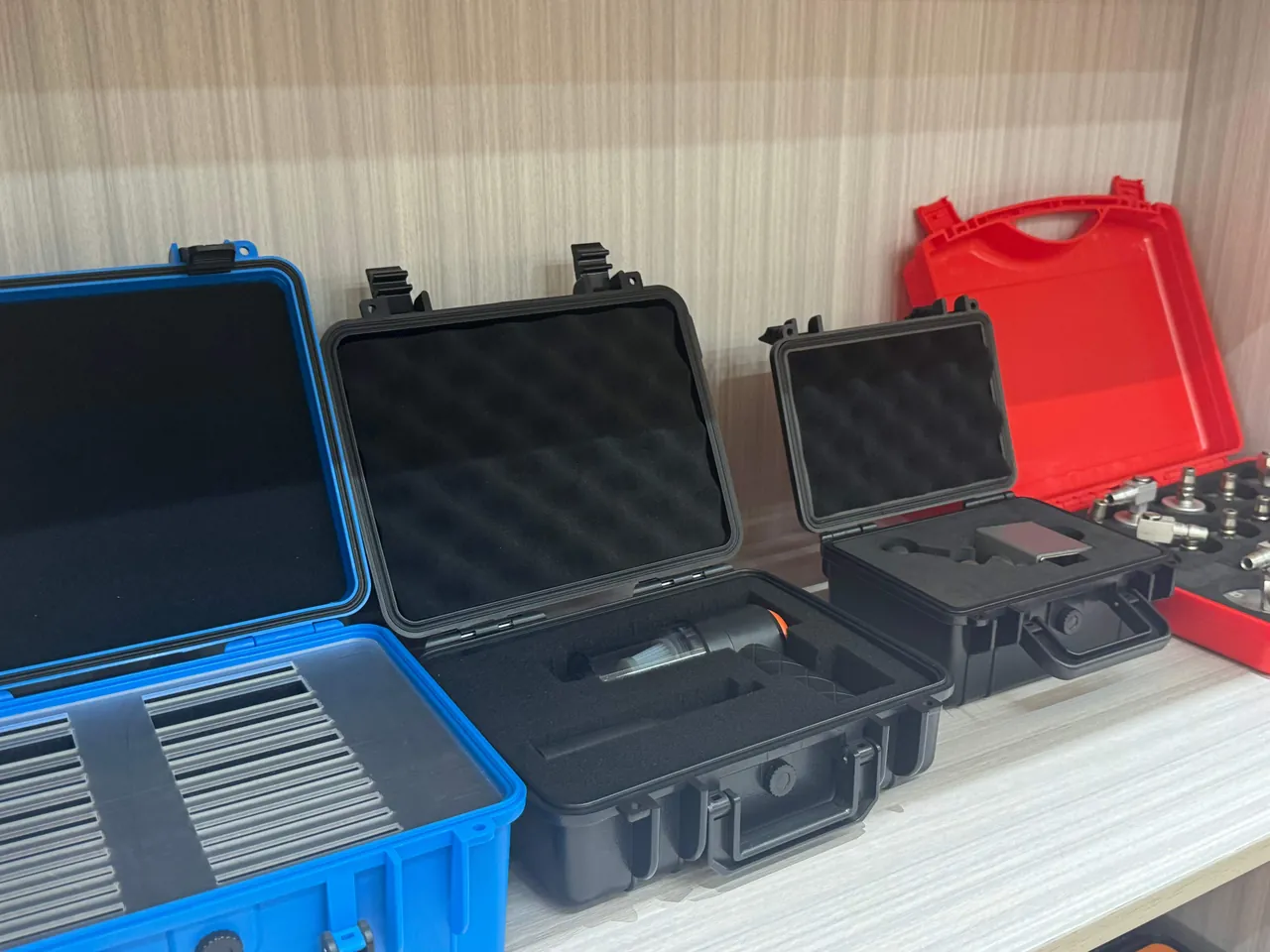
The action is the least machine-like precision mechanism in a piano. Each note drives a linkage built from a wippen, jack, repetition lever, hammer and damper, and a complete instrument contains thousands of wooden and felt parts. The accuracy of these linkages depends on two things: stable clearance at every pivot, and stable elastic recovery in the felt and leather. Both are sensitive to humidity and to compression.
The two most common transport injuries are compression set and misalignment. Compression set comes from stacking and point contact. A felt hammer left under sustained pressure takes a permanent indentation, and that indentation does not recover on its own, so the striking point and the tone change permanently. A damper felt compressed in the same way fails to seat properly, which shows up as notes that keep ringing after the key is released. Misalignment comes from vibration. Continuous low-amplitude vibration causes fretting wear at the jack and wippen centres, and it also shifts the lateral position of a whole row of hammers.
The packaging response to both is specific. First, lay the complete action flat and in layers, never stacked under load, with hammers facing up, soft dividers between layers, and each layer restrained on its own. Second, support the keyboard and key frame on a full planar surface. Two-point support with a suspended middle is not acceptable, because bending in the unsupported span leaves permanent clearance at the balance rail pin holes. Third, use materials with low compression set for every surface that touches felt, so that a foam which loses elasticity after long compression does not turn into a hard point contact.
One frequently overlooked detail is cleaning before packing. An action left open in a workshop for a few hours collects a significant amount of dust on the felt, and transport vibration drives that dust into the centre holes, producing a slow rise in friction. The customary practice is to brush and vacuum at low suction before packing, then fit a dust cover immediately and load the case. Where an action and keyboard must be stored for an extended period, for example while a new recital room is completed, the environment should be managed along the lines used for climate-controlled storage, as described in archival and paper artefact humidity-controlled storage cases regarding the humidity band and the permitted rate of change.
Cast Iron Plate and Strings: No Compression, No Vibration Under String Tension
Once a piano is strung up, the strings form a large internal force system across the whole instrument. Total string tension in a conventional upright is in the range of the low tens of tonnes, and higher in a grand. The cast iron plate is designed to carry that tension, so it has ample strength in itself, but it is very sensitive to additional local load and to vibration.
Additional local load comes from poor strapping and poor support. If a steel band or rope is pulled directly against the curved rim or the plate, tightening it creates local pressure far above design values, which can leave a stress concentration on the cast iron and can also crush the finish and the wooden frame. The correct approach is to place strap anchor points at positions that correspond to the board and the case main beams, so the strap load is transferred through the board rather than being absorbed locally by the instrument.
Vibration sensitivity comes from the friction fit between strings and tuning pins. Strings are anchored through tuning pins in the pin block, and pitch is held by friction between pin and wood. Sustained vibration during transit alters that friction state slightly, which appears on arrival as pitch drift beyond the normal range expected after transport. The more troublesome effect is that when vibration and temperature change combine, drift differs between registers, so the overall pitch curve distorts and the tuner needs a larger compensation.
Three measures are practicable. First, reduce string tension to the lower limit permitted by the maker before shipping, noting that some makers allow detuning for transport and others do not, so the manual governs. Second, avoid pressing the instrument onto local high points on the case floor or walls. Liners should make face contact rather than point contact, and contoured cradles should be used where geometry demands it. Third, control the vibration level along the route, using vehicles with air suspension or damping pads for short legs and minimising the number of transfers on long legs. The second point depends on liner design capability, which is exactly why the custom foam insert design workflow needs to be reviewed together with the scanned geometry of the instrument.
Delivering Constant Humidity: Sealing, Conditioning Media and Data Logging
Constant humidity is not achieved by dropping a desiccant sachet into a box. It is a system of four parts, a closed volume, moisture-absorbing and releasing media, monitoring, and serviceability. Remove any one and control fails somewhere along the route.
The first part is sealing. Humidity control depends on the case having a low air exchange boundary. Gasket profile, hardness, compression and lid stiffness together determine the exchange rate. A profile that is too soft loses resilience at low temperature, while one that is too hard cannot be compressed continuously against a thin lid. For piano cases that must survive long ocean legs, a double seal or a composite profile with a carrier is common.
The second part is conditioning media. The usual approach combines absorbing and releasing materials. Silica-based media absorb strongly in the mid to high humidity range but release weakly, which suits rainy seasons and ocean freight, while saturated salt or clay-based media have a flatter sorption isotherm and suit applications that need stability rather than extreme dryness. Quantity is calculated from free volume, transit duration and starting humidity, with margin. One caution: desiccant only lowers humidity and never raises it, so a desiccant-only plan can push the interior below 35% in a northern winter or on a high-altitude air leg.
The third part is monitoring. An exportable temperature and humidity logger is the key evidence when liability has to be established. A sampling interval of 10 to 30 minutes normally covers packing, line haul, storage and unpacking. The logger should sit at the same height as the instrument body, close to the soundboard, not hanging near the lid where internal air stratification biases the reading.
The fourth part is serviceability. On long transits the conditioning media must be replaced or regenerated, which is impossible if the case can only be opened fully. A practical answer is a gasketed access hatch in a side wall, or a replaceable conditioning cartridge bay, so maintenance never breaks the primary seal. Once a gasket is replaced, the seal integrity must be re-verified, which connects directly to the compression set and ageing issues discussed in seal material selection and service life.
Temperature Difference and Dew Point: Design Across Seasons and Climate Zones
Relative humidity control and temperature control are two sides of one problem. If the absolute moisture content of the air inside a case stays constant while temperature falls, relative humidity rises, and once the dew point is crossed, condensation forms. A piano packed in a humid southern climate and then carried through a northern winter line haul or a high-altitude air leg can therefore experience a complete supersaturation and condensation cycle inside its own case.
The direct consequence of condensation is a water film on strings, tuning pins, the cast iron plate and the metal parts of the action, which produces rust spots. On felt and leather it produces mould and hardening. Rust on tuning pins changes friction, and rust on a string becomes the starting point for a broken string.
| Transit scenario | Typical temperature and humidity challenge | Design response |
|---|---|---|
| --- | --- | --- |
| Packed in southern rainy season, inland line haul | High absolute moisture, diurnal temperature swing causes the case to breathe | Purge with dry air before closing, strengthen sealing, increase absorbing media |
| Packed in the south, delivered in northern winter | Continuous cooling en route raises internal RH until condensation forms | Insulation plus humidity control rather than drying alone, acclimatise before opening |
| High-altitude air leg or plateau road | Falling ambient pressure, large differential across the case wall, extremely dry air | Fit a pressure equalisation valve to stop lid distortion under load, and add humidifying media against over-drying |
| Ocean container | Diurnal swing condenses on container walls, salt-laden moisture migrates | Use salt-spray-resistant hardware, keep the case independently sealed, place desiccant bars in the container |
| Large indoor-outdoor temperature difference on arrival | Cold surfaces absorb moisture at the moment of opening | Let the closed case stand until near room temperature, then open |
One practical point concerns the opening sequence. Let the case stand on the floor until the outer surface is close to room temperature before lifting the lid. After opening, do not immediately remove the instrument; allow the internal air to exchange slowly with the room so that cold surfaces are not suddenly surrounded by humid air. This matters equally for a winter delivery in the north and a summer delivery in the south.
Tip-Over Prevention and Centre-of-Gravity Restraint: Three-Point Support and Tilt Limits
The mass of a piano is very unevenly distributed. The cast iron plate and pin block sit towards the back posts or the straight side, while the keyboard and action side is comparatively light. The transport board and the case must be designed around this real centre of gravity rather than the geometric centre of the outline.
Locating the centre of gravity should be done by a lifting trial before packing rather than by estimation. Suspend the body slowly on slings and observe which way it tilts, adjusting the lift points until it hangs level; the projection of those points onto the horizontal plane is then a good approximation of the centre of gravity. Marking that position on the board and on the outside of the case significantly reduces the chance of mishandling downstream.
Support arrangement is best provided by three or four planar points, with at least two close to the centre-of-gravity projection. Three-point support cannot rock on an uneven floor, but the triangle must enclose the centre of gravity. Four-point support is more stable but far more sensitive to floor flatness and to support height consistency, and any single high point will twist the case. A common engineering answer is a rigid base beam with adjustable support blocks, so the load is concentrated into the beams.
Tilt limits are the core metric for tip-over prevention. A grand on its side should stay as close to 90 degrees as possible, and an upright on its back should stay as close to flat as possible. Unavoidable transient tilt during handling should be bounded by stops and strapping, with tilt indicator labels fitted to the case so that an excursion that cannot be reset is recorded and liability is easier to establish.
Strapping should be designed to limit displacement rather than to clamp. Straps should anchor between the board and the case main beams, with the tension direction as parallel as possible to the case surface so no component pushes the body into a local area. Contact faces need corner protectors and felt, and strap tension must be rechecked after every transfer on a long route.
Felt Pads, Acid-Free Liners and Finish Protection
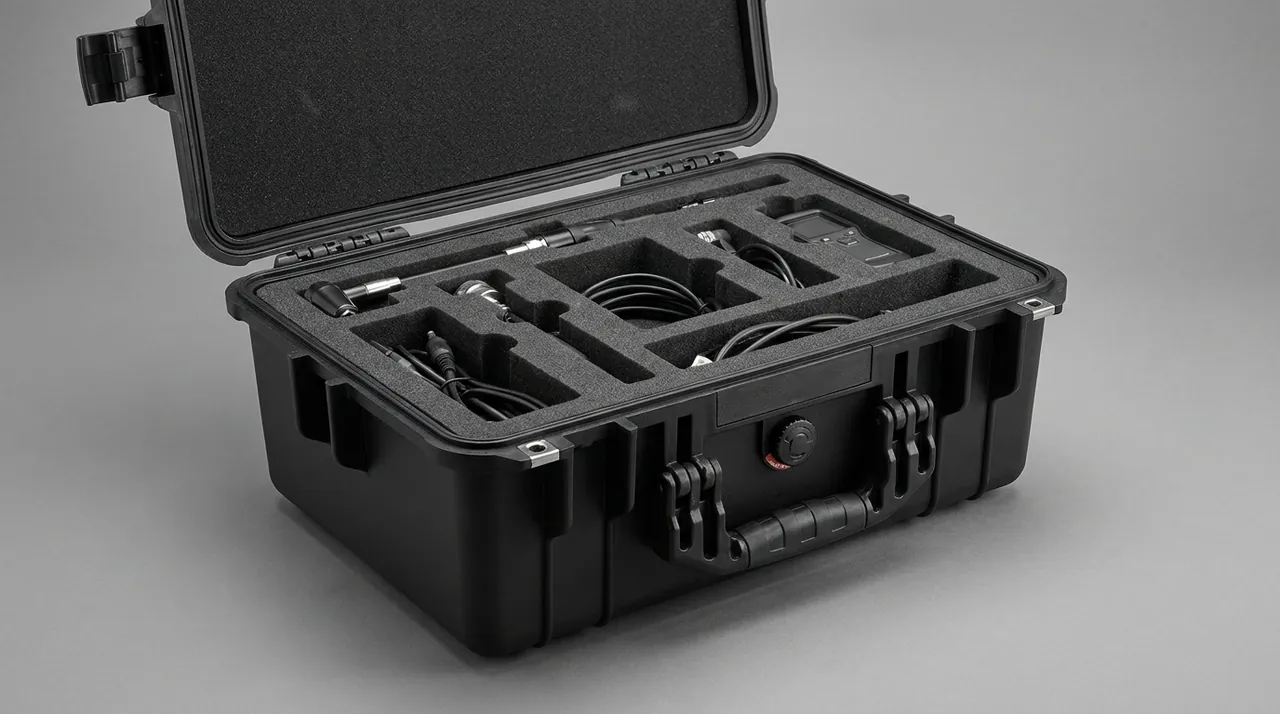
The outer surfaces of a piano are finish and veneer, while the inner surfaces are felt, leather and metal. These two sets of surfaces place completely different demands on contact materials, so liner design has to be zoned.
On the side that touches the finish, the requirement is soft and non-migrating. Wool felt and long-pile nonwoven fabric are the usual choices, with two cautions. The felt itself must be clean, because a felt carrying grit behaves like abrasive paper under vibration. And dyed felt can transfer dye to the finish once it takes on moisture, so colourfast, pH-neutral grades should be selected.
On the side that touches internal metal parts, the requirement is no chemical reaction with plating or finish. Sulphur-bearing rubber and chlorine-bearing plastics will darken or even pit silver-white plated parts in long contact, so inert materials should be used against tuning pins, tuning pin hardware and pedal fittings.
On the side that touches wood and felt parts, the requirement is acid-free, non-migrating and non-residue. Acidic materials accelerate lignin degradation, and long contact will darken and embrittle wooden surfaces. Interlayers in direct contact with the soundboard, keyboard and action should therefore be acid-free tissue or acid-free nonwoven, with a pH typically required to fall between neutral and mildly alkaline, following the concept of permanent paper as described in ISO 9706.
| Contact surface | Recommended material | To be avoided | Reason |
|---|---|---|---|
| --- | --- | --- | --- |
| Finish and veneer | Clean long-pile nonwoven, solid-colour wool felt | Gritty or fugitive-dyed felt, rigid foam laid directly on the surface | Scratching, dye transfer |
| Plated parts and hardware | Inert polyolefin nonwoven, acid-free tissue | Sulphur rubber, chlorine-bearing soft PVC | Sulphide and chloride induced corrosion |
| Soundboard and keyboard | Acid-free tissue, acid-free nonwoven | Recycled paper, acidic kraft | Acidic species accelerate wood degradation |
| Action and hammers | Low compression set foam plus soft cloth | High density rigid foam, reclaimed cotton | Permanent indentation, dust contamination |
| Strings and plate | Contoured face supports plus inert interlayer | Point contact blocks, direct steel banding | Excessive local pressure, stress concentration |
One point deserves separate attention: the difference between temporary protection and a long-term liner. A dust cover or stretch wrap on the outside of the instrument is temporary protection and should be removed or at least vented after the case is closed, because a fully wrapped instrument cannot release moisture from the shell, and trapped moisture forms a damp layer under the finish. Only the internal liner is a long-term protective layer.
Case Structure and Rigging: Upright Cases versus Grand Cases
When the same factory builds an upright case and a grand case, the structural logic differs substantially.
An upright case is close to a tall, thin cabinet. The dominant loads are vertical compression from the back posts and fore-aft rocking in transit. The base should therefore be a continuous rigid beam rather than a set of feet, the side panels need reinforcement in the lower third where the bending moment during rotation is highest, and the lid has to resist the local reaction from the instrument lid as it is handled in the lying attitude. The usual opening arrangements are a side door or a lift-off front, but either way the frame must still hold the seal once closed.
A grand case is close to a flat, wide enclosure. The dominant loads come from the weight distribution once the body is on its side and from anti-roll restraint. The floor needs contoured cradles positioned under the spine, and the curved side needs anti-roll blocks. The lid is normally a removable split cover so that after the case is positioned, a crane or lifting arm can take the body out directly, avoiding a second rotation at floor level.
Rigging design has several common requirements. Lift points should be symmetrical about the centre of gravity and marked. The number and capacity of lift points should be based on the case plus contents, with a design safety factor on connections, commonly in the region of 4:1. The case should have forklift pockets or lifting slots so that site crews do not sling steel bands around the enclosure. Forklift pocket positions must align with the centre of gravity, otherwise the case tips forward as the forks rise. In addition, the exterior should carry centre-of-gravity markings, lift point markings, this-way-up orientation and tilt limits, following the packaging pictorial marking approach of GB/T 191.
For cross-border moves with several transfers, the case surface should also provide a visible window for the logger and the tilt indicator, so that every handover point can confirm status on site without opening the case.
Cushioning and Vibration Isolation: Shock Pulse, G Level and Liner Build
The core of cushioning design is not to be as soft as possible. It is to keep the peak acceleration transmitted to the instrument inside the permitted value while limiting displacement to the clearance available inside the case.
Why not too soft. The softer the cushion and the longer its compression travel, the more room the contents have to move. Once a piano of several hundred kilograms gains displacement in transit, it develops fresh kinetic energy as the direction reverses, producing a second impact. High-mass objects are therefore usually cushioned with moderate stiffness and controlled travel rather than very soft material.
Why not too stiff. A very stiff cushion cannot reduce peak acceleration effectively, and the shock reaches the board and soundboard almost unchanged.
The customary engineering approach is a two-layer build. The near layer, against the instrument, uses medium-density foam or felt with low compression set, spreading local pressure and damping high-frequency vibration. The far layer uses a structure with greater deformation and higher energy absorption efficiency, such as honeycomb board, expanded polypropylene blocks or moulded pulp blocks, to clip the peak. A board separates the two layers and also distributes the load into the case main beams.
On quantified targets, the industry normally tracks three parameters: peak shock acceleration expressed in g, pulse duration in milliseconds, and maximum internal displacement. Many piano makers state permitted peak shock and tilt in their transport instructions, and engineering experience commonly works in the region of a peak internal shock limited to around 10 G with a pulse duration of some tens of milliseconds, but this is only an approximate reference and the specific figures in the maker's manual always govern. Cushion thickness and stiffness should be back-calculated from those figures rather than chosen from habit.
It is important to note that cushion material choice and humidity control interact. Open-cell foam absorbs water as humidity changes, and its cushioning performance when wet differs markedly from its dry performance, while the damp foam becomes a continuing source of moisture inside the case. In humid environments, closed-cell or low-absorption materials should therefore be preferred, or the cushion layer should be encapsulated against moisture. For a comparison of absorption, resilience and compression set, see protective case foam material comparison and cushion liner design points.
Testing and Standards: GB/T 4857, ASTM D4169, ISTA and MIL-STD-810H
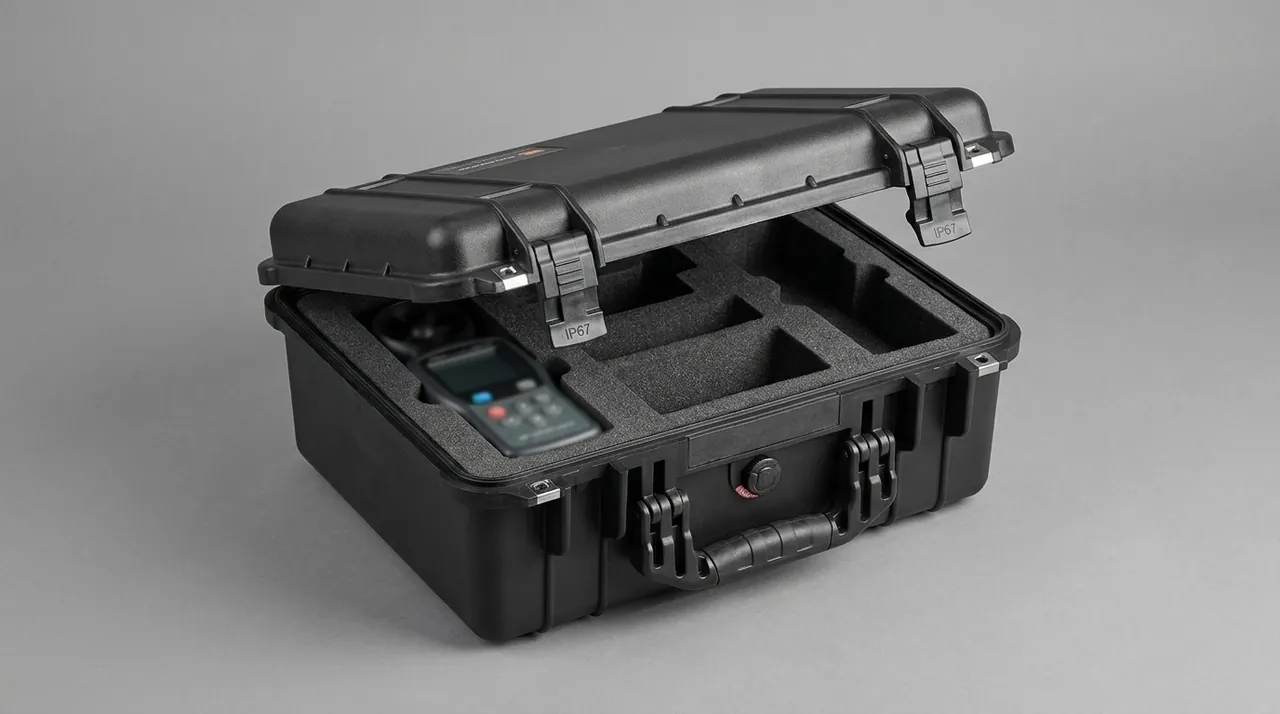
Whether a packaging plan is sound must ultimately be verified by test rather than judged from a drawing. For high-value objects that suffer irreversible damage, such as pianos, at least three test groups are advisable.
The first group covers basic transport package tests. The GB/T 4857 series sets out methods for drop, stacking, vibration and impact and is the foundation of package verification in China. For a piano case, the stacking test, which reveals long-term deformation under the weight of upper layers, and the random vibration test, which simulates sustained road and rail excitation, are the usual focus.
The second group covers distribution cycle performance. ASTM D4169 uses the distribution cycle as its framework, combining repeated drops, vibration and concentrated impact into a sequence that better reflects real multi-leg handling. For pianos that must be transferred several times across borders, this framework has more reference value than a single test item.
The third group covers environmental preconditioning and temperature and humidity testing. MIL-STD-810H provides methods for high temperature, low temperature, temperature shock and humidity that can serve as a methodological basis for environmental verification. It should be stated plainly that citing MIL-STD-810H means citing its environmental test methods only, and does not imply any military certification. For a piano, the most valuable sequence is temperature and humidity cycling followed immediately by vibration and impact, because only that combination reveals coupled failures such as degraded cushioning after condensation.
The fourth group is documentation. Test reports, liner drawings, bills of material, gasket specifications and the export format of logger data should be delivered as a package. Where a project requires a third-party laboratory report, the technical agreement should specify the test items, the sequence, the acceptance criteria and the treatment of non-conformance. A description of the test flow is available in the ISTA transport testing procedure.
Unpacking, Acclimatisation and Tuning Handover, Plus a Selection Checklist
Delivery is not the end of the risk. Poor unpacking can turn a successful shipment into a claim.
Arrival inspection should begin with the packaging still closed. First check whether the tilt indicator has triggered, whether the logger data stayed inside the agreed band, and whether the case shows obvious impact marks. Then open and inspect the instrument attitude, the state of the strapping and whether the liner has shifted. Any anomaly should be photographed and recorded before the case is opened further.
Acclimatisation is mandatory. Let the closed case stand indoors until the outer surface is close to room temperature, which takes longer on a winter delivery, then lift the lid. After opening, continue standing so that internal and room air exchange gradually, keeping cold surfaces away from humid air.
Tuning handover should start with a condition check once acclimatisation is complete: consistent key feel, absence of unwanted noise, correct pedal travel, and no abnormal spread in pitch drift. Tuning on the day of arrival is generally not advisable, because wood and felt need time to reach equilibrium with the room again, and the recommended standing period should follow the maker's guidance.
A selection checklist can be worked through item by item:
- Have the maker's handling and transport instructions been obtained, and has the transport attitude plus any requirement to detune been set accordingly?
- Has the centre of gravity been measured and marked on the board and the case?
- Is the internal target relative humidity stated as 45% to 65%, and is the conditioning media quantity calculated from free volume and transit duration with margin?
- Is an exportable temperature and humidity logger fitted, with a sensible sampling interval and mounting position?
- Are liner materials zoned by contact surface, that is finish, plated parts, wood and felt, and do they meet the acid-free and inert requirements?
- Is the cushioning plan back-calculated from permitted shock G level and internal clearance rather than stacked to a habitual thickness?
- Are gaskets evaluated on compression and compression set using sealed-enclosure logic, with a service access point provided?
- Are lift points, forklift pockets, centre of gravity and tilt limits fully marked, following the marking approach of GB/T 191 and GB/T 13384?
- Have test items, acceptance criteria and the documentation list been agreed?
Five common misconceptions are worth naming. First, treating a wooden crate plus desiccant as a humidity control plan, which ignores exchange rate and moisture release capacity. Second, assuming softer cushioning is always better, which leads to excessive internal displacement. Third, using point contact blocks as supports, which creates high local pressure under self weight. Fourth, wrapping the instrument completely after packing, which traps moisture in the shell. Fifth, skipping acclimatisation and opening and tuning while the instrument is still cold.
Frequently Asked Questions (FAQ)
Q: Does piano shipping really need humidity control, or will an ordinary wooden crate with a few desiccant bags do?
A: For a short same-city move delivered the same day, an ordinary crate can be adequate, because the soundboard does not have time to reach a new equilibrium moisture content with its surroundings. Once transit lasts more than a few days, or includes any temporary storage, humidity control moves from an optional extra to a requirement. The reason is that the dimensions and internal stress state of the soundboard are tied to the equilibrium moisture content at the time it was built, so slow moisture uptake or loss alters the soundboard crown and imposes extra shear on glue lines. Industry experience suggests that leaving an instrument at above 75% relative humidity for two weeks is enough to produce a perceptible change in volume and timbre, and such a change is often only noticed weeks after tuning. An ordinary crate plus desiccant fails in two ways: a crate has a high air exchange rate so desiccant is consumed very quickly, and desiccant only lowers humidity and cannot raise it, so in a dry environment it can push the interior below 35% and accelerate shrinkage and cracking.
Q: Should the action be removed and shipped separately, or can it stay in the instrument?
A: Whether to remove the action depends on distance, road conditions and model, and the maker's handling instructions ultimately govern. Common practice is to remove the action and pack it separately for long-distance and cross-border shipments, while retaining it in place for short same-city moves. There are three reasons for removal. First, action parts are the lightest and the most easily misaligned, so a separate case allows softer liners and a smaller free travel. Second, when shipped inside the instrument, the action is located only by its own weight and cannot resist lateral shock, so a whole row of mechanism can slide together. Third, separate packing allows the felt parts to be protected against dust and controlled for humidity, preventing line-haul dust from reaching the centre holes. If the action stays in place, confirm that any retaining bolts specified by the maker are tightened, that the key cover and top are locked, and that no other parts are free to move above the action, and add extra restraint around the keyboard area so that longitudinal sliding of the body does not drag the mechanism with it.
Q: How was the 45% to 65% humidity band arrived at, and does a small excursion matter?
A: The band corresponds to the middle of the equilibrium moisture content curve for wood and is the range long used by instrument makers and by the museum storage sector. Its purpose is to leave margin in both the wetting and the drying direction. A short excursion to 70% or down to 40% makes wooden parts absorb or release some moisture, but because the wood has not moved far from equilibrium, the deformation remains recoverable. Beyond 75% or below 35%, deformation begins to enter the non-recoverable range and the probability of cracks and glue line damage rises sharply. It is important to distinguish transient variation from sustained exposure. Short fluctuation has limited effect on a complete instrument, and what actually governs damage is the accumulated time spent outside the band. A sound specification therefore states not only upper and lower limits but also the permitted excursion magnitude and cumulative duration, for example that 65% to 70% is allowed for no more than 24 hours cumulatively and that 75% must never be reached. These figures should follow the maker's technical documentation and be written into the technical agreement as the basis for arrival acceptance and liability.
Q: Can a grand piano be shipped leaning or partly upright?
A: No. The safest attitude for a grand is fully on its side, resting on the straight edge known as the spine with the curved side facing up, and the body should bear fully on a purpose-made board. The partly tilted attitude is prohibited because the self weight of the body induces torsion between the curved rim and the spine. The cast iron plate is stiff while the soundboard and wooden frame are relatively compliant, so in a partly tilted state the two deform relative to one another, and sustained or repeated exposure changes the uniformity of the plate to soundboard relationship. The result is not immediate detuning but a loss of tonal evenness that tuning cannot compensate. Practical points include removing the three legs, the pedal lyre and the front fallboard before laying the instrument over; fitting anti-roll blocks and strapping immediately after it is on its side; never rolling the body on the board; shaping the board to follow the spine rather than supporting on two points; and keeping the attitude angle stable through every transfer so that space is never saved by temporarily laying it flat and standing it up again. On arrival, fit the legs and confirm they are loaded before slowly lowering the instrument, avoiding any sudden release.
Q: How much internal temperature variation is acceptable, and is active temperature control needed?
A: Piano transport environments are normally not actively temperature controlled, because the instrument has a large mass and high thermal capacity, making active control uneconomic in both cost and energy. The engineering approach is to control the rate of change and to control the dew point rather than to lock temperature at a fixed value. In practice, rapid change should be avoided, particularly rates above a few degrees per hour, because a fast temperature drop raises internal relative humidity quickly and can cross the dew point. The way to decide whether extra measures are needed is to compare absolute moisture content with the lowest temperature expected en route. If the dew point of the air inside the case at packing is above the minimum temperature the shipment will meet, condensation will occur somewhere on the route, and at that point the cooling rate must be reduced by insulation, or the packing dew point lowered by purging with dry air. Winter delivery in the north and high-altitude air legs are the two classic high-risk scenarios. On arrival the closed case should be allowed to return to room temperature before opening, which in effect prevents cold surfaces from being surrounded by humid indoor air.
Q: Are felt and acid-free materials essential, or are they a marketing claim?
A: Judged by failure mechanism, they solve real problems rather than being a marketing claim, though the applicable scenarios differ. The value of wool felt lies in low compression set and good pressure distribution. Felt hammer and damper felt take on permanent indentation under sustained pressure, and if the liner between case and instrument has poor resilience and compresses permanently, that liner itself becomes a source of hard point contact after the journey. The value of acid-free materials lies in preventing acidic species from accelerating lignin degradation. The soundboard, keyboard and action are thin-walled wooden assemblies, and long contact with acidic interleaving makes the contact surfaces darken and embrittle. The process is slow, but for a high-value instrument stored in a warehouse for several months the cumulative effect is not negligible. What genuinely needs scrutiny is material substitution under a borrowed name, for example felt described as wool but loaded with reclaimed fibre and grit, or tissue described as acid-free with an acidic pH. In purchasing, the workable approach is to request material declarations and basic test data such as pH or water absorption, and to sample and verify at acceptance, rather than relying on the name alone.
Q: How long after arrival should a piano be tuned, and what should happen in between?
A: Tuning on the day of arrival is generally not advisable, because the body, soundboard and action need time to reach equilibrium moisture content with the room, and pitch continues to move during that period, so a tuning result will not be stable. The sensible sequence is as follows. Let the closed case stand indoors until the outer surface approaches room temperature, then open the lid. Continue standing so internal and room air exchange slowly. Then carry out a condition check, confirming consistent key feel, absence of unusual noise, normal pedal travel and no visible abnormality on the body or soundboard. Finally arrange the first tuning. The standing period depends on the environmental difference: moving from a cold dry environment into a warm humid one, or the reverse, needs a longer equilibration time than a same-city move at normal temperature. Industry experience indicates that cross-border and winter deliveries need a longer standing period than ordinary same-city delivery, and the specific duration should follow the maker's and technician's advice. If the tilt indicator has triggered or the logger shows the agreed band was exceeded, carry out a full inspection and preserve evidence before tuning, so a possible transport injury is not concealed.
Q: What extra packaging points matter for exporting a piano by sea?
A: Ocean freight concentrates the risk in piano shipping, and four points require extra attention. The first is salt spray and condensation. Diurnal temperature swing inside a container causes condensation on internal walls, and salt-laden moisture migrates to case surfaces and hardware, so exterior hardware should be selected for salt spray resistance, the interior should remain independently sealed, and desiccant bars should be placed in the container to reduce standing water risk outside the case. The second is prolonged pressure variation. Container pressure changes with temperature, and without pressure equalisation the lid repeatedly carries a differential load, which over time fatigues gaskets and distorts the lid, so a design with a pressure equalisation structure should be chosen and its opening pressure and venting rate confirmed against the internal humidity control requirement. The third is documentation and marking. The exterior should fully carry centre-of-gravity position, lift points, this-way-up orientation, tilt limits and a tilt indicator, following the marking approach of GB/T 191 and GB/T 13384 so that port and warehouse staff across languages can read it. The fourth is the unpacking handover, since the arrival port and the final location often differ greatly in climate, so the standing and opening procedure at the destination should be written into the technical agreement.
Q: What customisation and documentation support can JUNZHIJIA provide?
A: JUNZHIJIA supplies made-to-order protective case programmes for piano transport. Typical scope covers calculating liner support faces and internal displacement clearance from the scanned geometry and measured centre of gravity; zoning liner materials by the four contact classes of finish, plated parts, wood and felt, with the material list and in-house inspection records; calculating conditioning media quantity from transit duration and route climate and fitting an exportable temperature and humidity logger; designing the board, anti-roll stops and lift points around both the upright lying attitude and the fully side-lying grand attitude; and configuring gasket specifications and spare part kits to project. On documentation, we can work with customers to provide packing lists, liner drawings, assembly and disassembly sequence instructions, flammability self-assessment to UL94 concepts, seal class verification records, and an export format for the in-case temperature and humidity data. This product is manufactured by Kexin New Materials (Guangdong) Co., Ltd. Wholesale, distribution and OEM/ODM models are supported, and specific terms follow the mutually agreed technical agreement and quotation.
Conclusion and Related Reading
A piano transport case is a portable humidity-controlled isolation chamber. It must hold relative humidity between 45% and 65%, exclude condensation, isolate the soundboard, action and strings from compression and vibration, and keep attitude and centre of gravity controlled. Strength in one dimension never compensates for another.
Related reading