

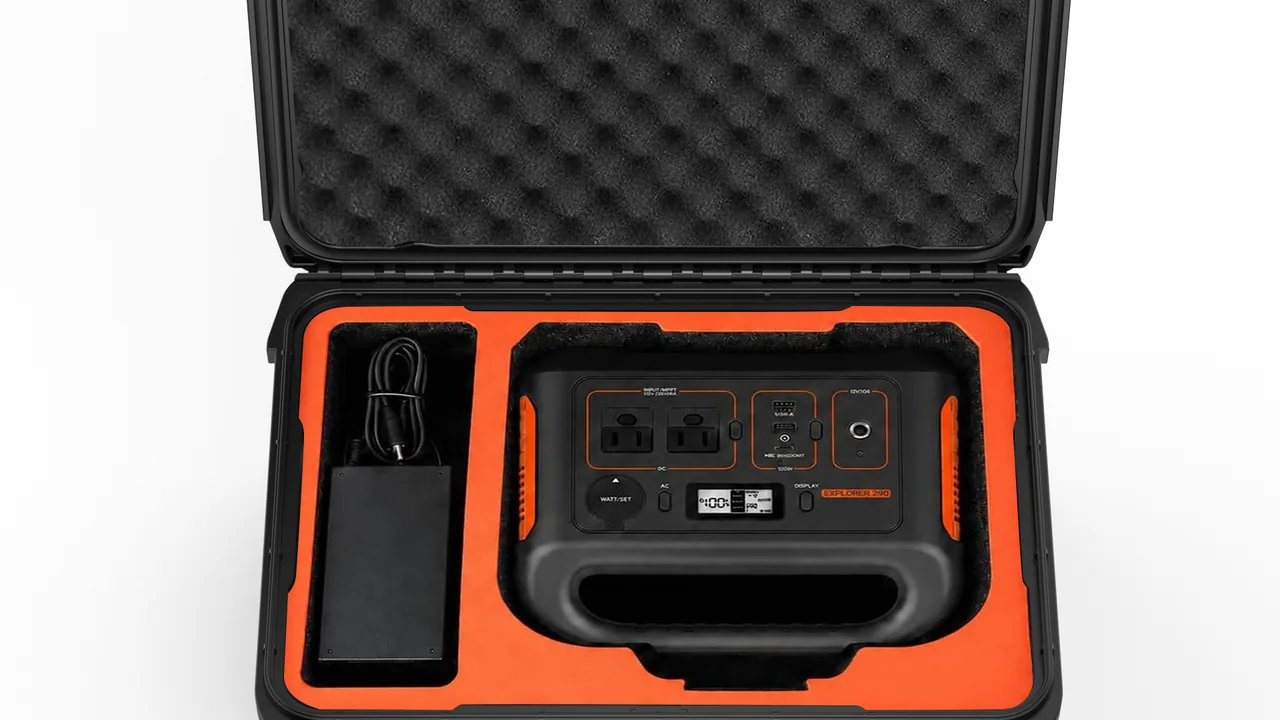
Data centre rack relocation, edge node distribution and disaster-recovery equipment transfer share one defining characteristic: several hundred kilograms of precision electronics must survive multiple handling events across highways, aircraft cargo holds, freight lifts and loading docks. A rail-mounted 2U server weighs roughly 25 kg packed and carries eight to twenty-four enterprise drives, while a fully populated 42U cabinet routinely exceeds 900 kg. The losses rarely come from a dramatic drop. They come from damage nobody sees: broadband vibration between 20 and 200 Hz repeatedly compressing the sub-micron air bearing between a read head and a platter, a half-millimetre of rail travel fretting a backplane connector, a single 300 G shock initiating fatigue cracks under BGA solder joints that only surface weeks later as intermittent faults.
JUNZHIJIA holds a specific protection principle for server and storage logistics: upgrade the goal from "survive the drop" to "rack-ready on arrival", by using quantifiable shock attenuation, verifiable sealing ratings and reproducible test criteria to turn transit from a probability game into a controlled process. That principle only holds when six subsystems work simultaneously: shell structure, cushioning liner, compartment restraint, sealing and cleanliness, pressure equalization, and traceable identification. Any single weak link nullifies the investment in the other five.
Table of Contents
- Failure Map of Server Transit
- Mechanical Thresholds of Drives
- Mass Distribution and Centre of Gravity
- Cushioning System Design
- Foam Selection Windows
- Shell Technology Routes
- Sealing and Cleanliness
- Pressure Equalization and Humidity
- Internal Compartments and Restraint
- Stacking, Handling and Forklift Loads
- ESD Control and Documentation
- Transit Testing and Acceptance
- Frequently Asked Questions FAQ
- Conclusion and Related Reading
Failure Map of Server Transit
Designing a competent server transit case starts with the load spectrum, not with materials. Road transport concentrates energy between 1 and 200 Hz: 3 to 5 Hz from sprung-mass suspension, 8 to 15 Hz from unsprung axle and tyre mass, and 20 to 200 Hz from road texture excitation and panel resonance. Air freight adds little low-frequency vibration but introduces two unique hazards, landing shock and cargo-hold pressure differential. Handling contributes single high-G events — a slide off a dock, a forklift tine strike, a conveyor drop — with peaks of 50 to 400 G over 2 to 20 ms.
Mapping loads to damage produces the reference table below, which converts a vague request for "a strong case" into six measurable design inputs.
| Failure mode | Dominant load | Typical magnitude | Visible symptom | Detection method |
|---|---|---|---|---|
| --- | --- | --- | --- | --- |
| Head-to-platter contact | Non-operating shock | 250–350 G / 2 ms | SMART 05/C5 warnings | SMART read, surface scan |
| BGA solder fatigue | Random vibration | 0.5–1.0 Grms, 3–8x gain | Intermittent hangs | X-ray, dye and pry |
| Backplane fretting | Low-frequency motion | 0.1–0.5 mm | CRC errors, link drops | Insertion force, metallography |
| Rail and chassis distortion | Stack load, corner drop | > 40 kPa point load | Racking seizure | CMM, feeler gauge |
| Fan bearing loosening | Broadband vibration | 60–120 Hz peak | Noise, speed faults | Spectrum analysis |
| Electrochemical migration | Humidity plus dust | RH > 60%, 48 h | Leakage, shorting | Ion chromatography |
Every downstream decision — wall thickness, foam density, rib layout, latch count — must close the loop back to these six rows. JUNZHIJIA normally begins a data centre programme by requesting an equipment schedule and a failure history, then works backwards to the case specification rather than forcing a stock enclosure onto the problem.
Mechanical Thresholds of Drives
Hard disk drives are the most fragile component in a server and the most likely to fail long after delivery. A mechanical drive has two entirely separate limits. Non-operating, with heads parked on a ramp or contact-start-stop zone and platters stationary, an enterprise 3.5-inch drive tolerates 250 to 350 G at 2 ms half-sine. Operating, with heads flying a few nanometres above the platter, tolerance collapses to 60 to 80 G, and random vibration tolerance is only 0.5 to 0.7 Grms.
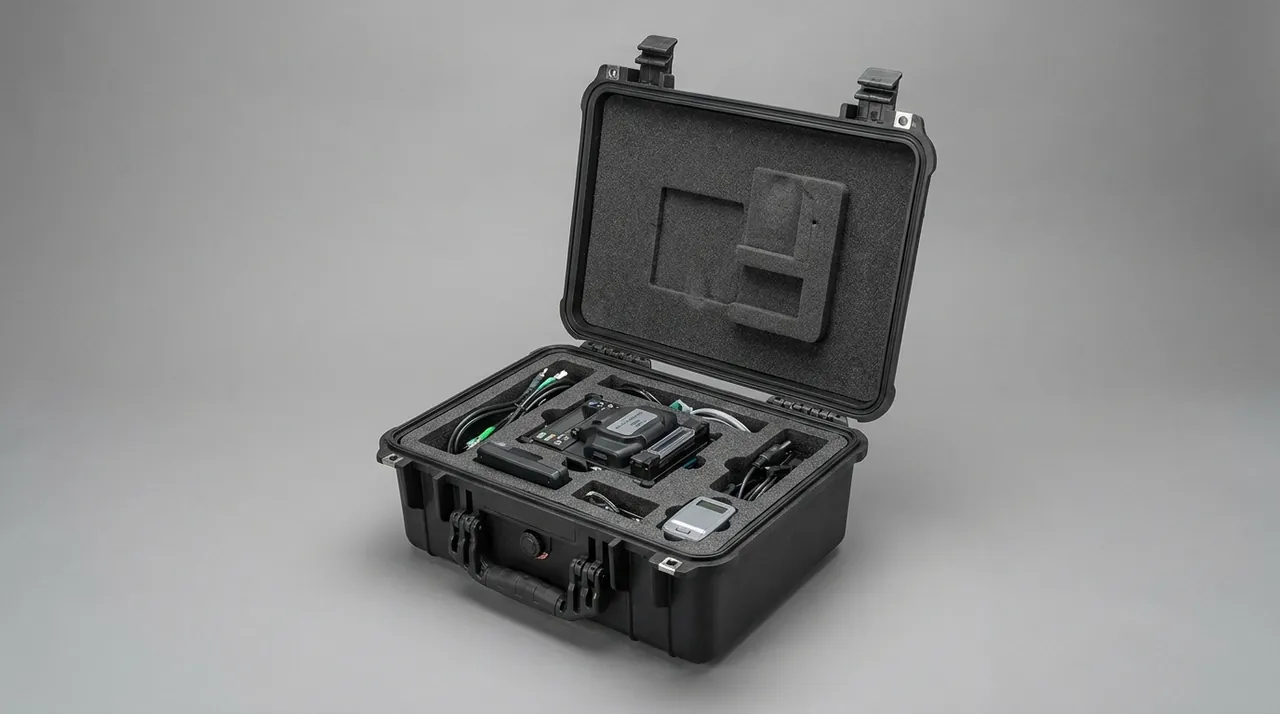
Two mechanisms explain why drives still fail during transit even though they are powered down. The first is the transitional shock window: for several minutes after power-down the platters coast on inertia while the heads have not fully returned to the parking zone, so impact tolerance sits at its worst intermediate value. The second is cumulative fatigue: a single 100 G event leaves no trace, but thousands of 20 to 60 G events across a long haul progressively alter the preload state of the head suspension, which appears later as a rising seek error rate.
Solid-state drives have no moving parts and advertise 1500 G shock ratings, yet they fail differently. Risk concentrates in BGA solder joints, in the interconnect between NAND and controller, and at the M.2 or U.2 connector interface. NAND packages are brittle and carry significant tensile stress when the board flexes, while U.2 hot-swap contact springs fret under random vibration; once contact resistance drifts from 20 mΩ past 100 mΩ the link begins to downshift.
| Device | Non-operating shock | Operating vibration | Dominant mechanism | Transit control |
|---|---|---|---|---|
| --- | --- | --- | --- | --- |
| 3.5in enterprise HDD | 250–350 G / 2 ms | 0.5–0.7 Grms | Parking-zone wear | Rest 5 min before moving |
| 2.5in enterprise HDD | 300–400 G / 2 ms | 0.7–1.0 Grms | Suspension preload drift | Individual slots, no stacking |
| SATA/SAS SSD | 1000–1500 G / 0.5 ms | 1.5–3.0 Grms | Connector fretting | Connector retainers |
| M.2 NVMe module | 1500 G / 0.5 ms | 3.0–5.0 Grms | Solder fatigue, warpage | Board support stiffness |
| DIMM module | Not applicable | 3.0–5.0 Grms | Finger fretting, latch relax | Hold-down bar or foam pad |
Effective drive protection therefore means three things at once: enforce a five-minute rest after power-down, locate every drive individually so no two bodies touch and no hard load path forms between them, and design the cushion layer for the drive's own static stress window rather than reusing the whole-machine parameter. Compartment practice from Sensor Transport Cases transfers directly to this problem.
Mass Distribution and Centre of Gravity
Rack equipment is heavy and badly balanced. A fully loaded 4U storage server reaches 40 to 55 kg with mass concentrated at the rear power shelf and the front drive bay, while the mid-chassis motherboard region is comparatively light. Supporting that dumbbell distribution on a flat sheet of uniform foam concentrates load onto two narrow strips, drives local static stress far above the foam's optimal band, and leaves the centre unsupported so the lid drums under vibration.
The correct method is to map mass first: split the chassis into six to ten longitudinal segments, weigh each, plot the distribution curve and position support ribs to match. The support area should place static stress at the midpoint of the chosen foam's optimal band, and each support segment should align with its segment centroid within 30 mm. Empty redundant power bays complicate this by shifting the real centroid away from the nominal position.
Centroid height governs tip-over resistance: a loaded case should keep its combined centre of gravity below roughly half the short side of its base, or use a flared skirt or pallet base to widen the supporting polygon. Whole-cabinet transport routinely exceeds one metre of centroid height, so forklift pockets and floor anchor points become mandatory and transit speed must be limited in the work instruction.
JUNZHIJIA applies a graded teardown strategy on rack programmes: 1U and 2U servers and switches travel as individual units; 4U storage arrays and GPU servers are assessed on rail and backplane strength before rail retention is approved; whole cabinets move only with professional handling equipment and a reinforced pallet. Teardown reduces both centroid height and internal degrees of freedom, which is where most transit risk actually lives.
Cushioning System Design
Cushioning is the technical core of a server transit case and the step most often decided by feel. A complete design must satisfy two objectives at once: hold transmitted acceleration below the equipment tolerance during shock events, and avoid resonance amplification across broadband random vibration. The first is solved with cushion curves, the second with the transmissibility function, and their optima do not coincide, so iteration is unavoidable.
The starting point is static stress, sigma = W / A, where W is equipment weight in newtons and A the effective bearing area. Every foam has a cushion curve relating peak transmitted G to static stress, with a minimum that defines the optimal band: typically 15 to 35 kPa for EPE, 30 to 70 kPa for EVA and 25 to 60 kPa for IXPE. After computing the required area, thickness is checked against the drop energy the liner must absorb, using the energy absorption efficiency of closed-cell polyethylene, generally 0.55 to 0.75.
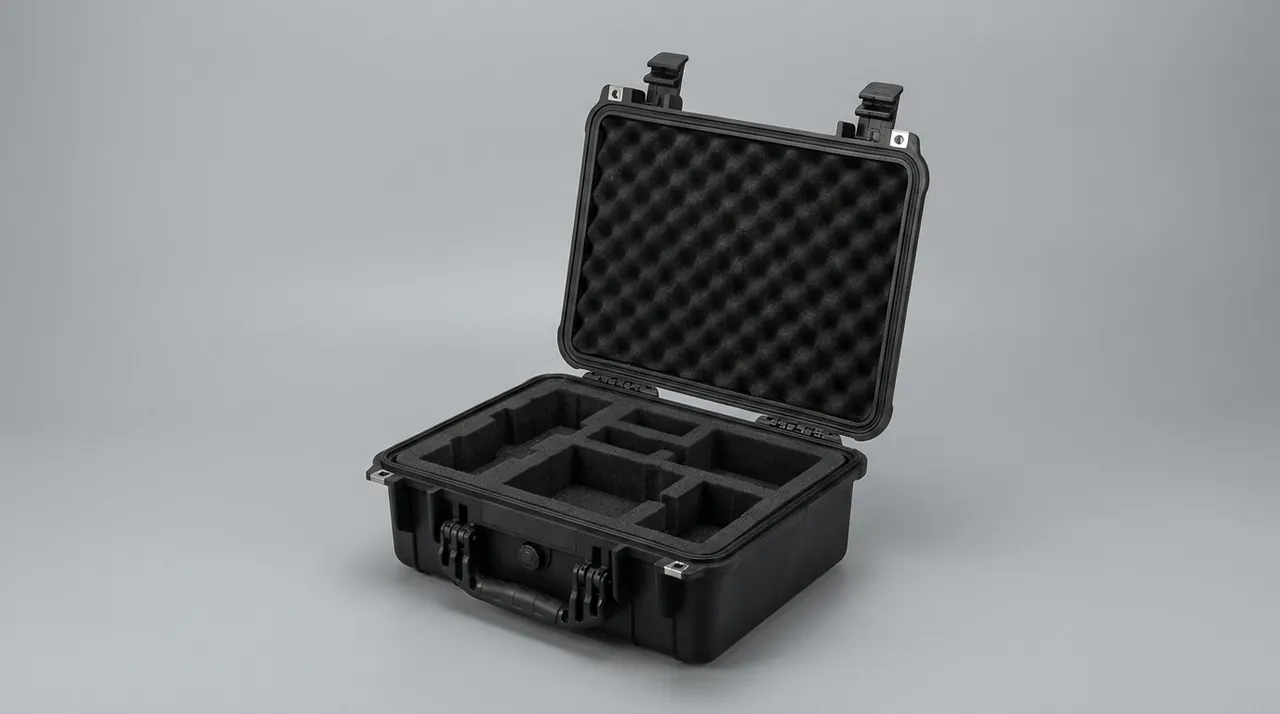
Isolation design must escape the resonance region: transmissibility exceeds unity whenever the frequency ratio falls below the square root of two, so the mounted natural frequency must sit well under the dominant excitation, a ratio of at least 2.5. On the road the strongest content starts near 3 Hz, implying a natural frequency near 1.2 Hz and a static deflection close to 170 mm, which is physically impossible in a shipping case.
The practical answer is to accept resonance and cap its magnification instead. Adding damping holds the resonance peak to three times input or less, and the design must then confirm that relative displacement at resonance stays inside the usable compression travel. JUNZHIJIA builds graded stacks for this reason: a thick low-density EPE base supplying travel and low-frequency compliance, a medium-density EVA core carrying static support and shape retention, and a low-friction IXPE or fabric facing protecting the finish. Three layers bonded by heat sealing or low-emission adhesive create rising stiffness, which avoids the performance collapse of any single material across a wide band and lets one layer be swapped for a different payload.
| Parameter | Symbol | Working range | Consequence of excursion |
|---|---|---|---|
| --- | --- | --- | --- |
| Static stress | sigma | 15–70 kPa by material | Too low, excessive sway; too high, stiff response |
| Cushion factor | Gm | 25–60 | Higher means higher transmitted G |
| Natural frequency | fn | 8–20 Hz practical | Overlap with strong band amplifies |
| Damping ratio | zeta | 0.08–0.20 | Low spikes resonance; high slows recovery |
| Resonance gain | Q | 3 or less | Above 5, solder fatigue risk climbs sharply |
| Usable travel | delta | 0.6 of foam thickness | Bottoming equals no cushioning |
Foam Selection Windows
The liner executes the design, so a wrong material defeats even a correct calculation. Four families dominate server transit work and their behaviour differs sharply.
EPE is closed-cell non-crosslinked polyethylene at 18 to 35 kg per cubic metre, with 60 to 150 kPa compression strength and 75 to 85 percent recovery. It is cheap, heat-sealable and available in thick slabs across a wide density ladder, but shows sizable creep, high surface friction and accumulated permanent set after repeated impacts, suiting it to one-way long-haul duty in thick base layers.
EVA runs 60 to 200 kg per cubic metre with 200 to 700 kPa compression strength and 60 to 75 percent recovery. It is hard, dimensionally precise, thermoformable into crisp cavity edges and abrasion resistant, but heavier and markedly stiffer in cold conditions, suiting structural skeletons and precision locating pockets.
IXPE, electron-beam crosslinked polyethylene, spans 30 to 100 kg per cubic metre with 120 to 400 kPa compression strength and 85 to 92 percent recovery, with a fine uniform cell structure and clean surface. It recovers best, creeps least and resists scuffing, suiting facing layers and reusable liners, at higher cost and limited thick-slab availability.
PU flexible foam is soft and conformable but open-celled, hygroscopic, poor in recovery and prone to dusting, so in server transit it appears only as a light anti-scuff facing.
| Material | Density | Compression strength | Recovery | Creep | Recommended role |
|---|---|---|---|---|---|
| --- | --- | --- | --- | --- | --- |
| EPE standard | 18–35 kg/m3 | 60–150 kPa | 75–85% | Medium | Thick base cushioning |
| EPE high density | 35–60 kg/m3 | 150–300 kPa | 70–80% | Medium | Mid-layer support, routing |
| EVA | 60–200 kg/m3 | 200–700 kPa | 60–75% | Low | Skeleton, precision pockets |
| IXPE | 30–100 kg/m3 | 120–400 kPa | 85–92% | Very low | Facing layer, reusable liner |
| PU flexible | 20–60 kg/m3 | 30–120 kPa | 40–65% | High | Anti-scuff facing only |
Two further constraints matter in server work. Static control comes first: ordinary foam exceeds 10 to the twelfth power ohms surface resistance and can discharge enough energy to destroy components, so antistatic grades at 10 to the sixth through 10 to the ninth ohms are required, bearing in mind that topical coatings migrate and lose effect within six to twelve months. Outgassing comes second: some reclaimed-content foams release low-molecular species that condense as haze in a sealed case, so JUNZHIJIA subjects every incoming foam lot to a 70 degree Celsius, 24 hour check. Deeper liner guidance appears in Cushion Liner Cases.
Shell Technology Routes
Three process routes serve server transit enclosures, each with a clear boundary. Rotomolding heats polyethylene powder in a biaxially rotating mould to produce a seamless one-piece shell with adjustable wall thickness, thickened corners and excellent impact toughness, at tooling cost roughly one fifth to one tenth of injection tooling. Above 40 kg of payload it is the safest choice, since corner impact strength runs two to three times that of an equivalent injection part and toughness is retained at minus 40 degrees Celsius. Trade-offs are tolerances of plus or minus 3 to 5 mm, limited cavity precision and a textured surface.
Injection moulding with PP, PC, ABS or PC/ABS alloy reaches tolerances near plus or minus 0.5 mm, integrates snap fits, ribs and inserts, and suits sub-30 kg equipment and modular stackable systems. Limits are high tooling investment, size ceilings set by clamp force, and wall uniformity on large parts.
Aluminium frame construction, using extruded profiles with composite panels and edge hardware, offers the best strength-to-weight ratio and the greatest freedom for irregular equipment and frequent access. Sealing is harder to engineer, corners are the weak point, cost is high and profiles dent under forklift contact.
| Process | Tolerance | Impact resistance | Payload ceiling | Tooling cost | Best fit |
|---|---|---|---|---|---|
| --- | --- | --- | --- | --- | --- |
| Rotomolding | ±3–5 mm | Excellent | 100 kg and above | Low | Large racks, whole cabinets |
| Injection | ±0.5 mm | Moderate | 30 kg | High | Small servers, switches |
| Aluminium frame | ±1 mm | Moderate, weak corners | 80 kg | Medium | Irregular shapes, frequent access |
JUNZHIJIA usually combines a rotomolded outer shell for impact and stacking, an injection-moulded inner skeleton for precise drive pockets, and metal hinges and latches for repeated cycle life. The trade-off analysis in Rotomolded Protective Cases and Rotomold versus Injection Cases applies directly.
Sealing and Cleanliness
Servers care less about immersion than about contamination. Data halls look clean but suspend textile fibres, skin flakes, paper lint and metal particles; coastal and ocean legs add salt aerosol. Once deposited on heatsink fins and printed board assemblies, that film becomes an electrochemical migration path under humidity, dropping insulation resistance and causing leakage or shorting.
The governing definitions are IEC 60529 and GB/T 4208 IP codes, where the first digit covers solid ingress and the second liquid ingress. IP65 means dust-tight and protected against water jets; IP67 means dust-tight and capable of brief immersion at one metre for thirty minutes. For server transit the first digit 6 is non-negotiable because it guarantees no settleable particulate enters, while the second digit at 5 covers road rain, dock exposure and accidental sprinkler discharge. Raise it to 6 or 7 only for open-deck or unsheltered yard storage and for roll-on roll-off legs with immersion risk.
Three details decide whether a seal actually works. Gasket material should be EPDM or silicone at 40 to 60 Shore A with compression set under 25 percent after 22 hours at 70 degrees Celsius. Groove compression should be 20 to 30 percent of free gasket height, since over-compression distorts hinges and under-compression leaks. Lid stiffness must be checked, because a lid that bows between latches opens a leak path at mid-span, which is why large rotomolded shells need three or four latches rather than two.
Coastal and ocean routes add salt fog. GB/T 10125 neutral salt spray normally runs 48 to 96 hours with no red rust; hardware should be 316 stainless or Dacromet-treated carbon steel and pivots greased. Salt spray is an accelerated screening test for materials and plating, not a service-life prediction, so JUNZHIJIA states both test conditions and in-service recommendations in the delivery file. Gasket geometry is covered further in Outdoor Case Seal Rings.
Pressure Equalization and Humidity
Air freight is the most underestimated leg. At cruise altitude a cargo hold is typically pressurised to the equivalent of 2400 metres, about 0.75 atmospheres, and unpressurised holds reach 0.6 atmospheres. A case sealed at sea level therefore sees a 0.25 to 0.4 atmosphere differential. Across a 0.3 square metre lid that is 7.5 to 12 kilonewtons of outward force, enough to roll a gasket, deform latches or burst a lid.
A pressure equalization valve solves it. Its core is an expanded PTFE microporous membrane with pores between 0.1 and 5 micrometres, passing gas freely while blocking liquid water and particulate. Selection focuses on airflow, typically 100 to 1000 millilitres per minute at 7 kilopascals, on membrane rating of IP67 or better, and on a working range of minus 40 to plus 85 degrees Celsius.
One misconception deserves correction: the valve equalises pressure, not humidity. Water vapour moves with the air, so desiccant remains necessary. Real moisture control rests on three actions. Condition equipment and packing environment together for at least four hours so a cold chassis does not condense hot humid air. Load sufficient desiccant, estimating silica mass in grams as case volume in litres multiplied by roughly 1.2, by transit days, and by a humidity factor above 1.5 for tropical routes. Add a humidity indicator card read at first opening as part of the acceptance record.
Temperature and humidity loggers should be standard on high-value programmes because they deliver a time history rather than a single reading, showing whether the shipment crossed any limit and supporting responsibility allocation and insurance claims. JUNZHIJIA specifies one logger per ten cases, with dedicated units on critical crates.
Internal Compartments and Restraint
Compartment design exists to eliminate internal degrees of freedom. A 40 kg chassis with five millimetres of free travel converts momentum into severe contact stress at impact, independent of drop height and governed purely by clearance. The first principle is zero-clearance fit; the second is that no two components may form a hard load path between each other.
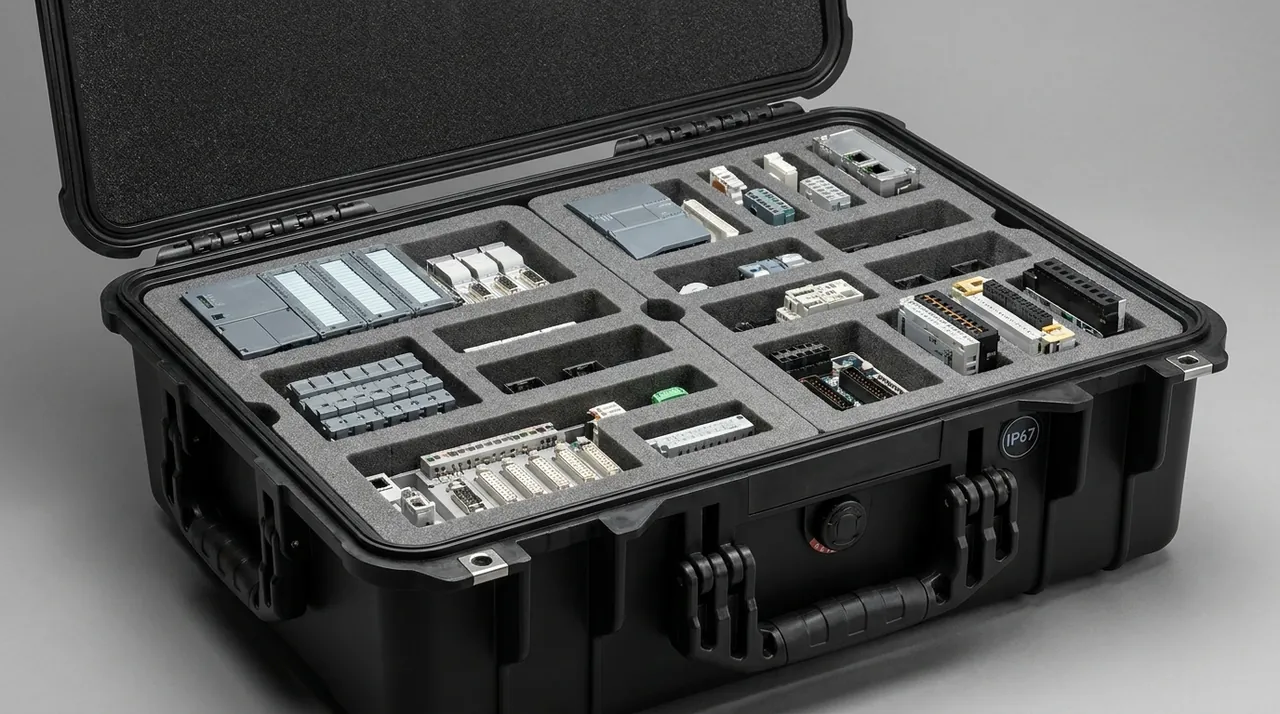
Drives deserve the most attention. Enterprise drives should travel in their original trays, which provide bay location and partial cushioning. Multiple drives must never stack; each needs its own foam slot or plastic cell with wall thickness of at least 8 millimetres, cavity clearance of 1 to 2 millimetres over the body and depth covering more than 70 percent of drive height so impact cannot eject it. Orient the SATA or SAS connector face inward.
Rails follow one of two strategies. Retained rails must be rigidly fixed to the case at no fewer than two points and their slides locked in the closed position so inertia cannot extend them. Removed rails travel in a labelled parts pouch inside the same case to avoid a rack-ready delay from missing hardware. JUNZHIJIA recommends removal below 30 kg where the customer has tooling, and rigid retention above it.
Cables and peripherals cause a disproportionate share of damage. Power cords, network leads, optical modules, screw kits and rail hardware left loose in voids hammer the chassis and create local hard points. Use a separate lidded parts box isolated by foam, keep dust plugs in optical modules and seat them in antistatic slots, and bag screw kits with the model name.
Poka-yoke and labelling complete the compartment. Every cavity should carry a part number matching the packing list, and any cavity with an ambiguous orientation needs an asymmetric feature such as a cut corner to prevent reversed installation. Related discipline is described in Precision Instrument Protective Cases.
Stacking, Handling and Forklift Loads
Three stacking conditions apply: warehouse static storage, in-vehicle stacking and container stacking, each with a different load case. Static stacking governs the bottom case, which carries the mass of every case above it. GB/T 4857.3 practice multiplies the test load by a safety factor of 1.5 to 2.0 to cover misalignment, dynamic effects and long-term creep, and requires deformation below one percent of case height with no separation at the seal face. Rotomolded shells are limited by sidewall buckling, so vertical ribs and top stacking bosses matter, and boss-to-recess engagement also prevents sliding.
In-vehicle stacking adds horizontal acceleration. Emergency braking generates 0.5 to 0.8 g longitudinally and cornering 0.3 to 0.5 g laterally, so interfaces must resist sliding or the whole stack must be strapped, matted and stretch-wrapped. JUNZHIJIA requires pallets with full wrapping and interlayer anti-slip mats of at least 0.6 friction coefficient above three layers.
Forklift handling is where accidents concentrate. Provide clear tine entry guidance, pallet fork openings at least 80 millimetres high and 200 millimetres wide, and corner protection on sidewalls within tine height. Procedure matters as much as geometry: enter to at least two thirds of pallet depth, lift slowly and smoothly, and never nudge a case with a tine tip. Whole-cabinet moves also need floor anchor holes for in-vehicle strapping.
| Condition | Dominant load | Acceptance criterion | Protective measure |
|---|---|---|---|
| --- | --- | --- | --- |
| Warehouse stacking | Long-term static load, creep | Deformation under 1% of height | Stacking bosses, vertical ribs |
| In-vehicle stacking | Static load plus lateral g | No interlayer sliding | Straps, anti-slip mats, wrap |
| Container stacking | Sea motion plus stacking | Sidewall buckling stability | Palletisation, corner support |
| Forklift handling | Localised concentrated load | No base deformation | Tine guides, corner guards |
| Manual handling | Drop and impact | Corner cracking absent | Side and base hand grips |
ESD Control and Documentation
Electrostatic control is not optional in server logistics. Data centre staff usually understand ESD, but transport and dock crews often do not. Case-level protection comes from two routes: antistatic liner foam held between 10 to the sixth and 10 to the ninth ohms surface resistance, and permanent antistatic additive in the shell polymer rather than a topical coating, holding the exterior below 10 to the tenth ohms so handling friction cannot charge it.
Performance decays with time. Topical agents rely on absorbed moisture and stop working below 30 percent relative humidity, and they wear off with abrasion. Permanent additives form an internal conductive network, remain humidity independent and last as long as the polymer, at a premium. Verify with a high-resistance meter and standard electrodes every twelve months, or more often in dry or continuously air-conditioned environments.
Labelling carries asset traceability. Each case needs a unique identifier plus external marking of equipment type, source rack, destination hall and rack position, gross weight, stacking limit and up-arrow, and each internal cavity carries its asset number. Two-dimensional codes are preferable to linear barcodes because they hold more data and tolerate partial damage; high-volume programmes can adopt RFID for batch reading.
Documentation supports acceptance and claims and should include a packing list with asset numbers, a pre-shipment condition record covering SMART values, photographs and self-test results, logger or indicator card data, an unpacking instruction covering rest time, sequence and ESD requirements, and an exception reporting process. JUNZHIJIA supplies a complete document set for cabinet relocation programmes and can align it with the customer's asset management system. This mirrors the batch logic in Custom Case Acceptance AQL.
Transit Testing and Acceptance
Design must be proven by test. Three frameworks apply: the ISTA series, the GB/T 4857 series and ASTM D4169. ISTA 3A covers individual packages up to 70 kg, ISTA 3E covers unitised loads of identical product, GB/T 4857 provides national standard sub-tests including drop, stacking and vibration, and ASTM D4169 offers a complete flow graded by assurance level.
| Test | Reference | Typical condition | Pass criterion |
|---|---|---|---|
| --- | --- | --- | --- |
| Free-fall drop | GB/T 4857.5, ISTA | One corner, three edges, six faces | No shell cracking, liner intact |
| Random vibration | GB/T 4857.23, ASTM D4169 | 0.4–0.7 Grms, 1 h per axis | Equipment fully functional |
| Stacking | GB/T 4857.3 | 1.5–2.0x load, 24 h | Deformation under 1% height |
| Water spray | IEC 60529 IPX5 | 12.5 L/min, 3 min at 3 m | No ingress |
| Dust | IEC 60529 IP6X | 2 kg/m3 talc, 8 h | No visible internal dust |
| Low pressure | Customer specific | 0.6 atm, 4 h | Seal intact, lid unmoved |
The most commonly omitted criterion is equipment functionality. Many programmes prove only that the case survived, never that the payload still works. JUNZHIJIA requires a baseline record before packing, the full test sequence, then a repeat measurement of the identical metrics and a line-by-line comparison. Only matching data qualifies the design, and in volume production this runs on AQL sampling rather than on full inspection or none at all.
Standard tests simulate a typical environment in the laboratory and cannot cover every extreme. For very high value payloads, such as GPU servers carrying irreplaceable training data, add one instrumented road trial on the actual route, vehicle and loading pattern, then correct the cushion design from the measured acceleration time history.
Frequently Asked Questions FAQ
Q: What separates a server transit case from a general-purpose protective case?
A: A general protective case is designed around a single drop event, with drop height and payload weight as the primary inputs and shell integrity as the pass criterion. A server transit case is designed around cumulative damage. Road vibration between 3 and 200 Hz excites multiple resonances in boards, heatsink modules and backplane connectors; individual events may measure only 0.5 Grms, but over hours and hundreds of thousands of cycles they produce solder fatigue and connector fretting far exceeding the damage from one drop. That difference drives three additional requirements. First, support must follow the measured mass distribution curve rather than a uniform sheet, because rack equipment concentrates mass at the power shelf and drive bay and locally overloads flat foam. Second, resonance gain must be capped near three times input through damping and graded stiffness, rather than simply adding thickness. Third, the case must carry electrostatic control and a full documentation set, because server damage often appears weeks after power-on and without a baseline record nobody can establish where the loss occurred.
Q: How long should drives rest after power-down before the equipment is moved?
A: Allow at least five minutes, and closer to ten for large enterprise drives above fourteen terabytes. A mechanical drive executes a head-parking sequence on power loss: the spindle coasts on back electromotive force while the head travels from the data zone back to the parking ramp or contact-start-stop zone. That motion takes several seconds to tens of seconds, and during it the air bearing under the slider is unstable, so the head is effectively half-flying. Impact tolerance in this transitional window sits near the operating value, roughly 60 to 80 G, instead of the 250 to 350 G that applies once the head is fully parked and the platters are still. A drop or hard knock inside this window raises the probability of head-to-platter contact, and the resulting damage typically surfaces weeks later as spreading bad sectors rather than as an immediate failure. JUNZHIJIA recommends writing the rest period into the operations manual as a mandatory clause and marking it prominently on the exterior of every case.
Q: Is it feasible to ship a fully populated rack without disassembly?
A: It is technically feasible but only when three conditions are satisfied simultaneously. The first is mass and centroid: a fully populated 42U cabinet weighs between 900 and 1300 kilograms with a combined centre of gravity above one metre, which demands a pallet base with sufficient bending stiffness, a full-load deflection not exceeding one two-hundred-and-fiftieth of the span, plus forklift pockets and floor anchor points. The second is internal restraint: every server must be rigidly bolted or strapped to the cabinet posts, never left resting on rails alone, drive trays need anti-ejection clips, and all moving items including fan modules, power supplies and cable arms must be locked. The third is handling capability: a forklift or hydraulic dolly with adequate rating, a level loading route, and a written speed limit for cornering. In practice JUNZHIJIA recommends graded teardown, extracting switches, 1U and 2U servers and optical modules into individual cases, deciding rail retention for 4U storage after a strength review, and moving the empty cabinet separately, which keeps the heaviest single package below sixty kilograms.
Q: Why is a pressure equalization valve necessary, and what happens without one?
A: Air freight lowers external pressure substantially and creates a large outward force on the lid. At cruise altitude a cargo hold is normally pressurised to the equivalent of about 2400 metres, near 0.75 atmospheres, and unpressurised holds reach 0.6 atmospheres. Across a lid area of 0.3 square metres a differential of 0.3 atmospheres produces roughly nine kilonewtons acting outward, close to a tonne of force. Without a valve that load is carried entirely by latches and gaskets, and the outcome is usually one of three failures: the gasket is drawn out and rolls so the seal no longer functions after descent, the latches deform plastically so the lid cannot reseat, or in the worst case the lid or hinge structure bursts. A pressure equalization valve uses an expanded PTFE membrane to let gas pass freely while blocking liquid water and particulate, holding the differential near zero. Select on airflow, membrane rating of IP67 or better, and temperature range, and remember that it manages pressure rather than moisture.
Q: How long does antistatic foam stay effective and how can you tell?
A: The answer depends entirely on which antistatic technology was used. Topical treatment sprays a hydrophilic surfactant onto the foam surface, and that layer works by absorbing moisture from the air to form a conductive film pulling surface resistance down from above ten to the twelfth power ohms into the ten-to-the-eighth to ten-to-the-tenth range. It is inexpensive but fragile: below roughly thirty percent relative humidity no conductive film forms and performance disappears, abrasion and cleaning strip the layer away, and useful life is generally six to twelve months. Permanent antistatic agents are conductive fillers or hydrophilic polymers compounded into the resin, forming an internal network that is humidity independent and lasts as long as the foam itself, at a cost premium. Verification is by periodic surface resistance measurement with a high-resistance meter and standard electrodes; readings above ten to the eleventh power ohms indicate failure. JUNZHIJIA states the antistatic type and expected service life in the delivery documentation and advises re-testing every twelve months, shortening to six where cases operate in dry or continuously air-conditioned conditions.
Q: Is thicker cushioning always better for a server transit case?
A: No, because the two objectives of cushion design respond to thickness in opposite directions. For shock attenuation, additional thickness genuinely helps: it provides more compression travel, moves the operating point closer to the minimum of the cushion curve and lowers transmitted acceleration. For vibration control, additional thickness lowers the mounted natural frequency; if that frequency lands inside the band where transport energy concentrates, typically 3 to 8 Hz on the road and up to 20 to 60 Hz through structural resonances, the response is amplified rather than reduced. There is also a stability penalty: excessive thickness increases static compression and lets the payload sway, producing large horizontal displacement under braking and cornering and secondary impacts against the case wall. The correct sequence is to size the bearing area from static stress so it lands at the midpoint of the material's optimal band, then derive the minimum thickness from drop energy, and finally check natural frequency and resonance gain. If gain exceeds three, adjust stiffness and damping through a graded stack instead of simply adding or removing thickness.
Q: Should a server transit case be specified at IP65 or IP67?
A: The first digit should always be six for server work, because dust-tight construction is the property that actually protects the payload. Fibres and skin flakes from the data hall, road dust during transit and lint generated at unpacking all settle on heatsink fins and printed board assemblies, and under elevated humidity they form the electrolyte path for electrochemical migration. The second digit is where the trade-off lives. Rating 5, protection against water jets, already covers road rain, brief dock exposure and accidental sprinkler discharge, and it keeps gasket compression, latch force and hinge loads modest, which preserves cycle life on cases that open frequently. Move to 6 or 7 only for open-deck or unsheltered yard storage, roll-on roll-off legs with genuine immersion risk, or routes where the cargo hold fire suppression system may discharge in volume. The penalty is real: higher gasket compression raises latch effort and hinge load and shortens fatigue life, and the pressure equalization valve specification becomes more demanding. JUNZHIJIA therefore specifies IP65 as the baseline and upgrades individual programmes where the route justifies it.
Q: How should a production batch of server transit cases be verified before acceptance?
A: Build a three-layer verification system covering the case, the payload and the sampling rule. The first layer is case testing to ISTA 3A or 3E, GB/T 4857 or ASTM D4169, running drop, random vibration, stacking, spray and dust, with pass criteria of no shell cracking, no seal failure and liner permanent set below ten percent. The second layer is the one most often skipped and the most important: record a payload baseline before packing, covering SMART values, memory test results, power-on self-test logs and photographs, run the full test sequence, then repeat every measurement and require an exact match. This is the only layer that catches a case which survives while the equipment inside is already damaged. The third layer is sampling discipline, applying AQL rather than full or zero inspection, typically general inspection level II at AQL 1.0 to 2.5.
Conclusion and Related Reading
JUNZHIJIA delivers server transit programmes from shell tooling through liner engineering, electrostatic treatment and documentation, with OEM and ODM support, matching designs to measured mass distribution and the actual transport route.
Related Reading