

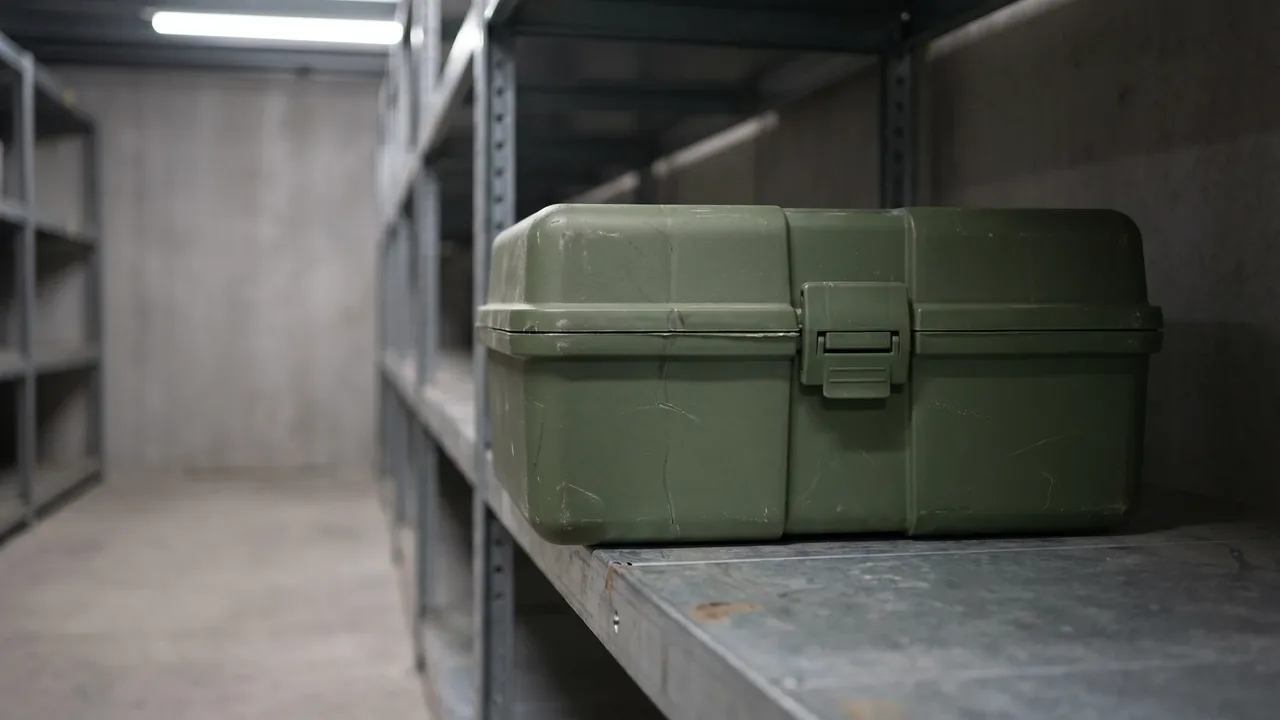
A submachine gun occupies a different place in law enforcement and security logistics than a rifle or a handgun, and that difference shapes the case built around it. The weapon is short and compact, it is paired with a surprising number of accessories, and it is deployed often, so a proper Submachine Gun Case has to satisfy two demands that appear to pull in opposite directions: hold the contents firmly, and release them quickly. A Submachine Gun Storage Case that simply drops a flat sheet of foam into a generic cavity fails at both, because it neither constrains movement nor shortens the path from an open lid to a drawn weapon.
JUNZHIJIA treats compartment lining and rapid access as one design problem with two outputs rather than two separate features. Compartments settle fixation and stop mixed storage damage; latches and an efficient opening path deliver response speed; sealing and shock absorption protect the contents through long storage and rough transit. Written for law enforcement equipment departments and security integrators, this article walks through weapon form factors, internal layout, compartment design, liner materials, opening hardware, sealing, cushioning, shell materials, compliant closure, stacking and handling interfaces, marking and traceability, and test verification, with configuration guidance and frequently asked questions.
Storage and Handling Characteristics of Submachine Guns
A submachine gun sits between a rifle and a handgun in form. Its overall length is typically well short of a rifle, its mass is concentrated around the receiver and stock area, and because it is a high-cycle, frequently deployed item it often lives in a "ready" state rather than in long-term sealed storage. That combination of geometry and duty cycle creates two risk profiles at once: knocks and mixed-storage collisions during frequent short trips, and moisture-driven corrosion during the longer intervals when the equipment sits idle.
Damage reports cluster around four causes. The first is contact between the weapon and its accessories. Because magazines, suppressors and optics travel together with the weapon, packing everything into one common cavity lets metal parts strike each other in transit; coatings are soon chipped, and optical bodies and their adjustment assemblies can suffer as well. The second is point loading on protruding parts. Optics, charging handles and selector levers stick out above the main body, and without dedicated relief the closed lid or a stacked case presses directly on them. The third is corrosion. Steel receivers, rails and magazines condense moisture when humidity swings, and once a coating is scratched, rust spreads along the scratch. The fourth is wear from repeated handling. The more often the case is opened, the faster its latches, hinges and liner slots fatigue, and a duty case cycles far more than a low-frequency case for a longer weapon.
The design goals therefore reduce to four commitments: constrain displacement, isolate accessories, keep moisture out, and survive repeated opening. These commitments are linked. Weak compartments let contents shift; awkward opening tempts users to skip stowing items properly; poor sealing makes long storage expensive in metal condition. The sections below follow the structural design sequence.
Submachine Gun Case Dimensions and Internal Layout
Sizing is the first step and the most underestimated one. Unlike a long-weapon case built around length, a submachine gun case is built around volume: the internal cavity must hold the weapon, several magazines and a set of accessories in as compact a footprint as possible while still leaving finger and tool clearance for loading and unloading. Too small and handling is awkward; too large and the void becomes free travel space that lets contents slide in transit.
Three decisions come first. Single-weapon or multi-weapon: a single-weapon case pursues tight dimensions and easy carry, while a multi-weapon case pursues volumetric efficiency and a uniform asset register. Flat or upright layout: a flat layout keeps the center of gravity low and makes contents obvious once the lid opens, which suits most submachine guns, whereas an upright layout saves bench area but needs a deeper cavity and firmer base retention. Fixed accessory list: once the number of spare magazines, suppressors, optics, cleaning tools and spare batteries is settled, it should be converted into fixed bay assignments rather than re-arranged at every packing session.
The general layout order is to lock the position and orientation of the weapon bay first, place magazine and accessory bays along its periphery second, and reserve relief for protruding parts last. Clear boundaries between bays help a user see at a glance what goes where. For units that reconcile contents with warehouse records, label positions should be reserved beside the bays so that bay numbers and asset numbers match. In compact equipment JUNZHIJIA often divides the interior into weapon, consumable and tool groups, so that going from an open lid to a drawn weapon takes a single motion and high-frequency handling loses fewer steps.
Compartment Lining: Weapon Bay, Magazine Bay and Accessory Bay
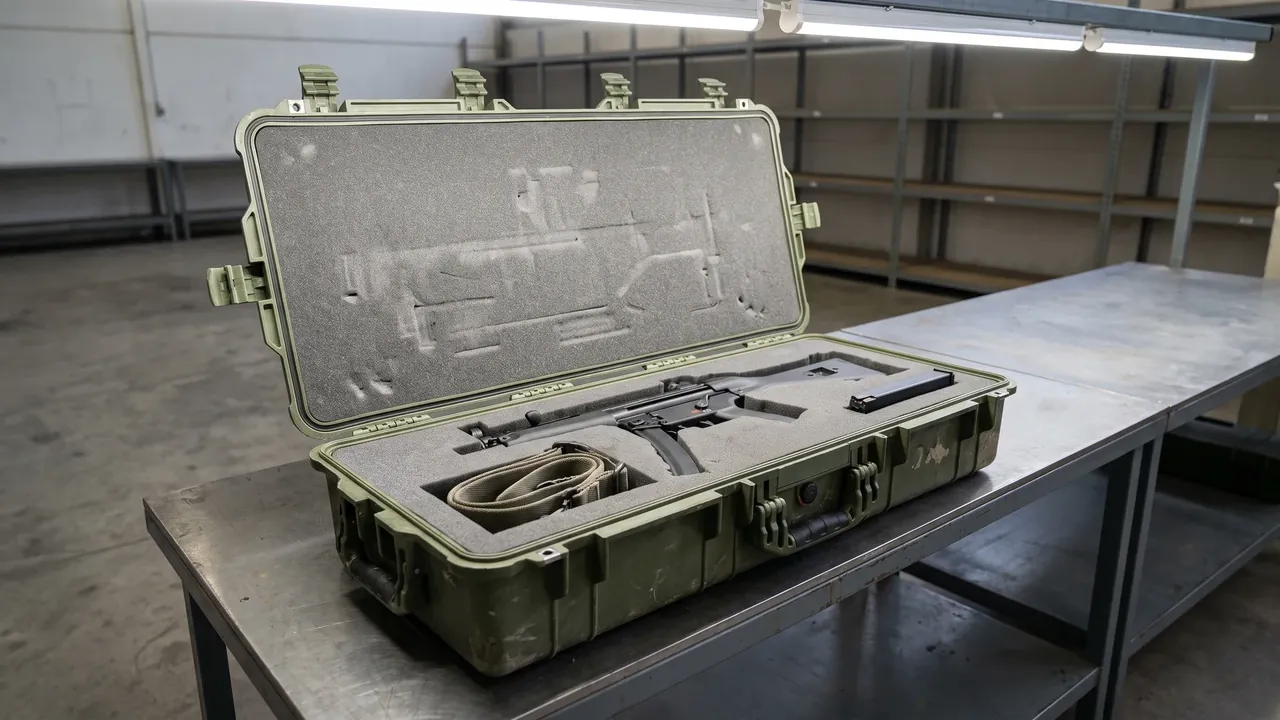
The compartment liner is the protective core of a submachine gun storage box. Rather than spreading foam across the floor, compartment lining cuts dedicated bays to the shape and purpose of each item so the weapon, magazines and accessories stay in place and never touch each other. The benefit is twofold: it constrains displacement during drops and vibration, and it removes the paths along which metal parts would strike one another.
A typical layout uses three groups. The weapon bay is formed to the outer profile of the submachine gun, with slot depth usually set between one half and two thirds of the body section so the weapon cannot lift out as a whole while retaining enough material to grip. The magazine bay arranges magazines in columns by shape and count, each in its own cell, which prevents magazines from knocking together and makes counting immediate. The accessory bay holds suppressors, optics, weapon lights and cleaning tools. Optics demand particular care: they must have dedicated relief, soft foam around the body, and clear space above, so that a closed lid or a stacked case never presses on the optic body.
The divider material matters as much as the layout. Bays should be separated by one-piece molded dividers rather than glued scraps of foam, because glued seams crack first under repeated handling and then stop constraining anything. For multi-weapon cases a modular approach works well, with each weapon position built as a replaceable liner unit so one shell can be reconfigured for different weapon models. This mirrors the modular logic of a removable divider system, and the density and routing of bays can follow the zoning experience described for tactical gear box internal layouts.
Rapid Access Hardware: Latches, Hinges and One-Hand Opening
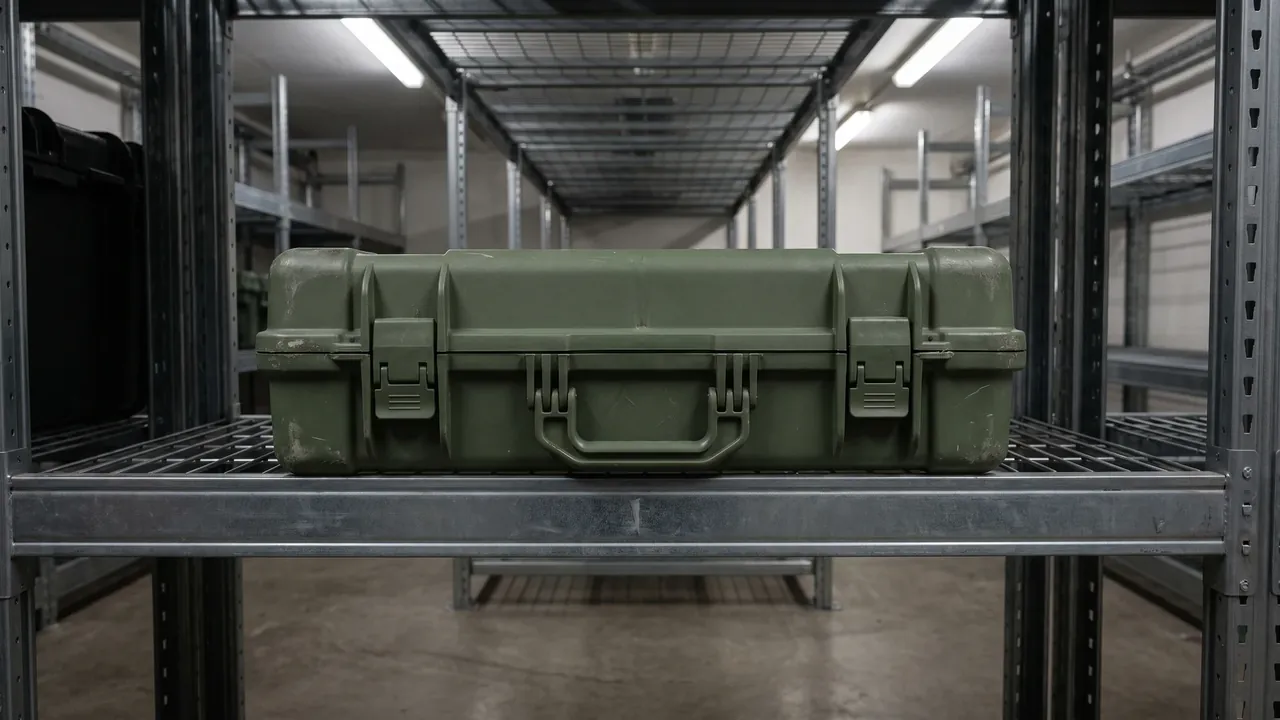
Rapid access is what distinguishes a duty case from a sealed storage case. The goal is not to make the shell as rigid as possible in isolation, but to compress the motion from an open lid to a drawn weapon into as few steps as possible while preserving fixation and sealing. That requires latches, hinges and interior routing to work as a system, not just a switch to a quick-release latch.
Latches are the first gate. Three families dominate. Draw latches suit cases that must also generate sealing compression, because they deliver a stable clamping force when closed. Push-button catches open quickly and suit frequent single-person use. Twist locks favor resistance to accidental opening and compliant closure. In high-frequency duty, a latch should open one-handed, need a moderate and consistent force, and give a tactile confirmation so a user can tell the state of the case in low light or while wearing gloves. Using too few latches leaves the lid unevenly loaded when closed, which harms both sealing and the feel of opening.
Hinges and opening angle are the second gate. A hinge must tolerate frequent cycling while keeping clearance stable, and once open the lid should rest at an angle that allows two-handed access instead of falling back and pinching fingers. Heavier multi-weapon cases benefit from a stay or prop that holds the lid open. Interior routing is the third gate: no accessory should block the path from the opening to the weapon grip, so consumable and tool bays belong beside or beyond the weapon bay, never in front of it.
Rapid access and protective fixation do not conflict; only the design order does. The sound order is to set bay orientation for the shortest access path, then set slot depth and retaining features for drop retention, and finally choose the latch family for one-hand opening. With the order right, both goals hold at the same time.
Liner Materials: Choosing Between EVA, EPE and EPDM
The liner material sets fit accuracy, rebound stability and long-term compression resistance. Closed-cell foams such as EVA, EPE and EPDM are the common choices for a submachine gun case liner, and each leans toward a different balance of hardness, rebound and weathering, so material selection should follow the storage duration and handling frequency rather than defaulting to one sheet throughout.
EVA stands out for low compression set, stable rebound and fine-moldability, which suits a weapon bay that must follow a detailed profile and protruding parts; its drawbacks are relatively higher cost and a sensitivity to density and formulation, so hardness and density should be specified at purchase. EPE is lighter, cushions well and costs less, making it a good fit for an energy-absorbing base layer or an accessory bay where fit accuracy matters less; its rebound recovery is slower, and it can take a set after long compression. EPDM is more balanced in weathering, aging and temperature tolerance, which suits cases stored long-term or exposed to large temperature swings and humid heat, though its molding behavior and surface fineness are usually below EVA. The molding approach described for pre-cut foam liners is a useful reference for separating the high-fit requirement of the weapon bay from the general cushioning of accessory bays.
A layered build balances the two needs: a softer, finer foam against the contents to lower contact stress, and a firmer, rebound-stable foam against the shell to spread load. This soft-to-hard gradient lets the soft layer absorb local contact shock first, then passes the remainder to the firm layer, which spreads it over a larger area. Whichever material is chosen, density, hardness, resilience and compression set should appear as acceptance criteria in the technical requirement, so that deliveries are not judged by color or thickness alone.
Sealing and Moisture Control: IP Ratings, Gaskets and Pressure Equalization
Metal parts in a submachine gun are sensitive to humidity, so sealing and moisture control in the case serve both short trips and long idle storage. Sealing levels are described by the IP codes defined in IEC 60529 and GB/T 4208. IP65 means dust-tight and protected against water jets, which suits rain, spray and dust. IP67 means dust-tight and protected against short immersion, which suits possible immersion or sustained high humidity. Higher ratings cover special duties that involve continuous immersion. Because these cases are often used at field posts and in vehicles, IP67 is a sensible baseline, with a pressure equalization valve added according to use.
Sealing reliability rests on three things. The first is the match between the gasket groove and the gasket: the ratio of groove depth to cord diameter must produce a stable compression when the latches close, neither too little to seal nor so much that the gasket takes a permanent set. The second is gasket material and aging: silicone and EPDM differ in temperature and weathering behavior, and a gasket that has lost its rebound is the most common cause of seal failure, so it belongs on the periodic inspection list. The third is the interaction with the latches: only when the latches supply enough and evenly distributed clamping force can the gasket reach its working compression, and too few latches make part of the seal effectively absent.
A pressure equalization valve uses a waterproof breathable membrane to slowly balance pressure differences while blocking liquid water and dust, which matters especially for air transport and travel across climate zones. Inside the case, moisture control combines desiccant, humidity indication and vapor-phase corrosion protection: size the desiccant to the cavity volume and expected storage period, include a humidity indicator card so the internal state can be judged without opening, and add vapor-phase protection against surface rust for metal parts held long-term.
Shock Absorption and Retaining: Drop Energy and Cushion Gradients
Shock absorption and retaining are the means by which a case protects its contents during drops and transport vibration, and they follow directly from compartment lining. Compartments constrain the contents; cushioning attenuates energy before it reaches them. Neither alone is sufficient. With compartments but no cushioning, impact travels through hard contact into the weapon and optics. With cushioning but no compartments, contents migrate through the foam and strike the shell.
The design centers on the pairing of a cushion gradient with retaining features. The gradient arranges materials from soft to firm between the contents and the shell, so drop energy is absorbed softly first and spread firmly afterward. Retaining features place rigid or semi-rigid structures around the weapon and accessory slots, limiting travel to within the slot and preventing soft foam from being compressed flat after repeated drops and then losing its restraint. Retaining blocks should sit at the center of gravity and at protruding parts, so impact loads land on structurally strong areas.
Cushion thickness should follow the expected drop height and the allowable shock level of the contents, not simply maximal thickness. Foam that is too thick and soft rebounds noticeably after a drop, loading the contents a second time, while foam that is too thin cannot absorb energy and passes load straight to the shell. A practical approach sets a baseline thickness by test and then locally thickens the heaviest content combinations. JUNZHIJIA designs cushioning, retaining and compartments together as one parameter set, consistent with the constraint principles in firearm storage box safety design, instead of treating foam as the whole answer.
Shell Materials: Rotomolded HDPE and Engineering Plastics
The shell material sets rigidity, weathering and batch consistency, and it also drives weight and cost. Three families are common: rotomolded HDPE, injection-molded engineering plastics such as glass-filled PP and PC alloys, and metal framework structures. Each fits a different duty level and batch scale.
Rotomolded HDPE offers thick walls, strong impact and low-temperature crack resistance, a seamless body and good weathering, which suits multi-weapon cases, vehicle cases and long outdoor storage; the trade-off is higher weight and tooling investment, so it best fits mid-to-large uniform production. Injection-molded engineering plastics offer low weight, high dimensional accuracy, a clean appearance and low unit cost, which suits single-weapon carry cases and products needing a finely fitted interior; the trade-off is a thinner wall that relies on ribs and section shape for rigidity. Metal frames or metal edging are usually used to reinforce a plastic shell for very high rigidity and stacking loads rather than as a standalone option.
Whatever the material, structural reinforcement cannot be skipped. Walls should carry longitudinal and transverse ribs that break large panels into shorter spans to raise bending and compression capacity. The mating faces of lid and base must load evenly along their full length when closed, and latch count along the long side must match case size. Handle, hinge and wheel mounts should land on reinforced structure so handling loads travel into the main body rather than a single wall thickness. Material and structure choices should also connect with the overall principles of a military tactical protective case, keeping protection, portability and cost in balance.
Locks, Tamper-Evident Seals and Compliant Closure
Transport and storage of submachine guns are governed by law, so a case closure must satisfy both safety and compliance. Compliance usually centers on three points: the container should be lockable, it should not open without authorization once locked, and unlocking authority should rest with designated personnel. Around those points, lock design must balance pick resistance, closure reliability and opening convenience, which does not conflict with rapid access provided each is engineered on its own terms.
Mechanical locks are a common answer, combining secure closure with reasonably quick opening. Where an external padlock is required, the case should provide metal-reinforced shackle holes so a plastic eye is not torn out under load. For unit-issued equipment, common keys or keyed-alike groups let an armory manage opening authority centrally. Tamper-evident seals are another important tool: a one-time seal gives a visible record of whether a case was opened during handover, transit or return, and combined with a number log it forms a complete chain of custody.
It must be stressed that possession, transport and storage of submachine guns are tightly regulated in every jurisdiction. This article concerns the structure and protective design of the packaging container itself and does not address the use or performance of the weapon. For military trade and export, local law and export control requirements prevail, and only the packaging container is discussed here. Specifications and test records for the lock should be retained so they can be shown to a carrier or during customs clearance.
Stacking, Lifting and Forklift Interfaces
In warehouses and vehicle convoys a submachine gun case often has to be stacked and moved by machine, so compression capacity and handling interfaces directly affect transport safety and case life. The core of stacking design is to pass load through structure. Top and bottom faces should carry matching bearing surfaces and locating features so the weight of upper cases travels down through walls and ribs instead of pressing on the lid center or the contents. For multi-weapon cases, the allowed stack count should be calculated from shell compression capacity and content weight, and the limit marked on the case.
Lifting and forklift interfaces serve heavy or fully loaded cases. Lifting points should sit on load-bearing structure with the lift force close to the center of gravity, avoiding twist from an off-center lift. Fork pockets belong in the base, with depth and position matched to common fork dimensions so entry and exit are smooth and do not scrape the shell. On injection-molded cases these interfaces are usually added through structural reinforcement, while on rotomolded cases they can be formed by local thickening during molding.
Handling interfaces must be verified over time. After repeated cycles, walls near lifting points and fork pockets should be checked for cracks or deformation, and structural damage should retire the case pending assessment. Handles and wheels are handling interfaces too: a handle near the center of gravity keeps the case level, larger wheels with a locking feature roll better, and wheel mounts should transfer load into the inner wall through a reinforcement plate. The reliability of stacking and handling largely decides whether a case keeps its protection level through frequent turnover.
Marking and Traceability: RFID, Barcodes and Asset Registers
For law enforcement units and security integrators, a submachine gun case is rarely a standalone item; it is part of a managed equipment inventory. Marking and traceability are therefore both a product feature and a management requirement. The exterior should carry clear, durable markings that are difficult to change without damaging the case, typically a case number, owning unit or responsible party, a contents list reminder, and any necessary handling marks.
Traceability technology can be chosen by management granularity. Barcodes are low-cost and fast to deploy, which suits management by unit or batch. RFID reads many tags at a distance, which suits armory in-and-out processing and convoy counts that need fast quantity checks. Both depend on a numbering rule that is uniform and consistent with the register: bay numbers, case numbers and asset numbers should correspond so that opening a case and reconciling a system confirm each other. For cases that cycle repeatedly, the number should also link to in-and-out records, maintenance records and seal numbers, forming a chain from packing through transit and use to return.
Marking durability matters as much. Printing or labels must withstand outdoor ultraviolet, temperature and humidity cycling and routine wiping without fading or peeling. RFID tags should avoid tight contact with metal, which degrades read performance, and should be fixed in a low-wear location; the mounting position should be reserved at the design stage rather than added after production. Bringing marking and traceability forward into the design lets a case be manageable at delivery instead of being patched up in service.
Test Verification: MIL-STD-810H and GJB Methods
The protective capability of a submachine gun case must be verified by test rather than claimed by specification. Verification can follow three lines: whole-package transport performance, military environmental qualification, and sealing performance. Together they answer whether the case survives transport, whether it works in extreme environments, and whether dust and water protection meet the target.
Military environmental qualification commonly follows the methods of MIL-STD-810H or the domestic GJB series, covering vibration, mechanical shock, drop, temperature and humidity cycling, and salt fog. For a submachine gun case the three critical loads are drop, vibration and temperature-humidity cycling. Drop tests the joint cushioning of shell, latches and liner; vibration tests content displacement and structural fatigue under sustained excitation; cycling tests the stability of seals and liner under repeated temperature and humidity. Salt fog assesses corrosion resistance of metal parts and hardware for coastal or sea transport. Test method selection can follow the common practice of GJB military standard cases, and air transport should also consider the effect of low pressure on the sealed cavity.
When a test plan is written, the actual transport route and expected loads should be defined first, then the corresponding test sequence and severity chosen, rather than applying a single template. Acceptance should not stop at "the shell did not break"; it should also require no displacement of contents, no compression marks on protruding parts, correct latch function, and no seal leakage. Test samples and records should be kept as part of the evidence of product consistency and delivery. It should be stated honestly that a test verifies performance under given conditions and cannot by itself guarantee behavior along any real route.
Selection Advice for Law Enforcement and Security Integrators
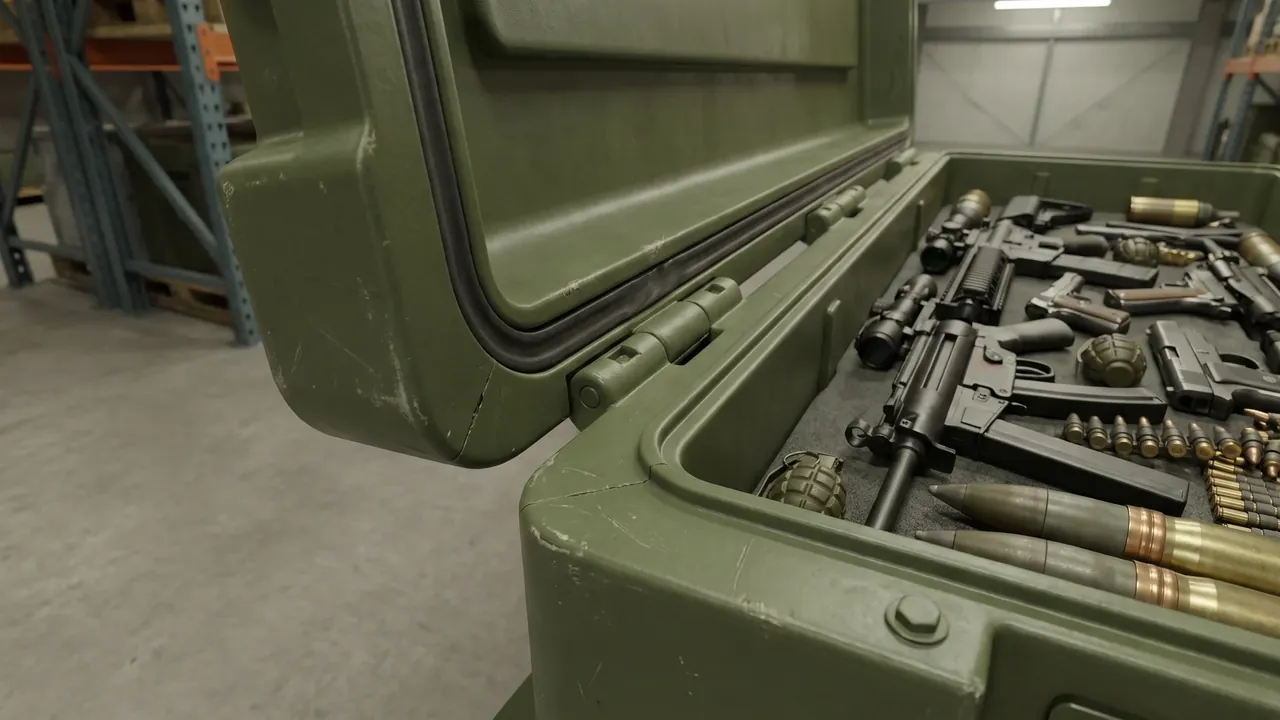
Selection proceeds through three widening layers: use, environment and load. Use asks whether the case is for single-weapon carry, squad issue or armory storage. Environment asks whether it travels by air, is used at an outdoor post, or is stored long-term. Load asks for the combined weight of weapon and accessories and whether stacking and machine handling are needed. Once the three layers are fixed, case size, material, bay layout, sealing level and handling configuration converge.
| Configuration | Single-weapon carry | Squad issue | Armory storage |
|---|---|---|---|
| --- | --- | --- | --- |
| Shell material | Glass-filled PP injection | Rotomolded HDPE | Rotomolded HDPE or metal edge |
| Interior layout | Weapon bay + two magazine slots | Multi-weapon bay + modular compartments | Multi-weapon bay + register bays |
| Rapid access | Push-button catch + one-hand opening | Draw latch + stay | Draw latch + keyed-alike locks |
| Sealing | IP67 | IP67 + pressure valve | IP67 + pressure valve |
| Handling | Load-bearing handle + sling | Handle + wheels | Wheels + fork pockets |
| Traceability | Barcode number | Barcode or RFID | RFID + register integration |
The most common mistake is comparing size and price only. The value of a submachine gun case lies mainly in compartment fit, the smoothness of rapid access, sealing reliability, cushioning and retaining design, and traceability, none of which is obvious from appearance. At procurement, ask for the liner configuration, lock specification, sealing level statement and test records, and check them against the actual use and transport route instead of ordering on exterior dimensions alone. JUNZHIJIA advises law enforcement units and security integrators on structure selection, liner tooling, lock options and traceability programs; the configuration logic in the gun case buying guide and the military special operations case is a useful reference for pushing protection and management needs into the design stage.
Implementation Checklist and Conclusion
The difficulty in designing a submachine gun case is not single-point strength but the balance between retention and speed. Divide the interior into three groups so the weapon, magazines and accessories each have a place. Mold the liner to the outline and layer the cushioning so impact is absorbed before it is spread. Design latches and the opening path for one-hand use so frequent access does not cost fixation. Pair the gasket with a pressure equalization valve so long storage shrugs off humidity. Then fold closure, stacking, lifting and traceability into the same design pass, and the case will hold its protection level through frequent turnover. In practice the sequence is straightforward: define the weapon and accessory list, fix the bay layout and access path, choose liner materials by storage duration, size the seal and cushioning by environment and drop height, and specify closure, handling interfaces and marking so the case is manageable from day one. JUNZHIJIA advises law enforcement units and security integrators on shell selection, liner tooling, lock options, traceability programs and documentation support, and can quote against specific weapon models and task groupings. The manufacturer is Kexin New Materials (Guangdong) Co., Ltd. For military trade and export, local law and export control requirements prevail, and only the packaging container is discussed here.
Submachine Gun Case FAQ
Q: Why can a submachine gun case not rely on a single flat sheet of foam?
A: Flat foam can only support weight; it cannot constrain displacement. When a submachine gun travels with magazines, optics and a suppressor, vibration and drops make the parts move relative to one another. Sharing one common cavity without molded slots lets metal parts strike each other, so coatings and paint are quickly damaged and optical bodies and their adjustment assemblies can be harmed. Flat foam also cannot relieve protruding parts, so a closed lid or a stacked case presses directly onto optics and charging handles, creating point loads that may distort or crack them over time. The correct approach is a compartmented liner cut to the outline of each item, with the weapon, magazines and accessories each in its own bay. Slot depth is usually set between one half and two thirds of the body section, which constrains movement in six directions while still leaving enough room to grip and remove items. Dividers should be one-piece molded rather than glued scraps, because glued seams crack first under repeated handling and then stop constraining anything at all.
Q: How should a three-group compartment layout be divided?
A: The three groups are the weapon bay, the magazine bay and the accessory bay. The weapon bay is molded to the outer profile of the submachine gun and constrains it in six directions. The magazine bay arranges magazines in columns by shape and count, each in its own cell, which prevents them from knocking together and allows immediate counting when the case is opened. The accessory bay holds suppressors, optics, weapon lights and cleaning tools. Optics need particular care: dedicated relief, soft foam around the body, and clear space above, so that a closed lid or a stacked case never presses on the optic body. Bays should be separated by one-piece molded dividers rather than glued foam scraps, because glued seams fail first under repeated handling. For multi-weapon cases, modular liner units let one shell be reconfigured across weapon models, combining a standard shell and a uniform asset register with flexible grouping for each task or unit, and the three groups should stay visually distinct so a user can identify every bay at a glance.
Q: Do rapid access and firm retention conflict with each other?
A: They do not conflict; only the design order does. The sound order is to set bay orientation for the shortest access path first, so that nothing blocks the way from an open lid to the weapon grip. Then set slot depth and retaining features for drop retention. Finally choose the latch family for one-hand opening. A latch should open one-handed, need a moderate and consistent force, and give tactile confirmation so a user can tell the case state in low light or while wearing gloves. Latch count must not be too low, or the lid loads unevenly along its long side when closed, harming both sealing and the feel of opening. Draw latches generate sealing compression, push-button catches open fastest, and twist locks resist accidental opening. With routing, retention and latches designed in this order, rapid access and reliable fixation hold at the same time instead of trading against each other. Bay orientation, slot depth and latch choice should therefore be recorded as one set of parameters before a prototype is built, so the trade-off is resolved on paper rather than discovered at the bench.
Q: How should EVA, EPE and EPDM liners be compared?
A: Each material leans a different way. EVA has low compression set, stable rebound and fine moldability, which suits a weapon bay that must follow a detailed profile and relieve protruding parts, though it costs more and is sensitive to density and formulation. EPE is lighter, cushions well and costs less, suiting an energy-absorbing base layer or a general accessory bay, but its rebound recovery is slower and it can take a set after long compression. EPDM is more balanced in weathering, aging and temperature tolerance, so it suits long-term storage or cases exposed to large temperature swings and humid heat, though its molding behavior and surface fineness are usually below EVA. A common way to combine them is layering: a softer, finer foam against the contents to lower contact stress, and a firmer, rebound-stable foam against the shell to spread load, giving a soft-to-hard energy gradient. Whatever the choice, density, hardness, resilience and compression set should appear in the acceptance criteria.
Q: Should sealing be IP65 or IP67, and is a pressure equalization valve necessary?
A: IP65 means dust-tight and protected against water jets, suiting rain, spray and dust. IP67 means dust-tight and protected against short immersion, suiting possible immersion or sustained high humidity. Because these cases are often used at field posts and in vehicles, IP67 is a sensible baseline. Sealing reliability depends on three things: the match between groove and gasket, so compression is stable when the latches close; gasket material and aging, since a gasket that has lost its rebound is the most common cause of seal failure; and whether latch clamping force is even around the perimeter, because too few latches make part of the seal effectively absent. A pressure equalization valve uses a waterproof breathable membrane to balance pressure differences slowly while blocking liquid water and dust, which matters especially for air transport and travel across climate zones. It should be engineered together with the gasket as one sealing system rather than added as an afterthought. Gasket and valve should both be listed as periodic inspection items, since either can degrade long before the shell shows any sign of wear.
Q: What is the relationship between cushioning and compartments, and why are both needed?
A: They work as a front and back pair. Compartments constrain the contents from migrating, while cushioning attenuates impact energy before it reaches them. With compartments but no cushioning, impact travels through hard contact into the weapon and optics. With cushioning but no compartments, contents move through the foam and strike the shell. The design centers on pairing a cushion gradient with retaining features. The gradient arranges materials from soft to firm between the contents and the shell, so energy is absorbed softly first and spread firmly afterward. Retaining features place rigid or semi-rigid structures around the slots, limiting travel to within the slot and preventing soft foam from being flattened after repeated drops and then losing its restraint. Retaining blocks should sit at the center of gravity and at protruding parts, so impact loads land on structurally strong areas. Cushion thickness follows the expected drop height and allowable shock level, and thicker is not automatically better. A practical method sets a baseline thickness by test, then locally thickens the bays that carry the heaviest items.
Q: What should be considered for stacking and lifting a multi-weapon case?
A: Stacking should pass load through structure. Top and bottom faces need matching bearing surfaces and locating features, so the weight of upper cases travels down through walls and ribs instead of pressing on the lid center or the contents. The allowed stack count should be calculated from shell compression capacity and content weight and marked on the case. Lifting points should sit on load-bearing structure with the lift force close to the center of gravity, avoiding twist from an off-center lift. Fork pockets belong in the base, with depth and position matched to common fork dimensions so entry and exit are smooth and do not scrape the shell. Handling interfaces must also be verified over time. After repeated cycles, walls near lifting points and fork pockets should be inspected for cracks or deformation, and structural damage should retire the case pending assessment rather than being patched up and returned to service. Where wheeled or heavy cases are involved, the same inspection should cover wheel mounts and handles, because those points carry the highest repeated loads.
Q: How can a traceable marking system be built for submachine gun cases?
A: Traceability depends on a uniform numbering rule consistent with the register: bay numbers, case numbers and asset numbers must correspond, so that opening a case and reconciling a system confirm each other. Technology can be chosen by management granularity. Barcodes are low-cost and fast to deploy, suiting management by unit or batch. RFID reads many tags at a distance, suiting armory in-and-out processing and convoy counts that need fast quantity checks. Labels must withstand outdoor ultraviolet, temperature and humidity cycling and routine wiping without fading, avoid tight contact with metal that degrades read performance, and have mounting positions reserved at the design stage. For cases that cycle repeatedly, the number should also link to in-and-out, maintenance and seal records, forming a complete chain from packing through transit and use to return.
Related Reading
- Removable divider system for modular case interiors
- Tactical gear box internal layout zoning
- Pre-cut foam liner molding and acceptance
- Firearm storage box safety design essentials
- Military tactical protective case design principles
- GJB military standard cases and testing
- Gun case buying guide
- Military special operations case configuration